H.261 Video Compression Standard Presented by Parul Mathur Brad Gagné This report was prepared for Professor L. Orozco-Barbosa in partial fulfillment of the requirements for the course CEG 4183.
Presentation Overview Introduction Key Terms and Concepts H.261 Specifications How It Works Design Details Encoding Process Diagram Performance H.261 vs. MPEG Where It Is Used
Introduction H.261 is a video coding standard published by the ITU-T in 1990. It is the most widely used international video compression standard for video coding. H.261 is usually used in conjunction with other control and framing standards. http://www-mobile.ecs.soton.ac.uk/peter/h261/h261.html http://www.cs.ucl.ac.uk/staff/jon/mmbook/book/node121.html
Key Terms and Concepts (1) ITU-T  – International Telecommunication Union CIF - Common Intermediate Format A video format used in videoconferencing systems that easily supports both NTSC and PAL signals, and specifies a data rate of 30 fps, with 352x288 pixel frames. DPCM  – Differential Pulse Code Modulation a form of PCM that produces a digital signal with a lower bit rate than standard PCM by recording only the difference between samples and adjusting the coding scale dynamically to accommodate large and small differences DCT – Discrete Cosine Transform A technique for representing waveform data as a weighted sum of cosines; commonly used for data compression, as in JPEG.   http://www.webopedia.com
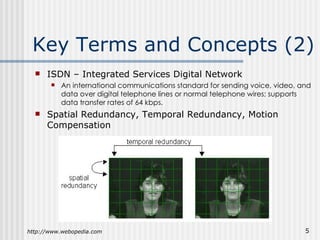
Key Terms and Concepts (2) ISDN – Integrated Services Digital Network An international communications standard for sending voice, video, and data over digital telephone lines or normal telephone wires; supports data transfer rates of 64 kbps. Spatial Redundancy, Temporal Redundancy, Motion Compensation http://www.webopedia.com
H.261 Specifications (1) The H.261 standard describes the video coding/decoding methods for the video portion of an audiovisual service Designed for data rates of p*64 kbps, where p is in the range 1-30 Targeted for circuit-switched networks (ISDN was the communication channel considered within the framework of the standard) http://www-mobile.ecs.soton.ac.uk/peter/h261/h261.html
H.261 Specifications (2) Defines two picture formats: CIF (352x288) and QCIF(176x144) The H.621 encoding algorithm is a combination of: inter-picture prediction (to remove temporal redundancy) transform coding (to remove spatial redundancy) motion vectors (for motion compensation) http://www-mobile.ecs.soton.ac.uk/peter/h261/h261.html
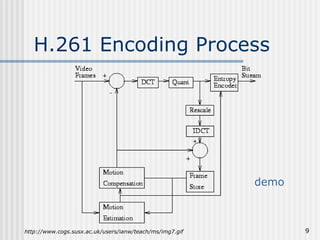
Design Details The three main elements are: Prediction: blocks are intra- or inter-coded Intra-coded blocks stand alone Inter-coded blocks are based on differences between the previous frame and the current one Block Transformation:   each block (inter and intra) is composed into 8x8 blocks and processed by a 2-D DCT function Quantization & Entropy Coding: achieves further compression by representing DCT coefficients with only the necessary precision entropy encoding (non-lossy) using Huffman encoding http://www.cs.ucl.ac.uk/staff/jon/mmbook/book/node121.html
H.261 Encoding Process http://www.cogs.susx.ac.uk/users/ianw/teach/ms/img7.gif demo
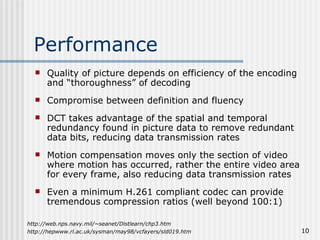
Performance Quality of picture depends on efficiency of the encoding and “thoroughness” of decoding Compromise between definition and fluency DCT takes advantage of the spatial and temporal redundancy found in picture data to remove redundant data bits, reducing data transmission rates Motion compensation moves only the section of video where motion has occurred, rather the entire video area for every frame , also  reducing data transmission rates Even a minimum H.261 compliant codec can provide tremendous compression ratios (well beyond 100:1)   http://hepwww.rl.ac.uk/sysman/may98/vcfayers/sld019.htm http://web.nps.navy.mil/~seanet/Distlearn/chp3.htm
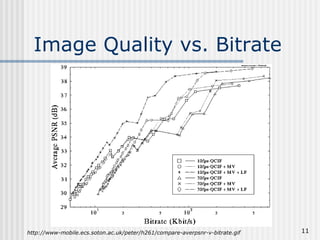
Image Quality vs. Bitrate http://www-mobile.ecs.soton.ac.uk/peter/h261/compare-averpsnr-v-bitrate.gif
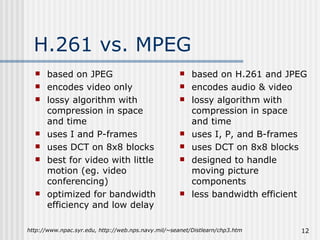
H.261 vs. MPEG based on JPEG encodes video only lossy algorithm with compression in space  and time uses I and P-frames uses DCT on 8x8 blocks best for video with little motion (eg. video conferencing) optimized for bandwidth efficiency and low delay based on H.261 and JPEG encodes audio & video lossy algorithm with compression in space  and time uses I, P, and B-frames uses DCT on 8x8 blocks designed to handle moving picture components less bandwidth efficient http://www.npac.syr.edu, http://web.nps.navy.mil/~seanet/Distlearn/chp3.htm
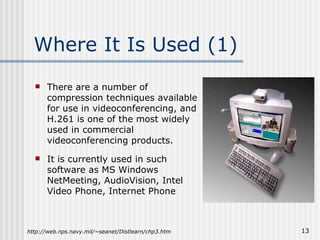
Where It Is Used (1) There are a number of compression techniques available for use in videoconferencing, and H.261 is one of the most widely used in commercial videoconferencing products. It is currently used in such software as MS Windows NetMeeting, AudioVision, Intel Video Phone, Internet Phone http://web.nps.navy.mil/~seanet/Distlearn/chp3.htm
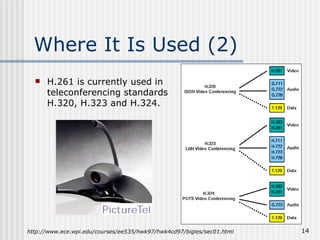
Where It Is Used (2) H.261 is currently used in teleconferencing standards H.320, H.323 and H.324. http://www.ece.wpi.edu/courses/ee535/hwk97/hwk4cd97/bigles/sec01.html
Thank You Questions?
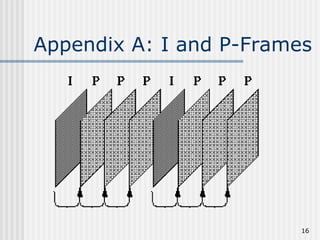
Appendix A: I and P-Frames
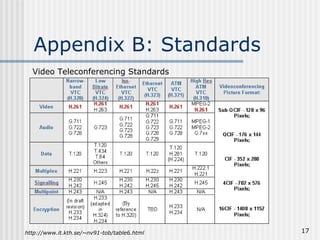
Appendix B: Standards Video Teleconferencing Standards http://www.it.kth.se/~nv91-tob/table6.html
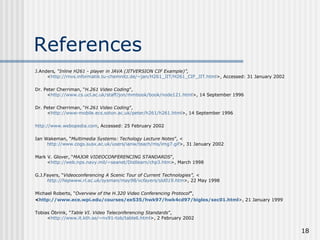
References J.Anders , “Inline H261 - player in JAVA (JITVERSION CIF Example)”,   < http://rnvs.informatik.tu-chemnitz.de/~jan/H261_JIT/H261_CIF_JIT.html >, Accessed: 31 January 2002 Dr. Peter Cherriman, “ H.261 Video Coding ”, < http://www.cs.ucl.ac.uk/staff/jon/mmbook/book/node121.html >, 14 September 1996 Dr. Peter Cherriman, “ H.261 Video Coding ”, < http://www-mobile. ecs . soton .ac. uk /peter/h261/h261.html >, 14 September 1996 http://www.webopedia.com , Accessed: 25 February 2002 Ian Wakeman, “ Multimedia Systems: Techology Lecture Notes ”, < http://www.cogs.susx.ac.uk/users/ianw/teach/ms/img7.gif >, 31 January 2002 Mark V. Glover, “ MAJOR VIDEOCONFERENCING STANDARDS ”,  < http://web. nps .navy.mil/~ seanet / Distlearn /chp3. htm >, March 1998 G.J.Fayers, “ Videoconferencing A Scenic Tour of Current Technologies”, < http://hepwww.rl.ac.uk/sysman/may98/vcfayers/sld019. htm >, 22 May 1998 Michael Roberts, “ Overview of the H.320 Video Conferencing Protocol ” ,  < http://www.ece.wpi.edu/courses/ee535/hwk97/hwk4cd97/bigles/sec01.html >, 21 January 1999 Tobias Öbrink, “ Table VI. Video Teleconferencing Standards ”,  < http://www.it.kth.se/~nv91-tob/table6.html >, 2 February 2002
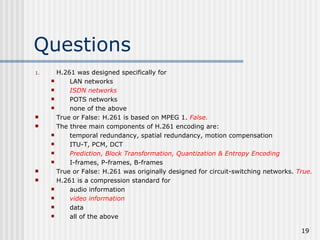
Questions H.261 was designed specifically for LAN networks ISDN networks POTS networks none of the above True or False: H.261 is based on MPEG 1.  False. The three main components of H.261 encoding are: temporal redundancy, spatial redundancy, motion compensation ITU-T, PCM, DCT Prediction, Block Transformation, Quantization & Entropy Encoding I-frames, P-frames, B-frames True or False: H.261 was originally designed for circuit-switching networks.  True. H.261 is a compression standard for audio information video information data all of the above

H261

  • 1.
    H.261 Video CompressionStandard Presented by Parul Mathur Brad Gagné This report was prepared for Professor L. Orozco-Barbosa in partial fulfillment of the requirements for the course CEG 4183.
  • 2.
    Presentation Overview IntroductionKey Terms and Concepts H.261 Specifications How It Works Design Details Encoding Process Diagram Performance H.261 vs. MPEG Where It Is Used
  • 3.
    Introduction H.261 isa video coding standard published by the ITU-T in 1990. It is the most widely used international video compression standard for video coding. H.261 is usually used in conjunction with other control and framing standards. http://www-mobile.ecs.soton.ac.uk/peter/h261/h261.html http://www.cs.ucl.ac.uk/staff/jon/mmbook/book/node121.html
  • 4.
    Key Terms andConcepts (1) ITU-T – International Telecommunication Union CIF - Common Intermediate Format A video format used in videoconferencing systems that easily supports both NTSC and PAL signals, and specifies a data rate of 30 fps, with 352x288 pixel frames. DPCM – Differential Pulse Code Modulation a form of PCM that produces a digital signal with a lower bit rate than standard PCM by recording only the difference between samples and adjusting the coding scale dynamically to accommodate large and small differences DCT – Discrete Cosine Transform A technique for representing waveform data as a weighted sum of cosines; commonly used for data compression, as in JPEG. http://www.webopedia.com
  • 5.
    Key Terms andConcepts (2) ISDN – Integrated Services Digital Network An international communications standard for sending voice, video, and data over digital telephone lines or normal telephone wires; supports data transfer rates of 64 kbps. Spatial Redundancy, Temporal Redundancy, Motion Compensation http://www.webopedia.com
  • 6.
    H.261 Specifications (1)The H.261 standard describes the video coding/decoding methods for the video portion of an audiovisual service Designed for data rates of p*64 kbps, where p is in the range 1-30 Targeted for circuit-switched networks (ISDN was the communication channel considered within the framework of the standard) http://www-mobile.ecs.soton.ac.uk/peter/h261/h261.html
  • 7.
    H.261 Specifications (2)Defines two picture formats: CIF (352x288) and QCIF(176x144) The H.621 encoding algorithm is a combination of: inter-picture prediction (to remove temporal redundancy) transform coding (to remove spatial redundancy) motion vectors (for motion compensation) http://www-mobile.ecs.soton.ac.uk/peter/h261/h261.html
  • 8.
    Design Details Thethree main elements are: Prediction: blocks are intra- or inter-coded Intra-coded blocks stand alone Inter-coded blocks are based on differences between the previous frame and the current one Block Transformation: each block (inter and intra) is composed into 8x8 blocks and processed by a 2-D DCT function Quantization & Entropy Coding: achieves further compression by representing DCT coefficients with only the necessary precision entropy encoding (non-lossy) using Huffman encoding http://www.cs.ucl.ac.uk/staff/jon/mmbook/book/node121.html
  • 9.
    H.261 Encoding Processhttp://www.cogs.susx.ac.uk/users/ianw/teach/ms/img7.gif demo
  • 10.
    Performance Quality ofpicture depends on efficiency of the encoding and “thoroughness” of decoding Compromise between definition and fluency DCT takes advantage of the spatial and temporal redundancy found in picture data to remove redundant data bits, reducing data transmission rates Motion compensation moves only the section of video where motion has occurred, rather the entire video area for every frame , also reducing data transmission rates Even a minimum H.261 compliant codec can provide tremendous compression ratios (well beyond 100:1) http://hepwww.rl.ac.uk/sysman/may98/vcfayers/sld019.htm http://web.nps.navy.mil/~seanet/Distlearn/chp3.htm
  • 11.
    Image Quality vs.Bitrate http://www-mobile.ecs.soton.ac.uk/peter/h261/compare-averpsnr-v-bitrate.gif
  • 12.
    H.261 vs. MPEGbased on JPEG encodes video only lossy algorithm with compression in space and time uses I and P-frames uses DCT on 8x8 blocks best for video with little motion (eg. video conferencing) optimized for bandwidth efficiency and low delay based on H.261 and JPEG encodes audio & video lossy algorithm with compression in space and time uses I, P, and B-frames uses DCT on 8x8 blocks designed to handle moving picture components less bandwidth efficient http://www.npac.syr.edu, http://web.nps.navy.mil/~seanet/Distlearn/chp3.htm
  • 13.
    Where It IsUsed (1) There are a number of compression techniques available for use in videoconferencing, and H.261 is one of the most widely used in commercial videoconferencing products. It is currently used in such software as MS Windows NetMeeting, AudioVision, Intel Video Phone, Internet Phone http://web.nps.navy.mil/~seanet/Distlearn/chp3.htm
  • 14.
    Where It IsUsed (2) H.261 is currently used in teleconferencing standards H.320, H.323 and H.324. http://www.ece.wpi.edu/courses/ee535/hwk97/hwk4cd97/bigles/sec01.html
  • 15.
  • 16.
    Appendix A: Iand P-Frames
  • 17.
    Appendix B: StandardsVideo Teleconferencing Standards http://www.it.kth.se/~nv91-tob/table6.html
  • 18.
    References J.Anders ,“Inline H261 - player in JAVA (JITVERSION CIF Example)”, < http://rnvs.informatik.tu-chemnitz.de/~jan/H261_JIT/H261_CIF_JIT.html >, Accessed: 31 January 2002 Dr. Peter Cherriman, “ H.261 Video Coding ”, < http://www.cs.ucl.ac.uk/staff/jon/mmbook/book/node121.html >, 14 September 1996 Dr. Peter Cherriman, “ H.261 Video Coding ”, < http://www-mobile. ecs . soton .ac. uk /peter/h261/h261.html >, 14 September 1996 http://www.webopedia.com , Accessed: 25 February 2002 Ian Wakeman, “ Multimedia Systems: Techology Lecture Notes ”, < http://www.cogs.susx.ac.uk/users/ianw/teach/ms/img7.gif >, 31 January 2002 Mark V. Glover, “ MAJOR VIDEOCONFERENCING STANDARDS ”, < http://web. nps .navy.mil/~ seanet / Distlearn /chp3. htm >, March 1998 G.J.Fayers, “ Videoconferencing A Scenic Tour of Current Technologies”, < http://hepwww.rl.ac.uk/sysman/may98/vcfayers/sld019. htm >, 22 May 1998 Michael Roberts, “ Overview of the H.320 Video Conferencing Protocol ” , < http://www.ece.wpi.edu/courses/ee535/hwk97/hwk4cd97/bigles/sec01.html >, 21 January 1999 Tobias Öbrink, “ Table VI. Video Teleconferencing Standards ”, < http://www.it.kth.se/~nv91-tob/table6.html >, 2 February 2002
  • 19.
    Questions H.261 wasdesigned specifically for LAN networks ISDN networks POTS networks none of the above True or False: H.261 is based on MPEG 1. False. The three main components of H.261 encoding are: temporal redundancy, spatial redundancy, motion compensation ITU-T, PCM, DCT Prediction, Block Transformation, Quantization & Entropy Encoding I-frames, P-frames, B-frames True or False: H.261 was originally designed for circuit-switching networks. True. H.261 is a compression standard for audio information video information data all of the above

Editor's Notes

  • #3 (Self-explanatory)
  • #4 (Self-explanatory)
  • #5 CIF – there is also QCIF (“Quarter CIF”), which is the same format except only half of the height and half of the width (so 176x144), and therefore one quarter size of CIF (hence the name). DPCM – in other words, basically PCM with an adaptive scale DCT is non-lossy compression, but algorithms that use it always round off the coefficients, which results in lossy compression
  • #6 Spatial Redundancy : identical (or very similar) blocks within the same frame only one needs to be fully represented; the others can reference it Temporal Redundancy : identical (or very similar) blocks between adjacent frames blocks can refer back to a block in the previous frame I-frames and P-frames: I-frames contain a complete image P-frames record only the differences between the last frame and the current one Motion Compensation : using motion vectors, a P-frame can indicate that a portion of a block in the previous image has remained the same in appearance but has moved to a different location
  • #7 H.261 is only for video ; there is no audio representation. P*64 kbps obtains data rates in the range of (approximately) 64kbps to 2Mbps, which is a perfect match for typical ISDN network data rates. Designed for circuit-switched networks; adaptations have been made to optimize it for packet-switching networks also, using packet-dropping when necessary to adapt to available data rates
  • #8 CIF &amp; QCIF – see slide 4 (Key Terms and Concepts) temporal redundancy, spatial redundancy, motion compensation – see slide 5 (Key Terms and Concepts)
  • #9 Intra-blocks represent a portion of a frame’s image independently of other blocks Inter-blocks represent a portion of a frame’s image in terms of another similar intra-block DCT – see slide 4 – Key Terms and Concepts Huffman encoding : the block of text to encode in run through a frequency analyzer repetitive strings are encoded using short symbols the more common the string, the shorter the symbol that will be used to encode it
  • #10 The H.261 Encoding Process full images as inputs, plus previous frame (used for removing temporal redundancy) images are divided into blocks (intra or inter) and a DCT function is applied (“DCT”) coefficients of the DCT function are rounded off (“QUANT”) Intra- and Inter- blocks are resized into 8x8 blocks and the 2-d DCT function is applied for further compression frame is put into frame store; used to calculate motion vectors between current and next frame frame is used as an input when encoding the next frame
  • #11 Quality of picture depends on efficiency of the encoding and “thoroughness” of decoding: The encoded data may contain detailed information about the encoded images, but if the information is only done “roughly” then only a rough image will be produced Compromise between definition and fluency: With high image quality, frame rates must be lowered to compensate and keep a relatively small data rate (and vice versa). Motion Compensation – see slide 5 – Key Terms and Concepts
  • #12 PSNR = (# bits in original image) / (# bits in decoded image) As can be seen on the graph, better image quality (PSNR) causes higher bitrates. Best performance is achieved when the encoding process uses motion vectors (“MV”) and loop filtering (“LF”). This is the “efficiency” and “thoroughness” referred to in the previous slide.
  • #13 (Self-explanatory)
  • #14 (Self-explanatory)
  • #15 Image at left shows a typical video conferencing device. Image at right shows where H.261 fits into the standards for video conferencing for ISDN, LAN, and POTS (“Plain Old Telephone System”) networks.
  • #16 (Self-explanatory)
  • #17 Image shows a typical sequencing of I-Frames and P-Frames. For definitions, please refer to slide 5, under “Temporal Redundancy”.
  • #18 This table shows where H.261 is used in the Video Teleconferencing Standards.
  • #19 References