ROCK MECHANICS
Submitted by Abhineet Godayal
M.Tech GeoTechnical Engg.
 Durability may be defined as resistance to
destruction. If a rock mass is more durable,
it will last for a longer period when put to an
use.
 Durability of rock mass will depend on the
nature of environment against which it is
going to be used
 In other words, the durability depends on
climate and atmosphere and the amount of
exposure of rock mass.
 Which reduce the durability of rock mass are
-Hydration, Slaking, Solution, Oxidation,
Abrasion etc. These may act alone and in
combination.
 Rock mass starts changing as soon as a fresh
surface is exposed to the atmosphere. The
process of decay retards with time.
 Hence before using a rock mass , its degree
of decay or its durability , has to be
ascertained
 To describe the ranking of rock durability ,
an index is commonly used and it is known as
‘SLAKE DURABILITY INDEX’
 This test is done to find out the resistance
offered by a rock sample to weakening and
disintegration when subjected to two
standard cycles of drying and wetting in a
slaking fluid usually water.
 Gamble proposed a test to determine the
slake durability index(Id).
 500 gm of dry rock is broken into 10 pieces and
put into a drum of 140 mm dia and 100 mm
length.
 The cylindrical wall of drum is made of sieve
mesh of 2mm openings.
 The drum is turned in water bath for 10 minutes
at a rate of 20 rpm.
 The sample in the drum is dried(105+ 50c) and
again rotated for 10 minutes at the rate of
20rpm.
 The sample of drum is collected and dried. The
percent of rock retained in the drum (on dry
weight basis) is known as slake durability index
(Id).
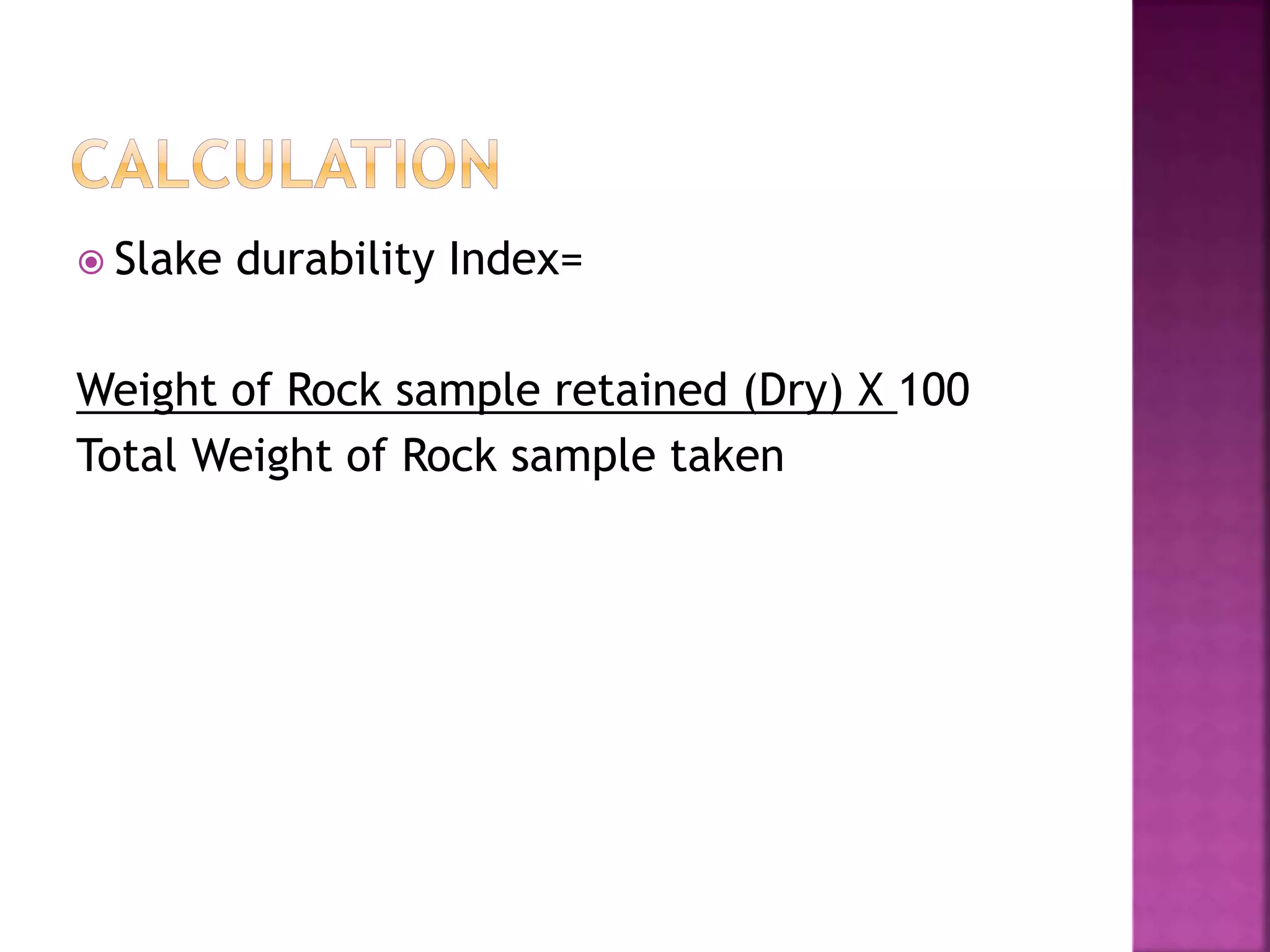
 Slake durability Index=
Weight of Rock sample retained (Dry) X 100
Total Weight of Rock sample taken
Group % Retained after
one 10 minute cycle
% Retained after
two 10 minute cycle
Very high Durability > 99 >98
High Durability 98-99 95-98
Medium high
Durability
95-98 85-95
Medium Durability 85-95 60-85
Low Durability 60-85 30-60
Very Low Durability <60 <30

Durability test for rock mass

  • 1.
    ROCK MECHANICS Submitted byAbhineet Godayal M.Tech GeoTechnical Engg.
  • 2.
     Durability maybe defined as resistance to destruction. If a rock mass is more durable, it will last for a longer period when put to an use.  Durability of rock mass will depend on the nature of environment against which it is going to be used  In other words, the durability depends on climate and atmosphere and the amount of exposure of rock mass.
  • 3.
     Which reducethe durability of rock mass are -Hydration, Slaking, Solution, Oxidation, Abrasion etc. These may act alone and in combination.  Rock mass starts changing as soon as a fresh surface is exposed to the atmosphere. The process of decay retards with time.  Hence before using a rock mass , its degree of decay or its durability , has to be ascertained
  • 4.
     To describethe ranking of rock durability , an index is commonly used and it is known as ‘SLAKE DURABILITY INDEX’  This test is done to find out the resistance offered by a rock sample to weakening and disintegration when subjected to two standard cycles of drying and wetting in a slaking fluid usually water.
  • 5.
     Gamble proposeda test to determine the slake durability index(Id).
  • 6.
     500 gmof dry rock is broken into 10 pieces and put into a drum of 140 mm dia and 100 mm length.  The cylindrical wall of drum is made of sieve mesh of 2mm openings.  The drum is turned in water bath for 10 minutes at a rate of 20 rpm.  The sample in the drum is dried(105+ 50c) and again rotated for 10 minutes at the rate of 20rpm.  The sample of drum is collected and dried. The percent of rock retained in the drum (on dry weight basis) is known as slake durability index (Id).
  • 7.
     Slake durabilityIndex= Weight of Rock sample retained (Dry) X 100 Total Weight of Rock sample taken
  • 8.
    Group % Retainedafter one 10 minute cycle % Retained after two 10 minute cycle Very high Durability > 99 >98 High Durability 98-99 95-98 Medium high Durability 95-98 85-95 Medium Durability 85-95 60-85 Low Durability 60-85 30-60 Very Low Durability <60 <30