Part 2.6: Using Character Tables
1
Using Character Tables
• Basis Functions
• Representations
– Reducible
– Irreducible
• Red. to Irr. Reps
• Examples
– N2H2
– XeOF4
• Direct Products
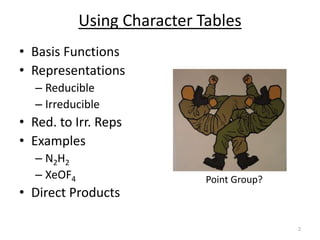
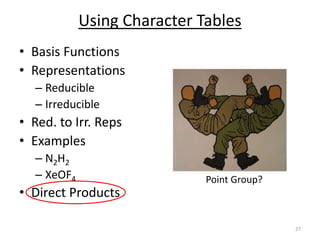
Point Group?
2
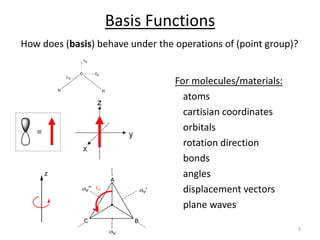
Basis Functions
For molecules/materials:
atoms
cartisian coordinates
orbitals
rotation direction
bonds
angles
displacement vectors
plane waves
How does (basis) behave under the operations of (point group)?
C3
3
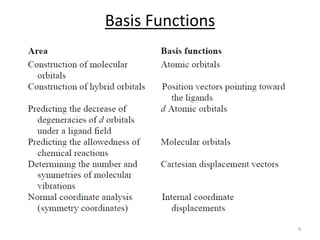
Basis Functions
4
Representations (G)
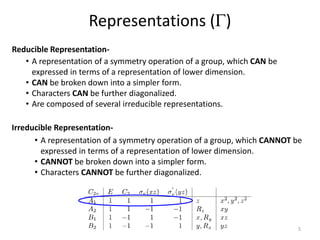
• A representation of a symmetry operation of a group, which CANNOT be
expressed in terms of a representation of lower dimension.
• CANNOT be broken down into a simpler form.
• Characters CANNOT be further diagonalized.
Irreducible Representation-
Reducible Representation-
• A representation of a symmetry operation of a group, which CAN be
expressed in terms of a representation of lower dimension.
• CAN be broken down into a simpler form.
• Characters CAN be further diagonalized.
• Are composed of several irreducible representations.
5
Representations (G)
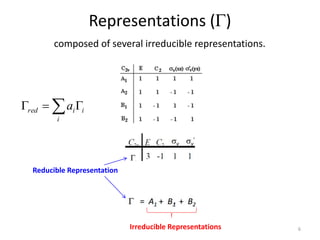
composed of several irreducible representations.
Reducible Representation
Irreducible Representations
 G

G
i
i
i
red a
6
Representations (G)
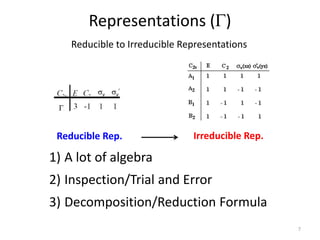
Reducible to Irreducible Representations
Reducible Rep. Irreducible Rep.
1) A lot of algebra
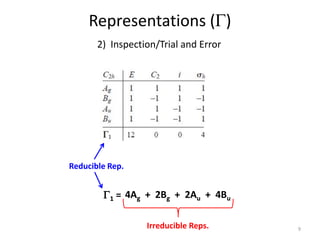
2) Inspection/Trial and Error
3) Decomposition/Reduction Formula
7
Representations (G)
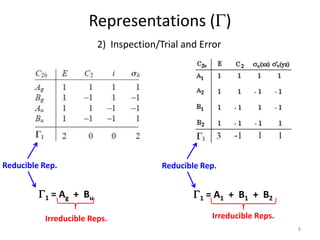
2) Inspection/Trial and Error
Reducible Rep.
Irreducible Reps.
G1 = A1 + B1 + B2
Reducible Rep.
Irreducible Reps.
G1 = Ag + Bu
8
Representations (G)
2) Inspection/Trial and Error
Reducible Rep.
Irreducible Reps.
G1 = 4Ag + 2Bg + 2Au + 4Bu
9
Representations (G)
3) Decomposition/Reduction Formula
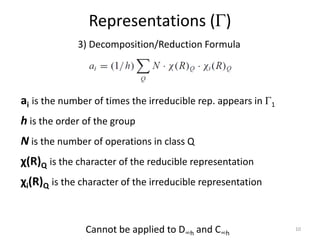
ai is the number of times the irreducible rep. appears in G1
h is the order of the group
N is the number of operations in class Q
χ(R)Q is the character of the reducible representation
χi(R)Q is the character of the irreducible representation
Cannot be applied to D∞h and C∞h
10
Representations (G)
3) Decomposition/Reduction Formula
h = 1 + 1 + 1 + 1 = 4
order (h)
aAg = + (1)(0)(1) + (1)(0)(1) + (1)(2)(1)
1
4
[ ]
(1)(2)(1) = 1
=
4
4
G1 = Ag + Bu
11
Representations (G)
3) Decomposition/Reduction Formula
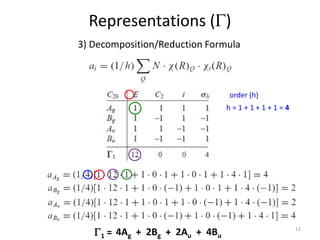
h = 1 + 1 + 1 + 1 = 4
order (h)
G1 = 4Ag + 2Bg + 2Au + 4Bu
12
Representations (G)
3) Decomposition/Reduction Formula
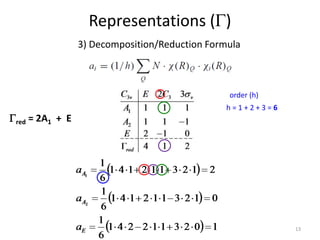
h = 1 + 2 + 3 = 6
order (h)
Gred = 2A1 + E
13
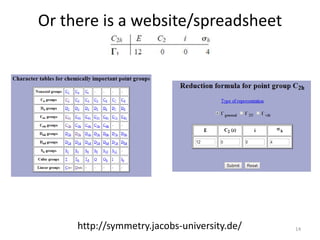
Or there is a website/spreadsheet
http://symmetry.jacobs-university.de/ 14
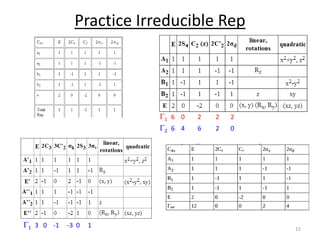
Practice Irreducible Rep
15
6 0 2 2 2
G1
6 4 6 2 0
G2
3 0 -1 -3 0 1
G1
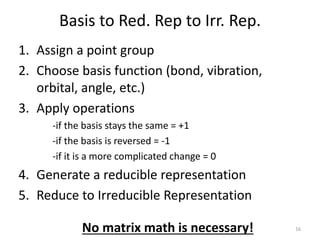
Basis to Red. Rep to Irr. Rep.
1. Assign a point group
2. Choose basis function (bond, vibration,
orbital, angle, etc.)
3. Apply operations
-if the basis stays the same = +1
-if the basis is reversed = -1
-if it is a more complicated change = 0
4. Generate a reducible representation
5. Reduce to Irreducible Representation
No matrix math is necessary! 16
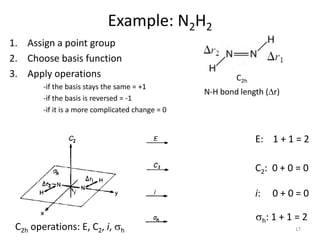
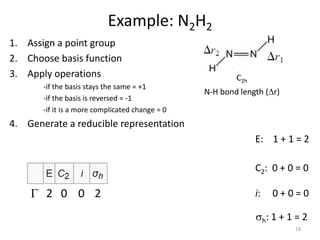
Example: N2H2
N-H bond length (Dr)
1. Assign a point group
2. Choose basis function
3. Apply operations
-if the basis stays the same = +1
-if the basis is reversed = -1
-if it is a more complicated change = 0
C2h operations: E, C2, i, sh
E: 1 + 1 = 2
C2: 0 + 0 = 0
i: 0 + 0 = 0
sh: 1 + 1 = 2
17
C2h
Example: N2H2
1. Assign a point group
2. Choose basis function
3. Apply operations
-if the basis stays the same = +1
-if the basis is reversed = -1
-if it is a more complicated change = 0
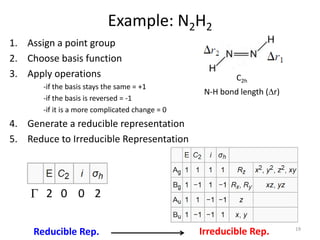
4. Generate a reducible representation
E: 1 + 1 = 2
C2: 0 + 0 = 0
i: 0 + 0 = 0
sh: 1 + 1 = 2
G 2 2
0 0
18
N-H bond length (Dr)
C2h
Example: N2H2
1. Assign a point group
2. Choose basis function
3. Apply operations
-if the basis stays the same = +1
-if the basis is reversed = -1
-if it is a more complicated change = 0
4. Generate a reducible representation
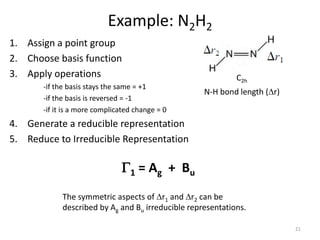
5. Reduce to Irreducible Representation
G 2 2
0 0
Reducible Rep. Irreducible Rep. 19
N-H bond length (Dr)
C2h
Decomposition/Reduction Formula
h = 1 + 1 + 1 + 1 = 4
order (h)
aAg = + (1)(0)(1) + (1)(0)(1) + (1)(2)(1)
1
4
[ ]
(1)(2)(1) = 1
=
4
4
G1 = Ag + Bu
Example: N2H2
20
Example: N2H2
1. Assign a point group
2. Choose basis function
3. Apply operations
-if the basis stays the same = +1
-if the basis is reversed = -1
-if it is a more complicated change = 0
4. Generate a reducible representation
5. Reduce to Irreducible Representation
21
N-H bond length (Dr)
C2h
G1 = Ag + Bu
The symmetric aspects of Dr1 and Dr2 can be
described by Ag and Bu irreducible representations.
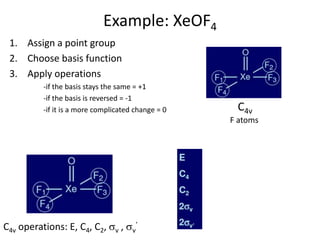
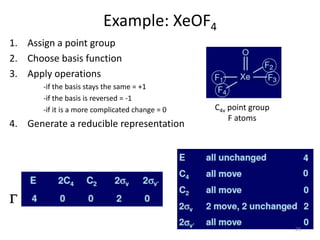
Example: XeOF4
1. Assign a point group
2. Choose basis function
3. Apply operations
-if the basis stays the same = +1
-if the basis is reversed = -1
-if it is a more complicated change = 0
C4v operations: E, C4, C2, sv , sv
’
C4v
22
F atoms
1. Assign a point group
2. Choose basis function
3. Apply operations
-if the basis stays the same = +1
-if the basis is reversed = -1
-if it is a more complicated change = 0
4. Generate a reducible representation
G
Example: XeOF4
C4v point group
F atoms
23
1. Assign a point group
2. Choose basis function
3. Apply operations
-if the basis stays the same = +1
-if the basis is reversed = -1
-if it is a more complicated change = 0
4. Generate a reducible representation
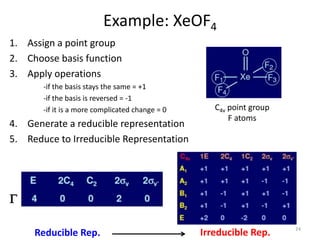
5. Reduce to Irreducible Representation
Reducible Rep. Irreducible Rep.
G
Example: XeOF4
C4v point group
F atoms
24
Decomposition/Reduction Formula
aA1 = + (2)(0)(1) + (1)(0)(1) + (2)(2)(1) + (2)(0)(1)
1
8
[ ]
(1)(4)(1) = 1
=
8
8
G = A1 + B1 + E
Example: XeOF4
h = 1 + 2 + 1 + 2 + 2 = 8
order (h)
25
1. Assign a point group
2. Choose basis function
3. Apply operations
-if the basis stays the same = +1
-if the basis is reversed = -1
-if it is a more complicated change = 0
4. Generate a reducible representation
5. Reduce to Irreducible Representation
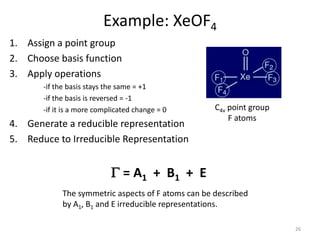
Example: XeOF4
C4v point group
F atoms
26
G = A1 + B1 + E
The symmetric aspects of F atoms can be described
by A1, B1 and E irreducible representations.
Using Character Tables
• Basis Functions
• Representations
– Reducible
– Irreducible
• Red. to Irr. Reps
• Examples
– N2H2
– XeOF4
• Direct Products
Point Group?
27
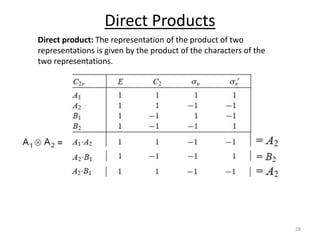
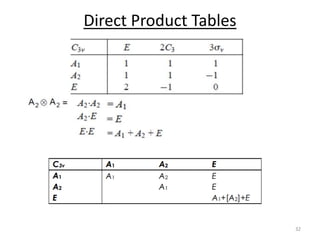
Direct Products
Direct product: The representation of the product of two
representations is given by the product of the characters of the
two representations.
28
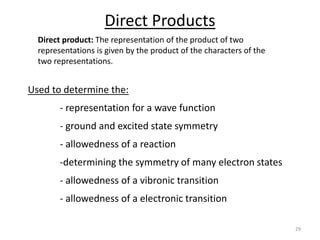
Direct Products
Direct product: The representation of the product of two
representations is given by the product of the characters of the
two representations.
29
Used to determine the:
- representation for a wave function
- ground and excited state symmetry
- allowedness of a reaction
-determining the symmetry of many electron states
- allowedness of a vibronic transition
- allowedness of a electronic transition
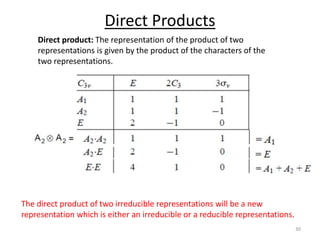
Direct Products
Direct product: The representation of the product of two
representations is given by the product of the characters of the
two representations.
The direct product of two irreducible representations will be a new
representation which is either an irreducible or a reducible representations.
30
31
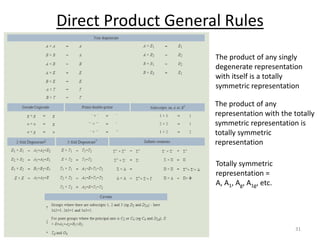
Direct Product General Rules
The product of any singly
degenerate representation
with itself is a totally
symmetric representation
The product of any
representation with the totally
symmetric representation is
totally symmetric
representation
Totally symmetric
representation =
A, A1, Ag, A1g, etc.
32
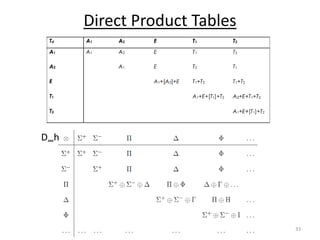
Direct Product Tables
33
Direct Product Tables
D∞h
Direct Products
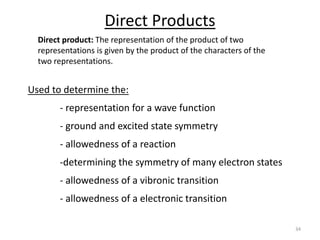
Direct product: The representation of the product of two
representations is given by the product of the characters of the
two representations.
34
Used to determine the:
- representation for a wave function
- ground and excited state symmetry
- allowedness of a reaction
-determining the symmetry of many electron states
- allowedness of a vibronic transition
- allowedness of a electronic transition
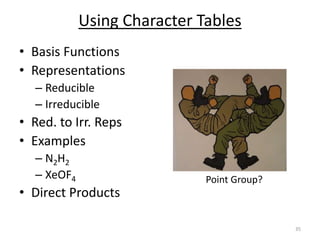
Using Character Tables
• Basis Functions
• Representations
– Reducible
– Irreducible
• Red. to Irr. Reps
• Examples
– N2H2
– XeOF4
• Direct Products
Point Group?
35

Character table in symmmetry operation a

  • 1.
    Part 2.6: UsingCharacter Tables 1
  • 2.
    Using Character Tables •Basis Functions • Representations – Reducible – Irreducible • Red. to Irr. Reps • Examples – N2H2 – XeOF4 • Direct Products Point Group? 2
  • 3.
    Basis Functions For molecules/materials: atoms cartisiancoordinates orbitals rotation direction bonds angles displacement vectors plane waves How does (basis) behave under the operations of (point group)? C3 3
  • 4.
  • 5.
    Representations (G) • Arepresentation of a symmetry operation of a group, which CANNOT be expressed in terms of a representation of lower dimension. • CANNOT be broken down into a simpler form. • Characters CANNOT be further diagonalized. Irreducible Representation- Reducible Representation- • A representation of a symmetry operation of a group, which CAN be expressed in terms of a representation of lower dimension. • CAN be broken down into a simpler form. • Characters CAN be further diagonalized. • Are composed of several irreducible representations. 5
  • 6.
    Representations (G) composed ofseveral irreducible representations. Reducible Representation Irreducible Representations  G  G i i i red a 6
  • 7.
    Representations (G) Reducible toIrreducible Representations Reducible Rep. Irreducible Rep. 1) A lot of algebra 2) Inspection/Trial and Error 3) Decomposition/Reduction Formula 7
  • 8.
    Representations (G) 2) Inspection/Trialand Error Reducible Rep. Irreducible Reps. G1 = A1 + B1 + B2 Reducible Rep. Irreducible Reps. G1 = Ag + Bu 8
  • 9.
    Representations (G) 2) Inspection/Trialand Error Reducible Rep. Irreducible Reps. G1 = 4Ag + 2Bg + 2Au + 4Bu 9
  • 10.
    Representations (G) 3) Decomposition/ReductionFormula ai is the number of times the irreducible rep. appears in G1 h is the order of the group N is the number of operations in class Q χ(R)Q is the character of the reducible representation χi(R)Q is the character of the irreducible representation Cannot be applied to D∞h and C∞h 10
  • 11.
    Representations (G) 3) Decomposition/ReductionFormula h = 1 + 1 + 1 + 1 = 4 order (h) aAg = + (1)(0)(1) + (1)(0)(1) + (1)(2)(1) 1 4 [ ] (1)(2)(1) = 1 = 4 4 G1 = Ag + Bu 11
  • 12.
    Representations (G) 3) Decomposition/ReductionFormula h = 1 + 1 + 1 + 1 = 4 order (h) G1 = 4Ag + 2Bg + 2Au + 4Bu 12
  • 13.
    Representations (G) 3) Decomposition/ReductionFormula h = 1 + 2 + 3 = 6 order (h) Gred = 2A1 + E 13
  • 14.
    Or there isa website/spreadsheet http://symmetry.jacobs-university.de/ 14
  • 15.
    Practice Irreducible Rep 15 60 2 2 2 G1 6 4 6 2 0 G2 3 0 -1 -3 0 1 G1
  • 16.
    Basis to Red.Rep to Irr. Rep. 1. Assign a point group 2. Choose basis function (bond, vibration, orbital, angle, etc.) 3. Apply operations -if the basis stays the same = +1 -if the basis is reversed = -1 -if it is a more complicated change = 0 4. Generate a reducible representation 5. Reduce to Irreducible Representation No matrix math is necessary! 16
  • 17.
    Example: N2H2 N-H bondlength (Dr) 1. Assign a point group 2. Choose basis function 3. Apply operations -if the basis stays the same = +1 -if the basis is reversed = -1 -if it is a more complicated change = 0 C2h operations: E, C2, i, sh E: 1 + 1 = 2 C2: 0 + 0 = 0 i: 0 + 0 = 0 sh: 1 + 1 = 2 17 C2h
  • 18.
    Example: N2H2 1. Assigna point group 2. Choose basis function 3. Apply operations -if the basis stays the same = +1 -if the basis is reversed = -1 -if it is a more complicated change = 0 4. Generate a reducible representation E: 1 + 1 = 2 C2: 0 + 0 = 0 i: 0 + 0 = 0 sh: 1 + 1 = 2 G 2 2 0 0 18 N-H bond length (Dr) C2h
  • 19.
    Example: N2H2 1. Assigna point group 2. Choose basis function 3. Apply operations -if the basis stays the same = +1 -if the basis is reversed = -1 -if it is a more complicated change = 0 4. Generate a reducible representation 5. Reduce to Irreducible Representation G 2 2 0 0 Reducible Rep. Irreducible Rep. 19 N-H bond length (Dr) C2h
  • 20.
    Decomposition/Reduction Formula h =1 + 1 + 1 + 1 = 4 order (h) aAg = + (1)(0)(1) + (1)(0)(1) + (1)(2)(1) 1 4 [ ] (1)(2)(1) = 1 = 4 4 G1 = Ag + Bu Example: N2H2 20
  • 21.
    Example: N2H2 1. Assigna point group 2. Choose basis function 3. Apply operations -if the basis stays the same = +1 -if the basis is reversed = -1 -if it is a more complicated change = 0 4. Generate a reducible representation 5. Reduce to Irreducible Representation 21 N-H bond length (Dr) C2h G1 = Ag + Bu The symmetric aspects of Dr1 and Dr2 can be described by Ag and Bu irreducible representations.
  • 22.
    Example: XeOF4 1. Assigna point group 2. Choose basis function 3. Apply operations -if the basis stays the same = +1 -if the basis is reversed = -1 -if it is a more complicated change = 0 C4v operations: E, C4, C2, sv , sv ’ C4v 22 F atoms
  • 23.
    1. Assign apoint group 2. Choose basis function 3. Apply operations -if the basis stays the same = +1 -if the basis is reversed = -1 -if it is a more complicated change = 0 4. Generate a reducible representation G Example: XeOF4 C4v point group F atoms 23
  • 24.
    1. Assign apoint group 2. Choose basis function 3. Apply operations -if the basis stays the same = +1 -if the basis is reversed = -1 -if it is a more complicated change = 0 4. Generate a reducible representation 5. Reduce to Irreducible Representation Reducible Rep. Irreducible Rep. G Example: XeOF4 C4v point group F atoms 24
  • 25.
    Decomposition/Reduction Formula aA1 =+ (2)(0)(1) + (1)(0)(1) + (2)(2)(1) + (2)(0)(1) 1 8 [ ] (1)(4)(1) = 1 = 8 8 G = A1 + B1 + E Example: XeOF4 h = 1 + 2 + 1 + 2 + 2 = 8 order (h) 25
  • 26.
    1. Assign apoint group 2. Choose basis function 3. Apply operations -if the basis stays the same = +1 -if the basis is reversed = -1 -if it is a more complicated change = 0 4. Generate a reducible representation 5. Reduce to Irreducible Representation Example: XeOF4 C4v point group F atoms 26 G = A1 + B1 + E The symmetric aspects of F atoms can be described by A1, B1 and E irreducible representations.
  • 27.
    Using Character Tables •Basis Functions • Representations – Reducible – Irreducible • Red. to Irr. Reps • Examples – N2H2 – XeOF4 • Direct Products Point Group? 27
  • 28.
    Direct Products Direct product:The representation of the product of two representations is given by the product of the characters of the two representations. 28
  • 29.
    Direct Products Direct product:The representation of the product of two representations is given by the product of the characters of the two representations. 29 Used to determine the: - representation for a wave function - ground and excited state symmetry - allowedness of a reaction -determining the symmetry of many electron states - allowedness of a vibronic transition - allowedness of a electronic transition
  • 30.
    Direct Products Direct product:The representation of the product of two representations is given by the product of the characters of the two representations. The direct product of two irreducible representations will be a new representation which is either an irreducible or a reducible representations. 30
  • 31.
    31 Direct Product GeneralRules The product of any singly degenerate representation with itself is a totally symmetric representation The product of any representation with the totally symmetric representation is totally symmetric representation Totally symmetric representation = A, A1, Ag, A1g, etc.
  • 32.
  • 33.
  • 34.
    Direct Products Direct product:The representation of the product of two representations is given by the product of the characters of the two representations. 34 Used to determine the: - representation for a wave function - ground and excited state symmetry - allowedness of a reaction -determining the symmetry of many electron states - allowedness of a vibronic transition - allowedness of a electronic transition
  • 35.
    Using Character Tables •Basis Functions • Representations – Reducible – Irreducible • Red. to Irr. Reps • Examples – N2H2 – XeOF4 • Direct Products Point Group? 35