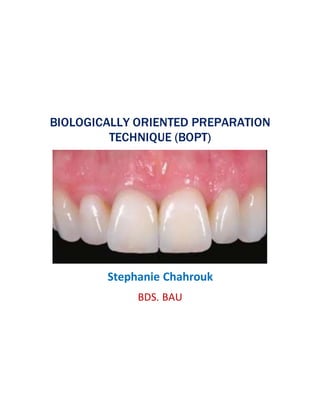
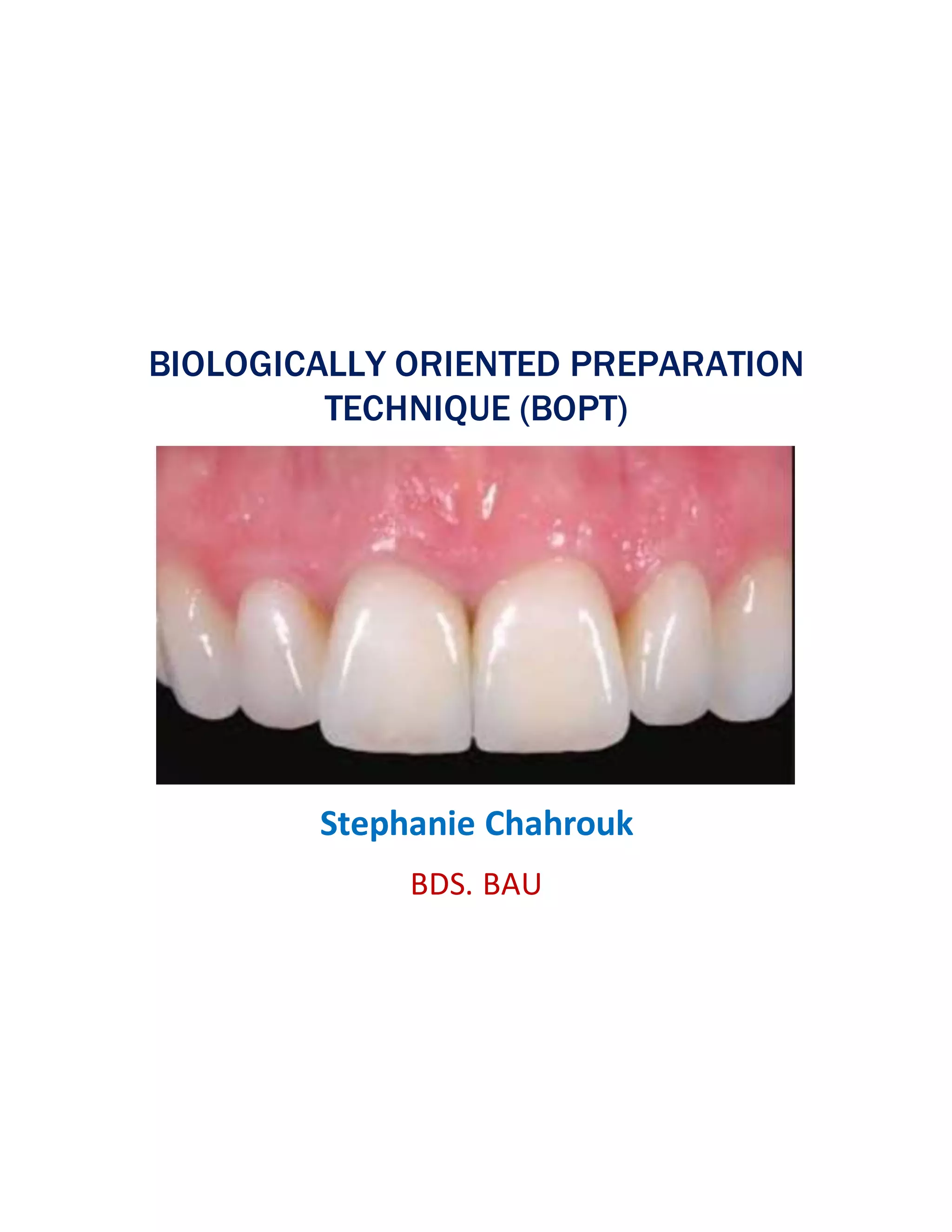

BIOLOGICALLY ORIENTED PREPARATION
TECHNIQUE (BOPT)
Stephanie Chahrouk
BDS. BAU
Introduction
• Unsatisfactory esthetic due to apical migration of gingival
margin is one of the main clinical complications in fixed
prosthodontics.
Different types of preparationsandmargindefinitions have beenproposed:
Chamfer with bevel.
Shoulder
Inclined shoulder
Shoulder with bevel.
Chamfer.
B.O.P.T
Definition:
A prosthetic technique for periodontal healthy teeth
using feather edge preparation
in a flapless approach in both esthetic and posterior
areas with ceramo-metal and zirconia restorations,
achieving high quality clinical and esthetic results in
terms of soft tissue stability at the prosthetic/tissue
interface, both in the short and in the long term.
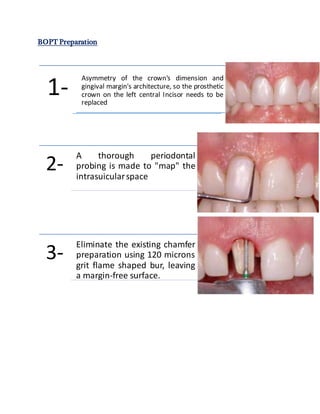
BOPT Preparation
1-
Asymmetry of the crown's dimension and
gingival margin's architecture, so the prosthetic
crown on the left central Incisor needs to be
replaced
2-
A thorough periodontal
probing is made to "map" the
intrasuicularspace
3-
Eliminate the existing chamfer
preparation using 120 microns
grit flame shaped bur, leaving
a margin-free surface.
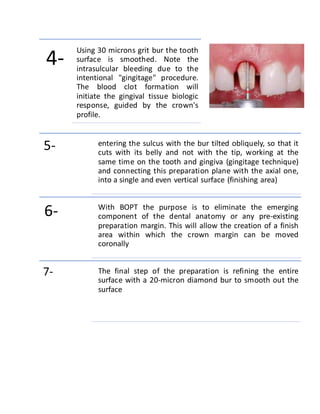
4-
Using 30 microns grit bur the tooth
surface is smoothed. Note the
intrasulcular bleeding due to the
intentional "gingitage" procedure.
The blood clot formation will
initiate the gingival tissue biologic
response, guided by the crown's
profile.
5- entering the sulcus with the bur tilted obliquely, so that it
cuts with its belly and not with the tip, working at the
same time on the tooth and gingiva (gingitage technique)
and connecting this preparation plane with the axial one,
into a single and even vertical surface (finishing area)
6- With BOPT the purpose is to eliminate the emerging
component of the dental anatomy or any pre-existing
preparation margin. This will allow the creation of a finish
area within which the crown margin can be moved
coronally
7- The final step of the preparation is refining the entire
surface with a 20-micron diamond bur to smooth out the
surface
•Erasure of anatomical cementoenamel junction (CEJ) in unprepared
teeth and deletion of the previously existing finish lines in already
prepared teeth.
•The possibility to position the final finish line at different levels,
either more coronally or more apically, within the gingival sulcus
(controlled invasion of sulcus), without affecting the quality of
marginaladaptation of the restoration.
•The possibility to modulate the crown emergence profiles to create
the ideal esthetic gingival architecture (adaptive forms and
profiles). In this way, a new prosthetic cemientoenamel junction
(PCEJ) will be created.
•Saving of dental structure.
•Easy and fastto execute.
•Ease in relining and finishing temporary crowns.
•Ease in impression taking.
Clinical Advantages
• Increase in gingival thickness.
• Increased stability of the gingival margin over time.
• Possibility to coronalize the gingival margin by remodeling emergency
profiles.
Biological Advantages
• After a minimum of 4 weeks, the gingival tissue will be stabilized and it
will be possible to take the impression to finalize the restoration.
• The absence of any finish line will make the procedure faster and
simpler.
• The use of two retraction cords is strongly suggested in order to have a
good reading of the sulcus and to help the technician during laboratory
procedures.
Impression technique
THANKYOU

BIOLOGICALLY ORIENTED PREPARATION TECHNIQUE (BOPT)

  • 1.
    BIOLOGICALLY ORIENTED PREPARATION TECHNIQUE(BOPT) Stephanie Chahrouk BDS. BAU
  • 2.
    Introduction • Unsatisfactory estheticdue to apical migration of gingival margin is one of the main clinical complications in fixed prosthodontics. Different types of preparationsandmargindefinitions have beenproposed: Chamfer with bevel. Shoulder Inclined shoulder Shoulder with bevel. Chamfer. B.O.P.T Definition: A prosthetic technique for periodontal healthy teeth using feather edge preparation in a flapless approach in both esthetic and posterior areas with ceramo-metal and zirconia restorations, achieving high quality clinical and esthetic results in terms of soft tissue stability at the prosthetic/tissue interface, both in the short and in the long term.
  • 3.
    BOPT Preparation 1- Asymmetry ofthe crown's dimension and gingival margin's architecture, so the prosthetic crown on the left central Incisor needs to be replaced 2- A thorough periodontal probing is made to "map" the intrasuicularspace 3- Eliminate the existing chamfer preparation using 120 microns grit flame shaped bur, leaving a margin-free surface.
  • 4.
    4- Using 30 micronsgrit bur the tooth surface is smoothed. Note the intrasulcular bleeding due to the intentional "gingitage" procedure. The blood clot formation will initiate the gingival tissue biologic response, guided by the crown's profile. 5- entering the sulcus with the bur tilted obliquely, so that it cuts with its belly and not with the tip, working at the same time on the tooth and gingiva (gingitage technique) and connecting this preparation plane with the axial one, into a single and even vertical surface (finishing area) 6- With BOPT the purpose is to eliminate the emerging component of the dental anatomy or any pre-existing preparation margin. This will allow the creation of a finish area within which the crown margin can be moved coronally 7- The final step of the preparation is refining the entire surface with a 20-micron diamond bur to smooth out the surface
  • 5.
    •Erasure of anatomicalcementoenamel junction (CEJ) in unprepared teeth and deletion of the previously existing finish lines in already prepared teeth. •The possibility to position the final finish line at different levels, either more coronally or more apically, within the gingival sulcus (controlled invasion of sulcus), without affecting the quality of marginaladaptation of the restoration. •The possibility to modulate the crown emergence profiles to create the ideal esthetic gingival architecture (adaptive forms and profiles). In this way, a new prosthetic cemientoenamel junction (PCEJ) will be created. •Saving of dental structure. •Easy and fastto execute. •Ease in relining and finishing temporary crowns. •Ease in impression taking. Clinical Advantages • Increase in gingival thickness. • Increased stability of the gingival margin over time. • Possibility to coronalize the gingival margin by remodeling emergency profiles. Biological Advantages • After a minimum of 4 weeks, the gingival tissue will be stabilized and it will be possible to take the impression to finalize the restoration. • The absence of any finish line will make the procedure faster and simpler. • The use of two retraction cords is strongly suggested in order to have a good reading of the sulcus and to help the technician during laboratory procedures. Impression technique
  • 6.