VFF project Holistic, extensible, scalable and standard Virtual Factory Framework  Conference name ddmmyyy VFF project Presenter’s name
Context Companies are required to increase the level of flexibility and respond to market quickly. improving the level of productivity and quality through process improvement and integration into the various activities of the factory, both at the cellular level or at all.
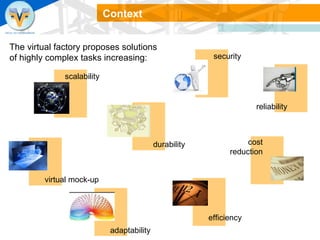
Context efficiency adaptability The virtual factory proposes solutions of highly complex tasks increasing: durability security reliability scalability virtual mock-up cost reduction
VFF project DURATION:   42 months STARTING DATE:   1st September 2009 PROJECT N°:   FP7-NMP-2008-3.4-1; 228595 STRATEGIC OBJECTIVE:   Theme 4 – NMP – Nanosciences, Nanotechnologies, Materials and new Production Technologies BUDGET:   12.075.455€   COORDINATOR:   ITIA-CNR
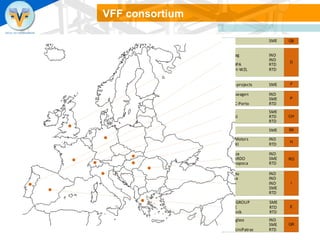
VFF consortium
It’s based on four pillars which  collaboration leads to the realization of the Virtual Factory concepts. VFF objective VFF supports the deployment of a next generation Virtual Factory promoting the EU manufacturing competitiveness.
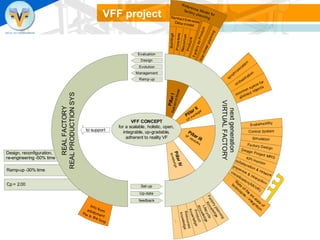
VFF project
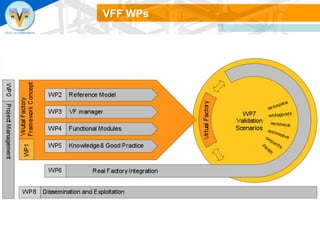
VFF WPs
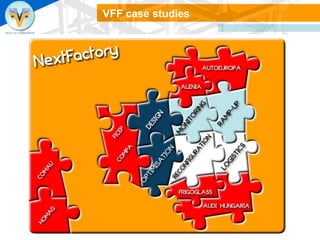
VFF case studies
Description:  The VFF tools will be used to design (or re-design) the factory, aiming at higher solution efficiency and effectiveness, and to optimise the configuration of the production systems.  Main Goals: Reduce development time and costs and improve quality of product and processes; Reduce factory recycling due a successful original planning; Standardize processes; Increase performance levels; Decrease implementation costs; Scope:  Technical, Logistical, Quality departments. Scenario 1: Design and Optimization
Description: The VFF tools will enhance the capability to monitor the real factory and improve the set-up activities during the ramp-up phase.  Main Goals: Achieve rigorous and expedite methods and tools to measure and analyse the performance of the factory; Identify significant failures in production processes;  Evaluate the impact of the continuous improvement actions;  Compare the real performance with the required performance to achieve the targets and budget and even perform benchmark with other factories of the same industrial sector. Scope:  Manpower performance monitoring. Scenario 2: Ramp Up & Monitoring
Description: The factory reconfiguration decisions can be supported by simulation and optimization tools, whereas logistics decisions need VFF tools to efficiently face variable demand by means of flexible networked operations.    Main Goals: Support the planning procedure of layout and control changes; Decrease planning / reconfiguration time and costs; On-line connect the real control system with the simulation and allow faster and easier analysis for reconfiguration; Decrease failure probability; Reduce inventory, work in progress and scrap costs. Scope: To support the pearl chain delivery of the finished products but also includes some minor layout and organization changes in the engine delivery logistic system. Factory Planning, the product Handling and Logistics Department are be involved in the scenario. Scenario 3: Reconfiguration & Logistics
Description: The purpose of the next factory scenario is to demonstrate the possibilities, limitations and benefits of an integrated holistic planning and engineering process for a new factory.   Main Goals: Reduction of efforts for planning, engineering and ramp-up of new factories; Avoidance of mistakes in productivity planning; Set up safe processes in order to meet customer’s requirements; Build up an integrated planning network  Agile planning processes to handle order and engineering plans   Scope:  The scenario comprises the technical and organizational planning processes, the simulation based configuration and engineering of production lines, the ramp-up of the lines and the monitoring of the factory operation. Scenario 4: Next Factory
Visit VFF web site:  www.vff-project.eu   For further information, please contact VFF coordinator:  info@vff-project.eu  Project contacts

Vff project presentation-2009-10-19-1

  • 1.
    VFF project Holistic,extensible, scalable and standard Virtual Factory Framework Conference name ddmmyyy VFF project Presenter’s name
  • 2.
    Context Companies arerequired to increase the level of flexibility and respond to market quickly. improving the level of productivity and quality through process improvement and integration into the various activities of the factory, both at the cellular level or at all.
  • 3.
    Context efficiency adaptabilityThe virtual factory proposes solutions of highly complex tasks increasing: durability security reliability scalability virtual mock-up cost reduction
  • 4.
    VFF project DURATION: 42 months STARTING DATE: 1st September 2009 PROJECT N°: FP7-NMP-2008-3.4-1; 228595 STRATEGIC OBJECTIVE: Theme 4 – NMP – Nanosciences, Nanotechnologies, Materials and new Production Technologies BUDGET: 12.075.455€ COORDINATOR: ITIA-CNR
  • 5.
  • 6.
    It’s based onfour pillars which collaboration leads to the realization of the Virtual Factory concepts. VFF objective VFF supports the deployment of a next generation Virtual Factory promoting the EU manufacturing competitiveness.
  • 7.
  • 8.
  • 9.
  • 10.
    Description: TheVFF tools will be used to design (or re-design) the factory, aiming at higher solution efficiency and effectiveness, and to optimise the configuration of the production systems. Main Goals: Reduce development time and costs and improve quality of product and processes; Reduce factory recycling due a successful original planning; Standardize processes; Increase performance levels; Decrease implementation costs; Scope: Technical, Logistical, Quality departments. Scenario 1: Design and Optimization
  • 11.
    Description: The VFFtools will enhance the capability to monitor the real factory and improve the set-up activities during the ramp-up phase. Main Goals: Achieve rigorous and expedite methods and tools to measure and analyse the performance of the factory; Identify significant failures in production processes; Evaluate the impact of the continuous improvement actions; Compare the real performance with the required performance to achieve the targets and budget and even perform benchmark with other factories of the same industrial sector. Scope: Manpower performance monitoring. Scenario 2: Ramp Up & Monitoring
  • 12.
    Description: The factoryreconfiguration decisions can be supported by simulation and optimization tools, whereas logistics decisions need VFF tools to efficiently face variable demand by means of flexible networked operations.   Main Goals: Support the planning procedure of layout and control changes; Decrease planning / reconfiguration time and costs; On-line connect the real control system with the simulation and allow faster and easier analysis for reconfiguration; Decrease failure probability; Reduce inventory, work in progress and scrap costs. Scope: To support the pearl chain delivery of the finished products but also includes some minor layout and organization changes in the engine delivery logistic system. Factory Planning, the product Handling and Logistics Department are be involved in the scenario. Scenario 3: Reconfiguration & Logistics
  • 13.
    Description: The purposeof the next factory scenario is to demonstrate the possibilities, limitations and benefits of an integrated holistic planning and engineering process for a new factory.   Main Goals: Reduction of efforts for planning, engineering and ramp-up of new factories; Avoidance of mistakes in productivity planning; Set up safe processes in order to meet customer’s requirements; Build up an integrated planning network Agile planning processes to handle order and engineering plans   Scope: The scenario comprises the technical and organizational planning processes, the simulation based configuration and engineering of production lines, the ramp-up of the lines and the monitoring of the factory operation. Scenario 4: Next Factory
  • 14.
    Visit VFF website: www.vff-project.eu For further information, please contact VFF coordinator: info@vff-project.eu Project contacts

Editor's Notes

  • #8 PILLAR 1: Reference Model The Reference Model for factory planning is based on two key concepts: the “factory as a product” and the “non-linear non-deterministic planning methodology”. The Reference Model establish a coherent standard extensible data-model at the base of the common representation of Factory Objects PILLAR 2: VF manager The VF manager handles the common space of abstract objects, representing the Factory. This representation is based on the standard data model defined in Pillar I PILLAR 3: VF modules The VF modules are the Decoupled Functional Modules that implement the various tools and services for the Factory design, evolution, evaluation, management … They all operate on the same Common Space of Abstract Object, defined in Pillar II. This structure allows plug and play of existing and new modules. PILLAR 4: Knowledge Knowledge as engine for the VFF CONCEPT. To model a wider range of complex systems and support greater comprehension of modeled the phenomenon. The VIRTUAL and REAL FACTORY interact also thanks to the “hardware in the loop” concept