ANATOMY AND
PHYSIOLOGY OF
EQUILIBRIUM
PRESENTER – DR ASMITA CHANDA
MODERATOR – DR NEHA VERMA
FUNCTIONS OF EQUILIBRIUM
 General orientation of the body with respect to gravity
 Enables balanced locomotion and body position
 Readjust autonomic functions after body reorientation
 Gaze stabilization
These functions are achieved by the following
mechanisms
 Gaze stabilisation - vestibulo ocular reflex
 General orientation of body and locomotion –
vestibulospinal reflex
 Readjustment of autonomic function after
reorientation – vestibulosympathetic reflex.
SPATIONAL MOVEMENTS
 Every motion in space has three
rotational degree of freedom and three
translational degree of freedom.
Rotational
translational
pitch
yaw
roll
up down
fore-aft
left right
RECEPTORS FOR MOVEMENT DETECTION

Vestibular
labrynth
Semicircular
canal
Otolith organs
horizontal
anterior
posterior
utricle
saccule
Vestibular
labrynth
SEMICIRCULAR CANALS
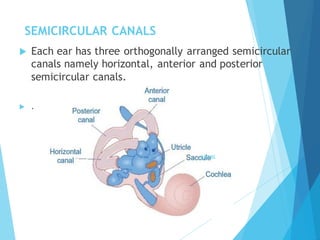
 Each ear has three orthogonally arranged semicircular
canals namely horizontal, anterior and posterior
semicircular canals.
 .
C BY-NC
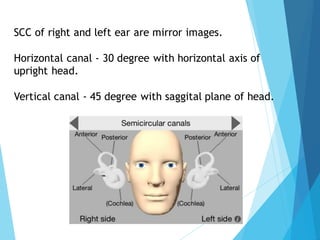
SCC of right and left ear are mirror images.
Horizontal canal - 30 degree with horizontal axis of
upright head.
Vertical canal - 45 degree with saggital plane of head.
 The right anterior SCC is parallel with the
left posterior SCC and vice versa.
 The horizontal SCC of both the ears are
parallel with each other.
 Semicircular canals are filled endolymph.
 Each SCC has bulge at its base called , ampulla.
 Membrane lining of ampulla gets thickenend and forms crista.
 Crista contains hair cells and supporting cells which gets stimulated by
movement.
 Hair cells are embedded in cupula (gelatinous substance)
 Hair cells are innervated by afferents of vestibular nerve.
OTOLITH ORGANS
 Utricle + saccule = otolith organ.
 Sensory neuroepithelium - macula.
 Utricular macula- lies in a horizontal plane
- perceives horizontal linear accelerations
 Saccular macula- lies in a vertical plane-
perceives vertical linear accelerations. It is
therefore sensitive to gravity.
 Macula contains hair cells.
 Utricular hair cells are oriented in different direction.
 This orientation is determined by striola , a curved dividing ridge through
the middle of the macula.
 Kinocilia are oriented towards striola.
 Enables precise coding of direction of acceleration.
 Saccular hair cells are divided into ventral and dorsal group.
 The orientation of kinocilum is away from striola.
HAIR CELL STRUCTUREAND PHYSIOLOGY
 Hair cells are the receptor cells of vestibular apparatus.
 On the basis of their morphology, physiology and afferent innervation they
are classified either as type I hair cells and type II hair cells.
 Composed of single kinocilium and multiple rows of stereocilia.
 20 to 100 stereocilia per hair cell.
 Kinocilium - tallest member of hair cell bundle.
 Position of kinocilium indicates orientation of hair cell.
Stereocilia- connected by tip links.
 Tip links are connected to the molecular gate of transduction
channels.
 Tension in tip controls opening and closing of channels.
MECHANOTRANSDUCTION IN THE
SEMICIRCULAR CANAL
 Detect rotational accelerations.
 When head is rotated to the left, the endolymph moves in the opposite
direction due to inertia of the liquid, thus bending the cupula to the right.
to left
MECHANOTRANSDUCTION IN OTOLITH
ORGANS
 The inertial mass in otolith organs is provided by otoconia which sits on
top of otolith membrane.
 Depending upon the movement of stereocilia towards or away from
kinocilium the hair cells are stimulated or inhibited respectively.
 In otolith organs, hair cells are oriented in different directions.
 Hair cells with axes in alignment with the acceleration of head -
excited maximally
 Hair cells whose axes are perpendicular to the axis of acceleration
of head are not stimulated.
 This allows the brain to estimate the direction and magnitude of
linear acceleration.
GAZE STABILISATION
 Achieved by means of vestibuloocular reflex.
 It functions to stabilize images on retina during head movement by
producing eye movement in the opposite direction.
VESTIBULOOCULAR REFLEX GENERATION
 At rest, hair cells in both SCC have a resting discharge rate
of 90 spikes per second.
 When head is rotated to right –Endolymph lags behind and
moves relatively to left due to inertia.
 Cupula bends to the left in each canal.
 In the right SCC, the stereocilia bend towards the kinocilium
causing depolarisation of the hair cell .
 In the left SCC, the stereocila bend away from the
kinocilium –hyperpolarization of hair cells
Right
SCC
Left SCC
head movement to right
lateral
rectus
right
vestibular
nucleus
type I
inhibitory
neuron
abducens
nuclei
occulomotor
nucleus
lateral rectus
medial rectus
VESTIBULAR NUCLEI
 Vestibular nuclei are cranial
nuclei for vestibular nerve.
 Situated in pons and medulla of
brainstem.
 It has four subnuclei.
 From vestibular nuclei,
informations are carried to
higher centres.
 Vestibular nucleus has three types of neurons-
 type I excitatory neuron
 type I inhibitory neuron
 type II inhibitory neuron
Type I excitatory
neuron
Type I
inhibitory
neuron
Type II inhibitory
neuron
COMMISSURAL PATHWAY
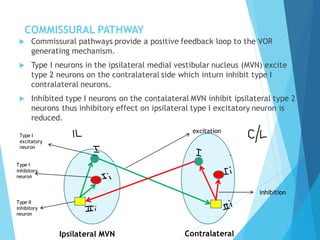
 Commissural pathways provide a positive feedback loop to the VOR
generating mechanism.
 Type I neurons in the ipsilateral medial vestibular nucleus (MVN) excite
type 2 neurons on the contralateral side which inturn inhibit type I
contralateral neurons.
 Inhibited type I neurons on the contalateral MVN inhibit ipsilateral type 2
neurons thus inhibitory effect on ipsilateral type I excitatory neuron is
reduced.
Type I
excitatory
neuron
Type I
inhibitory
neuron
Type II
inhibitory
neuron
Ipsilateral MVN Contralateral
inhibition
excitation
ACUTE PERIPHERAL VESTIBULAR LESION
AND VESTIBULAR COMPENSATION
 In acute unilateral vestibular disease,
 There is absence of peripheral activity by the SCC afferent neurons
 The firing rate of type I neurons on affected side decreases.
 Contralateral type 2 neurons are less stimulated, thereby inhibitory effect
on contralateral healthy type I neurons is decreased.
 This increased type I activity on healthy side inturn
activates the inhibitory type 2 neurons on the lesioned
side which in turn inhibit type I neurons on the lesioned
side.
 This absence of input from ipsilateral MVN and increased activity on
contralateral MVN mimic rotation towards intact side generating
spontaneous nystagmus.
 Patient also keeps their head is tilted down towards lesioned side.
STIMULATION OF ANTERIOR AND
POSTERIOR CANALS AND CORRESPONDING
EYE MOVEMENTS
Actions of the extraocular muscles
Muscle Primary action Secondary action
Medial rectus adduction
Inferior rectus depression extorsion
Lateral rectus abduction
Superior rectus elevation intorsion
Superior oblique intorsion depression
Inferior oblique extorsion elevation
SIN – superiors are intorters (superior oblique and superior
rectus)
Canal stimulation and eye movemnts
Canal stimulation Eye muscle contracted
Horizontal SCC Ipsilateral medial rectus
Contralateral lateral
rectus
Anterior SCC Ipsilateral superior
rectus
Contalateral inferior
rectus
Posterior SCC Ipsilateral superior
oblique
Contralateral inferior
rectus
 When head is turned 45 degree to the the right and moved downward
in that plane .
 Right anterior canal is stimulated while left posterior canal is
inhibited.
 During forward bending of head, right anterior and left anterior
semicircular canal are stimulated.
 Right superior rectus, right inferior oblique, left inferior oblique and left
superior rectus are stimulated and contract.
 Eyes moves upward and torsional components are cancelled out.
APPLIED ASPECT
NYSTAGMUS
 Involuntary eye movement rapidly move from side to
side, up and down or in a circle.
 Consists of a slow phase until the eye reaches the outer
canthus and a fast phase to reset eyes in its initial
position.
 The direction of nystagmus is defined by the fast reset
phase.
ACUTE WHOLE LABYRINTHINE DEFICIENCY
 Lesions on all canals of one side is interpreted by brain as
excitation of contralateral vestibular system.
 It causes contraction of C/L eye MR, SR and SO muscles.
 When all muscles contract simultaneously, elevation and
depression cancel out
 Only torsional movement and horizontal nystagmus remains
due to contraction of I/L medial rectus muscle.
 Torsional and horizontal nystagmus are clinical signs of acute
whole labyrinthine deficiency.
HEAD IMPULSE TEST
 Head impulse test or head thrust test is used to help identify impaired
vestibulo ocular reflex (VOR) in patients with vertigo.
VESTIBULOSPINAL REFLEX
 Helps us to ensure maintenance of an
upright position, and head stabilisation in
space.
 Extensor muscles of neck, trunk, arms
and limbs are effector organs.
THANK YOU

Middle ear mechanics

  • 1.
    ANATOMY AND PHYSIOLOGY OF EQUILIBRIUM PRESENTER– DR ASMITA CHANDA MODERATOR – DR NEHA VERMA
  • 2.
    FUNCTIONS OF EQUILIBRIUM General orientation of the body with respect to gravity  Enables balanced locomotion and body position  Readjust autonomic functions after body reorientation  Gaze stabilization
  • 3.
    These functions areachieved by the following mechanisms  Gaze stabilisation - vestibulo ocular reflex  General orientation of body and locomotion – vestibulospinal reflex  Readjustment of autonomic function after reorientation – vestibulosympathetic reflex.
  • 4.
    SPATIONAL MOVEMENTS  Everymotion in space has three rotational degree of freedom and three translational degree of freedom. Rotational translational pitch yaw roll up down fore-aft left right
  • 5.
    RECEPTORS FOR MOVEMENTDETECTION  Vestibular labrynth Semicircular canal Otolith organs horizontal anterior posterior utricle saccule Vestibular labrynth
  • 6.
    SEMICIRCULAR CANALS  Eachear has three orthogonally arranged semicircular canals namely horizontal, anterior and posterior semicircular canals.  . C BY-NC
  • 7.
    SCC of rightand left ear are mirror images. Horizontal canal - 30 degree with horizontal axis of upright head. Vertical canal - 45 degree with saggital plane of head.
  • 8.
     The rightanterior SCC is parallel with the left posterior SCC and vice versa.  The horizontal SCC of both the ears are parallel with each other.
  • 9.
     Semicircular canalsare filled endolymph.  Each SCC has bulge at its base called , ampulla.  Membrane lining of ampulla gets thickenend and forms crista.  Crista contains hair cells and supporting cells which gets stimulated by movement.  Hair cells are embedded in cupula (gelatinous substance)  Hair cells are innervated by afferents of vestibular nerve.
  • 10.
    OTOLITH ORGANS  Utricle+ saccule = otolith organ.  Sensory neuroepithelium - macula.  Utricular macula- lies in a horizontal plane - perceives horizontal linear accelerations  Saccular macula- lies in a vertical plane- perceives vertical linear accelerations. It is therefore sensitive to gravity.
  • 13.
     Macula containshair cells.  Utricular hair cells are oriented in different direction.  This orientation is determined by striola , a curved dividing ridge through the middle of the macula.  Kinocilia are oriented towards striola.  Enables precise coding of direction of acceleration.
  • 14.
     Saccular haircells are divided into ventral and dorsal group.  The orientation of kinocilum is away from striola.
  • 15.
    HAIR CELL STRUCTUREANDPHYSIOLOGY  Hair cells are the receptor cells of vestibular apparatus.  On the basis of their morphology, physiology and afferent innervation they are classified either as type I hair cells and type II hair cells.
  • 16.
     Composed ofsingle kinocilium and multiple rows of stereocilia.  20 to 100 stereocilia per hair cell.  Kinocilium - tallest member of hair cell bundle.  Position of kinocilium indicates orientation of hair cell.
  • 17.
    Stereocilia- connected bytip links.  Tip links are connected to the molecular gate of transduction channels.  Tension in tip controls opening and closing of channels.
  • 18.
    MECHANOTRANSDUCTION IN THE SEMICIRCULARCANAL  Detect rotational accelerations.  When head is rotated to the left, the endolymph moves in the opposite direction due to inertia of the liquid, thus bending the cupula to the right. to left
  • 20.
    MECHANOTRANSDUCTION IN OTOLITH ORGANS The inertial mass in otolith organs is provided by otoconia which sits on top of otolith membrane.
  • 21.
     Depending uponthe movement of stereocilia towards or away from kinocilium the hair cells are stimulated or inhibited respectively.
  • 22.
     In otolithorgans, hair cells are oriented in different directions.  Hair cells with axes in alignment with the acceleration of head - excited maximally  Hair cells whose axes are perpendicular to the axis of acceleration of head are not stimulated.  This allows the brain to estimate the direction and magnitude of linear acceleration.
  • 23.
    GAZE STABILISATION  Achievedby means of vestibuloocular reflex.  It functions to stabilize images on retina during head movement by producing eye movement in the opposite direction.
  • 24.
    VESTIBULOOCULAR REFLEX GENERATION At rest, hair cells in both SCC have a resting discharge rate of 90 spikes per second.  When head is rotated to right –Endolymph lags behind and moves relatively to left due to inertia.  Cupula bends to the left in each canal.  In the right SCC, the stereocilia bend towards the kinocilium causing depolarisation of the hair cell .  In the left SCC, the stereocila bend away from the kinocilium –hyperpolarization of hair cells
  • 27.
    Right SCC Left SCC head movementto right lateral rectus
  • 28.
  • 29.
    VESTIBULAR NUCLEI  Vestibularnuclei are cranial nuclei for vestibular nerve.  Situated in pons and medulla of brainstem.  It has four subnuclei.  From vestibular nuclei, informations are carried to higher centres.
  • 30.
     Vestibular nucleushas three types of neurons-  type I excitatory neuron  type I inhibitory neuron  type II inhibitory neuron Type I excitatory neuron Type I inhibitory neuron Type II inhibitory neuron
  • 31.
    COMMISSURAL PATHWAY  Commissuralpathways provide a positive feedback loop to the VOR generating mechanism.  Type I neurons in the ipsilateral medial vestibular nucleus (MVN) excite type 2 neurons on the contralateral side which inturn inhibit type I contralateral neurons.  Inhibited type I neurons on the contalateral MVN inhibit ipsilateral type 2 neurons thus inhibitory effect on ipsilateral type I excitatory neuron is reduced. Type I excitatory neuron Type I inhibitory neuron Type II inhibitory neuron Ipsilateral MVN Contralateral inhibition excitation
  • 32.
    ACUTE PERIPHERAL VESTIBULARLESION AND VESTIBULAR COMPENSATION  In acute unilateral vestibular disease,  There is absence of peripheral activity by the SCC afferent neurons  The firing rate of type I neurons on affected side decreases.  Contralateral type 2 neurons are less stimulated, thereby inhibitory effect on contralateral healthy type I neurons is decreased.
  • 33.
     This increasedtype I activity on healthy side inturn activates the inhibitory type 2 neurons on the lesioned side which in turn inhibit type I neurons on the lesioned side.
  • 34.
     This absenceof input from ipsilateral MVN and increased activity on contralateral MVN mimic rotation towards intact side generating spontaneous nystagmus.  Patient also keeps their head is tilted down towards lesioned side.
  • 35.
    STIMULATION OF ANTERIORAND POSTERIOR CANALS AND CORRESPONDING EYE MOVEMENTS Actions of the extraocular muscles Muscle Primary action Secondary action Medial rectus adduction Inferior rectus depression extorsion Lateral rectus abduction Superior rectus elevation intorsion Superior oblique intorsion depression Inferior oblique extorsion elevation SIN – superiors are intorters (superior oblique and superior rectus)
  • 37.
    Canal stimulation andeye movemnts Canal stimulation Eye muscle contracted Horizontal SCC Ipsilateral medial rectus Contralateral lateral rectus Anterior SCC Ipsilateral superior rectus Contalateral inferior rectus Posterior SCC Ipsilateral superior oblique Contralateral inferior rectus
  • 38.
     When headis turned 45 degree to the the right and moved downward in that plane .  Right anterior canal is stimulated while left posterior canal is inhibited.
  • 39.
     During forwardbending of head, right anterior and left anterior semicircular canal are stimulated.  Right superior rectus, right inferior oblique, left inferior oblique and left superior rectus are stimulated and contract.  Eyes moves upward and torsional components are cancelled out.
  • 40.
    APPLIED ASPECT NYSTAGMUS  Involuntaryeye movement rapidly move from side to side, up and down or in a circle.  Consists of a slow phase until the eye reaches the outer canthus and a fast phase to reset eyes in its initial position.  The direction of nystagmus is defined by the fast reset phase.
  • 41.
    ACUTE WHOLE LABYRINTHINEDEFICIENCY  Lesions on all canals of one side is interpreted by brain as excitation of contralateral vestibular system.  It causes contraction of C/L eye MR, SR and SO muscles.  When all muscles contract simultaneously, elevation and depression cancel out  Only torsional movement and horizontal nystagmus remains due to contraction of I/L medial rectus muscle.  Torsional and horizontal nystagmus are clinical signs of acute whole labyrinthine deficiency.
  • 42.
    HEAD IMPULSE TEST Head impulse test or head thrust test is used to help identify impaired vestibulo ocular reflex (VOR) in patients with vertigo.
  • 43.
    VESTIBULOSPINAL REFLEX  Helpsus to ensure maintenance of an upright position, and head stabilisation in space.  Extensor muscles of neck, trunk, arms and limbs are effector organs.
  • 44.