Vernacular Architecture in
Multan
The City of Saints
History of Multan
• Multan is one of the oldest cities of the world dating back 6000 years when it was
known as Maloha, a cultural and trade hub between Central Asia and South Asia.
• Multan was conquered along with Sindh by Muhammad bin Qasim in 712 AD.
• Multan was attacked by Mahmud of Ghazni in 1005 CE.
• Timur, Babur and many other rulers invaded this city.
• It is not surprising, is also known as "Mandinatu-Aulya", the city of saints.
The Historical Tombs
• Being a historical city, Multan is full to tombs, mosques, "Khanqahs" (hospices) of
saints and other monuments of Muslim origin. Multan’s architecture begins with the
Muslim conquest.
• Keeping in view their historical value, priceless art work, architecture style and
craftsmanship involved, all these monuments are beautifully decorated and
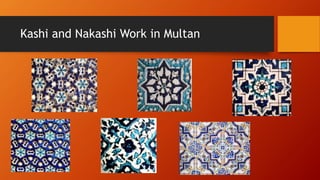
ornamented with blue titles, fresco-paints and mosaic work, and some with the
delightful and soothing Kashi and Naqashi work for which Multan is famous.
• Most of the crafts and monuments of artistic value are clearly influenced by Islam.
• The architecture of Multan prior to the 11thcentury, though elsewhere in Pakistan
we can trace the genesis of Muslim architecture from the 8th century A.D
Architecture of Tombs
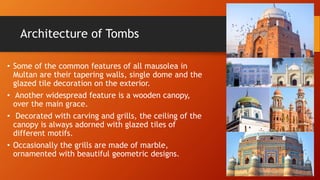
• Some of the common features of all mausolea in
Multan are their tapering walls, single dome and the
glazed tile decoration on the exterior.
• Another widespread feature is a wooden canopy,
over the main grace.
• Decorated with carving and grills, the ceiling of the
canopy is always adorned with glazed tiles of
different motifs.
• Occasionally the grills are made of marble,
ornamented with beautiful geometric designs.
Walled City and Six Gates
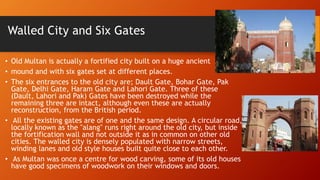
• Old Multan is actually a fortified city built on a huge ancient
• mound and with six gates set at different places.
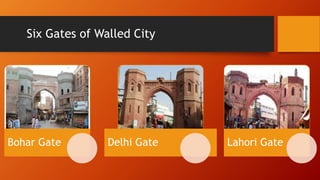
• The six entrances to the old city are; Dault Gate, Bohar Gate, Pak
Gate, Delhi Gate, Haram Gate and Lahori Gate. Three of these
(Dault, Lahori and Pak) Gates have been destroyed while the
remaining three are intact, although even these are actually
reconstruction, from the British period.
• All the existing gates are of one and the same design. A circular road,
locally known as the "alang" runs right around the old city, but inside
the fortification wall and not outside it as in common on other old
cities. The walled city is densely populated with narrow streets,
winding lanes and old style houses built quite close to each other.
• As Multan was once a centre for wood carving, some of its old houses
have good specimens of woodwork on their windows and doors.
Tomb of Hazrat Bahauddin Zakarya
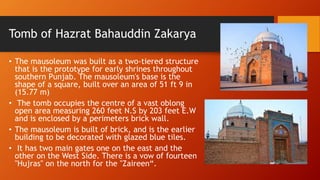
• The mausoleum was built as a two-tiered structure
that is the prototype for early shrines throughout
southern Punjab. The mausoleum's base is the
shape of a square, built over an area of 51 ft 9 in
(15.77 m)
• The tomb occupies the centre of a vast oblong
open area measuring 260 feet N.S by 203 feet E.W
and is enclosed by a perimeters brick wall.
• The mausoleum is built of brick, and is the earlier
building to be decorated with glazed blue tiles.
• It has two main gates one on the east and the
other on the West Side. There is a vow of fourteen
"Hujras" on the north for the "Zaireen“.
Tomb of Shah Rukn-e-Alam
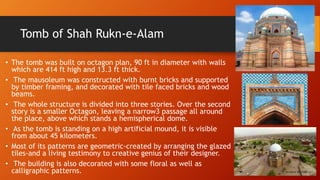
• The tomb was built on octagon plan, 90 ft in diameter with walls
which are 414 ft high and 13.3 ft thick.
• The mausoleum was constructed with burnt bricks and supported
by timber framing, and decorated with tile faced bricks and wood
beams.
• The whole structure is divided into three stories. Over the second
story is a smaller Octagon, leaving a narrow3 passage all around
the place, above which stands a hemispherical dome.
• As the tomb is standing on a high artificial mound, it is visible
from about 45 kilometers.
• Most of its patterns are geometric-created by arranging the glazed
tiles-and a living testimony to creative genius of their designer.
• The building is also decorated with some floral as well as
calligraphic patterns.
Tomb of Shah Shams Sabzwari
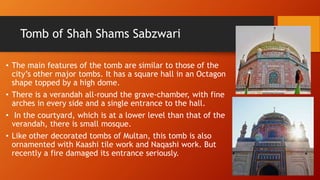
• The main features of the tomb are similar to those of the
city’s other major tombs. It has a square hall in an Octagon
shape topped by a high dome.
• There is a verandah all-round the grave-chamber, with fine
arches in every side and a single entrance to the hall.
• In the courtyard, which is at a lower level than that of the
verandah, there is small mosque.
• Like other decorated tombs of Multan, this tomb is also
ornamented with Kaashi tile work and Naqashi work. But
recently a fire damaged its entrance seriously.
Tomb of Sultan Ali Akbar
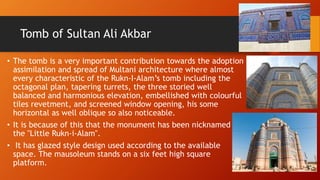
• The tomb is a very important contribution towards the adoption
assimilation and spread of Multani architecture where almost
every characteristic of the Rukn-I-Alam’s tomb including the
octagonal plan, tapering turrets, the three storied well
balanced and harmonious elevation, embellished with colourful
tiles revetment, and screened window opening, his some
horizontal as well oblique so also noticeable.
• It is because of this that the monument has been nicknamed
the "Little Rukn-i-Alam".
• It has glazed style design used according to the available
space. The mausoleum stands on a six feet high square
platform.
Tomb of Shah Yusuf Gardezi
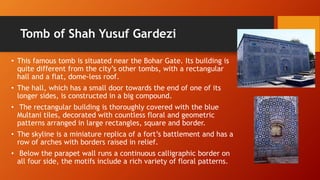
• This famous tomb is situated near the Bohar Gate. Its building is
quite different from the city’s other tombs, with a rectangular
hall and a flat, dome-less roof.
• The hall, which has a small door towards the end of one of its
longer sides, is constructed in a big compound.
• The rectangular building is thoroughly covered with the blue
Multani tiles, decorated with countless floral and geometric
patterns arranged in large rectangles, square and border.
• The skyline is a miniature replica of a fort’s battlement and has a
row of arches with borders raised in relief.
• Below the parapet wall runs a continuous calligraphic border on
all four side, the motifs include a rich variety of floral patterns.
Six Gates of Walled City
Bohar Gate Delhi Gate Lahori Gate
Kashi and Nakashi Work in Multan
THANKS

Vernacular architecture in multan

  • 1.
  • 2.
    History of Multan •Multan is one of the oldest cities of the world dating back 6000 years when it was known as Maloha, a cultural and trade hub between Central Asia and South Asia. • Multan was conquered along with Sindh by Muhammad bin Qasim in 712 AD. • Multan was attacked by Mahmud of Ghazni in 1005 CE. • Timur, Babur and many other rulers invaded this city. • It is not surprising, is also known as "Mandinatu-Aulya", the city of saints.
  • 3.
    The Historical Tombs •Being a historical city, Multan is full to tombs, mosques, "Khanqahs" (hospices) of saints and other monuments of Muslim origin. Multan’s architecture begins with the Muslim conquest. • Keeping in view their historical value, priceless art work, architecture style and craftsmanship involved, all these monuments are beautifully decorated and ornamented with blue titles, fresco-paints and mosaic work, and some with the delightful and soothing Kashi and Naqashi work for which Multan is famous. • Most of the crafts and monuments of artistic value are clearly influenced by Islam. • The architecture of Multan prior to the 11thcentury, though elsewhere in Pakistan we can trace the genesis of Muslim architecture from the 8th century A.D
  • 4.
    Architecture of Tombs •Some of the common features of all mausolea in Multan are their tapering walls, single dome and the glazed tile decoration on the exterior. • Another widespread feature is a wooden canopy, over the main grace. • Decorated with carving and grills, the ceiling of the canopy is always adorned with glazed tiles of different motifs. • Occasionally the grills are made of marble, ornamented with beautiful geometric designs.
  • 5.
    Walled City andSix Gates • Old Multan is actually a fortified city built on a huge ancient • mound and with six gates set at different places. • The six entrances to the old city are; Dault Gate, Bohar Gate, Pak Gate, Delhi Gate, Haram Gate and Lahori Gate. Three of these (Dault, Lahori and Pak) Gates have been destroyed while the remaining three are intact, although even these are actually reconstruction, from the British period. • All the existing gates are of one and the same design. A circular road, locally known as the "alang" runs right around the old city, but inside the fortification wall and not outside it as in common on other old cities. The walled city is densely populated with narrow streets, winding lanes and old style houses built quite close to each other. • As Multan was once a centre for wood carving, some of its old houses have good specimens of woodwork on their windows and doors.
  • 6.
    Tomb of HazratBahauddin Zakarya • The mausoleum was built as a two-tiered structure that is the prototype for early shrines throughout southern Punjab. The mausoleum's base is the shape of a square, built over an area of 51 ft 9 in (15.77 m) • The tomb occupies the centre of a vast oblong open area measuring 260 feet N.S by 203 feet E.W and is enclosed by a perimeters brick wall. • The mausoleum is built of brick, and is the earlier building to be decorated with glazed blue tiles. • It has two main gates one on the east and the other on the West Side. There is a vow of fourteen "Hujras" on the north for the "Zaireen“.
  • 7.
    Tomb of ShahRukn-e-Alam • The tomb was built on octagon plan, 90 ft in diameter with walls which are 414 ft high and 13.3 ft thick. • The mausoleum was constructed with burnt bricks and supported by timber framing, and decorated with tile faced bricks and wood beams. • The whole structure is divided into three stories. Over the second story is a smaller Octagon, leaving a narrow3 passage all around the place, above which stands a hemispherical dome. • As the tomb is standing on a high artificial mound, it is visible from about 45 kilometers. • Most of its patterns are geometric-created by arranging the glazed tiles-and a living testimony to creative genius of their designer. • The building is also decorated with some floral as well as calligraphic patterns.
  • 8.
    Tomb of ShahShams Sabzwari • The main features of the tomb are similar to those of the city’s other major tombs. It has a square hall in an Octagon shape topped by a high dome. • There is a verandah all-round the grave-chamber, with fine arches in every side and a single entrance to the hall. • In the courtyard, which is at a lower level than that of the verandah, there is small mosque. • Like other decorated tombs of Multan, this tomb is also ornamented with Kaashi tile work and Naqashi work. But recently a fire damaged its entrance seriously.
  • 9.
    Tomb of SultanAli Akbar • The tomb is a very important contribution towards the adoption assimilation and spread of Multani architecture where almost every characteristic of the Rukn-I-Alam’s tomb including the octagonal plan, tapering turrets, the three storied well balanced and harmonious elevation, embellished with colourful tiles revetment, and screened window opening, his some horizontal as well oblique so also noticeable. • It is because of this that the monument has been nicknamed the "Little Rukn-i-Alam". • It has glazed style design used according to the available space. The mausoleum stands on a six feet high square platform.
  • 10.
    Tomb of ShahYusuf Gardezi • This famous tomb is situated near the Bohar Gate. Its building is quite different from the city’s other tombs, with a rectangular hall and a flat, dome-less roof. • The hall, which has a small door towards the end of one of its longer sides, is constructed in a big compound. • The rectangular building is thoroughly covered with the blue Multani tiles, decorated with countless floral and geometric patterns arranged in large rectangles, square and border. • The skyline is a miniature replica of a fort’s battlement and has a row of arches with borders raised in relief. • Below the parapet wall runs a continuous calligraphic border on all four side, the motifs include a rich variety of floral patterns.
  • 11.
    Six Gates ofWalled City Bohar Gate Delhi Gate Lahori Gate
  • 12.
    Kashi and NakashiWork in Multan
  • 13.