ARCHITECTURAL CONSERVATION
ISSUES & CHALLENGES OF THE CONSERVATION
OF BUILDINGS IN MALAYSIA
a b s t r a c t
Historical buildings fundamentally portrays the most distinctive aspect of the past history and
culture of the place.
Malaysia, has a rich heritage of historical buildings with fine craftsmanship and architectural
quality. These admirable historical features and legacy are formed by the past work of a man.
Hence it is vital to conserve and preserve historical buildings; as they are the asset to the
country that provides the sense of identity and continuity in our current fast changing world
for the future generations.
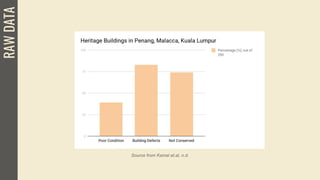
However, some of these historical buildings are at risk from defects and are not well taken
care; due to the insignificant public participation, environmental issues, technical issues,
poor financial support, and the rapid country development.
01
Introduction
02
-
03
The understanding towards the practice upon building
conservation is still limited, even though Malaysia has
numbered heritage buildings across the country. Hence,
different meanings can be interpreted to describe
building conservation in Malaysia, which is subject to the
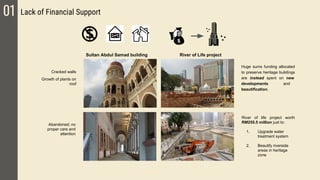
wrong perception of the public towards building
conservation, that are strongly related to the issues and
challenges by conservation in Malaysia.
01
Objective of study
02
-
03
To improve understanding towards architectural
conservation in Malaysia
01
02 To understand relationship between conservation
and factors of issues & challenges
03 To propose solution for issues and challenges
faced by conservation works in Malaysia
01
What is conservation?
02
-
03
Retention of existing buildings (historic/heritage).01
02 Involves technical activities such as:
● Conserve(prevent) & preserve(prolong)
● Restoration without alteration
01 General Issues Of The Heritage Conservation in Malaysia
02 Case Studies and Analysis
03 Questionnaire Regarding Public Awareness
RAWDATA
Source from Kamal et.al, n.d.
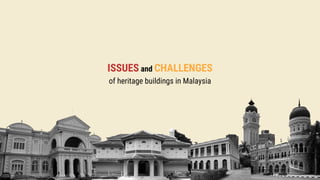
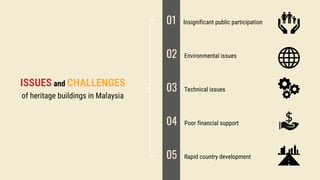
ISSUES and CHALLENGES
of heritage buildings in Malaysia
ISSUES and CHALLENGES
of heritage buildings in Malaysia
01 Insignificant public participation
02 Environmental issues
03 Technical issues
04 Poor financial support
05 Rapid country development
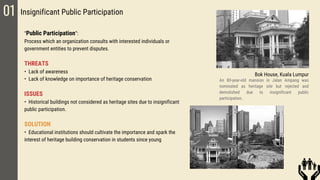
01 Insignificant Public Participation
“Public Participation”:
Process which an organization consults with interested individuals or
government entities to prevent disputes.
THREATS
• Lack of awareness
• Lack of knowledge on importance of heritage conservation
ISSUES
• Historical buildings not considered as heritage sites due to insignificant
public participation.
SOLUTION
• Educational institutions should cultivate the importance and spark the
interest of heritage building conservation in students since young
Bok House, Kuala Lumpur
An 80-year-old mansion in Jalan Ampang was
nominated as heritage site but rejected and
demolished due to insignificant public
participation.
THREATS
• Building on cliff
• Unstable soil condition
• Humid surrounding
• Urbanized polluted surrounding
ISSUES
• Deteriorate old heritage buildings
SOLUTION
• Structure relocation
02 Environmental Issues
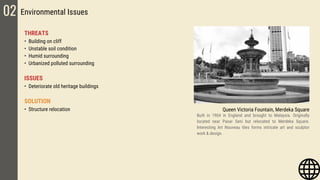
Queen Victoria Fountain, Merdeka Square
Built in 1904 in England and brought to Malaysia. Originally
located near Pasar Seni but relocated to Merdeka Square.
Interesting Art Nouveau tiles forms intricate art and sculptor
work & design.
03 Technical Issues
THREATS
• Identification of old buildings
• Absence of important technical data
• Collection of specific rare materials
• Shortage of capable expertise and labour
ISSUES
• Increase difficulty in dividing scope of work
• Supply of materials and resources could not be determined accurately
• Cause overall conservation progress to be laborious and time consuming
• Shortage of original materials and experienced craftsmen reduce the
authenticity of the heritage building
SOLUTION
• Government should provide ample support to concerned authorities
• Cultivate more talents in architecture conservation field
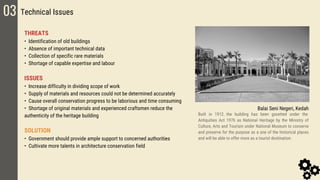
Balai Seni Negeri, Kedah
Built in 1912,the building has been gazetted under the
Antiquities Act 1976 as National Heritage by the Ministry of
Culture, Arts and Tourism under National Museum to conserve
and preserve for the purpose as a one of the historical places
and will be able to offer more as a tourist destination.
04 Poor Financial Support
THREATS
• Poor financial support from government, NGO Badan Warisan Malaysia, and owners
• Conservation project requires high material, labour, and maintenance cost
ISSUES
• Underfinanced situation will lead to suspension of conservation project
SOLUTION
• Heritage tourism could be the solution to the issue. As heritage tourism develops in
high pace, higher financial support will be acquired from the tourism profit, which also
solves most of the technical issues.
05 Rapid Country Development
THREATS
• Traditional tangible and intangible elements are discarded and eliminated
ISSUES
• Development pressure from infrastructure and real estate projects that
requires demolition of heritage buildings
SOLUTION
• Awareness campaign should be held constantly such as educative tour to
visit heritage buildings helps cultivate passion and importance on building
conservation.
• Public petitions with signature collection on heritage registration will help
to designate heritage buildings as landmark and prevent demolition.
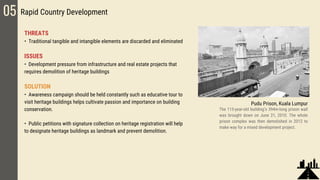
Pudu Prison, Kuala Lumpur
The 115-year-old building’s 394m-long prison wall
was brought down on June 21, 2010. The whole
prison complex was then demolished in 2012 to
make way for a mixed development project.
CASE STUDY EXAMPLE 1:
KUALA LUMPUR CHINATOWN (KLC), PETALING STREET
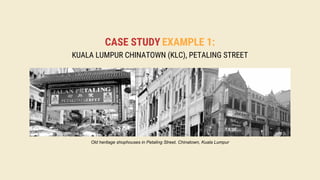
Old heritage shophouses in Petaling Street, Chinatown, Kuala Lumpur
KUALA LUMPUR CHINATOWN (KLC), PETALING STREETINTRO
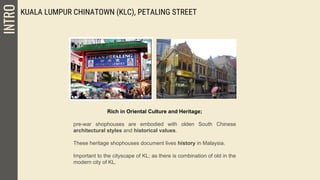
Rich in Oriental Culture and Heritage;
pre-war shophouses are embodied with olden South Chinese
architectural styles and historical values.
These heritage shophouses document lives history in Malaysia.
Important to the cityscape of KL; as there is combination of old in the
modern city of KL.
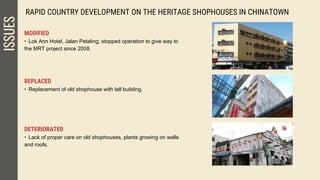
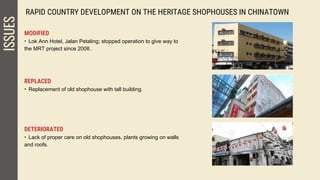
RAPID COUNTRY DEVELOPMENT ON THE HERITAGE SHOPHOUSES IN CHINATOWNISSUES
MODIFIED
• Lok Ann Hotel, Jalan Petaling; stopped operation to give way to
the MRT project since 2008.
REPLACED
• Replacement of old shophouse with tall building.
DETERIORATED
• Lack of proper care on old shophouses, plants growing on walls
and roofs.
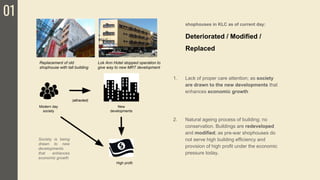
01
1. Lack of proper care attention; as society
are drawn to the new developments that
enhances economic growth
2. Natural ageing process of building; no
conservation. Buildings are redeveloped
and modified; as pre-war shophouses do
not serve high building efficiency and
provision of high profit under the economic
pressure today.
shophouses in KLC as of current day:
Deteriorated / Modified /
Replaced
Society is being
drawn to new
developments
that enhances
economic growth
Replacement of old
shophouse with tall building
Lok Ann Hotel stopped operation to
give way to new MRT development
Modern day
society
New
developments
(attracted)
High profit
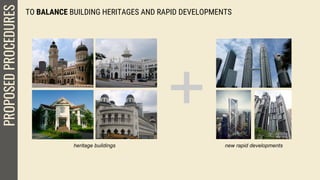
TO BALANCE BUILDING HERITAGES AND RAPID DEVELOPMENTSPROPOSEDPROCEDURES
+
heritage buildings new rapid developments
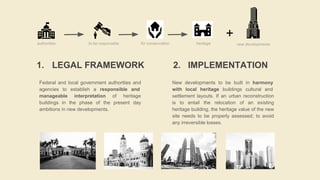
1. LEGAL FRAMEWORK
Federal and local government authorities and
agencies to establish a responsible and
manageable interpretation of heritage
buildings in the phase of the present day
ambitions in new developments.
2. IMPLEMENTATION
New developments to be built in harmony
with local heritage buildings cultural and
settlement layouts. If an urban reconstruction
is to entail the relocation of an existing
heritage building, the heritage value of the new
site needs to be properly assessed; to avoid
any irreversible losses.
+
authorities to be responsible for conservation heritage new developments
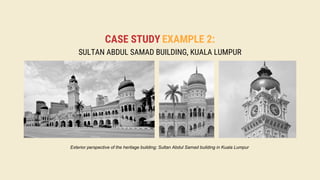
CASE STUDY EXAMPLE 2:
SULTAN ABDUL SAMAD BUILDING, KUALA LUMPUR
Exterior perspective of the heritage building; Sultan Abdul Samad building in Kuala Lumpur
RAPID COUNTRY DEVELOPMENT ON THE HERITAGE SHOPHOUSES IN CHINATOWNISSUES
MODIFIED
• Lok Ann Hotel, Jalan Petaling; stopped operation to give way to
the MRT project since 2008.
REPLACED
• Replacement of old shophouse with tall building.
DETERIORATED
• Lack of proper care on old shophouses, plants growing on walls
and roofs.
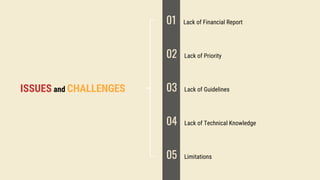
ISSUES and CHALLENGES
01 Lack of Financial Report
02 Lack of Priority
03 Lack of Guidelines
04 Lack of Technical Knowledge
05 Limitations
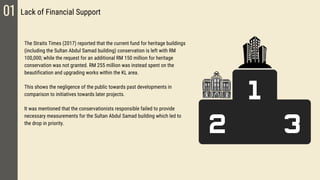
01 Lack of Financial Support
The Straits Times (2017) reported that the current fund for heritage buildings
(including the Sultan Abdul Samad building) conservation is left with RM
100,000; while the request for an additional RM 150 million for heritage
conservation was not granted. RM 255 million was instead spent on the
beautification and upgrading works within the KL area.
This shows the negligence of the public towards past developments in
comparison to initiatives towards later projects.
It was mentioned that the conservationists responsible failed to provide
necessary measurements for the Sultan Abdul Samad building which led to
the drop in priority.
01 Lack of Financial Support
Cracked walls
Growth of plants on
roof
Abandoned; no
proper care and
attention
River of Life projectSultan Abdul Samad building
River of life project worth
RM255.5 million just to:
1. Upgrade water
treatment system
2. Beautify riverside
areas in heritage
zone
Huge sums funding allocated
to preserve heritage buildings
are instead spent on new
developments and
beautification.
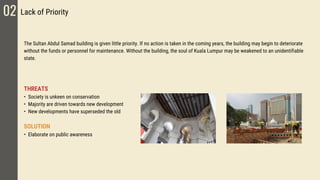
The Sultan Abdul Samad building is given little priority. If no action is taken in the coming years, the building may begin to deteriorate
without the funds or personnel for maintenance. Without the building, the soul of Kuala Lumpur may be weakened to an unidentifiable
state.
THREATS
• Society is unkeen on conservation
• Majority are driven towards new development
• New developments have superseded the old
SOLUTION
• Elaborate on public awareness
02 Lack of Priority
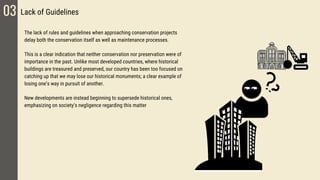
03 Lack of Guidelines
The lack of rules and guidelines when approaching conservation projects
delay both the conservation itself as well as maintenance processes.
This is a clear indication that neither conservation nor preservation were of
importance in the past. Unlike most developed countries, where historical
buildings are treasured and preserved, our country has been too focused on
catching up that we may lose our historical monuments; a clear example of
losing one’s way in pursuit of another.
New developments are instead beginning to supersede historical ones,
emphasizing on society’s negligence regarding this matter
04 Lack of Technical Knowledge
Lack of technical knowledge in coping with repairing and maintenance in historic
buildings leads to the effectiveness and efficiency in the maintenance of historical
buildings.
This includes the Sultan Abdul Samad building
05 Limitations
● INCOMPLETE RECORDINGS OF HISTORICAL EVENTS
-E.g.: Hang Tuah Mausoleum
● ADAPTIVITY TO MODERN USE (SPECIFIC BUILDINGS)
-E.g.: Religious buildings, monuments
● LEGISLATION AND PROCEDURES
-E.g. : Rire regulations that prohibits restoration
● SURROUNDING HERITAGE CONTEXT
-E.g. : Tree roots, river
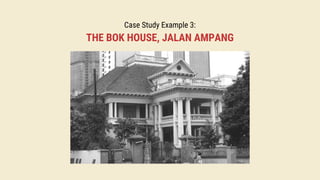
Case Study Example 3:
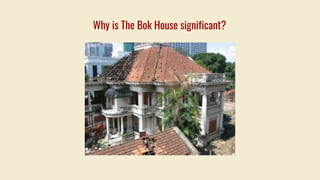
THE BOK HOUSE, JALAN AMPANG
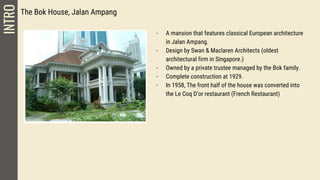
The Bok House, Jalan Ampang
- A mansion that features classical European architecture
in Jalan Ampang.
- Design by Swan & Maclaren Architects (oldest
architectural firm in Singapore.)
- Owned by a private trustee managed by the Bok family.
- Complete construction at 1929.
- In 1958, The front half of the house was converted into
the Le Coq D’or restaurant (French Restaurant)
INTRO
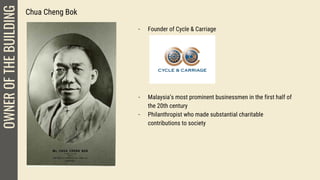
Chua Cheng Bok
- Founder of Cycle & Carriage
OWNEROFTHEBUILDING
- Malaysia’s most prominent businessmen in the first half of
the 20th century
- Philanthropist who made substantial charitable
contributions to society
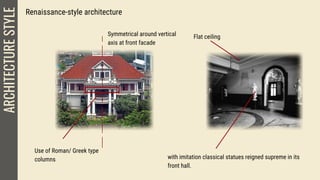
Renaissance-style architecture
Symmetrical around vertical
axis at front facade
ARCHITECTURESTYLE
Use of Roman/ Greek type
columns
Flat ceiling
with imitation classical statues reigned supreme in its
front hall.
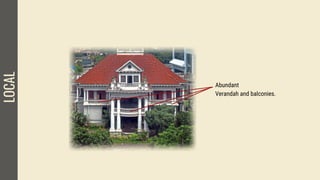
Abundant
Verandah and balconies.
LOCAL
ADAPTATION
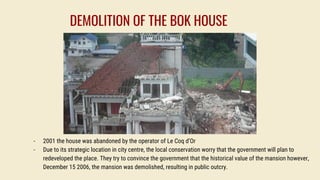
- 2001 the house was abandoned by the operator of Le Coq d’Or
- Due to its strategic location in city centre, the local conservation worry that the government will plan to
redeveloped the place. They try to convince the government that the historical value of the mansion however,
December 15 2006, the mansion was demolished, resulting in public outcry.
DEMOLITION OF THE BOK HOUSE
ISSUES and CHALLENGES
Lack of awareness and public participation
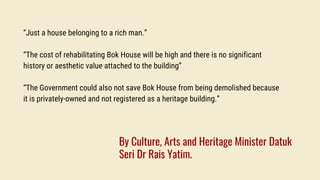
“Just a house belonging to a rich man.”
“The cost of rehabilitating Bok House will be high and there is no significant
history or aesthetic value attached to the building”
“The Government could also not save Bok House from being demolished because
it is privately-owned and not registered as a heritage building.”
By Culture, Arts and Heritage Minister Datuk
Seri Dr Rais Yatim.
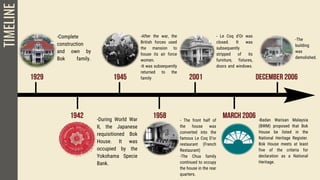
Why is The Bok House significant?
TIMELINE
-Complete
construction
and own by
Bok family.
-During World War
II, the Japanese
requisitioned Bok
House. It was
occupied by the
Yokohama Specie
Bank.
-After the war, the
British forces used
the mansion to
house its air force
women.
-It was subsequently
returned to the
family
- The front half of
the house was
converted into the
famous Le Coq D’or
restaurant (French
Restaurant)
-The Chua family
continued to occupy
the house in the rear
quarters.
- Le Coq d'Or was
closed. It was
subsequently
stripped of its
furniture, fixtures,
doors and windows.
-Badan Warisan Malaysia
(BWM) proposed that Bok
House be listed in the
National Heritage Register.
Bok House meets at least
five of the criteria for
declaration as a National
Heritage.
-The
building
was
demolished.
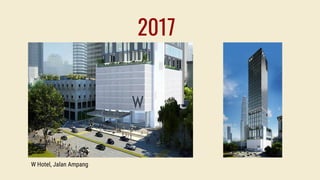
2017
W Hotel, Jalan Ampang
“Chua was the first to introduce a bus service to Kuala Lumpur before World War I.
In fact, the rickshaw pullers of the city rioted because of the threat to their
livelihood.”
By Historian Prof Emeritus Datuk Dr Khoo Kay
Kim
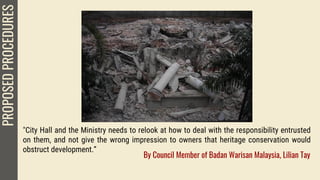
"City Hall and the Ministry needs to relook at how to deal with the responsibility entrusted
on them, and not give the wrong impression to owners that heritage conservation would
obstruct development.”
PROPOSEDPROCEDURES
By Council Member of Badan Warisan Malaysia, Lilian Tay
Continuous promotion
by mass media
PUBLICEDUCATIONCAMPAIGN
Seminars and
workshops
Immerge of heritage
building knowledge in
Education institution
PUBLICEDUCATIONCAMPAIGN
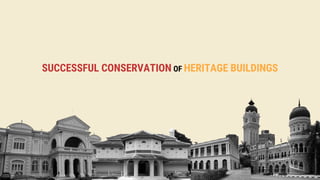
SUCCESSFUL CONSERVATION OF HERITAGE BUILDINGS
SUFFOLKHOUSE,PENANG
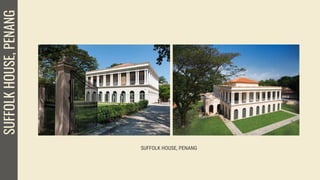
SUFFOLK HOUSE, PENANG
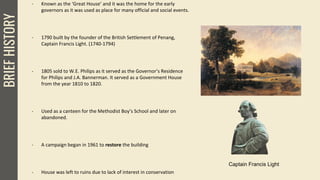
BRIEFHISTORY
Captain Francis Light
- Known as the ‘Great House’ and it was the home for the early
governors as it was used as place for many official and social events.
- 1790 built by the founder of the British Settlement of Penang,
Captain Francis Light. (1740-1794)
- 1805 sold to W.E. Philips as it served as the Governor’s Residence
for Philips and J.A. Bannerman. It served as a Government House
from the year 1810 to 1820.
- Used as a canteen for the Methodist Boy’s School and later on
abandoned.
- A campaign began in 1961 to restore the building
- House was left to ruins due to lack of interest in conservation
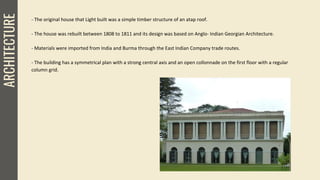
ARCHITECTURE - The original house that Light built was a simple timber structure of an atap roof.
- The house was rebuilt between 1808 to 1811 and its design was based on Anglo- Indian Georgian Architecture.
- Materials were imported from India and Burma through the East Indian Company trade routes.
- The building has a symmetrical plan with a strong central axis and an open collonnade on the first floor with a regular
column grid.
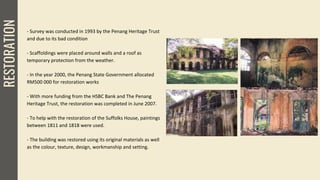
RESTORATION
- Survey was conducted in 1993 by the Penang Heritage Trust
and due to its bad condition
- Scaffoldings were placed around walls and a roof as
temporary protection from the weather.
- In the year 2000, the Penang State Government allocated
RM500 000 for restoration works
- With more funding from the HSBC Bank and The Penang
Heritage Trust, the restoration was completed in June 2007.
- To help with the restoration of the Suffolks House, paintings
between 1811 and 1818 were used.
- The building was restored using its original materials as well
as the colour, texture, design, workmanship and setting.
ISSUESANDCHALLENGES
- Lacked skilled and experienced workers in the field of
conservation but after some time, workers gained additional
knowledge and understanding about heritage conservation.
- Difficulty of getting the original materials as most of the
materials used in the construction of the building could only
be found overseas.
- For example, the clay roof tiles had to be imported from
China.
01
Conclusion
02
-
03
The results of the study indicated that issues and
challenges in building conservation work, which are
mentioned above are due to the poor availability of
conservation knowledge, that has a direct linkage to the
insufficiency of support from Government sector.
However, building conservation is a multi-disciplinary
field, which involves professionals such as architects,
engineers, historians, archaeologists, chemists and
environmentalists. In order to achieve higher efficiency
in conservation, more efforts should be undertaken by all
sectors to educate the public about heritage
conservation, especially institutions which are more
effective in impacting the following generation.
https://www.geni.com/people/CHUA-Cheng-Bok-%E8%94%A1%E6%B8%85%E6%9C%A8/6000000025818696499
https://groups.yahoo.com/neo/groups/beritamalaysia/conversations/topics/88247
http://www.thestar.com.my/news/nation/2006/06/16/move-to-keep-bok-house/#pTvoX1zCv77uO5dc
http://www.thestar.com.my/news/nation/2006/12/23/historian-bok-house-important-part-of-kls-history/.99
http://www.thesundaily.my/node/171813
https://eprints.qut.edu.au/91544/1/Miljenka_Perovic_Thesis.pdf
http://www.sciencedirect.com/science/article/pii/S1877705811029468
https://ac.els-cdn.com/S1877042813020934/1-s2.0-S1877042813020934-main.pdf?_tid=11034de8-b3fa-11e7-b14f-00000aab0f
27&acdnat=1508327406_012d25b0baea8fa7b4306964d40b6102
Harun, N. (n.d.). The Restoration of Suffolk House, Penang, Malaysia. Retrieved October 24, 2017, from
http://www.academia.edu/6035441/The_Restoration_of_Suffolk_House_Penang_Malaysia
Arkitek LLA » Suffolk House. (n.d.). Retrieved October 24, 2017, from http://lla.com.my/projects/suffolk-house/
Reference Link

Architecture Conservation Project 1 Presentation Slides

  • 1.
    ARCHITECTURAL CONSERVATION ISSUES &CHALLENGES OF THE CONSERVATION OF BUILDINGS IN MALAYSIA
  • 2.
    a b st r a c t Historical buildings fundamentally portrays the most distinctive aspect of the past history and culture of the place. Malaysia, has a rich heritage of historical buildings with fine craftsmanship and architectural quality. These admirable historical features and legacy are formed by the past work of a man. Hence it is vital to conserve and preserve historical buildings; as they are the asset to the country that provides the sense of identity and continuity in our current fast changing world for the future generations. However, some of these historical buildings are at risk from defects and are not well taken care; due to the insignificant public participation, environmental issues, technical issues, poor financial support, and the rapid country development.
  • 3.
    01 Introduction 02 - 03 The understanding towardsthe practice upon building conservation is still limited, even though Malaysia has numbered heritage buildings across the country. Hence, different meanings can be interpreted to describe building conservation in Malaysia, which is subject to the wrong perception of the public towards building conservation, that are strongly related to the issues and challenges by conservation in Malaysia.
  • 4.
    01 Objective of study 02 - 03 Toimprove understanding towards architectural conservation in Malaysia 01 02 To understand relationship between conservation and factors of issues & challenges 03 To propose solution for issues and challenges faced by conservation works in Malaysia
  • 5.
    01 What is conservation? 02 - 03 Retentionof existing buildings (historic/heritage).01 02 Involves technical activities such as: ● Conserve(prevent) & preserve(prolong) ● Restoration without alteration
  • 6.
    01 General IssuesOf The Heritage Conservation in Malaysia 02 Case Studies and Analysis 03 Questionnaire Regarding Public Awareness
  • 7.
  • 8.
    ISSUES and CHALLENGES ofheritage buildings in Malaysia
  • 9.
    ISSUES and CHALLENGES ofheritage buildings in Malaysia 01 Insignificant public participation 02 Environmental issues 03 Technical issues 04 Poor financial support 05 Rapid country development
  • 10.
    01 Insignificant PublicParticipation “Public Participation”: Process which an organization consults with interested individuals or government entities to prevent disputes. THREATS • Lack of awareness • Lack of knowledge on importance of heritage conservation ISSUES • Historical buildings not considered as heritage sites due to insignificant public participation. SOLUTION • Educational institutions should cultivate the importance and spark the interest of heritage building conservation in students since young Bok House, Kuala Lumpur An 80-year-old mansion in Jalan Ampang was nominated as heritage site but rejected and demolished due to insignificant public participation.
  • 11.
    THREATS • Building oncliff • Unstable soil condition • Humid surrounding • Urbanized polluted surrounding ISSUES • Deteriorate old heritage buildings SOLUTION • Structure relocation 02 Environmental Issues Queen Victoria Fountain, Merdeka Square Built in 1904 in England and brought to Malaysia. Originally located near Pasar Seni but relocated to Merdeka Square. Interesting Art Nouveau tiles forms intricate art and sculptor work & design.
  • 12.
    03 Technical Issues THREATS •Identification of old buildings • Absence of important technical data • Collection of specific rare materials • Shortage of capable expertise and labour ISSUES • Increase difficulty in dividing scope of work • Supply of materials and resources could not be determined accurately • Cause overall conservation progress to be laborious and time consuming • Shortage of original materials and experienced craftsmen reduce the authenticity of the heritage building SOLUTION • Government should provide ample support to concerned authorities • Cultivate more talents in architecture conservation field Balai Seni Negeri, Kedah Built in 1912,the building has been gazetted under the Antiquities Act 1976 as National Heritage by the Ministry of Culture, Arts and Tourism under National Museum to conserve and preserve for the purpose as a one of the historical places and will be able to offer more as a tourist destination.
  • 13.
    04 Poor FinancialSupport THREATS • Poor financial support from government, NGO Badan Warisan Malaysia, and owners • Conservation project requires high material, labour, and maintenance cost ISSUES • Underfinanced situation will lead to suspension of conservation project SOLUTION • Heritage tourism could be the solution to the issue. As heritage tourism develops in high pace, higher financial support will be acquired from the tourism profit, which also solves most of the technical issues.
  • 14.
    05 Rapid CountryDevelopment THREATS • Traditional tangible and intangible elements are discarded and eliminated ISSUES • Development pressure from infrastructure and real estate projects that requires demolition of heritage buildings SOLUTION • Awareness campaign should be held constantly such as educative tour to visit heritage buildings helps cultivate passion and importance on building conservation. • Public petitions with signature collection on heritage registration will help to designate heritage buildings as landmark and prevent demolition. Pudu Prison, Kuala Lumpur The 115-year-old building’s 394m-long prison wall was brought down on June 21, 2010. The whole prison complex was then demolished in 2012 to make way for a mixed development project.
  • 15.
    CASE STUDY EXAMPLE1: KUALA LUMPUR CHINATOWN (KLC), PETALING STREET Old heritage shophouses in Petaling Street, Chinatown, Kuala Lumpur
  • 16.
    KUALA LUMPUR CHINATOWN(KLC), PETALING STREETINTRO Rich in Oriental Culture and Heritage; pre-war shophouses are embodied with olden South Chinese architectural styles and historical values. These heritage shophouses document lives history in Malaysia. Important to the cityscape of KL; as there is combination of old in the modern city of KL.
  • 17.
    RAPID COUNTRY DEVELOPMENTON THE HERITAGE SHOPHOUSES IN CHINATOWNISSUES MODIFIED • Lok Ann Hotel, Jalan Petaling; stopped operation to give way to the MRT project since 2008. REPLACED • Replacement of old shophouse with tall building. DETERIORATED • Lack of proper care on old shophouses, plants growing on walls and roofs.
  • 18.
    01 1. Lack ofproper care attention; as society are drawn to the new developments that enhances economic growth 2. Natural ageing process of building; no conservation. Buildings are redeveloped and modified; as pre-war shophouses do not serve high building efficiency and provision of high profit under the economic pressure today. shophouses in KLC as of current day: Deteriorated / Modified / Replaced Society is being drawn to new developments that enhances economic growth Replacement of old shophouse with tall building Lok Ann Hotel stopped operation to give way to new MRT development Modern day society New developments (attracted) High profit
  • 19.
    TO BALANCE BUILDINGHERITAGES AND RAPID DEVELOPMENTSPROPOSEDPROCEDURES + heritage buildings new rapid developments
  • 20.
    1. LEGAL FRAMEWORK Federaland local government authorities and agencies to establish a responsible and manageable interpretation of heritage buildings in the phase of the present day ambitions in new developments. 2. IMPLEMENTATION New developments to be built in harmony with local heritage buildings cultural and settlement layouts. If an urban reconstruction is to entail the relocation of an existing heritage building, the heritage value of the new site needs to be properly assessed; to avoid any irreversible losses. + authorities to be responsible for conservation heritage new developments
  • 21.
    CASE STUDY EXAMPLE2: SULTAN ABDUL SAMAD BUILDING, KUALA LUMPUR Exterior perspective of the heritage building; Sultan Abdul Samad building in Kuala Lumpur
  • 22.
    RAPID COUNTRY DEVELOPMENTON THE HERITAGE SHOPHOUSES IN CHINATOWNISSUES MODIFIED • Lok Ann Hotel, Jalan Petaling; stopped operation to give way to the MRT project since 2008. REPLACED • Replacement of old shophouse with tall building. DETERIORATED • Lack of proper care on old shophouses, plants growing on walls and roofs.
  • 23.
    ISSUES and CHALLENGES 01Lack of Financial Report 02 Lack of Priority 03 Lack of Guidelines 04 Lack of Technical Knowledge 05 Limitations
  • 24.
    01 Lack ofFinancial Support The Straits Times (2017) reported that the current fund for heritage buildings (including the Sultan Abdul Samad building) conservation is left with RM 100,000; while the request for an additional RM 150 million for heritage conservation was not granted. RM 255 million was instead spent on the beautification and upgrading works within the KL area. This shows the negligence of the public towards past developments in comparison to initiatives towards later projects. It was mentioned that the conservationists responsible failed to provide necessary measurements for the Sultan Abdul Samad building which led to the drop in priority.
  • 25.
    01 Lack ofFinancial Support Cracked walls Growth of plants on roof Abandoned; no proper care and attention River of Life projectSultan Abdul Samad building River of life project worth RM255.5 million just to: 1. Upgrade water treatment system 2. Beautify riverside areas in heritage zone Huge sums funding allocated to preserve heritage buildings are instead spent on new developments and beautification.
  • 26.
    The Sultan AbdulSamad building is given little priority. If no action is taken in the coming years, the building may begin to deteriorate without the funds or personnel for maintenance. Without the building, the soul of Kuala Lumpur may be weakened to an unidentifiable state. THREATS • Society is unkeen on conservation • Majority are driven towards new development • New developments have superseded the old SOLUTION • Elaborate on public awareness 02 Lack of Priority
  • 27.
    03 Lack ofGuidelines The lack of rules and guidelines when approaching conservation projects delay both the conservation itself as well as maintenance processes. This is a clear indication that neither conservation nor preservation were of importance in the past. Unlike most developed countries, where historical buildings are treasured and preserved, our country has been too focused on catching up that we may lose our historical monuments; a clear example of losing one’s way in pursuit of another. New developments are instead beginning to supersede historical ones, emphasizing on society’s negligence regarding this matter
  • 28.
    04 Lack ofTechnical Knowledge Lack of technical knowledge in coping with repairing and maintenance in historic buildings leads to the effectiveness and efficiency in the maintenance of historical buildings. This includes the Sultan Abdul Samad building
  • 29.
    05 Limitations ● INCOMPLETERECORDINGS OF HISTORICAL EVENTS -E.g.: Hang Tuah Mausoleum ● ADAPTIVITY TO MODERN USE (SPECIFIC BUILDINGS) -E.g.: Religious buildings, monuments ● LEGISLATION AND PROCEDURES -E.g. : Rire regulations that prohibits restoration ● SURROUNDING HERITAGE CONTEXT -E.g. : Tree roots, river
  • 30.
    Case Study Example3: THE BOK HOUSE, JALAN AMPANG
  • 31.
    The Bok House,Jalan Ampang - A mansion that features classical European architecture in Jalan Ampang. - Design by Swan & Maclaren Architects (oldest architectural firm in Singapore.) - Owned by a private trustee managed by the Bok family. - Complete construction at 1929. - In 1958, The front half of the house was converted into the Le Coq D’or restaurant (French Restaurant) INTRO
  • 32.
    Chua Cheng Bok -Founder of Cycle & Carriage OWNEROFTHEBUILDING - Malaysia’s most prominent businessmen in the first half of the 20th century - Philanthropist who made substantial charitable contributions to society
  • 33.
    Renaissance-style architecture Symmetrical aroundvertical axis at front facade ARCHITECTURESTYLE Use of Roman/ Greek type columns Flat ceiling with imitation classical statues reigned supreme in its front hall.
  • 34.
  • 35.
    - 2001 thehouse was abandoned by the operator of Le Coq d’Or - Due to its strategic location in city centre, the local conservation worry that the government will plan to redeveloped the place. They try to convince the government that the historical value of the mansion however, December 15 2006, the mansion was demolished, resulting in public outcry. DEMOLITION OF THE BOK HOUSE
  • 36.
    ISSUES and CHALLENGES Lackof awareness and public participation
  • 37.
    “Just a housebelonging to a rich man.” “The cost of rehabilitating Bok House will be high and there is no significant history or aesthetic value attached to the building” “The Government could also not save Bok House from being demolished because it is privately-owned and not registered as a heritage building.” By Culture, Arts and Heritage Minister Datuk Seri Dr Rais Yatim.
  • 38.
    Why is TheBok House significant?
  • 39.
    TIMELINE -Complete construction and own by Bokfamily. -During World War II, the Japanese requisitioned Bok House. It was occupied by the Yokohama Specie Bank. -After the war, the British forces used the mansion to house its air force women. -It was subsequently returned to the family - The front half of the house was converted into the famous Le Coq D’or restaurant (French Restaurant) -The Chua family continued to occupy the house in the rear quarters. - Le Coq d'Or was closed. It was subsequently stripped of its furniture, fixtures, doors and windows. -Badan Warisan Malaysia (BWM) proposed that Bok House be listed in the National Heritage Register. Bok House meets at least five of the criteria for declaration as a National Heritage. -The building was demolished.
  • 40.
  • 41.
    “Chua was thefirst to introduce a bus service to Kuala Lumpur before World War I. In fact, the rickshaw pullers of the city rioted because of the threat to their livelihood.” By Historian Prof Emeritus Datuk Dr Khoo Kay Kim
  • 42.
    "City Hall andthe Ministry needs to relook at how to deal with the responsibility entrusted on them, and not give the wrong impression to owners that heritage conservation would obstruct development.” PROPOSEDPROCEDURES By Council Member of Badan Warisan Malaysia, Lilian Tay
  • 43.
    Continuous promotion by massmedia PUBLICEDUCATIONCAMPAIGN Seminars and workshops Immerge of heritage building knowledge in Education institution
  • 44.
  • 45.
    SUCCESSFUL CONSERVATION OFHERITAGE BUILDINGS
  • 46.
  • 47.
    BRIEFHISTORY Captain Francis Light -Known as the ‘Great House’ and it was the home for the early governors as it was used as place for many official and social events. - 1790 built by the founder of the British Settlement of Penang, Captain Francis Light. (1740-1794) - 1805 sold to W.E. Philips as it served as the Governor’s Residence for Philips and J.A. Bannerman. It served as a Government House from the year 1810 to 1820. - Used as a canteen for the Methodist Boy’s School and later on abandoned. - A campaign began in 1961 to restore the building - House was left to ruins due to lack of interest in conservation
  • 48.
    ARCHITECTURE - Theoriginal house that Light built was a simple timber structure of an atap roof. - The house was rebuilt between 1808 to 1811 and its design was based on Anglo- Indian Georgian Architecture. - Materials were imported from India and Burma through the East Indian Company trade routes. - The building has a symmetrical plan with a strong central axis and an open collonnade on the first floor with a regular column grid.
  • 49.
    RESTORATION - Survey wasconducted in 1993 by the Penang Heritage Trust and due to its bad condition - Scaffoldings were placed around walls and a roof as temporary protection from the weather. - In the year 2000, the Penang State Government allocated RM500 000 for restoration works - With more funding from the HSBC Bank and The Penang Heritage Trust, the restoration was completed in June 2007. - To help with the restoration of the Suffolks House, paintings between 1811 and 1818 were used. - The building was restored using its original materials as well as the colour, texture, design, workmanship and setting.
  • 50.
    ISSUESANDCHALLENGES - Lacked skilledand experienced workers in the field of conservation but after some time, workers gained additional knowledge and understanding about heritage conservation. - Difficulty of getting the original materials as most of the materials used in the construction of the building could only be found overseas. - For example, the clay roof tiles had to be imported from China.
  • 51.
    01 Conclusion 02 - 03 The results ofthe study indicated that issues and challenges in building conservation work, which are mentioned above are due to the poor availability of conservation knowledge, that has a direct linkage to the insufficiency of support from Government sector. However, building conservation is a multi-disciplinary field, which involves professionals such as architects, engineers, historians, archaeologists, chemists and environmentalists. In order to achieve higher efficiency in conservation, more efforts should be undertaken by all sectors to educate the public about heritage conservation, especially institutions which are more effective in impacting the following generation.
  • 52.
    https://www.geni.com/people/CHUA-Cheng-Bok-%E8%94%A1%E6%B8%85%E6%9C%A8/6000000025818696499 https://groups.yahoo.com/neo/groups/beritamalaysia/conversations/topics/88247 http://www.thestar.com.my/news/nation/2006/06/16/move-to-keep-bok-house/#pTvoX1zCv77uO5dc http://www.thestar.com.my/news/nation/2006/12/23/historian-bok-house-important-part-of-kls-history/.99 http://www.thesundaily.my/node/171813 https://eprints.qut.edu.au/91544/1/Miljenka_Perovic_Thesis.pdf http://www.sciencedirect.com/science/article/pii/S1877705811029468 https://ac.els-cdn.com/S1877042813020934/1-s2.0-S1877042813020934-main.pdf?_tid=11034de8-b3fa-11e7-b14f-00000aab0f 27&acdnat=1508327406_012d25b0baea8fa7b4306964d40b6102 Harun, N. (n.d.).The Restoration of Suffolk House, Penang, Malaysia. Retrieved October 24, 2017, from http://www.academia.edu/6035441/The_Restoration_of_Suffolk_House_Penang_Malaysia Arkitek LLA » Suffolk House. (n.d.). Retrieved October 24, 2017, from http://lla.com.my/projects/suffolk-house/ Reference Link