VERB
• A verb is a word that expresses an action,
occurrence, or state of being.
• Examples:
• - Action: I live in USA.
• - State: She is a scientist.
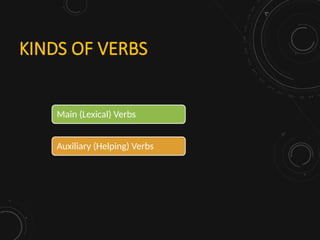
KINDS OF VERBS
Main (Lexical) Verbs
Auxiliary (Helping) Verbs
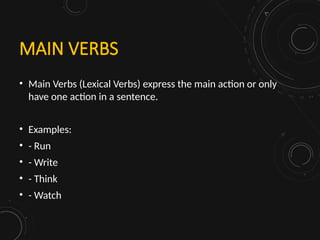
MAIN VERBS
• Main Verbs (Lexical Verbs) express the main action or only
have one action in a sentence.
• Examples:
• - Run
• - Write
• - Think
• - Watch
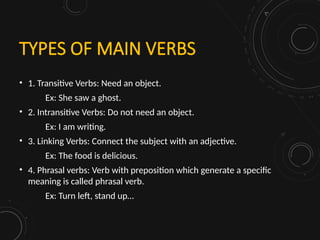
TYPES OF MAIN VERBS
• 1. Transitive Verbs: Need an object.
Ex: She saw a ghost.
• 2. Intransitive Verbs: Do not need an object.
Ex: I am writing.
• 3. Linking Verbs: Connect the subject with an adjective.
Ex: The food is delicious.
• 4. Phrasal verbs: Verb with preposition which generate a specific
meaning is called phrasal verb.
Ex: Turn left, stand up…
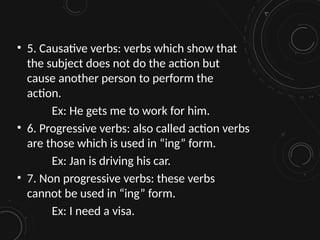
• 5. Causative verbs: verbs which show that
the subject does not do the action but
cause another person to perform the
action.
Ex: He gets me to work for him.
• 6. Progressive verbs: also called action verbs
are those which is used in “ing” form.
Ex: Jan is driving his car.
• 7. Non progressive verbs: these verbs
cannot be used in “ing” form.
Ex: I need a visa.
AUXILIARY VERBS
• Auxiliary (Helping) Verbs help the main verb form
tenses, moods, or voices.
• Examples:
• - is, am, are
• - have, has, had
• - can, must, should
TYPES OF AUXILIARY VERBS
• 1. Primary Auxiliaries: be, have, do
• 2. Modal Auxiliaries: can, may, must, should
1. Primary Auxiliaries: these verbs are used to form
different tenses, voices and aspects.
• Be (am, is, are, was, were, been, being).
Used for continuous tenses and passive voice.
Ex: She is running. (present continuous)
• Have (have, has, had, having)
Used to form perfect tenses.
Ex: They have eaten dinner.
• Do (do, does, did)
Used in questions, negatives and emphasis.
Ex: Do you like music?
2. Modal Auxiliaries: are those verbs which
express ability, possibility, permission, or
obligation.
• Can (could)
• May (might)
• Shall (should)
• Will (would)
• Must (ought to)
Ex: she can swim very well.
Ex: we must study for the exam.
English presentation, complete info about verb.pptx

  • 1.
    VERB • A verbis a word that expresses an action, occurrence, or state of being. • Examples: • - Action: I live in USA. • - State: She is a scientist.
  • 2.
    KINDS OF VERBS Main(Lexical) Verbs Auxiliary (Helping) Verbs
  • 3.
    MAIN VERBS • MainVerbs (Lexical Verbs) express the main action or only have one action in a sentence. • Examples: • - Run • - Write • - Think • - Watch
  • 4.
    TYPES OF MAINVERBS • 1. Transitive Verbs: Need an object. Ex: She saw a ghost. • 2. Intransitive Verbs: Do not need an object. Ex: I am writing. • 3. Linking Verbs: Connect the subject with an adjective. Ex: The food is delicious. • 4. Phrasal verbs: Verb with preposition which generate a specific meaning is called phrasal verb. Ex: Turn left, stand up…
  • 5.
    • 5. Causativeverbs: verbs which show that the subject does not do the action but cause another person to perform the action. Ex: He gets me to work for him. • 6. Progressive verbs: also called action verbs are those which is used in “ing” form. Ex: Jan is driving his car. • 7. Non progressive verbs: these verbs cannot be used in “ing” form. Ex: I need a visa.
  • 6.
    AUXILIARY VERBS • Auxiliary(Helping) Verbs help the main verb form tenses, moods, or voices. • Examples: • - is, am, are • - have, has, had • - can, must, should
  • 7.
    TYPES OF AUXILIARYVERBS • 1. Primary Auxiliaries: be, have, do • 2. Modal Auxiliaries: can, may, must, should
  • 8.
    1. Primary Auxiliaries:these verbs are used to form different tenses, voices and aspects. • Be (am, is, are, was, were, been, being). Used for continuous tenses and passive voice. Ex: She is running. (present continuous) • Have (have, has, had, having) Used to form perfect tenses. Ex: They have eaten dinner. • Do (do, does, did) Used in questions, negatives and emphasis. Ex: Do you like music?
  • 9.
    2. Modal Auxiliaries:are those verbs which express ability, possibility, permission, or obligation. • Can (could) • May (might) • Shall (should) • Will (would) • Must (ought to) Ex: she can swim very well. Ex: we must study for the exam.