
1
Unit 1: Complete Sentences VS Fragments
At the end of this unit you will be
able to:
I. Identify the difference between
an independence clause and a
dependence clause.
II. Identify the difference between a
sentence and a fragment.
III.Correct fragment in your writing.
2
Unit 1: Complete Sentences VS Fragments
I. Clauses
 Independent Clauses
 Dependent Clauses
II. Fragments and How to correct
them
III.Practice
3
Unit 1: Complete Sentences VS Fragments
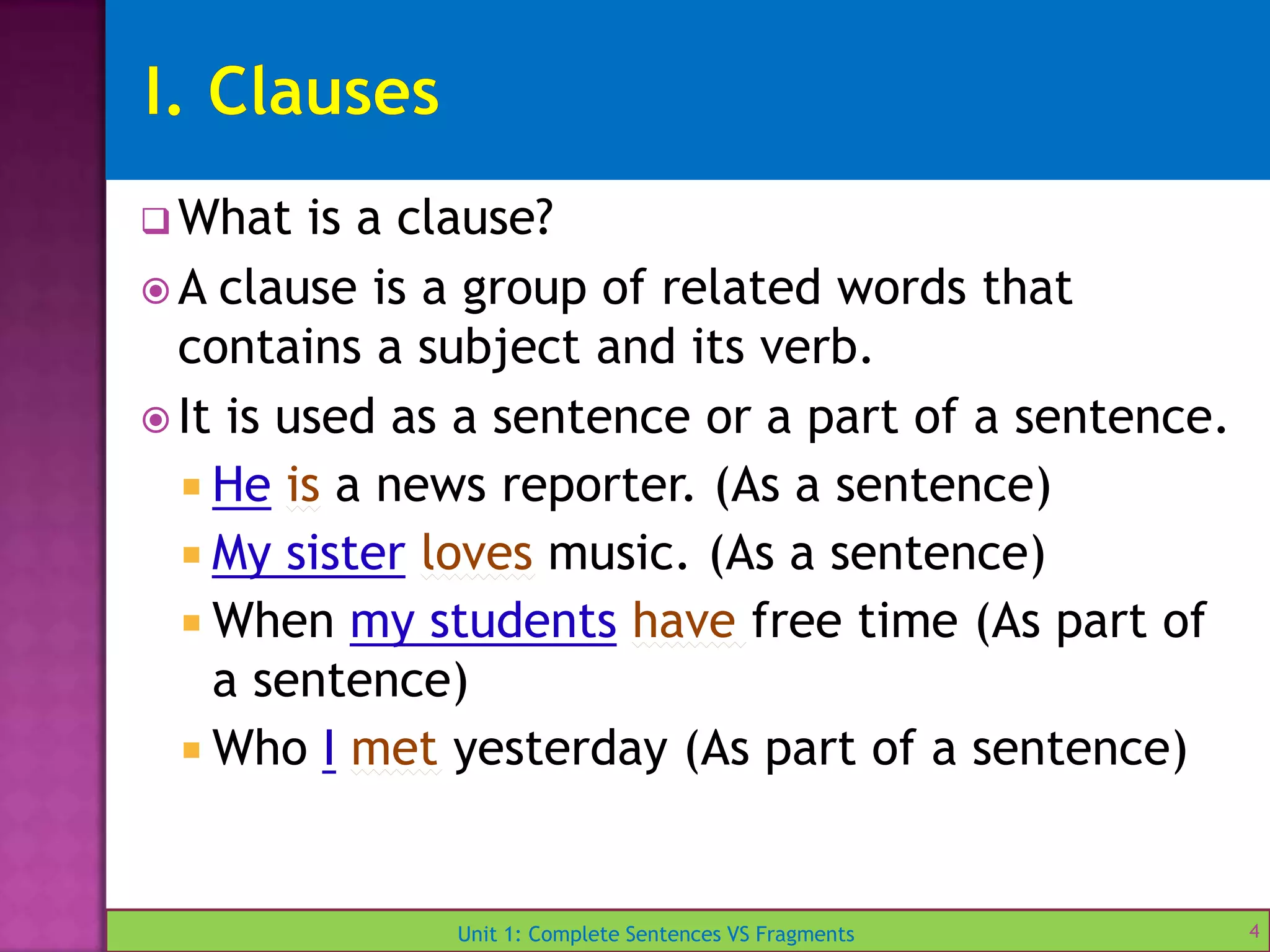
 What is a clause?
 A clause is a group of related words that
contains a subject and its verb.
 It is used as a sentence or a part of a sentence.
 He is a news reporter. (As a sentence)
 My sister loves music. (As a sentence)
 When my students have free time (As part of
a sentence)
 Who I met yesterday (As part of a sentence)
4
Unit 1: Complete Sentences VS Fragments
 What are the types of clauses?
 There are two types of clauses:
 Independent clauses (IC)
 Also called principle clauses or main clauses
 Dependent clauses (DC)
 Also called subordinate clauses or sub-
clauses
5
Unit 1: Complete Sentences VS Fragments
 Independent Clauses
 What is an independent clause?
 An independent clause has a subject and a finite
verb. It can stand alone as a complete sentence; It
expresses a complete thought.
 They work in marketing department.
 What shall we do?
 The company didn't perform well last year.
 Products were in short supply.
6
Unit 1: Complete Sentences VS Fragments
 Dependent Clauses
 What is a dependent clause?
 A dependent clause has a subject and a finite verb
but cannot stand alone as a complete sentence; It
does not express a complete thought.
 If new products are produced.
 After World War II ended.
 Who is standing over there.
 What you have proposed.
7
Unit 1: Complete Sentences VS Fragments
 What is a fragment?
 A fragment is a group of words that is missing parts of
a complete sentence.
 Remember that any sentence, in order to be complete,
must express a complete thought and must include
both a subject and a verb.
 I was in the middle of my morning shower when it
happened. (sentence)
 I was in the middle of my morning shower. When it
happened. (a sentence followed by a fragment)
8
Unit 1: Complete Sentences VS Fragments
 How can we find a fragment?
 Ask: Is there a subject in the word group? A
verb?
 Ask: Does the word group express a complete
thought?
 If the answer to any of these questions is “no,”
then the word group is a fragment.
9
Unit 1: Complete Sentences VS Fragments
 How can you correct a fragment?
 There are two basic ways to fix a fragment:
 Add what is missing (a subject, a verb, or
both).
 Attach the fragment to the sentence before
or after it.
10
Unit 1: Complete Sentences VS Fragments
 Fragments that start with dependent words
 What is a dependent word?
 A dependent word (also called a subordinating conjunction) is
the first word in a dependent clause.
 A dependent clause is not a sentence because it does not
express a complete thought, even though it contains a subject
and a verb.
 Example: Since I won the meet. I have not stopped smiling.
 “Since I won” has a subject (I) and a verb (won), but it doesn’t
express a complete thought. (What happened since I won?)
11
Unit 1: Complete Sentences VS Fragments
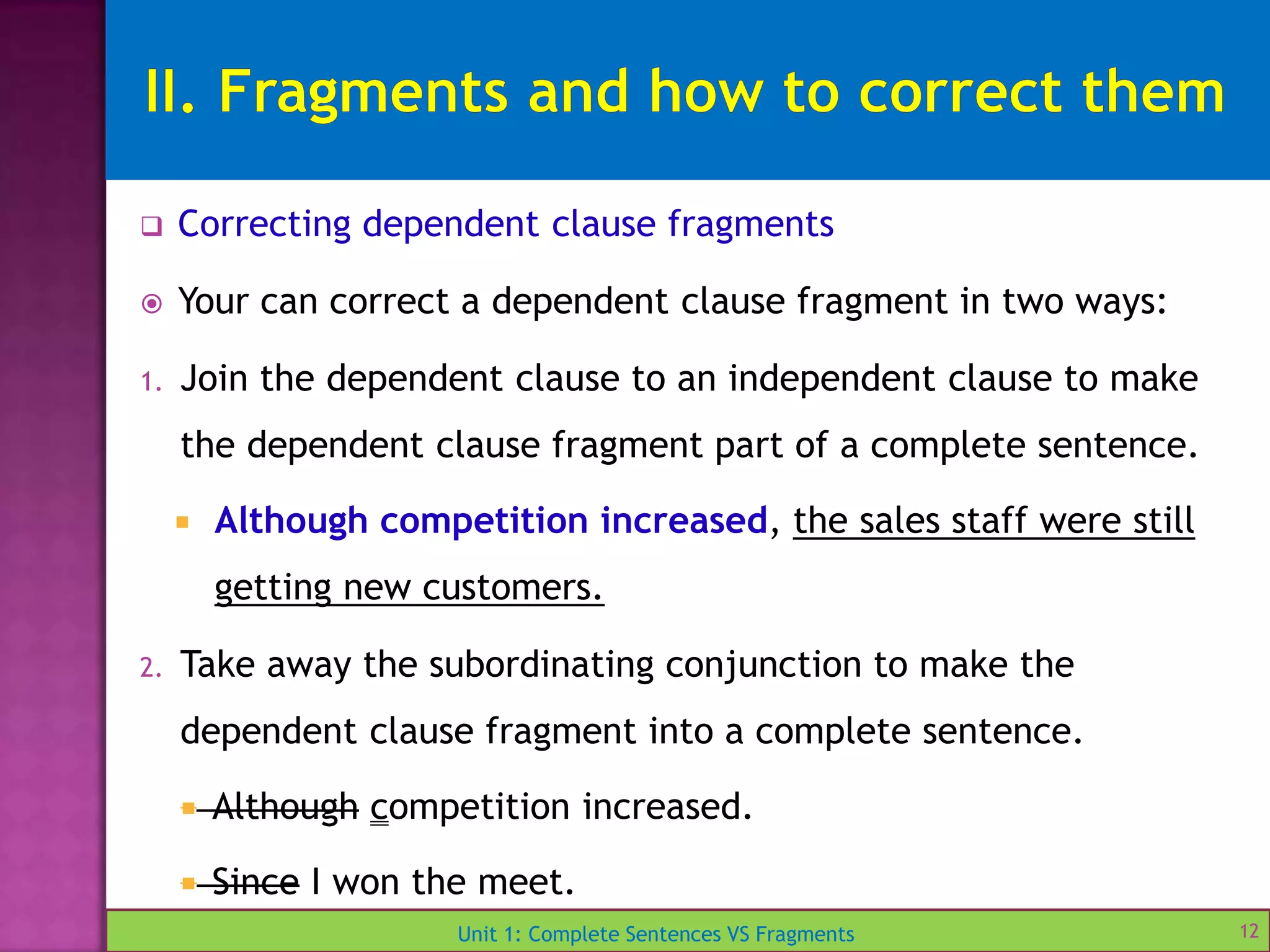
 Correcting dependent clause fragments
 Your can correct a dependent clause fragment in two ways:
1. Join the dependent clause to an independent clause to make
the dependent clause fragment part of a complete sentence.
 Although competition increased, the sales staff were still
getting new customers.
2. Take away the subordinating conjunction to make the
dependent clause fragment into a complete sentence.
 Although competition increased.
 Since I won the meet.
12
Unit 1: Complete Sentences VS Fragments
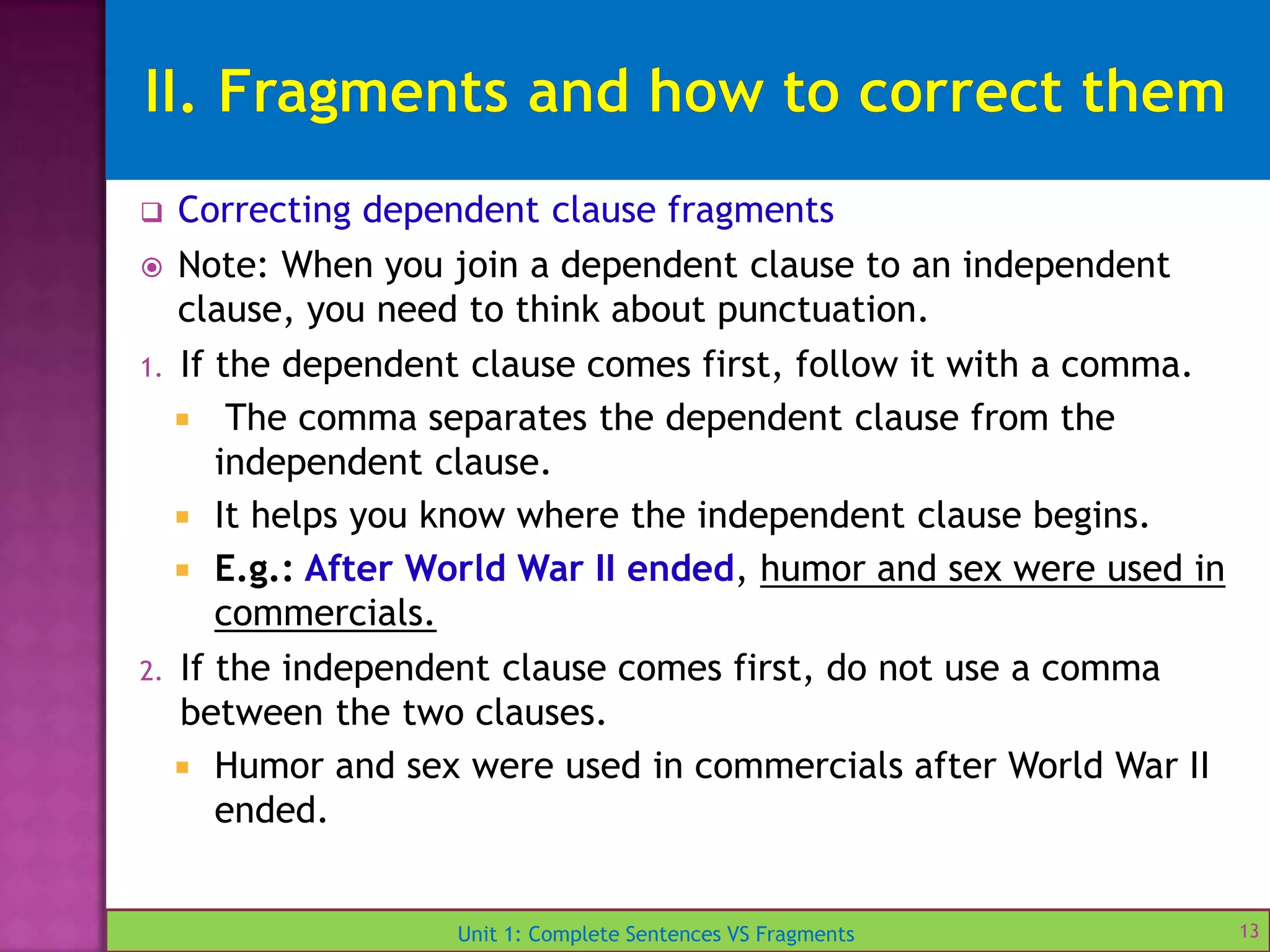
 Correcting dependent clause fragments
 Note: When you join a dependent clause to an independent
clause, you need to think about punctuation.
1. If the dependent clause comes first, follow it with a comma.
 The comma separates the dependent clause from the
independent clause.
 It helps you know where the independent clause begins.
 E.g.: After World War II ended, humor and sex were used in
commercials.
2. If the independent clause comes first, do not use a comma
between the two clauses.
 Humor and sex were used in commercials after World War II
ended.
13
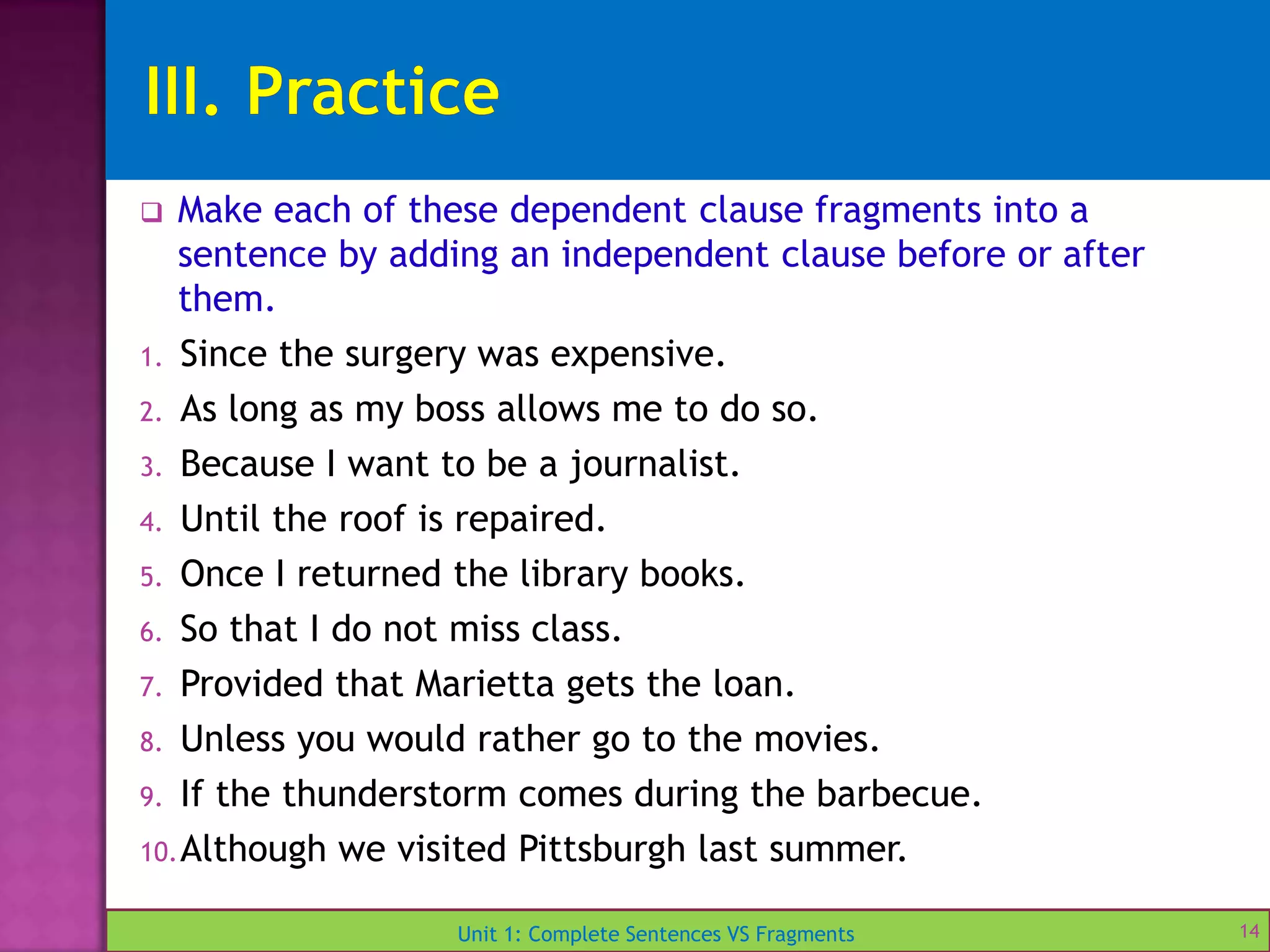
Unit 1: Complete Sentences VS Fragments
 Make each of these dependent clause fragments into a
sentence by adding an independent clause before or after
them.
1. Since the surgery was expensive.
2. As long as my boss allows me to do so.
3. Because I want to be a journalist.
4. Until the roof is repaired.
5. Once I returned the library books.
6. So that I do not miss class.
7. Provided that Marietta gets the loan.
8. Unless you would rather go to the movies.
9. If the thunderstorm comes during the barbecue.
10.Although we visited Pittsburgh last summer.
14
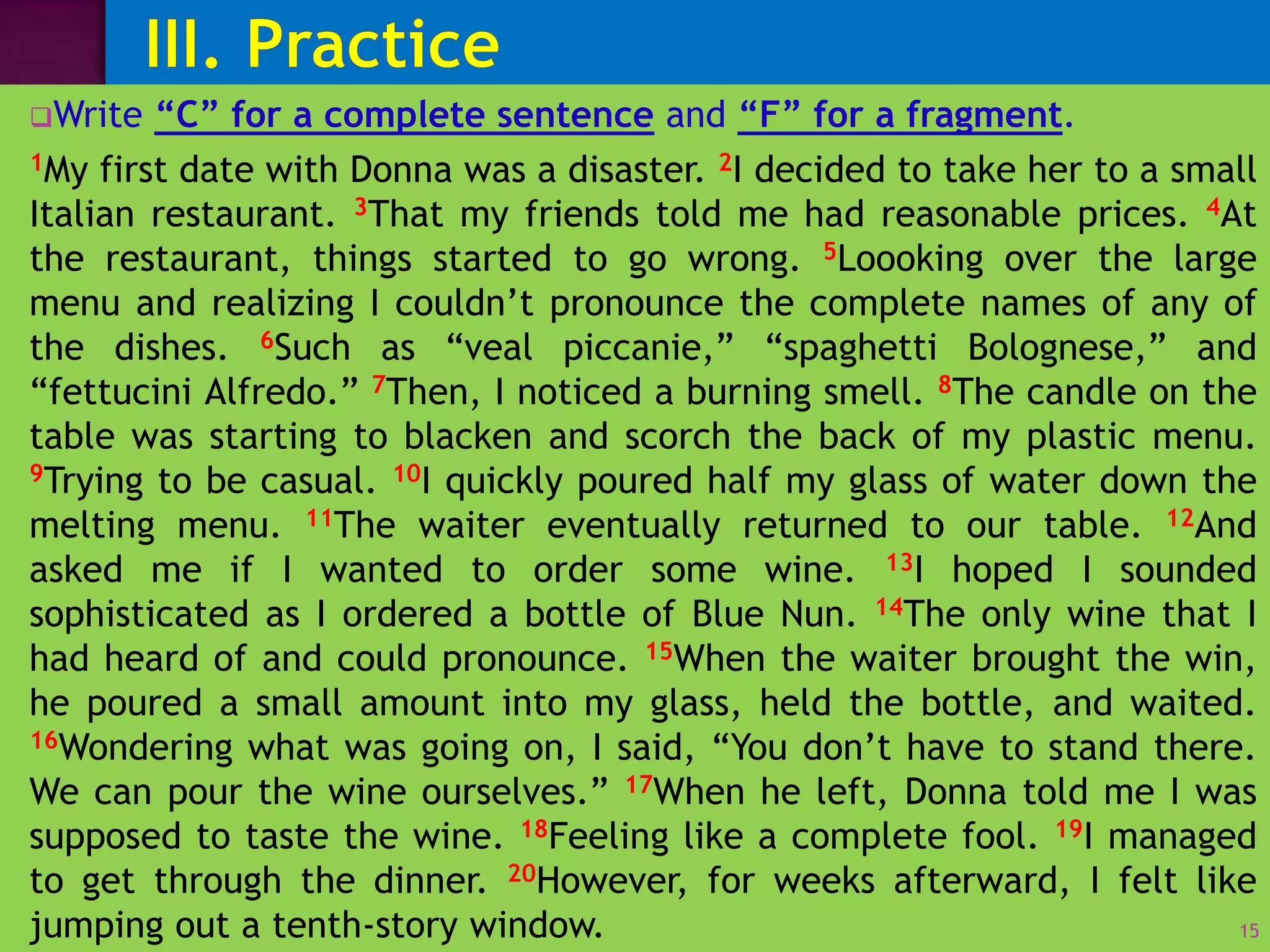
Unit 1: Complete Sentences VS Fragments
Write “C” for a complete sentence and “F” for a fragment.
1My first date with Donna was a disaster. 2I decided to take her to a small
Italian restaurant. 3That my friends told me had reasonable prices. 4At
the restaurant, things started to go wrong. 5Loooking over the large
menu and realizing I couldn’t pronounce the complete names of any of
the dishes. 6Such as “veal piccanie,” “spaghetti Bolognese,” and
“fettucini Alfredo.” 7Then, I noticed a burning smell. 8The candle on the
table was starting to blacken and scorch the back of my plastic menu.
9Trying to be casual. 10I quickly poured half my glass of water down the
melting menu. 11The waiter eventually returned to our table. 12And
asked me if I wanted to order some wine. 13I hoped I sounded
sophisticated as I ordered a bottle of Blue Nun. 14The only wine that I
had heard of and could pronounce. 15When the waiter brought the win,
he poured a small amount into my glass, held the bottle, and waited.
16Wondering what was going on, I said, “You don’t have to stand there.
We can pour the wine ourselves.” 17When he left, Donna told me I was
supposed to taste the wine. 18Feeling like a complete fool. 19I managed
to get through the dinner. 20However, for weeks afterward, I felt like
jumping out a tenth-story window. 15
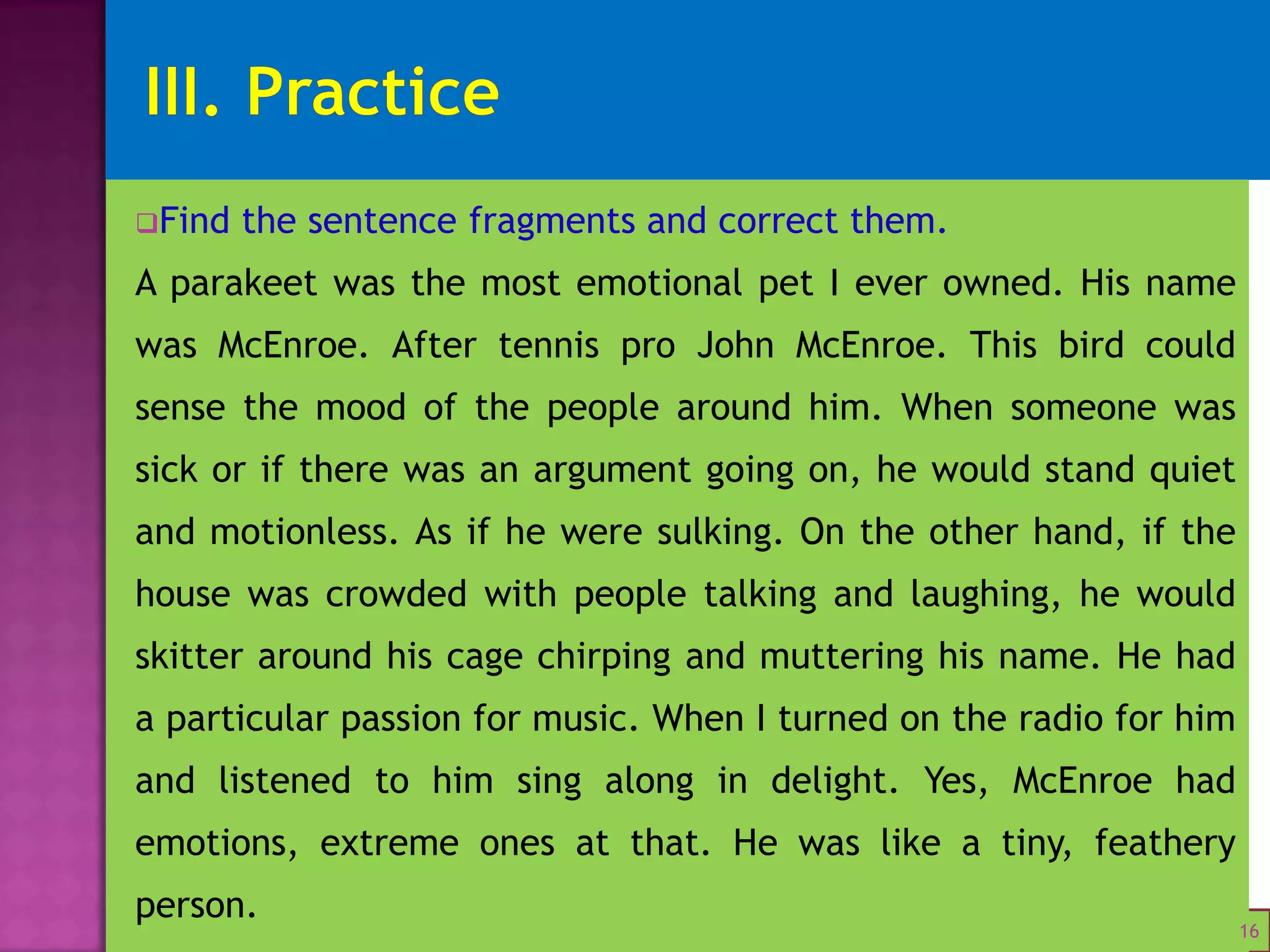
Unit 1: Complete Sentences VS Fragments
Find the sentence fragments and correct them.
A parakeet was the most emotional pet I ever owned. His name
was McEnroe. After tennis pro John McEnroe. This bird could
sense the mood of the people around him. When someone was
sick or if there was an argument going on, he would stand quiet
and motionless. As if he were sulking. On the other hand, if the
house was crowded with people talking and laughing, he would
skitter around his cage chirping and muttering his name. He had
a particular passion for music. When I turned on the radio for him
and listened to him sing along in delight. Yes, McEnroe had
emotions, extreme ones at that. He was like a tiny, feathery
person.
16
Unit 1: Complete Sentences VS Fragments
Find the sentence fragments and correct them.
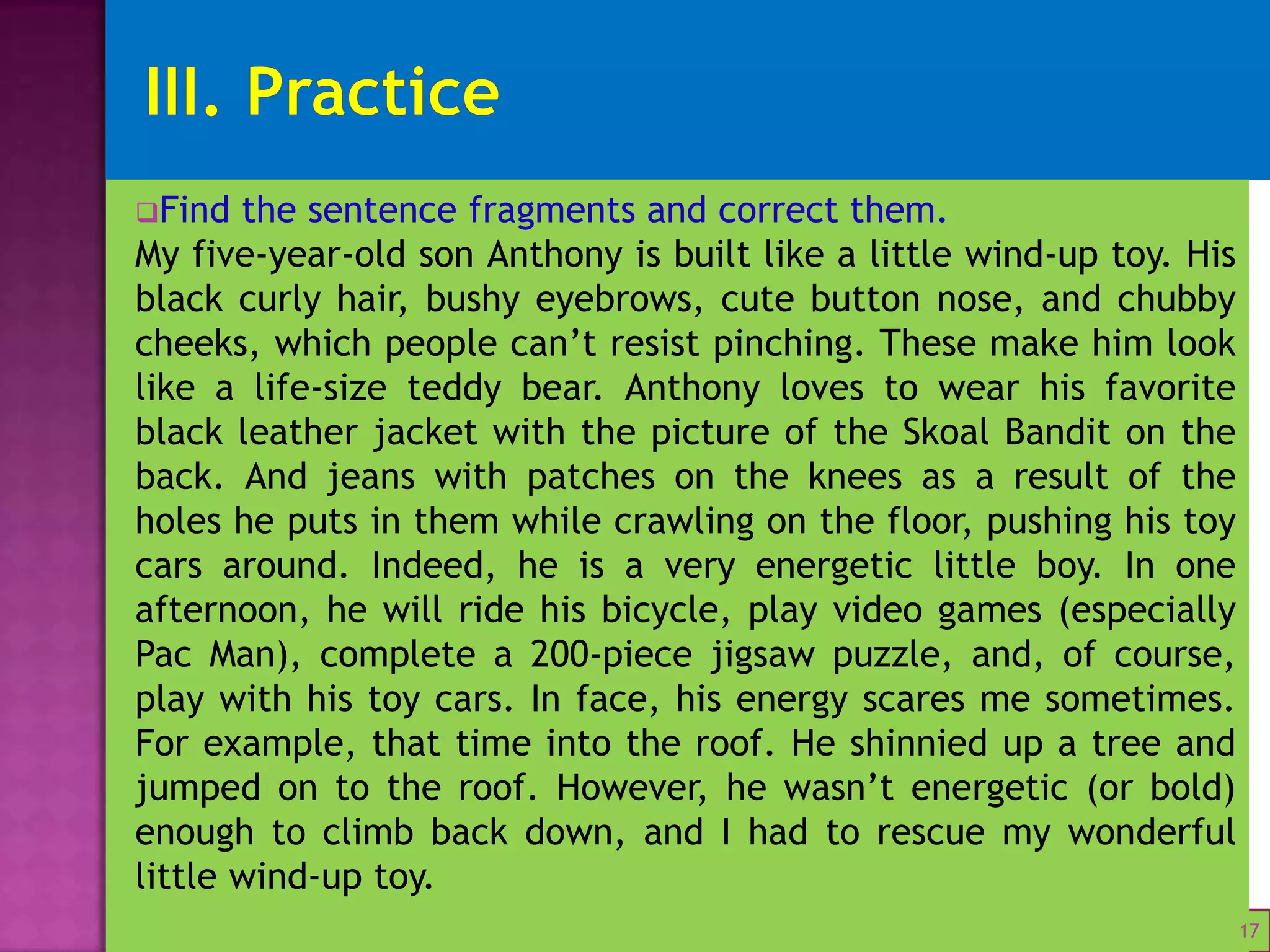
My five-year-old son Anthony is built like a little wind-up toy. His
black curly hair, bushy eyebrows, cute button nose, and chubby
cheeks, which people can’t resist pinching. These make him look
like a life-size teddy bear. Anthony loves to wear his favorite
black leather jacket with the picture of the Skoal Bandit on the
back. And jeans with patches on the knees as a result of the
holes he puts in them while crawling on the floor, pushing his toy
cars around. Indeed, he is a very energetic little boy. In one
afternoon, he will ride his bicycle, play video games (especially
Pac Man), complete a 200-piece jigsaw puzzle, and, of course,
play with his toy cars. In face, his energy scares me sometimes.
For example, that time into the roof. He shinnied up a tree and
jumped on to the roof. However, he wasn’t energetic (or bold)
enough to climb back down, and I had to rescue my wonderful
little wind-up toy.
17
Unit 1: Complete Sentences VS Fragments 18
Thank You!

Unit 1 complete sentences vs fragments

  • 1.
  • 2.
    Unit 1: CompleteSentences VS Fragments At the end of this unit you will be able to: I. Identify the difference between an independence clause and a dependence clause. II. Identify the difference between a sentence and a fragment. III.Correct fragment in your writing. 2
  • 3.
    Unit 1: CompleteSentences VS Fragments I. Clauses  Independent Clauses  Dependent Clauses II. Fragments and How to correct them III.Practice 3
  • 4.
    Unit 1: CompleteSentences VS Fragments  What is a clause?  A clause is a group of related words that contains a subject and its verb.  It is used as a sentence or a part of a sentence.  He is a news reporter. (As a sentence)  My sister loves music. (As a sentence)  When my students have free time (As part of a sentence)  Who I met yesterday (As part of a sentence) 4
  • 5.
    Unit 1: CompleteSentences VS Fragments  What are the types of clauses?  There are two types of clauses:  Independent clauses (IC)  Also called principle clauses or main clauses  Dependent clauses (DC)  Also called subordinate clauses or sub- clauses 5
  • 6.
    Unit 1: CompleteSentences VS Fragments  Independent Clauses  What is an independent clause?  An independent clause has a subject and a finite verb. It can stand alone as a complete sentence; It expresses a complete thought.  They work in marketing department.  What shall we do?  The company didn't perform well last year.  Products were in short supply. 6
  • 7.
    Unit 1: CompleteSentences VS Fragments  Dependent Clauses  What is a dependent clause?  A dependent clause has a subject and a finite verb but cannot stand alone as a complete sentence; It does not express a complete thought.  If new products are produced.  After World War II ended.  Who is standing over there.  What you have proposed. 7
  • 8.
    Unit 1: CompleteSentences VS Fragments  What is a fragment?  A fragment is a group of words that is missing parts of a complete sentence.  Remember that any sentence, in order to be complete, must express a complete thought and must include both a subject and a verb.  I was in the middle of my morning shower when it happened. (sentence)  I was in the middle of my morning shower. When it happened. (a sentence followed by a fragment) 8
  • 9.
    Unit 1: CompleteSentences VS Fragments  How can we find a fragment?  Ask: Is there a subject in the word group? A verb?  Ask: Does the word group express a complete thought?  If the answer to any of these questions is “no,” then the word group is a fragment. 9
  • 10.
    Unit 1: CompleteSentences VS Fragments  How can you correct a fragment?  There are two basic ways to fix a fragment:  Add what is missing (a subject, a verb, or both).  Attach the fragment to the sentence before or after it. 10
  • 11.
    Unit 1: CompleteSentences VS Fragments  Fragments that start with dependent words  What is a dependent word?  A dependent word (also called a subordinating conjunction) is the first word in a dependent clause.  A dependent clause is not a sentence because it does not express a complete thought, even though it contains a subject and a verb.  Example: Since I won the meet. I have not stopped smiling.  “Since I won” has a subject (I) and a verb (won), but it doesn’t express a complete thought. (What happened since I won?) 11
  • 12.
    Unit 1: CompleteSentences VS Fragments  Correcting dependent clause fragments  Your can correct a dependent clause fragment in two ways: 1. Join the dependent clause to an independent clause to make the dependent clause fragment part of a complete sentence.  Although competition increased, the sales staff were still getting new customers. 2. Take away the subordinating conjunction to make the dependent clause fragment into a complete sentence.  Although competition increased.  Since I won the meet. 12
  • 13.
    Unit 1: CompleteSentences VS Fragments  Correcting dependent clause fragments  Note: When you join a dependent clause to an independent clause, you need to think about punctuation. 1. If the dependent clause comes first, follow it with a comma.  The comma separates the dependent clause from the independent clause.  It helps you know where the independent clause begins.  E.g.: After World War II ended, humor and sex were used in commercials. 2. If the independent clause comes first, do not use a comma between the two clauses.  Humor and sex were used in commercials after World War II ended. 13
  • 14.
    Unit 1: CompleteSentences VS Fragments  Make each of these dependent clause fragments into a sentence by adding an independent clause before or after them. 1. Since the surgery was expensive. 2. As long as my boss allows me to do so. 3. Because I want to be a journalist. 4. Until the roof is repaired. 5. Once I returned the library books. 6. So that I do not miss class. 7. Provided that Marietta gets the loan. 8. Unless you would rather go to the movies. 9. If the thunderstorm comes during the barbecue. 10.Although we visited Pittsburgh last summer. 14
  • 15.
    Unit 1: CompleteSentences VS Fragments Write “C” for a complete sentence and “F” for a fragment. 1My first date with Donna was a disaster. 2I decided to take her to a small Italian restaurant. 3That my friends told me had reasonable prices. 4At the restaurant, things started to go wrong. 5Loooking over the large menu and realizing I couldn’t pronounce the complete names of any of the dishes. 6Such as “veal piccanie,” “spaghetti Bolognese,” and “fettucini Alfredo.” 7Then, I noticed a burning smell. 8The candle on the table was starting to blacken and scorch the back of my plastic menu. 9Trying to be casual. 10I quickly poured half my glass of water down the melting menu. 11The waiter eventually returned to our table. 12And asked me if I wanted to order some wine. 13I hoped I sounded sophisticated as I ordered a bottle of Blue Nun. 14The only wine that I had heard of and could pronounce. 15When the waiter brought the win, he poured a small amount into my glass, held the bottle, and waited. 16Wondering what was going on, I said, “You don’t have to stand there. We can pour the wine ourselves.” 17When he left, Donna told me I was supposed to taste the wine. 18Feeling like a complete fool. 19I managed to get through the dinner. 20However, for weeks afterward, I felt like jumping out a tenth-story window. 15
  • 16.
    Unit 1: CompleteSentences VS Fragments Find the sentence fragments and correct them. A parakeet was the most emotional pet I ever owned. His name was McEnroe. After tennis pro John McEnroe. This bird could sense the mood of the people around him. When someone was sick or if there was an argument going on, he would stand quiet and motionless. As if he were sulking. On the other hand, if the house was crowded with people talking and laughing, he would skitter around his cage chirping and muttering his name. He had a particular passion for music. When I turned on the radio for him and listened to him sing along in delight. Yes, McEnroe had emotions, extreme ones at that. He was like a tiny, feathery person. 16
  • 17.
    Unit 1: CompleteSentences VS Fragments Find the sentence fragments and correct them. My five-year-old son Anthony is built like a little wind-up toy. His black curly hair, bushy eyebrows, cute button nose, and chubby cheeks, which people can’t resist pinching. These make him look like a life-size teddy bear. Anthony loves to wear his favorite black leather jacket with the picture of the Skoal Bandit on the back. And jeans with patches on the knees as a result of the holes he puts in them while crawling on the floor, pushing his toy cars around. Indeed, he is a very energetic little boy. In one afternoon, he will ride his bicycle, play video games (especially Pac Man), complete a 200-piece jigsaw puzzle, and, of course, play with his toy cars. In face, his energy scares me sometimes. For example, that time into the roof. He shinnied up a tree and jumped on to the roof. However, he wasn’t energetic (or bold) enough to climb back down, and I had to rescue my wonderful little wind-up toy. 17
  • 18.
    Unit 1: CompleteSentences VS Fragments 18 Thank You!

Editor's Notes

  • #5 + What is a sentence? - It is a group of words. It has at least a subject and a finite verb. It must express a complete thought. It should not leave a question in your mind or leave an idea unfinished. It ends in a full stop (.) or a question mark (?). + What is a phrase? - A phrase is a group of words that. It does not include a subject and a verb.
  • #8 +There are three types of dependent (subordinate) clauses: Noun clauses: What you have proposed is acceptable. Adjective clauses: The man who is standing over there is a product development manager. Adverb clauses: There will be some promotion when the new product are available.
  • #15 Provided that = if Would rather = would prefer to = it is better to Unless I'm mistaken, she was back at work yesterday As long as = only if = since/to the extent that Since = because/as Although = though (despite the fact that) = but/however
  • #16 There are 7 fragments in the paragraph