Grammar: 4 types of sentences
By: lligeon
Sentence function
Sentences have functions and purposes accordingly.
Four types of sentence purposes exist in the English language:
Declarative sentences
Interrogative sentences
Declarative sentences
Interrogative sentences
Imperative sentences
Declarative sentences
Interrogative sentences
Imperative sentences
Exclamatory sentences
Declarative sentences
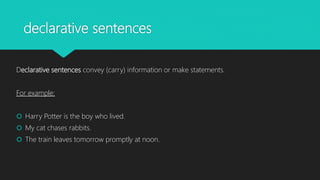
Declarative sentences convey (carry) information or make statements.
For example:
declarative sentences
Declarative sentences convey (carry) information or make statements.
For example:
 Harry Potter is the boy who lived.
 My cat chases rabbits.
 The train leaves tomorrow promptly at noon.
Interrogative sentences
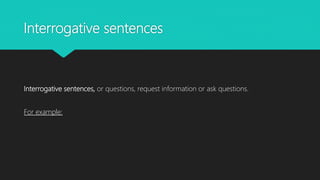
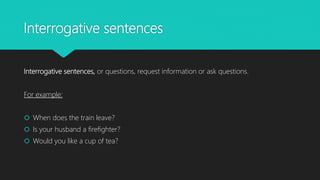
Interrogative sentences, or questions, request information or ask questions.
For example:
Interrogative sentences
Interrogative sentences, or questions, request information or ask questions.
For example:
 When does the train leave?
 Is your husband a firefighter?
 Would you like a cup of tea?
A tag question or a question tag
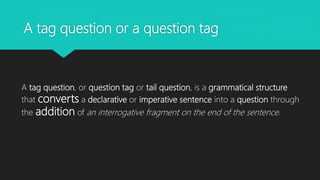
A tag question, or question tag or tail question, is a grammatical structure
that converts a declarative or imperative sentence into a question through
the addition of an interrogative fragment on the end of the sentence.
A tag question or a question tag
A tag question, or question tag or tail question, is a grammatical structure that
converts a declarative or imperative sentence into a question through the
addition of an interrogative fragment on the end of the sentence.
For example:
He didn’t take the train, did he?
I am going with you, aren’t I?
For more on that check the list in the grammar sectin.
Imperative sentences
Imperative sentences, or imperatives, make commands or requests.
For example:
Imperative sentences
Imperative sentences, or imperatives, make commands or requests.
For example:
 Bring me some sugar.
 Shut the door please.
 Stop talking so loudly!
Exclamatory sentences
Exclamatory sentences, or exclamations, show emphasis. Unlike the other three
sentences purposes, exclamatory sentences are not a distinct sentence type.
Instead, declarative, interrogative, and imperative sentences become exclamatory
through added emphasis
For example:
Exclamatory sentences
Exclamatory sentences, or exclamations, show emphasis. Unlike the other three
sentences purposes, exclamatory sentences are not a distinct sentence type.
Instead, declarative, interrogative, and imperative sentences become exclamatory
through added emphasis
For example:
 You broke the lamp! (declarative)
 What the heck was that?! (interrogative)
 Stop chewing with your mouth open! (imperative)
Summary
The four types of sentence purposes in the English language are declarative, interrogative,
imperative, and exclamatory.
 Declarative sentences, or declarations, convey information or make statements.
 Interrogtive sentences, or questions, request information or ask questions.
 Imperative sentences, or imperatives, make commands or requests.
 Exclamatory sentences, or exclamations, show emphasis.

Grammar typesofsentences