Verb Tense and Irregular Verbs
          Definition of VerbA verb is a word that expresses action or state of being (existence).
Present tense – expresses an action (or existence) which is happening now or which happens continually, regularlyFuture tense – expresses action that will take place
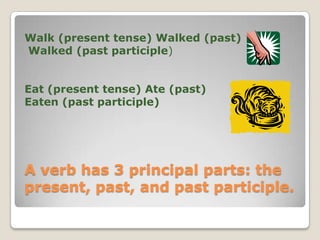
Tense refers to when an action happenedSimple Present Tense:Today I teach English 100.Today I am teaching English 100.Today I eat vegetables.  Simple Future TenseTomorrow I will teach English 100.A verb has 3 principal parts: the present, past, and past participle.Walk (present tense) Walked (past) Walked (past participle)  Eat (present tense) Ate (past) Eaten (past participle)
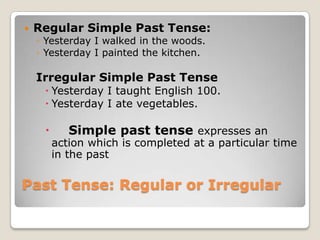
Past Tense: Regular or IrregularRegular Simple Past Tense:Yesterday I walked in the woods.Yesterday I painted the kitchen.Irregular Simple Past TenseYesterday I taught English 100.Yesterday I ate vegetables.    Simple past tense expresses an action which is completed at a particular time in the past
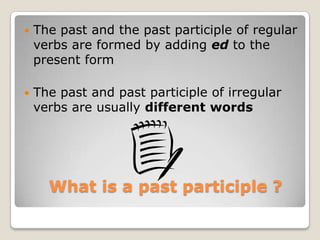
     What is a past participle ?The past and the past participle of regular verbs are formed by adding ed to the present formThe past and past participle of irregular verbs are usually different words
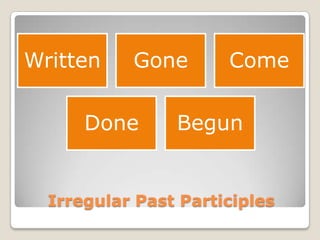
     Irregular Past Participles
     The Present Perfect TenseThe present perfect tense expresses action which began in the pastbut continues in the present or is completed in the presentTo form the present perfect tense, add has or have to the past participle
           Past Perfect TenseThe past perfect tense expresses action which began in the past and was completed in the past
To form the past perfect tense , add had to the past participle       Future Perfect TenseThe future perfect tense expresses action or existence which will begin in the future and will be completed by a specific time in the future.To form the future perfect tense, add shall have or will haveto the past participle
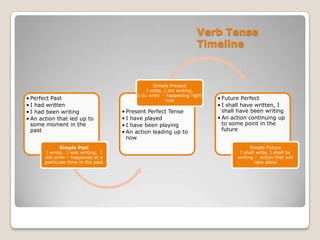
Verb Tense Timeline
Verb tense and irregular verbs

Verb tense and irregular verbs

  • 1.
    Verb Tense andIrregular Verbs
  • 2.
    Definition of VerbA verb is a word that expresses action or state of being (existence).
  • 3.
    Present tense –expresses an action (or existence) which is happening now or which happens continually, regularlyFuture tense – expresses action that will take place
  • 4.
    Tense refers towhen an action happenedSimple Present Tense:Today I teach English 100.Today I am teaching English 100.Today I eat vegetables. Simple Future TenseTomorrow I will teach English 100.A verb has 3 principal parts: the present, past, and past participle.Walk (present tense) Walked (past) Walked (past participle) Eat (present tense) Ate (past) Eaten (past participle)
  • 5.
    Past Tense: Regularor IrregularRegular Simple Past Tense:Yesterday I walked in the woods.Yesterday I painted the kitchen.Irregular Simple Past TenseYesterday I taught English 100.Yesterday I ate vegetables. Simple past tense expresses an action which is completed at a particular time in the past
  • 6.
    What is a past participle ?The past and the past participle of regular verbs are formed by adding ed to the present formThe past and past participle of irregular verbs are usually different words
  • 7.
    Irregular Past Participles
  • 8.
    The Present Perfect TenseThe present perfect tense expresses action which began in the pastbut continues in the present or is completed in the presentTo form the present perfect tense, add has or have to the past participle
  • 9.
    Past Perfect TenseThe past perfect tense expresses action which began in the past and was completed in the past
  • 10.
    To form thepast perfect tense , add had to the past participle Future Perfect TenseThe future perfect tense expresses action or existence which will begin in the future and will be completed by a specific time in the future.To form the future perfect tense, add shall have or will haveto the past participle
  • 11.