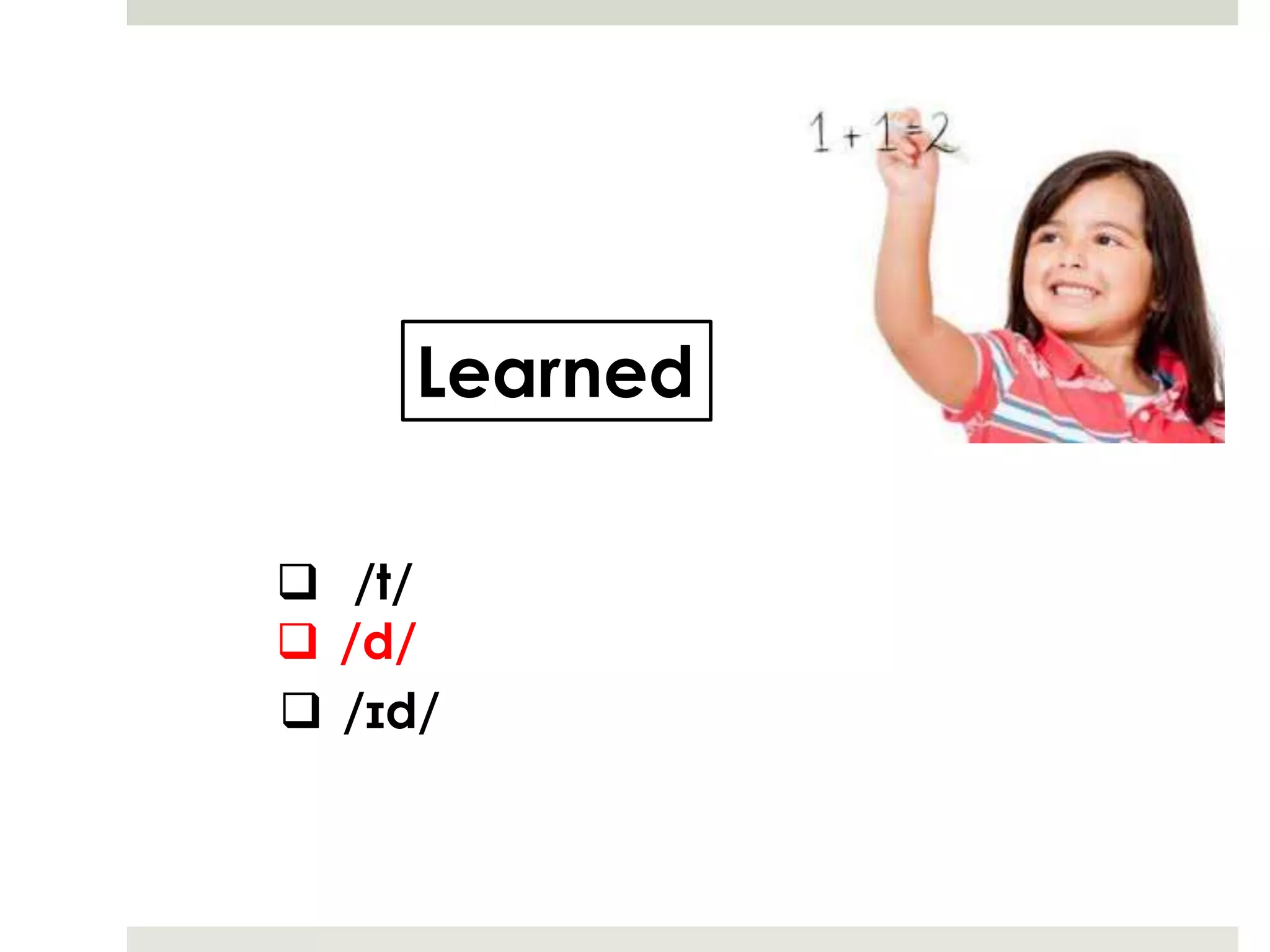
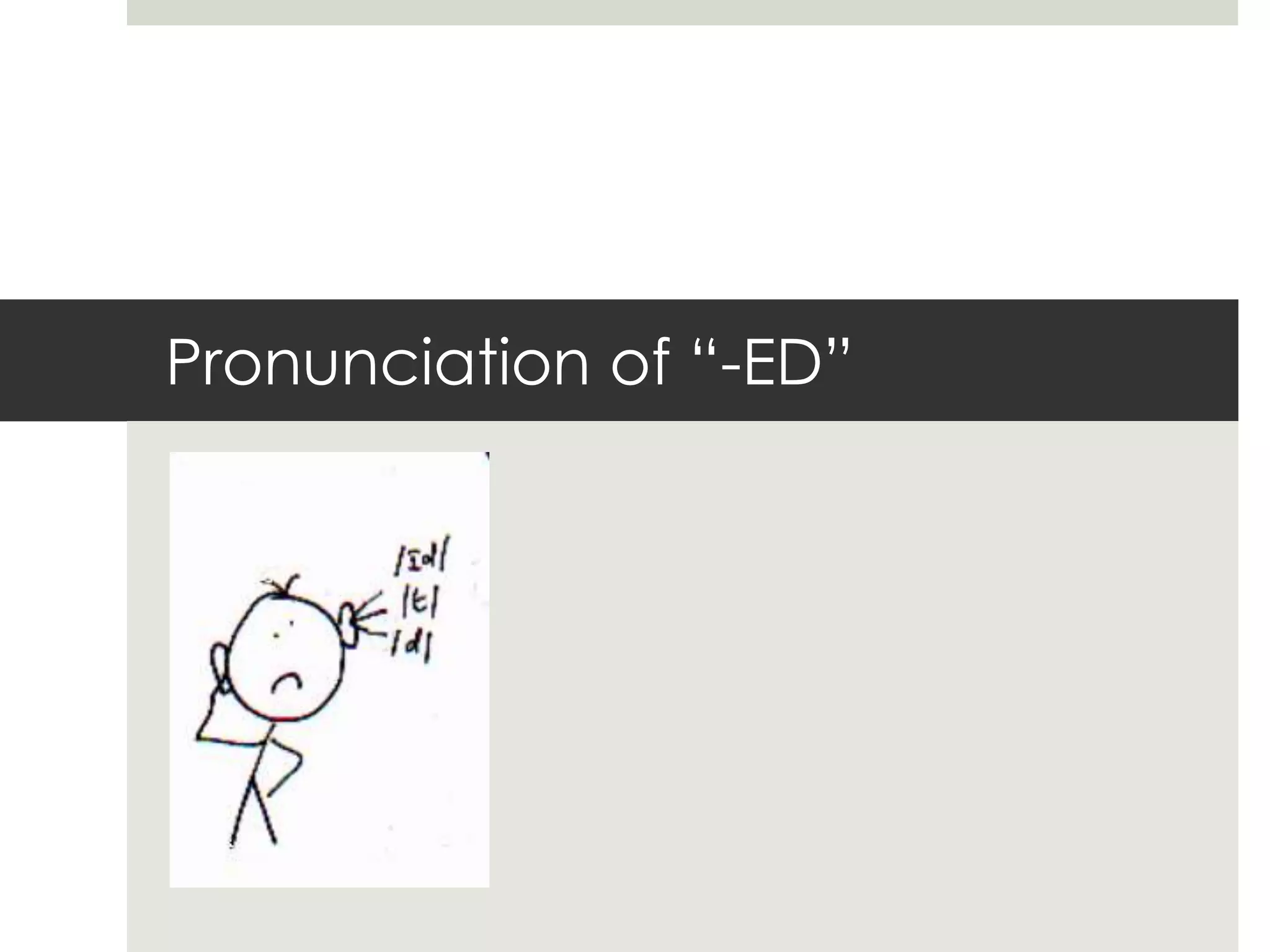
The document discusses the different sounds that the "-ed" ending can make when added to verbs to make the past tense. It explains that the sound depends on the final consonant of the verb. Verbs ending in voiceless consonants like t, p, f take an ed sound pronounced as /t/. Verbs ending in voiced consonants like b, d, g take an ed sound pronounced as /d/. Verbs ending in t or d take an ed sound pronounced as /ɪd/. These rules are important for connected speech when a word ending in a consonant is followed by a word starting with a vowel.

![The final sound will largely depend on the last
sound of the verb.
* Place your fingertips on the front of your neck, and pronounce the
following words. What do you feel on your fingers when you say the
underlined sound?
vow | fake (vvv | fff)
zebra | snake (zzz | sss)
When we pronounce voiced sounds, our vocal chords vibrate when
we say those sounds. [v] [z].
When we pronounce voiceless sounds, our vocal chords do not
vibrate. [f] [s]. No vibration.](https://image.slidesharecdn.com/edpronunciation-140827215248-phpapp02/75/ed-pronunciation-3-2048.jpg)
![[t] final sound
Verbs ending in voiceless sounds [p, k, f, s, ʃ, tʃ] cause the “-ed”
ending to be pronounced as the voiceless [t] (with no vocal chord
vibration).
[p] “He popped a balloon.” [papt]
[k] “They talked a lot” [takt]
[f] “I laughed at the movie.” [læft]
[s] “She kissed her child good-bye.” [kIst]
[ʃ] “sh”: “We brushed our teeth.” [bruʃt]
[tʃ] “ch”: “I reached the end of the road.” [riytʃt]](https://image.slidesharecdn.com/edpronunciation-140827215248-phpapp02/75/ed-pronunciation-4-2048.jpg)
![[d] final sound
Verbs ending in the voiced sounds [b, g, v, z, ʒ, dʒ, m, n, ŋ, r, l] cause the “-
ed” ending to be pronounced as a voiced [d].
[b] “She grabbed her coat and ran away.” [grabd]
[g] “He begged her to stay.” [bɛgd]
[v] “They loved it.” [luvd]
[z] “He raised his hand.” [reyzd]
[dʒ] “They managed the issue quickly.” [ ]
[m] “She claimed the prize.” [kleymd]
[n] “They banned smoking in public spaces.” [bænd]
[ŋ] “She banged on the door.” [bæŋd]
[r] “The waitress cleared the table.” [kliyrd]
[l] “I rolled up the paper.” [rowld]
mænɪdʒd](https://image.slidesharecdn.com/edpronunciation-140827215248-phpapp02/75/ed-pronunciation-5-2048.jpg)
![[ɪd] final sound
Verbs ending in the sounds [t] or [d] will cause the “-ed” ending of a
verb to be pronounced as the syllable [əd] or [ɪd].
[t] “I visited the Empire State Building.” [vɪzɪtəd]
[t] “She edited the report.” [ɛdɪtɪd]
[d] “We ended the game early.” [ɛndɪd]
[d] “the chef breaded the chicken.” [brɛdɪd]](https://image.slidesharecdn.com/edpronunciation-140827215248-phpapp02/75/ed-pronunciation-6-2048.jpg)
![Why are these rules important?
Connected Speech [c+v]
These “-ed” pronunciation rules are particularly important,
because in English we connect our speech when we have a word
that:
• ends in a consonant; and
• is followed by a word that begins with a vowel.
In this case, the way you say the verb’s “-ed” ending will be heard loudly and
clearly.
“He walked away” [walkt] –> “He walk taway” [hiy WAWK
təWEY]
“She turned around.”
For Example:
Cont…](https://image.slidesharecdn.com/edpronunciation-140827215248-phpapp02/75/ed-pronunciation-7-2048.jpg)
![The same rule of connected speech [c+v] occurs when h-deletion causes
us to delete the “h” sound at the beginning of a word.
…Cont.
H- deletion
“We raised her expectations” [reyzd] –> “We raizd her expectations” –>
“We raizdər expectations”](https://image.slidesharecdn.com/edpronunciation-140827215248-phpapp02/75/ed-pronunciation-8-2048.jpg)