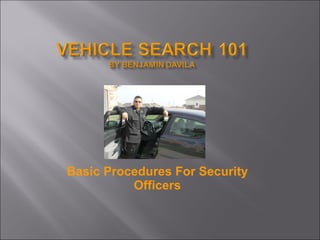
Basic Procedures For Security Officers
Objective   To be  familiar  with the proper  basic  procedures  to follow in conducting searches and seizures and to specifically outline the legal and ethical restrictions involved.
Review basic  procedures  in conducting vehicle searches and seizures  VEHICLE SEARCH 101
Always position yourself so that you are highly visible to traffic Always establish eye contact with the driver before approaching the vehicle Always ensure driver turns off engine and sets parking brake prior to inspection Always know where the driver/passengers are Always have driver open doors/compartments SAFETY FIRST
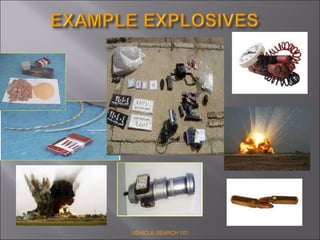
A search is simply an  examination of a person ,  place ,  possession or vehicle .  What are we looking for? Fruits of the crime,  i.e., the stolen goods, the object the crime was committed with, etc. Contraband.  Items that are against the law to possess, i.e., narcotics, counterfeit currency, short barrel shot gun, etc. Prohibited property.  Items prohibited by company rules, i.e. alcoholic beverages, cameras, firearms, explosives, etc. Be aware of current conditions (threat, support, response available, weather, etc)
Never inspect a vehicle with the motor running  Never get into a vulnerable position in relation to the driver and vehicle occupants Never TOUCH any suspicious items  Establish a thorough and systematic routine
Drivers are interviewed as part of any vehicle search to  gather information  about any unknown individual that may  indicate  a potential threat An  indicator  is an item, occurrence, condition, or situation that suggests the presence of contraband or explosive materials  (combinations of indicators should raise suspicion and warrant more detailed search, contact a supervisor or to call local authorities for support) VEHICLE SEARCH 101
Critical information is obtained as part of a driver interview by: Observing behavior Observing vehicle appearance Questioning of driver and occupants  "where are you going?“.  Recognizing stress or deception mechanisms Knowledge of local mannerisms, documents, etc.  listening to answers, make sure to make eye contact with the people in the car Always be polite and respectful
Background information every entry controller should know: Local or typical traffic regulations and laws Different vehicle type characteristics Information that can be gained from driver interview, driver identification and vehicle documents Existing intelligence information, threat level, and criminal patterns VEHICLE SEARCH 101
Typical documentation to check as part of interview: Drivers license / Identification Shipment manifests Bill of lading or shipping papers
Driver inappropriately dressed for vehicle type Driver does not know specific destination Driver documentation incomplete or brand new Driver explanation of delivery makes no sense Driver exhibits nervousness or impatience Driver refuses to submit to search team requests or answer questions
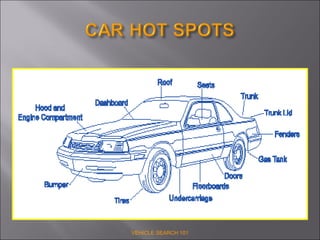
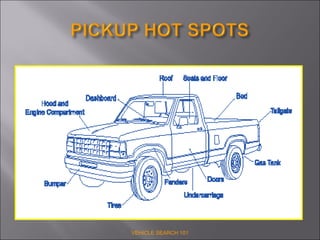
Anything contained in factory built compartments or firewall spaces New or shiny bolts, screw, or brackets on open road vehicles Bent sheet metal or broken covers Wire or tape unattached to electrical parts New or broken welds on undercarriage No vehicle identification number (VIN) Any area or component cleaner or dirtier than surrounding area
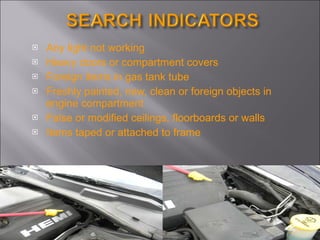
Any light not working Heavy doors or compartment covers Foreign items in gas tank tube  Freshly painted, new, clean or foreign objects in engine compartment False or modified ceilings, floorboards or walls Items taped or attached to frame
VEHICLE SEARCH 101
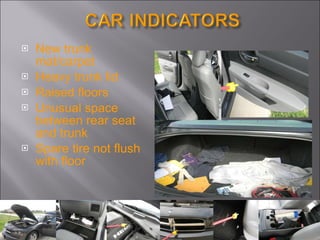
New trunk mat/carpet Heavy trunk lid Raised floors Unusual space between rear seat and trunk Spare tire not flush with floor
VEHICLE SEARCH 101
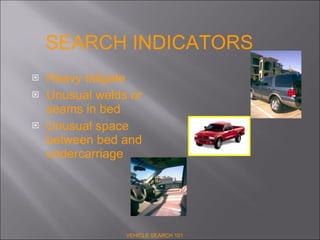
Heavy tailgate Unusual welds or seams in bed Unusual space between bed and undercarriage VEHICLE SEARCH 101 SEARCH INDICATORS
VEHICLE SEARCH 101
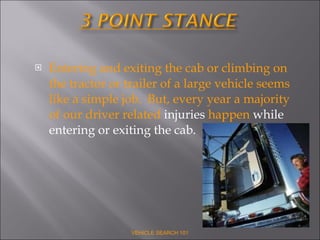
Entering and exiting the cab or climbing on the tractor or trailer of a large vehicle seems like a simple job.  But, every year a majority of our driver related  injuries  happen  while entering or exiting the cab.  VEHICLE SEARCH 101
Will help you avoid slip injuries and properly distribute your weight to prevent pulled muscles.  Put simply:  ‘3-point stance”  means that 3 of your 4 limbs are firmly placed on part of the truck at all times -  - either 2 hands  and  1 foot , or 2 feet and 1 hand. Exit the truck by climbing backward, as down a ladder, maintaining three points of contact at all times .
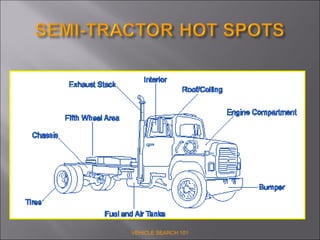
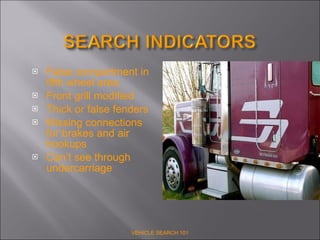
False compartment in fifth wheel area Front grill modified Thick or false fenders Missing connections for brakes and air hookups Can’t see through undercarriage  VEHICLE SEARCH 101
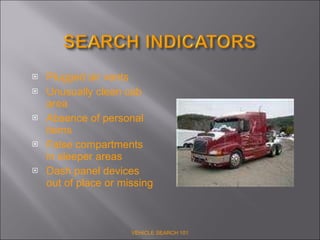
Plugged air vents Unusually clean cab area Absence of personal items False compartments in sleeper areas Dash panel devices out of place or missing VEHICLE SEARCH 101
 
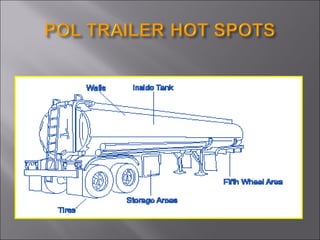
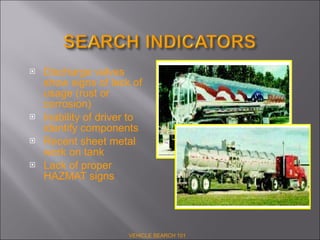
Discharge valves show signs of lack of usage (rust or corrosion) Inability of driver to identify components Recent sheet metal work on tank Lack of proper HAZMAT signs VEHICLE SEARCH 101
VEHICLE SEARCH 101
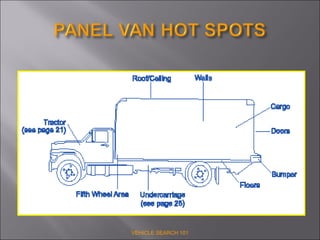
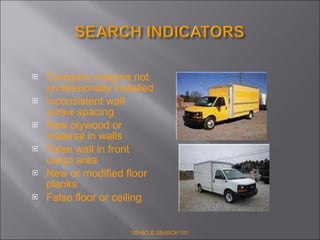
Company insignia not professionally installed Inconsistent wall screw spacing  New plywood or material in walls False wall in front cargo area New or modified floor planks False floor or ceiling VEHICLE SEARCH 101
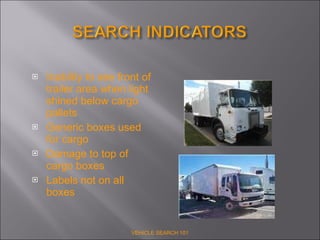
Inability to see front of trailer area when light shined below cargo pallets Generic boxes used for cargo Damage to top of cargo boxes  Labels not on all boxes VEHICLE SEARCH 101
Vehicle markings:  All commercial vehicles have US DOT or MC numbers  Most have professionally applied company logos Verify vehicle identification numbers  HAZMAT placards should match cargo Check state DOT decals for overdue inspections Most drivers carry trailer receipts for non-company trailers; verify receipts against trailer logo
VEHICLE SEARCH 101
VEHICLE SEARCH 101
 
Seizure places a responsibility on those who take custody of the object to exercise care over the item.  This responsibility involves insuring that neither the object nor its evidentiary value is damaged or destroyed.  Remember that the object, if not contraband, will be  returned to the true owner  after the matter is resolved.  Care must be exercised in the handling of the item's seized.
Actually seize or collect the item. Issue a receipt  for the items taken. Initiate the evidence tag and maintain the  chain of custody. Mark the item for identification. Secure it  (Attempt not to let other people handle it, to include other security officers due to destruction of possible latent fingerprints).   keep care and preservation in mind throughout each of these steps.
Do not detain Do not search against a person’s will Do not use  force  in order to conduct the search Security Officer has the rights of citizen's arrest, bearing arms and acting in agency---all rights common to every citizen without a felony conviction.
*  provides protection against  unreasonable searches  and seizures by  governmental agencies/officials . We do not represent a governmental agency.  REMEMBER!! we must anticipate that  every action that we take will be closely scrutinized  in an adversary system.  This will insure that the results of our efforts are usable. We should anticipate that we will be called upon to testify as to what steps we accomplished and what we found .
http://www.linkedin.com/in/bendavila Ben Davila Security Specialist/LA Narcotic Task Force Officer
http://www.armystudyguide.com/content/SMCT_CTT_Tasks/Skill_Level_1/1913765140-search-a-vehic.shtml http://www.ehow.com/how_7571303_perform-vehicle-security-search.html   http://www.armystudyguide.com/content/SMCT_CTT_Tasks/Skill_Level_1/index.shtml

Vehicle Search 101

  • 1.
    Basic Procedures ForSecurity Officers
  • 2.
    Objective To be familiar with the proper basic procedures to follow in conducting searches and seizures and to specifically outline the legal and ethical restrictions involved.
  • 3.
    Review basic procedures in conducting vehicle searches and seizures VEHICLE SEARCH 101
  • 4.
    Always position yourselfso that you are highly visible to traffic Always establish eye contact with the driver before approaching the vehicle Always ensure driver turns off engine and sets parking brake prior to inspection Always know where the driver/passengers are Always have driver open doors/compartments SAFETY FIRST
  • 5.
    A search issimply an examination of a person , place , possession or vehicle . What are we looking for? Fruits of the crime, i.e., the stolen goods, the object the crime was committed with, etc. Contraband. Items that are against the law to possess, i.e., narcotics, counterfeit currency, short barrel shot gun, etc. Prohibited property. Items prohibited by company rules, i.e. alcoholic beverages, cameras, firearms, explosives, etc. Be aware of current conditions (threat, support, response available, weather, etc)
  • 6.
    Never inspect avehicle with the motor running Never get into a vulnerable position in relation to the driver and vehicle occupants Never TOUCH any suspicious items Establish a thorough and systematic routine
  • 7.
    Drivers are interviewedas part of any vehicle search to gather information about any unknown individual that may indicate a potential threat An indicator is an item, occurrence, condition, or situation that suggests the presence of contraband or explosive materials (combinations of indicators should raise suspicion and warrant more detailed search, contact a supervisor or to call local authorities for support) VEHICLE SEARCH 101
  • 8.
    Critical information isobtained as part of a driver interview by: Observing behavior Observing vehicle appearance Questioning of driver and occupants "where are you going?“. Recognizing stress or deception mechanisms Knowledge of local mannerisms, documents, etc. listening to answers, make sure to make eye contact with the people in the car Always be polite and respectful
  • 9.
    Background information everyentry controller should know: Local or typical traffic regulations and laws Different vehicle type characteristics Information that can be gained from driver interview, driver identification and vehicle documents Existing intelligence information, threat level, and criminal patterns VEHICLE SEARCH 101
  • 10.
    Typical documentation tocheck as part of interview: Drivers license / Identification Shipment manifests Bill of lading or shipping papers
  • 11.
    Driver inappropriately dressedfor vehicle type Driver does not know specific destination Driver documentation incomplete or brand new Driver explanation of delivery makes no sense Driver exhibits nervousness or impatience Driver refuses to submit to search team requests or answer questions
  • 12.
    Anything contained infactory built compartments or firewall spaces New or shiny bolts, screw, or brackets on open road vehicles Bent sheet metal or broken covers Wire or tape unattached to electrical parts New or broken welds on undercarriage No vehicle identification number (VIN) Any area or component cleaner or dirtier than surrounding area
  • 13.
    Any light notworking Heavy doors or compartment covers Foreign items in gas tank tube Freshly painted, new, clean or foreign objects in engine compartment False or modified ceilings, floorboards or walls Items taped or attached to frame
  • 14.
  • 15.
    New trunk mat/carpetHeavy trunk lid Raised floors Unusual space between rear seat and trunk Spare tire not flush with floor
  • 16.
  • 17.
    Heavy tailgate Unusualwelds or seams in bed Unusual space between bed and undercarriage VEHICLE SEARCH 101 SEARCH INDICATORS
  • 18.
  • 19.
    Entering and exitingthe cab or climbing on the tractor or trailer of a large vehicle seems like a simple job. But, every year a majority of our driver related injuries happen while entering or exiting the cab. VEHICLE SEARCH 101
  • 20.
    Will help youavoid slip injuries and properly distribute your weight to prevent pulled muscles. Put simply: ‘3-point stance” means that 3 of your 4 limbs are firmly placed on part of the truck at all times - - either 2 hands and 1 foot , or 2 feet and 1 hand. Exit the truck by climbing backward, as down a ladder, maintaining three points of contact at all times .
  • 21.
    False compartment infifth wheel area Front grill modified Thick or false fenders Missing connections for brakes and air hookups Can’t see through undercarriage VEHICLE SEARCH 101
  • 22.
    Plugged air ventsUnusually clean cab area Absence of personal items False compartments in sleeper areas Dash panel devices out of place or missing VEHICLE SEARCH 101
  • 23.
  • 24.
    Discharge valves showsigns of lack of usage (rust or corrosion) Inability of driver to identify components Recent sheet metal work on tank Lack of proper HAZMAT signs VEHICLE SEARCH 101
  • 25.
  • 26.
    Company insignia notprofessionally installed Inconsistent wall screw spacing New plywood or material in walls False wall in front cargo area New or modified floor planks False floor or ceiling VEHICLE SEARCH 101
  • 27.
    Inability to seefront of trailer area when light shined below cargo pallets Generic boxes used for cargo Damage to top of cargo boxes Labels not on all boxes VEHICLE SEARCH 101
  • 28.
    Vehicle markings: All commercial vehicles have US DOT or MC numbers Most have professionally applied company logos Verify vehicle identification numbers HAZMAT placards should match cargo Check state DOT decals for overdue inspections Most drivers carry trailer receipts for non-company trailers; verify receipts against trailer logo
  • 29.
  • 30.
  • 31.
  • 32.
    Seizure places aresponsibility on those who take custody of the object to exercise care over the item. This responsibility involves insuring that neither the object nor its evidentiary value is damaged or destroyed. Remember that the object, if not contraband, will be returned to the true owner after the matter is resolved. Care must be exercised in the handling of the item's seized.
  • 33.
    Actually seize orcollect the item. Issue a receipt for the items taken. Initiate the evidence tag and maintain the chain of custody. Mark the item for identification. Secure it (Attempt not to let other people handle it, to include other security officers due to destruction of possible latent fingerprints). keep care and preservation in mind throughout each of these steps.
  • 34.
    Do not detainDo not search against a person’s will Do not use force in order to conduct the search Security Officer has the rights of citizen's arrest, bearing arms and acting in agency---all rights common to every citizen without a felony conviction.
  • 35.
    * providesprotection against unreasonable searches and seizures by governmental agencies/officials . We do not represent a governmental agency. REMEMBER!! we must anticipate that every action that we take will be closely scrutinized in an adversary system. This will insure that the results of our efforts are usable. We should anticipate that we will be called upon to testify as to what steps we accomplished and what we found .
  • 36.
    http://www.linkedin.com/in/bendavila Ben DavilaSecurity Specialist/LA Narcotic Task Force Officer
  • 37.