Defensive Driving Presentation
(Construction Vehicle Hazards)
Defensive Driving
AGENDA
 Introduction/Statistics
Company’s Driver Safety Performance
 Construction Vehicle Hazards
 Safety Videos
 15 Driver Safety Tips (handout)
General Discussion
WHY DRIVER TRAINING?
Driving is something we all do daily.
It’s the most dangerous thing we do, and is the
number one killer of those under 50 years of
age.
It’s responsible for over 50% of all work-related
fatalities.
General Discussion
Statistics
Nationwide:
– 40,000 people die each year!
– 115 drivers go to work today will never return!
Missouri:
– 180,000 Collisions:
 90,000 Injuries
 1,100 Fatalities
General Discussion
Continuation
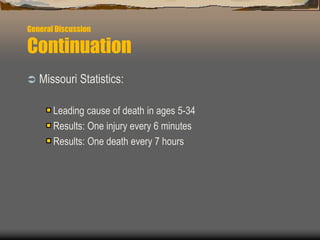
 Missouri Statistics:
Leading cause of death in ages 5-34
Results: One injury every 6 minutes
Results: One death every 7 hours
General Discussion
Continuation
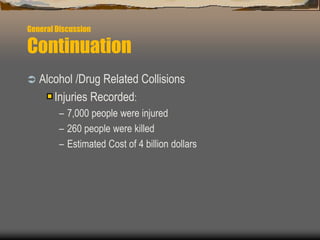
 Alcohol /Drug Related Collisions
Injuries Recorded:
– 7,000 people were injured
– 260 people were killed
– Estimated Cost of 4 billion dollars
GeneralDiscussion
Why Accidents Occur?
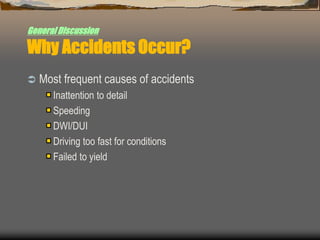
 Most frequent causes of accidents
Inattention to detail
Speeding
DWI/DUI
Driving too fast for conditions
Failed to yield
Driver Safety Accountability
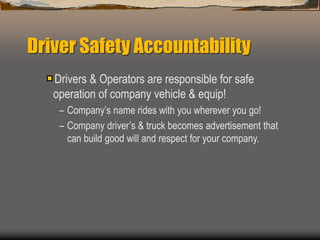
Drivers & Operators are responsible for safe
operation of company vehicle & equip!
– Company’s name rides with you wherever you go!
– Company driver’s & truck becomes advertisement that
can build good will and respect for your company.
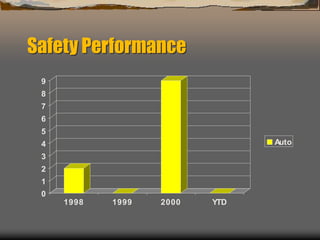
Safety Performance
0
1
2
3
4
5
6
7
8
9
1998 1999 2000 YTD
Auto
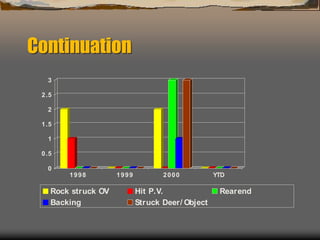
Continuation
0
0.5
1
1.5
2
2.5
3
1998 1999 2000 YTD
Rock struck OV Hit P.V. Rearend
Backing Struck Deer/ Object
Vehicle Hazards
Construction Operations/Environment
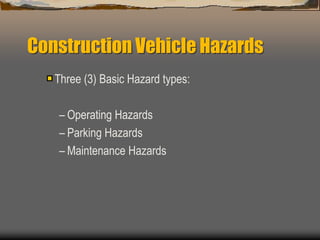
Construction Vehicle Hazards
Three (3) Basic Hazard types:
– Operating Hazards
– Parking Hazards
– Maintenance Hazards
Operating Hazards
 Types:
Rollovers
Striking workers/pedestrians
Striking Overhead Objects (Inadequate clearance)
Operating Hazards
1) Rollovers (causes):
– Exceeding the Load Limits
– Inadequate loading methods.
– Operating too fast for conditions!
Operating Hazards
 2) Striking workers/pedestrian on foot:
Inadequate brakes
Malfunctioning back-up alarms
Op. neglects to check blind spot
Improperly barricade areas from pedestrian access
Operating Hazards
 3) Striking overhead objects (causes):
Inadequate clearances
– Knocking down overhead wires and tree branches
– Cab potentially becomes energized when vehicle
/equipment hits overhead wires (shock hazards)!
Prevention Techniques
Best management practices/strategies!
Prevention Techniques
 Strategies (General):
Use of hard hats & high visibility vests are vital!
All drivers must be trained in the safe operation of
vehicle & equipment!
Preventing Pedestrian Strikes
Perform regular maintenance!
Brakes must be able to stop and hold fully loaded
equipment.
Verify back-up alarms work!
Check for nearby workers before starting machine
(Circle of Safety)
use mirrors!
Make sure glass is not distorted.
Preventing overhead
obstructions
 Instruct operators to check clearance each time
they start vehicle & equipment.
 Flag electrical lines to ensure visibility.
 Maintain a safe distance from electrical lines!
Parking Hazards
 Major Hazard associated with parked construction
vehicles?
Struck by other vehicles (traffic)
 Employee parking should be away from construction work
zones!
 “Only Operating construction equipment “ is acceptable!
Preventing Parking strikes
 Park equipment completely off the road (30 feet
from the traffic)
 Barricade vehicle and equipment that must stay
on the road! Lights and flashers should be used
as well.
 Set all brakes when vehicles are not in use.
Continuation
 Chock the wheels, especially when vehicles are on an
incline.
 Lower the equipment when parking a construction
vehicle/equipment!
Maintenance Hazards
 Refueling vehicles and equipment? (if so):
Provide training on safe procedures for refueling,
maintenance and repair!
– Perform lockout/tagout as required
– Chock disabled equipment!
Driver Training
Lets watch a VIDEO!!!!!
GeneralDiscussion
Driver Expectations?
 Company expects high standards of performance, including safe
driving.
 Company expects not just safe driving performance, but award
winning safety performance.
WHY?
 Because it’s possible!!
Driver Safety Practices
(Defensive Driving Safety Tips)
15 in 30
1) Pre-Trip & Post Trip Inspection
Take a walk around your vehicle.
Windows clean?
Lights/signals clean & working.
Tires properly inflated / tread wear.
Fluid leaks on the ground.
Check the level of coolant in radiator
Check engine oil, steering fluid and hydraulic fluid.
Continuation
 Check the battery
 Report any broken or defective equipment
 Verify back up alarm is audible!
 Make sure steps, catwalks and handholds free from
grease, ice and loose materials.
 Check belts! Report any frayed,worn or loose belts.
15 in 30
2) Inside the Vehicle
 Check Seat Belts
 Check Mirrors
 Check horn, headlights,blinkers, and emergency
flashers & wipers
 Verify backup alarm is working
 Check fuel gauges
15 in 30
3) Your State Of Mind
Mental State:
 Stress / Emotions / Attitudes
 Drowsiness / Fatigue
 Vision / Hearing
 Alcohol
Myths about ALCOHOL
Myth: Coffee will sober up a drinker.
Fact: Coffee only makes a wide awake drunk.
Myth: Strenuous exercise will sober up a drinker.
Fact: Exercise makes a hot, sticky drunk.
Myth: A cold shower will sober up a drinker.
Fact: A cold shower only makes a cold, wet drunk.
Myth: A cold swim will sober up a drinker.
Fact: A cold swim could result in a dead drunk.
The Alcohol Process
 When ingested, approximately 5% enters the blood
stream directly thru the mouth and throat tissues.
 80% is absorbed thru the small intestine after passing
thru the stomach.
 Alcohol distributes itself to organs with the highest fluid
content, concentrating on organs with large blood
supplies like the brain and liver.
The Alcohol Process (continued)
 Alcohol cannot be stored in tissue, and less than 10% is
eliminated by the kidneys, lungs, and skin.
 The liver eliminates the other 90% thru the process of oxidation.
 The liver can eliminate approximately one drink per hour.
15 in 30
4) Getting the Big Picture
Scan the road ahead
– City (Approx. 1 block)
– Rural (Approx. 1/4 mile)
Keep your eyes moving.
– Check your mirrors every 5 seconds.
15 in 30
5) Following Distance
Speed & Stopping distance are key.
Stay 3 to 4 seconds behind.
Tailgaters
Avoid quick changes.
Increase your following distance.
Don’t speed up.
Avoid tricks. (Control emotions.)
15 in 30
6) Lane Changes
 Check to make sure there is enough room.
 Signal your intentions.
 Check your blind spot and space again.
 Make the lane change.
 Blind Spots
Don’t drive in someone else’s.
Make yourself as visible as possible. (*At all times)
15 in 30
7) Avoiding On-the-Job Problems
 Entering Job-sites:
Check area thoroughly
Watch for workers in the area
Look for obstacles:
– gas meters, phone/power lines, septic systems
– Get help backing out of tight spots
– Do not drive sideway on hills
15 in 30
8) Right-Of-Way
 At an intersection, the vehicle on the right has
the right to go first.
NO ONE IS GUARANTEED THE RIGHT OF WAY.
15 in 30
9) Backing
Use extreme caution!
Use a helper (spotter) when possible!
Consider using hand signals!
– Look at your path.
– Back slowly.
– Back to the driver’s side when possible.
15 in 30
10) Ramps (On / Off)
 Obey speed limits posted.
– Speed limits designed for autos; larger vehicles need to
go slower.
 Exits going downhill and turning are particularly
dangerous.
15 in 30
11) Signs
 Regulatory Signs
 Warning Signs
15 in 30
12) Railroad Crossings
 The cross buck is found at most public crossings.
 These signs should be treated in the same manner as a
yield sign.
15 in 30
13) Emergency Vehicles
 Immediately move to the right of your lane, to another lane, or to
the shoulder if possible.
 If moving right is not possible, stay where you are. Do not move
left.
15 in 30
14) Winter Driving
 IDENTIFYING SLIPPERY SURFACES.
Shaded Areas - Shady parts of the road will remain icy and
slippery after open areas have melted.
Bridges - Bridges freeze before roads do.
Melting Ice - Slight melting will make ice wet.
Black Ice - If the temperature is below freezing and the road looks
wet.
Vehicle Ice - Open the window and feel the front of the mirror and
antenna. (The road is icing up!)
15 in 30
15) Accident Reporting
 Report any accident immediately, no matter how minor.
 Get a police report whenever possible.
 Complete the vehicle Accident Reporting Kit!

Defensive_Driving.ppt

  • 1.
  • 2.
    Defensive Driving AGENDA  Introduction/Statistics Company’sDriver Safety Performance  Construction Vehicle Hazards  Safety Videos  15 Driver Safety Tips (handout)
  • 3.
    General Discussion WHY DRIVERTRAINING? Driving is something we all do daily. It’s the most dangerous thing we do, and is the number one killer of those under 50 years of age. It’s responsible for over 50% of all work-related fatalities.
  • 4.
    General Discussion Statistics Nationwide: – 40,000people die each year! – 115 drivers go to work today will never return! Missouri: – 180,000 Collisions:  90,000 Injuries  1,100 Fatalities
  • 5.
    General Discussion Continuation  MissouriStatistics: Leading cause of death in ages 5-34 Results: One injury every 6 minutes Results: One death every 7 hours
  • 6.
    General Discussion Continuation  Alcohol/Drug Related Collisions Injuries Recorded: – 7,000 people were injured – 260 people were killed – Estimated Cost of 4 billion dollars
  • 7.
    GeneralDiscussion Why Accidents Occur? Most frequent causes of accidents Inattention to detail Speeding DWI/DUI Driving too fast for conditions Failed to yield
  • 8.
    Driver Safety Accountability Drivers& Operators are responsible for safe operation of company vehicle & equip! – Company’s name rides with you wherever you go! – Company driver’s & truck becomes advertisement that can build good will and respect for your company.
  • 9.
  • 10.
    Continuation 0 0.5 1 1.5 2 2.5 3 1998 1999 2000YTD Rock struck OV Hit P.V. Rearend Backing Struck Deer/ Object
  • 11.
  • 12.
    Construction Vehicle Hazards Three(3) Basic Hazard types: – Operating Hazards – Parking Hazards – Maintenance Hazards
  • 13.
    Operating Hazards  Types: Rollovers Strikingworkers/pedestrians Striking Overhead Objects (Inadequate clearance)
  • 14.
    Operating Hazards 1) Rollovers(causes): – Exceeding the Load Limits – Inadequate loading methods. – Operating too fast for conditions!
  • 15.
    Operating Hazards  2)Striking workers/pedestrian on foot: Inadequate brakes Malfunctioning back-up alarms Op. neglects to check blind spot Improperly barricade areas from pedestrian access
  • 16.
    Operating Hazards  3)Striking overhead objects (causes): Inadequate clearances – Knocking down overhead wires and tree branches – Cab potentially becomes energized when vehicle /equipment hits overhead wires (shock hazards)!
  • 17.
  • 18.
    Prevention Techniques  Strategies(General): Use of hard hats & high visibility vests are vital! All drivers must be trained in the safe operation of vehicle & equipment!
  • 19.
    Preventing Pedestrian Strikes Performregular maintenance! Brakes must be able to stop and hold fully loaded equipment. Verify back-up alarms work! Check for nearby workers before starting machine (Circle of Safety) use mirrors! Make sure glass is not distorted.
  • 20.
    Preventing overhead obstructions  Instructoperators to check clearance each time they start vehicle & equipment.  Flag electrical lines to ensure visibility.  Maintain a safe distance from electrical lines!
  • 21.
    Parking Hazards  MajorHazard associated with parked construction vehicles? Struck by other vehicles (traffic)  Employee parking should be away from construction work zones!  “Only Operating construction equipment “ is acceptable!
  • 22.
    Preventing Parking strikes Park equipment completely off the road (30 feet from the traffic)  Barricade vehicle and equipment that must stay on the road! Lights and flashers should be used as well.  Set all brakes when vehicles are not in use.
  • 23.
    Continuation  Chock thewheels, especially when vehicles are on an incline.  Lower the equipment when parking a construction vehicle/equipment!
  • 24.
    Maintenance Hazards  Refuelingvehicles and equipment? (if so): Provide training on safe procedures for refueling, maintenance and repair! – Perform lockout/tagout as required – Chock disabled equipment!
  • 25.
  • 26.
    GeneralDiscussion Driver Expectations?  Companyexpects high standards of performance, including safe driving.  Company expects not just safe driving performance, but award winning safety performance. WHY?  Because it’s possible!!
  • 27.
  • 28.
    15 in 30 1)Pre-Trip & Post Trip Inspection Take a walk around your vehicle. Windows clean? Lights/signals clean & working. Tires properly inflated / tread wear. Fluid leaks on the ground. Check the level of coolant in radiator Check engine oil, steering fluid and hydraulic fluid.
  • 29.
    Continuation  Check thebattery  Report any broken or defective equipment  Verify back up alarm is audible!  Make sure steps, catwalks and handholds free from grease, ice and loose materials.  Check belts! Report any frayed,worn or loose belts.
  • 30.
    15 in 30 2)Inside the Vehicle  Check Seat Belts  Check Mirrors  Check horn, headlights,blinkers, and emergency flashers & wipers  Verify backup alarm is working  Check fuel gauges
  • 31.
    15 in 30 3)Your State Of Mind Mental State:  Stress / Emotions / Attitudes  Drowsiness / Fatigue  Vision / Hearing  Alcohol
  • 32.
    Myths about ALCOHOL Myth:Coffee will sober up a drinker. Fact: Coffee only makes a wide awake drunk. Myth: Strenuous exercise will sober up a drinker. Fact: Exercise makes a hot, sticky drunk. Myth: A cold shower will sober up a drinker. Fact: A cold shower only makes a cold, wet drunk. Myth: A cold swim will sober up a drinker. Fact: A cold swim could result in a dead drunk.
  • 33.
    The Alcohol Process When ingested, approximately 5% enters the blood stream directly thru the mouth and throat tissues.  80% is absorbed thru the small intestine after passing thru the stomach.  Alcohol distributes itself to organs with the highest fluid content, concentrating on organs with large blood supplies like the brain and liver.
  • 34.
    The Alcohol Process(continued)  Alcohol cannot be stored in tissue, and less than 10% is eliminated by the kidneys, lungs, and skin.  The liver eliminates the other 90% thru the process of oxidation.  The liver can eliminate approximately one drink per hour.
  • 35.
    15 in 30 4)Getting the Big Picture Scan the road ahead – City (Approx. 1 block) – Rural (Approx. 1/4 mile) Keep your eyes moving. – Check your mirrors every 5 seconds.
  • 36.
    15 in 30 5)Following Distance Speed & Stopping distance are key. Stay 3 to 4 seconds behind. Tailgaters Avoid quick changes. Increase your following distance. Don’t speed up. Avoid tricks. (Control emotions.)
  • 37.
    15 in 30 6)Lane Changes  Check to make sure there is enough room.  Signal your intentions.  Check your blind spot and space again.  Make the lane change.  Blind Spots Don’t drive in someone else’s. Make yourself as visible as possible. (*At all times)
  • 38.
    15 in 30 7)Avoiding On-the-Job Problems  Entering Job-sites: Check area thoroughly Watch for workers in the area Look for obstacles: – gas meters, phone/power lines, septic systems – Get help backing out of tight spots – Do not drive sideway on hills
  • 39.
    15 in 30 8)Right-Of-Way  At an intersection, the vehicle on the right has the right to go first. NO ONE IS GUARANTEED THE RIGHT OF WAY.
  • 40.
    15 in 30 9)Backing Use extreme caution! Use a helper (spotter) when possible! Consider using hand signals! – Look at your path. – Back slowly. – Back to the driver’s side when possible.
  • 41.
    15 in 30 10)Ramps (On / Off)  Obey speed limits posted. – Speed limits designed for autos; larger vehicles need to go slower.  Exits going downhill and turning are particularly dangerous.
  • 42.
    15 in 30 11)Signs  Regulatory Signs  Warning Signs
  • 43.
    15 in 30 12)Railroad Crossings  The cross buck is found at most public crossings.  These signs should be treated in the same manner as a yield sign.
  • 44.
    15 in 30 13)Emergency Vehicles  Immediately move to the right of your lane, to another lane, or to the shoulder if possible.  If moving right is not possible, stay where you are. Do not move left.
  • 45.
    15 in 30 14)Winter Driving  IDENTIFYING SLIPPERY SURFACES. Shaded Areas - Shady parts of the road will remain icy and slippery after open areas have melted. Bridges - Bridges freeze before roads do. Melting Ice - Slight melting will make ice wet. Black Ice - If the temperature is below freezing and the road looks wet. Vehicle Ice - Open the window and feel the front of the mirror and antenna. (The road is icing up!)
  • 46.
    15 in 30 15)Accident Reporting  Report any accident immediately, no matter how minor.  Get a police report whenever possible.  Complete the vehicle Accident Reporting Kit!