
PLN9 Security Services Pvt. Ltd.
Patrolling
The Concept And Actual
AIM
The aim of this lecture is to enable the trainees
to carry out effective patrolling in the Industrial
Premises.
Learning Outcomes
• At the end of this lecture the trainees should be able
to:-
• Understand the objectives of Patrolling.
• Know about the various types of patrols.
• Methodology of patrolling.
• Preparation for patrolling.
• While patrolling what to perceive and record.
• Use of senses.
• Organizing and conducting patrol.
Parts
• Purpose
• Types
• Pattern and Communication.
• Preparation and Conduct.
• Patrol Records
• Benefits of Effective Patrolling.
• Performance Expectation from a Person on Patrolling
Duty.
• Tasking Of Patrols.
• Conclusion.
Practical
• PART-I Organizing and conducting.
• PART-II Checks and duties.
• PART-III Preparation of report.
Part-II: Types Of Patrols
• External
• Internal
• Route
• General
External Patrol
External patrols cover/ observe the following: -
• The open grounds,
• Parking,
• Areas surrounding the facility /building.
• Facilities surrounding the building and perimeter
• Vulnerable approaches from perimeter.
• Repair and functional state of the barriers/ perimeter and watch towers.
• Watch the activities in neighbouring villages, which may be disturbing. This needs
to be done with tact
Purpose
• To deny intrusion and delay intrusion,
• To prevent carrying of unauthorized property from the facility,
Note
Security personnel conducting external patrolling will enhance the over all level of
protection by constantly observing the perimeter areas and external spaces.
Internal Patrols
Purpose.
• To ensure the security of the plant and machinery, and all their elements.
• Remain on top of things as far as security is concerned.
Points to be Checked
• The points as enumerated for External Patrols.
• Checking of doors & windows, correcting & reporting abnormal conditions
(open/ closed/Locked / unlocked / broken).
• Checking Fire protection equipment (sprinkles, riser, fire extinguishers,
and fire alarm panel) for proper condition.
• General observation like what all thing or equipment are lying in
workstations, any unattended object lying on the floor and any suspicious
movement of the people
General Patrolling
It should also be done by SOs at the commencement of duty, intermittently,
and prior to leaving the facility at closing hours. Purpose of this would be
as follows: -
• Check security.
• Ensure safety.
• Monitoring the duties of the security staff.
• At the close, ensuring that locks and doors/ windows and ventilators are
secure.
• Remain on top of things.
• Give report/ feedback to the superiors.
Note
This type of patrol is characterized by surprise, alertness and flexibilty.
Revision Questionaire
• What are the purposes of patrolling?
• Name the types of patrolling?
• How many ways are there to record the patrolling timings,
name them?
• What is the purpose and duties in External, internal, and
general patrolling activity.
Communication
• Use of Good languages & diction.
• Remember – It is not an entertainment device.
• Do not cut in some one during the conversation.
• Do not hold radio too close to your mouth when speaking.
• Use radiotelephony procedures and language.
Preparation
While preparing to leave on a patrol assignment should always check his
equipment.
• A watch,
• Pen, and
• Note book are needed for good reporting.
• A weapon if the nature of patrol requires.
• Walkie Talkies/Mobile for communication.
• For Night patrol, an explosion-proof type flash-light should be carried.
• Raincoat/ umbrella if required.
• A water bottle for long patrol.
Note
The patrol shall essentially be conducted in uniform.
Conduct
• Routes are normally covered in one or two hours.
• It is a general practice for two security personnel to alternate routes from
a fixed post such as gatehouse.
• One patrolman/ security guard would be on gate duty during the period
of time that his partner is covering the route.
• On return to the gatehouse after the one hour tour, the patrolman would
switch.
• Accordingly, one half of the timeframe is utilized for patrolling and other
half at the Gate.
Details of Patrol Record
• Record Serial number
• Date & time
• Patrol party details
• Whether on foot, mobile or dog patrol?
• Specialized equipment used or not
• Communication details
• From place to place
• Patrol out and in time
• Tasking in clear, specific and brief
• Details of movements and what time
Record/Action In Case Of An
Incident
Actions/ Make notes
(i) Who saw, when and how – brief details
(ii) Action taken – Brief details
(iii) Reporting – whom and when
(iv) What further actions were taken by authority on being reported
• Submission of patrol reports by security personnel on return from patrol
duties.
• Debriefing of patrol party by security officer at the earliest.
Areas To Be Watched/ Observed
• Location of fire alarm and watch stations
• Location of telephones
• Identity of key personnel in each area
• Layout of the facility
• Location of utility controls
• Stairway locations
• Light switches and emergency lighting panels
• Storage areas of flammable and hazardous materials
• Locations of first aid and medical facilities.
• Product and high value storage areas.
• Location of Emergency Exit / Fire doors
• The knowledge of which doors should be locked. Should be handy.
• Complete layout of the buildings should be available.
Performance Expectation from a
Person on Patrol Duty
Whether a patrolman is assigned to route patrol or general patrol, he may
have to perform any of the following:-
• Observe hazardous conditions and take necessary corrective measures
• Enforce state and local laws as prescribed by his superiors
• Enforce company rules and regulations
• Be alert for and report possible environment problems
• Assist other company personnel as needed
• Protect personnel, property and information
What should ‘SO’ See Perceive &
Record
• Tasking: What tasks will you be assigning to a patrol? Will it be a general
observation patrol or a beat routine patrol? Will it to find, locate and
introduce/ objectionable objects in a specific area? Accordingly, a patrol
will be briefed and tasked to find, locate, identify, apprehend and search.
• Training Have the members of a patrol party been given specialized
training? Are they technically competent through technical training for
patrolling tasks requiring use of specialized equipment?
• Duration & Acquaintance. How long are the members of the patrol
working in a particular factory/organization? Are the members of the
patrol party well acquainted with the area in which
Some Tasks
• To carryout patrolling in area form A to B from time X to time Y with a view
to preventing entry of intruder/ objectionable person.
• To locate and identify in intruder/ objectionable person.
• To identify fire and spill over hazards and intimate all concerned for action.
• To locate unlocked doors/windows put them under locks and keys.
• To check security /safety systems especially at night.
• To check barrier system and rectify.
• To check that the locks, doors and ventilators are secure.
Using Sensory Perceptions
• Rely upon this common senses to determine if conditions are normal
or abnormal.
• Use his sense of vision to recognize familiar objects in familiar
objects. Additionally, vision will indicate change in the surroundings
has occurred since last patrol.
• The sense of hearing will enable a security person to distinguish
various happenings, say, glass breakages and malfunctioning
equipment from normal operations.
• The sense of touch enables us to identify equipment malfunctioning,
possibility of outbreak of fire, short circuiting, leakage of lubricants,
and fuel etc
Using Sensory Perceptions
• The sense of smell allows a security person to distinguish
normal aroma form acidic, chemical burning fumes.
• Security Officers can use taste buds to better use when
suspicious. As such, the taste buds also require to be trained.
Gut-feeling/Intuition/ Sixth Sense/
• It is essential that a security person learn what a normal
situation from an abnormal situation is.
• When a security person believes that a condition may be
“abnormal” further investigation and follow up is required.
Sixth sense?
• Knowing what is going on around you/ identifying a problem
before it happens. If you are conscientious, you have it.
Revision Questionnaire
• What items would you advise the patrol to carry to maintain
records?
• What information should the patrol gather during the
patrolling?
• What needs to be recorded during the patrolling? Name any
five.
• What actions are to be taken/ records made, on occurrence of
an incident.
• What are various tasks that could be given to a patrol? Name
any five.
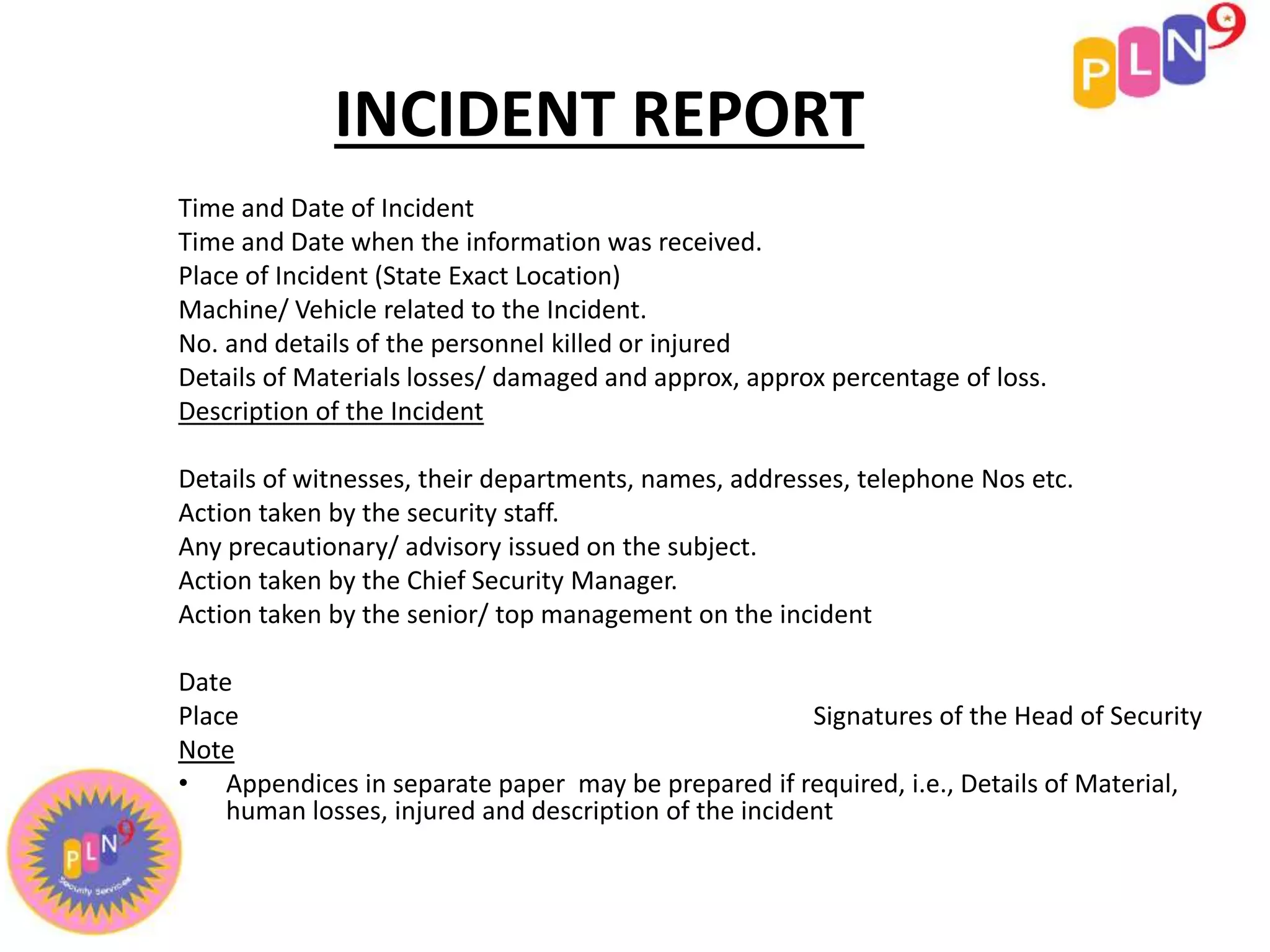
INCIDENT REPORT
Time and Date of Incident
Time and Date when the information was received.
Place of Incident (State Exact Location)
Machine/ Vehicle related to the Incident.
No. and details of the personnel killed or injured
Details of Materials losses/ damaged and approx, approx percentage of loss.
Description of the Incident
Details of witnesses, their departments, names, addresses, telephone Nos etc.
Action taken by the security staff.
Any precautionary/ advisory issued on the subject.
Action taken by the Chief Security Manager.
Action taken by the senior/ top management on the incident
Date
Place Signatures of the Head of Security
Note
• Appendices in separate paper may be prepared if required, i.e., Details of Material,
human losses, injured and description of the incident
Thank You

Patrolling

  • 1.
  • 2.
  • 3.
    AIM The aim ofthis lecture is to enable the trainees to carry out effective patrolling in the Industrial Premises.
  • 4.
    Learning Outcomes • Atthe end of this lecture the trainees should be able to:- • Understand the objectives of Patrolling. • Know about the various types of patrols. • Methodology of patrolling. • Preparation for patrolling. • While patrolling what to perceive and record. • Use of senses. • Organizing and conducting patrol.
  • 5.
    Parts • Purpose • Types •Pattern and Communication. • Preparation and Conduct. • Patrol Records • Benefits of Effective Patrolling. • Performance Expectation from a Person on Patrolling Duty. • Tasking Of Patrols. • Conclusion.
  • 6.
    Practical • PART-I Organizingand conducting. • PART-II Checks and duties. • PART-III Preparation of report.
  • 7.
    Part-II: Types OfPatrols • External • Internal • Route • General
  • 8.
    External Patrol External patrolscover/ observe the following: - • The open grounds, • Parking, • Areas surrounding the facility /building. • Facilities surrounding the building and perimeter • Vulnerable approaches from perimeter. • Repair and functional state of the barriers/ perimeter and watch towers. • Watch the activities in neighbouring villages, which may be disturbing. This needs to be done with tact Purpose • To deny intrusion and delay intrusion, • To prevent carrying of unauthorized property from the facility, Note Security personnel conducting external patrolling will enhance the over all level of protection by constantly observing the perimeter areas and external spaces.
  • 9.
    Internal Patrols Purpose. • Toensure the security of the plant and machinery, and all their elements. • Remain on top of things as far as security is concerned. Points to be Checked • The points as enumerated for External Patrols. • Checking of doors & windows, correcting & reporting abnormal conditions (open/ closed/Locked / unlocked / broken). • Checking Fire protection equipment (sprinkles, riser, fire extinguishers, and fire alarm panel) for proper condition. • General observation like what all thing or equipment are lying in workstations, any unattended object lying on the floor and any suspicious movement of the people
  • 10.
    General Patrolling It shouldalso be done by SOs at the commencement of duty, intermittently, and prior to leaving the facility at closing hours. Purpose of this would be as follows: - • Check security. • Ensure safety. • Monitoring the duties of the security staff. • At the close, ensuring that locks and doors/ windows and ventilators are secure. • Remain on top of things. • Give report/ feedback to the superiors. Note This type of patrol is characterized by surprise, alertness and flexibilty.
  • 11.
    Revision Questionaire • Whatare the purposes of patrolling? • Name the types of patrolling? • How many ways are there to record the patrolling timings, name them? • What is the purpose and duties in External, internal, and general patrolling activity.
  • 12.
    Communication • Use ofGood languages & diction. • Remember – It is not an entertainment device. • Do not cut in some one during the conversation. • Do not hold radio too close to your mouth when speaking. • Use radiotelephony procedures and language.
  • 13.
    Preparation While preparing toleave on a patrol assignment should always check his equipment. • A watch, • Pen, and • Note book are needed for good reporting. • A weapon if the nature of patrol requires. • Walkie Talkies/Mobile for communication. • For Night patrol, an explosion-proof type flash-light should be carried. • Raincoat/ umbrella if required. • A water bottle for long patrol. Note The patrol shall essentially be conducted in uniform.
  • 14.
    Conduct • Routes arenormally covered in one or two hours. • It is a general practice for two security personnel to alternate routes from a fixed post such as gatehouse. • One patrolman/ security guard would be on gate duty during the period of time that his partner is covering the route. • On return to the gatehouse after the one hour tour, the patrolman would switch. • Accordingly, one half of the timeframe is utilized for patrolling and other half at the Gate.
  • 15.
    Details of PatrolRecord • Record Serial number • Date & time • Patrol party details • Whether on foot, mobile or dog patrol? • Specialized equipment used or not • Communication details • From place to place • Patrol out and in time • Tasking in clear, specific and brief • Details of movements and what time
  • 16.
    Record/Action In CaseOf An Incident Actions/ Make notes (i) Who saw, when and how – brief details (ii) Action taken – Brief details (iii) Reporting – whom and when (iv) What further actions were taken by authority on being reported • Submission of patrol reports by security personnel on return from patrol duties. • Debriefing of patrol party by security officer at the earliest.
  • 17.
    Areas To BeWatched/ Observed • Location of fire alarm and watch stations • Location of telephones • Identity of key personnel in each area • Layout of the facility • Location of utility controls • Stairway locations • Light switches and emergency lighting panels • Storage areas of flammable and hazardous materials • Locations of first aid and medical facilities. • Product and high value storage areas. • Location of Emergency Exit / Fire doors • The knowledge of which doors should be locked. Should be handy. • Complete layout of the buildings should be available.
  • 18.
    Performance Expectation froma Person on Patrol Duty Whether a patrolman is assigned to route patrol or general patrol, he may have to perform any of the following:- • Observe hazardous conditions and take necessary corrective measures • Enforce state and local laws as prescribed by his superiors • Enforce company rules and regulations • Be alert for and report possible environment problems • Assist other company personnel as needed • Protect personnel, property and information
  • 19.
    What should ‘SO’See Perceive & Record • Tasking: What tasks will you be assigning to a patrol? Will it be a general observation patrol or a beat routine patrol? Will it to find, locate and introduce/ objectionable objects in a specific area? Accordingly, a patrol will be briefed and tasked to find, locate, identify, apprehend and search. • Training Have the members of a patrol party been given specialized training? Are they technically competent through technical training for patrolling tasks requiring use of specialized equipment? • Duration & Acquaintance. How long are the members of the patrol working in a particular factory/organization? Are the members of the patrol party well acquainted with the area in which
  • 20.
    Some Tasks • Tocarryout patrolling in area form A to B from time X to time Y with a view to preventing entry of intruder/ objectionable person. • To locate and identify in intruder/ objectionable person. • To identify fire and spill over hazards and intimate all concerned for action. • To locate unlocked doors/windows put them under locks and keys. • To check security /safety systems especially at night. • To check barrier system and rectify. • To check that the locks, doors and ventilators are secure.
  • 21.
    Using Sensory Perceptions •Rely upon this common senses to determine if conditions are normal or abnormal. • Use his sense of vision to recognize familiar objects in familiar objects. Additionally, vision will indicate change in the surroundings has occurred since last patrol. • The sense of hearing will enable a security person to distinguish various happenings, say, glass breakages and malfunctioning equipment from normal operations. • The sense of touch enables us to identify equipment malfunctioning, possibility of outbreak of fire, short circuiting, leakage of lubricants, and fuel etc
  • 22.
    Using Sensory Perceptions •The sense of smell allows a security person to distinguish normal aroma form acidic, chemical burning fumes. • Security Officers can use taste buds to better use when suspicious. As such, the taste buds also require to be trained. Gut-feeling/Intuition/ Sixth Sense/ • It is essential that a security person learn what a normal situation from an abnormal situation is. • When a security person believes that a condition may be “abnormal” further investigation and follow up is required. Sixth sense? • Knowing what is going on around you/ identifying a problem before it happens. If you are conscientious, you have it.
  • 23.
    Revision Questionnaire • Whatitems would you advise the patrol to carry to maintain records? • What information should the patrol gather during the patrolling? • What needs to be recorded during the patrolling? Name any five. • What actions are to be taken/ records made, on occurrence of an incident. • What are various tasks that could be given to a patrol? Name any five.
  • 24.
    INCIDENT REPORT Time andDate of Incident Time and Date when the information was received. Place of Incident (State Exact Location) Machine/ Vehicle related to the Incident. No. and details of the personnel killed or injured Details of Materials losses/ damaged and approx, approx percentage of loss. Description of the Incident Details of witnesses, their departments, names, addresses, telephone Nos etc. Action taken by the security staff. Any precautionary/ advisory issued on the subject. Action taken by the Chief Security Manager. Action taken by the senior/ top management on the incident Date Place Signatures of the Head of Security Note • Appendices in separate paper may be prepared if required, i.e., Details of Material, human losses, injured and description of the incident
  • 25.