Med_students0
Vector borne disease
Objective:
• B- Discuss epidemiology and pathology of important
vector disease.
Med_students0
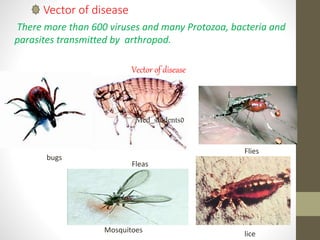
There more than 600 viruses and many Protozoa, bacteria and
parasites transmitted by arthropod.
Vector of disease
bugs
Flies
lice
Fleas
Mosquitoes
Vector of disease
Med_students0
 Importantvectordiseases:
• Malaria
• Dengue Fever
• Arboviruses
• Lyme Disease
• Tick-borne
Relapsing Fever
(TBRF)
• Leishmaniasis
• Chagas’ Disease
• African
Trypanosomiasis
(Sleeping Sickness)
• Lymphatic Filariasis
(Elephantiasis)
• Onchocerciasis
(River Blindness)
Med_students0
There is type of parasite that causes malaria known as plasmodium.
There are many types of plasmodium , but there four types from
plasmodium that cause malaria in human .
They are:
plasmodium falciparum (most deadly)
plasmodium vivax (most common)
plasmodium Malaria(rare)
plasmodium Ovale
Transmission: female anopheles mosquito
Characterized by recurrent bouts of chills fever & hemolysis
malaria
Malaria parasites can complete their growth cycle in the female
anopheles mosquitoes
• Temperature is important .
• For example, at temperatures below 20°C Plasmodium
falciparum (which causes severe malaria) cannot complete
its growth cycle in the Anopheles mosquito, and thus cannot
be transmitted.
• transmission will not occur in:
• very high altitudes
• During colder season
• In deserts (excluding the oases)
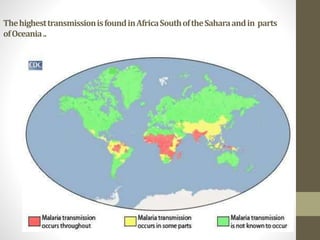
ThehighesttransmissionisfoundinAfricaSouthoftheSaharaandin parts
ofOceania..
Leishmaniasis
• A chronic inflammatory disease of the skin, mucous membrane
and viscera.
Transmitted by bite of sandfly (Phlebotomus)
It has 3 types of disease :
1- Visceral leishmaniasis
2- Cutaneous leishmaniasis
3- Mucocutaneous leishmaniasis.
Epidemiology Leishmaniasis :
Leishmaniasis prevalent world wide: ranging from south
east Asia, Indo-Pakistan, north and central Africa, and south
and central America
Med_students0
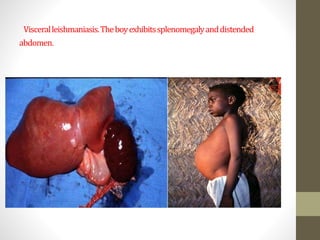
Visceralleishmaniasis.Theboyexhibitssplenomegalyanddistended
.abdomen
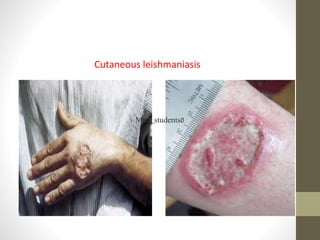
Cutaneous leishmaniasis
Med_students0
Mucocutaneousleishmaniasis.
Lymphatic Filariasis (Elephantiasis)
• They are parasitic nematodes cause of elephantiasis in humans:
• Wuchereria bancrofti, which is responsible for 90% of the cases
• Brugia malayi, which causes most of the remainder of the cases
• B. timori, which also causes the diseases.
• Most cases are caused by Wuchereria bancrofti or Brugia malayi
• Transmitted by:
• bite of infected female mosquito (Anopheles and Culex spp.)
Filariasis generally doesn’t kill but it can cause considerable disability.
• Epidemiology Elephantiasis:
• Filariasis is found throughout Africa, India
• and parts of Southeast Asia and Oceania.
African Trypanosomiasis
(SleepingSickness)
• Transmitted by: tsetse fly (Glossina sp.)
• which can induce coma by invading the
central nervous system
• There are two subspecies of the parasite that are responsible
for initiating the disease in humans: Trypanosoma brucei
gambiense causes the diseases in west and central Africa
whereas, Trypanosoma brucei rhodesiense has a limited
geographical range in east and southern Africa.
Med_students0
Summary
• Enumerate some vector important
diseases.
• Transition of vector diseases.
Med_students0
my resources :
•Robbins basic pathology 8th edition.
•Picture from internet.
•Questions
Tankyou
Thank you
supervisors:
Med_students0
Done by : Anas saad alsaab

Vector borne disease

  • 1.
  • 2.
    Objective: • B- Discussepidemiology and pathology of important vector disease. Med_students0
  • 3.
    There more than600 viruses and many Protozoa, bacteria and parasites transmitted by arthropod. Vector of disease bugs Flies lice Fleas Mosquitoes Vector of disease Med_students0
  • 4.
     Importantvectordiseases: • Malaria •Dengue Fever • Arboviruses • Lyme Disease • Tick-borne Relapsing Fever (TBRF) • Leishmaniasis • Chagas’ Disease • African Trypanosomiasis (Sleeping Sickness) • Lymphatic Filariasis (Elephantiasis) • Onchocerciasis (River Blindness) Med_students0
  • 5.
    There is typeof parasite that causes malaria known as plasmodium. There are many types of plasmodium , but there four types from plasmodium that cause malaria in human . They are: plasmodium falciparum (most deadly) plasmodium vivax (most common) plasmodium Malaria(rare) plasmodium Ovale Transmission: female anopheles mosquito Characterized by recurrent bouts of chills fever & hemolysis malaria
  • 6.
    Malaria parasites cancomplete their growth cycle in the female anopheles mosquitoes • Temperature is important . • For example, at temperatures below 20°C Plasmodium falciparum (which causes severe malaria) cannot complete its growth cycle in the Anopheles mosquito, and thus cannot be transmitted. • transmission will not occur in: • very high altitudes • During colder season • In deserts (excluding the oases)
  • 7.
  • 8.
    Leishmaniasis • A chronicinflammatory disease of the skin, mucous membrane and viscera. Transmitted by bite of sandfly (Phlebotomus) It has 3 types of disease : 1- Visceral leishmaniasis 2- Cutaneous leishmaniasis 3- Mucocutaneous leishmaniasis. Epidemiology Leishmaniasis : Leishmaniasis prevalent world wide: ranging from south east Asia, Indo-Pakistan, north and central Africa, and south and central America Med_students0
  • 9.
  • 10.
  • 11.
  • 12.
    Lymphatic Filariasis (Elephantiasis) •They are parasitic nematodes cause of elephantiasis in humans: • Wuchereria bancrofti, which is responsible for 90% of the cases • Brugia malayi, which causes most of the remainder of the cases • B. timori, which also causes the diseases. • Most cases are caused by Wuchereria bancrofti or Brugia malayi • Transmitted by: • bite of infected female mosquito (Anopheles and Culex spp.) Filariasis generally doesn’t kill but it can cause considerable disability. • Epidemiology Elephantiasis: • Filariasis is found throughout Africa, India • and parts of Southeast Asia and Oceania.
  • 14.
    African Trypanosomiasis (SleepingSickness) • Transmittedby: tsetse fly (Glossina sp.) • which can induce coma by invading the central nervous system • There are two subspecies of the parasite that are responsible for initiating the disease in humans: Trypanosoma brucei gambiense causes the diseases in west and central Africa whereas, Trypanosoma brucei rhodesiense has a limited geographical range in east and southern Africa. Med_students0
  • 15.
    Summary • Enumerate somevector important diseases. • Transition of vector diseases. Med_students0
  • 16.
    my resources : •Robbinsbasic pathology 8th edition. •Picture from internet.
  • 17.
  • 18.