NARRAH HIGH SCHOOL
NARRAH,BANKURA
Name of the Student: Sourav De
Roll No: 136 Registration No:2131331336
Subject: Biology (Project Work)
Class: XII (Science)
Certificates
This is to certify that the student of class 12th
, Sourav De , has been
successfully finished the investigatory project work on Malaria
Prevention Strategy in the malaria prone block in Bankura District.
I wish him every success in future.
Assistant Teacher
Biology
Narrah High School , Narrah , Bankura.
Acknowledgement
First of all , I appreciate the help of my teacher Tara sankar Singha , Biology
Teacher , Narrah High School . It will always in my remember of his guidance , innovative
work and his experience which I utilized in my project to make it a successful investigatory
work.
I am also thanks to the Public Health Department under Chief Medical Officer of
Health , Bankura and Consultant work under his authorization.
Moreover I am very much grateful to my parents for their support to make this
work.
(Sourav De)
Class XII ,Narrah High School,Bankura.
Index Page
1. Introduction
Mosquito & Malaria: Introducing the Disease in brief
Historical Prospective: Malaria from beginning
Symptoms of Malaria : Identification of the Disease
Vector of Malaria : Protozoa Carrier
Malaria Control Strategy: Elimination of the Disease Malaria
Life Cycle of the Malaria Parasite
2. Aims & Objectives
3. Methods and Methodology
4. Result
5. Discussion
Introduction
Mosquito & Malaria: Introducing the Disease in brief
Malaria is a life threatening parasitic disease caused by parasites known as
Plasmodium viviax (P.vivax), Plasmodium falciparum (P.falciparum), Plasmodium
malariae (P.malariae) and Plasmodium ovale (P.ovale).
It is transmitted by the infective bite of Anopheles mosquito.
Man develops disease after 10 to 14 days of being bitten by an infective mosquito.
There are two types of parasites of human malaria, Plasmodium vivax, P.
falciparum,which are commonly reported from India.
Inside the human host, the parasite undergoes a series of changes as part of its complex
life cycle. (Plasmodium is a protozoan parasite).
The parasite completes life cycle in liver cells and red blood cells.
Infection with P.falciparum is the most deadly form of malaria.
Historical Prospective: Malaria from beginning
Malaria has been a major public health problem in India. Intermittent fever, with high
incidence during the rainy season, coinciding with agriculture, sowing and harvesting,
was first recognized by Romans and Greeks who associated it with swampy areas. They
postulated that intermittent fevers were due to the 'bad odour' coming from the
marshy areas and thus gave the name 'malaria' ('mal'=bad + 'air') to intermittent
fevers. In spite of the fact that today the causative organism is known, the name has
stuck to this disease.
1
Symptoms of Malaria : Identification of the Disease
Typically, malaria produces fever, headache, vomiting and other flu-like symptoms.
The parasite infects and destroys red blood cells resulting in easy fatigue-ability due to
anemia, fits/convulsions and loss of consciousness.
Parasites are carried by blood to the brain (cerebral malaria) and to other vital
organs.
Malaria in pregnancy poses a substantial risk to the mother, the fetus and the newborn
infant. Pregnant women are less capable of coping with and clearing malaria infections,
adversely affecting the unborn fetus.
Vector of Malaria : Protozoa Carrier
There are many vectors of malaria.
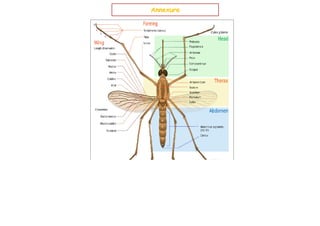
Anopheles culicifacies is the main vector of malaria.It is one types of mosquito.
It is a small to medium sized mosquito with Culex like sitting posture
1. Feeding habits
It is a zoophilic species
When high densities build up relatively large numbers feed on men
2. Resting habits
Rests during daytime in human dwellings and cattlesheds
3. Breeding places
Breeds in rainwater pools and puddles, borrowpits, river bed pools, irrigation channels,
seepages, rice fields, wells, pond margins, sluggish streams with sandy margins.
Extensive breeding is generally encountered following monsoon rains.
4. Biting time
Biting time of each vector species is determined by its generic
character, but can be readily influenced by environmental conditions.
2
Most of the vectors, including Anopheles culicifacies, start biting soon after dusk.
Therefore, biting starts much earlier in winter than in summer but the peak time varies
from species to species.
Malaria Control Strategy: Elimination of the Disease Malaria
1. Early case Detection and Prompt Treatment (EDPT)
 EDPT is the main strategy of malaria control - radical treatment is necessary for
all the cases of malaria to prevent transmission of malaria.
 Chloroquine is the main anti-malaria drug for uncomplicated malaria.
 Drug Distribution Centres (DDCs) and Fever Treatment Depots (FTDs) have been
established in the rural areas for providing easy access to anti-malarial drugs to
the community.
 Alternative drugs for chloroquine resistant malaria are recommended as per the
drug policy of malaria.
2. Vector Control
(i) Chemical Control
 Use of Indoor Residual Spray (IRS) with insecticides recommended under the
programnme
 Use of chemical larvicides like Abate in potable water
 Aerosol space spray during day time
 Malathion fogging during outbreaks
(ii) Biological Control
 Use of larvivorous fish in ornamental tanks, fountains etc.
 Use of biocides.
(iii) Personal Prophylatic Measures that individuals/communities can take up
 Use of mosquito repellent creams, liquids, coils, mats etc.
 Screening of the houses with wire mesh
3
 Use of bednets treated with insecticide
 Wearing clothes that cover maximum surface area of the body
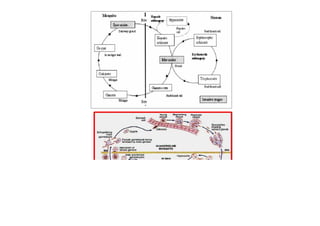
Life Cycle of the Malaria Parasite
1. A female Anopheles mosquito carrying malaria-causing parasites feeds on a human and
injects the parasites in the form of sporozoites into the bloodstream. The sporozoites
travel to the liver and invade liver cells.
2. Over 5-16 days*, the sporozoites grow, divide, and produce tens of thousands of haploid
forms, called merozoites, per liver cell. Some malaria parasite species remain dormant
for extended periods in the liver, causing relapses weeks or months later.
3. The merozoites exit the liver cells and re-enter the bloodstream, beginning a cycle of
invasion of red blood cells, asexual replication, and release of newly formed merozoites
from the red blood cells repeatedly over 1-3 days*. This multiplication can result in
thousands of parasite-infected cells in the host bloodstream, leading to illness and
complications of malaria that can last for months if not treated.
4. Some of the merozoite-infected blood cells leave the cycle of asexual multiplication.
Instead of replicating, the merozoites in these cells develop into sexual forms of the
parasite, called male and female gametocytes, that circulate in the bloodstream.
5. When a mosquito bites an infected human, it ingests the gametocytes. In the mosquito
gut, the infected human blood cells burst, releasing the gametocytes, which develop
further into mature sex cells called gametes. Male and female gametes fuse to form
diploid zygotes, which develop into actively moving ookinetes that burrow into the
mosquito midgut wall and form oocysts.
6. Growth and division of each oocyst produces thousands of active haploid forms called
sporozoites. After 8-15 days, the oocyst bursts, releasing sporozoites into the body cavity
of the mosquito, from which they travel to and invade the mosquito salivary glands. The
cycle of human infection re-starts when the mosquito takes a blood meal, injecting the
sporozoites from its salivary glands into the human bloodstream.
Aims &Objective
Aims & Objective: The Goal
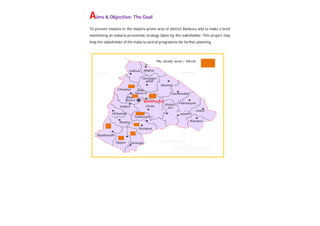
To prevent malaria in the malaria prone area of district Bankura and to make a brief
monitoring on malaria prevention strategy taken by the stakeholder. This project may
help the stakeholder of the malaria control programme for further planning.
Methods
&
Methodology
Method & Methodology: The technique utilized
To observe the way of work of stakeholder (Govt. Agencies/NGO etc.) for prevention of
malaria, I prepared a format. In that format, I note down the prevention techniques
implemented by the stakeholder. This filled up, format can analyse the preventive work
done by the stakeholder.
Question & Answer method is used here. Random selection of persons & household has
been done in malaria prone blocks of Bankura District.
I also collect the data of malaria cases found in the 8 malaria blocks of the district
bankura which may help me in my interpretation.
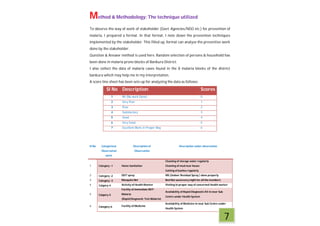
A score line sheet has been sets up for analyzing the data as follows:
Sl No Description Scores
1 Nil (No work Done) 0
2 Very Poor 1
3 Poor 2
4 Satisfactory 3
5 Good 4
6 Very Good 5
7 Excellent Work in Proper Way 6
Sl No Categorised
Observation
work
Description of
Observation
Description under observation
1 Category -1 Home Sanitation
Cleaning of storage water regularly
Cleaning of mud near house
Cutting of bushes regularly
2 Category -2 DDT spray IRS (Indoor Residual Spray ) done properly
3 Category -3 Mosquito Net Bed Net used every night for all the members
4 Catgory-4 Activity of Health Worker Visiting in proper way of concerned Health worker
5 Catgory-5
Facility of Immediate RDT-
Malaria
(Rapid Diagnostic Test-Malaria)
Availability of Rapid Diagnostic Kit in near Sub
Centre under Health System
6 Catagory-6 Facility of Medicine
Availability of Medicine in near Sub Centre under
Health System
7
Result
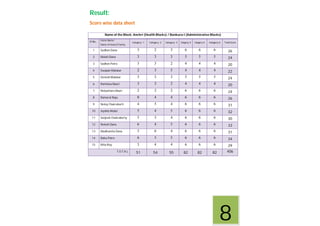
Result:
Score wise data sheet
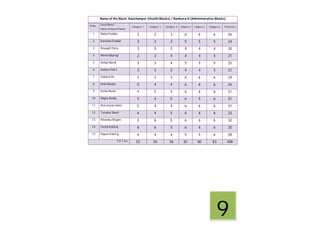
Name of the Block: Anchri (Health Blocks) / Bankura-I (Administrative Blocks)
Sl No. Home Name/
Name of Head of Family
Category -1 Category -2 Category -3 Catgory-4 Catgory-5 Catagory-6 Total Score
1 Sadhan Dana 3 2 3 6 6 6 26
2 Malati Dana 3 3 3 5 5 5 24
3 Sadhan Patra 3 3 2 4 4 4 20
4 Swapan Malakar 2 3 5 4 4 4 22
5 Denesh Malakar 3 3 3 5 5 5 24
6 Ramtanu Bauri 3 3 2 4 4 4 20
7 Noiyantara Bauri 2 2 2 6 6 6 24
8 Ramarai Raju 0 4 4 6 6 6 26
9 Neloy Chakraborti 4 5 4 6 6 6 31
10 Joydeb Abdul 5 4 5 6 6 6 32
11 Sanjeeb Chakraborty 5 3 4 6 6 6 30
12 Nelesh Dana 6 4 5 6 6 6 33
13 Madhumita Dana 3 6 4 6 6 6 31
14 Babu Patra 6 5 5 6 6 6 34
15 Mita Roy 3 4 4 6 6 6 29
T O T A L 51 54 55 82 82 82 406
8
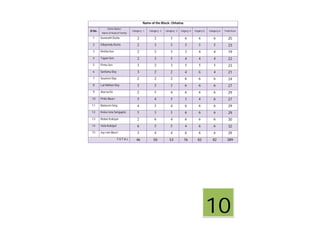
Name of the Block: Kanchanpur (Health Blocks) / Bankura-II (Administrative Blocks)
Sl No. Home Name/
Name of Head of Family
Category -1 Category -2 Category -3 Catgory-4 Catgory-5 Catagory-6 Total Score
1 Bablu Poddar 3 2 3 6 6 6 26
2 Kanchan Poddar 3 3 3 5 5 5 24
3 Biswajit Patra 3 3 2 4 4 4 20
4 Nimai Bayragi 2 3 4 4 4 4 21
5 Netaji Nandi 3 3 4 5 5 5 25
6 Subhas Patra 3 3 2 4 4 5 21
7 Subipta De 2 2 2 6 6 6 24
8 Robi Baedia 0 4 4 6 6 6 26
9 Roma Bedia 4 5 4 6 6 6 31
10 Raghu Bedia 5 4 5 6 5 6 31
11 Nelu Kanta Sahis 5 4 4 6 6 6 31
12 Tenubor Bauri 6 4 5 6 6 6 33
13 Khoosbu Begam 3 6 5 6 6 6 32
14 Pucha Kobiraj 6 6 5 6 6 6 35
15 Papun Kobiraj 4 4 4 5 5 6 28
T O T A L 52 56 56 81 80 83 408
9
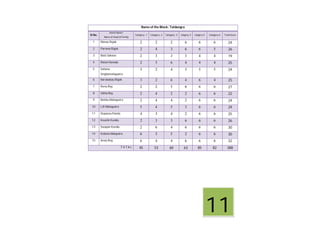
Name of the Block: Chhatna
Sl No.
Home Name/
Name of Head of Family
Category -1 Category -2 Category -3 Catgory-4 Catgory-5 Catagory-6 Total Score
1 Somnath Dutta 2 2 3 6 6 6 25
2 Dibyendu Dutta 2 3 3 5 5 5 23
3 Rekha Sen 2 3 3 3 4 4 19
4 Tapan Sen 2 3 5 4 4 4 22
5 Pintu Sen 3 2 3 5 5 5 23
6 Santanu Dey 3 2 2 4 6 4 21
7 Soumen Day 2 2 2 6 6 6 24
8 Lal Mohan Dey 3 3 3 6 6 6 27
9 Jharna De 2 5 4 6 6 6 29
10 Pinki Bauri 5 4 5 3 4 6 27
11 Balaram Sing 4 3 4 6 6 6 29
12 Keka rena Sengupta 5 3 3 6 6 6 29
13 Robat Kobiyal 2 6 4 6 6 6 30
14 Vola Kobiyal 6 5 5 4 6 6 32
15 Joy ram Bauri 3 4 4 6 6 6 29
T O T A L 46 50 53 76 82 82 389
10
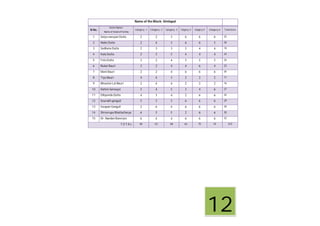
Name of the Block: Taldangra
Sl No.
Home Name/
Name of Head of Family
Category -1 Category -2 Category -3 Catgory-4 Catgory-5 Catagory-6 Total Score
1 Manas Rajak 2 2 2 6 6 6 24
2 Poroma Rajak 2 4 3 6 6 5 26
3 Bebi Sahana 2 3 3 3 4 4 19
4 Ratan Hansda 2 5 6 4 4 4 25
5 Sahana
Singhamahapatra
3 2 4 5 5 5 24
6 Barababau Rajak 3 2 6 4 6 4 25
7 Renu Ray 2 2 5 6 6 6 27
8 Sikha Ray 2 4 2 2 6 6 22
9 Bebhu Mahapatra 2 4 4 2 6 6 24
10 Lili Mahapatra 5 4 5 3 6 6 29
11 Depansu Panda 4 3 4 2 6 6 25
12 Kounik Kundu 2 3 3 6 6 6 26
13 Swapan Kundu 2 6 4 6 6 6 30
14 Kobota Mahpatra 6 5 5 2 6 6 30
15 Anna Roy 6 4 4 6 6 6 32
T O T A L 45 53 60 63 85 82 388
11
Name of the Block: Simlapal
Sl No.
Home Name/
Name of Head of Family
Category -1 Category -2 Category -3 Catgory-4 Catgory-5 Catagory-6 Total Score
1 Satya narayan Dutta 2 2 3 6 6 6 25
2 Nabo Dutta 2 4 3 6 6 5 26
3 Sadhana Dutta 2 3 3 3 4 4 19
4 Kalu Dutta 2 5 5 4 4 4 24
5 Felu Dutta 3 2 4 5 5 5 24
6 Bubai Bauri 3 2 4 4 6 4 23
7 Mani Bauri 2 2 4 6 6 6 26
8 Tiya Bauri 4 4 3 2 2 2 17
9 Bhouton Lal Bauri 2 4 4 2 2 2 16
10 Rahim Sannaysi 5 4 5 3 4 6 27
11 Dibyendu Dutta 4 3 4 2 6 6 25
12 Sourabh ganguli 5 3 3 6 6 6 29
13 Swapan Ganguli 2 6 4 6 6 6 30
14 Shreerupa Bhattacharya 6 5 5 2 6 6 30
15 Dr. Nandan Banerjee 6 4 4 6 6 6 32
T O T A L 50 53 58 63 75 74 373
12
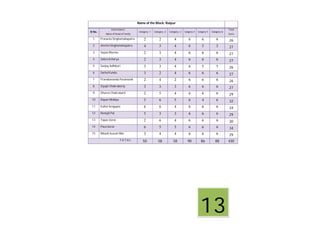
Name of the Block: Raipur
Sl No.
Home Name/
Name of Head of Family
Category -1 Category -2 Category -3 Catgory-4 Catgory-5 Catagory-6
Total
Score
1 Prasanta Singhamahapatra 2 2 4 6 6 6 26
2 Amrita Singhamahapatra 4 3 4 6 5 5 27
3 Sayan Murmu 2 3 4 6 6 6 27
4 Sabra Acharya 2 3 4 6 6 6 27
5 Sanjay Adhikari 3 3 4 6 5 5 26
6 Sarba Kundu 3 2 4 6 6 6 27
7 Pranabananda Paramanik 2 4 2 6 6 6 26
8 Styajit Chakraborty 3 3 3 6 6 6 27
9 Dheren Chakrabarti 2 5 4 6 6 6 29
10 Rapan Middya 5 6 5 6 4 6 32
11 Kallol Sengupta 6 6 4 6 6 6 34
12 Ronojit Pal 5 3 3 6 6 6 29
13 Tapas Gorai 2 6 4 6 6 6 30
14 Pava Gorai 6 5 5 6 6 6 34
15 Bikash kusum Moi 3 4 4 6 6 6 29
T O T A L 50 58 58 90 86 88 430
13
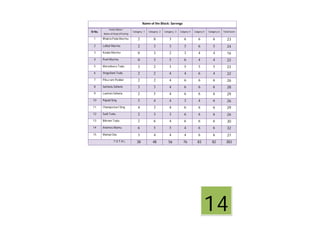
Name of the Block: Sarenga
Sl No.
Home Name/
Name of Head of Family
Category -1 Category -2 Category -3 Catgory-4 Catgory-5 Catagory-6 Total Score
1 Bhakta Pada Murmu 2 0 3 6 6 6 23
2 Lalbal Murmu 2 3 3 5 6 5 24
3 Kaaba Murmu 0 3 2 3 4 4 16
4 Puni Murmu 0 3 5 6 4 4 22
5 Maranburu Tudu 3 2 3 5 5 5 23
6 Singultani Tudu 2 2 4 4 6 4 22
7 Piku ram Poddar 2 2 4 6 6 6 26
8 Santanu Sahana 3 3 4 6 6 6 28
9 Laxman Sahana 2 5 4 6 6 6 29
10 Papad Sing 5 4 4 3 4 6 26
11 Champa buri Sing 4 3 4 6 6 6 29
12 Sudi Tudu 2 3 3 6 6 6 26
13 Bikram Tudu 2 6 4 6 6 6 30
14 Anemes Mumu 6 5 5 4 6 6 32
15 Mampi Das 3 4 4 4 6 6 27
T O T A L 38 48 56 76 83 82 383
14
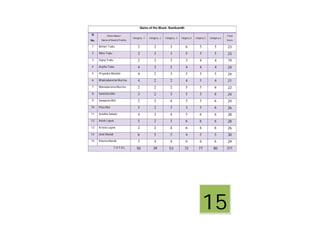
Name of the Block: Ranibandh
Sl
No.
Home Name/
Name of Head of Family
Category -1 Category -2 Category -3 Catgory-4 Catgory-5 Catagory-6
Total
Score
1 Behari Tudu 2 2 3 6 5 5 23
2 Niku Tudu 2 3 3 5 5 5 23
3 Sujoy Tudu 2 3 3 3 4 4 19
4 Arpita Tudu 4 3 5 4 4 4 24
5 Priyanka Mondal 4 2 3 5 5 5 24
6 Bhaktabancha Murmu 4 2 2 4 5 4 21
7 Mamataroma Murmu 2 2 2 5 5 6 22
8 Sanchita Moi 3 2 3 5 5 6 24
9 Sangeeta Moi 2 2 4 5 5 6 24
10 Pinu Moi 5 2 5 3 5 6 26
11 Anidita Sahala 4 3 4 5 6 6 28
12 Asish Layek 5 2 3 6 6 6 28
13 Krisna Layek 2 2 4 6 6 6 26
14 Jinat Mandi 6 5 5 4 5 5 30
15 Khoma Mandi 3 4 4 6 6 6 29
T O T A L 50 39 53 72 77 80 371
15
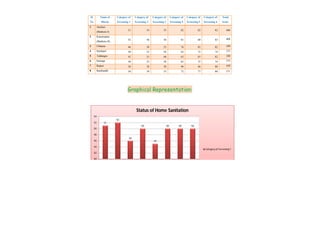
Graphical Representation:
51
52
46
50
45
50 50 50
40
42
44
46
48
50
52
54
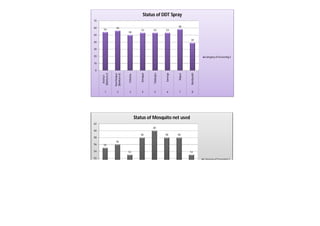
Status of Home Sanitation
Category of Screening 1
Sl
No
Name of
Blocks
Category of
Screening 1
Category of
Screening 2
Category of
Screening 3
Category of
Screening 4
Category of
Screening 5
Category of
Screening 6
Total
Score
1 Anchuri
(Bankura-I)
51 54 55 82 82 82 406
2 Kanchanpur
(Bankura-II)
52 56 56 81 80 83 408
3 Chhatna 46 50 53 76 82 82 389
4 Simlapal 50 53 58 63 75 74 373
5 Taldangra 45 53 60 63 85 82 388
6 Sarenga 50 53 58 63 75 74 373
7 Raipur 50 58 58 90 86 88 430
8 Ranibandh 50 39 53 72 77 80 371
54
56
50
53 53 53
58
39
0
10
20
30
40
50
60
70
Anchuri
(Bankura-I)
Kanchanpur
(Bankura-II)
Chhatna
Simlapal
Taldangra
Sarenga
Raipur
Ranibandh
1 2 3 4 5 6 7 8
Status of DDT Spray
Category of Screening 2
55
56
53
58
60
58 58
53
52
54
56
58
60
62
Status of Mosquito net used
Category of Screening 3
82 81
76
63 63 63
90
72
0
10
20
30
40
50
60
70
80
90
100
Anchuri
(Bankura-I)
Kanchanpur
(Bankura-II)
Chhatna
Simlapal
Taldangra
Sarenga
Raipur
Ranibandh
1 2 3 4 5 6 7 8
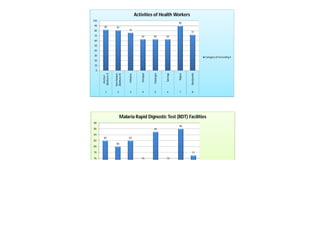
Activities of Health Workers
Category of Screening 4
82
80
82
75
85
75
86
77
76
78
80
82
84
86
88
Malaria Rapid Dignostic Test (RDT) Facilities
82
83
82
74
82
74
88
80
65
70
75
80
85
90
Anchuri
(Bankura-I)
Kanchanpur
(Bankura-II)
Chhatna
Simlapal
Taldangra
Sarenga
Raipur
Ranibandh
1 2 3 4 5 6 7 8
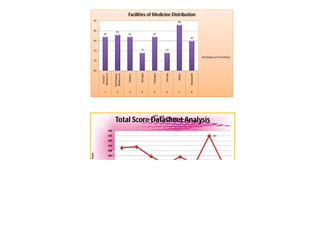
Facilities of Medicine Distribution
Category of Screening 6
430
380
390
400
410
420
430
440
Score
Total Score Datasheet Analysis
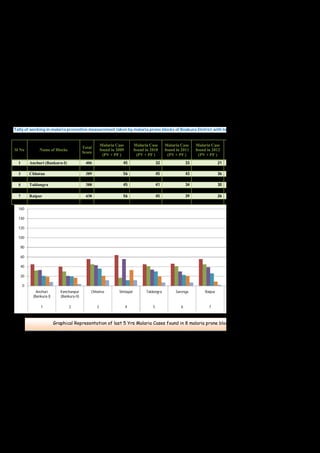
Tally of working in malaria preventive measurement taken by malaria prone blocks of Bnakura District with total malaria cases
0
20
40
60
80
100
120
140
160
Anchuri
(Bankura-I)
Kanchanpur
(Bankura-II)
Chhatna Simlapal Taldangra Sarenga Raipur
1 2 3 4 5 6 7
Sl No Name of Blocks
Total
Score
Malaria Case
found in 2009
(PV + PF )
Malaria Case
found in 2010
(PV + PF )
Malaria Case
found in 2011
(PV + PF )
Malaria Case
found in 2012
(PV + PF )
1 Anchuri (Bankura-I) 406 45 32 33 21
2 Kanchanpur (Bankura-II) 408 40 30 21 20
3 Chhatna 389 56 45 43 36
4 Simlapal 373 64 17 56 12
5 Taldangra 388 45 41 34 30
6 Sarenga 373 46 41 30 23
7 Raipur 430 56 45 39 26
8 Ranibandh 371 103 145 56 86
Graphical Representation of last 5 Yrs Malaria Cases found in 8 malaria prone blocks of Bankura
158 132 213 194 177 168
177
489
0
100
200
300
400
500
600
Anchuri
(Bankura-I)
Kanchanpur
(Bankura-II)
Chhatna
Simlapal
Taldangra
Sarenga
Raipur
Ranibandh
1 2 3 4 5 6 7 8
TotalNo.ofCases
Name of Blocks
Total Malaria
cases found in 6 Yrs
158
132
213
194
177
489
Total Malaria
cases found in 6 Yrs
Anchuri
(Bankura-I)
Kanchanpur
(Bankura-II)
Chhatna Simlapal
Taldangra Sarenga
Graphical Representation of last 5 Yrs Malaria total Cases found in 8 malaria prone blocks of Bankura Dsitrict
Discussion
Discussion:
From my study it has been proved that the Blocks had done the preventive steps properly good
minimized the disease condition.
Malaria prevention can be done by taking the preventive steps before the rainy seasons came.
Ranibandh had the more worst stage regarding the malaria condition from other blocks.
Raipur block as taken the better preventive steps in this year 2014 so less malaria cases found
there.
So, Prevention is better than the cure.
22
Annexure

Project work malaria class 12_ HS biology project

  • 1.
    NARRAH HIGH SCHOOL NARRAH,BANKURA Nameof the Student: Sourav De Roll No: 136 Registration No:2131331336 Subject: Biology (Project Work) Class: XII (Science)
  • 2.
    Certificates This is tocertify that the student of class 12th , Sourav De , has been successfully finished the investigatory project work on Malaria Prevention Strategy in the malaria prone block in Bankura District. I wish him every success in future. Assistant Teacher Biology Narrah High School , Narrah , Bankura.
  • 3.
    Acknowledgement First of all, I appreciate the help of my teacher Tara sankar Singha , Biology Teacher , Narrah High School . It will always in my remember of his guidance , innovative work and his experience which I utilized in my project to make it a successful investigatory work. I am also thanks to the Public Health Department under Chief Medical Officer of Health , Bankura and Consultant work under his authorization. Moreover I am very much grateful to my parents for their support to make this work. (Sourav De) Class XII ,Narrah High School,Bankura.
  • 4.
    Index Page 1. Introduction Mosquito& Malaria: Introducing the Disease in brief Historical Prospective: Malaria from beginning Symptoms of Malaria : Identification of the Disease Vector of Malaria : Protozoa Carrier Malaria Control Strategy: Elimination of the Disease Malaria Life Cycle of the Malaria Parasite 2. Aims & Objectives 3. Methods and Methodology 4. Result 5. Discussion
  • 6.
  • 7.
    Mosquito & Malaria:Introducing the Disease in brief Malaria is a life threatening parasitic disease caused by parasites known as Plasmodium viviax (P.vivax), Plasmodium falciparum (P.falciparum), Plasmodium malariae (P.malariae) and Plasmodium ovale (P.ovale). It is transmitted by the infective bite of Anopheles mosquito. Man develops disease after 10 to 14 days of being bitten by an infective mosquito. There are two types of parasites of human malaria, Plasmodium vivax, P. falciparum,which are commonly reported from India. Inside the human host, the parasite undergoes a series of changes as part of its complex life cycle. (Plasmodium is a protozoan parasite). The parasite completes life cycle in liver cells and red blood cells. Infection with P.falciparum is the most deadly form of malaria. Historical Prospective: Malaria from beginning Malaria has been a major public health problem in India. Intermittent fever, with high incidence during the rainy season, coinciding with agriculture, sowing and harvesting, was first recognized by Romans and Greeks who associated it with swampy areas. They postulated that intermittent fevers were due to the 'bad odour' coming from the marshy areas and thus gave the name 'malaria' ('mal'=bad + 'air') to intermittent fevers. In spite of the fact that today the causative organism is known, the name has stuck to this disease. 1
  • 8.
    Symptoms of Malaria: Identification of the Disease Typically, malaria produces fever, headache, vomiting and other flu-like symptoms. The parasite infects and destroys red blood cells resulting in easy fatigue-ability due to anemia, fits/convulsions and loss of consciousness. Parasites are carried by blood to the brain (cerebral malaria) and to other vital organs. Malaria in pregnancy poses a substantial risk to the mother, the fetus and the newborn infant. Pregnant women are less capable of coping with and clearing malaria infections, adversely affecting the unborn fetus. Vector of Malaria : Protozoa Carrier There are many vectors of malaria. Anopheles culicifacies is the main vector of malaria.It is one types of mosquito. It is a small to medium sized mosquito with Culex like sitting posture 1. Feeding habits It is a zoophilic species When high densities build up relatively large numbers feed on men 2. Resting habits Rests during daytime in human dwellings and cattlesheds 3. Breeding places Breeds in rainwater pools and puddles, borrowpits, river bed pools, irrigation channels, seepages, rice fields, wells, pond margins, sluggish streams with sandy margins. Extensive breeding is generally encountered following monsoon rains. 4. Biting time Biting time of each vector species is determined by its generic character, but can be readily influenced by environmental conditions. 2
  • 9.
    Most of thevectors, including Anopheles culicifacies, start biting soon after dusk. Therefore, biting starts much earlier in winter than in summer but the peak time varies from species to species. Malaria Control Strategy: Elimination of the Disease Malaria 1. Early case Detection and Prompt Treatment (EDPT)  EDPT is the main strategy of malaria control - radical treatment is necessary for all the cases of malaria to prevent transmission of malaria.  Chloroquine is the main anti-malaria drug for uncomplicated malaria.  Drug Distribution Centres (DDCs) and Fever Treatment Depots (FTDs) have been established in the rural areas for providing easy access to anti-malarial drugs to the community.  Alternative drugs for chloroquine resistant malaria are recommended as per the drug policy of malaria. 2. Vector Control (i) Chemical Control  Use of Indoor Residual Spray (IRS) with insecticides recommended under the programnme  Use of chemical larvicides like Abate in potable water  Aerosol space spray during day time  Malathion fogging during outbreaks (ii) Biological Control  Use of larvivorous fish in ornamental tanks, fountains etc.  Use of biocides. (iii) Personal Prophylatic Measures that individuals/communities can take up  Use of mosquito repellent creams, liquids, coils, mats etc.  Screening of the houses with wire mesh 3
  • 10.
     Use ofbednets treated with insecticide  Wearing clothes that cover maximum surface area of the body Life Cycle of the Malaria Parasite 1. A female Anopheles mosquito carrying malaria-causing parasites feeds on a human and injects the parasites in the form of sporozoites into the bloodstream. The sporozoites travel to the liver and invade liver cells. 2. Over 5-16 days*, the sporozoites grow, divide, and produce tens of thousands of haploid forms, called merozoites, per liver cell. Some malaria parasite species remain dormant for extended periods in the liver, causing relapses weeks or months later. 3. The merozoites exit the liver cells and re-enter the bloodstream, beginning a cycle of invasion of red blood cells, asexual replication, and release of newly formed merozoites from the red blood cells repeatedly over 1-3 days*. This multiplication can result in thousands of parasite-infected cells in the host bloodstream, leading to illness and complications of malaria that can last for months if not treated. 4. Some of the merozoite-infected blood cells leave the cycle of asexual multiplication. Instead of replicating, the merozoites in these cells develop into sexual forms of the parasite, called male and female gametocytes, that circulate in the bloodstream. 5. When a mosquito bites an infected human, it ingests the gametocytes. In the mosquito gut, the infected human blood cells burst, releasing the gametocytes, which develop further into mature sex cells called gametes. Male and female gametes fuse to form diploid zygotes, which develop into actively moving ookinetes that burrow into the mosquito midgut wall and form oocysts. 6. Growth and division of each oocyst produces thousands of active haploid forms called sporozoites. After 8-15 days, the oocyst bursts, releasing sporozoites into the body cavity of the mosquito, from which they travel to and invade the mosquito salivary glands. The cycle of human infection re-starts when the mosquito takes a blood meal, injecting the sporozoites from its salivary glands into the human bloodstream.
  • 13.
  • 14.
    Aims & Objective:The Goal To prevent malaria in the malaria prone area of district Bankura and to make a brief monitoring on malaria prevention strategy taken by the stakeholder. This project may help the stakeholder of the malaria control programme for further planning.
  • 16.
  • 17.
    Method & Methodology:The technique utilized To observe the way of work of stakeholder (Govt. Agencies/NGO etc.) for prevention of malaria, I prepared a format. In that format, I note down the prevention techniques implemented by the stakeholder. This filled up, format can analyse the preventive work done by the stakeholder. Question & Answer method is used here. Random selection of persons & household has been done in malaria prone blocks of Bankura District. I also collect the data of malaria cases found in the 8 malaria blocks of the district bankura which may help me in my interpretation. A score line sheet has been sets up for analyzing the data as follows: Sl No Description Scores 1 Nil (No work Done) 0 2 Very Poor 1 3 Poor 2 4 Satisfactory 3 5 Good 4 6 Very Good 5 7 Excellent Work in Proper Way 6 Sl No Categorised Observation work Description of Observation Description under observation 1 Category -1 Home Sanitation Cleaning of storage water regularly Cleaning of mud near house Cutting of bushes regularly 2 Category -2 DDT spray IRS (Indoor Residual Spray ) done properly 3 Category -3 Mosquito Net Bed Net used every night for all the members 4 Catgory-4 Activity of Health Worker Visiting in proper way of concerned Health worker 5 Catgory-5 Facility of Immediate RDT- Malaria (Rapid Diagnostic Test-Malaria) Availability of Rapid Diagnostic Kit in near Sub Centre under Health System 6 Catagory-6 Facility of Medicine Availability of Medicine in near Sub Centre under Health System 7
  • 19.
  • 20.
    Result: Score wise datasheet Name of the Block: Anchri (Health Blocks) / Bankura-I (Administrative Blocks) Sl No. Home Name/ Name of Head of Family Category -1 Category -2 Category -3 Catgory-4 Catgory-5 Catagory-6 Total Score 1 Sadhan Dana 3 2 3 6 6 6 26 2 Malati Dana 3 3 3 5 5 5 24 3 Sadhan Patra 3 3 2 4 4 4 20 4 Swapan Malakar 2 3 5 4 4 4 22 5 Denesh Malakar 3 3 3 5 5 5 24 6 Ramtanu Bauri 3 3 2 4 4 4 20 7 Noiyantara Bauri 2 2 2 6 6 6 24 8 Ramarai Raju 0 4 4 6 6 6 26 9 Neloy Chakraborti 4 5 4 6 6 6 31 10 Joydeb Abdul 5 4 5 6 6 6 32 11 Sanjeeb Chakraborty 5 3 4 6 6 6 30 12 Nelesh Dana 6 4 5 6 6 6 33 13 Madhumita Dana 3 6 4 6 6 6 31 14 Babu Patra 6 5 5 6 6 6 34 15 Mita Roy 3 4 4 6 6 6 29 T O T A L 51 54 55 82 82 82 406 8
  • 21.
    Name of theBlock: Kanchanpur (Health Blocks) / Bankura-II (Administrative Blocks) Sl No. Home Name/ Name of Head of Family Category -1 Category -2 Category -3 Catgory-4 Catgory-5 Catagory-6 Total Score 1 Bablu Poddar 3 2 3 6 6 6 26 2 Kanchan Poddar 3 3 3 5 5 5 24 3 Biswajit Patra 3 3 2 4 4 4 20 4 Nimai Bayragi 2 3 4 4 4 4 21 5 Netaji Nandi 3 3 4 5 5 5 25 6 Subhas Patra 3 3 2 4 4 5 21 7 Subipta De 2 2 2 6 6 6 24 8 Robi Baedia 0 4 4 6 6 6 26 9 Roma Bedia 4 5 4 6 6 6 31 10 Raghu Bedia 5 4 5 6 5 6 31 11 Nelu Kanta Sahis 5 4 4 6 6 6 31 12 Tenubor Bauri 6 4 5 6 6 6 33 13 Khoosbu Begam 3 6 5 6 6 6 32 14 Pucha Kobiraj 6 6 5 6 6 6 35 15 Papun Kobiraj 4 4 4 5 5 6 28 T O T A L 52 56 56 81 80 83 408 9
  • 22.
    Name of theBlock: Chhatna Sl No. Home Name/ Name of Head of Family Category -1 Category -2 Category -3 Catgory-4 Catgory-5 Catagory-6 Total Score 1 Somnath Dutta 2 2 3 6 6 6 25 2 Dibyendu Dutta 2 3 3 5 5 5 23 3 Rekha Sen 2 3 3 3 4 4 19 4 Tapan Sen 2 3 5 4 4 4 22 5 Pintu Sen 3 2 3 5 5 5 23 6 Santanu Dey 3 2 2 4 6 4 21 7 Soumen Day 2 2 2 6 6 6 24 8 Lal Mohan Dey 3 3 3 6 6 6 27 9 Jharna De 2 5 4 6 6 6 29 10 Pinki Bauri 5 4 5 3 4 6 27 11 Balaram Sing 4 3 4 6 6 6 29 12 Keka rena Sengupta 5 3 3 6 6 6 29 13 Robat Kobiyal 2 6 4 6 6 6 30 14 Vola Kobiyal 6 5 5 4 6 6 32 15 Joy ram Bauri 3 4 4 6 6 6 29 T O T A L 46 50 53 76 82 82 389 10
  • 23.
    Name of theBlock: Taldangra Sl No. Home Name/ Name of Head of Family Category -1 Category -2 Category -3 Catgory-4 Catgory-5 Catagory-6 Total Score 1 Manas Rajak 2 2 2 6 6 6 24 2 Poroma Rajak 2 4 3 6 6 5 26 3 Bebi Sahana 2 3 3 3 4 4 19 4 Ratan Hansda 2 5 6 4 4 4 25 5 Sahana Singhamahapatra 3 2 4 5 5 5 24 6 Barababau Rajak 3 2 6 4 6 4 25 7 Renu Ray 2 2 5 6 6 6 27 8 Sikha Ray 2 4 2 2 6 6 22 9 Bebhu Mahapatra 2 4 4 2 6 6 24 10 Lili Mahapatra 5 4 5 3 6 6 29 11 Depansu Panda 4 3 4 2 6 6 25 12 Kounik Kundu 2 3 3 6 6 6 26 13 Swapan Kundu 2 6 4 6 6 6 30 14 Kobota Mahpatra 6 5 5 2 6 6 30 15 Anna Roy 6 4 4 6 6 6 32 T O T A L 45 53 60 63 85 82 388 11
  • 24.
    Name of theBlock: Simlapal Sl No. Home Name/ Name of Head of Family Category -1 Category -2 Category -3 Catgory-4 Catgory-5 Catagory-6 Total Score 1 Satya narayan Dutta 2 2 3 6 6 6 25 2 Nabo Dutta 2 4 3 6 6 5 26 3 Sadhana Dutta 2 3 3 3 4 4 19 4 Kalu Dutta 2 5 5 4 4 4 24 5 Felu Dutta 3 2 4 5 5 5 24 6 Bubai Bauri 3 2 4 4 6 4 23 7 Mani Bauri 2 2 4 6 6 6 26 8 Tiya Bauri 4 4 3 2 2 2 17 9 Bhouton Lal Bauri 2 4 4 2 2 2 16 10 Rahim Sannaysi 5 4 5 3 4 6 27 11 Dibyendu Dutta 4 3 4 2 6 6 25 12 Sourabh ganguli 5 3 3 6 6 6 29 13 Swapan Ganguli 2 6 4 6 6 6 30 14 Shreerupa Bhattacharya 6 5 5 2 6 6 30 15 Dr. Nandan Banerjee 6 4 4 6 6 6 32 T O T A L 50 53 58 63 75 74 373 12
  • 25.
    Name of theBlock: Raipur Sl No. Home Name/ Name of Head of Family Category -1 Category -2 Category -3 Catgory-4 Catgory-5 Catagory-6 Total Score 1 Prasanta Singhamahapatra 2 2 4 6 6 6 26 2 Amrita Singhamahapatra 4 3 4 6 5 5 27 3 Sayan Murmu 2 3 4 6 6 6 27 4 Sabra Acharya 2 3 4 6 6 6 27 5 Sanjay Adhikari 3 3 4 6 5 5 26 6 Sarba Kundu 3 2 4 6 6 6 27 7 Pranabananda Paramanik 2 4 2 6 6 6 26 8 Styajit Chakraborty 3 3 3 6 6 6 27 9 Dheren Chakrabarti 2 5 4 6 6 6 29 10 Rapan Middya 5 6 5 6 4 6 32 11 Kallol Sengupta 6 6 4 6 6 6 34 12 Ronojit Pal 5 3 3 6 6 6 29 13 Tapas Gorai 2 6 4 6 6 6 30 14 Pava Gorai 6 5 5 6 6 6 34 15 Bikash kusum Moi 3 4 4 6 6 6 29 T O T A L 50 58 58 90 86 88 430 13
  • 26.
    Name of theBlock: Sarenga Sl No. Home Name/ Name of Head of Family Category -1 Category -2 Category -3 Catgory-4 Catgory-5 Catagory-6 Total Score 1 Bhakta Pada Murmu 2 0 3 6 6 6 23 2 Lalbal Murmu 2 3 3 5 6 5 24 3 Kaaba Murmu 0 3 2 3 4 4 16 4 Puni Murmu 0 3 5 6 4 4 22 5 Maranburu Tudu 3 2 3 5 5 5 23 6 Singultani Tudu 2 2 4 4 6 4 22 7 Piku ram Poddar 2 2 4 6 6 6 26 8 Santanu Sahana 3 3 4 6 6 6 28 9 Laxman Sahana 2 5 4 6 6 6 29 10 Papad Sing 5 4 4 3 4 6 26 11 Champa buri Sing 4 3 4 6 6 6 29 12 Sudi Tudu 2 3 3 6 6 6 26 13 Bikram Tudu 2 6 4 6 6 6 30 14 Anemes Mumu 6 5 5 4 6 6 32 15 Mampi Das 3 4 4 4 6 6 27 T O T A L 38 48 56 76 83 82 383 14
  • 27.
    Name of theBlock: Ranibandh Sl No. Home Name/ Name of Head of Family Category -1 Category -2 Category -3 Catgory-4 Catgory-5 Catagory-6 Total Score 1 Behari Tudu 2 2 3 6 5 5 23 2 Niku Tudu 2 3 3 5 5 5 23 3 Sujoy Tudu 2 3 3 3 4 4 19 4 Arpita Tudu 4 3 5 4 4 4 24 5 Priyanka Mondal 4 2 3 5 5 5 24 6 Bhaktabancha Murmu 4 2 2 4 5 4 21 7 Mamataroma Murmu 2 2 2 5 5 6 22 8 Sanchita Moi 3 2 3 5 5 6 24 9 Sangeeta Moi 2 2 4 5 5 6 24 10 Pinu Moi 5 2 5 3 5 6 26 11 Anidita Sahala 4 3 4 5 6 6 28 12 Asish Layek 5 2 3 6 6 6 28 13 Krisna Layek 2 2 4 6 6 6 26 14 Jinat Mandi 6 5 5 4 5 5 30 15 Khoma Mandi 3 4 4 6 6 6 29 T O T A L 50 39 53 72 77 80 371 15
  • 28.
    Graphical Representation: 51 52 46 50 45 50 5050 40 42 44 46 48 50 52 54 Status of Home Sanitation Category of Screening 1 Sl No Name of Blocks Category of Screening 1 Category of Screening 2 Category of Screening 3 Category of Screening 4 Category of Screening 5 Category of Screening 6 Total Score 1 Anchuri (Bankura-I) 51 54 55 82 82 82 406 2 Kanchanpur (Bankura-II) 52 56 56 81 80 83 408 3 Chhatna 46 50 53 76 82 82 389 4 Simlapal 50 53 58 63 75 74 373 5 Taldangra 45 53 60 63 85 82 388 6 Sarenga 50 53 58 63 75 74 373 7 Raipur 50 58 58 90 86 88 430 8 Ranibandh 50 39 53 72 77 80 371
  • 29.
    54 56 50 53 53 53 58 39 0 10 20 30 40 50 60 70 Anchuri (Bankura-I) Kanchanpur (Bankura-II) Chhatna Simlapal Taldangra Sarenga Raipur Ranibandh 12 3 4 5 6 7 8 Status of DDT Spray Category of Screening 2 55 56 53 58 60 58 58 53 52 54 56 58 60 62 Status of Mosquito net used Category of Screening 3
  • 30.
    82 81 76 63 6363 90 72 0 10 20 30 40 50 60 70 80 90 100 Anchuri (Bankura-I) Kanchanpur (Bankura-II) Chhatna Simlapal Taldangra Sarenga Raipur Ranibandh 1 2 3 4 5 6 7 8 Activities of Health Workers Category of Screening 4 82 80 82 75 85 75 86 77 76 78 80 82 84 86 88 Malaria Rapid Dignostic Test (RDT) Facilities
  • 31.
    82 83 82 74 82 74 88 80 65 70 75 80 85 90 Anchuri (Bankura-I) Kanchanpur (Bankura-II) Chhatna Simlapal Taldangra Sarenga Raipur Ranibandh 1 2 34 5 6 7 8 Facilities of Medicine Distribution Category of Screening 6 430 380 390 400 410 420 430 440 Score Total Score Datasheet Analysis
  • 32.
    Tally of workingin malaria preventive measurement taken by malaria prone blocks of Bnakura District with total malaria cases 0 20 40 60 80 100 120 140 160 Anchuri (Bankura-I) Kanchanpur (Bankura-II) Chhatna Simlapal Taldangra Sarenga Raipur 1 2 3 4 5 6 7 Sl No Name of Blocks Total Score Malaria Case found in 2009 (PV + PF ) Malaria Case found in 2010 (PV + PF ) Malaria Case found in 2011 (PV + PF ) Malaria Case found in 2012 (PV + PF ) 1 Anchuri (Bankura-I) 406 45 32 33 21 2 Kanchanpur (Bankura-II) 408 40 30 21 20 3 Chhatna 389 56 45 43 36 4 Simlapal 373 64 17 56 12 5 Taldangra 388 45 41 34 30 6 Sarenga 373 46 41 30 23 7 Raipur 430 56 45 39 26 8 Ranibandh 371 103 145 56 86 Graphical Representation of last 5 Yrs Malaria Cases found in 8 malaria prone blocks of Bankura
  • 33.
    158 132 213194 177 168 177 489 0 100 200 300 400 500 600 Anchuri (Bankura-I) Kanchanpur (Bankura-II) Chhatna Simlapal Taldangra Sarenga Raipur Ranibandh 1 2 3 4 5 6 7 8 TotalNo.ofCases Name of Blocks Total Malaria cases found in 6 Yrs 158 132 213 194 177 489 Total Malaria cases found in 6 Yrs Anchuri (Bankura-I) Kanchanpur (Bankura-II) Chhatna Simlapal Taldangra Sarenga Graphical Representation of last 5 Yrs Malaria total Cases found in 8 malaria prone blocks of Bankura Dsitrict
  • 35.
  • 36.
    Discussion: From my studyit has been proved that the Blocks had done the preventive steps properly good minimized the disease condition. Malaria prevention can be done by taking the preventive steps before the rainy seasons came. Ranibandh had the more worst stage regarding the malaria condition from other blocks. Raipur block as taken the better preventive steps in this year 2014 so less malaria cases found there. So, Prevention is better than the cure. 22
  • 37.