VECTOR
Week 3
TYPES OF QUANTITY
• In the previous lesson, we understand that there are a lot of physics
quantity. All of them can be divied into two types of the quantity-
scalar quantity and vector quantity.
• Scalar quantity is a quantity that only has value. For example: mass,
volume, etc.
• Vector quantity is a quantity that has value and direction. For
example: velocity, acceleration, etc.
HOW TO WRITE AND DRAW VECTOR?
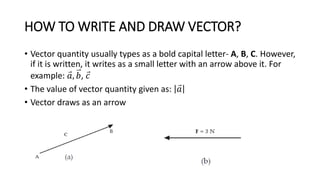
• Vector quantity usually types as a bold capital letter- A, B, C. However,
if it is written, it writes as a small letter with an arrow above it. For
example: 𝑎, 𝑏, 𝑐
• The value of vector quantity given as: 𝑎
• Vector draws as an arrow
VECTOR RESULTANT
• There are some methods to get the vector resultant: segitiga/triangle,
jajargenjang, poligon/polygon, analitis/analysis.
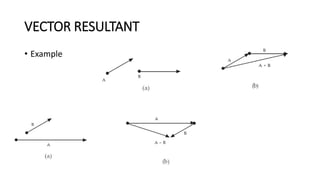
1. TRIANGLE METHOD/METODE SEGITIGA
a. Draw the first vector based on the value and the direction
b. Draw second vector based on the value and the direction with the
edge point close to the point of the first vector
c. Connect the first vector and the second vector
• Example
VECTOR RESULTANT
2. METODE JAJARAN
GENJANG/PARALLELOGRAM METHOD
a. Draw the first and the second vector with the end point close to on
another
b. Draw a parallelogram with both vector as the edge of the draw
c. Vector resultant is a diagonal of the parallelogram with the same
position of the end point
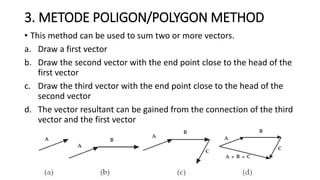
3. METODE POLIGON/POLYGON METHOD
• This method can be used to sum two or more vectors.
a. Draw a first vector
b. Draw the second vector with the end point close to the head of the
first vector
c. Draw the third vector with the end point close to the head of the
second vector
d. The vector resultant can be gained from the connection of the third
vector and the first vector
4. ANALYSIS METHOD
• This is the best method of all methods to result the vector resultant
• Using analitical equation:
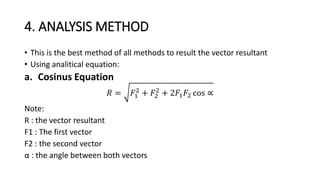
a. Cosinus Equation
𝑅 = 𝐹1
2
+ 𝐹2
2
+ 2𝐹1𝐹2 cos ∝
Note:
R : the vector resultant
F1 : The first vector
F2 : the second vector
α : the angle between both vectors
EXAMPLE
There are two vectors, each 8 N and
6 N. What is the vector resultant of
both vectors if the angle between
the first end point and the second
end point is 60o?
Answer:
𝑅 = 𝐹1
2
+ 𝐹2
2
+ 2𝐹1𝐹2 cos ∝
= 82 + 62 + 2.8.6 cos 60𝑜
= 124 𝑁
4. ANALYSIS METHOD
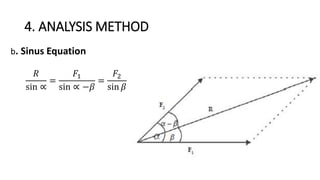
b. Sinus Equation
𝑅
sin ∝
=
𝐹1
sin ∝ −𝛽
=
𝐹2
sin 𝛽
EXAMPLE
There are two vectors, 8 cm and 6 cm. If both vectors close and
perpendicular each other, what is direction of the vector resultant of
the vectors?
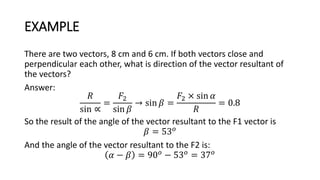
Answer:
𝑅
sin ∝
=
𝐹2
sin 𝛽
→ sin 𝛽 =
𝐹2 × sin 𝛼
𝑅
= 0.8
So the result of the angle of the vector resultant to the F1 vector is
𝛽 = 53𝑜
And the angle of the vector resultant to the F2 is:
𝛼 − 𝛽 = 90𝑜 − 53𝑜 = 37𝑜
VECTOR ELABORATION
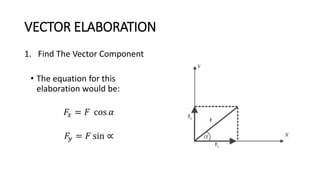
1. Find The Vector Component
• The equation for this
elaboration would be:
𝐹𝑥 = 𝐹 cos 𝛼
𝐹𝑦 = 𝐹 sin ∝
EXAMPLE
• Decide the vector component of the force with 20 N to 60o to the
positif x axes!
Answer:
𝐹𝑥 = 𝐹 cos 𝛼 = 20 cos 60𝑜
= 20 × 0.5 = 10 𝑁
𝐹𝑦 = 𝐹 sin ∝ = 20 sin 60𝑜
= 20 ×
1
2
3 = 10 3 𝑁
2. Find the direction and quantity of the vector
• The quantity of the vector
𝐹 = 𝐹𝑥
2
+ 𝐹𝑦
2
• Direction of the Vector
tan ∝ =
𝐹𝑦
𝐹𝑥
VECTOR ELABORATION
EXAMPLE
• Find the quantity and direction of vector F, if there is two vectors, 8 N
and 6 N!
Answer:
Quantity
𝐹 = 𝐹𝑥
2
+ 𝐹𝑦
2
= 82 + 62 = 100 = 10 𝑁
Direction
tan ∝ =
𝐹𝑦
𝐹𝑥
=
6
8
= 0.75 →∝= 36.87𝑜
TRIGONOMETRI TABLE
0 30 36 45 53 60 90
Sin 0
1
2
0.5 0.6
1
2
2 0.7 0.8
1
2
3 0.87 1
Cos 1
1
2
3 0.87
0.8 1
2
2 0.7
0.6 1
2
0.5 0
Tan 0
1
3
3 0.58 0.7 1 1 1.32 3 1.73 ∞
THANK YOU

Vector

  • 1.
  • 2.
    TYPES OF QUANTITY •In the previous lesson, we understand that there are a lot of physics quantity. All of them can be divied into two types of the quantity- scalar quantity and vector quantity. • Scalar quantity is a quantity that only has value. For example: mass, volume, etc. • Vector quantity is a quantity that has value and direction. For example: velocity, acceleration, etc.
  • 3.
    HOW TO WRITEAND DRAW VECTOR? • Vector quantity usually types as a bold capital letter- A, B, C. However, if it is written, it writes as a small letter with an arrow above it. For example: 𝑎, 𝑏, 𝑐 • The value of vector quantity given as: 𝑎 • Vector draws as an arrow
  • 4.
    VECTOR RESULTANT • Thereare some methods to get the vector resultant: segitiga/triangle, jajargenjang, poligon/polygon, analitis/analysis. 1. TRIANGLE METHOD/METODE SEGITIGA a. Draw the first vector based on the value and the direction b. Draw second vector based on the value and the direction with the edge point close to the point of the first vector c. Connect the first vector and the second vector
  • 5.
  • 6.
    2. METODE JAJARAN GENJANG/PARALLELOGRAMMETHOD a. Draw the first and the second vector with the end point close to on another b. Draw a parallelogram with both vector as the edge of the draw c. Vector resultant is a diagonal of the parallelogram with the same position of the end point
  • 7.
    3. METODE POLIGON/POLYGONMETHOD • This method can be used to sum two or more vectors. a. Draw a first vector b. Draw the second vector with the end point close to the head of the first vector c. Draw the third vector with the end point close to the head of the second vector d. The vector resultant can be gained from the connection of the third vector and the first vector
  • 8.
    4. ANALYSIS METHOD •This is the best method of all methods to result the vector resultant • Using analitical equation: a. Cosinus Equation 𝑅 = 𝐹1 2 + 𝐹2 2 + 2𝐹1𝐹2 cos ∝ Note: R : the vector resultant F1 : The first vector F2 : the second vector α : the angle between both vectors
  • 9.
    EXAMPLE There are twovectors, each 8 N and 6 N. What is the vector resultant of both vectors if the angle between the first end point and the second end point is 60o? Answer: 𝑅 = 𝐹1 2 + 𝐹2 2 + 2𝐹1𝐹2 cos ∝ = 82 + 62 + 2.8.6 cos 60𝑜 = 124 𝑁
  • 10.
    4. ANALYSIS METHOD b.Sinus Equation 𝑅 sin ∝ = 𝐹1 sin ∝ −𝛽 = 𝐹2 sin 𝛽
  • 11.
    EXAMPLE There are twovectors, 8 cm and 6 cm. If both vectors close and perpendicular each other, what is direction of the vector resultant of the vectors? Answer: 𝑅 sin ∝ = 𝐹2 sin 𝛽 → sin 𝛽 = 𝐹2 × sin 𝛼 𝑅 = 0.8 So the result of the angle of the vector resultant to the F1 vector is 𝛽 = 53𝑜 And the angle of the vector resultant to the F2 is: 𝛼 − 𝛽 = 90𝑜 − 53𝑜 = 37𝑜
  • 12.
    VECTOR ELABORATION 1. FindThe Vector Component • The equation for this elaboration would be: 𝐹𝑥 = 𝐹 cos 𝛼 𝐹𝑦 = 𝐹 sin ∝
  • 13.
    EXAMPLE • Decide thevector component of the force with 20 N to 60o to the positif x axes! Answer: 𝐹𝑥 = 𝐹 cos 𝛼 = 20 cos 60𝑜 = 20 × 0.5 = 10 𝑁 𝐹𝑦 = 𝐹 sin ∝ = 20 sin 60𝑜 = 20 × 1 2 3 = 10 3 𝑁
  • 14.
    2. Find thedirection and quantity of the vector • The quantity of the vector 𝐹 = 𝐹𝑥 2 + 𝐹𝑦 2 • Direction of the Vector tan ∝ = 𝐹𝑦 𝐹𝑥 VECTOR ELABORATION
  • 15.
    EXAMPLE • Find thequantity and direction of vector F, if there is two vectors, 8 N and 6 N! Answer: Quantity 𝐹 = 𝐹𝑥 2 + 𝐹𝑦 2 = 82 + 62 = 100 = 10 𝑁 Direction tan ∝ = 𝐹𝑦 𝐹𝑥 = 6 8 = 0.75 →∝= 36.87𝑜
  • 16.
    TRIGONOMETRI TABLE 0 3036 45 53 60 90 Sin 0 1 2 0.5 0.6 1 2 2 0.7 0.8 1 2 3 0.87 1 Cos 1 1 2 3 0.87 0.8 1 2 2 0.7 0.6 1 2 0.5 0 Tan 0 1 3 3 0.58 0.7 1 1 1.32 3 1.73 ∞
  • 17.