ANOMALIES OF AORTIC ARCH
ANATOMICAL CLASSIFICATION
Abnormality of branching
Abnormality of arch position
Supernumerary arch- double aortic arch
Abnormal origin of pulmonary artery from
descending aorta
DEFINITION:
Bronchus which is crossed by, defines the arch
2D ECHO- branching pattern of brachiocephalic vessel
First arch vessel carotid artery goes opposite to side of the arch
Exception: retroesophageal innominate artery, isolated
innominate artery and congenital absence of carotid artery
Diagnostic methods:
• Barium esophagography
• Echocardiography
• Angiography
• USG
A/W digeorge syndrome, velocardiofacial and conotruncal
anomaly and CATCH22
Cardiac anomaly: conotruncal anomaly
Subaortic stenosis with post malalingment of IVS
Truncus arteriosus communis
TOF+/- PA
60% of aortic arch anomaly without cardiac defect will have
22q11 deletion
Aortic arch anomaly in which trachea and esophagus are
completely surrounded by vascular structures- vascular ring
Structures need not to be patent
c/f- stridor, pneumonia and bronchitis and cough
apnea , choking , swallowing difficulty and interciurrent urti
Recurrent wheezing
Mistaken respirtaory symptom i/v/o cardiac anomaly
Asthma masquerading symptoms
Asymptomatic
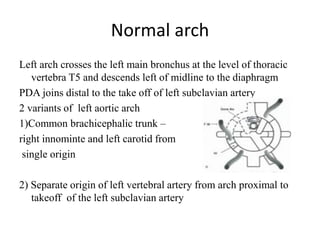
Normal arch
Left arch crosses the left main bronchus at the level of thoracic
vertebra T5 and descends left of midline to the diaphragm
PDA joins distal to the take off of left subclavian artery
2 variants of left aortic arch
1)Common brachicephalic trunk –
right innominte and left carotid from
single origin
2) Separate origin of left vertebral artery from arch proximal to
takeoff of the left subclavian artery
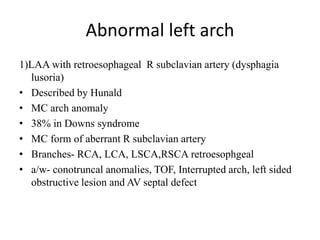
Abnormal left arch
1)LAA with retroesophageal R subclavian artery (dysphagia
lusoria)
• Described by Hunald
• MC arch anomaly
• 38% in Downs syndrome
• MC form of aberrant R subclavian artery
• Branches- RCA, LCA, LSCA,RSCA retroesophgeal
• a/w- conotruncal anomalies, TOF, Interrupted arch, left sided
obstructive lesion and AV septal defect
Embryology-
Disappearance of R 4th aortic arch
Distal R dorsal aorta becomes the proximal r subclavian artery
forming its retroesophageal portion
R sixth arch also involutes
Diagnosis and Mx-
No innominate artery
Barium esophagography- fixed filling defect
2D ECHO- non bifurcating first branch ascends towards R
2)LAA with R sided retroesophageal Diverticulum of
Kommerall:
1 st vascular ring diagnosed
Branching is same as before with difference in the size of
proximal subclavian aretryand presence of ligamentum
arteriosum
Embryology :
Distal R sixth arch persist and forms a ring
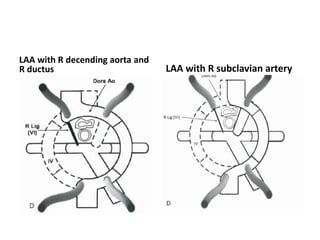
3)Left aortic arch with R descending aorta and R ducutus for
ligamentum
Circumflex aortic arch
Arch becomes retroesophageal, so subclavain is not
retroesophageal
Descending aorta is connected by ductus to right RPA forming a
vacular ring
Embryology:
Left arch with retroesophageal subclavian artery
Disappearance of R 4th arch with distal left dorsal aorta forming
distal aortic arch passess retroesophageally to descending aorta
R seventh intersegmental artery arises from R side descending
aorta
R sixth arch connects RPA portion of truncoaortic sac with distal
R dorsal aorta
Diagnosis and Mx:
Vascular ring symptoms
Barium esophagography- large post indentation
DD- RAA with retroesophageal diverticulum
Angio , MRI
4)Left aortic arch with isolated R subclavian artery
• RSCA arises from ductus arteriosus
• Branching pattern is RCA, LCA and left SCA
• Persistence of R 6th arch from which subclavian artery arises
Diagnosis :
When ductus patent- lim sat< head sat
Ductus closes – same sat through retrograde flow- no Sx
Rx- implantation of subclavian artery to carotid artery
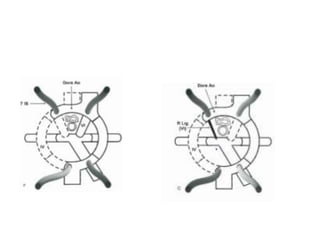
LAA with R decending aorta and
R ductus LAA with R subclavian artery
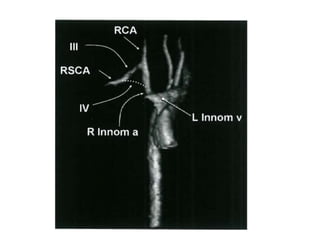
5)Left aortic arch with cevical origin of right subclavian artery
a/w interrupted aortic arch, TOF with PA, and 22q11 deletion
Innominates bifurcates in neck to internal and external carotid
and subclavian and traverse back to thorax to supply arm
Embryology:
B/L or U/L absence or atresia of embryonic fourth arch
Fate of subclavian artery if atresia or absence occurs on side
opposite to aorta
1) Origin from descending aorta ( distal to intersegmental artery)
2) Origin from sixth arch
3) Origin from third arch- more cephalad than fourth ,
subclavian from neck
When 4th arch is absent or atretic ipsilateral to definitive aortic
arch – 3 possibilities
1) Interrupted aortic arc in which sixth arch replaces 4th
2) Persistent fifth aortic arch with atresia of distal 4th
3) Cervical aortic arch – 3rd arch replaces 4th
Right aortic arch
Single aortic arch that crosses over right main stem bronchus
passing R of the trachea
4 main types of R arch:
a) Mirror –image branching of R descending aorta
b) With retroesophageal left subclavian artery
c) With retroesophageal diverticulum of Kommerall
d) With R descending aorta
Incidence- 13 to 34%
A/w Truncus> TOF> D-TGA
RAA with CoA- 1.7% of all CoA, 2.9% of RAA
Abberant LSCA- 65%
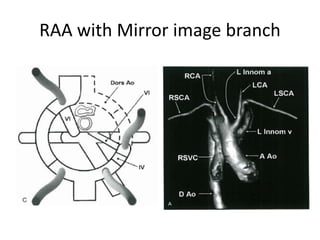
1)RAA with mirror image branching:
Branches- left innominate artery RCARSCA
Ductus arteriosus from left side or base of innominate artery
A/W CHD – TOF, TA, TGA,DORV
Right bronchus compression btw RPA and DA
Embryology:
Dissolution of left dorsal aorta distal to the origin of 7th
intersegmental artery
Right 6th arch involutes and left 6th arch persist
Left ductus arise from underside of left innominate artery and
passess to RPA appears as congenital BT shunt
Left sixth arch disappears and right persist – true mirror image
Diagnosis and management:
Incidental imaging
2D Echo
CXR- right sided indentation
Barium esophagography- right sided indentation on trachea
Rx- no trrearment
For systemic to pulmonary shunts, anatomy must be known
For repair of esophageal atresia and TEF
RAA with Mirror image branch
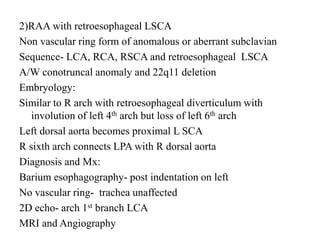
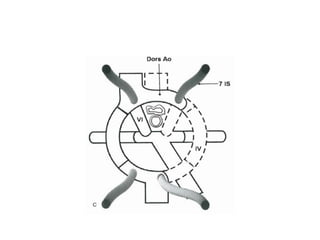
2)RAA with retroesophageal LSCA
Non vascular ring form of anomalous or aberrant subclavian
Sequence- LCA, RCA, RSCA and retroesophageal LSCA
A/W conotruncal anomaly and 22q11 deletion
Embryology:
Similar to R arch with retroesophageal diverticulum with
involution of left 4th arch but loss of left 6th arch
Left dorsal aorta becomes proximal L SCA
R sixth arch connects LPA with R dorsal aorta
Diagnosis and Mx:
Barium esophagography- post indentation on left
No vascular ring- trachea unaffected
2D echo- arch 1st branch LCA
MRI and Angiography
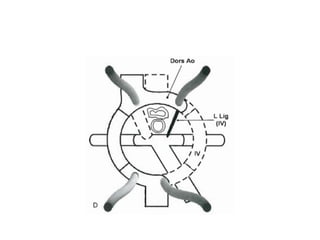
3)RAA with retroesophageal diverticulum of Kommerall:
Second most common vascular ring after double aortic arch
Branches: LCA, RCA, right subclavian artery, and finally a
retroesophageal vessel from which the left subclavian artery
arises and the left ductus arteriosus connects
ring formed by the aortic arch on the right, retroesophageal vessel
supplying the left subclavian posteriorly, the ductus on the left,
and the pulmonary artery anteriorly
Congenital absence of the left carotid artery is a rare association
with right arch, diverticulum of Kommerell
Embryology:
Disappearance of the left fourth embryonic arch with persistence
of the left sixth (ductal) arch between the truncoaortic sac
(pulmonary artery precursor) and left dorsal aorta
The presentation in symptomatic patients is usually that of a
vascular ring
Barium esophagram reveals a large posterior indentation on the
esophagus
Angiography demonstrates the characteristic branching pattern
and abrupt change in caliber from diverticulum to subclavian
artery
MRI /CT
The majority of people with this arch anomaly are asymptomatic.
Treatment -division of the ductus or ligamentum through left
thoracotomy.
Also resection of the diverticulum and transfer of the left
subclavian artery to the left carotid artery
Right Aortic Arch with Left Descending Aorta
and Left Ductus (Ligamentum) Arteriosus(um
Circumflex right arch
Aortic arch cross the midline to the left at the level of the T4 or
T5 vertebral body at which point it gives rise to the left ductus
arteriosus
Branching - mirrorimage branching pattern-left innominate, right
carotid, right subclavian
Left carotid, right carotid, right subclavian, and finally the left
subclavian
Aberrant left innominate artery-right carotid, right subclavian,
left innominate as the last vessel
Aortic arch is retrooesophageal in all cases, not the branches
Two forms exist with dissolution of either the left dorsal aorta
distal to the takeoff of the left subclavian artery or the left
fourth arch
The persistent left sixth arch connects to the left sided dorsal
aorta completing a vascular ring
Diagnosis and management:
Barium esophagography: downward and left indentation
Division of the vascular ring is indicated when patients are
symptomatic (usually loose)
Division of the aortic arch with mobilization of the
retroesophageal portion and reanastomosis of ascending and
descending aorta using a tube graft may be necessary to relieve
the esophageal compression (in adults)
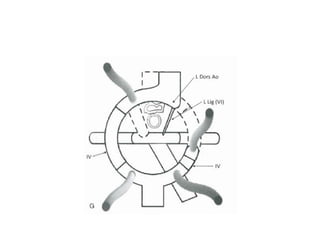
Cervical aortic arch
Arch is found above the level of clavicle as high as C2 vertebra
2 types:
1)Anomalous subclavian artery and vascular ring with either
descending aorta contralateral to arch or retroesophageal
diverticulum
2)Normal branching pattern
1st group- RAA asso present
Separate origin of ICA and ECA from arch
Common carotid artery or bicarotid trunk and subclavian
separately
In contralateral DA- vascular ring by AA on R, retroesophageal
segment of aorta posteriorly , ligamnetum arteriosum to left
and PA anteriorly
2nd type: With LAA
AA obstruction is uncommon
A/W CoA in ring and non ring group
Embryology :
Dissolution of embryonic 4th arch
Presence of ductus caroticus (segment of dorsal aorta between
3rd and 4th embryonic arch)
Both ICA and ECA arise from 3rd arch
A/W 22q11 deletion
Alternative explanation: failure of normal descen tof aortic arch
system from cephalic location @3rd week to intrathoracic @7th
week
Diagnosis :
Pulsatile mass in supraclavicular fossa
In infants- stridor , dyspnea and repeated LRTI
Subclavian steal syndrome
Compression of mass- loss of femoral pulse
X ray-
widened mediastinum
Absent aortic knob
Anteriorly deviated trachea
Angiography :
2D Echo:
Treatment :
Ind: Arch hypoplasia and vascular ring aneurysm
Left sided ascending to descending aorta anastomosis or tube
graft interposition
Double Aortic Arch:
Anomaly in which both right and left aortic arches are present
Variations:
a) Both arches of similar size
b) Hypoplasia of one arch (Left)
c) Atresia of one arch( left)
Ductus or ligamentum may be present
Right arch is more superiorly located
DAA form vascular ring around trachea and esophagus
Branching pattern is determined by patency of various arch
component and side of descending aorta
Both arch patent- symmetrical origin of arteries
Atretic left arch- distal to origin of left subclavian ( RAA with
mirror image pattern)
Atretic right arch btwn LSCA and left carotid (RAA with
retroesophageal diverticulum of Kommerall)
A/w TOF> TGA>CCTGA
Embryology: Persistence of both 4th embryonic arch
Diagnosis-
Tight rings/ both arches patent – present in first week of life
With atretic left arch (loose ring)- present at 3-6 months of life
Adult: sesllowing difficulty or resp symptoms
Xray: tracheal indentation- sup right sided arch and inf left sided
arch
Lateral view- posteriorly indentation by right arch
Treatment :
For symptomatic parient:
Division of ring in its smaller limb
Ductus arteriosus must be considered
Persistent fifth arch:
Double lumen aortic arch- both arches appears on same side
Variations:
With both lumen patent
Atresia/interruption of superior arch with patent inferior arch(5th )
Hypoplastic but patent superior arch
Inferior arch extends from innominate artery to a point opposite
to take off to the LSCA
Incidental or a/w CoA
Diagnosis and management:
Angiography
Echocardiogrphy
MRI
Interrupted aortic arch
Complete separtion of ascending and descending aorta
Anomalies related to the pattern of branching of brachiocephalic
vessels
Caloria and Patton classification:
Type A- interruption distal to LSCA
Type B- Between carotid and LSCA
Type C- Between carotids
With retroesophageal or isolated subclavian artery
With retroesophageal subclavian
With isolated subclavian artery
Interrupted RAA – in Digeorge syndrome
Type B more common than type A
Type A in AP window, TGA and innterrupted aortic arch
Embryology:
Type A – involution of both dorsal aorta distal to 4th arch and
proximal to persistent sixth arch
B- involution of one 4th arch and one dorsal aorta btwn arch 4
and 6
C- involution of one limb of truncoaortic sac and associated
proximal third arch and entire fourth arch
Diagnosis and management:
CV collapse and heart failure after spontaneous closure of ductus
arteriosus
Fluid resuscitation
PGE1 infusion for ductal patency
Ionotropic support
Absence of all limb pulse – type B with anomalous subclavian
Strong carotid pulse- diff critical AS from interrupted aortica arch
Differential cyanosis
2DEcho and Angiography
MRI
Surgery depends on degree of subaortic obstruction
Subaortic diameters>/=5-6mm- intracardiac repair and arch
reconstruction
Subaortic diameter 4mm or less- homograft augmentation of
ascending aorta using pulmonary artery
IAA with TGA- ASO with transannular patch

Aortic arch anomalies

  • 1.
  • 2.
    ANATOMICAL CLASSIFICATION Abnormality ofbranching Abnormality of arch position Supernumerary arch- double aortic arch Abnormal origin of pulmonary artery from descending aorta
  • 3.
    DEFINITION: Bronchus which iscrossed by, defines the arch 2D ECHO- branching pattern of brachiocephalic vessel First arch vessel carotid artery goes opposite to side of the arch Exception: retroesophageal innominate artery, isolated innominate artery and congenital absence of carotid artery Diagnostic methods: • Barium esophagography • Echocardiography • Angiography • USG
  • 4.
    A/W digeorge syndrome,velocardiofacial and conotruncal anomaly and CATCH22 Cardiac anomaly: conotruncal anomaly Subaortic stenosis with post malalingment of IVS Truncus arteriosus communis TOF+/- PA 60% of aortic arch anomaly without cardiac defect will have 22q11 deletion
  • 5.
    Aortic arch anomalyin which trachea and esophagus are completely surrounded by vascular structures- vascular ring Structures need not to be patent c/f- stridor, pneumonia and bronchitis and cough apnea , choking , swallowing difficulty and interciurrent urti Recurrent wheezing Mistaken respirtaory symptom i/v/o cardiac anomaly Asthma masquerading symptoms Asymptomatic
  • 6.
    Normal arch Left archcrosses the left main bronchus at the level of thoracic vertebra T5 and descends left of midline to the diaphragm PDA joins distal to the take off of left subclavian artery 2 variants of left aortic arch 1)Common brachicephalic trunk – right innominte and left carotid from single origin 2) Separate origin of left vertebral artery from arch proximal to takeoff of the left subclavian artery
  • 7.
    Abnormal left arch 1)LAAwith retroesophageal R subclavian artery (dysphagia lusoria) • Described by Hunald • MC arch anomaly • 38% in Downs syndrome • MC form of aberrant R subclavian artery • Branches- RCA, LCA, LSCA,RSCA retroesophgeal • a/w- conotruncal anomalies, TOF, Interrupted arch, left sided obstructive lesion and AV septal defect
  • 9.
    Embryology- Disappearance of R4th aortic arch Distal R dorsal aorta becomes the proximal r subclavian artery forming its retroesophageal portion R sixth arch also involutes Diagnosis and Mx- No innominate artery Barium esophagography- fixed filling defect 2D ECHO- non bifurcating first branch ascends towards R
  • 10.
    2)LAA with Rsided retroesophageal Diverticulum of Kommerall: 1 st vascular ring diagnosed Branching is same as before with difference in the size of proximal subclavian aretryand presence of ligamentum arteriosum Embryology : Distal R sixth arch persist and forms a ring
  • 11.
    3)Left aortic archwith R descending aorta and R ducutus for ligamentum Circumflex aortic arch Arch becomes retroesophageal, so subclavain is not retroesophageal Descending aorta is connected by ductus to right RPA forming a vacular ring Embryology: Left arch with retroesophageal subclavian artery Disappearance of R 4th arch with distal left dorsal aorta forming distal aortic arch passess retroesophageally to descending aorta R seventh intersegmental artery arises from R side descending aorta R sixth arch connects RPA portion of truncoaortic sac with distal R dorsal aorta
  • 12.
    Diagnosis and Mx: Vascularring symptoms Barium esophagography- large post indentation DD- RAA with retroesophageal diverticulum Angio , MRI 4)Left aortic arch with isolated R subclavian artery • RSCA arises from ductus arteriosus • Branching pattern is RCA, LCA and left SCA • Persistence of R 6th arch from which subclavian artery arises Diagnosis : When ductus patent- lim sat< head sat Ductus closes – same sat through retrograde flow- no Sx Rx- implantation of subclavian artery to carotid artery
  • 13.
    LAA with Rdecending aorta and R ductus LAA with R subclavian artery
  • 14.
    5)Left aortic archwith cevical origin of right subclavian artery a/w interrupted aortic arch, TOF with PA, and 22q11 deletion Innominates bifurcates in neck to internal and external carotid and subclavian and traverse back to thorax to supply arm Embryology: B/L or U/L absence or atresia of embryonic fourth arch Fate of subclavian artery if atresia or absence occurs on side opposite to aorta 1) Origin from descending aorta ( distal to intersegmental artery) 2) Origin from sixth arch 3) Origin from third arch- more cephalad than fourth , subclavian from neck
  • 15.
    When 4th archis absent or atretic ipsilateral to definitive aortic arch – 3 possibilities 1) Interrupted aortic arc in which sixth arch replaces 4th 2) Persistent fifth aortic arch with atresia of distal 4th 3) Cervical aortic arch – 3rd arch replaces 4th
  • 17.
    Right aortic arch Singleaortic arch that crosses over right main stem bronchus passing R of the trachea 4 main types of R arch: a) Mirror –image branching of R descending aorta b) With retroesophageal left subclavian artery c) With retroesophageal diverticulum of Kommerall d) With R descending aorta Incidence- 13 to 34% A/w Truncus> TOF> D-TGA RAA with CoA- 1.7% of all CoA, 2.9% of RAA Abberant LSCA- 65%
  • 18.
    1)RAA with mirrorimage branching: Branches- left innominate artery RCARSCA Ductus arteriosus from left side or base of innominate artery A/W CHD – TOF, TA, TGA,DORV Right bronchus compression btw RPA and DA Embryology: Dissolution of left dorsal aorta distal to the origin of 7th intersegmental artery Right 6th arch involutes and left 6th arch persist Left ductus arise from underside of left innominate artery and passess to RPA appears as congenital BT shunt Left sixth arch disappears and right persist – true mirror image
  • 19.
    Diagnosis and management: Incidentalimaging 2D Echo CXR- right sided indentation Barium esophagography- right sided indentation on trachea Rx- no trrearment For systemic to pulmonary shunts, anatomy must be known For repair of esophageal atresia and TEF
  • 20.
    RAA with Mirrorimage branch
  • 21.
    2)RAA with retroesophagealLSCA Non vascular ring form of anomalous or aberrant subclavian Sequence- LCA, RCA, RSCA and retroesophageal LSCA A/W conotruncal anomaly and 22q11 deletion Embryology: Similar to R arch with retroesophageal diverticulum with involution of left 4th arch but loss of left 6th arch Left dorsal aorta becomes proximal L SCA R sixth arch connects LPA with R dorsal aorta Diagnosis and Mx: Barium esophagography- post indentation on left No vascular ring- trachea unaffected 2D echo- arch 1st branch LCA MRI and Angiography
  • 23.
    3)RAA with retroesophagealdiverticulum of Kommerall: Second most common vascular ring after double aortic arch Branches: LCA, RCA, right subclavian artery, and finally a retroesophageal vessel from which the left subclavian artery arises and the left ductus arteriosus connects ring formed by the aortic arch on the right, retroesophageal vessel supplying the left subclavian posteriorly, the ductus on the left, and the pulmonary artery anteriorly Congenital absence of the left carotid artery is a rare association with right arch, diverticulum of Kommerell Embryology: Disappearance of the left fourth embryonic arch with persistence of the left sixth (ductal) arch between the truncoaortic sac (pulmonary artery precursor) and left dorsal aorta
  • 25.
    The presentation insymptomatic patients is usually that of a vascular ring Barium esophagram reveals a large posterior indentation on the esophagus Angiography demonstrates the characteristic branching pattern and abrupt change in caliber from diverticulum to subclavian artery MRI /CT The majority of people with this arch anomaly are asymptomatic. Treatment -division of the ductus or ligamentum through left thoracotomy.
  • 26.
    Also resection ofthe diverticulum and transfer of the left subclavian artery to the left carotid artery
  • 27.
    Right Aortic Archwith Left Descending Aorta and Left Ductus (Ligamentum) Arteriosus(um Circumflex right arch Aortic arch cross the midline to the left at the level of the T4 or T5 vertebral body at which point it gives rise to the left ductus arteriosus Branching - mirrorimage branching pattern-left innominate, right carotid, right subclavian Left carotid, right carotid, right subclavian, and finally the left subclavian Aberrant left innominate artery-right carotid, right subclavian, left innominate as the last vessel Aortic arch is retrooesophageal in all cases, not the branches
  • 28.
    Two forms existwith dissolution of either the left dorsal aorta distal to the takeoff of the left subclavian artery or the left fourth arch The persistent left sixth arch connects to the left sided dorsal aorta completing a vascular ring Diagnosis and management: Barium esophagography: downward and left indentation Division of the vascular ring is indicated when patients are symptomatic (usually loose) Division of the aortic arch with mobilization of the retroesophageal portion and reanastomosis of ascending and descending aorta using a tube graft may be necessary to relieve the esophageal compression (in adults)
  • 30.
    Cervical aortic arch Archis found above the level of clavicle as high as C2 vertebra 2 types: 1)Anomalous subclavian artery and vascular ring with either descending aorta contralateral to arch or retroesophageal diverticulum 2)Normal branching pattern 1st group- RAA asso present Separate origin of ICA and ECA from arch Common carotid artery or bicarotid trunk and subclavian separately In contralateral DA- vascular ring by AA on R, retroesophageal segment of aorta posteriorly , ligamnetum arteriosum to left and PA anteriorly
  • 31.
    2nd type: WithLAA AA obstruction is uncommon A/W CoA in ring and non ring group Embryology : Dissolution of embryonic 4th arch Presence of ductus caroticus (segment of dorsal aorta between 3rd and 4th embryonic arch) Both ICA and ECA arise from 3rd arch A/W 22q11 deletion Alternative explanation: failure of normal descen tof aortic arch system from cephalic location @3rd week to intrathoracic @7th week
  • 32.
    Diagnosis : Pulsatile massin supraclavicular fossa In infants- stridor , dyspnea and repeated LRTI Subclavian steal syndrome Compression of mass- loss of femoral pulse X ray- widened mediastinum Absent aortic knob Anteriorly deviated trachea Angiography : 2D Echo:
  • 33.
    Treatment : Ind: Archhypoplasia and vascular ring aneurysm Left sided ascending to descending aorta anastomosis or tube graft interposition Double Aortic Arch: Anomaly in which both right and left aortic arches are present Variations: a) Both arches of similar size b) Hypoplasia of one arch (Left) c) Atresia of one arch( left) Ductus or ligamentum may be present Right arch is more superiorly located DAA form vascular ring around trachea and esophagus
  • 34.
    Branching pattern isdetermined by patency of various arch component and side of descending aorta Both arch patent- symmetrical origin of arteries Atretic left arch- distal to origin of left subclavian ( RAA with mirror image pattern) Atretic right arch btwn LSCA and left carotid (RAA with retroesophageal diverticulum of Kommerall) A/w TOF> TGA>CCTGA Embryology: Persistence of both 4th embryonic arch Diagnosis- Tight rings/ both arches patent – present in first week of life With atretic left arch (loose ring)- present at 3-6 months of life Adult: sesllowing difficulty or resp symptoms
  • 35.
    Xray: tracheal indentation-sup right sided arch and inf left sided arch Lateral view- posteriorly indentation by right arch Treatment : For symptomatic parient: Division of ring in its smaller limb Ductus arteriosus must be considered Persistent fifth arch: Double lumen aortic arch- both arches appears on same side Variations: With both lumen patent Atresia/interruption of superior arch with patent inferior arch(5th ) Hypoplastic but patent superior arch
  • 36.
    Inferior arch extendsfrom innominate artery to a point opposite to take off to the LSCA Incidental or a/w CoA Diagnosis and management: Angiography Echocardiogrphy MRI
  • 37.
    Interrupted aortic arch Completesepartion of ascending and descending aorta Anomalies related to the pattern of branching of brachiocephalic vessels Caloria and Patton classification: Type A- interruption distal to LSCA Type B- Between carotid and LSCA Type C- Between carotids With retroesophageal or isolated subclavian artery With retroesophageal subclavian With isolated subclavian artery
  • 38.
    Interrupted RAA –in Digeorge syndrome Type B more common than type A Type A in AP window, TGA and innterrupted aortic arch Embryology: Type A – involution of both dorsal aorta distal to 4th arch and proximal to persistent sixth arch B- involution of one 4th arch and one dorsal aorta btwn arch 4 and 6 C- involution of one limb of truncoaortic sac and associated proximal third arch and entire fourth arch
  • 39.
    Diagnosis and management: CVcollapse and heart failure after spontaneous closure of ductus arteriosus Fluid resuscitation PGE1 infusion for ductal patency Ionotropic support Absence of all limb pulse – type B with anomalous subclavian Strong carotid pulse- diff critical AS from interrupted aortica arch Differential cyanosis 2DEcho and Angiography MRI
  • 40.
    Surgery depends ondegree of subaortic obstruction Subaortic diameters>/=5-6mm- intracardiac repair and arch reconstruction Subaortic diameter 4mm or less- homograft augmentation of ascending aorta using pulmonary artery IAA with TGA- ASO with transannular patch