

Introduction



K+ channel architecture



Selectivity filter



Ion permeation



K+ channelopathies



Drugs


Ion channels are integral proteins



Plays a vital role in functioning of a cell



Genetic identification of ion channels has
improved our understanding……….



Ion channels

enzymes…
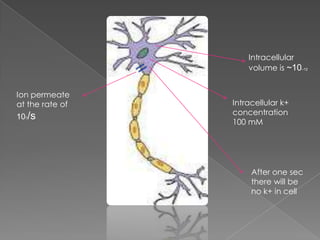
Intracellular
volume is ~10–12
Ion permeate
at the rate of
107/s

Intracellular k+
concentration
100 mM

After one sec
there will be
no k+ in cell
Hence to b effective in altering the
membrane potential …………….

 The opening & closing of channel should be
brief and fast……….
Structural basis of
permeation & selectivity




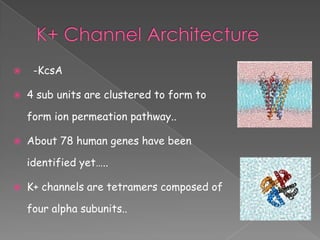
-KcsA

4 sub units are clustered to form to
form ion permeation pathway..



About 78 human genes have been
identified yet…..



K+ channels are tetramers composed of
four alpha subunits..
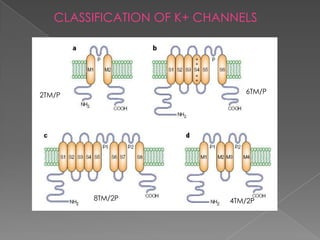
CLASSIFICATION OF K+ CHANNELS

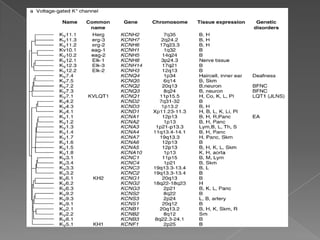
6TM/P

22TM/P

8TM/2P

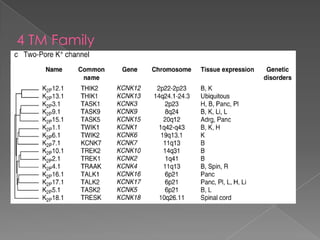
4TM/2P
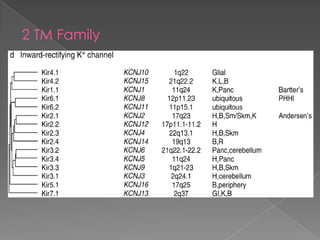
 2TM/P is essentially a universal feature of k+
channel

 it has amino tetramerization domain, carboxy
terminal, protein interacting domain..
 standard nomenclature of these channels was

proposed by Nomenclature and Drug
Classification International Union of Basic and
Clinical Pharmacology Committee on Receptor

Nomenclature and Drug classification (NCIUPHAR)
2 TM Family
4 TM Family
6 TM Family
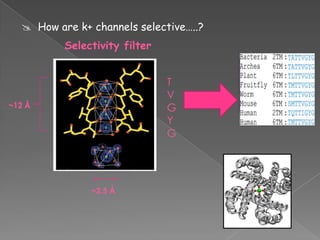
 How are k+ channels selective…..?
Selectivity filter

T
V
G
Y
G

~12 Å

~2.5 Å

Series of
stereo
chemical
check points
Ion permeation
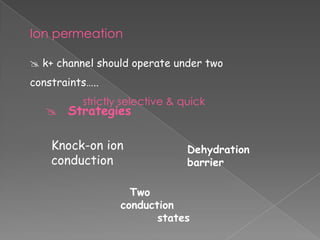
 k+ channel should operate under two

constraints…..
strictly selective & quick

 Strategies
Knock-on ion
conduction

Dehydration
barrier

Two
conduction
states
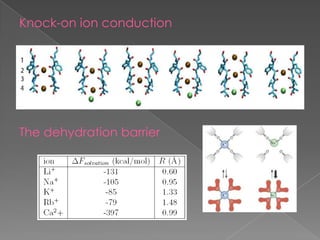
Knock-on ion conduction

The dehydration barrier
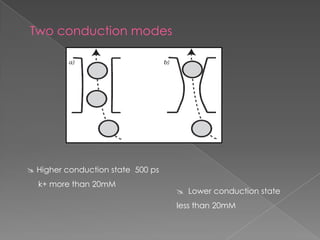
Two conduction modes

 Higher conduction state 500 ps
k+ more than 20mM

 Lower conduction state
less than 20mM
K+ Channelopathies
 Cardiac diseases (KvLQT1)

CNS diseases (KCNA1)
Deafness (KCNQ4)
Renal diseases(KCNJ1)
Metabolic diseases (SUR1)
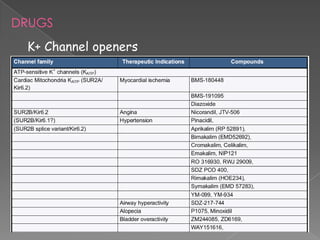
DRUGS
K+ Channel openers
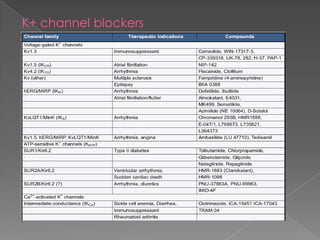
K+ channel blockers
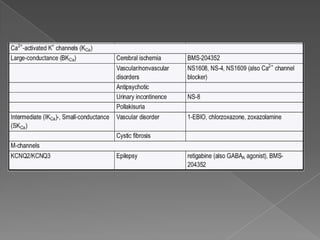
K+ channel modulators

K+ channel modulators

  • 2.
     Introduction  K+ channel architecture  Selectivityfilter  Ion permeation  K+ channelopathies  Drugs
  • 3.
     Ion channels areintegral proteins  Plays a vital role in functioning of a cell  Genetic identification of ion channels has improved our understanding……….  Ion channels enzymes…
  • 4.
    Intracellular volume is ~10–12 Ionpermeate at the rate of 107/s Intracellular k+ concentration 100 mM After one sec there will be no k+ in cell
  • 5.
    Hence to beffective in altering the membrane potential …………….  The opening & closing of channel should be brief and fast………. Structural basis of permeation & selectivity
  • 6.
      -KcsA 4 sub unitsare clustered to form to form ion permeation pathway..  About 78 human genes have been identified yet…..  K+ channels are tetramers composed of four alpha subunits..
  • 7.
    CLASSIFICATION OF K+CHANNELS 6TM/P 22TM/P 8TM/2P 4TM/2P
  • 8.
     2TM/P isessentially a universal feature of k+ channel  it has amino tetramerization domain, carboxy terminal, protein interacting domain..  standard nomenclature of these channels was proposed by Nomenclature and Drug Classification International Union of Basic and Clinical Pharmacology Committee on Receptor Nomenclature and Drug classification (NCIUPHAR)
  • 9.
  • 10.
  • 11.
  • 12.
     How arek+ channels selective…..? Selectivity filter T V G Y G ~12 Å ~2.5 Å Series of stereo chemical check points
  • 13.
    Ion permeation  k+channel should operate under two constraints….. strictly selective & quick  Strategies Knock-on ion conduction Dehydration barrier Two conduction states
  • 14.
    Knock-on ion conduction Thedehydration barrier
  • 15.
    Two conduction modes Higher conduction state 500 ps k+ more than 20mM  Lower conduction state less than 20mM
  • 16.
    K+ Channelopathies  Cardiacdiseases (KvLQT1) CNS diseases (KCNA1) Deafness (KCNQ4) Renal diseases(KCNJ1) Metabolic diseases (SUR1)
  • 17.
  • 19.