1
ACM 116: The Kalman filter
• Example
• General Setup
• Derivation
• Numerical examples
– Estimating the voltage
– 1D tracking
– 2D tracking
2
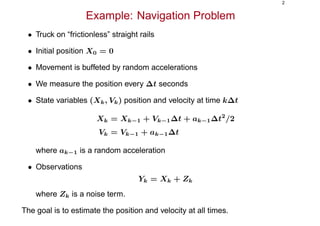
Example: Navigation Problem
• Truck on “frictionless” straight rails
• Initial position X0 = 0
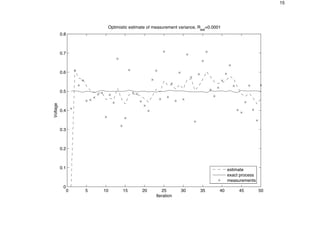
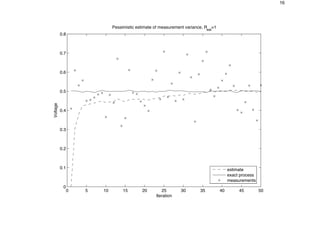
• Movement is buffeted by random accelerations
• We measure the position every ∆t seconds
• State variables (Xk, Vk) position and velocity at time k∆t
Xk = Xk−1 + Vk−1∆t + ak−1∆t2
/2
Vk = Vk−1 + ak−1∆t
where ak−1 is a random acceleration
• Observations
Yk = Xk + Zk
where Zk is a noise term.
The goal is to estimate the position and velocity at all times.
3
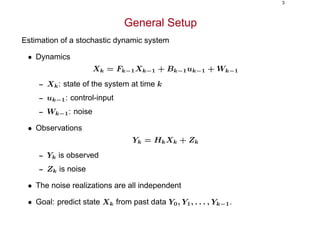
General Setup
Estimation of a stochastic dynamic system
• Dynamics
Xk = Fk−1Xk−1 + Bk−1uk−1 + Wk−1
– Xk: state of the system at time k
– uk−1: control-input
– Wk−1: noise
• Observations
Yk = HkXk + Zk
– Yk is observed
– Zk is noise
• The noise realizations are all independent
• Goal: predict state Xk from past data Y0, Y1, . . . , Yk−1.
4
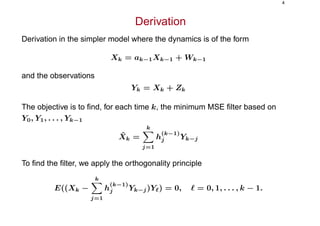
Derivation
Derivation in the simpler model where the dynamics is of the form
Xk = ak−1Xk−1 + Wk−1
and the observations
Yk = Xk + Zk
The objective is to find, for each time k, the minimum MSE filter based on
Y0, Y1, . . . , Yk−1
ˆXk =
k
j=1
h
(k−1)
j Yk−j
To find the filter, we apply the orthogonality principle
E((Xk −
k
j=1
h
(k−1)
j Yk−j)Y ) = 0, = 0, 1, . . . , k − 1.
5
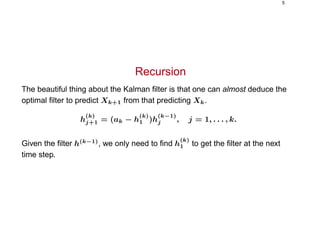
Recursion
The beautiful thing about the Kalman filter is that one can almost deduce the
optimal filter to predict Xk+1 from that predicting Xk.
h
(k)
j+1 = (ak − h
(k)
1 )h
(k−1)
j , j = 1, . . . , k.
Given the filter h(k−1)
, we only need to find h
(k)
1 to get the filter at the next
time step.
6
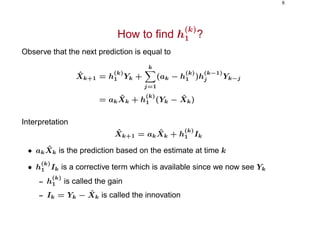
How to find h
(k)
1 ?
Observe that the next prediction is equal to
ˆXk+1 = h
(k)
1 Yk +
k
j=1
(ak − h
(k)
1 )h
(k−1)
j Yk−j
= ak
ˆXk + h
(k)
1 (Yk − ˆXk)
Interpretation
ˆXk+1 = ak
ˆXk + h
(k)
1 Ik
• ak
ˆXk is the prediction based on the estimate at time k
• h
(k)
1 Ik is a corrective term which is available since we now see Yk
– h
(k)
1 is called the gain
– Ik = Yk − ˆXk is called the innovation
7
Error of Prediction
To find h
(k)
1 , we look at the error of prediction
k = Xk − ˆXk
We have the recursion
k+1 = (ak − h
(k)
1 ) k + Wk − h
(k)
1 Zk
• 0 = Z0
• E( k) = 0
• E( 2
k+1) = [ak − h
(k)
1 ]2
E( 2
k) + E(W 2
k ) + [h
(k)
1 ]2
E(Z2
k)
8
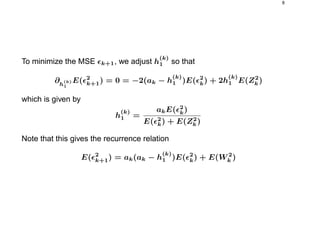
To minimize the MSE k+1, we adjust h
(k)
1 so that
∂h
(k)
1
E( 2
k+1) = 0 = −2(ak − h
(k)
1 )E( 2
k) + 2h
(k)
1 E(Z2
k)
which is given by
h
(k)
1 =
akE( 2
k)
E( 2
k) + E(Z2
k)
Note that this gives the recurrence relation
E( 2
k+1) = ak(ak − h
(k)
1 )E( 2
k) + E(W 2
k )
9
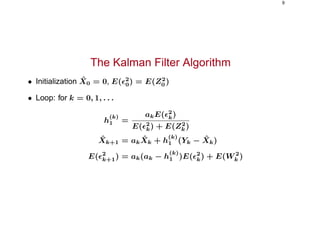
The Kalman Filter Algorithm
• Initialization ˆX0 = 0, E( 2
0) = E(Z2
0 )
• Loop: for k = 0, 1, . . .
h
(k)
1 =
akE( 2
k)
E( 2
k) + E(Z2
k)
ˆXk+1 = ak
ˆXk + h
(k)
1 (Yk − ˆXk)
E( 2
k+1) = ak(ak − h
(k)
1 )E( 2
k) + E(W 2
k )
10
Benefits
• Requires no knowledge about the structure of Wk and Zk (only variances)
• Easy implementation
• Many applications
– Inertial guidance system
– Autopilot
– Satellite navigation system
– Many others
11
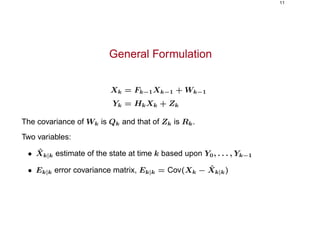
General Formulation
Xk = Fk−1Xk−1 + Wk−1
Yk = HkXk + Zk
The covariance of Wk is Qk and that of Zk is Rk.
Two variables:
• ˆXk|k estimate of the state at time k based upon Y0, . . . , Yk−1
• Ek|k error covariance matrix, Ek|k = Cov(Xk − ˆXk|k)
12
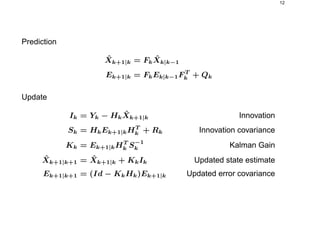
Prediction
ˆXk+1|k = Fk
ˆXk|k−1
Ek+1|k = FkEk|k−1F T
k + Qk
Update
Ik = Yk − Hk
ˆXk+1|k Innovation
Sk = HkEk+1|kHT
k + Rk Innovation covariance
Kk = Ek+1|kHT
k S−1
k Kalman Gain
ˆXk+1|k+1 = ˆXk+1|k + KkIk Updated state estimate
Ek+1|k+1 = (Id − KkHk)Ek+1|k Updated error covariance
13
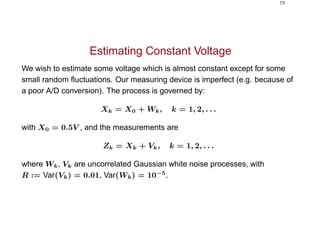
Estimating Constant Voltage
We wish to estimate some voltage which is almost constant except for some
small random fluctuations. Our measuring device is imperfect (e.g. because of
a poor A/D conversion). The process is governed by:
Xk = X0 + Wk, k = 1, 2, . . .
with X0 = 0.5V , and the measurements are
Zk = Xk + Vk, k = 1, 2, . . .
where Wk, Vk are uncorrelated Gaussian white noise processes, with
R := Var(Vk) = 0.01, Var(Wk) = 10−5
.
14
0 5 10 15 20 25 30 35 40 45 50
0
0.1
0.2
0.3
0.4
0.5
0.6
0.7
0.8
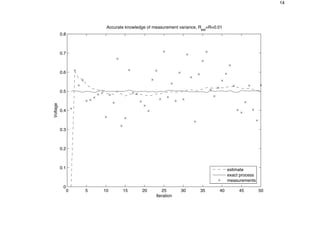
Accurate knowledge of measurement variance, Rest
=R=0.01
Iteration
Voltage
estimate
exact process
measurements
15
0 5 10 15 20 25 30 35 40 45 50
0
0.1
0.2
0.3
0.4
0.5
0.6
0.7
0.8
Optimistic estimate of measurement variance, Rest
=0.0001
Iteration
Voltage
estimate
exact process
measurements
16
0 5 10 15 20 25 30 35 40 45 50
0
0.1
0.2
0.3
0.4
0.5
0.6
0.7
0.8
Pessimistic estimate of measurement variance, Rest
=1
Iteration
Voltage
estimate
exact process
measurements
17
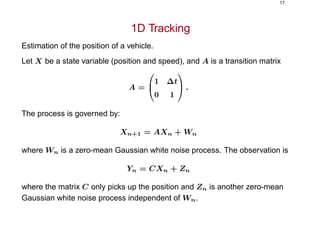
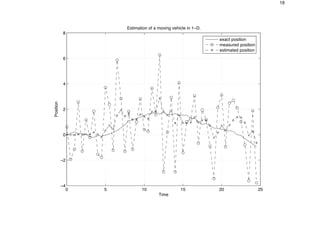
1D Tracking
Estimation of the position of a vehicle.
Let X be a state variable (position and speed), and A is a transition matrix
A =


1 ∆t
0 1

 .
The process is governed by:
Xn+1 = AXn + Wn
where Wn is a zero-mean Gaussian white noise process. The observation is
Yn = CXn + Zn
where the matrix C only picks up the position and Zn is another zero-mean
Gaussian white noise process independent of Wn.
18
0 5 10 15 20 25
!4
!2
0
2
4
6
8
Time
Position
Estimation of a moving vehicle in 1!D.
exact position
measured position
estimated position
19
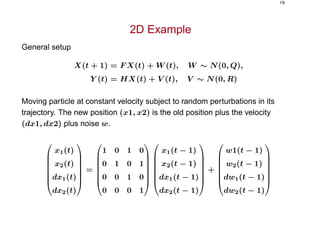
2D Example
General setup
X(t + 1) = F X(t) + W (t), W ∼ N(0, Q),
Y (t) = HX(t) + V (t), V ∼ N(0, R)
Moving particle at constant velocity subject to random perturbations in its
trajectory. The new position (x1, x2) is the old position plus the velocity
(dx1, dx2) plus noise w.







x1(t)
x2(t)
dx1(t)
dx2(t)







=







1 0 1 0
0 1 0 1
0 0 1 0
0 0 0 1














x1(t − 1)
x2(t − 1)
dx1(t − 1)
dx2(t − 1)







+







w1(t − 1)
w2(t − 1)
dw1(t − 1)
dw2(t − 1)







20
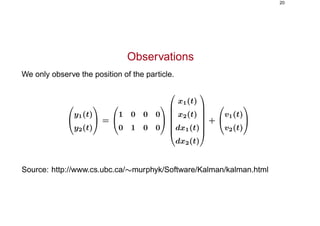
Observations
We only observe the position of the particle.


y1(t)
y2(t)

 =


1 0 0 0
0 1 0 0









x1(t)
x2(t)
dx1(t)
dx2(t)







+


v1(t)
v2(t)


Source: http://www.cs.ubc.ca/∼murphyk/Software/Kalman/kalman.html
21
Implementation
% Make a point move in the 2D plane
% State = (x y xdot ydot). We only observe (x y).
% This code was used to generate Figure 17.9 of
% "Artificial Intelligence: a Modern Approach",
% Russell and Norvig, 2nd edition, Prentice Hall, in preparation.
% X(t+1) = F X(t) + noise(Q)
% Y(t) = H X(t) + noise(R)
ss = 4; % state size
os = 2; % observation size
F = [1 0 1 0; 0 1 0 1; 0 0 1 0; 0 0 0 1];
H = [1 0 0 0; 0 1 0 0];
Q = 1*eye(ss);
R = 10*eye(os);
initx = [10 10 1 0]’;
initV = 10*eye(ss);
22
seed = 8; rand(’state’, seed);
randn(’state’, seed);
T = 50;
[x,y] = sample_lds(F,H,Q,R,initx,T);
23
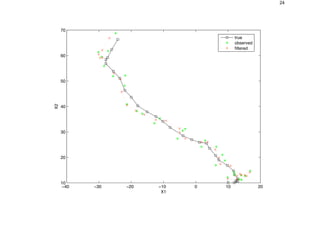
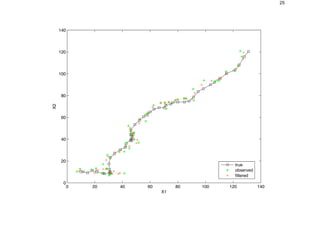
Apply Kalman Filter
[xfilt,Vfilt] = kalman_filter(y,F,H,Q,R,initx,initV);
dfilt = x([1 2],:) - xfilt([1 2],:);
mse_filt = sqrt(sum(sum(dfilt.ˆ2)))
figure;
plot(x(1,:), x(2,:), ’ks-’);
hold on
plot(y(1,:), y(2,:), ’g*’);
plot(xfilt(1,:), xfilt(2,:), ’rx:’);
hold off
legend(’true’, ’observed’, ’filtered’, 0)
xlabel(’X1’), ylabel(’X2’)
24
!40 !30 !20 !10 0 10 20
10
20
30
40
50
60
70
X1
X2
true
observed
filtered
25
0 20 40 60 80 100 120 140
0
20
40
60
80
100
120
140
X1
X2
true
observed
filtered
26
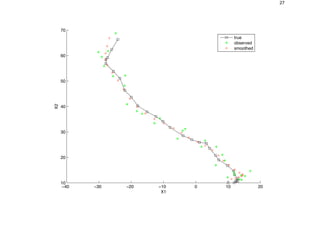
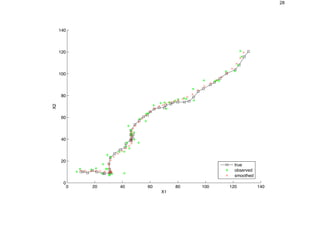
Apply Kalman Smoother
[xsmooth, Vsmooth] = kalman_smoother(y,F,H,Q,R,initx,initV);
dsmooth = x([1 2],:) - xsmooth([1 2],:);
mse_smooth = sqrt(sum(sum(dsmooth.ˆ2)))
figure;
hold on
plot(x(1,:), x(2,:), ’ks-’);
plot(y(1,:), y(2,:), ’g*’);
plot(xsmooth(1,:), xsmooth(2,:), ’rx:’);
hold off
legend(’true’, ’observed’, ’smoothed’, 0)
xlabel(’X1’), ylabel(’X2’)
27
!!0 !#0 !20 !10 0 10 20
10
20
#0
!0
50
'0
(0
)1
)2
*+,-
./0-+1-2
03..*4-2
28
0 20 40 60 80 100 120 140
0
20
40
60
80
100
120
140
X1
X2
true
observed
smoothed

Kalman

  • 1.
    1 ACM 116: TheKalman filter • Example • General Setup • Derivation • Numerical examples – Estimating the voltage – 1D tracking – 2D tracking
  • 2.
    2 Example: Navigation Problem •Truck on “frictionless” straight rails • Initial position X0 = 0 • Movement is buffeted by random accelerations • We measure the position every ∆t seconds • State variables (Xk, Vk) position and velocity at time k∆t Xk = Xk−1 + Vk−1∆t + ak−1∆t2 /2 Vk = Vk−1 + ak−1∆t where ak−1 is a random acceleration • Observations Yk = Xk + Zk where Zk is a noise term. The goal is to estimate the position and velocity at all times.
  • 3.
    3 General Setup Estimation ofa stochastic dynamic system • Dynamics Xk = Fk−1Xk−1 + Bk−1uk−1 + Wk−1 – Xk: state of the system at time k – uk−1: control-input – Wk−1: noise • Observations Yk = HkXk + Zk – Yk is observed – Zk is noise • The noise realizations are all independent • Goal: predict state Xk from past data Y0, Y1, . . . , Yk−1.
  • 4.
    4 Derivation Derivation in thesimpler model where the dynamics is of the form Xk = ak−1Xk−1 + Wk−1 and the observations Yk = Xk + Zk The objective is to find, for each time k, the minimum MSE filter based on Y0, Y1, . . . , Yk−1 ˆXk = k j=1 h (k−1) j Yk−j To find the filter, we apply the orthogonality principle E((Xk − k j=1 h (k−1) j Yk−j)Y ) = 0, = 0, 1, . . . , k − 1.
  • 5.
    5 Recursion The beautiful thingabout the Kalman filter is that one can almost deduce the optimal filter to predict Xk+1 from that predicting Xk. h (k) j+1 = (ak − h (k) 1 )h (k−1) j , j = 1, . . . , k. Given the filter h(k−1) , we only need to find h (k) 1 to get the filter at the next time step.
  • 6.
    6 How to findh (k) 1 ? Observe that the next prediction is equal to ˆXk+1 = h (k) 1 Yk + k j=1 (ak − h (k) 1 )h (k−1) j Yk−j = ak ˆXk + h (k) 1 (Yk − ˆXk) Interpretation ˆXk+1 = ak ˆXk + h (k) 1 Ik • ak ˆXk is the prediction based on the estimate at time k • h (k) 1 Ik is a corrective term which is available since we now see Yk – h (k) 1 is called the gain – Ik = Yk − ˆXk is called the innovation
  • 7.
    7 Error of Prediction Tofind h (k) 1 , we look at the error of prediction k = Xk − ˆXk We have the recursion k+1 = (ak − h (k) 1 ) k + Wk − h (k) 1 Zk • 0 = Z0 • E( k) = 0 • E( 2 k+1) = [ak − h (k) 1 ]2 E( 2 k) + E(W 2 k ) + [h (k) 1 ]2 E(Z2 k)
  • 8.
    8 To minimize theMSE k+1, we adjust h (k) 1 so that ∂h (k) 1 E( 2 k+1) = 0 = −2(ak − h (k) 1 )E( 2 k) + 2h (k) 1 E(Z2 k) which is given by h (k) 1 = akE( 2 k) E( 2 k) + E(Z2 k) Note that this gives the recurrence relation E( 2 k+1) = ak(ak − h (k) 1 )E( 2 k) + E(W 2 k )
  • 9.
    9 The Kalman FilterAlgorithm • Initialization ˆX0 = 0, E( 2 0) = E(Z2 0 ) • Loop: for k = 0, 1, . . . h (k) 1 = akE( 2 k) E( 2 k) + E(Z2 k) ˆXk+1 = ak ˆXk + h (k) 1 (Yk − ˆXk) E( 2 k+1) = ak(ak − h (k) 1 )E( 2 k) + E(W 2 k )
  • 10.
    10 Benefits • Requires noknowledge about the structure of Wk and Zk (only variances) • Easy implementation • Many applications – Inertial guidance system – Autopilot – Satellite navigation system – Many others
  • 11.
    11 General Formulation Xk =Fk−1Xk−1 + Wk−1 Yk = HkXk + Zk The covariance of Wk is Qk and that of Zk is Rk. Two variables: • ˆXk|k estimate of the state at time k based upon Y0, . . . , Yk−1 • Ek|k error covariance matrix, Ek|k = Cov(Xk − ˆXk|k)
  • 12.
    12 Prediction ˆXk+1|k = Fk ˆXk|k−1 Ek+1|k= FkEk|k−1F T k + Qk Update Ik = Yk − Hk ˆXk+1|k Innovation Sk = HkEk+1|kHT k + Rk Innovation covariance Kk = Ek+1|kHT k S−1 k Kalman Gain ˆXk+1|k+1 = ˆXk+1|k + KkIk Updated state estimate Ek+1|k+1 = (Id − KkHk)Ek+1|k Updated error covariance
  • 13.
    13 Estimating Constant Voltage Wewish to estimate some voltage which is almost constant except for some small random fluctuations. Our measuring device is imperfect (e.g. because of a poor A/D conversion). The process is governed by: Xk = X0 + Wk, k = 1, 2, . . . with X0 = 0.5V , and the measurements are Zk = Xk + Vk, k = 1, 2, . . . where Wk, Vk are uncorrelated Gaussian white noise processes, with R := Var(Vk) = 0.01, Var(Wk) = 10−5 .
  • 14.
    14 0 5 1015 20 25 30 35 40 45 50 0 0.1 0.2 0.3 0.4 0.5 0.6 0.7 0.8 Accurate knowledge of measurement variance, Rest =R=0.01 Iteration Voltage estimate exact process measurements
  • 15.
    15 0 5 1015 20 25 30 35 40 45 50 0 0.1 0.2 0.3 0.4 0.5 0.6 0.7 0.8 Optimistic estimate of measurement variance, Rest =0.0001 Iteration Voltage estimate exact process measurements
  • 16.
    16 0 5 1015 20 25 30 35 40 45 50 0 0.1 0.2 0.3 0.4 0.5 0.6 0.7 0.8 Pessimistic estimate of measurement variance, Rest =1 Iteration Voltage estimate exact process measurements
  • 17.
    17 1D Tracking Estimation ofthe position of a vehicle. Let X be a state variable (position and speed), and A is a transition matrix A =   1 ∆t 0 1   . The process is governed by: Xn+1 = AXn + Wn where Wn is a zero-mean Gaussian white noise process. The observation is Yn = CXn + Zn where the matrix C only picks up the position and Zn is another zero-mean Gaussian white noise process independent of Wn.
  • 18.
    18 0 5 1015 20 25 !4 !2 0 2 4 6 8 Time Position Estimation of a moving vehicle in 1!D. exact position measured position estimated position
  • 19.
    19 2D Example General setup X(t+ 1) = F X(t) + W (t), W ∼ N(0, Q), Y (t) = HX(t) + V (t), V ∼ N(0, R) Moving particle at constant velocity subject to random perturbations in its trajectory. The new position (x1, x2) is the old position plus the velocity (dx1, dx2) plus noise w.        x1(t) x2(t) dx1(t) dx2(t)        =        1 0 1 0 0 1 0 1 0 0 1 0 0 0 0 1               x1(t − 1) x2(t − 1) dx1(t − 1) dx2(t − 1)        +        w1(t − 1) w2(t − 1) dw1(t − 1) dw2(t − 1)       
  • 20.
    20 Observations We only observethe position of the particle.   y1(t) y2(t)   =   1 0 0 0 0 1 0 0          x1(t) x2(t) dx1(t) dx2(t)        +   v1(t) v2(t)   Source: http://www.cs.ubc.ca/∼murphyk/Software/Kalman/kalman.html
  • 21.
    21 Implementation % Make apoint move in the 2D plane % State = (x y xdot ydot). We only observe (x y). % This code was used to generate Figure 17.9 of % "Artificial Intelligence: a Modern Approach", % Russell and Norvig, 2nd edition, Prentice Hall, in preparation. % X(t+1) = F X(t) + noise(Q) % Y(t) = H X(t) + noise(R) ss = 4; % state size os = 2; % observation size F = [1 0 1 0; 0 1 0 1; 0 0 1 0; 0 0 0 1]; H = [1 0 0 0; 0 1 0 0]; Q = 1*eye(ss); R = 10*eye(os); initx = [10 10 1 0]’; initV = 10*eye(ss);
  • 22.
    22 seed = 8;rand(’state’, seed); randn(’state’, seed); T = 50; [x,y] = sample_lds(F,H,Q,R,initx,T);
  • 23.
    23 Apply Kalman Filter [xfilt,Vfilt]= kalman_filter(y,F,H,Q,R,initx,initV); dfilt = x([1 2],:) - xfilt([1 2],:); mse_filt = sqrt(sum(sum(dfilt.ˆ2))) figure; plot(x(1,:), x(2,:), ’ks-’); hold on plot(y(1,:), y(2,:), ’g*’); plot(xfilt(1,:), xfilt(2,:), ’rx:’); hold off legend(’true’, ’observed’, ’filtered’, 0) xlabel(’X1’), ylabel(’X2’)
  • 24.
    24 !40 !30 !20!10 0 10 20 10 20 30 40 50 60 70 X1 X2 true observed filtered
  • 25.
    25 0 20 4060 80 100 120 140 0 20 40 60 80 100 120 140 X1 X2 true observed filtered
  • 26.
    26 Apply Kalman Smoother [xsmooth,Vsmooth] = kalman_smoother(y,F,H,Q,R,initx,initV); dsmooth = x([1 2],:) - xsmooth([1 2],:); mse_smooth = sqrt(sum(sum(dsmooth.ˆ2))) figure; hold on plot(x(1,:), x(2,:), ’ks-’); plot(y(1,:), y(2,:), ’g*’); plot(xsmooth(1,:), xsmooth(2,:), ’rx:’); hold off legend(’true’, ’observed’, ’smoothed’, 0) xlabel(’X1’), ylabel(’X2’)
  • 27.
    27 !!0 !#0 !20!10 0 10 20 10 20 #0 !0 50 '0 (0 )1 )2 *+,- ./0-+1-2 03..*4-2
  • 28.
    28 0 20 4060 80 100 120 140 0 20 40 60 80 100 120 140 X1 X2 true observed smoothed