ANIMALS CLASSIFICATION
DISNEY
ANIMALS
CLASSIFICATION
THEIR STRUCTURE THE FOOD THEY
EAT
THEIR
REDROPUCTION
• CARNIVOROUS
•HERBIVOROUS
•OMNIVOROUS
• VIVIPAROUS
• OVIPAROUS
• INVERTEBRATE
• VERTEBRATE
 MAMMALS
BIRDS
FISH
REPTILES
AMPHIBIANS
ACCORDING TO:
ANIMALS
CLASSIFICATION
ACCORDING TO:
THEIR STRUCTURE
INVERTEBRATE
VERTEBRATE
They have got a backbone.
There are few animals on
Earth (less than 10%).
They haven’t got a backbone.
There are lots of animals on
Earth (over 90%).
ANIMALS
CLASSIFICATION
ACCORDING TO:
THE FOOD THEY
EAT
CARNIVOROUS
HERBIVOROUS
OMNIVOROUS
They eat animals.
They eat plants.
They eat both
animals and plants.
ANIMALS
CLASSIFICATION
ACCORDING TO:
HOW THEY ARE
BORN
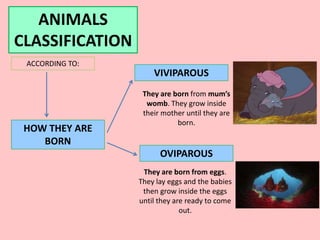
VIVIPAROUS
OVIPAROUS
They are born from mum’s
womb. They grow inside
their mother until they are
born.
They are born from eggs.
They lay eggs and the babies
then grow inside the eggs
until they are ready to come
out.
VERTEBRATE
ANIMALS
Animals with backbones.
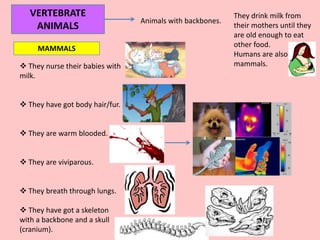
MAMMALS
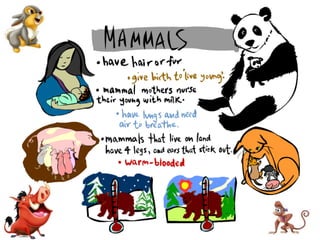
 They nurse their babies with
milk.
 They have got body hair/fur.
 They are warm blooded.
 They are viviparous.
 They breath through lungs.
 They have got a skeleton
with a backbone and a skull
(cranium).
They drink milk from
their mothers until they
are old enough to eat
other food.
Humans are also
mammals.
VERTEBRATE
ANIMALS
SPECIAL MAMMALS
 Marine animals which are mammals:
whales, seals, sea lions and walruses.
 The only mammal that
can fly is the bat.
VERTEBRATE
ANIMALS
Animals with backbones.
REPTILES
They are generally oviparous,
but there are some viviparous
reptiles (ovoviviparous). They
have got scales and dry skin.
They usually lay eggs and the
babies then grow inside the egg
until they are ready to come out.
Sometimes reptiles will give
birth like mammals, without
eggs.
AMPHIBIANS
They are oviparous. They lay eggs. They lay
thousands and sometimes millions of small, soft
eggs, and they lay them in the water! The eggs
are jelly-like. They have got wet skin.
Amphibian means "double life"... the early part of
an amphibian's life is spent in the water, and
usually as they get older then they also spend
time on land. Think of a tadpole turning into a
frog! The process amphibians go through is called
"metamorphosis". Baby amphibian looks
completely different than the adult amphibians!
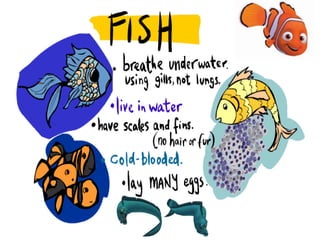
FISH
VERTEBRATE
ANIMALS
Animals with backbones.
They are generally oviparous. They are
small. They lay many many eggs -
sometimes millions of tiny eggs! They are also
laid in the water.
BIRDS
They are oviparous. They
lay eggs. They generally
lay 1 to 17 eggs at a time.
 Not all birds can fly.
Here there are some
of them:
 Penguin.
 Kiwi.
 Ostrich.
 …
INVERTEBRATE
ANIMALS
Animals without a backbone.

Disney animals classification 1

  • 1.
  • 2.
    ANIMALS CLASSIFICATION THEIR STRUCTURE THEFOOD THEY EAT THEIR REDROPUCTION • CARNIVOROUS •HERBIVOROUS •OMNIVOROUS • VIVIPAROUS • OVIPAROUS • INVERTEBRATE • VERTEBRATE  MAMMALS BIRDS FISH REPTILES AMPHIBIANS ACCORDING TO:
  • 3.
    ANIMALS CLASSIFICATION ACCORDING TO: THEIR STRUCTURE INVERTEBRATE VERTEBRATE Theyhave got a backbone. There are few animals on Earth (less than 10%). They haven’t got a backbone. There are lots of animals on Earth (over 90%).
  • 4.
    ANIMALS CLASSIFICATION ACCORDING TO: THE FOODTHEY EAT CARNIVOROUS HERBIVOROUS OMNIVOROUS They eat animals. They eat plants. They eat both animals and plants.
  • 5.
    ANIMALS CLASSIFICATION ACCORDING TO: HOW THEYARE BORN VIVIPAROUS OVIPAROUS They are born from mum’s womb. They grow inside their mother until they are born. They are born from eggs. They lay eggs and the babies then grow inside the eggs until they are ready to come out.
  • 6.
    VERTEBRATE ANIMALS Animals with backbones. MAMMALS They nurse their babies with milk.  They have got body hair/fur.  They are warm blooded.  They are viviparous.  They breath through lungs.  They have got a skeleton with a backbone and a skull (cranium). They drink milk from their mothers until they are old enough to eat other food. Humans are also mammals.
  • 7.
    VERTEBRATE ANIMALS SPECIAL MAMMALS  Marineanimals which are mammals: whales, seals, sea lions and walruses.  The only mammal that can fly is the bat.
  • 8.
    VERTEBRATE ANIMALS Animals with backbones. REPTILES Theyare generally oviparous, but there are some viviparous reptiles (ovoviviparous). They have got scales and dry skin. They usually lay eggs and the babies then grow inside the egg until they are ready to come out. Sometimes reptiles will give birth like mammals, without eggs. AMPHIBIANS They are oviparous. They lay eggs. They lay thousands and sometimes millions of small, soft eggs, and they lay them in the water! The eggs are jelly-like. They have got wet skin. Amphibian means "double life"... the early part of an amphibian's life is spent in the water, and usually as they get older then they also spend time on land. Think of a tadpole turning into a frog! The process amphibians go through is called "metamorphosis". Baby amphibian looks completely different than the adult amphibians!
  • 9.
    FISH VERTEBRATE ANIMALS Animals with backbones. Theyare generally oviparous. They are small. They lay many many eggs - sometimes millions of tiny eggs! They are also laid in the water. BIRDS They are oviparous. They lay eggs. They generally lay 1 to 17 eggs at a time.  Not all birds can fly. Here there are some of them:  Penguin.  Kiwi.  Ostrich.  …
  • 17.