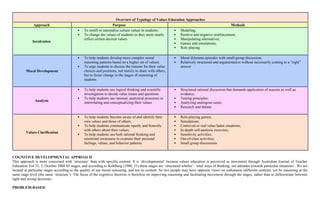
Overview of Typology of Values Education Approaches
Approach Purpose Methods
Inculcation
 To instill or internalize certain values in students;
 To change the values of students so they more nearly
reflect certain desired values
 Modeling;
 Positive and negative reinforcement;
 Manipulating alternatives;
 Games and simulations;
 Role playing
Moral Development
 To help students develop more complex moral
reasoning patterns based on a higher set of values;
 To urge students to discuss the reasons for their value
choices and positions, not merely to share with others,
but to foster change in the stages of reasoning of
students
 Moral dilemma episodes with small-group discussion;
 Relatively structured and argumentative without necessarily coming to a "right"
answer
Analysis
 To help students use logical thinking and scientific
investigation to decide value issues and questions
 To help students use rational, analytical processes in
interrelating and conceptualizing their values
 Structured rational discussion that demands application of reasons as well as
evidence;
 Testing principles;
 Analyzing analogous cases;
 Research and debate
Values Clarification
 To help students become aware of and identify their
own values and those of others;
 To help students communicate openly and honestly
with others about their values;
 To help students use both rational thinking and
emotional awareness to examine their personal
feelings, values, and behavior patterns
 Role-playing games;
 Simulations;
 Contrived or real value-laden situations;
 In-depth self-analysis exercises;
 Sensitivity activities;
 Out-of-class activities;
 Small group discussions
COGNITIVE DEVELOPMENTAL APPROACH
This approach is more concerned with ‘structure’ than with specific content. It is ‘developmental’ because values education is perceived as movement through Australian Journal of Teacher
Education Vol 33, 5, October 2008 85 stages, and according to Kohlberg (1980, 31) these stages are ‘structured wholes’: ‘total ways of thinking, not attitudes towards particular situations’. We are
located at particular stages according to the quality of our moral reasoning, and not its content. So two people may have opposite views on euthanasia (different content), yet be reasoning at the
same stage level (the same ‘structure’). The focus of the cognitive theorists is therefore on improving reasoning and facilitating movement through the stages, rather than to differentiate between
right and wrong decisions.
PROBLEM-BASED
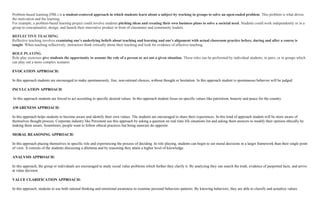
Problem-based learning (PBL) is a student-centered approach in which students learn about a subject by working in groups to solve an open-ended problem. This problem is what drives
the motivation and the learning.
For example, a problem-based learning project could involve students pitching ideas and creating their own business plans to solve a societal need. Students could work independently or in a
group to conceptualize, design, and launch their innovative product in front of classmates and community leaders.
REFLECTIVE TEACHING
Reflective teaching involves examining one's underlying beliefs about teaching and learning and one's alignment with actual classroom practice before, during and after a course is
taught. When teaching reflectively, instructors think critically about their teaching and look for evidence of effective teaching.
ROLE PLAYING
Role play exercises give students the opportunity to assume the role of a person or act out a given situation. These roles can be performed by individual students, in pairs, or in groups which
can play out a more complex scenario.
EVOCATION APPROACH:
In this approach students are encouraged to make spontaneously, free, non-rational choices, without thought or hesitation. In this approach student is spontaneous behavior will be judged
INCULCATION APPROACH:
In this approach students are forced to act according to specific desired values. In this approach student focus on specific values like patriotism, honesty and peace for the country.
AWARENESS APPROACH:
In this approach helps students to become aware and identify their own values. The students are encouraged to share their experiences. In this kind of approach student will be more aware of
themselves thought process. Corporate industry like Persistent use this approach by asking a question on real time life situations list and asking them answers to modify their opinion ethically by
making them aware, Sometimes, people want to follow ethical practices but being unaware do opposite
MORAL REASONING APPROACH:
In this approach placing themselves in specific role and experiencing the process of deciding. In role playing, students can begin to see moral decisions in a larger framework than their single point
of view. It consists of the students discussing a dilemma and by reasoning they attain a higher level of knowledge.
ANALYSIS APPROACH:
In this approach, the group or individuals are encouraged to study social value problems which further they clarify it. By analyzing they can search the truth, evidence of purported facts, and arrive
at value decision.
VALUE CLARIFICATION APPROACH:
In this approach, students to use both rational thinking and emotional awareness to examine personal behaviors patterns. By knowing behaviors, they are able to classify and actualize values.
COMMITMENT APPROACH:
In this approach, students to perceive themselves not merely as passive reactors or as free individuals but as inner-relative members of a social group and system.
UNION APPROACH:
the purpose is to help students perceive themselves and act not as separate egos but as part of a larger interrelated whole-time human race, the world, the cosmos.

Values Education Approaches GMRC subject.docx

  • 1.
    Overview of Typologyof Values Education Approaches Approach Purpose Methods Inculcation  To instill or internalize certain values in students;  To change the values of students so they more nearly reflect certain desired values  Modeling;  Positive and negative reinforcement;  Manipulating alternatives;  Games and simulations;  Role playing Moral Development  To help students develop more complex moral reasoning patterns based on a higher set of values;  To urge students to discuss the reasons for their value choices and positions, not merely to share with others, but to foster change in the stages of reasoning of students  Moral dilemma episodes with small-group discussion;  Relatively structured and argumentative without necessarily coming to a "right" answer Analysis  To help students use logical thinking and scientific investigation to decide value issues and questions  To help students use rational, analytical processes in interrelating and conceptualizing their values  Structured rational discussion that demands application of reasons as well as evidence;  Testing principles;  Analyzing analogous cases;  Research and debate Values Clarification  To help students become aware of and identify their own values and those of others;  To help students communicate openly and honestly with others about their values;  To help students use both rational thinking and emotional awareness to examine their personal feelings, values, and behavior patterns  Role-playing games;  Simulations;  Contrived or real value-laden situations;  In-depth self-analysis exercises;  Sensitivity activities;  Out-of-class activities;  Small group discussions COGNITIVE DEVELOPMENTAL APPROACH This approach is more concerned with ‘structure’ than with specific content. It is ‘developmental’ because values education is perceived as movement through Australian Journal of Teacher Education Vol 33, 5, October 2008 85 stages, and according to Kohlberg (1980, 31) these stages are ‘structured wholes’: ‘total ways of thinking, not attitudes towards particular situations’. We are located at particular stages according to the quality of our moral reasoning, and not its content. So two people may have opposite views on euthanasia (different content), yet be reasoning at the same stage level (the same ‘structure’). The focus of the cognitive theorists is therefore on improving reasoning and facilitating movement through the stages, rather than to differentiate between right and wrong decisions. PROBLEM-BASED
  • 2.
    Problem-based learning (PBL)is a student-centered approach in which students learn about a subject by working in groups to solve an open-ended problem. This problem is what drives the motivation and the learning. For example, a problem-based learning project could involve students pitching ideas and creating their own business plans to solve a societal need. Students could work independently or in a group to conceptualize, design, and launch their innovative product in front of classmates and community leaders. REFLECTIVE TEACHING Reflective teaching involves examining one's underlying beliefs about teaching and learning and one's alignment with actual classroom practice before, during and after a course is taught. When teaching reflectively, instructors think critically about their teaching and look for evidence of effective teaching. ROLE PLAYING Role play exercises give students the opportunity to assume the role of a person or act out a given situation. These roles can be performed by individual students, in pairs, or in groups which can play out a more complex scenario. EVOCATION APPROACH: In this approach students are encouraged to make spontaneously, free, non-rational choices, without thought or hesitation. In this approach student is spontaneous behavior will be judged INCULCATION APPROACH: In this approach students are forced to act according to specific desired values. In this approach student focus on specific values like patriotism, honesty and peace for the country. AWARENESS APPROACH: In this approach helps students to become aware and identify their own values. The students are encouraged to share their experiences. In this kind of approach student will be more aware of themselves thought process. Corporate industry like Persistent use this approach by asking a question on real time life situations list and asking them answers to modify their opinion ethically by making them aware, Sometimes, people want to follow ethical practices but being unaware do opposite MORAL REASONING APPROACH: In this approach placing themselves in specific role and experiencing the process of deciding. In role playing, students can begin to see moral decisions in a larger framework than their single point of view. It consists of the students discussing a dilemma and by reasoning they attain a higher level of knowledge. ANALYSIS APPROACH: In this approach, the group or individuals are encouraged to study social value problems which further they clarify it. By analyzing they can search the truth, evidence of purported facts, and arrive at value decision. VALUE CLARIFICATION APPROACH: In this approach, students to use both rational thinking and emotional awareness to examine personal behaviors patterns. By knowing behaviors, they are able to classify and actualize values.
  • 3.
    COMMITMENT APPROACH: In thisapproach, students to perceive themselves not merely as passive reactors or as free individuals but as inner-relative members of a social group and system. UNION APPROACH: the purpose is to help students perceive themselves and act not as separate egos but as part of a larger interrelated whole-time human race, the world, the cosmos.