COMPETITIVE STRATEGIES
Competitive Advantage
• When a firm achieves profit more than the industry
average
• Cost Advantage
– When the firm is able to deliver the same benefits as
competitors but at lower cost
• Differentiation advantage
– When a firm is able to deliver benefits that exceed those
of competing products
– Offering unique product attributes that the customer
values and will pay a premium for
• Create superior value for its customers and superior
profits for itself
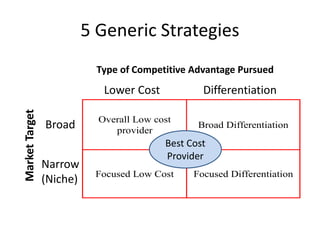
5 Generic Strategies
Market
Target
Broad
Narrow
(Niche)
Lower Cost Differentiation
Overall Low cost
provider
Broad Differentiation
Focused Low Cost Focused Differentiation
Type of Competitive Advantage Pursued
Best Cost
Provider
Cost Drivers of VC
• Economies of Scale
• Learning
• Cost of key resource inputs
• Linkages among activities
• Interrelationships among business units
• Degree of vertical integration
• Timing of market entry (Product Life Cycle)
• Capacity Utilization
• Firm’s Strategy
Cost Advantage
• Control the drivers better than rivals
• Reconfiguring the Value Chain
Controlling cost drivers
• Economies of scale
– Standardize products for different markets
– Simplify product line
– Use common parts/ components in different
models
• Learning curve
– Bring improvements through experience
Controlling cost drivers
• Cost of key Inputs
• Linkages between activities
– One VC activity can affect cost or performance of
other activity
• Eg. change design  manufacturing cost   service cost
• Interrelationships among business units
– Share resources and processes, eg sales force, order
processing, warehouse, distribution, customer service,
technical support
– Share know-how and experience
Controlling cost drivers
• Vertical Integration
– To overcome bargaining power of suppliers or buyers
– But outsourcing may be better
• Timing of market entry (Industry/Product Life
Cycle)
– First mover advantage
– When technology is developing fast, waiting for better
& cheaper technology may help
– Follow the innovator
Controlling cost drivers
• Capacity Utilization
– Higher rate – depreciation and other fixed spread over
larger unit volume – fixed cost per unit 
– Find ways to operate close to full capacity year-round
• Firm’s Policies
– Add/cut services provided to buyers
– Incorporate more/less performance or quality
features
– Increase/ decrease no. of channels
– Increase/ decrease wages, incentives
– Raise/ lower specifications for RM or components
Revamping the Value Chain
• Make greater use of technology
– Software for supply chain management, ERP
– Internet – link customer orders to production and
supplier delivery
– Online systems – monitor sales – more accurate
demand forecasting – adjust production schedules
– Paperless, online processes, less labor, save time
Revamping the Value Chain
• Direct-to-end-user sales
– E-business
– Tele or net booking of tickets
• Simplify product design
– Reduce no. of parts
– Standardize parts across models and styles
– Easy to manufacture design
Revamping the Value Chain
• Strip away extras
– Reduce multiple features and options
– Eg. No frills / Low cost airlines
• Relocate facilities
– Close to customer or supplier or both
• Prune product line
When Low-cost Provider Strategy ?
• Rigorous price competition among rivals
• Identical products of rivals readily available
• Low switching costs
• Differentiation difficult
• Common user requirements – low price more
important than features or quality
• High bargaining power of buyers
• Pricing power of low cost provider acts as barrier
for entry
Caution
• Added unit sales should bring higher total profit
• Price cut should not be large than the cost
advantage
• Avenues of cost advantage should be sustainable
and not easy to copy
• Firm’s offering should not end up non-attractive
• New market developments - Declining buyer
sensitivity to price, buyer interest in added
features or service, etc.
Differentiation
• Focus on activities associated with core
competencies and perform them better than
competitors
• Study buyer’s needs and behaviour
• Can allow firm to
– Command a premium price
– Increase unit sales
– Brand loyalty
Differentiation
• Features that raise product performance –
reliability, durability, ease of use, cleaner,
safer, quieter, maintenance-free
• Features that enhance buyer satisfaction in
intangible ways – status, image, fashion
• Deliver value through competitive capabilities
– innovation, eg. microsoft.
Differentiation and the Value Chain
• Suppliers
– Quality of raw material, strict specifications
• R&D
– Improve design or performance
– Expand uses and applications
– Higher quality, reliability, safety
– Wider variety
Differentiation and the Value Chain
• Technology and production
– Custom manufacturing at lower cost
• Outbound logistics
– Faster delivery
– Quicker and accurate order filings - Lower rejects
• Marketing, sales and customer service
– Provide better product information
– Better training materials
– Faster maintenance and repair
– Better credit terms
– Customer convenience
When Differentiate?
• Buyers needs and use diverse
• There is scope for differentiation
• Few rivals following similar differentiation
• Fast technological change, rapidly evolving
products
Focused Strategies
• Focused Low-cost strategy
– Serving buyers in a target market niche at a lower
cost and lower price than rivals
– Limit customer base to a well-defined customer
base
– Eg. Generic manufacturers
• Focused Differentiation strategy
– Offering niche customers a product they perceive
well-suited to their unique tastes and preferences
Best Cost Provider Strategies
• Value for Money
• Deliver superior value to customers by satisfying
their expectations, and beating their expectation
on price
• Ability to incorporate attractive attributes at
lower cost than rivals
• Diverse, price sensitive buyers
• Offer medium quality product at below average
price or high quality product at average price

7 generic strategies.pptx

  • 1.
  • 2.
    Competitive Advantage • Whena firm achieves profit more than the industry average • Cost Advantage – When the firm is able to deliver the same benefits as competitors but at lower cost • Differentiation advantage – When a firm is able to deliver benefits that exceed those of competing products – Offering unique product attributes that the customer values and will pay a premium for • Create superior value for its customers and superior profits for itself
  • 3.
    5 Generic Strategies Market Target Broad Narrow (Niche) LowerCost Differentiation Overall Low cost provider Broad Differentiation Focused Low Cost Focused Differentiation Type of Competitive Advantage Pursued Best Cost Provider
  • 4.
    Cost Drivers ofVC • Economies of Scale • Learning • Cost of key resource inputs • Linkages among activities • Interrelationships among business units • Degree of vertical integration • Timing of market entry (Product Life Cycle) • Capacity Utilization • Firm’s Strategy
  • 5.
    Cost Advantage • Controlthe drivers better than rivals • Reconfiguring the Value Chain
  • 6.
    Controlling cost drivers •Economies of scale – Standardize products for different markets – Simplify product line – Use common parts/ components in different models • Learning curve – Bring improvements through experience
  • 7.
    Controlling cost drivers •Cost of key Inputs • Linkages between activities – One VC activity can affect cost or performance of other activity • Eg. change design  manufacturing cost   service cost • Interrelationships among business units – Share resources and processes, eg sales force, order processing, warehouse, distribution, customer service, technical support – Share know-how and experience
  • 8.
    Controlling cost drivers •Vertical Integration – To overcome bargaining power of suppliers or buyers – But outsourcing may be better • Timing of market entry (Industry/Product Life Cycle) – First mover advantage – When technology is developing fast, waiting for better & cheaper technology may help – Follow the innovator
  • 9.
    Controlling cost drivers •Capacity Utilization – Higher rate – depreciation and other fixed spread over larger unit volume – fixed cost per unit  – Find ways to operate close to full capacity year-round • Firm’s Policies – Add/cut services provided to buyers – Incorporate more/less performance or quality features – Increase/ decrease no. of channels – Increase/ decrease wages, incentives – Raise/ lower specifications for RM or components
  • 10.
    Revamping the ValueChain • Make greater use of technology – Software for supply chain management, ERP – Internet – link customer orders to production and supplier delivery – Online systems – monitor sales – more accurate demand forecasting – adjust production schedules – Paperless, online processes, less labor, save time
  • 11.
    Revamping the ValueChain • Direct-to-end-user sales – E-business – Tele or net booking of tickets • Simplify product design – Reduce no. of parts – Standardize parts across models and styles – Easy to manufacture design
  • 12.
    Revamping the ValueChain • Strip away extras – Reduce multiple features and options – Eg. No frills / Low cost airlines • Relocate facilities – Close to customer or supplier or both • Prune product line
  • 13.
    When Low-cost ProviderStrategy ? • Rigorous price competition among rivals • Identical products of rivals readily available • Low switching costs • Differentiation difficult • Common user requirements – low price more important than features or quality • High bargaining power of buyers • Pricing power of low cost provider acts as barrier for entry
  • 14.
    Caution • Added unitsales should bring higher total profit • Price cut should not be large than the cost advantage • Avenues of cost advantage should be sustainable and not easy to copy • Firm’s offering should not end up non-attractive • New market developments - Declining buyer sensitivity to price, buyer interest in added features or service, etc.
  • 15.
    Differentiation • Focus onactivities associated with core competencies and perform them better than competitors • Study buyer’s needs and behaviour • Can allow firm to – Command a premium price – Increase unit sales – Brand loyalty
  • 16.
    Differentiation • Features thatraise product performance – reliability, durability, ease of use, cleaner, safer, quieter, maintenance-free • Features that enhance buyer satisfaction in intangible ways – status, image, fashion • Deliver value through competitive capabilities – innovation, eg. microsoft.
  • 17.
    Differentiation and theValue Chain • Suppliers – Quality of raw material, strict specifications • R&D – Improve design or performance – Expand uses and applications – Higher quality, reliability, safety – Wider variety
  • 18.
    Differentiation and theValue Chain • Technology and production – Custom manufacturing at lower cost • Outbound logistics – Faster delivery – Quicker and accurate order filings - Lower rejects • Marketing, sales and customer service – Provide better product information – Better training materials – Faster maintenance and repair – Better credit terms – Customer convenience
  • 19.
    When Differentiate? • Buyersneeds and use diverse • There is scope for differentiation • Few rivals following similar differentiation • Fast technological change, rapidly evolving products
  • 20.
    Focused Strategies • FocusedLow-cost strategy – Serving buyers in a target market niche at a lower cost and lower price than rivals – Limit customer base to a well-defined customer base – Eg. Generic manufacturers • Focused Differentiation strategy – Offering niche customers a product they perceive well-suited to their unique tastes and preferences
  • 21.
    Best Cost ProviderStrategies • Value for Money • Deliver superior value to customers by satisfying their expectations, and beating their expectation on price • Ability to incorporate attractive attributes at lower cost than rivals • Diverse, price sensitive buyers • Offer medium quality product at below average price or high quality product at average price