MARYAM BATOOL
20-3713
BS PSYCHOLOGY
6th semester
Research presentation
Topic: SURVRY
survey
Definition
 A type of research to collect the data and facts about some certain situation or
issue from the target population existing in surroundings having relevance to the
nature of study.
 Survey research is the research strategy to study the relationships and
characteristics.
 Surveys are method of data collection in which information is gathered through
oral or written questioning.
Purpose and uses of survey
 To describe the situation
 To explain the situation
 Problem identification and solving
 To measure the change
 To study attitudes, behavior and habits
 To examine the cause and effect
 To study the characteristics
 To formulate the hypothesis
 Decision making
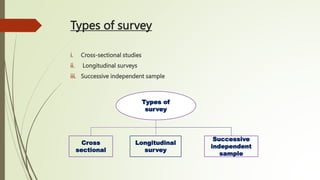
Types of survey
i. Cross-sectional studies
ii. Longitudinal surveys
iii. Successive independent sample
Types of
survey
Cross
sectional
Longitudinal
survey
Successive
independent
sample
Survey Research Designs
 In Cross-sectional design, one or more samples are drawn from the populations at
one time.
 These surveys are administered to a small sample from a larger population within a
small time frame.
 In successive independent samples design, different samples of respondents from
the population complete the survey over a time period.
 It allows researchers to study changes in a population over time.
 In longitudinal design , the same respondents are surveyed over time in order to
examine changes in individual respondent.
 It is difficult to identify the cause of individual’s changes over time
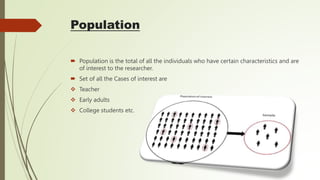
Population
 Population is the total of all the individuals who have certain characteristics and are
of interest to the researcher.
 Set of all the Cases of interest are
 Teacher
 Early adults
 College students etc.
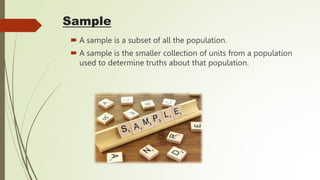
Sample
 A sample is a subset of all the population.
 A sample is the smaller collection of units from a population
used to determine truths about that population.
Sampling
 Sampling is the process of selecting units e.g., people, organizations
 The sampling frame is the list from which the potential respondents are
drawn.
 Careful selection allows researchers to generalize results back to the
population from which sample is drawn
 The ability to generalize from sample to population depends on the
representativeness of sample
 Population: 40% males & 60% females
 In sample of 200, 80 males and 120 females is representative sample
 Over representation
 Underrepresentation
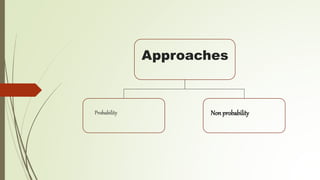
Approaches
Non probability
Probability
Probability
 Probability that every element has an equal chance of being selected in the sample
i. Random sampling
ii. Each subject has a known probability of being selected
iii. Simple random sampling
iv. Stratified random sampling
v. Cluster sampling
vi. Systematic sampling
vii. Multi-stage sampling
SIMPLE RANDOM SAMPLING
.
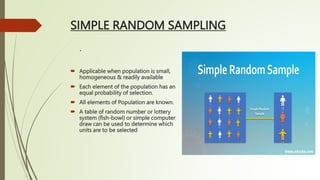
 Applicable when population is small,
homogeneous & readily available
 Each element of the population has an
equal probability of selection.
 All elements of Population are known.
 A table of random number or lottery
system (fish-bowl) or simple computer
draw can be used to determine which
units are to be selected
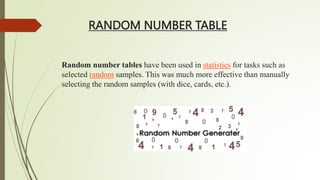
RANDOM NUMBER TABLE
Random number tables have been used in statistics for tasks such as
selected random samples. This was much more effective than manually
selecting the random samples (with dice, cards, etc.).
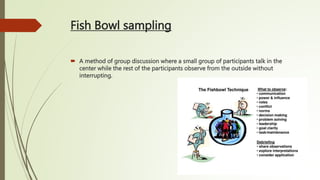
Fish Bowl sampling
 A method of group discussion where a small group of participants talk in the
center while the rest of the participants observe from the outside without
interrupting.
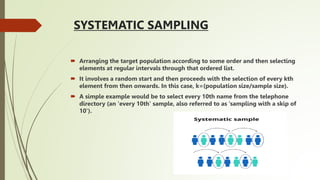
SYSTEMATIC SAMPLING
 Arranging the target population according to some order and then selecting
elements at regular intervals through that ordered list.
 It involves a random start and then proceeds with the selection of every kth
element from then onwards. In this case, k=(population size/sample size).
 A simple example would be to select every 10th name from the telephone
directory (an 'every 10th' sample, also referred to as 'sampling with a skip of
10').
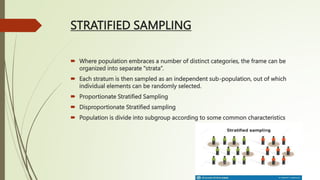
STRATIFIED SAMPLING
 Where population embraces a number of distinct categories, the frame can be
organized into separate "strata”.
 Each stratum is then sampled as an independent sub-population, out of which
individual elements can be randomly selected.
 Proportionate Stratified Sampling
 Disproportionate Stratified sampling
 Population is divide into subgroup according to some common characteristics
CLUSTER SAMPLING
 Cluster: a group of sampling units close to each other i.e. crowding together in the same
area or neighborhood
 Population divided into clusters of homogeneous units, usually based on geographical
contiguity.
 It is an example of 'two-stage sampling' .
 At first stage a sample of areas is chosen;
 In second stage a sample of respondents within those areas is selected randomly.
 Two types of cluster sampling methods.
 One-stage sampling. All of the elements within selected clusters are included in the
sample.
 Two-stage sampling. A subset of elements within selected clusters are randomly
selected for inclusion in the sample.
MULTISTAGE SAMPLING
 Complex form of cluster sampling in which two or more levels of units are
embedded one in the other.
 First stage, random number of districts chosen in all
 states.
 Followed by random number of villages.
 Then third stage units will be houses.
 All ultimate units (houses, for instance) selected at last step are surveyed.
NON-PROABABILITY SAMPLING
 A sample in which no guarantee that each element of population has same chance
of being included.
 No way to assess the probability of inclusion of each element.
 That does not follow the rules of probability sampling.
TYPES OF NONPROBABILITY SAMPLING
i. Accidental sampling
ii. Convenient sampling
iii. Purposive sampling
iv. Judgmental sampling
v. Quota sampling
vi. Snowball sampling
ACCIDENTAL SAMPLING
 Accidental sampling involves selecting respondents primarily on the basis of their
availability and willingness to respond.
 Call in surveys on TV
 Pols by papers regarding any issue
Haphazard sampling
 In this a researcher selects any case he comes across that seriously misinterprets
the population.
 Its cheap and quick.
 Can produce ineffective and highly unrepresentative samples.
CONVENIENCE SAMPLING
 Is merely as available, which appears to offer answers of your interest.
 There is no evidence that they are representative of the population we are
interested in generalizing to.
PURPOSIVE SAMPLING
 Researcher samples with a purpose in mind
 Usually have one/more specific predefined groups or screened them out.
 Investigator selects the elements to be included in the sample on the basis of their
special characteristics with specific purpose of the study
 Such study can only be conducted on that particular population.
JUDGMENTAL SAMPLING
 The researcher uses his/her judgment in selecting the units from the population for
study based on the population.
 Such person must have long experience in conducting surveys
 Correct grasp of the objective of surveys.
 Unbiased attitude to use his judgment.
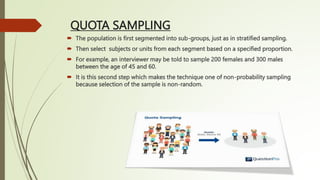
QUOTA SAMPLING
 The population is first segmented into sub-groups, just as in stratified sampling.
 Then select subjects or units from each segment based on a specified proportion.
 For example, an interviewer may be told to sample 200 females and 300 males
between the age of 45 and 60.
 It is this second step which makes the technique one of non-probability sampling
because selection of the sample is non-random.
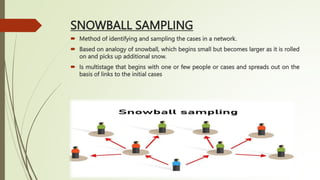
SNOWBALL SAMPLING
 Method of identifying and sampling the cases in a network.
 Based on analogy of snowball, which begins small but becomes larger as it is rolled
on and picks up additional snow.
 Is multistage that begins with one or few people or cases and spreads out on the
basis of links to the initial cases
Survey methods
 Mail survey
 Personal survey
 Interview
 Telephone interview
 Internet survey
Survey methods
 A mail survey is a method of collecting data by sending questionnaires to
respondents through postal mail.
 Participants fill out the surveys and return them by mail.
 Face-to-Face Surveys is a method which involves researchers directly interacting
with respondents and asking them questions in person.
 Face-to-face surveys are often conducted using structured questionnaires and can
be done in homes, public places, or specific locations.
 Interviews are a widely used research method that involves direct interaction
between the researcher and the participant. Interviews can provide valuable
qualitative data, insights, and in-depth understanding of individuals' perspectives
and experiences.
 Telephone Surveys: Researchers conduct surveys by calling respondents and asking
them a series of questions over the phone. Telephone surveys can be conducted
using computer-assisted telephone interviewing (CATI) systems.
Internet survey
 Internet surveys, also known as online surveys, are a popular method of data
collection in research. Conducting surveys online offers several advantages, such as
wide reach, convenience, cost-effectiveness, and efficient data collection.
 With the widespread use of the internet, online surveys have become increasingly
popular. Researchers create web-based questionnaires using survey platforms or
software and distribute them through email, social media, websites, or online
panels.
Survey and its Type

Survey and its Type

  • 1.
    MARYAM BATOOL 20-3713 BS PSYCHOLOGY 6thsemester Research presentation Topic: SURVRY
  • 2.
  • 3.
    Definition  A typeof research to collect the data and facts about some certain situation or issue from the target population existing in surroundings having relevance to the nature of study.  Survey research is the research strategy to study the relationships and characteristics.  Surveys are method of data collection in which information is gathered through oral or written questioning.
  • 4.
    Purpose and usesof survey  To describe the situation  To explain the situation  Problem identification and solving  To measure the change  To study attitudes, behavior and habits  To examine the cause and effect  To study the characteristics  To formulate the hypothesis  Decision making
  • 5.
    Types of survey i.Cross-sectional studies ii. Longitudinal surveys iii. Successive independent sample Types of survey Cross sectional Longitudinal survey Successive independent sample
  • 6.
    Survey Research Designs In Cross-sectional design, one or more samples are drawn from the populations at one time.  These surveys are administered to a small sample from a larger population within a small time frame.  In successive independent samples design, different samples of respondents from the population complete the survey over a time period.  It allows researchers to study changes in a population over time.  In longitudinal design , the same respondents are surveyed over time in order to examine changes in individual respondent.  It is difficult to identify the cause of individual’s changes over time
  • 7.
    Population  Population isthe total of all the individuals who have certain characteristics and are of interest to the researcher.  Set of all the Cases of interest are  Teacher  Early adults  College students etc.
  • 8.
    Sample  A sampleis a subset of all the population.  A sample is the smaller collection of units from a population used to determine truths about that population.
  • 9.
    Sampling  Sampling isthe process of selecting units e.g., people, organizations  The sampling frame is the list from which the potential respondents are drawn.  Careful selection allows researchers to generalize results back to the population from which sample is drawn  The ability to generalize from sample to population depends on the representativeness of sample  Population: 40% males & 60% females  In sample of 200, 80 males and 120 females is representative sample  Over representation  Underrepresentation
  • 10.
  • 11.
    Probability  Probability thatevery element has an equal chance of being selected in the sample i. Random sampling ii. Each subject has a known probability of being selected iii. Simple random sampling iv. Stratified random sampling v. Cluster sampling vi. Systematic sampling vii. Multi-stage sampling
  • 12.
    SIMPLE RANDOM SAMPLING . Applicable when population is small, homogeneous & readily available  Each element of the population has an equal probability of selection.  All elements of Population are known.  A table of random number or lottery system (fish-bowl) or simple computer draw can be used to determine which units are to be selected
  • 13.
    RANDOM NUMBER TABLE Randomnumber tables have been used in statistics for tasks such as selected random samples. This was much more effective than manually selecting the random samples (with dice, cards, etc.).
  • 14.
    Fish Bowl sampling A method of group discussion where a small group of participants talk in the center while the rest of the participants observe from the outside without interrupting.
  • 15.
    SYSTEMATIC SAMPLING  Arrangingthe target population according to some order and then selecting elements at regular intervals through that ordered list.  It involves a random start and then proceeds with the selection of every kth element from then onwards. In this case, k=(population size/sample size).  A simple example would be to select every 10th name from the telephone directory (an 'every 10th' sample, also referred to as 'sampling with a skip of 10').
  • 16.
    STRATIFIED SAMPLING  Wherepopulation embraces a number of distinct categories, the frame can be organized into separate "strata”.  Each stratum is then sampled as an independent sub-population, out of which individual elements can be randomly selected.  Proportionate Stratified Sampling  Disproportionate Stratified sampling  Population is divide into subgroup according to some common characteristics
  • 17.
    CLUSTER SAMPLING  Cluster:a group of sampling units close to each other i.e. crowding together in the same area or neighborhood  Population divided into clusters of homogeneous units, usually based on geographical contiguity.  It is an example of 'two-stage sampling' .  At first stage a sample of areas is chosen;  In second stage a sample of respondents within those areas is selected randomly.  Two types of cluster sampling methods.  One-stage sampling. All of the elements within selected clusters are included in the sample.  Two-stage sampling. A subset of elements within selected clusters are randomly selected for inclusion in the sample.
  • 18.
    MULTISTAGE SAMPLING  Complexform of cluster sampling in which two or more levels of units are embedded one in the other.  First stage, random number of districts chosen in all  states.  Followed by random number of villages.  Then third stage units will be houses.  All ultimate units (houses, for instance) selected at last step are surveyed.
  • 19.
    NON-PROABABILITY SAMPLING  Asample in which no guarantee that each element of population has same chance of being included.  No way to assess the probability of inclusion of each element.  That does not follow the rules of probability sampling.
  • 20.
    TYPES OF NONPROBABILITYSAMPLING i. Accidental sampling ii. Convenient sampling iii. Purposive sampling iv. Judgmental sampling v. Quota sampling vi. Snowball sampling
  • 21.
    ACCIDENTAL SAMPLING  Accidentalsampling involves selecting respondents primarily on the basis of their availability and willingness to respond.  Call in surveys on TV  Pols by papers regarding any issue
  • 22.
    Haphazard sampling  Inthis a researcher selects any case he comes across that seriously misinterprets the population.  Its cheap and quick.  Can produce ineffective and highly unrepresentative samples.
  • 23.
    CONVENIENCE SAMPLING  Ismerely as available, which appears to offer answers of your interest.  There is no evidence that they are representative of the population we are interested in generalizing to.
  • 24.
    PURPOSIVE SAMPLING  Researchersamples with a purpose in mind  Usually have one/more specific predefined groups or screened them out.  Investigator selects the elements to be included in the sample on the basis of their special characteristics with specific purpose of the study  Such study can only be conducted on that particular population.
  • 25.
    JUDGMENTAL SAMPLING  Theresearcher uses his/her judgment in selecting the units from the population for study based on the population.  Such person must have long experience in conducting surveys  Correct grasp of the objective of surveys.  Unbiased attitude to use his judgment.
  • 26.
    QUOTA SAMPLING  Thepopulation is first segmented into sub-groups, just as in stratified sampling.  Then select subjects or units from each segment based on a specified proportion.  For example, an interviewer may be told to sample 200 females and 300 males between the age of 45 and 60.  It is this second step which makes the technique one of non-probability sampling because selection of the sample is non-random.
  • 27.
    SNOWBALL SAMPLING  Methodof identifying and sampling the cases in a network.  Based on analogy of snowball, which begins small but becomes larger as it is rolled on and picks up additional snow.  Is multistage that begins with one or few people or cases and spreads out on the basis of links to the initial cases
  • 28.
    Survey methods  Mailsurvey  Personal survey  Interview  Telephone interview  Internet survey
  • 29.
    Survey methods  Amail survey is a method of collecting data by sending questionnaires to respondents through postal mail.  Participants fill out the surveys and return them by mail.  Face-to-Face Surveys is a method which involves researchers directly interacting with respondents and asking them questions in person.  Face-to-face surveys are often conducted using structured questionnaires and can be done in homes, public places, or specific locations.  Interviews are a widely used research method that involves direct interaction between the researcher and the participant. Interviews can provide valuable qualitative data, insights, and in-depth understanding of individuals' perspectives and experiences.  Telephone Surveys: Researchers conduct surveys by calling respondents and asking them a series of questions over the phone. Telephone surveys can be conducted using computer-assisted telephone interviewing (CATI) systems.
  • 30.
    Internet survey  Internetsurveys, also known as online surveys, are a popular method of data collection in research. Conducting surveys online offers several advantages, such as wide reach, convenience, cost-effectiveness, and efficient data collection.  With the widespread use of the internet, online surveys have become increasingly popular. Researchers create web-based questionnaires using survey platforms or software and distribute them through email, social media, websites, or online panels.