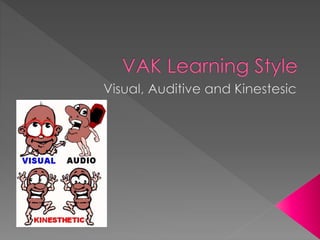
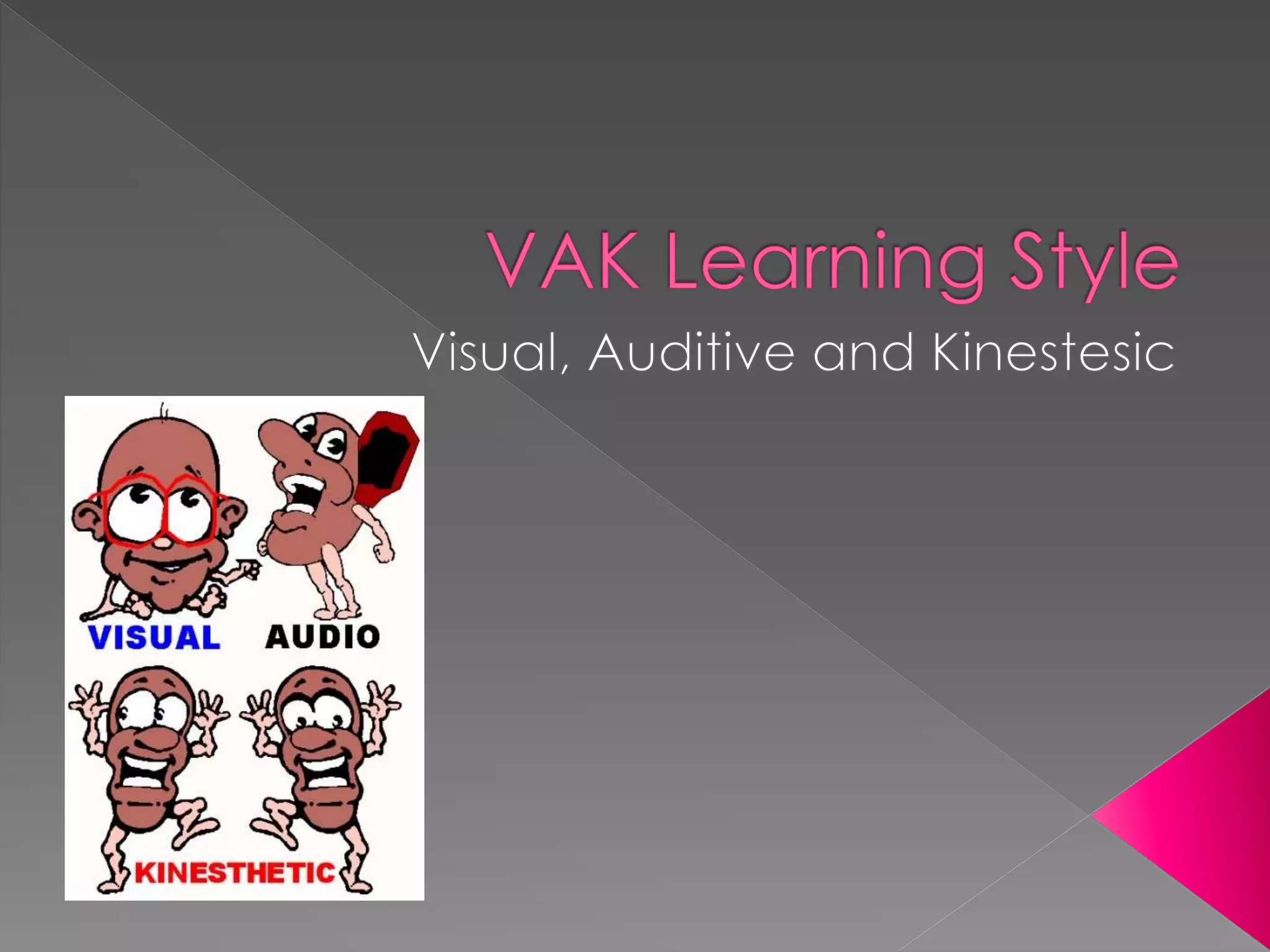
 The VAK learning style uses the three
main sensory receivers: Visual, Auditory,
and Kinesthetic (movement) to
determine the dominant learning style.
 Learners use all three modalities to
receive and learn new information and
experiences.
 The original VAK concepts were first
developed by psychologists and
teaching (of children) specialists such as
Fernald, Keller, Orton, Gillingham,
Stillman and Montessori, starting in the
1920's.
 Learn through seeing
 Think in pictures and need to create vivid
mental images to retain information
 Enjoy looking at maps, charts, pictures, videos,
and movies
 Have visual skills which are demonstrated in
puzzle building, reading, writing, understanding
charts and graphs, a good sense of direction,
sketching, painting, creating visual metaphors
and analogies, manipulating images,
constructing, fixing, designing practical
objects, and interpreting visual images.
 Visual Learners
"Show me and I'll understand."
 These students will value to-do lists,
assignment logs, and written notes. Many
of these techniques, however, also
benefit kinesthetic learners.
 Auditory learners tend to benefit
most from traditional teaching
techniques. Many teachers use a lecture-
style forum, presenting information by
talking to their students.
 Auditory learners succeed when directions
are read aloud, speeches are required, or
information is presented and requested
verbally.
 Auditory learners often talk to themselves.
 They also may move their lips and read out loud.
 They may have difficulty with reading and writing tasks.
 Use the Socratic method of lecturing by questioning learners
to draw as much information from them as possible and
then fill in the gaps with you own expertise.
 Include auditory activities, such as brainstorming, buzz
groups, or Jeopardy. Leave plenty of time to debrief
activities. This allows them to make connections of what
they leaned and how it applies to their situation.
 Have the learners verbalize the questions.
 Develop an internal dialogue between yourself and the
learners.
 One or two of these receiving styles is
normally dominant. This dominant style
defines the best way for a person to
learn new information by filtering what is
to be learned.

Vak learning style

  • 2.
     The VAKlearning style uses the three main sensory receivers: Visual, Auditory, and Kinesthetic (movement) to determine the dominant learning style.  Learners use all three modalities to receive and learn new information and experiences.
  • 3.
     The originalVAK concepts were first developed by psychologists and teaching (of children) specialists such as Fernald, Keller, Orton, Gillingham, Stillman and Montessori, starting in the 1920's.
  • 4.
     Learn throughseeing  Think in pictures and need to create vivid mental images to retain information  Enjoy looking at maps, charts, pictures, videos, and movies  Have visual skills which are demonstrated in puzzle building, reading, writing, understanding charts and graphs, a good sense of direction, sketching, painting, creating visual metaphors and analogies, manipulating images, constructing, fixing, designing practical objects, and interpreting visual images.
  • 5.
     Visual Learners "Showme and I'll understand."  These students will value to-do lists, assignment logs, and written notes. Many of these techniques, however, also benefit kinesthetic learners.
  • 6.
     Auditory learnerstend to benefit most from traditional teaching techniques. Many teachers use a lecture- style forum, presenting information by talking to their students.  Auditory learners succeed when directions are read aloud, speeches are required, or information is presented and requested verbally.
  • 7.
     Auditory learnersoften talk to themselves.  They also may move their lips and read out loud.  They may have difficulty with reading and writing tasks.  Use the Socratic method of lecturing by questioning learners to draw as much information from them as possible and then fill in the gaps with you own expertise.  Include auditory activities, such as brainstorming, buzz groups, or Jeopardy. Leave plenty of time to debrief activities. This allows them to make connections of what they leaned and how it applies to their situation.  Have the learners verbalize the questions.  Develop an internal dialogue between yourself and the learners.
  • 8.
     One ortwo of these receiving styles is normally dominant. This dominant style defines the best way for a person to learn new information by filtering what is to be learned.