Vaginal & Genitourinary Reconstruction Sanjay Sharma, M.D. Jeffrey Friedman, M.D. Rahul Nath, M.D. Tue Dinh, M.D.
Outline Embryology Vaginal Reconstruction Congenital defects Acquired defects Penile/Scrotal Reconstruction Cavernous nerve reconstruction Other entities of GU reconstruction
Anatomy/Embryology
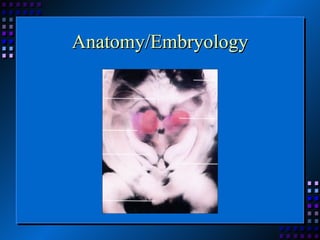
Anatomy/Embryology Genital and urinary tracts intimately associated in development All 3 germ layers involved Mesoderm Nephrotic system, Wolffian Ducts, Mullerian Ducts, Gonads Endoderm Cloaca, Cloacal membrane Ectoderm External Genitalia
Anatomy/Embryology Male Wolffian Ducts Epididymis Vas deferens Seminal vesicles Mullerian ducts regress
Anatomy/Embryology Female Mullerian Ducts differentiate into Fallopian tubes Uterus Upper portion of vagina Wolffian tubes degenerate
2 pairs genital ducts Males - mesonephric (Wolffian) Females - paramesonephric (Mullerian)
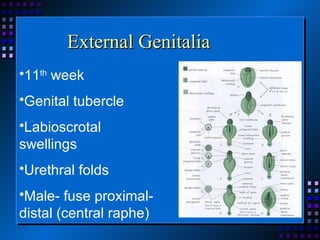
External Genitalia 11 th  week Genital tubercle  Labioscrotal swellings Urethral folds Male- fuse proximal-distal (central raphe)
Congenital Defects Vaginal Agenesis Mayer-Rokitansky Syndrome Ambiguous Genitalia Congenital Adrenal Hyperplasia Mixed Gonadal Dysgenesis Male pseudohermaphroditism
Ambiguous Genitalia
Bladder Exstrophy Absence of a portion of lower abdominal wall and anterior vesical wall Thought to be cleft of lower trunk, pubic diastasis Failure of cloacal membrane to allow ingrowth of mesoderm—leads to rupture Incidence: 1:25,000 to 1:40,000 live births Severe genitourinary defect
Bladder Exstrophy Surgical Correction Diversion of urinary stream Closure of exstrophied bladder Reconstruction of external genitalia Epispadias, release of chordee Cleft clitoris Diastasis of labia minora Mons pubis
Rokitansky Syndrome Congenital absence of the Vagina 1:4000 Defect mullerian duct development Partial or complete vaginal agenesis with renal abnormalities Usually normal external genitalia
Rokitansky Syndrome 46 XY karyotype Usually present 14-16 1 ° amenorrhea Rudimentary uterus, normal ovaries Baseline IVP for preop evaluation
Reconstruction Frank Method Bowel Flaps McIndoe Procedure Vulvovaginoplasty Musculocutaneous flaps
Preoperative Evaluation Mature individual, post puberty Compliance of patient/family—stents History & Physical Rectal examination C-spine Buccal smear Baseline U/S, IVP
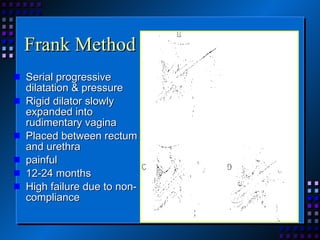
Frank Method Serial progressive dilatation & pressure Rigid dilator slowly expanded into rudimentary vagina Placed between rectum and urethra painful 12-24 months High failure due to non-compliance
Bowel Flaps Small bowel or colon Laparotomy and associated complications Large amount of mucous Malodorous discharge Fissures, bleeding, stenosis frequent 1-2% mortality rate
Local Flaps Vulvovaginoplasy Williams: labia majora infolded Hwang: labia minora flaps Tissue expansion Musculocutanous flaps Gracilis Rectus Posterior thigh fasciacutaeous TFL
McIndoe Technique Neovagina lined with skin graft Surgically created space between bladder and rectum Relatively easy procedure Obviates need for laparotomy Gynecology assistance
McIndoe Procedure
McIndoe Technique Patient Selection Mature, 16-18 years old Approaching sexual activity Mature and compliant Pre-operative considerations Full bowel prep Ememas Foley catheter DVT prohylaxis
Procedure STSG harvest Suprapubic region Tumescence Alternative sites: lateral thigh, buttock Single sheet, depth 0.015 " -0.018"
STSG Donor Sites Tumescence for uniform  Surface skin graft
Procedure Perineal Phase Rectovesicular space between bladder and rectum Avoid straight line incisions at introitus Vaginal stent used to guide depth of space ABSOLUTE HEMOSTASIS
Procedure Graft Fixation: Dermal side out Affix to mold, non linear suture line Use of Tisseel or similar fibrin glue Suture labia together Keep in hospital 1 week
 
 
Graft Fixation , dermal side out
Spiral Suture Line
 
Avoid straight line incisions at introitus
 
Rectovesical Space Peritoneal reflection (15 cm)
Meticulous hemostasis is essential
 
 
Suture labia together, prevents extrusion
 
Procedure Post-operative care Strict bedrest Foley catheter Anti-motility agent—lomotil Return to OR 1 week for stent removal Assessment of graft take, re-graft if necessary Replace stent
Check graft at POD #7 Regraft if >2 cm necrosis
Post-operative care Continue mold 3-6 months Sexual activity resume in 6 weeks Mucosalization/sensitivity Yearly followup Functional success ~90% Complications: fistula, stenosis, dyspareunia, graft failure, SCC (15 years)
Acquired Defects of GU System
Acquired Defects of GU System Extensiveness Defects of vulvoperineal surface Defects of scrotal skin Defects of vaginal vault Defects of penis Combined perineum and pelvic support structures Other—pelvic brim, urethra, sphinter mech
Preoperative Evaluation Define goals of reconstruction Wound healing Functional restoration Individualize for each patient—70 yo vs 20 yo Condition of surrounding tissue Need for adjuvent radiotherapy Previous pelvic surgery Physical examination Groin pulses Other incisions around planned flaps
Assessment of Defect Post oncologic Evaluation of size, missing tissue, donor vessels Planning of routes of flap transfer Intrapelvic—width of pelvis, height Body habitus—thick, bulky flaps Trauma Zone of injury Local-regional tissues
Vulvoperineal Surface Cancer resections Skinning vulvectomy Wide local excision Loss of skin, subcutaneous tissue
Vulvoperineal Surface Skin grafts Appropriate for unsure margins, high recurrence  Best in non-irradiated beds Non-meshed sheet STSG vs FTSG Donor site Suprapubic area, injectable saline Lateral thigh, gluteal area


Vulvoperineal Surface Local Flaps Irradiated tissue
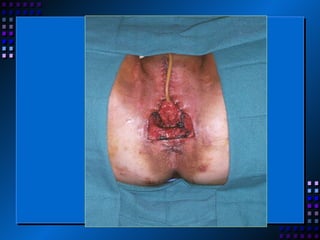
Vulvoperineal Surface Laxity posterior, lateral regions Small to medium defects: local rotation flaps, rhomboid Larger defects: fasciocutaneous flaps, posterior thigh Limit pressure in area DVT prophylaxis Sexual activity 6 weeks


Vaginal Vault Advantages of immediate reconstruction Primary healing of perineal defect Decreased fluid loss Reduced infection rate Emotional/psychological well-being Early rehabilitation Future radiotherapy
Vaginal Vault Considerations Patient Selection Wound coverage vs functional reconstruction Defect Analysis Oncologic Trauma Entire vagina vs anterior or posterior wall
Vaginal Vault Goals of Reconstruction Neovagina of sufficient depth Durability, pliability Provide closure of peritoneal cavity, separate bowel from pelvis Minimal morbidity
Vaginal Vault Gracilis Small dead space Relatively thin patient No associated laparotomy Previous workhorse flap
Vaginal Vault Gracilis Originates pubic symphysis, inserts on medial tibial condyle Raised distal to proximal off adductor group Medial circumflex femoral artery (Type II) 8-10 cm below origin Lithotomy position
Vaginal Vault Gracilis Limitations Distal skin island less reliable Rotation of flap dependent on pedicle Thus, limits depth of vault Bilateral gracilis for complete vault recon Donor site issues Bulge, unsightly scars 8X15 cm skin island
Vaginal Vault Rectus Abdominus Total or partial defects Ease of elevation, obliterates dead space Robust blood supply, resists radiation Contraindications Previous abdominoplasty, stoma through muscle, incisions across DIEA
Vaginal Vault Rectus Abdominus Originates on pubis, inserts on ribs 5-7 Superior and inferior epigastric arteries (type III) Harvested as inferiorly based musculo-cutaneous flap (TRAM or VRAM)
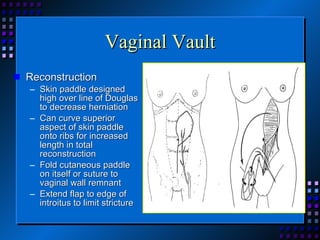
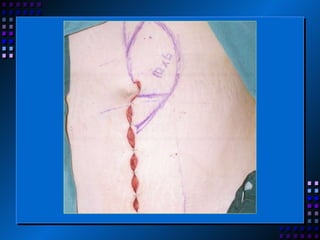
Vaginal Vault Reconstruction Skin paddle designed high over line of Douglas to decrease herniation Can curve superior aspect of skin paddle onto ribs for increased length in total reconstruction Fold cutaneous paddle on itself or suture to vaginal wall remnant Extend flap to edge of introitus to limit stricture


Vaginal Vault Posterior Thigh Flap Fasciocutaneous flap Descending branch of inferior gluteal vessel Great for large skin loss, total vaginal reconstructions Lack of rectus abdominus Sensory innervation by posterior femoral cutaneous n. Bilateral harvest in lithotomy position
Vaginal Vault Posterior Thigh Flap
Vaginal Vault Reconstuction
Vaginal Vault Other flaps Omentum with skin graft Obese patients, small pelvis Left gastroepiploic artery, pedicle flap STSG with stent as in McIndoe TFL Hemivaginal or perineal defects Shorter reach, donor site morbidity
Penis and Scrotum
Penile-Scrotal Reconstruction Congenital Hypospadias Epispadias Acquired Avulsions Amputations Burns Infections
Penile-Scrotal Defects Goals acceptable appearance normal micturition normal sexual activity Translates to a penis with adequate length, tactile sensation, sufficient rigidity
Avulsions Penis Caused by deceleration injury Gently clean any pedicled soft tissue and replace STSG—0.020 inch Lymphedematous changes arise in skin proximal to corona, therefore, remove
Scrotal avulsions Small defects Debridement and direct approx Highly elastic and compliant Complete scrotal avulsions Moist dressings over exposed testicles Testes and cords buried in subcutaneous thigh pockets Reconstruct scrotum by 4 weeks due to increased temp and injury to spermatogenesis
Scrotal avulsions Reconstruction STSG 0.014-0.018 in Flaps Superolateral thigh TFL Rectus abdominus Gracilis posterior thigh
Scrotal Defects
Scrotal Defects
Scrotal Defect Gracilis myocutaneous flap
Scrotal Defect
Coverage with Gracilis
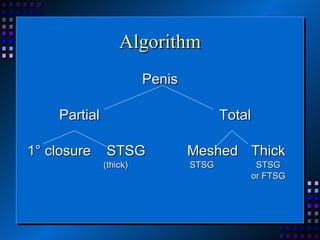
Algorithm Penis Partial Total 1 ° closure  STSG Meshed Thick (thick)  STSG   STSG or FTSG
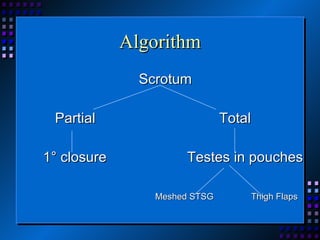
Algorithm Scrotum   Partial Total 1 ° closure Testes in pouches Meshed STSG Thigh Flaps
Penis Amputations Primary reattachment Bux and coworkers 14 cases, no vascular anastomosis Corpus spongiosum approximated Corpus cavernosa sutured through tunica albuginea Aspiration of corpora cavernosa 2X day Survival, but shaft skin slough  STSG
Amputations Microvascular repair Artery x2, vein, nerves Urethra repair with urology svc Approximate corpora spongiosa Better outcome
Penis Replantation
Penis Replantation
Penis Replantation
 
 
Penis Replantation
Penis Reconstruction
Penile Reconstruction Previous attempts multistage Tubed abdominal flaps Scrotal skin flaps Muscle pedicle flaps All generally overly bulky or lack of length Best reconstructions one stage microvascular transfer
Phallus Reconstruction Goals: Urinary conduit Rigidity Errogenous and protective sensation Appearance
Penile Reconstruction Radial Forearm Free Flap Tube-within-tube Innervation via antebrachial cutaneous nerves to pudendal nerve Limited hair Vascularized urethra Return of tactile, errogenous sensation Rigidity via rib bone graft or prosthesis
Radial Forearm Flap
Radial Forearm Nondominant arm Allen’s test/duplex doppler Do not shave arm Urethral stones 15 x 17 cm Suprapubic catheter
 
Radial Forearm Saphenous vein loop- temp A-V fistula LAC to dorsal penile branches (Pudendal Nerve)
Radial Forearm Tactile sensation 4-6 mo Prosthesis 6-9 mo Achieve orgasm Complications Urethral stones Sinuses, fistulae Strictures Hypopigmentation Implant exposure
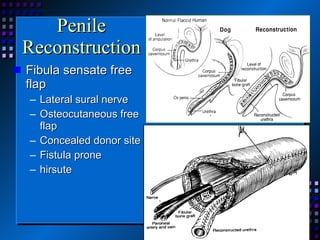
Penile Reconstruction Fibula sensate free flap Lateral sural nerve Osteocutaneous free flap Concealed donor site Fistula prone hirsute
Phallus Reconstruction Other descriptions: Ulnar forearm free flap Lateral Arm flap Pre-fabricated “ Cricket-bat” Flap
Gender Reassignment Psychological issues Physical issues Multispecialty approach Male to female Breast aug Genitalia  Female to male Mastectomy Genitalia, partial transformation More difficult
Male Potency Radical prostatectomy Cavernous nerves mediate erectile function Sacrifice unilateral or bilateral depending on extent of tumor Erectile function diminished to degree of nerve sacrifice
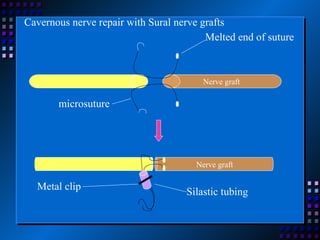
Cavernous Nerve Grafting Cavernous nerve grafting  Sural nerve harvest Loupe magnification Large instruments operating in a hole Clips and microsuture to hold grafts Epineural repair Results can be enhanced with Viagra
Unilateral Cavernous Nerve resection with Sural Nerve graft
Nerve graft Silastic tubing Metal clip microsuture Melted end of suture Cavernous nerve repair with Sural nerve grafts Nerve graft
Results 0% 60% Bilateral nerve grafts 21% 75% Unilateral nerve grafts Percentage of successful inter-course  WITHOUT  nerve grafting Percentage of successful inter-course  WITH  nerve grafting 200 cases to date
Inguinal Region Infected Vascular Grafts Presentation Local signs Fever Sepsis Pseudoaneurysm Thrombosis Bleeding
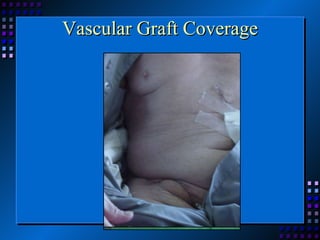
Inguinal Region Vascular grafts Common Flaps Sartorius Gracilis Rectus Abdominus Rectus Femoris TFL Vastus Lateralis
Vascular Graft Coverage
Gracilis Rotation Coverage
Gracilis Rotation Flap
Sartorius Flap
Exposed Vascular Graft
Sartorius Rotation Coverage
Infections Necrotizing infections Fournier’s Gangrene—1882 Penetrates Colles fascia Spreads in subDartos space, involves superficial tissues Sx: pain, fever, crepitus Pathophys: thrombosis of small vessels
Fournier’ Gangrene Treatment Radical debridement, repeat usually necessary Cultures, broad spectrum antibiotics Mixed aerobic/anaerobic organisms Hydrotherapy Skin grafting of defect, testes coverage
Genital Burns Children more often than adults Involve CPS for suspicious burns Usually 1 st  and 2 nd  degree burns Local wound care Serial debridement, dressing care with Bacitracin Hydrotherapy 3 rd  degree—excision and grafting
Pelvic Exenteration Through-and-through defects Skin defect Space filler to prevent bowel descent Flap choice—bulky, robust blood supply Posterior thigh Rectus abdominus Omentum—filler only, clear infection Gracilis—small lower pelvis/perineum
Pelvic Exenteration Importance of vascularized flaps Radiation Clear infection—pelvic abscess Durable tissue for sitting Prevents herniation of bowel
Pelvic/Perineum Defect
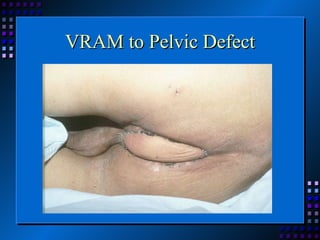
VRAM Reconstruction
VRAM to Pelvic Defect
Pelvic Defects Pelvic Bone defects Ensure continuity of pelvic ring Heavy, large non-absorbable mesh Support herniation of bowel Local flaps TFL Rectus omentum
Pelvic/Perineal Defects
 
Pelvic/Perineal Defects
Final Result
Anal Sphincter Reconstruction Restoration of fecal continence Rotational gracilis Free gracilis with implantable stimulator Inferior gluteus maximus
Gracilis Sphincter Reconstruction Pickrell 1956 Rt gracilis, clockwise 1 wrap N=6  all continent  Song 1982 2 wraps counterclockwise Inferior Gluteus- procedure of choice
Summary Form follows function Analyze the defect Vaginial—partial or total Penis/Scrotum—skin grafting, free tissue transfer  Pelvis/inguinal defects Primary flaps  Rectus, gracilis, posterior thigh
THANKS TO: Jeff Friedman, M.D. Rahul Nath, M.D Tue Dinh, M.D.
Vaginal & genitourinary reconstruction

  • 1.
    Vaginal & GenitourinaryReconstruction Sanjay Sharma, M.D. Jeffrey Friedman, M.D. Rahul Nath, M.D. Tue Dinh, M.D.
  • 2.
    Outline Embryology VaginalReconstruction Congenital defects Acquired defects Penile/Scrotal Reconstruction Cavernous nerve reconstruction Other entities of GU reconstruction
  • 3.
  • 4.
    Anatomy/Embryology Genital andurinary tracts intimately associated in development All 3 germ layers involved Mesoderm Nephrotic system, Wolffian Ducts, Mullerian Ducts, Gonads Endoderm Cloaca, Cloacal membrane Ectoderm External Genitalia
  • 5.
    Anatomy/Embryology Male WolffianDucts Epididymis Vas deferens Seminal vesicles Mullerian ducts regress
  • 6.
    Anatomy/Embryology Female MullerianDucts differentiate into Fallopian tubes Uterus Upper portion of vagina Wolffian tubes degenerate
  • 7.
    2 pairs genitalducts Males - mesonephric (Wolffian) Females - paramesonephric (Mullerian)
  • 8.
    External Genitalia 11th week Genital tubercle Labioscrotal swellings Urethral folds Male- fuse proximal-distal (central raphe)
  • 9.
    Congenital Defects VaginalAgenesis Mayer-Rokitansky Syndrome Ambiguous Genitalia Congenital Adrenal Hyperplasia Mixed Gonadal Dysgenesis Male pseudohermaphroditism
  • 10.
  • 11.
    Bladder Exstrophy Absenceof a portion of lower abdominal wall and anterior vesical wall Thought to be cleft of lower trunk, pubic diastasis Failure of cloacal membrane to allow ingrowth of mesoderm—leads to rupture Incidence: 1:25,000 to 1:40,000 live births Severe genitourinary defect
  • 12.
    Bladder Exstrophy SurgicalCorrection Diversion of urinary stream Closure of exstrophied bladder Reconstruction of external genitalia Epispadias, release of chordee Cleft clitoris Diastasis of labia minora Mons pubis
  • 13.
    Rokitansky Syndrome Congenitalabsence of the Vagina 1:4000 Defect mullerian duct development Partial or complete vaginal agenesis with renal abnormalities Usually normal external genitalia
  • 14.
    Rokitansky Syndrome 46XY karyotype Usually present 14-16 1 ° amenorrhea Rudimentary uterus, normal ovaries Baseline IVP for preop evaluation
  • 15.
    Reconstruction Frank MethodBowel Flaps McIndoe Procedure Vulvovaginoplasty Musculocutaneous flaps
  • 16.
    Preoperative Evaluation Matureindividual, post puberty Compliance of patient/family—stents History & Physical Rectal examination C-spine Buccal smear Baseline U/S, IVP
  • 17.
    Frank Method Serialprogressive dilatation & pressure Rigid dilator slowly expanded into rudimentary vagina Placed between rectum and urethra painful 12-24 months High failure due to non-compliance
  • 18.
    Bowel Flaps Smallbowel or colon Laparotomy and associated complications Large amount of mucous Malodorous discharge Fissures, bleeding, stenosis frequent 1-2% mortality rate
  • 19.
    Local Flaps VulvovaginoplasyWilliams: labia majora infolded Hwang: labia minora flaps Tissue expansion Musculocutanous flaps Gracilis Rectus Posterior thigh fasciacutaeous TFL
  • 20.
    McIndoe Technique Neovaginalined with skin graft Surgically created space between bladder and rectum Relatively easy procedure Obviates need for laparotomy Gynecology assistance
  • 21.
  • 22.
    McIndoe Technique PatientSelection Mature, 16-18 years old Approaching sexual activity Mature and compliant Pre-operative considerations Full bowel prep Ememas Foley catheter DVT prohylaxis
  • 23.
    Procedure STSG harvestSuprapubic region Tumescence Alternative sites: lateral thigh, buttock Single sheet, depth 0.015 " -0.018"
  • 24.
    STSG Donor SitesTumescence for uniform Surface skin graft
  • 25.
    Procedure Perineal PhaseRectovesicular space between bladder and rectum Avoid straight line incisions at introitus Vaginal stent used to guide depth of space ABSOLUTE HEMOSTASIS
  • 26.
    Procedure Graft Fixation:Dermal side out Affix to mold, non linear suture line Use of Tisseel or similar fibrin glue Suture labia together Keep in hospital 1 week
  • 27.
  • 28.
  • 29.
    Graft Fixation ,dermal side out
  • 30.
  • 31.
  • 32.
    Avoid straight lineincisions at introitus
  • 33.
  • 34.
  • 35.
  • 36.
  • 37.
  • 38.
    Suture labia together,prevents extrusion
  • 39.
  • 40.
    Procedure Post-operative careStrict bedrest Foley catheter Anti-motility agent—lomotil Return to OR 1 week for stent removal Assessment of graft take, re-graft if necessary Replace stent
  • 41.
    Check graft atPOD #7 Regraft if >2 cm necrosis
  • 42.
    Post-operative care Continuemold 3-6 months Sexual activity resume in 6 weeks Mucosalization/sensitivity Yearly followup Functional success ~90% Complications: fistula, stenosis, dyspareunia, graft failure, SCC (15 years)
  • 43.
  • 44.
    Acquired Defects ofGU System Extensiveness Defects of vulvoperineal surface Defects of scrotal skin Defects of vaginal vault Defects of penis Combined perineum and pelvic support structures Other—pelvic brim, urethra, sphinter mech
  • 45.
    Preoperative Evaluation Definegoals of reconstruction Wound healing Functional restoration Individualize for each patient—70 yo vs 20 yo Condition of surrounding tissue Need for adjuvent radiotherapy Previous pelvic surgery Physical examination Groin pulses Other incisions around planned flaps
  • 46.
    Assessment of DefectPost oncologic Evaluation of size, missing tissue, donor vessels Planning of routes of flap transfer Intrapelvic—width of pelvis, height Body habitus—thick, bulky flaps Trauma Zone of injury Local-regional tissues
  • 47.
    Vulvoperineal Surface Cancerresections Skinning vulvectomy Wide local excision Loss of skin, subcutaneous tissue
  • 48.
    Vulvoperineal Surface Skingrafts Appropriate for unsure margins, high recurrence Best in non-irradiated beds Non-meshed sheet STSG vs FTSG Donor site Suprapubic area, injectable saline Lateral thigh, gluteal area
  • 49.
  • 50.
  • 51.
  • 52.
    Vulvoperineal Surface LocalFlaps Irradiated tissue
  • 53.
    Vulvoperineal Surface Laxityposterior, lateral regions Small to medium defects: local rotation flaps, rhomboid Larger defects: fasciocutaneous flaps, posterior thigh Limit pressure in area DVT prophylaxis Sexual activity 6 weeks
  • 54.
  • 55.
  • 56.
  • 57.
  • 58.
  • 59.
    Vaginal Vault Advantagesof immediate reconstruction Primary healing of perineal defect Decreased fluid loss Reduced infection rate Emotional/psychological well-being Early rehabilitation Future radiotherapy
  • 60.
    Vaginal Vault ConsiderationsPatient Selection Wound coverage vs functional reconstruction Defect Analysis Oncologic Trauma Entire vagina vs anterior or posterior wall
  • 61.
    Vaginal Vault Goalsof Reconstruction Neovagina of sufficient depth Durability, pliability Provide closure of peritoneal cavity, separate bowel from pelvis Minimal morbidity
  • 62.
    Vaginal Vault GracilisSmall dead space Relatively thin patient No associated laparotomy Previous workhorse flap
  • 63.
    Vaginal Vault GracilisOriginates pubic symphysis, inserts on medial tibial condyle Raised distal to proximal off adductor group Medial circumflex femoral artery (Type II) 8-10 cm below origin Lithotomy position
  • 64.
    Vaginal Vault GracilisLimitations Distal skin island less reliable Rotation of flap dependent on pedicle Thus, limits depth of vault Bilateral gracilis for complete vault recon Donor site issues Bulge, unsightly scars 8X15 cm skin island
  • 65.
    Vaginal Vault RectusAbdominus Total or partial defects Ease of elevation, obliterates dead space Robust blood supply, resists radiation Contraindications Previous abdominoplasty, stoma through muscle, incisions across DIEA
  • 66.
    Vaginal Vault RectusAbdominus Originates on pubis, inserts on ribs 5-7 Superior and inferior epigastric arteries (type III) Harvested as inferiorly based musculo-cutaneous flap (TRAM or VRAM)
  • 67.
    Vaginal Vault ReconstructionSkin paddle designed high over line of Douglas to decrease herniation Can curve superior aspect of skin paddle onto ribs for increased length in total reconstruction Fold cutaneous paddle on itself or suture to vaginal wall remnant Extend flap to edge of introitus to limit stricture
  • 68.
  • 69.
  • 70.
  • 71.
  • 72.
  • 73.
  • 74.
  • 75.
    Vaginal Vault PosteriorThigh Flap Fasciocutaneous flap Descending branch of inferior gluteal vessel Great for large skin loss, total vaginal reconstructions Lack of rectus abdominus Sensory innervation by posterior femoral cutaneous n. Bilateral harvest in lithotomy position
  • 76.
  • 77.
  • 78.
  • 79.
  • 80.
  • 81.
  • 82.
    Vaginal Vault Otherflaps Omentum with skin graft Obese patients, small pelvis Left gastroepiploic artery, pedicle flap STSG with stent as in McIndoe TFL Hemivaginal or perineal defects Shorter reach, donor site morbidity
  • 83.
  • 84.
    Penile-Scrotal Reconstruction CongenitalHypospadias Epispadias Acquired Avulsions Amputations Burns Infections
  • 85.
    Penile-Scrotal Defects Goalsacceptable appearance normal micturition normal sexual activity Translates to a penis with adequate length, tactile sensation, sufficient rigidity
  • 86.
    Avulsions Penis Causedby deceleration injury Gently clean any pedicled soft tissue and replace STSG—0.020 inch Lymphedematous changes arise in skin proximal to corona, therefore, remove
  • 87.
    Scrotal avulsions Smalldefects Debridement and direct approx Highly elastic and compliant Complete scrotal avulsions Moist dressings over exposed testicles Testes and cords buried in subcutaneous thigh pockets Reconstruct scrotum by 4 weeks due to increased temp and injury to spermatogenesis
  • 88.
    Scrotal avulsions ReconstructionSTSG 0.014-0.018 in Flaps Superolateral thigh TFL Rectus abdominus Gracilis posterior thigh
  • 89.
  • 90.
  • 91.
    Scrotal Defect Gracilismyocutaneous flap
  • 92.
  • 93.
  • 94.
    Algorithm Penis PartialTotal 1 ° closure STSG Meshed Thick (thick) STSG STSG or FTSG
  • 95.
    Algorithm Scrotum Partial Total 1 ° closure Testes in pouches Meshed STSG Thigh Flaps
  • 96.
    Penis Amputations Primaryreattachment Bux and coworkers 14 cases, no vascular anastomosis Corpus spongiosum approximated Corpus cavernosa sutured through tunica albuginea Aspiration of corpora cavernosa 2X day Survival, but shaft skin slough  STSG
  • 97.
    Amputations Microvascular repairArtery x2, vein, nerves Urethra repair with urology svc Approximate corpora spongiosa Better outcome
  • 98.
  • 99.
  • 100.
  • 101.
  • 102.
  • 103.
  • 104.
  • 105.
    Penile Reconstruction Previousattempts multistage Tubed abdominal flaps Scrotal skin flaps Muscle pedicle flaps All generally overly bulky or lack of length Best reconstructions one stage microvascular transfer
  • 106.
    Phallus Reconstruction Goals:Urinary conduit Rigidity Errogenous and protective sensation Appearance
  • 107.
    Penile Reconstruction RadialForearm Free Flap Tube-within-tube Innervation via antebrachial cutaneous nerves to pudendal nerve Limited hair Vascularized urethra Return of tactile, errogenous sensation Rigidity via rib bone graft or prosthesis
  • 108.
  • 109.
    Radial Forearm Nondominantarm Allen’s test/duplex doppler Do not shave arm Urethral stones 15 x 17 cm Suprapubic catheter
  • 110.
  • 111.
    Radial Forearm Saphenousvein loop- temp A-V fistula LAC to dorsal penile branches (Pudendal Nerve)
  • 112.
    Radial Forearm Tactilesensation 4-6 mo Prosthesis 6-9 mo Achieve orgasm Complications Urethral stones Sinuses, fistulae Strictures Hypopigmentation Implant exposure
  • 113.
    Penile Reconstruction Fibulasensate free flap Lateral sural nerve Osteocutaneous free flap Concealed donor site Fistula prone hirsute
  • 114.
    Phallus Reconstruction Otherdescriptions: Ulnar forearm free flap Lateral Arm flap Pre-fabricated “ Cricket-bat” Flap
  • 115.
    Gender Reassignment Psychologicalissues Physical issues Multispecialty approach Male to female Breast aug Genitalia Female to male Mastectomy Genitalia, partial transformation More difficult
  • 116.
    Male Potency Radicalprostatectomy Cavernous nerves mediate erectile function Sacrifice unilateral or bilateral depending on extent of tumor Erectile function diminished to degree of nerve sacrifice
  • 117.
    Cavernous Nerve GraftingCavernous nerve grafting Sural nerve harvest Loupe magnification Large instruments operating in a hole Clips and microsuture to hold grafts Epineural repair Results can be enhanced with Viagra
  • 118.
    Unilateral Cavernous Nerveresection with Sural Nerve graft
  • 119.
    Nerve graft Silastictubing Metal clip microsuture Melted end of suture Cavernous nerve repair with Sural nerve grafts Nerve graft
  • 120.
    Results 0% 60%Bilateral nerve grafts 21% 75% Unilateral nerve grafts Percentage of successful inter-course WITHOUT nerve grafting Percentage of successful inter-course WITH nerve grafting 200 cases to date
  • 121.
    Inguinal Region InfectedVascular Grafts Presentation Local signs Fever Sepsis Pseudoaneurysm Thrombosis Bleeding
  • 122.
    Inguinal Region Vasculargrafts Common Flaps Sartorius Gracilis Rectus Abdominus Rectus Femoris TFL Vastus Lateralis
  • 123.
  • 124.
  • 125.
  • 126.
  • 127.
  • 128.
  • 129.
    Infections Necrotizing infectionsFournier’s Gangrene—1882 Penetrates Colles fascia Spreads in subDartos space, involves superficial tissues Sx: pain, fever, crepitus Pathophys: thrombosis of small vessels
  • 130.
    Fournier’ Gangrene TreatmentRadical debridement, repeat usually necessary Cultures, broad spectrum antibiotics Mixed aerobic/anaerobic organisms Hydrotherapy Skin grafting of defect, testes coverage
  • 131.
    Genital Burns Childrenmore often than adults Involve CPS for suspicious burns Usually 1 st and 2 nd degree burns Local wound care Serial debridement, dressing care with Bacitracin Hydrotherapy 3 rd degree—excision and grafting
  • 132.
    Pelvic Exenteration Through-and-throughdefects Skin defect Space filler to prevent bowel descent Flap choice—bulky, robust blood supply Posterior thigh Rectus abdominus Omentum—filler only, clear infection Gracilis—small lower pelvis/perineum
  • 133.
    Pelvic Exenteration Importanceof vascularized flaps Radiation Clear infection—pelvic abscess Durable tissue for sitting Prevents herniation of bowel
  • 134.
  • 135.
  • 136.
  • 137.
    Pelvic Defects PelvicBone defects Ensure continuity of pelvic ring Heavy, large non-absorbable mesh Support herniation of bowel Local flaps TFL Rectus omentum
  • 138.
  • 139.
  • 140.
  • 141.
  • 142.
    Anal Sphincter ReconstructionRestoration of fecal continence Rotational gracilis Free gracilis with implantable stimulator Inferior gluteus maximus
  • 143.
    Gracilis Sphincter ReconstructionPickrell 1956 Rt gracilis, clockwise 1 wrap N=6 all continent Song 1982 2 wraps counterclockwise Inferior Gluteus- procedure of choice
  • 144.
    Summary Form followsfunction Analyze the defect Vaginial—partial or total Penis/Scrotum—skin grafting, free tissue transfer Pelvis/inguinal defects Primary flaps Rectus, gracilis, posterior thigh
  • 145.
    THANKS TO: JeffFriedman, M.D. Rahul Nath, M.D Tue Dinh, M.D.

Editor's Notes