

Dr sumer yadav
Mch plastic and reconstructive surgery
transsexualism
 In the International Classification of Diseases
(ICD-10) “transsexualism” is described as a desire
to live and be accepted as a member of the
opposite sex, usually accompanied by a sense of
discomfort with, or inappropriateness of, one’s
anatomic sex, and a wish to undergo surgery and
hormonal treatment to makeone’s body as
congruent as possible with one’s preferred sex.
diagnostic criteria
 1. A sense of discomfort and inappropriateness about one’s
sex.
 2. A wish to be rid of one’s genitalia and the desire to live
life as a member of the opposite sex.
 3. This discomfort/disturbance has been continuously
present for a minimum of 2 years and is not limited to a
period of stress.
 4. An absence of physical intersex or genetic abnormality.
 5. Absence of a mental disorder such as schizophrenia.
Legal issues
 Letters from two mental health professionals are
required before carrying out Genital Surgery
 An appropriate period of hormone therapy
 specific consent form
 Change of Name Change of Name and Sex in various
certificates and identity cards through court
 waiver of liability, spousal release and parental consent
forms
 affidavits from a Notary or Magistrate. This means
that now the state is a witness.
goals
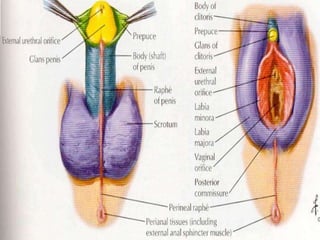
 creating a functional and aesthetically acceptable
vagina and vulva
 normal voiding function
 satisfactory sexual function
ideal neovagina
 should be moist, elastic and hairless
 no less than 10cm in depth and about 3-4cm in
diameter, with no introital stenoses
 Its innervation should provide adequate sensation, to
achieve a satisfactory level of erogenous stimulation
during sexual intercourse
 Clitoris should be small and obscured, but sensitive,
offering the patient complete arousal
 Labia minora and majora should be as similar as the
female vulva as possible and notbulky.
Surgical Techniques for
Vaginoplasty
 Nongenital Skin Grafts
 Penile Skin Graft
 Genital Skin Flaps
 Nongenital Skin Flap
 Pedicled Intestinal Transplant Vaginoplasty
 Clitoro-Labioplasty
Nongenital Skin Grafts
 the skin graft was draped, inside-out, over a sponge
placed between the rectum and urethra to serve as a
mold
 Advantage - hairless neovagina of sufficient depth and
width, with low risk of postoperative complications
 disadvantages - neovaginal prolapse, scarring of the
donor area, circular scarring present at the neovaginal
introitus, the tendency of the skin graft to shrink,
condylomatosis, intraepithelial neoplasia, poor
erogenous sensation and absence of natural
lubrication
Penile Skin Graft
 less prone to contraction than split-thickness skin
grafts. Still, intermittent dilatation is required in these
patients as well, for several months postoperatively, to
prevent shrinking of the neovagina.
 they may develop the same postoperative
complications as the patients with split thickness
neovaginas, such as condylomatosis, intraepithelial
neoplasia in combination with HPV, carcinoma, poor
erogenous sensation and absence of natural
lubrication
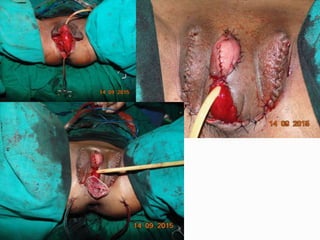
Genital Skin Flaps
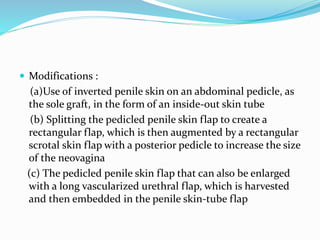
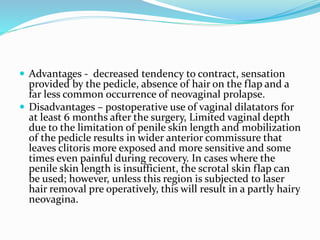
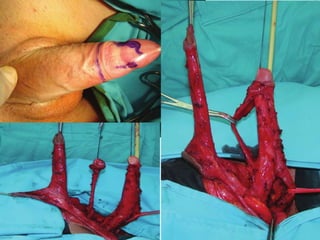
 Following the usual bilateral orchiectomy, the penis is
dissected into its anatomical components, that is, the
corpora cavernosa, the glans cap with neurovascular
bundle, urethra and the vascularized penile skin
 it remains the gold standard in male to female sex
reassignment surgery.
 Modifications :
(a)Use of inverted penile skin on an abdominal pedicle, as
the sole graft, in the form of an inside-out skin tube
(b) Splitting the pedicled penile skin flap to create a
rectangular flap, which is then augmented by a rectangular
scrotal skin flap with a posterior pedicle to increase the size
of the neovagina
(c) The pedicled penile skin flap that can also be enlarged
with a long vascularized urethral flap, which is harvested
and then embedded in the penile skin-tube flap
 Advantages - decreased tendency to contract, sensation
provided by the pedicle, absence of hair on the flap and a
far less common occurrence of neovaginal prolapse.
 Disadvantages – postoperative use of vaginal dilatators for
at least 6 months after the surgery, Limited vaginal depth
due to the limitation of penile skin length and mobilization
of the pedicle results in wider anterior commissure that
leaves clitoris more exposed and more sensitive and some
times even painful during recovery. In cases where the
penile skin length is insufficient, the scrotal skin flap can
be used; however, unless this region is subjected to laser
hair removal pre operatively, this will result in a partly hairy
neovagina.
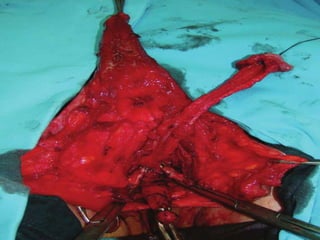
 The corpora cavernosa dissection up to their
attachments to the inferior ramus of the pubic Bones
 a long vascularized pedicle for the tube is of key
importance, so the incision is made <2cm above the
base of the mobilized penile skin
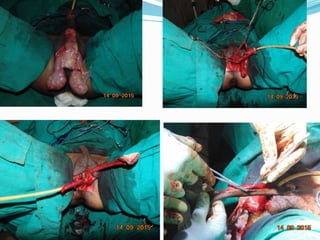
 blunt dissection of the vaginal cavity is performed
anterior to Denonvilliers fascia, taking care not to
injure the rectum
Vaginopexy to the sacrospinous
ligament
 A long-handled Deschamps ligature carrier preloaded with 2-0
absorbable suture is used to pierce the sacrospinous ligament
medially to the ischial spine. The surgeon must pay attention not
to place the suture close to the ischial spine to prevent injury of
the pudendal nerve and internal pudendal vessels.
 The two ends of the suture are brought out so that the fixation
stitches can be tied in place; one is passed through the skin and
the other is passed through the urethral flap in the part situated
in the distal Third of the neovagina, after which the stitches are
tied, with deep placement of the neovagina in the perineal cavity.
 This provides a good placement of the neovagina, avoiding its
prolapse.
 Bowel prep
Labialoplasty
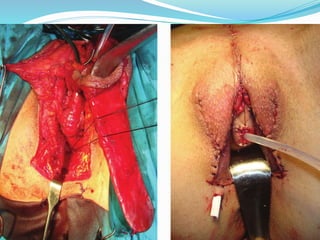
 A section of penile skin base is used to form the labia
minora, which are sutured to the de-epithelialized area
of the neoclitoris
 thus the neoclitoris is hooded with the labia minora.
 Excessive scrotal skin is removed and the remaining
section used to form the labia majora.
 A small posterior base of the inverted Y-incision,
facilitates the creation of an aesthetically appealing
posterior commissure
clitoroplasty
 creation of a well vascularized neoclitoris- very important
step
 1st reported- Brown in 1976 but later on he himself
reported for higher rate of necrosis.
 Upto 1995, creation of the neoclitoris was not an important
part then
 Now a days, the glans cap is divided into two parts, ventral
and dorsal; the dorsal section of the glans is reduced by
excising the central ventral tissue, leaving the sides of the
glans intact. Lateral excisions on the glans are not
recommended, to avoid injuring the neurovascular bundle,
which enters the glans cap lateroventrally.
 the sides are de-epithelialized and sutured, to obtain a
conical shape of the neoclitoris
 The clitoris, its prepuce and labia minora remain among
the most difficult structures to reconstruct
Quality of Sexual Life
 reports of sexual satisfaction after vaginoplasty in male
to female patients, who were capable of achieving an
orgasm in 70–80%
 Sexual expectations should be carefully discussed with
the patients in preoperative preparation in order to
help the patients deal with sexual changes and new
function of new genitals.
 Aesthetic result, sexual arousal, lubrication as well as
absence of pain during sexual intercourse are critical
points of a successful male to female surgery.
Revisions in vaginoplasty
 clitoroplasty: adjusting the size, shape, location or
hooding of the neo-clitoris.
 labiaplasty: adjusting the size or shape of the labia
minora or majora
 commisuroplasty: narrowing the superior aspect of the
labia majora (the anterior commisure)
 deepening the neo-vagina: occasionally the neo-vagina
will not be long enough or will contract in size. This is
usually the result of inadequate dilating.
Other surgical procedure
 Augmentation mammaplasty (breast augmentation)
 Facial feminizing surgery-- removal of supra-orbital
bossing (“brow bossing”) and orbital rim contouring,
brow elevation, rhinoplasty, ear pinning,augmentation
of the lip vermilion area, cheek augmentation,
widening of the zygomatic complex, chin/jaw
reduction, clockwise rotation of the bimaxillary
complex, and reduction laryngochondroplasty (also
known as “tracheal shave” or “Adam’s apple reduction”)
 Voice pitch-elevating surgery
 suction-assisted lipoplasty of the waist and
augmentation of the hips or buttocks
 Removal of the eleventh and twelfth rib is sought by
some MTFs to create a more defined waist
Conclusions
 Adequate depth of the neovagina and sensation of the
neoclitoris needed to achieve an orgasm.
 aesthetic appearance of the neocreated vulva
 visibility of scars and need for repeat surgeries.
 procedure should result in a neovagina that meets the
patients’ aesthetic and functional expectations.
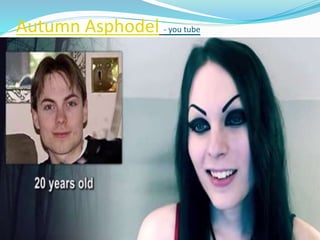
Autumn Asphodel - you tube
Thanks

Sex change surgery

  • 1.
    Dr sumer yadav Mchplastic and reconstructive surgery
  • 2.
    transsexualism  In theInternational Classification of Diseases (ICD-10) “transsexualism” is described as a desire to live and be accepted as a member of the opposite sex, usually accompanied by a sense of discomfort with, or inappropriateness of, one’s anatomic sex, and a wish to undergo surgery and hormonal treatment to makeone’s body as congruent as possible with one’s preferred sex.
  • 3.
    diagnostic criteria  1.A sense of discomfort and inappropriateness about one’s sex.  2. A wish to be rid of one’s genitalia and the desire to live life as a member of the opposite sex.  3. This discomfort/disturbance has been continuously present for a minimum of 2 years and is not limited to a period of stress.  4. An absence of physical intersex or genetic abnormality.  5. Absence of a mental disorder such as schizophrenia.
  • 4.
    Legal issues  Lettersfrom two mental health professionals are required before carrying out Genital Surgery  An appropriate period of hormone therapy  specific consent form  Change of Name Change of Name and Sex in various certificates and identity cards through court  waiver of liability, spousal release and parental consent forms  affidavits from a Notary or Magistrate. This means that now the state is a witness.
  • 5.
    goals  creating afunctional and aesthetically acceptable vagina and vulva  normal voiding function  satisfactory sexual function
  • 7.
    ideal neovagina  shouldbe moist, elastic and hairless  no less than 10cm in depth and about 3-4cm in diameter, with no introital stenoses  Its innervation should provide adequate sensation, to achieve a satisfactory level of erogenous stimulation during sexual intercourse  Clitoris should be small and obscured, but sensitive, offering the patient complete arousal  Labia minora and majora should be as similar as the female vulva as possible and notbulky.
  • 8.
    Surgical Techniques for Vaginoplasty Nongenital Skin Grafts  Penile Skin Graft  Genital Skin Flaps  Nongenital Skin Flap  Pedicled Intestinal Transplant Vaginoplasty  Clitoro-Labioplasty
  • 9.
    Nongenital Skin Grafts the skin graft was draped, inside-out, over a sponge placed between the rectum and urethra to serve as a mold  Advantage - hairless neovagina of sufficient depth and width, with low risk of postoperative complications  disadvantages - neovaginal prolapse, scarring of the donor area, circular scarring present at the neovaginal introitus, the tendency of the skin graft to shrink, condylomatosis, intraepithelial neoplasia, poor erogenous sensation and absence of natural lubrication
  • 10.
    Penile Skin Graft less prone to contraction than split-thickness skin grafts. Still, intermittent dilatation is required in these patients as well, for several months postoperatively, to prevent shrinking of the neovagina.  they may develop the same postoperative complications as the patients with split thickness neovaginas, such as condylomatosis, intraepithelial neoplasia in combination with HPV, carcinoma, poor erogenous sensation and absence of natural lubrication
  • 11.
    Genital Skin Flaps Following the usual bilateral orchiectomy, the penis is dissected into its anatomical components, that is, the corpora cavernosa, the glans cap with neurovascular bundle, urethra and the vascularized penile skin  it remains the gold standard in male to female sex reassignment surgery.
  • 12.
     Modifications : (a)Useof inverted penile skin on an abdominal pedicle, as the sole graft, in the form of an inside-out skin tube (b) Splitting the pedicled penile skin flap to create a rectangular flap, which is then augmented by a rectangular scrotal skin flap with a posterior pedicle to increase the size of the neovagina (c) The pedicled penile skin flap that can also be enlarged with a long vascularized urethral flap, which is harvested and then embedded in the penile skin-tube flap
  • 13.
     Advantages -decreased tendency to contract, sensation provided by the pedicle, absence of hair on the flap and a far less common occurrence of neovaginal prolapse.  Disadvantages – postoperative use of vaginal dilatators for at least 6 months after the surgery, Limited vaginal depth due to the limitation of penile skin length and mobilization of the pedicle results in wider anterior commissure that leaves clitoris more exposed and more sensitive and some times even painful during recovery. In cases where the penile skin length is insufficient, the scrotal skin flap can be used; however, unless this region is subjected to laser hair removal pre operatively, this will result in a partly hairy neovagina.
  • 17.
     The corporacavernosa dissection up to their attachments to the inferior ramus of the pubic Bones  a long vascularized pedicle for the tube is of key importance, so the incision is made <2cm above the base of the mobilized penile skin  blunt dissection of the vaginal cavity is performed anterior to Denonvilliers fascia, taking care not to injure the rectum
  • 19.
    Vaginopexy to thesacrospinous ligament  A long-handled Deschamps ligature carrier preloaded with 2-0 absorbable suture is used to pierce the sacrospinous ligament medially to the ischial spine. The surgeon must pay attention not to place the suture close to the ischial spine to prevent injury of the pudendal nerve and internal pudendal vessels.  The two ends of the suture are brought out so that the fixation stitches can be tied in place; one is passed through the skin and the other is passed through the urethral flap in the part situated in the distal Third of the neovagina, after which the stitches are tied, with deep placement of the neovagina in the perineal cavity.  This provides a good placement of the neovagina, avoiding its prolapse.  Bowel prep
  • 21.
    Labialoplasty  A sectionof penile skin base is used to form the labia minora, which are sutured to the de-epithelialized area of the neoclitoris  thus the neoclitoris is hooded with the labia minora.  Excessive scrotal skin is removed and the remaining section used to form the labia majora.  A small posterior base of the inverted Y-incision, facilitates the creation of an aesthetically appealing posterior commissure
  • 22.
    clitoroplasty  creation ofa well vascularized neoclitoris- very important step  1st reported- Brown in 1976 but later on he himself reported for higher rate of necrosis.  Upto 1995, creation of the neoclitoris was not an important part then  Now a days, the glans cap is divided into two parts, ventral and dorsal; the dorsal section of the glans is reduced by excising the central ventral tissue, leaving the sides of the glans intact. Lateral excisions on the glans are not recommended, to avoid injuring the neurovascular bundle, which enters the glans cap lateroventrally.  the sides are de-epithelialized and sutured, to obtain a conical shape of the neoclitoris  The clitoris, its prepuce and labia minora remain among the most difficult structures to reconstruct
  • 23.
    Quality of SexualLife  reports of sexual satisfaction after vaginoplasty in male to female patients, who were capable of achieving an orgasm in 70–80%  Sexual expectations should be carefully discussed with the patients in preoperative preparation in order to help the patients deal with sexual changes and new function of new genitals.  Aesthetic result, sexual arousal, lubrication as well as absence of pain during sexual intercourse are critical points of a successful male to female surgery.
  • 24.
    Revisions in vaginoplasty clitoroplasty: adjusting the size, shape, location or hooding of the neo-clitoris.  labiaplasty: adjusting the size or shape of the labia minora or majora  commisuroplasty: narrowing the superior aspect of the labia majora (the anterior commisure)  deepening the neo-vagina: occasionally the neo-vagina will not be long enough or will contract in size. This is usually the result of inadequate dilating.
  • 25.
    Other surgical procedure Augmentation mammaplasty (breast augmentation)  Facial feminizing surgery-- removal of supra-orbital bossing (“brow bossing”) and orbital rim contouring, brow elevation, rhinoplasty, ear pinning,augmentation of the lip vermilion area, cheek augmentation, widening of the zygomatic complex, chin/jaw reduction, clockwise rotation of the bimaxillary complex, and reduction laryngochondroplasty (also known as “tracheal shave” or “Adam’s apple reduction”)  Voice pitch-elevating surgery  suction-assisted lipoplasty of the waist and augmentation of the hips or buttocks  Removal of the eleventh and twelfth rib is sought by some MTFs to create a more defined waist
  • 26.
    Conclusions  Adequate depthof the neovagina and sensation of the neoclitoris needed to achieve an orgasm.  aesthetic appearance of the neocreated vulva  visibility of scars and need for repeat surgeries.  procedure should result in a neovagina that meets the patients’ aesthetic and functional expectations.
  • 28.
  • 29.