ASSESSING
THE FEMALE
GENITOURINA
RY SYSTEM
Outcomes
Identify pertinent genitourinary
history questions.
Obtain a female genitourinary
history.
Perform a female genitourinary
physical assessment.
(Continued)
Outcomes
Document pertinent genitourinary
assessment findings.
Identify actual/potential health
problems stated as nursing diagnosis.
Differentiate between normal and
abnormal findings.
Structures
Mons pubis Labia majora & minora
Clitoris Urinary meatus
Perineum Bartholin’s glands
Anus Cervix
Uterus Fallopian tubes
Ovaries Kidneys
Urethra Bladder
Vagina Skene’s gland
Anatomy and
Physiology
Review
Functions
What are the functions of…
Mons pubis:
Subcutaneous pad over symphysis
pubis for protection
Labia majora/minora:
Folds of adipose and connective
tissue that protect and lubricate
external genitalia
(Continued)
Functions
What are the functions of…
Clitoris:
Erectile tissue for sexual stimulation
Urinary meatus:
Opening to urethra
Skene’s glands:
Lubricate and protect
(Continued)
Functions
What are the functions of…
Vaginal introitus:
Opening of the vagina
Vagina:
Muscular tube for copulation, birth
canal, and menses
Bartholin’s glands:
Secretes alkaline mucus that improves
viability & motility of sperm
(Continued)
Functions
What are the functions of…
Cervix:
End of the uterus into vagina
Uterus:
Hollow, muscular organ; site for
fertilized egg implantation; protects
fetus
(Continued)
Functions
What are the functions of…
Tubes:
Passage for ovum to uterus, site of
fertilization
Ovaries:
Produce ova, estrogen and
progesterone
Kidneys:
Filter and excrete wastes (Continued)
Functions
What are the functions of…
Ureter:
Connects kidneys to bladder
Bladder:
Hollow muscular structure; holds urine
Urethra:
Connects bladder to urinary meatus
opening
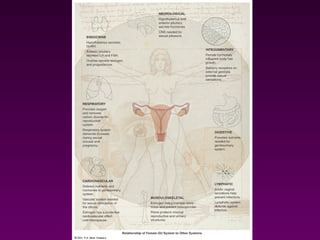
Relationship to
Other Systems
What is the
relationship of the
female genitourinary
system to other
systems?
Integumentary
Gastrointestinal
Lymphatic
Musculoskeletal
Cardiovascular
Respiratory
Endocrine
Neurological
Developmental
Variations
Children—next quarter
Pregnant clients—next quarter
Older Women
Reproductive ability peaks in late 20’s
Estrogen levels begin to decline, and between
46 & 55 menstrual periods become shorter,
less frequent, & cease
Increased risk of infection
(decreased vaginal secretions)
Cultural
Variations
page 618
African Americans
Asians
Jews
Native Americans
Whites
Case Study
Mrs. James, 29-year-
old, married, mother
of 4-year-old
daughter, housewife
C/O scant midcycle
vaginal bleeding for
past 2 months
Annual PAP test and
gynecologic exam
Symptoms
What symptoms would signal a problem
with the female genitourinary system?
Vaginal discharge
Lesions
Vaginal bleeding, pain
Amenorrhea
Urinary symptoms
Pertinent History
Findings
Midcycle vaginal bleeding
Taking BCP, occasional ASA
+ History of rheumatic fever
Gravida 1/para 1; menarche 12; LMP 21
days ago, cycle every 21-23 days, menses
5 days, moderate-to-light flow.
Sexually active in monogamous,
heterosexual relationship, satisfied with
sexual performance
Physical
Assessment
Anatomical landmarks: external--note
position of structures; internal--visualize
underlying structures
Approach: inspection, palpation
Position: lithotomy
Tools: gloves, speculum, lubricant, light,
slides and swabs for specimen collection
General survey and head-to-toe scan
Inspection
External genitalia: color, hair
distribution, condition of skin,
lesions, discharge, odor, pubic
pediculosis, prolapse
Rectal area: condition of skin, lesions,
discharge, bleeding, hemorrhoids,
fissures
(Continued)
Inspection
Pelvic exam: color, lesions of vaginal
walls; color, lesions, discharge,
position, size, shape, and patency of
cervical os (obtain specimens)
Palpation
Skene’s and Bartholin’s glands: masses,
swelling, discharge, tenderness
Vaginal wall: texture, swelling, lesions,
tenderness
Cervix: size, shape, consistency, position,
mobility, tenderness
Uterus: size, shape, symmetry, position,
masses, tenderness
Palpation
Ovaries: size, shape, symmetry,
tenderness
Anus and Rectum: sphincter tone,
tenderness, lesions, masses,
hemorrhoids, polyps; test any stool
for occult blood
Pertinent
Physical
FindingsExternal genitalia pink, moist, intact; small
amount of white, ordorless discharge; no
lesions
Vaginal walls and cervix pink, moist,
intact; no lesions
Uterus anteverted, no masses, non-tender
Ovaries and tubes non-palpable
No rectal masses; hematest negative
Nursing
Diagnosis
What actual or
potential
problems can
you identify
for Mrs.James?

Female system gu

  • 1.
  • 2.
    Outcomes Identify pertinent genitourinary historyquestions. Obtain a female genitourinary history. Perform a female genitourinary physical assessment. (Continued)
  • 3.
    Outcomes Document pertinent genitourinary assessmentfindings. Identify actual/potential health problems stated as nursing diagnosis. Differentiate between normal and abnormal findings.
  • 4.
    Structures Mons pubis Labiamajora & minora Clitoris Urinary meatus Perineum Bartholin’s glands Anus Cervix Uterus Fallopian tubes Ovaries Kidneys Urethra Bladder Vagina Skene’s gland
  • 5.
  • 6.
    Functions What are thefunctions of… Mons pubis: Subcutaneous pad over symphysis pubis for protection Labia majora/minora: Folds of adipose and connective tissue that protect and lubricate external genitalia (Continued)
  • 7.
    Functions What are thefunctions of… Clitoris: Erectile tissue for sexual stimulation Urinary meatus: Opening to urethra Skene’s glands: Lubricate and protect (Continued)
  • 8.
    Functions What are thefunctions of… Vaginal introitus: Opening of the vagina Vagina: Muscular tube for copulation, birth canal, and menses Bartholin’s glands: Secretes alkaline mucus that improves viability & motility of sperm (Continued)
  • 9.
    Functions What are thefunctions of… Cervix: End of the uterus into vagina Uterus: Hollow, muscular organ; site for fertilized egg implantation; protects fetus (Continued)
  • 10.
    Functions What are thefunctions of… Tubes: Passage for ovum to uterus, site of fertilization Ovaries: Produce ova, estrogen and progesterone Kidneys: Filter and excrete wastes (Continued)
  • 11.
    Functions What are thefunctions of… Ureter: Connects kidneys to bladder Bladder: Hollow muscular structure; holds urine Urethra: Connects bladder to urinary meatus opening
  • 12.
    Relationship to Other Systems Whatis the relationship of the female genitourinary system to other systems? Integumentary Gastrointestinal Lymphatic Musculoskeletal Cardiovascular Respiratory Endocrine Neurological
  • 14.
    Developmental Variations Children—next quarter Pregnant clients—nextquarter Older Women Reproductive ability peaks in late 20’s Estrogen levels begin to decline, and between 46 & 55 menstrual periods become shorter, less frequent, & cease Increased risk of infection (decreased vaginal secretions)
  • 15.
  • 16.
    Case Study Mrs. James,29-year- old, married, mother of 4-year-old daughter, housewife C/O scant midcycle vaginal bleeding for past 2 months Annual PAP test and gynecologic exam
  • 17.
    Symptoms What symptoms wouldsignal a problem with the female genitourinary system? Vaginal discharge Lesions Vaginal bleeding, pain Amenorrhea Urinary symptoms
  • 18.
    Pertinent History Findings Midcycle vaginalbleeding Taking BCP, occasional ASA + History of rheumatic fever Gravida 1/para 1; menarche 12; LMP 21 days ago, cycle every 21-23 days, menses 5 days, moderate-to-light flow. Sexually active in monogamous, heterosexual relationship, satisfied with sexual performance
  • 19.
    Physical Assessment Anatomical landmarks: external--note positionof structures; internal--visualize underlying structures Approach: inspection, palpation Position: lithotomy Tools: gloves, speculum, lubricant, light, slides and swabs for specimen collection General survey and head-to-toe scan
  • 20.
    Inspection External genitalia: color,hair distribution, condition of skin, lesions, discharge, odor, pubic pediculosis, prolapse Rectal area: condition of skin, lesions, discharge, bleeding, hemorrhoids, fissures (Continued)
  • 21.
    Inspection Pelvic exam: color,lesions of vaginal walls; color, lesions, discharge, position, size, shape, and patency of cervical os (obtain specimens)
  • 22.
    Palpation Skene’s and Bartholin’sglands: masses, swelling, discharge, tenderness Vaginal wall: texture, swelling, lesions, tenderness Cervix: size, shape, consistency, position, mobility, tenderness Uterus: size, shape, symmetry, position, masses, tenderness
  • 23.
    Palpation Ovaries: size, shape,symmetry, tenderness Anus and Rectum: sphincter tone, tenderness, lesions, masses, hemorrhoids, polyps; test any stool for occult blood
  • 26.
    Pertinent Physical FindingsExternal genitalia pink,moist, intact; small amount of white, ordorless discharge; no lesions Vaginal walls and cervix pink, moist, intact; no lesions Uterus anteverted, no masses, non-tender Ovaries and tubes non-palpable No rectal masses; hematest negative
  • 27.