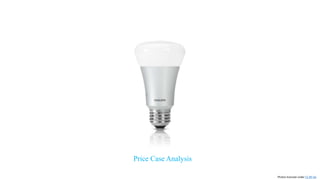
Price Case Analysis
Photos licensed under CC BY-SA
Context
LED1 – a new lighting technology
• Energy-efficient, long-life,
compact
Competition
• Incandescent and CFLs2
• GE3 ~50% market share
• Sold through wholesale and
retail channels
Problem statement
How should the new Philips LED be
positioned in the market?
• Whom to target?
• What channels to sell through?
• At what price point?
1. Light Emitting Diode 2. Compact Fluorescent Lightbulbs 3. General Electric
Source: Darden Business Pubslishing – Philips: Pricing the LED bulb
Summary
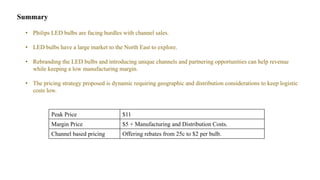
• Philips LED bulbs are facing hurdles with channel sales.
• LED bulbs have a large market to the North East to explore.
• Rebranding the LED bulbs and introducing unique channels and partnering opportunities can help revenue
while keeping a low manufacturing margin.
• The pricing strategy proposed is dynamic requiring geographic and distribution considerations to keep logistic
costs low.
Peak Price $11
Margin Price $5 + Manufacturing and Distribution Costs.
Channel based pricing Offering rebates from 25c to $2 per bulb.
Situation Analysis
Important attribute for consumer is the ‘Price’, while for business is ‘Watts.’ (See Appendix A)
Photos licensed under CC BY-SA
Consumer Business
+ 900 Lumens
+ $5 Price
+ 5 Watts
+ 1300 Lumens
+ $5 Price
+ 5 Watts
= 57.4 (Utility) = 59.3 (Utility)
See Appendix B for Top 10 utilities in each segment.
Top Attributes
Utility
Cost Usage
Cost for operating 18000 hours.
Standard White
Philips LED
Situation Analysis
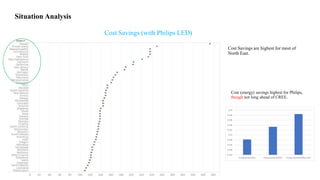
Cost Savings (with Philips LED)
Cost Savings are highest for most of
North East.
Cost (energy) savings highest for Philips,
though not long ahead of CREE.
Situation Analysis
Willingness to Pay
How much are consumers willing to pay to move from GE to Philips? $1.33
How much are businesses willing to pay to move from GE to Philips? 3 cents.
(See Appendix C.)
Attribute Trade Off (See Appendix D.)
Would an average consumer have a $2 price reduction or lower watts by 5 watts? Reduce Watts
Would an average business have a 5 watts reduction or lower price by $2? Reduce Watts
Situation Analysis
• Philips LED has a growth opportunities with a significant market in the North East.
• Philips need to be careful with pricing, as cost savings are very close to the next best alternative CREE.
• Philips can leverage brand as an attribute to compete for retail margin.
• Customers want to shift to using bulbs with lower watts.
Key Insights
Key Considerations
• Philips may want to focus on reducing supply chain costs to improve their manufacturing margin.
• Philips may want to create a geographically dynamic pricing policy to penetrate emerging markets.
• Philips may want to consider channels outside retailers to improve margins.
Situation Analysis
Approach
Location
• They may want to set up 2 manufacturing units are indicated above.
• Leverage better costs for shipping to density usage.
Pricing
Approach
Use peak load pricing of $11 during the months of November to February.
Keep a margin price of $5.
Offer quantity discounts to B2B clients of $9.5 for sales about 50 bulbs.
Slightly lower the margin to $4 during holidays.
Branding
Market LED Bulbs as ‘Smart Bulbs’.
Photos licensed under CC BY-SA-NC
Fashion dresses made from LED bulbs.
Channels
Tie up with Ecommerce sites.
Add a bulb, save the planet. ($10)
Free shipping for bulbs for cart orders placed from shippers close to Philips’
manufacturing locations.
Approach
Drives to encourage people shifting to Philips’ Smart Bulbs.
Incentivize customers to exchange their old bulbs with Smart Bulbs for a 25c
rebate per bulb.
Photos licensed under CC BY-SA-NC
Partner Programs
Tie up with solar electricity panel manufacturers/ installers.
+
Bundle pack of $500. (Selling at $10.5/
bulb to partners, with a mail-in rebate
of $2 per bulb.)
Photos licensed under CC BY-SA-NC
S ell more bulbs.
M arket to newer regions.
A ssign high priced products to sales managers with highest $ per unit.
R efine pricing strategies.
T hank your customers.
Strategies
Approach
Competitive Strategies
Approach
Photos licensed under CC BY-SA-NC
Current Stage.
Set a penetrating price
line with slim margins.
Net retailer margins can
be set to $3.9
Improve margins by
lowering manufacturing
costs to less than $4.
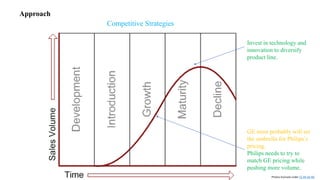
Competitive Strategies
Approach
Photos licensed under CC BY-SA-NC
GE most probably will set
the umbrella for Philips’s
pricing.
Philips needs to try to
match GE pricing while
pushing more volume.
Invest in technology and
innovation to diversify
product line.
Conclusion and Next Steps.
• Drive with larger volume sales.
• Seek alternate channels and incentivize channels to push products.
• Focus on growth but be open to lowering prices when an opportunity arises.
• Be open to partnering opportunities to drive sales either through incentivizing electricians
to push sales or seeking unique channels to push sales.
Appendix
0 0.1 0.2 0.3 0.4 0.5 0.6
Manufacturing
Watts
Lumens
Price
Consumer
0 0.05 0.1 0.15 0.2 0.25 0.3 0.35 0.4 0.45
Manufacturing
Watts
Lumens
Price
Business
A. Attribute Importance
B. Top 10 Utilities
Consumers Business
C. Willingness to Pay
Consumers Business
(2.9-5.1)/(-2.2-1.1) x ($13-$11) = $1.3 (2.1-2.2)/(0.1-5.7) x ($13- $11) = 3 cents
Assuming a customer wants to shift from paying $13 for a GE bulb to $11 for Philips's bulb.
D. Attribute Trade Off
12.5 – 6.1 > 2.2-1.1
Move from 10 watts to 5 watts or $13 to $11
Consumers
Watts Price
Business
Watts Price
23.8 – 12.1 > 5.7-0.1

Philips LED Pricing Strategy.

  • 1.
    Price Case Analysis Photoslicensed under CC BY-SA
  • 2.
    Context LED1 – anew lighting technology • Energy-efficient, long-life, compact Competition • Incandescent and CFLs2 • GE3 ~50% market share • Sold through wholesale and retail channels Problem statement How should the new Philips LED be positioned in the market? • Whom to target? • What channels to sell through? • At what price point? 1. Light Emitting Diode 2. Compact Fluorescent Lightbulbs 3. General Electric Source: Darden Business Pubslishing – Philips: Pricing the LED bulb
  • 3.
    Summary • Philips LEDbulbs are facing hurdles with channel sales. • LED bulbs have a large market to the North East to explore. • Rebranding the LED bulbs and introducing unique channels and partnering opportunities can help revenue while keeping a low manufacturing margin. • The pricing strategy proposed is dynamic requiring geographic and distribution considerations to keep logistic costs low. Peak Price $11 Margin Price $5 + Manufacturing and Distribution Costs. Channel based pricing Offering rebates from 25c to $2 per bulb.
  • 4.
    Situation Analysis Important attributefor consumer is the ‘Price’, while for business is ‘Watts.’ (See Appendix A) Photos licensed under CC BY-SA Consumer Business + 900 Lumens + $5 Price + 5 Watts + 1300 Lumens + $5 Price + 5 Watts = 57.4 (Utility) = 59.3 (Utility) See Appendix B for Top 10 utilities in each segment. Top Attributes Utility
  • 5.
    Cost Usage Cost foroperating 18000 hours. Standard White Philips LED Situation Analysis
  • 6.
    Cost Savings (withPhilips LED) Cost Savings are highest for most of North East. Cost (energy) savings highest for Philips, though not long ahead of CREE. Situation Analysis
  • 7.
    Willingness to Pay Howmuch are consumers willing to pay to move from GE to Philips? $1.33 How much are businesses willing to pay to move from GE to Philips? 3 cents. (See Appendix C.) Attribute Trade Off (See Appendix D.) Would an average consumer have a $2 price reduction or lower watts by 5 watts? Reduce Watts Would an average business have a 5 watts reduction or lower price by $2? Reduce Watts Situation Analysis
  • 8.
    • Philips LEDhas a growth opportunities with a significant market in the North East. • Philips need to be careful with pricing, as cost savings are very close to the next best alternative CREE. • Philips can leverage brand as an attribute to compete for retail margin. • Customers want to shift to using bulbs with lower watts. Key Insights Key Considerations • Philips may want to focus on reducing supply chain costs to improve their manufacturing margin. • Philips may want to create a geographically dynamic pricing policy to penetrate emerging markets. • Philips may want to consider channels outside retailers to improve margins. Situation Analysis
  • 9.
    Approach Location • They maywant to set up 2 manufacturing units are indicated above. • Leverage better costs for shipping to density usage.
  • 10.
    Pricing Approach Use peak loadpricing of $11 during the months of November to February. Keep a margin price of $5. Offer quantity discounts to B2B clients of $9.5 for sales about 50 bulbs. Slightly lower the margin to $4 during holidays. Branding Market LED Bulbs as ‘Smart Bulbs’. Photos licensed under CC BY-SA-NC Fashion dresses made from LED bulbs.
  • 11.
    Channels Tie up withEcommerce sites. Add a bulb, save the planet. ($10) Free shipping for bulbs for cart orders placed from shippers close to Philips’ manufacturing locations. Approach Drives to encourage people shifting to Philips’ Smart Bulbs. Incentivize customers to exchange their old bulbs with Smart Bulbs for a 25c rebate per bulb. Photos licensed under CC BY-SA-NC
  • 12.
    Partner Programs Tie upwith solar electricity panel manufacturers/ installers. + Bundle pack of $500. (Selling at $10.5/ bulb to partners, with a mail-in rebate of $2 per bulb.) Photos licensed under CC BY-SA-NC S ell more bulbs. M arket to newer regions. A ssign high priced products to sales managers with highest $ per unit. R efine pricing strategies. T hank your customers. Strategies Approach
  • 13.
    Competitive Strategies Approach Photos licensedunder CC BY-SA-NC Current Stage. Set a penetrating price line with slim margins. Net retailer margins can be set to $3.9 Improve margins by lowering manufacturing costs to less than $4.
  • 14.
    Competitive Strategies Approach Photos licensedunder CC BY-SA-NC GE most probably will set the umbrella for Philips’s pricing. Philips needs to try to match GE pricing while pushing more volume. Invest in technology and innovation to diversify product line.
  • 15.
    Conclusion and NextSteps. • Drive with larger volume sales. • Seek alternate channels and incentivize channels to push products. • Focus on growth but be open to lowering prices when an opportunity arises. • Be open to partnering opportunities to drive sales either through incentivizing electricians to push sales or seeking unique channels to push sales.
  • 16.
    Appendix 0 0.1 0.20.3 0.4 0.5 0.6 Manufacturing Watts Lumens Price Consumer 0 0.05 0.1 0.15 0.2 0.25 0.3 0.35 0.4 0.45 Manufacturing Watts Lumens Price Business A. Attribute Importance
  • 17.
    B. Top 10Utilities Consumers Business
  • 18.
    C. Willingness toPay Consumers Business (2.9-5.1)/(-2.2-1.1) x ($13-$11) = $1.3 (2.1-2.2)/(0.1-5.7) x ($13- $11) = 3 cents Assuming a customer wants to shift from paying $13 for a GE bulb to $11 for Philips's bulb. D. Attribute Trade Off 12.5 – 6.1 > 2.2-1.1 Move from 10 watts to 5 watts or $13 to $11 Consumers Watts Price Business Watts Price 23.8 – 12.1 > 5.7-0.1