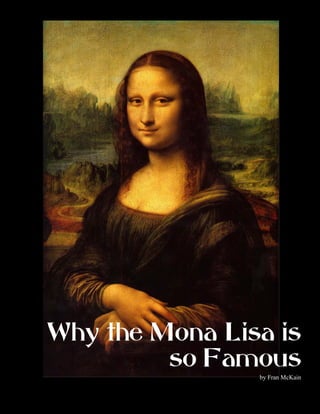
Why the Mona Lisa is
so Famous
by Fran McKain
Why the Mona Lisa is so Famous
The Mona Lisa, painted by Italian artist
Leonardo Da Vinci, is arguably the most famous
painting of all time. Six million people visit the
Louvre in France every year to view it (Canetti,
n.d.). Many copies have been made of it. Songs and
movies and books have referenced it, including the
recent phenomenon, The Da Vinci Code, which
increased traffic at the Louvre so
much that the workers went on
strike out of sheer frustration
(Bremmer, Tourres, 2007). It is
estimated that the Mona Lisa is
used commercially in some new
way every week (Puente, 2006).
How did this painting become so
famous? The fame of the Mona
Lisa began because it is an extraordinarily good
painting by an artist who was a renowned genius, it
grew because it gained the attention of kings and
that world-class art museum, the Louvre, and it
exploded due to a series of near catastrophes,
critics, and exploitations.
Leonardo Da Vinci was renowned as an
inventive and artistic genius long before he painted
the Mona Lisa, and his fame drew wide attention to
his art. His reputation as a genius was well-
deserved. Leonardo lived his motto, “He is a poor
pupil who does not surpass his master” and is said
to have surpassed not only his masters, but all his
contemporaries in each of the many arts and
disciplines to which he committed himself (Potter,
2006, ¶ 3). Leonardo researched anatomy to perfect
his art. He dissected animal and human cadavers to
learn the muscle and skeletal
structure and made copious drawings
and notes. He studied perspective,
the sky and atmosphere, and the way
light falls on curved surfaces and,
based on these studies, refined his
painting methods. Although only a
few of his paintings survive today,
his work is still admired by experts
(Potter, 2006). The Mona Lisa was one of his last
paintings, and although the work is only 30 inches
tall and 21 inches wide, he spent four years
completing it. In this painting, all his skill is
evident.
The rendition of the model in the Mona Lisa
is anatomically perfect. The lighting makes the skin
look so real that one critic said “” (Potter, 2006, 

As art may imitate
nature, she does not
appear to be painted,
but truly of flesh and
blood. On looking
closely at the pit of
her throat, one could
swear that the pulses
were beating

8). He used such thin layers of paint that no one has
figured out how he did it (Jozefowicz, 2007). In this
painting, Leonardo employed a method described
by Pliny that many other artists have attempted and
none have perfected as Leonardo did (Canetti, n.d.).
Art critics call it sfumato, which is Italian for
“smoky”. It involves the use of miniscule brush
strokes to create subtle transitions between light and
dark and between colors. The work was so far
beyond current methods, that it was received with
astonishment by all who saw it and attracted great
attention (Potter, 2006).
Soon after the splash created by Mona Lisa,
Francois I, king of France, invited Leonardo to the
palace at Fontainebleau under his patronage. Five
years later Leonardo died, leaving the portrait to his
friend. Francois hung it
prominently in his semi-private
gallery in the palace where it
gained the attention of visitors
from all over Europe. There
Mona Lisa acquired an aura of the femme fatale,
perhaps because part of the gallery was in the king’s
boudoir (Mona Lisa, n.d.). Francois’ art collection
formed the foundation of what eventually became
the Louvre Museum which opened in 1793 (Mona
Lisa, n.d.). Except for some time hidden in a
warehouse during the French Revolution, Mona
Lisa held court in the Louvre almost without
interruption. She did spend a few years in
Napoleon’s bedroom (Meanley, 2006), but when he
was exiled she returned to the Louvre. In that vast
museum, which now covers 49 acres, thousands of
visitors have seen her nearly every day for more
than 200 years (Mona Lisa, n.d.). Her royal
connections and her high visibility in the Louvre
might have been enough to maintain her fame, but a
near disaster escalated her popularity off the charts.
In 1910, Theophile Homolle, the director of
the National Museums, said that stealing the Mona
Lisa from the Louvre was impossible. “You might
as well pretend that one could steal the towers of
Notre Dame!” he claimed (Mona
Lisa, n.d., p. 7). When Mona Lisa
disappeared on August 21, 1911,
France was shocked. For two years,
they searched for their national
treasure. Authorities questioned and fired museum
employees, accused foreign governments and
business tycoons of publicity stunts, and even
brought in Pablo Picasso for questioning. Buffoons
made jokes, cartoons, riddles, and songs about

When the Mona Lisa
disappeared, France
was shocked.

Mona Lisa. Someone circulated postcards which
depicted Leonardo taking her out of France
thumbing her nose at Parisians (Mona Lisa, n.d.).
The Louvre and various journals offered rewards to
fortune tellers to foretell what had become of her
(Mona Lisa, n.d.). One of them, perhaps inspired by
the fresh disaster of the Titanic, declared that she
had been thrown into the sea. But,
unlike the “unsinkable” Titanic,
the Mona Lisa’s journey was not
over.
On December 10, 1913, a
patriotic Italian named Vincenzo
Perugia, a former Louvre employee, attempted to
sell her to an antique dealer in Italy and was
apprehended (Mona Lisa, n.d.). He said he wished
to return the Mona Lisa to her home country. The
Italians enjoyed a brief reunion with her before
returning her to the Louvre. They didn’t punish
Perugia very hard.
The subsequent rise in fame of the Mona
Lisa made her a target for modern artists such as
Marcel Duchamp and Salvador Dali who were
weary of the tyranny of the classical style (Potter,
2006). Both men painted her with a moustache.
Even the villainy increased her popularity (Puente,
2006). She also became a target for vandals. In
1956, someone spilled acid on the painting and
damaged it badly (Leonardo Da Vinci’s Mona Lisa,
2006). Just a few months later a young man threw a
rock at it which created a small nick. These
incidents resulted in even stronger security for the
increasingly precious Mona Lisa.
As the fame and value of the
Mona Lisa increased, it was not
surprising that, in 1963, First Lady
Jacqueline Kennedy asked to bring
her to the United States. It was also
not surprising that the request raised
much consternation. But, Francophile that she was,
Jacque was popular with the French and secured
permission for a seven-week tour in New York City
and Washington, D.C. On that tour, more than one
and a half million people saw the famous painting.
In 1974, more than two million people saw her on a
tour through Tokyo and Moscow. Ever since then,
people have been collecting “Monalisiana” (Puente,
2006). Leonardo’s famous lady has appeared in
advertising and promotion for everything
imaginable. Clearly, Mona Lisa’s colorful past has
earned her superstar status.

Leonardo’s famous
lady has appears in
advertising and
promotion for
everything
imaginable.

The famous Leonardo Da Vinci has been
called a true Renaissance man, a genius. Few people
have genius in both art and science, but Leonardo
did, and for him it was natural to study science to
figure out how to produce his art. Little wonder that
he should be the man to produce a painting good
enough to become the world’s most famous.
Mimicked and studied by contemporaries, adulated
by kings, romanticized by the crowds in the Louvre,
abused and exploited and narrowly escaping
disaster more than once, the Mona Lisa has become
the most famous painting of all time. With such a
combination of factors one wonders whether
another work could ever surpass her popularity.
References
Bremmer, C., Tourres, M. (2007, February). Mona
Lisa becomes a picture of misery.
TimesOnline. Retrieved September 10,
2008, from
http://www.timesonline.co.uk/tol/news/worl
d/europe/article1381404.ece
Canetti, C. (n.d.) The world’s most famous painting
has the Louvre all aflutter. Retrieved
September 9, 2008 from
http://www.diplomatie.gouv.fr
Da Vinci, L. (n.d.). Mona Lisa: Portrait of Lisa
Gherardini [digital image]. Retrieved July
15, 2011 from http://public-domain-
images.blogspot.com/2010/05/mona-lisa-
portrait-of-lisa-gherardini.html
Jozefowicz, C. (2007, January 19). Da Vinci
DECODED. (Cover story). Current Science,
92(10), 4-5. Retrieved September 7, 2008,
from Academic Search Premier database.
Leonardo Da Vinci’s Mona Lisa. (2006). Retrieved
September 10, 2008 from
http://www.leonardo-
davinci.org/monalisa.php
Meanley, E. (2006, November 13). My Super Sweet
500! [Electronic version]. Scholastic Scope,
55(6/7), 20-21. Retrieved September 7,
2008, from Academic Search Premier
database.
Mona Lisa. (n.d.). Retrieved September 10, 2008,
from
http://www.pbs.org/treasuresoftheworld/a_n
av/mona_nav/main_monafrm.html
Potter, P. (2006, August). Art, Science, and Life's
Enigmas [Electronic version]. Emerging
Infectious Diseases, 12(8), 1308-1309.
Retrieved September 7, 2008, from
Academic Search Premier database.
Puente, M. (2006, May). 'Mona Lisa' has been
smiling for 500 years [Electronic version].
USA Today, Retrieved September 7, 2008,
from Academic Search Premier database.

Why the Mona Lisa is so Famous!

  • 1.
    Why the MonaLisa is so Famous by Fran McKain
  • 2.
    Why the MonaLisa is so Famous The Mona Lisa, painted by Italian artist Leonardo Da Vinci, is arguably the most famous painting of all time. Six million people visit the Louvre in France every year to view it (Canetti, n.d.). Many copies have been made of it. Songs and movies and books have referenced it, including the recent phenomenon, The Da Vinci Code, which increased traffic at the Louvre so much that the workers went on strike out of sheer frustration (Bremmer, Tourres, 2007). It is estimated that the Mona Lisa is used commercially in some new way every week (Puente, 2006). How did this painting become so famous? The fame of the Mona Lisa began because it is an extraordinarily good painting by an artist who was a renowned genius, it grew because it gained the attention of kings and that world-class art museum, the Louvre, and it exploded due to a series of near catastrophes, critics, and exploitations. Leonardo Da Vinci was renowned as an inventive and artistic genius long before he painted the Mona Lisa, and his fame drew wide attention to his art. His reputation as a genius was well- deserved. Leonardo lived his motto, “He is a poor pupil who does not surpass his master” and is said to have surpassed not only his masters, but all his contemporaries in each of the many arts and disciplines to which he committed himself (Potter, 2006, ¶ 3). Leonardo researched anatomy to perfect his art. He dissected animal and human cadavers to learn the muscle and skeletal structure and made copious drawings and notes. He studied perspective, the sky and atmosphere, and the way light falls on curved surfaces and, based on these studies, refined his painting methods. Although only a few of his paintings survive today, his work is still admired by experts (Potter, 2006). The Mona Lisa was one of his last paintings, and although the work is only 30 inches tall and 21 inches wide, he spent four years completing it. In this painting, all his skill is evident. The rendition of the model in the Mona Lisa is anatomically perfect. The lighting makes the skin look so real that one critic said “” (Potter, 2006, ¶  As art may imitate nature, she does not appear to be painted, but truly of flesh and blood. On looking closely at the pit of her throat, one could swear that the pulses were beating 
  • 3.
    8). He usedsuch thin layers of paint that no one has figured out how he did it (Jozefowicz, 2007). In this painting, Leonardo employed a method described by Pliny that many other artists have attempted and none have perfected as Leonardo did (Canetti, n.d.). Art critics call it sfumato, which is Italian for “smoky”. It involves the use of miniscule brush strokes to create subtle transitions between light and dark and between colors. The work was so far beyond current methods, that it was received with astonishment by all who saw it and attracted great attention (Potter, 2006). Soon after the splash created by Mona Lisa, Francois I, king of France, invited Leonardo to the palace at Fontainebleau under his patronage. Five years later Leonardo died, leaving the portrait to his friend. Francois hung it prominently in his semi-private gallery in the palace where it gained the attention of visitors from all over Europe. There Mona Lisa acquired an aura of the femme fatale, perhaps because part of the gallery was in the king’s boudoir (Mona Lisa, n.d.). Francois’ art collection formed the foundation of what eventually became the Louvre Museum which opened in 1793 (Mona Lisa, n.d.). Except for some time hidden in a warehouse during the French Revolution, Mona Lisa held court in the Louvre almost without interruption. She did spend a few years in Napoleon’s bedroom (Meanley, 2006), but when he was exiled she returned to the Louvre. In that vast museum, which now covers 49 acres, thousands of visitors have seen her nearly every day for more than 200 years (Mona Lisa, n.d.). Her royal connections and her high visibility in the Louvre might have been enough to maintain her fame, but a near disaster escalated her popularity off the charts. In 1910, Theophile Homolle, the director of the National Museums, said that stealing the Mona Lisa from the Louvre was impossible. “You might as well pretend that one could steal the towers of Notre Dame!” he claimed (Mona Lisa, n.d., p. 7). When Mona Lisa disappeared on August 21, 1911, France was shocked. For two years, they searched for their national treasure. Authorities questioned and fired museum employees, accused foreign governments and business tycoons of publicity stunts, and even brought in Pablo Picasso for questioning. Buffoons made jokes, cartoons, riddles, and songs about  When the Mona Lisa disappeared, France was shocked. 
  • 4.
    Mona Lisa. Someonecirculated postcards which depicted Leonardo taking her out of France thumbing her nose at Parisians (Mona Lisa, n.d.). The Louvre and various journals offered rewards to fortune tellers to foretell what had become of her (Mona Lisa, n.d.). One of them, perhaps inspired by the fresh disaster of the Titanic, declared that she had been thrown into the sea. But, unlike the “unsinkable” Titanic, the Mona Lisa’s journey was not over. On December 10, 1913, a patriotic Italian named Vincenzo Perugia, a former Louvre employee, attempted to sell her to an antique dealer in Italy and was apprehended (Mona Lisa, n.d.). He said he wished to return the Mona Lisa to her home country. The Italians enjoyed a brief reunion with her before returning her to the Louvre. They didn’t punish Perugia very hard. The subsequent rise in fame of the Mona Lisa made her a target for modern artists such as Marcel Duchamp and Salvador Dali who were weary of the tyranny of the classical style (Potter, 2006). Both men painted her with a moustache. Even the villainy increased her popularity (Puente, 2006). She also became a target for vandals. In 1956, someone spilled acid on the painting and damaged it badly (Leonardo Da Vinci’s Mona Lisa, 2006). Just a few months later a young man threw a rock at it which created a small nick. These incidents resulted in even stronger security for the increasingly precious Mona Lisa. As the fame and value of the Mona Lisa increased, it was not surprising that, in 1963, First Lady Jacqueline Kennedy asked to bring her to the United States. It was also not surprising that the request raised much consternation. But, Francophile that she was, Jacque was popular with the French and secured permission for a seven-week tour in New York City and Washington, D.C. On that tour, more than one and a half million people saw the famous painting. In 1974, more than two million people saw her on a tour through Tokyo and Moscow. Ever since then, people have been collecting “Monalisiana” (Puente, 2006). Leonardo’s famous lady has appeared in advertising and promotion for everything imaginable. Clearly, Mona Lisa’s colorful past has earned her superstar status.  Leonardo’s famous lady has appears in advertising and promotion for everything imaginable. 
  • 5.
    The famous LeonardoDa Vinci has been called a true Renaissance man, a genius. Few people have genius in both art and science, but Leonardo did, and for him it was natural to study science to figure out how to produce his art. Little wonder that he should be the man to produce a painting good enough to become the world’s most famous. Mimicked and studied by contemporaries, adulated by kings, romanticized by the crowds in the Louvre, abused and exploited and narrowly escaping disaster more than once, the Mona Lisa has become the most famous painting of all time. With such a combination of factors one wonders whether another work could ever surpass her popularity. References Bremmer, C., Tourres, M. (2007, February). Mona Lisa becomes a picture of misery. TimesOnline. Retrieved September 10, 2008, from http://www.timesonline.co.uk/tol/news/worl d/europe/article1381404.ece Canetti, C. (n.d.) The world’s most famous painting has the Louvre all aflutter. Retrieved September 9, 2008 from http://www.diplomatie.gouv.fr Da Vinci, L. (n.d.). Mona Lisa: Portrait of Lisa Gherardini [digital image]. Retrieved July 15, 2011 from http://public-domain- images.blogspot.com/2010/05/mona-lisa- portrait-of-lisa-gherardini.html Jozefowicz, C. (2007, January 19). Da Vinci DECODED. (Cover story). Current Science, 92(10), 4-5. Retrieved September 7, 2008, from Academic Search Premier database. Leonardo Da Vinci’s Mona Lisa. (2006). Retrieved September 10, 2008 from http://www.leonardo- davinci.org/monalisa.php Meanley, E. (2006, November 13). My Super Sweet 500! [Electronic version]. Scholastic Scope, 55(6/7), 20-21. Retrieved September 7, 2008, from Academic Search Premier database. Mona Lisa. (n.d.). Retrieved September 10, 2008, from http://www.pbs.org/treasuresoftheworld/a_n av/mona_nav/main_monafrm.html Potter, P. (2006, August). Art, Science, and Life's Enigmas [Electronic version]. Emerging Infectious Diseases, 12(8), 1308-1309. Retrieved September 7, 2008, from Academic Search Premier database. Puente, M. (2006, May). 'Mona Lisa' has been smiling for 500 years [Electronic version]. USA Today, Retrieved September 7, 2008, from Academic Search Premier database.