ACHARYA NAGARJUNA UNIVERSITY COLLEGE OF
PHARMACEUTICAL SCIENCES
SEMINAR PRESENTED BY
O.SASIVARDHAN
Roll.no:Y15MPH326
IN PHARMACEUTICAL ANALYSIS
UV-VIS REFLECTANCE SPECTROSCOPY
• Types of reflection
• Instrumentation
• Factors affecting the reflectance
• Applications
• References
INTRODUCTION
• Reflectance, which is the base quantity that
characterizes the process of reflection, is defined as
the ratio of the reflected radiant flux to the incident
radiant flux (or power)
• Reflectance is introduced by Kubelka–Munk
scientist’s.
• Reflectance can be measured wide wavelength range
from 250-950 nm.
• Reflectance is characteristic for each of drug
molecules, solid samples and paints
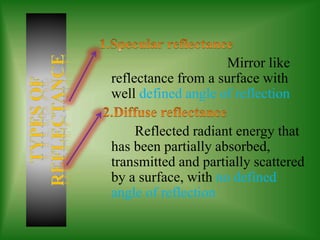
Mirror like
reflectance from a surface with
well defined angle of reflection
Reflected radiant energy that
has been partially absorbed,
transmitted and partially scattered
by a surface, with no defined
angle of reflection
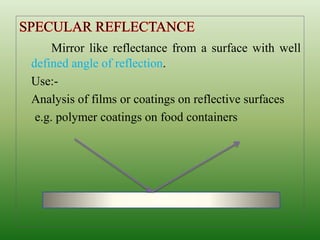
Mirror like reflectance from a surface with well
defined angle of reflection.
Use:-
Analysis of films or coatings on reflective surfaces
e.g. polymer coatings on food containers
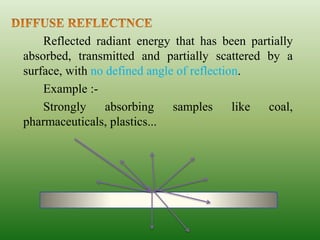
Reflected radiant energy that has been partially
absorbed, transmitted and partially scattered by a
surface, with no defined angle of reflection.
Example :-
Strongly absorbing samples like coal,
pharmaceuticals, plastics...
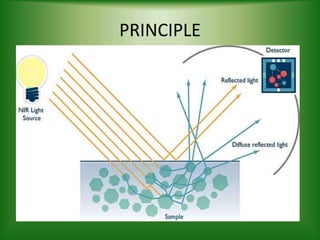
PRINCIPLE
SPECTRA
• This is the ratio of the diffusely reflected part of the
(whole) reflected flux to the incident flux. The
measurement of diffuse reflectance is made in
comparison to a reflection standard (reflectance N)
with a collimated or conical radiation beam. The
signals of the detector are calculated as follows:
• ρd = I (X) - I (stray) - ρ [ I (mi) - I (stray) ]
I (N) - I (stray) - ρN [ I (mi) - I (stray) ]
WHERE,
I (X): signal with sample irradiation
I (N): signal with standard irradiation
I (stray): signal with open measurement port
I (mi): signal with irradiance of a mirror
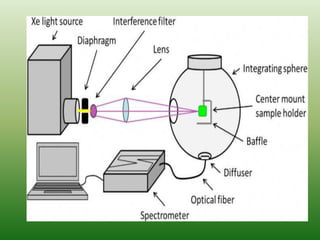
• UV-Vis diffuse reflectance spectrophotometer
the consist mainly following components.
1.light source
2.Interating sphere
3.Sample holders
4.Detectors
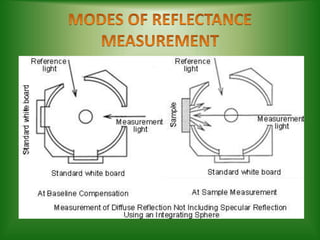
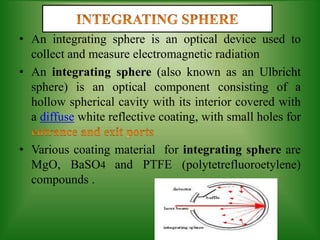
• An integrating sphere is an optical device used to
collect and measure electromagnetic radiation
• An integrating sphere (also known as an Ulbricht
sphere) is an optical component consisting of a
hollow spherical cavity with its interior covered with
a diffuse white reflective coating, with small holes for
• Various coating material for integrating sphere are
MgO, BaSO4 and PTFE (polytetrefluoroetylene)
compounds .
WORKING OF I.S
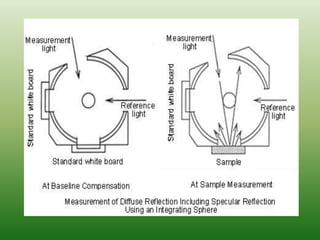
 Upon entering the sphere, the light strikes the sample
surface and the highly reflective walls of the cavity,
undergoing many diffuse reflections.
 Radiation trapped inside the sphere cavity can dissipate
by a combination of three ways.
1. Most of the light eventually is absorbed into the
sphere walls.
2.Some of the light exits the cavity through one of the
empty ports, and
3.A small portion of the trapped radiation strikes the
active surface of the sphere detector
 A steady state radiant flux distribution is established
almost instantaneously within the sphere and remains as
long as the beam source is active.
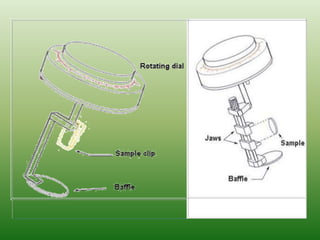
 Various types of sample holders used in DR UV-VIS
Spectroscopy,
1.Centre-Mount Cuvette-style sample holder
2.Clip and Jaw style centre mount sample holders
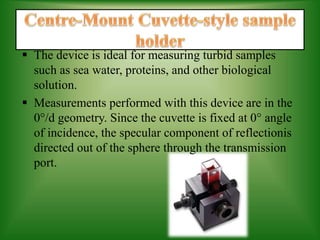
 The device is ideal for measuring turbid samples
such as sea water, proteins, and other biological
solution.
 Measurements performed with this device are in the
0°/d geometry. Since the cuvette is fixed at 0° angle
of incidence, the specular component of reflectionis
directed out of the sphere through the transmission
port.
 The clip style sample holder, uses a spring-loaded
clip to hold the sample.
 The sample must be in a sheet configuration and large
enough to accommodate the entire sample beam
 The jaw style sample holder is better for holding
large, bulky samples. The sample must be opaque or
an absorbent backing must be applied. The sample
holder is designed for reflectance measurements of
samples that do not transmit light
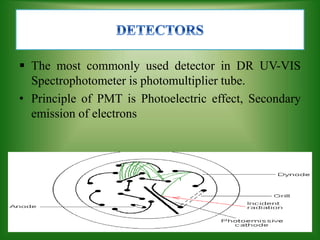
 The most commonly used detector in DR UV-VIS
Spectrophotometer is photomultiplier tube.
• Principle of PMT is Photoelectric effect, Secondary
emission of electrons
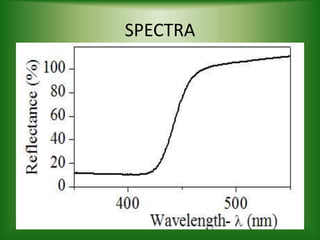
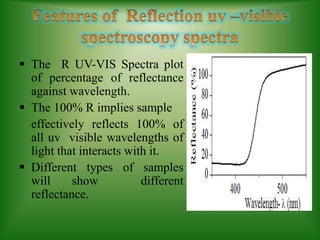
 The R UV-VIS Spectra plot
of percentage of reflectance
against wavelength.
 The 100% R implies sample
effectively reflects 100% of
all uv visible wavelengths of
light that interacts with it.
 Different types of samples
will show different
reflectance.
 1.Particle Size – reducing the size of the sample
particles reduces the contribution of reflection from the
surface. Smaller particles improve the quality of spectra
(narrow bandwidths and better relative intensity). The
recommended size of the sample/matrix particles is 50
micrometers or less. This fine powder is easily achieved
by using a ShakIR mixer.
 2.Refractive Index – effects result in specular
reflectance contributions (spectra of highly reflecting
samples will be more distorted by the specular
reflectance component). This effect can be significantly
reduced by sample dilution.
• 3.Homogeneity – samples prepared for diffuse
reflectance measurements should be uniformly and
well mixed. Non-homogenous samples will lack
reproducibility and will be difficult to quantify. An
ideal way to mix samples for diffuse reflectance is by
using a ShakIR.
• 4.Packing – the required sample depth is governed by
the amount of sample scattering. The minimum
necessary depth is about 1.5 mm. The sample should
be loosely but evenly packed in the cup to maximize
IR beam penetration and minimize spectral
distortions.
 Win UV Software
 UV WinLab software
 ASSP software
• The D R UV-VIS Spectroscopy have applications
widely in pharmaceutical and food and chemical
industry.
• The D R UV-VIS Spectroscopy used for estimation of
furosemide in bulk and dosage form
• D R UV-VIS Spectroscopy used for measurement of
enzyme activity of –ALP
• D R UV-VIS Spectroscopy used for quantitative
estimation of proteins
• D R UV-VIS Spectroscopy used for non-invasive
monitoring of tissue haemoglobin.
• D R UV-VIS Spectroscopy used for measurements of
small quantities of DNA samples and etc.
CONCLUSION
• D R UV-VIS Spectroscopy Is a novel
analytical technique used as qualitative and
quantitative purpose in pharmaceutical, food
and chemical industry.
REFERENCES
• Taylor, A.H., J. Opt. Soc. Am. 4, 9 (1919); Benford,
F., Gen. Elec.Rev. 23, 72 (1920).
• Hardy A.C., J. Opt. Soc. Am. 18,96 (1929).
• Hardy; A.C., Handbook of Colorimetry (M.
LT.Press Cambridge, Mass. 1936).
• Evans, R.M., An Introduction to Colour (John Wiley
and Sons, London, 1948).
• Le Grand, Y., Light, Colour and Vision (Chapman
and H all, London, 1957).
• Judd, D.B., and Wyszecki, G., Color in Business,
Science and Industry (John Wiley and Sons, London,
1963), 2d. edition.
• Billmeyer, F. W., and Saltzmann, M., Principles of
Color Technology (Intersciencc, New York, 1966).
• Wyszecki, G., and Stiles, W.S., Color Science,
Concepts and Methods, Quantitative Data and
Fon~~llas (John Wiley and Sons, New York, 19.67),
2d. edltlon.
UV VISIBLE REFLECTANCESPECTROSCOPY AND APPLICATION

UV VISIBLE REFLECTANCESPECTROSCOPY AND APPLICATION

  • 1.
    ACHARYA NAGARJUNA UNIVERSITYCOLLEGE OF PHARMACEUTICAL SCIENCES SEMINAR PRESENTED BY O.SASIVARDHAN Roll.no:Y15MPH326 IN PHARMACEUTICAL ANALYSIS UV-VIS REFLECTANCE SPECTROSCOPY
  • 2.
    • Types ofreflection • Instrumentation • Factors affecting the reflectance • Applications • References
  • 3.
    INTRODUCTION • Reflectance, whichis the base quantity that characterizes the process of reflection, is defined as the ratio of the reflected radiant flux to the incident radiant flux (or power) • Reflectance is introduced by Kubelka–Munk scientist’s. • Reflectance can be measured wide wavelength range from 250-950 nm. • Reflectance is characteristic for each of drug molecules, solid samples and paints
  • 4.
    Mirror like reflectance froma surface with well defined angle of reflection Reflected radiant energy that has been partially absorbed, transmitted and partially scattered by a surface, with no defined angle of reflection
  • 5.
    Mirror like reflectancefrom a surface with well defined angle of reflection. Use:- Analysis of films or coatings on reflective surfaces e.g. polymer coatings on food containers
  • 6.
    Reflected radiant energythat has been partially absorbed, transmitted and partially scattered by a surface, with no defined angle of reflection. Example :- Strongly absorbing samples like coal, pharmaceuticals, plastics...
  • 7.
  • 8.
  • 11.
    • This isthe ratio of the diffusely reflected part of the (whole) reflected flux to the incident flux. The measurement of diffuse reflectance is made in comparison to a reflection standard (reflectance N) with a collimated or conical radiation beam. The signals of the detector are calculated as follows: • ρd = I (X) - I (stray) - ρ [ I (mi) - I (stray) ] I (N) - I (stray) - ρN [ I (mi) - I (stray) ] WHERE, I (X): signal with sample irradiation I (N): signal with standard irradiation I (stray): signal with open measurement port I (mi): signal with irradiance of a mirror
  • 12.
    • UV-Vis diffusereflectance spectrophotometer the consist mainly following components. 1.light source 2.Interating sphere 3.Sample holders 4.Detectors
  • 14.
    • An integratingsphere is an optical device used to collect and measure electromagnetic radiation • An integrating sphere (also known as an Ulbricht sphere) is an optical component consisting of a hollow spherical cavity with its interior covered with a diffuse white reflective coating, with small holes for • Various coating material for integrating sphere are MgO, BaSO4 and PTFE (polytetrefluoroetylene) compounds .
  • 15.
    WORKING OF I.S Upon entering the sphere, the light strikes the sample surface and the highly reflective walls of the cavity, undergoing many diffuse reflections.  Radiation trapped inside the sphere cavity can dissipate by a combination of three ways. 1. Most of the light eventually is absorbed into the sphere walls. 2.Some of the light exits the cavity through one of the empty ports, and 3.A small portion of the trapped radiation strikes the active surface of the sphere detector  A steady state radiant flux distribution is established almost instantaneously within the sphere and remains as long as the beam source is active.
  • 16.
     Various typesof sample holders used in DR UV-VIS Spectroscopy, 1.Centre-Mount Cuvette-style sample holder 2.Clip and Jaw style centre mount sample holders
  • 17.
     The deviceis ideal for measuring turbid samples such as sea water, proteins, and other biological solution.  Measurements performed with this device are in the 0°/d geometry. Since the cuvette is fixed at 0° angle of incidence, the specular component of reflectionis directed out of the sphere through the transmission port.
  • 18.
     The clipstyle sample holder, uses a spring-loaded clip to hold the sample.  The sample must be in a sheet configuration and large enough to accommodate the entire sample beam  The jaw style sample holder is better for holding large, bulky samples. The sample must be opaque or an absorbent backing must be applied. The sample holder is designed for reflectance measurements of samples that do not transmit light
  • 20.
     The mostcommonly used detector in DR UV-VIS Spectrophotometer is photomultiplier tube. • Principle of PMT is Photoelectric effect, Secondary emission of electrons
  • 21.
     The RUV-VIS Spectra plot of percentage of reflectance against wavelength.  The 100% R implies sample effectively reflects 100% of all uv visible wavelengths of light that interacts with it.  Different types of samples will show different reflectance.
  • 22.
     1.Particle Size– reducing the size of the sample particles reduces the contribution of reflection from the surface. Smaller particles improve the quality of spectra (narrow bandwidths and better relative intensity). The recommended size of the sample/matrix particles is 50 micrometers or less. This fine powder is easily achieved by using a ShakIR mixer.  2.Refractive Index – effects result in specular reflectance contributions (spectra of highly reflecting samples will be more distorted by the specular reflectance component). This effect can be significantly reduced by sample dilution.
  • 23.
    • 3.Homogeneity –samples prepared for diffuse reflectance measurements should be uniformly and well mixed. Non-homogenous samples will lack reproducibility and will be difficult to quantify. An ideal way to mix samples for diffuse reflectance is by using a ShakIR. • 4.Packing – the required sample depth is governed by the amount of sample scattering. The minimum necessary depth is about 1.5 mm. The sample should be loosely but evenly packed in the cup to maximize IR beam penetration and minimize spectral distortions.
  • 24.
     Win UVSoftware  UV WinLab software  ASSP software
  • 25.
    • The DR UV-VIS Spectroscopy have applications widely in pharmaceutical and food and chemical industry. • The D R UV-VIS Spectroscopy used for estimation of furosemide in bulk and dosage form • D R UV-VIS Spectroscopy used for measurement of enzyme activity of –ALP • D R UV-VIS Spectroscopy used for quantitative estimation of proteins
  • 26.
    • D RUV-VIS Spectroscopy used for non-invasive monitoring of tissue haemoglobin. • D R UV-VIS Spectroscopy used for measurements of small quantities of DNA samples and etc.
  • 27.
    CONCLUSION • D RUV-VIS Spectroscopy Is a novel analytical technique used as qualitative and quantitative purpose in pharmaceutical, food and chemical industry.
  • 28.
    REFERENCES • Taylor, A.H.,J. Opt. Soc. Am. 4, 9 (1919); Benford, F., Gen. Elec.Rev. 23, 72 (1920). • Hardy A.C., J. Opt. Soc. Am. 18,96 (1929). • Hardy; A.C., Handbook of Colorimetry (M. LT.Press Cambridge, Mass. 1936). • Evans, R.M., An Introduction to Colour (John Wiley and Sons, London, 1948). • Le Grand, Y., Light, Colour and Vision (Chapman and H all, London, 1957).
  • 29.
    • Judd, D.B.,and Wyszecki, G., Color in Business, Science and Industry (John Wiley and Sons, London, 1963), 2d. edition. • Billmeyer, F. W., and Saltzmann, M., Principles of Color Technology (Intersciencc, New York, 1966). • Wyszecki, G., and Stiles, W.S., Color Science, Concepts and Methods, Quantitative Data and Fon~~llas (John Wiley and Sons, New York, 19.67), 2d. edltlon.