International Journal of Innovative Research in Advanced Engineering (IJIRAE) ISSN: 2349-2763
Issue 10, Volume 3 (October 2016) www.ijirae.com
________________________________________________________________________________________________
IJIRAE: Impact Factor Value – SJIF: Innospace, Morocco (2015): 3.361 | PIF: 2.469 | Jour Info: 4.085 |
Index Copernicus 2014 = 6.57
© 2014- 16, IJIRAE- All Rights Reserved Page -8
UTILIZATION OF COPPER SLAG AS A PARTIAL
REPLACEMENT OF FINE AGGREGATE IN
CONCRETE
DEEPIKA K P Dr.ASHA.K
Department of Civil Engineering Associate Professor/ Civil Engineering
MVJCE, Bangalore MVJ CE, Bangalore
Abstract: Today’s world is facing challenging and unsolved environmental problem such as global warming, forest
destruction and lack of resources. In order to solve these environmental problems, resources recycling have to be
done in environmentally safer methods. As there is a vast scarcity the production of aggregates for concrete the
recycled materials have great demand. The present study mainly focuses on investigating the effect of using copper
slag as a replacement of fine aggregate on the strength properties. In this report, M25 grade concrete was used and
tests were conducted for various proportions of copper slag replacement with sand of 40%, 80% and 100% in
concrete. In the first case along with replacement of copper slag with sand there is an attempt is made to replace the
cement with 50% flyash similarly in second case for 30% replacement of cement with flyash replacement and in the
third case with no replacement of cement with flyash. The obtained results were compared with those of nominal
concrete made with ordinary Portland cement and sand. Further split tensile strength and flexural strength studies
were also performed to check its durability aspects.
Key words: copper slag, FA= fly ash, sand replacement, compression, flexure, split tensile.
I. INTRODUCTION
Concrete is the world’s most ancient, capable, durable and reliable construction material. After water, concrete is the
most used material, which required large quantities of fine aggregate. As there is great demand of aggregates mainly
from civil engineering industry for road and concrete baring constructions. Hence, it is necessary to find an alternative
material to the existing most expensive, most resource consuming fine aggregate. Copper slag is one of the materials
that are considered as a waste material which could have a property of promising future in construction industry as
partial or full substitute of either cement or aggregates. It is a by-product obtained during the process of copper refining.
As the copper settles down in the smelter, it has a higher density, impurities that stay in the top layer and then are
transported to a water basin with a low temperature for solidification. The end product is a solid, hard material that goes
to the crusher for further processing.
II. COPPERSLAG CONCRETE
As earlier said copper slag is a granular grassy material which is similar with those of characteristics of fine aggregate
or sand with all its basic properties. As copper slag is a high density materials it increases the self weight of concrete
there by increases the strength and toughness against the various kinds of loads .By this it can also be stated that the
property of toughness and rigidness can be increased in the concrete by using copper slag in the concrete and various
researches are going on in the world to make use of copper waste in concrete.
III. MATERIALS AND METHODS:
Materials used in the experimental works are OPC 53grade cement, natural coarse aggregate, fine aggregate free from
clay, class F fly ash, Copper slag and super plasticizer.
3.1 CEMENT:
Ordinary Portland cement of OPC grade 53 confirming to IS 8112-1989. Various physical properties were performed as
per IS-4031 PART 11-1988.
International Journal of Innovative Research in Advanced Engineering (IJIRAE) ISSN: 2349-2763
Issue 10, Volume 3 (October 2016) www.ijirae.com
________________________________________________________________________________________________
IJIRAE: Impact Factor Value – SJIF: Innospace, Morocco (2015): 3.361 | PIF: 2.469 | Jour Info: 4.085 |
Index Copernicus 2014 = 6.57
© 2014- 16, IJIRAE- All Rights Reserved Page -9
3.2 SAND:
The aggregate size is lesser than 4.75 mm is considered as fine aggregate. Sand confirming IS 383 1970 comes under
zone II is used.
3.3 COARSE AGGREGATES:
The aggregate size bigger than 4.75 mm, and20mm downsize is considered as coarse aggregate.
3.4 FLY ASH:
Class F Fly ash was procured from Raichur Thermal power plant (RTPS). RTPS is a coal-fired electric power station
located at Raichur district of the state of Karnataka, India
3.5 COPPER SLAG:
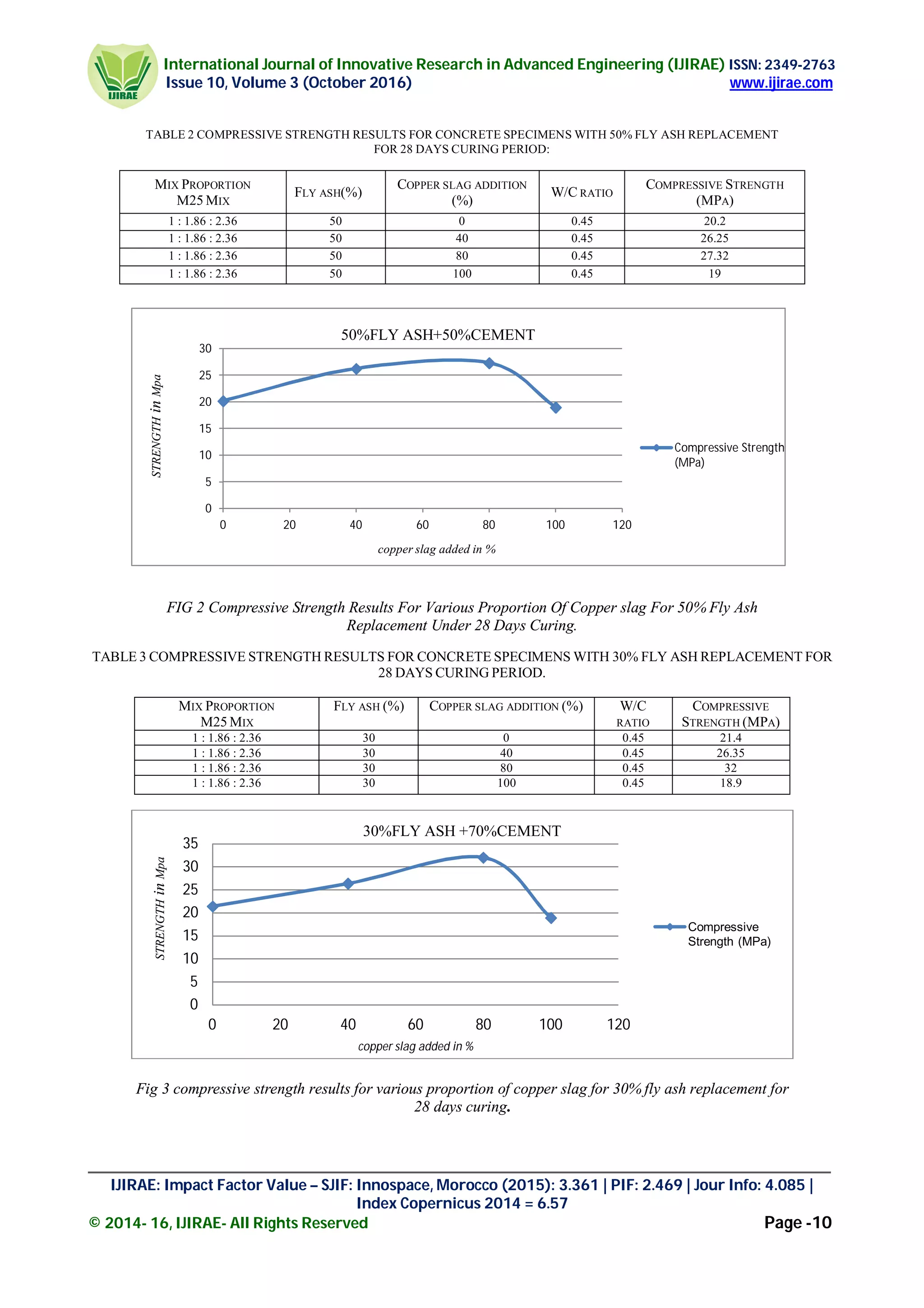
The slag is a black glassy and granular in nature and has a similar particle size range of sand which indicates that it
could be tried as replacement with sand in cementitious mixture. Copper slag used in this work was brought from
Sterlite Industries Ltd (SIL), Tuticorin, Tamil Nadu, India. SIL is producing Copper slag during the manufacture of
copper metal.
Fig 1 Copper Slag
IV.EXPERIMENTAL WORK:
4.1COPPER SLAG CHARACTERIZATIONS:
Initial basic properties of copper slag are similar to that of fine aggregate properties both in physical and chemical
properties
SCANNING ELECTRON MICROGRAPH (SEM):
Surface morphology of fly ash was studied using Quanta 200 ESEM present at IISc, Bangalore SEM of fly ash was
obtained at different magnifications ranging from 150 to 1000 times.
X-RAY DIFFRACTION (XRD) ANALYSIS:
X-ray diffraction was carried out on the air-dried fly ash and copper slag specimens using JOEL JDX-8030 present at
CECRI, Karaikudi, Tamil Nadu. X-ray analysis was carried out with CuKα radiation (at 2Ө scanning speed of 20
/min)
from 60
to 900
. The mix design for the work is done for M25 grade concrete as per IS: 10262(1982).water cement ratio
is fixed at 0.43 with a slump of 100mm.And the quantity of materials per m3
is listed in the table1.
TABLE 1 MATERILAS FOR 1M3
OF CONCRETE
V.TESTS AND RESULTS
5.1 COMPRESSIVE STRENGTH TEST:
150mm*150mm*150mm size cubes were casted and the compressive strength tests were done.
MATERIAL QUANTITY
CEMENT(KG)
FINE AGGREGATE(KG)
COARSE AGGREGATE(KG)
WATER(L)
SUPER PLASTICIZER(L)
318
864
1105
153
1.2
International Journal of Innovative Research in Advanced Engineering (IJIRAE) ISSN: 2349-2763
Issue 10, Volume 3 (October 2016) www.ijirae.com
________________________________________________________________________________________________
IJIRAE: Impact Factor Value – SJIF: Innospace, Morocco (2015): 3.361 | PIF: 2.469 | Jour Info: 4.085 |
Index Copernicus 2014 = 6.57
© 2014- 16, IJIRAE- All Rights Reserved Page -10
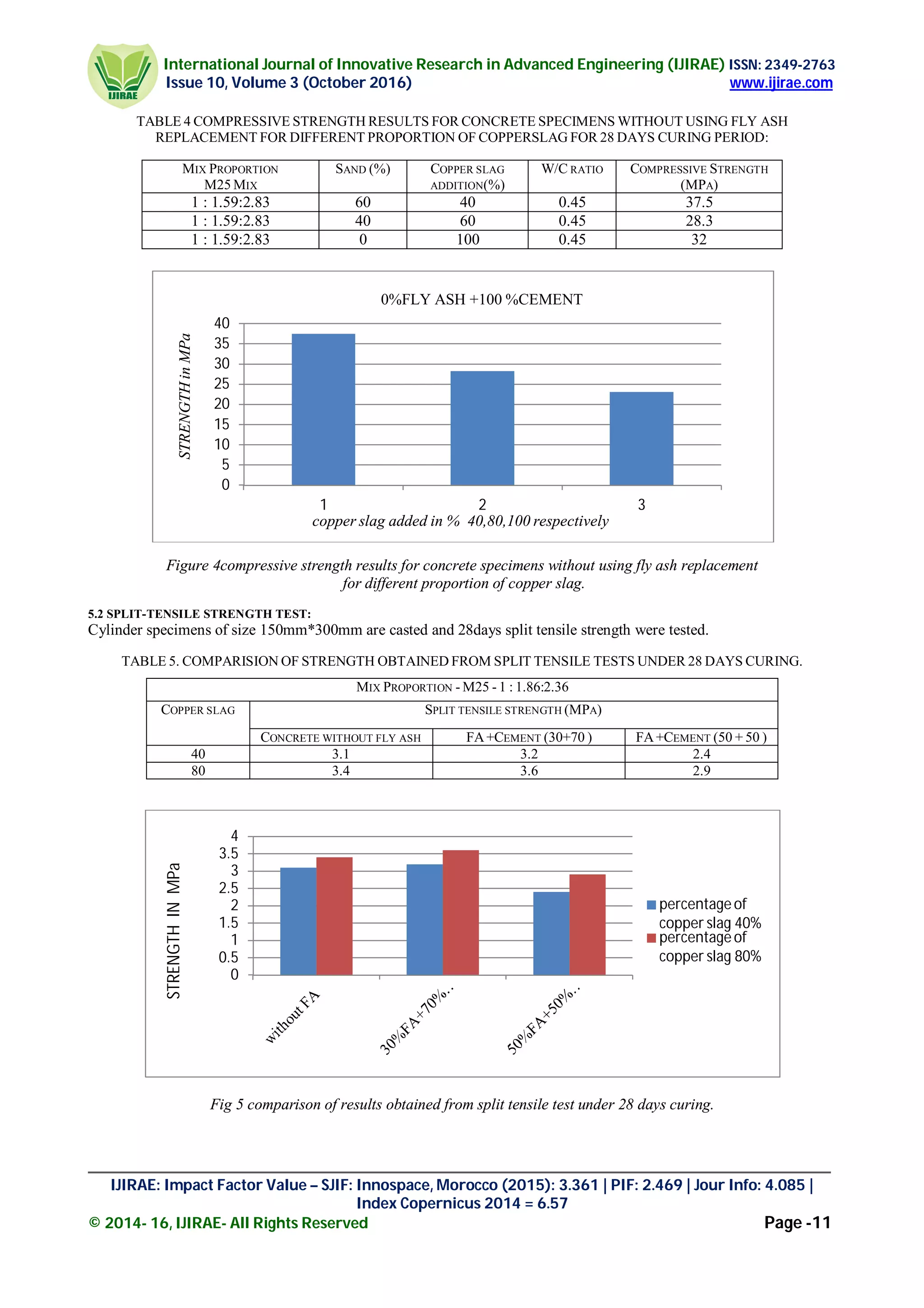
TABLE 2 COMPRESSIVE STRENGTH RESULTS FOR CONCRETE SPECIMENS WITH 50% FLY ASH REPLACEMENT
FOR 28 DAYS CURING PERIOD:
MIX PROPORTION
M25 MIX
FLY ASH(%)
COPPER SLAG ADDITION
(%)
W/C RATIO
COMPRESSIVE STRENGTH
(MPA)
1 : 1.86 : 2.36 50 0 0.45 20.2
1 : 1.86 : 2.36 50 40 0.45 26.25
1 : 1.86 : 2.36 50 80 0.45 27.32
1 : 1.86 : 2.36 50 100 0.45 19
FIG 2 Compressive Strength Results For Various Proportion Of Copper slag For 50% Fly Ash
Replacement Under 28 Days Curing.
TABLE 3 COMPRESSIVE STRENGTH RESULTS FOR CONCRETE SPECIMENS WITH 30% FLY ASH REPLACEMENT FOR
28 DAYS CURING PERIOD.
MIX PROPORTION
M25 MIX
FLY ASH (%) COPPER SLAG ADDITION (%) W/C
RATIO
COMPRESSIVE
STRENGTH (MPA)
1 : 1.86 : 2.36 30 0 0.45 21.4
1 : 1.86 : 2.36 30 40 0.45 26.35
1 : 1.86 : 2.36 30 80 0.45 32
1 : 1.86 : 2.36 30 100 0.45 18.9
Fig 3 compressive strength results for various proportion of copper slag for 30% fly ash replacement for
28 days curing.
0
5
10
15
20
25
30
35
0 20 40 60 80 100 120
copper slag added in %
30%FLY ASH +70%CEMENT
Compressive
Strength (MPa)
STRENGTHinMpa
0
5
10
15
20
25
30
0 20 40 60 80 100 120
Compressive Strength
(MPa)
STRENGTHinMpa
copper slag added in %
50%FLY ASH+50%CEMENT
International Journal of Innovative Research in Advanced Engineering (IJIRAE) ISSN: 2349-2763
Issue 10, Volume 3 (October 2016) www.ijirae.com
________________________________________________________________________________________________
IJIRAE: Impact Factor Value – SJIF: Innospace, Morocco (2015): 3.361 | PIF: 2.469 | Jour Info: 4.085 |
Index Copernicus 2014 = 6.57
© 2014- 16, IJIRAE- All Rights Reserved Page -11
TABLE 4 COMPRESSIVE STRENGTH RESULTS FOR CONCRETE SPECIMENS WITHOUT USING FLY ASH
REPLACEMENT FOR DIFFERENT PROPORTION OF COPPERSLAG FOR 28 DAYS CURING PERIOD:
MIX PROPORTION
M25 MIX
SAND (%) COPPER SLAG
ADDITION(%)
W/C RATIO COMPRESSIVE STRENGTH
(MPA)
1 : 1.59:2.83 60 40 0.45 37.5
1 : 1.59:2.83 40 60 0.45 28.3
1 : 1.59:2.83 0 100 0.45 32
Figure 4compressive strength results for concrete specimens without using fly ash replacement
for different proportion of copper slag.
5.2 SPLIT-TENSILE STRENGTH TEST:
Cylinder specimens of size 150mm*300mm are casted and 28days split tensile strength were tested.
TABLE 5. COMPARISION OF STRENGTH OBTAINED FROM SPLIT TENSILE TESTS UNDER 28 DAYS CURING.
MIX PROPORTION - M25 - 1 : 1.86:2.36
COPPER SLAG SPLIT TENSILE STRENGTH (MPA)
CONCRETE WITHOUT FLY ASH FA+CEMENT (30+70 ) FA+CEMENT (50 + 50 )
40 3.1 3.2 2.4
80 3.4 3.6 2.9
Fig 5 comparison of results obtained from split tensile test under 28 days curing.
0
5
10
15
20
25
30
35
40
1 2 3
0%FLY ASH +100 %CEMENT
STRENGTHinMPa
copper slag added in % 40,80,100 respectively
0
0.5
1
1.5
2
2.5
3
3.5
4
percentageof
copper slag 40%
percentageof
copper slag 80%
STRENGTHINMPa
International Journal of Innovative Research in Advanced Engineering (IJIRAE) ISSN: 2349-2763
Issue 10, Volume 3 (October 2016) www.ijirae.com
________________________________________________________________________________________________
IJIRAE: Impact Factor Value – SJIF: Innospace, Morocco (2015): 3.361 | PIF: 2.469 | Jour Info: 4.085 |
Index Copernicus 2014 = 6.57
© 2014- 16, IJIRAE- All Rights Reserved Page -12
5.3FLEXURAL STRENGTH TEST:
Beam specimens of size 100mm*100mm*150mm are casted and 28 days flexural strength tests were conducted
Figure 5 comparisons of results obtained from flexural strength test under 28 days curing.
V. CONCLUSIONS
 Addition of copper slag increases the density and thereby self weight and hence it is suitable for bearing structures
like piers, abutments, heavy bridges and also in pavement construction etc,
 It can be observed that the strength of concrete increases with the increase in copper slag up to 80% of replacement
with sand and 50% replacement of flyash with cement.
 For compression test based on the above experimental results 80% copper slag replaced with sand giving an good
acceptable value i.e., more than conventional value 26.5MPa in both the cases 50% fly ash replaced concrete and
30% fly ash replaced concrete. Next to that for 40% copper slag replaced mix also gives an acceptable strength
values for both fly ash replaced cases which is not a rejected result
 For split tensile strength it can conclude that 80% copper slag concrete with 50% fly ash mix gives a acceptable
value which can be considered for further research work.
 For flexural strength copper slag concrete with 30% replacement of fly ash shows a aggressive acceptable strength
of 3.94 MPa and for concrete without using fly ash showed a strength3MPa. And concrete with 50% fly ash
replacement showed strength of 3.62 MPa which is also in acceptable range.
REFRENCES
[1]. ASCE, Materials Engineering Conference, Materials for the New Millenium, ed. K. Chong, pp. 1677-86, 1996. B.
Mobasher1 M. ASCE, and R. Devaguptapu , A.M. Arino.
[2]. Australian Journal of Basic and Applied Sciences, 7(8): 886-891, 2013 ISSN 1991-8178 Corresponding Author: N
Sakthieswaran, Assistant Professor, Department of Civil Engineering, Regional Centre of Anna University,
Tirunelveli, TamilnaduSakthieswaran N, 2Ganesan K
[3]. Australian Journal of Basic and Applied Sciences, 7(8): 886-891, 2013 ISSN 1991-8178 Corresponding Author: N
Sakthieswaran, Assistant Professor, Department of Civil Engineering, Regional Centre of Anna University,
Tirunelveli, Tamilnadu, Sakthieswaran N, 2Ganesan K
[4]. Chavan, et al, International Journal of Advanced Engineering Research and Studies E-ISSN2249–8974 Int.J. Adv.
Engg. Res. Studies /II/IV/July-Sept., 2013/95-98, Research Paper.
[5]. International Journal of Earth Sciences and Engineering ISSN 0974-5904, Vol. 03, No. 04, august 2010, pp. 579-
585#02030713 copyright c 2010 cafet-innova technical society. by D. Brindha and S. Nagan
[6]. International journal of civil and structural engineeringVolume 1, No 2, 2010 ISSN 0976 – 4399 192D.Brindha
,Baskaran.T , Nagan.S
[7]. International Journal Of Civil And Structural Engineering Volume 1, No 4, 2011 Research Article Issn 0976 –
4399 918 Meenakshi Sudarvizhi. S, Ilangovan. R
0
0.5
1
1.5
2
2.5
3
3.5
4
4.5
percentageof
copper slag 40%
percentageof
copper slag 80%
STRENGTHINMPa
International Journal of Innovative Research in Advanced Engineering (IJIRAE) ISSN: 2349-2763
Issue 10, Volume 3 (October 2016) www.ijirae.com
________________________________________________________________________________________________
IJIRAE: Impact Factor Value – SJIF: Innospace, Morocco (2015): 3.361 | PIF: 2.469 | Jour Info: 4.085 |
Index Copernicus 2014 = 6.57
© 2014- 16, IJIRAE- All Rights Reserved Page -13
[8]. International Journal of Environmental Engineering Research, Volume 1, Issue 2, 2012, 51-59 Research
Publishing Groupwww.rpublishing.org51 V G. Havanagi1, A.K. Sinha, V.K. Arora, S. Mathur
[9]. International Journal of Engineering Research and Applications (IJERA) ISSN: 2248-9622 Trends and Recent
Advances in Civil Engineering (TRACE- 24th-25th January 2014) Sree Narayana Gurukulam College of
Engineering Edwin Fernando Vandana C.J, Indu.G.Nair
[10]. Slag Cement Association info@slagcement.org web: www.slagcement.org
[11]. TJER 2012, Vol. 9, No. 2, 90-102 AS Alnuaimi Department of Civil and Architectural Engineering, Sultan
Qaboos University, Al-Khoud, Muscat, Sultanate of Oman Received 6 March 2011; accepted 7 March 2012.

UTILIZATION OF COPPER SLAG AS A PARTIAL REPLACEMENT OF FINE AGGREGATE IN CONCRETE

  • 1.
    International Journal ofInnovative Research in Advanced Engineering (IJIRAE) ISSN: 2349-2763 Issue 10, Volume 3 (October 2016) www.ijirae.com ________________________________________________________________________________________________ IJIRAE: Impact Factor Value – SJIF: Innospace, Morocco (2015): 3.361 | PIF: 2.469 | Jour Info: 4.085 | Index Copernicus 2014 = 6.57 © 2014- 16, IJIRAE- All Rights Reserved Page -8 UTILIZATION OF COPPER SLAG AS A PARTIAL REPLACEMENT OF FINE AGGREGATE IN CONCRETE DEEPIKA K P Dr.ASHA.K Department of Civil Engineering Associate Professor/ Civil Engineering MVJCE, Bangalore MVJ CE, Bangalore Abstract: Today’s world is facing challenging and unsolved environmental problem such as global warming, forest destruction and lack of resources. In order to solve these environmental problems, resources recycling have to be done in environmentally safer methods. As there is a vast scarcity the production of aggregates for concrete the recycled materials have great demand. The present study mainly focuses on investigating the effect of using copper slag as a replacement of fine aggregate on the strength properties. In this report, M25 grade concrete was used and tests were conducted for various proportions of copper slag replacement with sand of 40%, 80% and 100% in concrete. In the first case along with replacement of copper slag with sand there is an attempt is made to replace the cement with 50% flyash similarly in second case for 30% replacement of cement with flyash replacement and in the third case with no replacement of cement with flyash. The obtained results were compared with those of nominal concrete made with ordinary Portland cement and sand. Further split tensile strength and flexural strength studies were also performed to check its durability aspects. Key words: copper slag, FA= fly ash, sand replacement, compression, flexure, split tensile. I. INTRODUCTION Concrete is the world’s most ancient, capable, durable and reliable construction material. After water, concrete is the most used material, which required large quantities of fine aggregate. As there is great demand of aggregates mainly from civil engineering industry for road and concrete baring constructions. Hence, it is necessary to find an alternative material to the existing most expensive, most resource consuming fine aggregate. Copper slag is one of the materials that are considered as a waste material which could have a property of promising future in construction industry as partial or full substitute of either cement or aggregates. It is a by-product obtained during the process of copper refining. As the copper settles down in the smelter, it has a higher density, impurities that stay in the top layer and then are transported to a water basin with a low temperature for solidification. The end product is a solid, hard material that goes to the crusher for further processing. II. COPPERSLAG CONCRETE As earlier said copper slag is a granular grassy material which is similar with those of characteristics of fine aggregate or sand with all its basic properties. As copper slag is a high density materials it increases the self weight of concrete there by increases the strength and toughness against the various kinds of loads .By this it can also be stated that the property of toughness and rigidness can be increased in the concrete by using copper slag in the concrete and various researches are going on in the world to make use of copper waste in concrete. III. MATERIALS AND METHODS: Materials used in the experimental works are OPC 53grade cement, natural coarse aggregate, fine aggregate free from clay, class F fly ash, Copper slag and super plasticizer. 3.1 CEMENT: Ordinary Portland cement of OPC grade 53 confirming to IS 8112-1989. Various physical properties were performed as per IS-4031 PART 11-1988.
  • 2.
    International Journal ofInnovative Research in Advanced Engineering (IJIRAE) ISSN: 2349-2763 Issue 10, Volume 3 (October 2016) www.ijirae.com ________________________________________________________________________________________________ IJIRAE: Impact Factor Value – SJIF: Innospace, Morocco (2015): 3.361 | PIF: 2.469 | Jour Info: 4.085 | Index Copernicus 2014 = 6.57 © 2014- 16, IJIRAE- All Rights Reserved Page -9 3.2 SAND: The aggregate size is lesser than 4.75 mm is considered as fine aggregate. Sand confirming IS 383 1970 comes under zone II is used. 3.3 COARSE AGGREGATES: The aggregate size bigger than 4.75 mm, and20mm downsize is considered as coarse aggregate. 3.4 FLY ASH: Class F Fly ash was procured from Raichur Thermal power plant (RTPS). RTPS is a coal-fired electric power station located at Raichur district of the state of Karnataka, India 3.5 COPPER SLAG: The slag is a black glassy and granular in nature and has a similar particle size range of sand which indicates that it could be tried as replacement with sand in cementitious mixture. Copper slag used in this work was brought from Sterlite Industries Ltd (SIL), Tuticorin, Tamil Nadu, India. SIL is producing Copper slag during the manufacture of copper metal. Fig 1 Copper Slag IV.EXPERIMENTAL WORK: 4.1COPPER SLAG CHARACTERIZATIONS: Initial basic properties of copper slag are similar to that of fine aggregate properties both in physical and chemical properties SCANNING ELECTRON MICROGRAPH (SEM): Surface morphology of fly ash was studied using Quanta 200 ESEM present at IISc, Bangalore SEM of fly ash was obtained at different magnifications ranging from 150 to 1000 times. X-RAY DIFFRACTION (XRD) ANALYSIS: X-ray diffraction was carried out on the air-dried fly ash and copper slag specimens using JOEL JDX-8030 present at CECRI, Karaikudi, Tamil Nadu. X-ray analysis was carried out with CuKα radiation (at 2Ө scanning speed of 20 /min) from 60 to 900 . The mix design for the work is done for M25 grade concrete as per IS: 10262(1982).water cement ratio is fixed at 0.43 with a slump of 100mm.And the quantity of materials per m3 is listed in the table1. TABLE 1 MATERILAS FOR 1M3 OF CONCRETE V.TESTS AND RESULTS 5.1 COMPRESSIVE STRENGTH TEST: 150mm*150mm*150mm size cubes were casted and the compressive strength tests were done. MATERIAL QUANTITY CEMENT(KG) FINE AGGREGATE(KG) COARSE AGGREGATE(KG) WATER(L) SUPER PLASTICIZER(L) 318 864 1105 153 1.2
  • 3.
    International Journal ofInnovative Research in Advanced Engineering (IJIRAE) ISSN: 2349-2763 Issue 10, Volume 3 (October 2016) www.ijirae.com ________________________________________________________________________________________________ IJIRAE: Impact Factor Value – SJIF: Innospace, Morocco (2015): 3.361 | PIF: 2.469 | Jour Info: 4.085 | Index Copernicus 2014 = 6.57 © 2014- 16, IJIRAE- All Rights Reserved Page -10 TABLE 2 COMPRESSIVE STRENGTH RESULTS FOR CONCRETE SPECIMENS WITH 50% FLY ASH REPLACEMENT FOR 28 DAYS CURING PERIOD: MIX PROPORTION M25 MIX FLY ASH(%) COPPER SLAG ADDITION (%) W/C RATIO COMPRESSIVE STRENGTH (MPA) 1 : 1.86 : 2.36 50 0 0.45 20.2 1 : 1.86 : 2.36 50 40 0.45 26.25 1 : 1.86 : 2.36 50 80 0.45 27.32 1 : 1.86 : 2.36 50 100 0.45 19 FIG 2 Compressive Strength Results For Various Proportion Of Copper slag For 50% Fly Ash Replacement Under 28 Days Curing. TABLE 3 COMPRESSIVE STRENGTH RESULTS FOR CONCRETE SPECIMENS WITH 30% FLY ASH REPLACEMENT FOR 28 DAYS CURING PERIOD. MIX PROPORTION M25 MIX FLY ASH (%) COPPER SLAG ADDITION (%) W/C RATIO COMPRESSIVE STRENGTH (MPA) 1 : 1.86 : 2.36 30 0 0.45 21.4 1 : 1.86 : 2.36 30 40 0.45 26.35 1 : 1.86 : 2.36 30 80 0.45 32 1 : 1.86 : 2.36 30 100 0.45 18.9 Fig 3 compressive strength results for various proportion of copper slag for 30% fly ash replacement for 28 days curing. 0 5 10 15 20 25 30 35 0 20 40 60 80 100 120 copper slag added in % 30%FLY ASH +70%CEMENT Compressive Strength (MPa) STRENGTHinMpa 0 5 10 15 20 25 30 0 20 40 60 80 100 120 Compressive Strength (MPa) STRENGTHinMpa copper slag added in % 50%FLY ASH+50%CEMENT
  • 4.
    International Journal ofInnovative Research in Advanced Engineering (IJIRAE) ISSN: 2349-2763 Issue 10, Volume 3 (October 2016) www.ijirae.com ________________________________________________________________________________________________ IJIRAE: Impact Factor Value – SJIF: Innospace, Morocco (2015): 3.361 | PIF: 2.469 | Jour Info: 4.085 | Index Copernicus 2014 = 6.57 © 2014- 16, IJIRAE- All Rights Reserved Page -11 TABLE 4 COMPRESSIVE STRENGTH RESULTS FOR CONCRETE SPECIMENS WITHOUT USING FLY ASH REPLACEMENT FOR DIFFERENT PROPORTION OF COPPERSLAG FOR 28 DAYS CURING PERIOD: MIX PROPORTION M25 MIX SAND (%) COPPER SLAG ADDITION(%) W/C RATIO COMPRESSIVE STRENGTH (MPA) 1 : 1.59:2.83 60 40 0.45 37.5 1 : 1.59:2.83 40 60 0.45 28.3 1 : 1.59:2.83 0 100 0.45 32 Figure 4compressive strength results for concrete specimens without using fly ash replacement for different proportion of copper slag. 5.2 SPLIT-TENSILE STRENGTH TEST: Cylinder specimens of size 150mm*300mm are casted and 28days split tensile strength were tested. TABLE 5. COMPARISION OF STRENGTH OBTAINED FROM SPLIT TENSILE TESTS UNDER 28 DAYS CURING. MIX PROPORTION - M25 - 1 : 1.86:2.36 COPPER SLAG SPLIT TENSILE STRENGTH (MPA) CONCRETE WITHOUT FLY ASH FA+CEMENT (30+70 ) FA+CEMENT (50 + 50 ) 40 3.1 3.2 2.4 80 3.4 3.6 2.9 Fig 5 comparison of results obtained from split tensile test under 28 days curing. 0 5 10 15 20 25 30 35 40 1 2 3 0%FLY ASH +100 %CEMENT STRENGTHinMPa copper slag added in % 40,80,100 respectively 0 0.5 1 1.5 2 2.5 3 3.5 4 percentageof copper slag 40% percentageof copper slag 80% STRENGTHINMPa
  • 5.
    International Journal ofInnovative Research in Advanced Engineering (IJIRAE) ISSN: 2349-2763 Issue 10, Volume 3 (October 2016) www.ijirae.com ________________________________________________________________________________________________ IJIRAE: Impact Factor Value – SJIF: Innospace, Morocco (2015): 3.361 | PIF: 2.469 | Jour Info: 4.085 | Index Copernicus 2014 = 6.57 © 2014- 16, IJIRAE- All Rights Reserved Page -12 5.3FLEXURAL STRENGTH TEST: Beam specimens of size 100mm*100mm*150mm are casted and 28 days flexural strength tests were conducted Figure 5 comparisons of results obtained from flexural strength test under 28 days curing. V. CONCLUSIONS  Addition of copper slag increases the density and thereby self weight and hence it is suitable for bearing structures like piers, abutments, heavy bridges and also in pavement construction etc,  It can be observed that the strength of concrete increases with the increase in copper slag up to 80% of replacement with sand and 50% replacement of flyash with cement.  For compression test based on the above experimental results 80% copper slag replaced with sand giving an good acceptable value i.e., more than conventional value 26.5MPa in both the cases 50% fly ash replaced concrete and 30% fly ash replaced concrete. Next to that for 40% copper slag replaced mix also gives an acceptable strength values for both fly ash replaced cases which is not a rejected result  For split tensile strength it can conclude that 80% copper slag concrete with 50% fly ash mix gives a acceptable value which can be considered for further research work.  For flexural strength copper slag concrete with 30% replacement of fly ash shows a aggressive acceptable strength of 3.94 MPa and for concrete without using fly ash showed a strength3MPa. And concrete with 50% fly ash replacement showed strength of 3.62 MPa which is also in acceptable range. REFRENCES [1]. ASCE, Materials Engineering Conference, Materials for the New Millenium, ed. K. Chong, pp. 1677-86, 1996. B. Mobasher1 M. ASCE, and R. Devaguptapu , A.M. Arino. [2]. Australian Journal of Basic and Applied Sciences, 7(8): 886-891, 2013 ISSN 1991-8178 Corresponding Author: N Sakthieswaran, Assistant Professor, Department of Civil Engineering, Regional Centre of Anna University, Tirunelveli, TamilnaduSakthieswaran N, 2Ganesan K [3]. Australian Journal of Basic and Applied Sciences, 7(8): 886-891, 2013 ISSN 1991-8178 Corresponding Author: N Sakthieswaran, Assistant Professor, Department of Civil Engineering, Regional Centre of Anna University, Tirunelveli, Tamilnadu, Sakthieswaran N, 2Ganesan K [4]. Chavan, et al, International Journal of Advanced Engineering Research and Studies E-ISSN2249–8974 Int.J. Adv. Engg. Res. Studies /II/IV/July-Sept., 2013/95-98, Research Paper. [5]. International Journal of Earth Sciences and Engineering ISSN 0974-5904, Vol. 03, No. 04, august 2010, pp. 579- 585#02030713 copyright c 2010 cafet-innova technical society. by D. Brindha and S. Nagan [6]. International journal of civil and structural engineeringVolume 1, No 2, 2010 ISSN 0976 – 4399 192D.Brindha ,Baskaran.T , Nagan.S [7]. International Journal Of Civil And Structural Engineering Volume 1, No 4, 2011 Research Article Issn 0976 – 4399 918 Meenakshi Sudarvizhi. S, Ilangovan. R 0 0.5 1 1.5 2 2.5 3 3.5 4 4.5 percentageof copper slag 40% percentageof copper slag 80% STRENGTHINMPa
  • 6.
    International Journal ofInnovative Research in Advanced Engineering (IJIRAE) ISSN: 2349-2763 Issue 10, Volume 3 (October 2016) www.ijirae.com ________________________________________________________________________________________________ IJIRAE: Impact Factor Value – SJIF: Innospace, Morocco (2015): 3.361 | PIF: 2.469 | Jour Info: 4.085 | Index Copernicus 2014 = 6.57 © 2014- 16, IJIRAE- All Rights Reserved Page -13 [8]. International Journal of Environmental Engineering Research, Volume 1, Issue 2, 2012, 51-59 Research Publishing Groupwww.rpublishing.org51 V G. Havanagi1, A.K. Sinha, V.K. Arora, S. Mathur [9]. International Journal of Engineering Research and Applications (IJERA) ISSN: 2248-9622 Trends and Recent Advances in Civil Engineering (TRACE- 24th-25th January 2014) Sree Narayana Gurukulam College of Engineering Edwin Fernando Vandana C.J, Indu.G.Nair [10]. Slag Cement Association info@slagcement.org web: www.slagcement.org [11]. TJER 2012, Vol. 9, No. 2, 90-102 AS Alnuaimi Department of Civil and Architectural Engineering, Sultan Qaboos University, Al-Khoud, Muscat, Sultanate of Oman Received 6 March 2011; accepted 7 March 2012.