International Research Journal of Engineering and Technology (IRJET) e-ISSN: 2395-0056
Volume: 06 Issue: 03 | Mar 2019 www.irjet.net p-ISSN: 2395-0072
© 2019, IRJET | Impact Factor value: 7.211 | ISO 9001:2008 Certified Journal | Page 203
A COMPARATIVE STUDY ON STRENGTH AND DURABILITY OF
CONCRETE USING COPPER SLAG AS A PARTIAL REPLACEMENT OF
FINE AGGREGATE
Somesh Desai1, Chetan Moze2, Mahendra Mane3, Neerajkumar Dubey4
1,2,3PG Student, G H Raisoni College of Engineering and Management, Pune, India.
4Professor, Dept. of Civil Engineering, PG Student, G H Raisoni College of Engineering and Management,
Pune, India.
---------------------------------------------------------------------***----------------------------------------------------------------------
Abstract - Now a days resources efficiency are becoming
important issue within todays construction industry. This
study reports potential use of copper slag as a replacement
of sand in concrete mixes. As no of countries are witnessing
rapid growth in construction industry, which involves the
use of natural resources for the development of
infrastructure. This paper study investigated the effect of
waste copper slag as partial replacement of fine aggregate
in various percentage (i.e 0% 20% 40% 60% 80%)
respectively, on concrete property such as mechanical
(compressive strength, splitting tensile strength and flexure
strength ) also durability and workability characteristics of
the concrete. This paper deals with the review of literature
of copper slag as a partial replacement of fine aggregate in
concrete.
Key Words: Concrete, cement, replacement of fine
aggregate, copper slag, sand, water, etc.
1. INTRODUCTION
This Concrete is a composite material composed of water,
coarse granular material (fine and coarse aggregate)
embedded in a hard matrix of material (the cement or
binder). Concrete is widely used for making architectural
structures, foundations, walls, pavements, bridges or
overpasses, highways, runways, parking structures, dams
etc. This requires large amount of cement, fine aggregate
(i.e sand) and coarse aggregate. Due to continuous
demand of this construction material there is shortage of
material. So to avoid shortage of fine aggregate, there is
one replacement known as copper slag. Copper slag is
used in the concrete as alternative material. It is the waste
product of copper from Steralite Industries. The safe
disposal of this waste of copper slag is the major problem,
also costly and causes environmental pollution. The
construction field is the only area where the safe disposal
or use of waste material (copper slag) is possible. When it
is introduced in concrete as a replacement of fine
aggregate, same way it reduces the environmental
pollution, disposal problem and also reduces the cost of
concrete. After replacement we have to study or to
conclude that the copper slag performs similar or better
compared to natural sand
2. OBJECTIVES
The main objective of this paper is to replacement of fine
aggregate by copper slag and to examine following
• To fine out the optimum content of copper slag that can
be gain maximum strength in the proportion replaced
with fine aggregate.
• To check the physical and chemical properties of
concrete when replaced with fine aggregate.
• To inspect the compressive strength flexure and split
tensile strength when copper salg used in concrete.
Properties Result
Specific gravity 3.22
Water absorption 0.68 %
• To study the durability and workability properties of
copper slag based concrete.
3. MATERIAL USED
3.1 CEMENT.
43 grades of ordinary portlant cement are used in this
project, following test of cement are conducted
Properties of cement
Properties Results
Initial setting time 32min
Final setting time 472min
Specific gravity 3.1
International Research Journal of Engineering and Technology (IRJET) e-ISSN: 2395-0056
Volume: 06 Issue: 03 | Mar 2019 www.irjet.net p-ISSN: 2395-0072
© 2019, IRJET | Impact Factor value: 7.211 | ISO 9001:2008 Certified Journal | Page 204
3.2 SAND.
In this study sand is used which is passing through
4.75mm sieve following properties are tasted for this
study
Properties Results
Specific gravity 2.51
Water absorption 0.8%
3.3 COARSE AGGREGATE.
For this project report max 20mm size aggregate used
which can be available locally
3.3 COPPER SLAG.
Copper slag is waste of copper manufacturing
industries which can be get easily if we use copper slag as
replacement of sand then the problem of disposal can be
easily solved, following are some properties of copper slag
Properties of copper slag.
4. MEXPERIMENTAL INVESTIGATION.
In this study M25 grade of concrete used according to IS
10262:2009 by replacing fine aggregate with copper slag,
the mix proportion obtained 1:1.66:2.66 and allowable
w/c ratio is 0.55. And then copper slag is added with the
varying proportion i.e 0% 20% 40% 60% 80%. After
mixing specimen casted and then it will check for the
compressive strength for 7 and 28 days. And split tensile
strength, and flexural strength taken for 28 day.
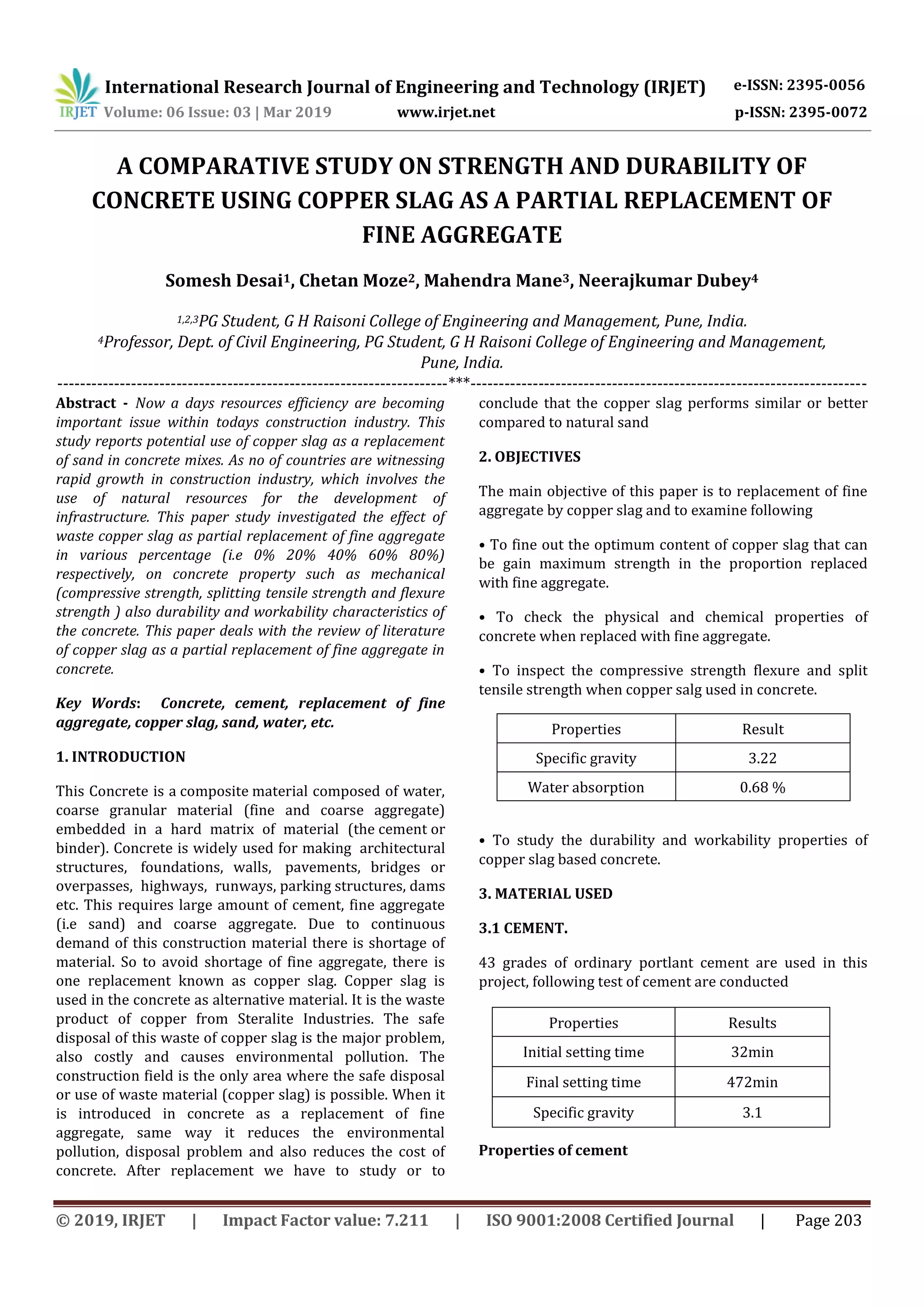
5. RESULTS.
Compressive strength test
Sr No
Replacement of
fine aggregate by
copper slag (%)
7th day
Compressive
strength
(N/mm2)
28th day
Compressive
strength
(N/mm2)
1 0 23.62 27.14
2 20 27.53 28.44
3 40 28.95 33.40
4 60 25.38 29
5 80 23.56 27.32
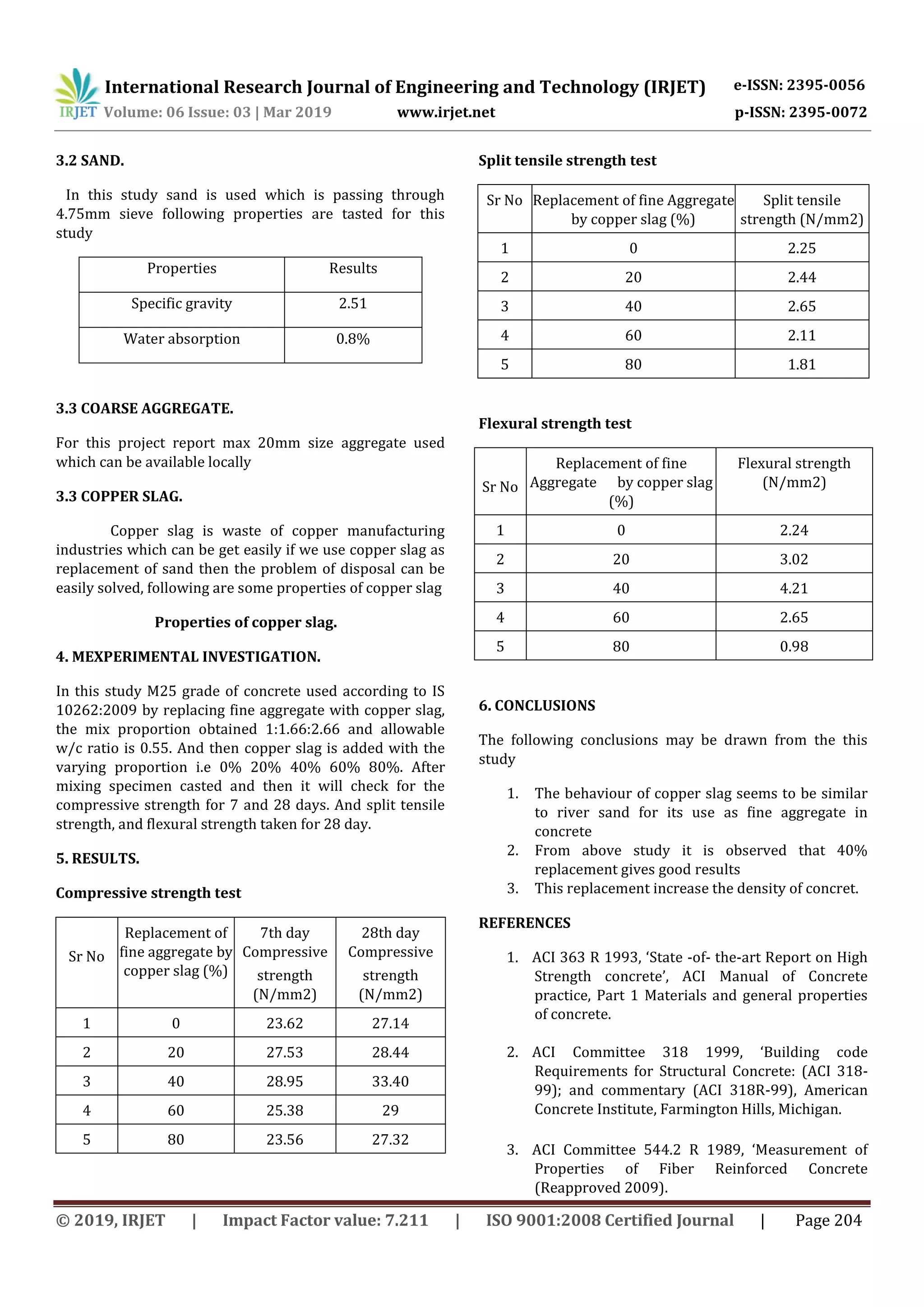
Split tensile strength test
Sr No Replacement of fine Aggregate
by copper slag (%)
Split tensile
strength (N/mm2)
1 0 2.25
2 20 2.44
3 40 2.65
4 60 2.11
5 80 1.81
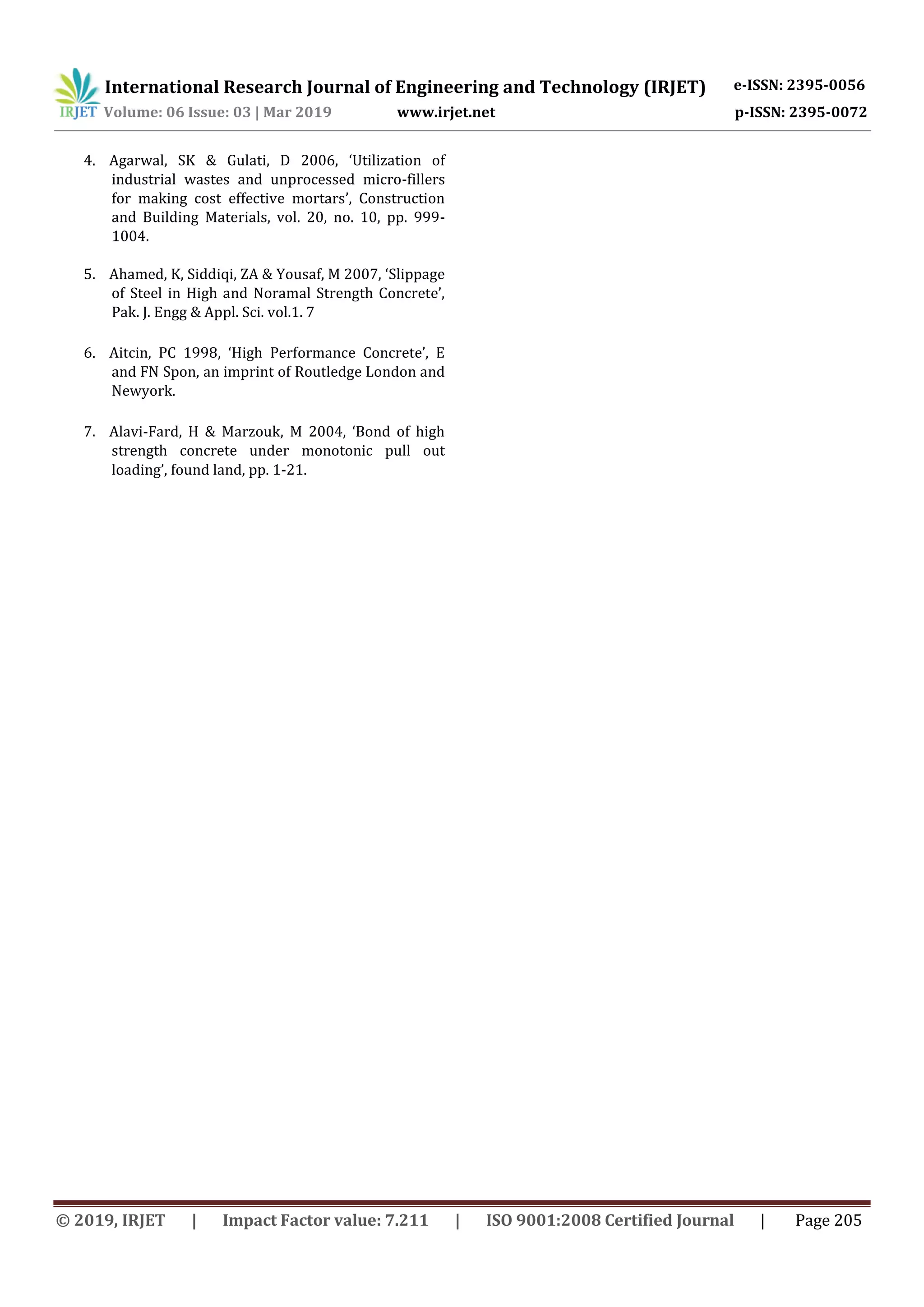
Flexural strength test
Sr No
Replacement of fine
Aggregate by copper slag
(%)
Flexural strength
(N/mm2)
1 0 2.24
2 20 3.02
3 40 4.21
4 60 2.65
5 80 0.98
6. CONCLUSIONS
The following conclusions may be drawn from the this
study
1. The behaviour of copper slag seems to be similar
to river sand for its use as fine aggregate in
concrete
2. From above study it is observed that 40%
replacement gives good results
3. This replacement increase the density of concret.
REFERENCES
1. ACI 363 R 1993, ‘State -of- the-art Report on High
Strength concrete’, ACI Manual of Concrete
practice, Part 1 Materials and general properties
of concrete.
2. ACI Committee 318 1999, ‘Building code
Requirements for Structural Concrete: (ACI 318-
99); and commentary (ACI 318R-99), American
Concrete Institute, Farmington Hills, Michigan.
3. ACI Committee 544.2 R 1989, ‘Measurement of
Properties of Fiber Reinforced Concrete
(Reapproved 2009).
International Research Journal of Engineering and Technology (IRJET) e-ISSN: 2395-0056
Volume: 06 Issue: 03 | Mar 2019 www.irjet.net p-ISSN: 2395-0072
© 2019, IRJET | Impact Factor value: 7.211 | ISO 9001:2008 Certified Journal | Page 205
4. Agarwal, SK & Gulati, D 2006, ‘Utilization of
industrial wastes and unprocessed micro-fillers
for making cost effective mortars’, Construction
and Building Materials, vol. 20, no. 10, pp. 999-
1004.
5. Ahamed, K, Siddiqi, ZA & Yousaf, M 2007, ‘Slippage
of Steel in High and Noramal Strength Concrete’,
Pak. J. Engg & Appl. Sci. vol.1. 7
6. Aitcin, PC 1998, ‘High Performance Concrete’, E
and FN Spon, an imprint of Routledge London and
Newyork.
7. Alavi-Fard, H & Marzouk, M 2004, ‘Bond of high
strength concrete under monotonic pull out
loading’, found land, pp. 1-21.

IRJET- A Comparative Study on Strength and Durability of Concrete using Copper Slag as a Partial Replacement of Fine Aggregate

  • 1.
    International Research Journalof Engineering and Technology (IRJET) e-ISSN: 2395-0056 Volume: 06 Issue: 03 | Mar 2019 www.irjet.net p-ISSN: 2395-0072 © 2019, IRJET | Impact Factor value: 7.211 | ISO 9001:2008 Certified Journal | Page 203 A COMPARATIVE STUDY ON STRENGTH AND DURABILITY OF CONCRETE USING COPPER SLAG AS A PARTIAL REPLACEMENT OF FINE AGGREGATE Somesh Desai1, Chetan Moze2, Mahendra Mane3, Neerajkumar Dubey4 1,2,3PG Student, G H Raisoni College of Engineering and Management, Pune, India. 4Professor, Dept. of Civil Engineering, PG Student, G H Raisoni College of Engineering and Management, Pune, India. ---------------------------------------------------------------------***---------------------------------------------------------------------- Abstract - Now a days resources efficiency are becoming important issue within todays construction industry. This study reports potential use of copper slag as a replacement of sand in concrete mixes. As no of countries are witnessing rapid growth in construction industry, which involves the use of natural resources for the development of infrastructure. This paper study investigated the effect of waste copper slag as partial replacement of fine aggregate in various percentage (i.e 0% 20% 40% 60% 80%) respectively, on concrete property such as mechanical (compressive strength, splitting tensile strength and flexure strength ) also durability and workability characteristics of the concrete. This paper deals with the review of literature of copper slag as a partial replacement of fine aggregate in concrete. Key Words: Concrete, cement, replacement of fine aggregate, copper slag, sand, water, etc. 1. INTRODUCTION This Concrete is a composite material composed of water, coarse granular material (fine and coarse aggregate) embedded in a hard matrix of material (the cement or binder). Concrete is widely used for making architectural structures, foundations, walls, pavements, bridges or overpasses, highways, runways, parking structures, dams etc. This requires large amount of cement, fine aggregate (i.e sand) and coarse aggregate. Due to continuous demand of this construction material there is shortage of material. So to avoid shortage of fine aggregate, there is one replacement known as copper slag. Copper slag is used in the concrete as alternative material. It is the waste product of copper from Steralite Industries. The safe disposal of this waste of copper slag is the major problem, also costly and causes environmental pollution. The construction field is the only area where the safe disposal or use of waste material (copper slag) is possible. When it is introduced in concrete as a replacement of fine aggregate, same way it reduces the environmental pollution, disposal problem and also reduces the cost of concrete. After replacement we have to study or to conclude that the copper slag performs similar or better compared to natural sand 2. OBJECTIVES The main objective of this paper is to replacement of fine aggregate by copper slag and to examine following • To fine out the optimum content of copper slag that can be gain maximum strength in the proportion replaced with fine aggregate. • To check the physical and chemical properties of concrete when replaced with fine aggregate. • To inspect the compressive strength flexure and split tensile strength when copper salg used in concrete. Properties Result Specific gravity 3.22 Water absorption 0.68 % • To study the durability and workability properties of copper slag based concrete. 3. MATERIAL USED 3.1 CEMENT. 43 grades of ordinary portlant cement are used in this project, following test of cement are conducted Properties of cement Properties Results Initial setting time 32min Final setting time 472min Specific gravity 3.1
  • 2.
    International Research Journalof Engineering and Technology (IRJET) e-ISSN: 2395-0056 Volume: 06 Issue: 03 | Mar 2019 www.irjet.net p-ISSN: 2395-0072 © 2019, IRJET | Impact Factor value: 7.211 | ISO 9001:2008 Certified Journal | Page 204 3.2 SAND. In this study sand is used which is passing through 4.75mm sieve following properties are tasted for this study Properties Results Specific gravity 2.51 Water absorption 0.8% 3.3 COARSE AGGREGATE. For this project report max 20mm size aggregate used which can be available locally 3.3 COPPER SLAG. Copper slag is waste of copper manufacturing industries which can be get easily if we use copper slag as replacement of sand then the problem of disposal can be easily solved, following are some properties of copper slag Properties of copper slag. 4. MEXPERIMENTAL INVESTIGATION. In this study M25 grade of concrete used according to IS 10262:2009 by replacing fine aggregate with copper slag, the mix proportion obtained 1:1.66:2.66 and allowable w/c ratio is 0.55. And then copper slag is added with the varying proportion i.e 0% 20% 40% 60% 80%. After mixing specimen casted and then it will check for the compressive strength for 7 and 28 days. And split tensile strength, and flexural strength taken for 28 day. 5. RESULTS. Compressive strength test Sr No Replacement of fine aggregate by copper slag (%) 7th day Compressive strength (N/mm2) 28th day Compressive strength (N/mm2) 1 0 23.62 27.14 2 20 27.53 28.44 3 40 28.95 33.40 4 60 25.38 29 5 80 23.56 27.32 Split tensile strength test Sr No Replacement of fine Aggregate by copper slag (%) Split tensile strength (N/mm2) 1 0 2.25 2 20 2.44 3 40 2.65 4 60 2.11 5 80 1.81 Flexural strength test Sr No Replacement of fine Aggregate by copper slag (%) Flexural strength (N/mm2) 1 0 2.24 2 20 3.02 3 40 4.21 4 60 2.65 5 80 0.98 6. CONCLUSIONS The following conclusions may be drawn from the this study 1. The behaviour of copper slag seems to be similar to river sand for its use as fine aggregate in concrete 2. From above study it is observed that 40% replacement gives good results 3. This replacement increase the density of concret. REFERENCES 1. ACI 363 R 1993, ‘State -of- the-art Report on High Strength concrete’, ACI Manual of Concrete practice, Part 1 Materials and general properties of concrete. 2. ACI Committee 318 1999, ‘Building code Requirements for Structural Concrete: (ACI 318- 99); and commentary (ACI 318R-99), American Concrete Institute, Farmington Hills, Michigan. 3. ACI Committee 544.2 R 1989, ‘Measurement of Properties of Fiber Reinforced Concrete (Reapproved 2009).
  • 3.
    International Research Journalof Engineering and Technology (IRJET) e-ISSN: 2395-0056 Volume: 06 Issue: 03 | Mar 2019 www.irjet.net p-ISSN: 2395-0072 © 2019, IRJET | Impact Factor value: 7.211 | ISO 9001:2008 Certified Journal | Page 205 4. Agarwal, SK & Gulati, D 2006, ‘Utilization of industrial wastes and unprocessed micro-fillers for making cost effective mortars’, Construction and Building Materials, vol. 20, no. 10, pp. 999- 1004. 5. Ahamed, K, Siddiqi, ZA & Yousaf, M 2007, ‘Slippage of Steel in High and Noramal Strength Concrete’, Pak. J. Engg & Appl. Sci. vol.1. 7 6. Aitcin, PC 1998, ‘High Performance Concrete’, E and FN Spon, an imprint of Routledge London and Newyork. 7. Alavi-Fard, H & Marzouk, M 2004, ‘Bond of high strength concrete under monotonic pull out loading’, found land, pp. 1-21.