Light Emitting Concrete
Presented by
Shaik.Asif.Ahmed [ASIF’ASHU]
Content:-
Introduction
History
Principle
Properties
Material used
Manufacturing Process
Advantages
Disadvantages
Examples
Conclusion
References
Introduction
Light emitting concrete also known as translucent concrete
It is a concrete based building material having light emitting
property.
 Light emitting property is mainly due to uniform distribution
Optical Fibers throughout its body .
It is available as prefabricated building blocks and panels.
History
In 2001 the idea of Light
emitting concrete was put
forward by Hungarian architect
‘Aron Losonzi’.
 Successfully produced the first
Light emitting concrete block in
2003,named LiTraCon.
 In 2004, he started a German
company named LiTraCon and
started producing Litracon
commercially.
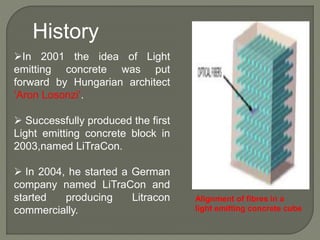
Alignment of fibres in a
light emitting concrete cube
Principle
Light emitting concrete works based on
“Nano-Optics”.
 Fibers are placed directly on top of
each other.
 Fibers acts like slits and carry light
through it.
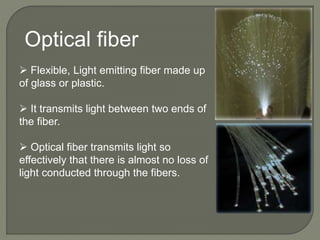
Optical fiber
 Flexible, Light emitting fiber made up
of glass or plastic.
 It transmits light between two ends of
the fiber.
 Optical fiber transmits light so
effectively that there is almost no loss of
light conducted through the fibers.
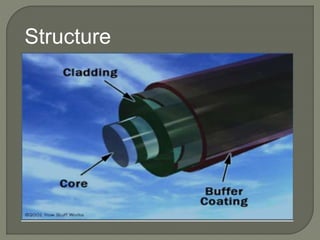
Structure
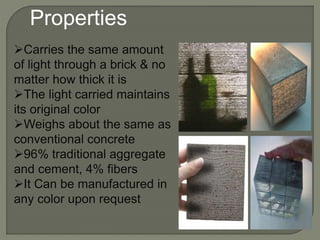
Properties
Carries the same amount
of light through a brick & no
matter how thick it is
The light carried maintains
its original color
Weighs about the same as
conventional concrete
96% traditional aggregate
and cement, 4% fibers
It Can be manufactured in
any color upon request
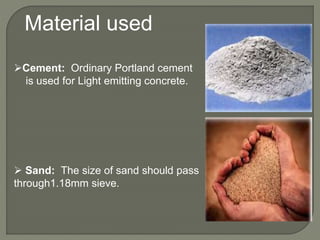
Material used
Cement: Ordinary Portland cement
is used for Light emitting concrete.
 Sand: The size of sand should pass
through1.18mm sieve.
Water: Water to be used for Light emitting
concrete should be of drinking water
quality.
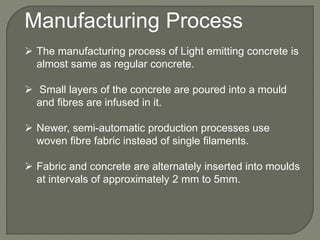
Optical fibers: Thickness of the optical
fibers can be varied between 2 μm and
2 mm.
Manufacturing Process
 The manufacturing process of Light emitting concrete is
almost same as regular concrete.
 Small layers of the concrete are poured into a mould
and fibres are infused in it.
 Newer, semi-automatic production processes use
woven fibre fabric instead of single filaments.
 Fabric and concrete are alternately inserted into moulds
at intervals of approximately 2 mm to 5mm.
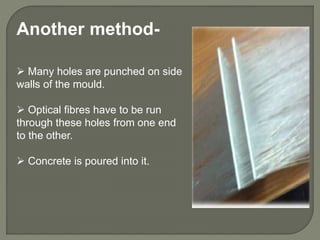
Another method-
 Many holes are punched on side
walls of the mould.
 Optical fibres have to be run
through these holes from one end
to the other.
 Concrete is poured into it.
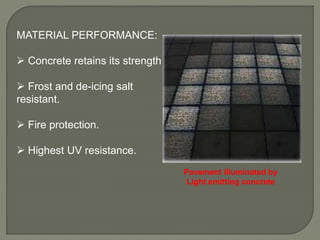
MATERIAL PERFORMANCE:
 Concrete retains its strength
 Frost and de-icing salt
resistant.
 Fire protection.
 Highest UV resistance.
Pavement illuminated by
Light emitting concrete
Advantages
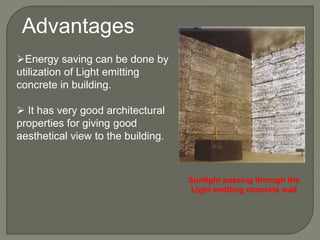
Energy saving can be done by
utilization of Light emitting
concrete in building.
 It has very good architectural
properties for giving good
aesthetical view to the building.
Sunlight passing through the
Light emitting concrete wall
Disadvantages
 Very high cost.
 Need of Labor with technical skills
Applications
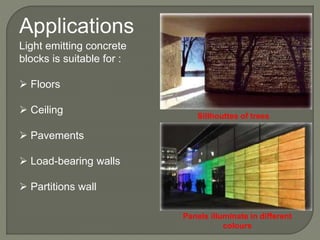
Light emitting concrete
blocks is suitable for :
 Floors
 Ceiling
 Pavements
 Load-bearing walls
 Partitions wall
Sillhouttes of trees
Panels illuminate in different
colours
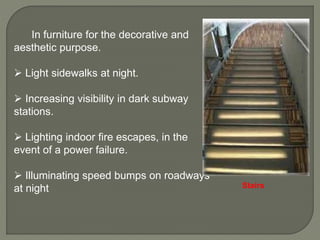
In furniture for the decorative and
aesthetic purpose.
 Light sidewalks at night.
 Increasing visibility in dark subway
stations.
 Lighting indoor fire escapes, in the
event of a power failure.
 Illuminating speed bumps on roadways
at night Stairs
Examples
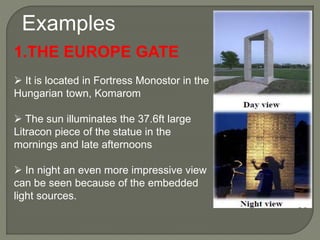
1.THE EUROPE GATE
 It is located in Fortress Monostor in the
Hungarian town, Komarom
 The sun illuminates the 37.6ft large
Litracon piece of the statue in the
mornings and late afternoons
 In night an even more impressive view
can be seen because of the embedded
light sources.
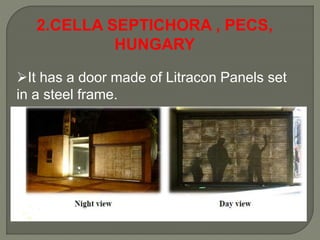
2.CELLA SEPTICHORA , PECS,
HUNGARY
It has a door made of Litracon Panels set
in a steel frame.
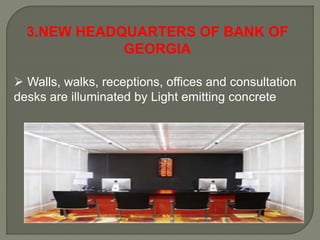
3.NEW HEADQUARTERS OF BANK OF
GEORGIA
 Walls, walks, receptions, offices and consultation
desks are illuminated by Light emitting concrete
Conclusion
Light emitting concrete is an emerging trend in concrete
technology.
 Its initial cost is high. But, routine maintenance is not required
and in long run it may be advantageous. In fact it worth the cost.
 It’s a green building material reducing the lightning cost during
day time. It’s proved to provide both aesthetic appearance and
structural stability.
 In future the it’s cost is expected to decrease.
 It is one of the best applications of optical fibers which is related
to technical textiles.
Reference
M.N.V.Padma Bhushan, D.Johnson, Md. Afzal
Basheer Pasha And Ms. K. Prasanthi. Optical Fibres in
the Modeling of Translucent Concrete
Blocks:International Journal of Engineering Research
and Applications (IJERA), Vol. 3, Issue 3, May-Jun 2013,
pp.013-017
Soumyajit Paul, Avik Dutta.Tranclucent
concrete:International Journal of Scientific and
Research Publications, Volume 3, Issue 10, October
2013
ANY
QUESTIONS?

Light emitting concrete [OR] Translucent concrete

  • 1.
    Light Emitting Concrete Presentedby Shaik.Asif.Ahmed [ASIF’ASHU]
  • 2.
  • 3.
    Introduction Light emitting concretealso known as translucent concrete It is a concrete based building material having light emitting property.  Light emitting property is mainly due to uniform distribution Optical Fibers throughout its body . It is available as prefabricated building blocks and panels.
  • 4.
    History In 2001 theidea of Light emitting concrete was put forward by Hungarian architect ‘Aron Losonzi’.  Successfully produced the first Light emitting concrete block in 2003,named LiTraCon.  In 2004, he started a German company named LiTraCon and started producing Litracon commercially. Alignment of fibres in a light emitting concrete cube
  • 5.
    Principle Light emitting concreteworks based on “Nano-Optics”.  Fibers are placed directly on top of each other.  Fibers acts like slits and carry light through it.
  • 6.
    Optical fiber  Flexible,Light emitting fiber made up of glass or plastic.  It transmits light between two ends of the fiber.  Optical fiber transmits light so effectively that there is almost no loss of light conducted through the fibers.
  • 7.
  • 8.
    Properties Carries the sameamount of light through a brick & no matter how thick it is The light carried maintains its original color Weighs about the same as conventional concrete 96% traditional aggregate and cement, 4% fibers It Can be manufactured in any color upon request
  • 9.
    Material used Cement: OrdinaryPortland cement is used for Light emitting concrete.  Sand: The size of sand should pass through1.18mm sieve.
  • 10.
    Water: Water tobe used for Light emitting concrete should be of drinking water quality. Optical fibers: Thickness of the optical fibers can be varied between 2 μm and 2 mm.
  • 11.
    Manufacturing Process  Themanufacturing process of Light emitting concrete is almost same as regular concrete.  Small layers of the concrete are poured into a mould and fibres are infused in it.  Newer, semi-automatic production processes use woven fibre fabric instead of single filaments.  Fabric and concrete are alternately inserted into moulds at intervals of approximately 2 mm to 5mm.
  • 12.
    Another method-  Manyholes are punched on side walls of the mould.  Optical fibres have to be run through these holes from one end to the other.  Concrete is poured into it.
  • 13.
    MATERIAL PERFORMANCE:  Concreteretains its strength  Frost and de-icing salt resistant.  Fire protection.  Highest UV resistance. Pavement illuminated by Light emitting concrete
  • 14.
    Advantages Energy saving canbe done by utilization of Light emitting concrete in building.  It has very good architectural properties for giving good aesthetical view to the building. Sunlight passing through the Light emitting concrete wall
  • 15.
    Disadvantages  Very highcost.  Need of Labor with technical skills
  • 16.
    Applications Light emitting concrete blocksis suitable for :  Floors  Ceiling  Pavements  Load-bearing walls  Partitions wall Sillhouttes of trees Panels illuminate in different colours
  • 17.
    In furniture forthe decorative and aesthetic purpose.  Light sidewalks at night.  Increasing visibility in dark subway stations.  Lighting indoor fire escapes, in the event of a power failure.  Illuminating speed bumps on roadways at night Stairs
  • 18.
    Examples 1.THE EUROPE GATE It is located in Fortress Monostor in the Hungarian town, Komarom  The sun illuminates the 37.6ft large Litracon piece of the statue in the mornings and late afternoons  In night an even more impressive view can be seen because of the embedded light sources.
  • 19.
    2.CELLA SEPTICHORA ,PECS, HUNGARY It has a door made of Litracon Panels set in a steel frame.
  • 20.
    3.NEW HEADQUARTERS OFBANK OF GEORGIA  Walls, walks, receptions, offices and consultation desks are illuminated by Light emitting concrete
  • 21.
    Conclusion Light emitting concreteis an emerging trend in concrete technology.  Its initial cost is high. But, routine maintenance is not required and in long run it may be advantageous. In fact it worth the cost.  It’s a green building material reducing the lightning cost during day time. It’s proved to provide both aesthetic appearance and structural stability.  In future the it’s cost is expected to decrease.  It is one of the best applications of optical fibers which is related to technical textiles.
  • 22.
    Reference M.N.V.Padma Bhushan, D.Johnson,Md. Afzal Basheer Pasha And Ms. K. Prasanthi. Optical Fibres in the Modeling of Translucent Concrete Blocks:International Journal of Engineering Research and Applications (IJERA), Vol. 3, Issue 3, May-Jun 2013, pp.013-017 Soumyajit Paul, Avik Dutta.Tranclucent concrete:International Journal of Scientific and Research Publications, Volume 3, Issue 10, October 2013
  • 24.

Editor's Notes