DISPLACEMENT OF UTERUS
Presented By- Dr. Monika Khardiya
MS Scholar (Prasuti evam Striroga )
Background
• The uterus is normally anteverted, anteflexed
• Version: is the angle between the longitudinal axis of cervix,
and that of the vagina
• Flexion: is the angle between the longitudinal axis of the
uterus, and that of the cervix
Genital Prolapse
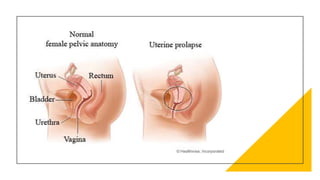
• Genital prolapse is the descent of one or more of the genital
organ (urethra, bladder, uterus, rectum or Pouch of Douglas
or rectouterine pouch) through the fasciomuscular pelvic
floor below their normal level.
• Vaginal prolapse can occur without uterine prolapse but the
uterus cannot descend without carrying the vagina with it.
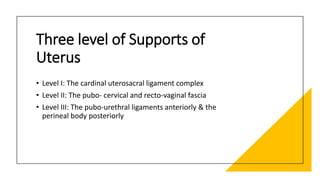
Three level of Supports of
Uterus
• Level I: The cardinal uterosacral ligament complex
• Level II: The pubo- cervical and recto-vaginal fascia
• Level III: The pubo-urethral ligaments anteriorly & the
perineal body posteriorly
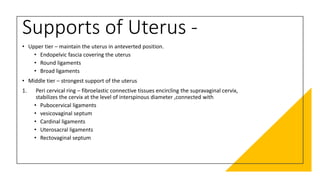
Supports of Uterus -
• Upper tier – maintain the uterus in anteverted position.
• Endopelvic fascia covering the uterus
• Round ligaments
• Broad ligaments
• Middle tier – strongest support of the uterus
1. Peri cervical ring – fibroelastic connective tissues encircling the supravaginal cervix,
stabilizes the cervix at the level of interspinous diameter ,connected with
• Pubocervical ligaments
• vesicovaginal septum
• Cardinal ligaments
• Uterosacral ligaments
• Rectovaginal septum
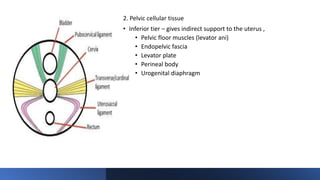
2. Pelvic cellular tissue
• Inferior tier – gives indirect support to the uterus ,
• Pelvic floor muscles (levator ani)
• Endopelvic fascia
• Levator plate
• Perineal body
• Urogenital diaphragm
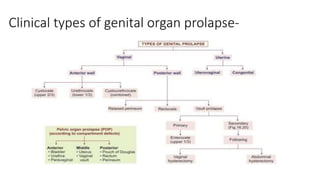
Clinical types of genital organ prolapse-
Anterior vaginal wall prolapse
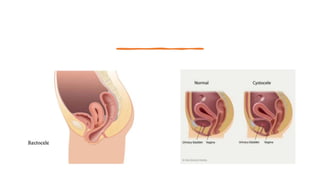
Prolapse of the upper 2/3 part of the anterior vaginal wall with
the base of the bladder is called cystocele
Prolapse
Prolapse of the lower 1/3 part of the anterior vaginal wall with
the urethra is called urethrocele.
Prolapse
Complete anterior vaginal wall prolapse is called cysto-
urethrocele.
Complete
Anterior vaginal wall prolapse
• Weakness in the
• Supports of the bladder neck
• Urethero vesical junction
• Proximal urethra
• Caused by
• Weakness of pubocervical fascia and pubourethral
ligaments
Posterior vaginal wall prolapse
a) It is called rectocele if there is laxity of the middle third of the posterior
vaginal wall.
b) Relaxed perineum
VAULT PROLAPSE -It is called enterocele if there is laxity of the upper third of
the posterior vaginal wall results in herniation of POD.
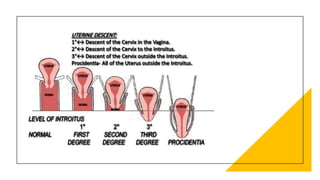
Uterine descent
• Utero-vaginal (the uterus descends first followed by the
vagina): This usually occurs in cases of virginal and nulliparous
prolapse due to congenital weakness of the cervical
ligaments.
• Vagino-uterine (the vagina descends first followed by the
uterus):This usually occurs in cases of prolapse resulting from
obstetric trauma.
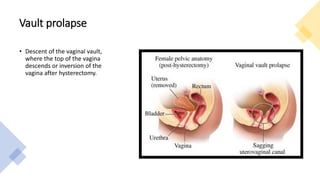
Vault prolapse
• Descent of the vaginal vault,
where the top of the vagina
descends or inversion of the
vagina after hysterectomy.
Aetiology
Anatomical factors
• Gravitational stress
• Anterior inclination of pelvis
• Stress of parturition
• Genetically weak supporting structures
Precipitating factors
• Acute and chronic trauma of vaginal delivery
• Aging ( post menopausal atrophy )
• Estrogen deprivation
• Intrinsic collagen abnormalities
• Multiparity
• Iatrogenic
 ↑ intra abdominal pressure
 ↑ weight of the uterus
 Traction of the uterus by vaginal prolapse or by a large cervical polyp
 Obesity(40%--75%)
 Smoking
 Pulmonary disease (chronic coughing)
 Constipation (chronic straining)
 Recreational or occupational activities
(frequent or heavy lifting)
Symptoms of Prolapse
• Pelvic floor disorders become symptomatic through either of two
mechanisms:
1. Mechanical difficulties produced by the actual prolapse,
2. Bladder or bowel dysfunction, disrupting either storage or emptying.
Clinical presentation
• Before actual prolapse. the patient feels a sensation of weakness in the perineum. particularly towards the end
of the day
• Later the patient notices a mass which appears on straining. and disappears when she lies down
• Urinary symptoms are common and trouble some even with slight prolapse:
a) Urgency and frequency by day
b) Stress incontinence
c) Inability to micturate unless the anterior vaginal wall is pushed upwards by the patient's fingers
d) Frequency when cystitis develops
• Rectal symptoms are not so marked. The patient always feels heaviness in
the rectum and a constant desire to defaecate. Piles develop from
straining.
• Backache, congestive dysmenorrhoea and menorrhagia are common.
• Leucorrhoea is caused by the congestion and associated by chronic
cervicitis.
• Associated decubitus ulcer may result in discharge which may be purulent
or blood stained.
Diagnostic approach
• Beginning with a careful inspection of the vulva and vagina to
identify erosions, ulcerations, or other lesions
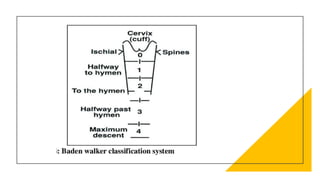
• The extent of prolapse should be systematically assessed
• Suspicious lesions should be biopsied
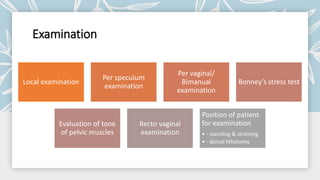
Examination
Local examination
Per speculum
examination
Per vaginal/
Bimanual
examination
Bonney’s stress test
Evaluation of tone
of pelvic muscles
Recto vaginal
examination
Position of patient
for examination
• - standing & straining
• - dorsal lithotomy
Diagnostic approach
• The maximal extent of prolapse is demonstrated with a
standing straining examination when the bladder is empty
• Pelvic muscle function should be assessed after the bimanual
examination → palpate the pelvic muscles a few centimeters
inside the hymen, along pelvic sidewalls at the 4 & 8 o’clock
• Resting tone & voluntary contraction of the anal sphincters
should be assessed during rectovaginal examination
Evaluation of pelvic floor tone
• Place 1 or 2 fingers in the vagina and instruct the patient to
contract her pelvic floor muscles (i.e., the levator ani
muscles). Then gauge her ability to contract these muscles, as
well as the strength, symmetry, and duration of the
contraction.
Prevention
During labour &puerperium
• Avoid premature bearing down
• Avoid long second stage
• Repairs all tears &incisions accurately in layers
• Do not express the uterus when attempting to deliver placenta
• Encourage pelvic floor exercise
• Avoid puerperal constipation
• To avoid strenuous activities for at least 6 months following delivery.
• To avoid further pregnancy too soon with help of contraceptive practice.
Pessary treatment
• Relieves the symptoms by stretching the hiatus urogenitalis , thus
preventing vaginal and uterine descent .
• Indications :
• Early pregnancy – upto 18 wks
• Puerperium
• Patients unfit for surgery
• Improvement of urinary symptoms
Treatment
• Physiotherapy
• Kegel’s pelvic floor exercise
• Influence only the voluntary muscles
Principles of Management
• Physical examination must not be used in isolation to develop
treatment strategy.
• Any decision for surgical intervention should take account of
how prolapse is affecting lifestyle.
Types of Operations
• Anterior colporrhaphy
• Perineorrhaphy
• Colpoperineorrhaphy
• Pelvic floor repair
• Fothergill’s or Manchester operation
• Hysterectomy
• Cervicopexy or sling operation (Purandare’s operation)
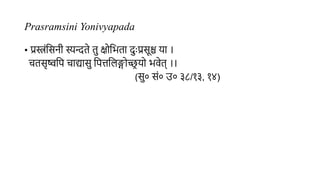
Prasramsini Yonivyapada
• प्रस्त्रंसिनी स्यन्दते तु क्षोसिता दुुःप्रिूश्च या ।
चतिृष्वसि चाद्यािु सित्तसिङ्गोच्छ्
र यो िवेत् ।।
(िु० िं० उ० ३८/१३, १४)
Pathogenesis according to ayurveda–
• Aggravation of nidana’s will result in apana vata vikruti or vata pitta dushti, this
will further affect garbhasaya gata mamsa dhatu which will cause khavaigunyata
in yoni and there will be shithilata and sramsa on pelvic organs (vagina/uterus).
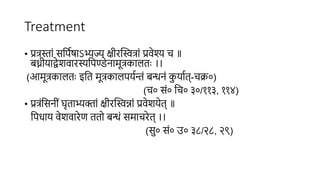
Treatment
• प्रत्रस्ां िसििषाऽभ्यज्य क्षीरस्वित्रां प्रवेश्य च ॥
बध्नीयाद्वेशवारस्यसिण्डेनामूत्रकाितुः ।।
(आमूत्रकाितुः इसत मूत्रकािियिन्तं बन्धनं क
ु याित्-चक्र०)
(च० िं० सच० ३०/११३, ११४)
• प्रत्रंसिनीं घृताभ्यक्ां क्षीरस्विन्ां प्रवेशयेत् ॥
सिधाय वेशवारेण ततो बन्धं िमाचरेत् ।।
(िु० िं० उ० ३८/२८, २९)
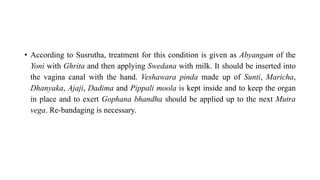
• According to Susrutha, treatment for this condition is given as Abyangam of the
Yoni with Ghrita and then applying Swedana with milk. It should be inserted into
the vagina canal with the hand. Veshawara pinda made up of Sunti, Maricha,
Dhanyaka, Ajaji, Dadima and Pippali moola is kept inside and to keep the organ
in place and to exert Gophana bhandha should be applied up to the next Mutra
vega. Re-bandaging is necessary.

pelvic organ prolapse.pptx

  • 1.
    DISPLACEMENT OF UTERUS PresentedBy- Dr. Monika Khardiya MS Scholar (Prasuti evam Striroga )
  • 2.
    Background • The uterusis normally anteverted, anteflexed • Version: is the angle between the longitudinal axis of cervix, and that of the vagina • Flexion: is the angle between the longitudinal axis of the uterus, and that of the cervix
  • 3.
    Genital Prolapse • Genitalprolapse is the descent of one or more of the genital organ (urethra, bladder, uterus, rectum or Pouch of Douglas or rectouterine pouch) through the fasciomuscular pelvic floor below their normal level. • Vaginal prolapse can occur without uterine prolapse but the uterus cannot descend without carrying the vagina with it.
  • 5.
    Three level ofSupports of Uterus • Level I: The cardinal uterosacral ligament complex • Level II: The pubo- cervical and recto-vaginal fascia • Level III: The pubo-urethral ligaments anteriorly & the perineal body posteriorly
  • 6.
    Supports of Uterus- • Upper tier – maintain the uterus in anteverted position. • Endopelvic fascia covering the uterus • Round ligaments • Broad ligaments • Middle tier – strongest support of the uterus 1. Peri cervical ring – fibroelastic connective tissues encircling the supravaginal cervix, stabilizes the cervix at the level of interspinous diameter ,connected with • Pubocervical ligaments • vesicovaginal septum • Cardinal ligaments • Uterosacral ligaments • Rectovaginal septum
  • 7.
    2. Pelvic cellulartissue • Inferior tier – gives indirect support to the uterus , • Pelvic floor muscles (levator ani) • Endopelvic fascia • Levator plate • Perineal body • Urogenital diaphragm
  • 8.
    Clinical types ofgenital organ prolapse-
  • 9.
    Anterior vaginal wallprolapse Prolapse of the upper 2/3 part of the anterior vaginal wall with the base of the bladder is called cystocele Prolapse Prolapse of the lower 1/3 part of the anterior vaginal wall with the urethra is called urethrocele. Prolapse Complete anterior vaginal wall prolapse is called cysto- urethrocele. Complete
  • 10.
    Anterior vaginal wallprolapse • Weakness in the • Supports of the bladder neck • Urethero vesical junction • Proximal urethra • Caused by • Weakness of pubocervical fascia and pubourethral ligaments
  • 11.
    Posterior vaginal wallprolapse a) It is called rectocele if there is laxity of the middle third of the posterior vaginal wall. b) Relaxed perineum VAULT PROLAPSE -It is called enterocele if there is laxity of the upper third of the posterior vaginal wall results in herniation of POD.
  • 13.
    Uterine descent • Utero-vaginal(the uterus descends first followed by the vagina): This usually occurs in cases of virginal and nulliparous prolapse due to congenital weakness of the cervical ligaments. • Vagino-uterine (the vagina descends first followed by the uterus):This usually occurs in cases of prolapse resulting from obstetric trauma.
  • 14.
    Vault prolapse • Descentof the vaginal vault, where the top of the vagina descends or inversion of the vagina after hysterectomy.
  • 17.
    Aetiology Anatomical factors • Gravitationalstress • Anterior inclination of pelvis • Stress of parturition • Genetically weak supporting structures
  • 18.
    Precipitating factors • Acuteand chronic trauma of vaginal delivery • Aging ( post menopausal atrophy ) • Estrogen deprivation • Intrinsic collagen abnormalities • Multiparity • Iatrogenic
  • 19.
     ↑ intraabdominal pressure  ↑ weight of the uterus  Traction of the uterus by vaginal prolapse or by a large cervical polyp  Obesity(40%--75%)  Smoking  Pulmonary disease (chronic coughing)  Constipation (chronic straining)  Recreational or occupational activities (frequent or heavy lifting)
  • 20.
    Symptoms of Prolapse •Pelvic floor disorders become symptomatic through either of two mechanisms: 1. Mechanical difficulties produced by the actual prolapse, 2. Bladder or bowel dysfunction, disrupting either storage or emptying.
  • 21.
    Clinical presentation • Beforeactual prolapse. the patient feels a sensation of weakness in the perineum. particularly towards the end of the day • Later the patient notices a mass which appears on straining. and disappears when she lies down • Urinary symptoms are common and trouble some even with slight prolapse: a) Urgency and frequency by day b) Stress incontinence c) Inability to micturate unless the anterior vaginal wall is pushed upwards by the patient's fingers d) Frequency when cystitis develops
  • 22.
    • Rectal symptomsare not so marked. The patient always feels heaviness in the rectum and a constant desire to defaecate. Piles develop from straining. • Backache, congestive dysmenorrhoea and menorrhagia are common. • Leucorrhoea is caused by the congestion and associated by chronic cervicitis. • Associated decubitus ulcer may result in discharge which may be purulent or blood stained.
  • 23.
    Diagnostic approach • Beginningwith a careful inspection of the vulva and vagina to identify erosions, ulcerations, or other lesions • The extent of prolapse should be systematically assessed • Suspicious lesions should be biopsied
  • 24.
    Examination Local examination Per speculum examination Pervaginal/ Bimanual examination Bonney’s stress test Evaluation of tone of pelvic muscles Recto vaginal examination Position of patient for examination • - standing & straining • - dorsal lithotomy
  • 25.
    Diagnostic approach • Themaximal extent of prolapse is demonstrated with a standing straining examination when the bladder is empty • Pelvic muscle function should be assessed after the bimanual examination → palpate the pelvic muscles a few centimeters inside the hymen, along pelvic sidewalls at the 4 & 8 o’clock • Resting tone & voluntary contraction of the anal sphincters should be assessed during rectovaginal examination
  • 26.
    Evaluation of pelvicfloor tone • Place 1 or 2 fingers in the vagina and instruct the patient to contract her pelvic floor muscles (i.e., the levator ani muscles). Then gauge her ability to contract these muscles, as well as the strength, symmetry, and duration of the contraction.
  • 27.
    Prevention During labour &puerperium •Avoid premature bearing down • Avoid long second stage • Repairs all tears &incisions accurately in layers • Do not express the uterus when attempting to deliver placenta • Encourage pelvic floor exercise • Avoid puerperal constipation • To avoid strenuous activities for at least 6 months following delivery. • To avoid further pregnancy too soon with help of contraceptive practice.
  • 28.
    Pessary treatment • Relievesthe symptoms by stretching the hiatus urogenitalis , thus preventing vaginal and uterine descent . • Indications : • Early pregnancy – upto 18 wks • Puerperium • Patients unfit for surgery • Improvement of urinary symptoms
  • 29.
    Treatment • Physiotherapy • Kegel’spelvic floor exercise • Influence only the voluntary muscles
  • 30.
    Principles of Management •Physical examination must not be used in isolation to develop treatment strategy. • Any decision for surgical intervention should take account of how prolapse is affecting lifestyle.
  • 31.
    Types of Operations •Anterior colporrhaphy • Perineorrhaphy • Colpoperineorrhaphy • Pelvic floor repair • Fothergill’s or Manchester operation • Hysterectomy • Cervicopexy or sling operation (Purandare’s operation)
  • 32.
    Prasramsini Yonivyapada • प्रस्त्रंसिनीस्यन्दते तु क्षोसिता दुुःप्रिूश्च या । चतिृष्वसि चाद्यािु सित्तसिङ्गोच्छ् र यो िवेत् ।। (िु० िं० उ० ३८/१३, १४)
  • 33.
    Pathogenesis according toayurveda– • Aggravation of nidana’s will result in apana vata vikruti or vata pitta dushti, this will further affect garbhasaya gata mamsa dhatu which will cause khavaigunyata in yoni and there will be shithilata and sramsa on pelvic organs (vagina/uterus).
  • 34.
    Treatment • प्रत्रस्ां िसििषाऽभ्यज्यक्षीरस्वित्रां प्रवेश्य च ॥ बध्नीयाद्वेशवारस्यसिण्डेनामूत्रकाितुः ।। (आमूत्रकाितुः इसत मूत्रकािियिन्तं बन्धनं क ु याित्-चक्र०) (च० िं० सच० ३०/११३, ११४) • प्रत्रंसिनीं घृताभ्यक्ां क्षीरस्विन्ां प्रवेशयेत् ॥ सिधाय वेशवारेण ततो बन्धं िमाचरेत् ।। (िु० िं० उ० ३८/२८, २९)
  • 35.
    • According toSusrutha, treatment for this condition is given as Abyangam of the Yoni with Ghrita and then applying Swedana with milk. It should be inserted into the vagina canal with the hand. Veshawara pinda made up of Sunti, Maricha, Dhanyaka, Ajaji, Dadima and Pippali moola is kept inside and to keep the organ in place and to exert Gophana bhandha should be applied up to the next Mutra vega. Re-bandaging is necessary.