USSR Afghan War
  -the Soviet’s Vietnam-
        1978-1992
Daniel Hennessey, with help from various
   historians and TV documentaries
VIPs
• Prince Mohammoud Daoud- King Zahir’s
  cousin; once Priminister (fired); then again Prime
  Minister and President (killed)
• PDPA- People’s Democratic Party of Afganistan
• Babrak Karmal- intellectual, co-founder of
  PDPA
• Hafizullah Amin-PDPA member
• Nur Mohammad Taraki- PDPA leader
Causes
Even though Russia and Afghanistan had
 a long history, going back to Tsarist
 expansions,
There was no major long term factor(s)
 that sparked the afghan conflict.
Unlike the 1st or 2nd World Wars, the Afghan conflict was a
  result of short and immediate sparks, not long gradual
  build up process
Background
•   1964: King Zahir initiated liberal constitution that permitted multi-party
    elections.
           PDPA formed in January 1965.
           Babrak Karmal- elected to parliament
           Hafizullah Amin- elected to parliament
•   1973 July 17: Military coup allowed Daoud to return to power; he dissolved
    the monarchy, and established a Republic with himself as President and
    Prime Minister.
•   1978 Spring Saur Coup: Daoud, already unpopular with economic and
    social reforms attempts to rid suspected opponents from his government.
    He tried to eliminate the PDPA by purging it’s leaders, yet was met by a
    mob and coup and Daoud was killed. PDPA leader Nur Mohammad
    Taraki declared the establishment of the Democratic Republic of
    Afghanistan and announced himself as President, with Babrak Karmal as
    deputy Prime Minister, and Hafizullah Amin as a leader of high position
•   THIS NEW GOVERNMENT WAS THAT OF A LEFT-WING SOCIALIST
    GOVERNMENT
•   Taraki promoted the establishment of full women's rights and
    the implementation of land reform. The great majority of the
    people were peasants and had no jobs, and thus the socialist
    leaders (abdul rashid for one) felt it a good idea to give the people
    their land and let them work it, since Afghanistan was a agricultural
    land. Women were told to not wear the veil, and they were
    educated side by side with the men, many felt threatened and
    widespread resistance to them began in the summer of 1978.
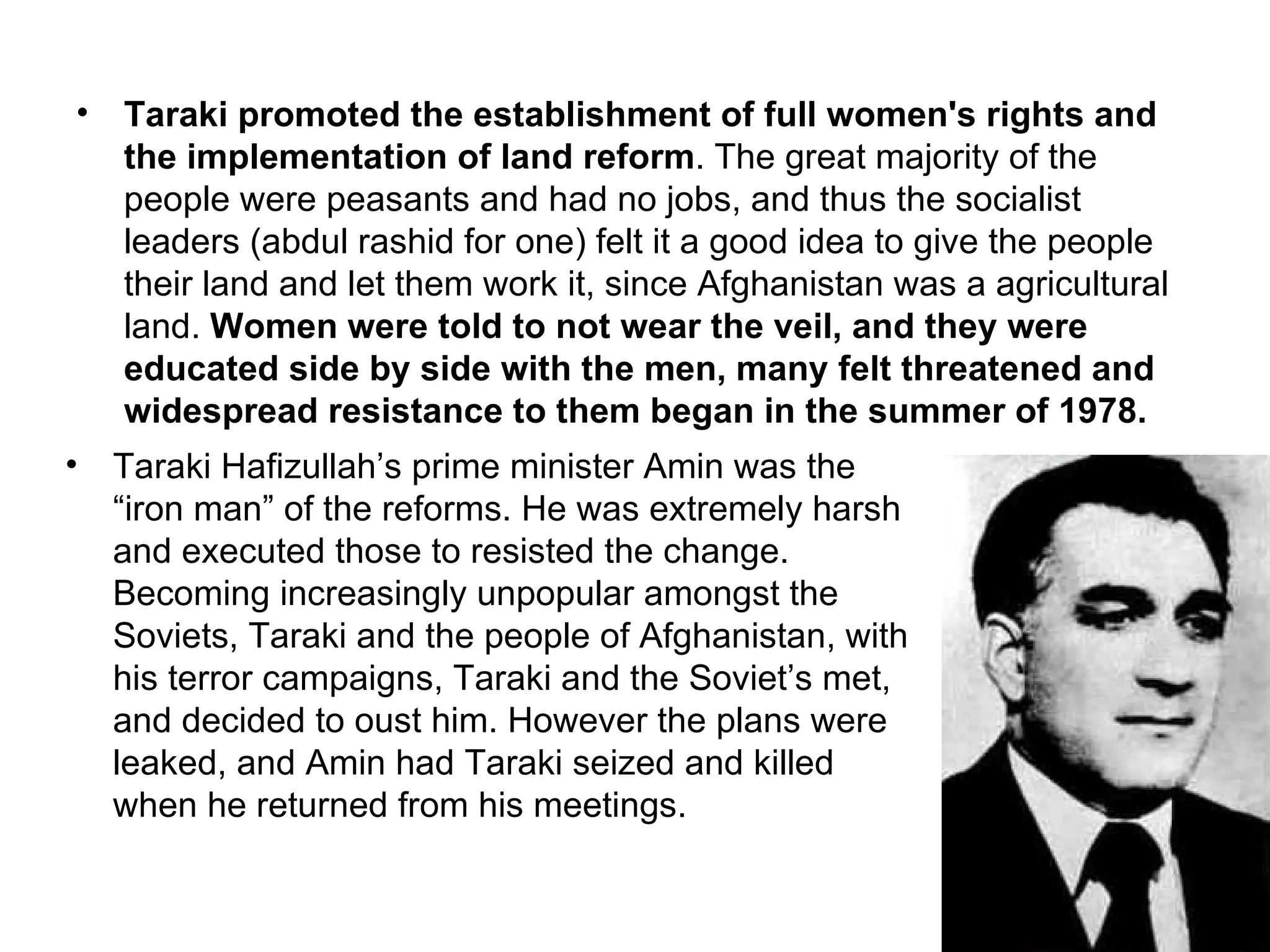
•   Taraki Hafizullah’s prime minister Amin was the
    “iron man” of the reforms. He was extremely harsh
    and executed those to resisted the change.
    Becoming increasingly unpopular amongst the
    Soviets, Taraki and the people of Afghanistan, with
    his terror campaigns, Taraki and the Soviet’s met,
    and decided to oust him. However the plans were
    leaked, and Amin had Taraki seized and killed
    when he returned from his meetings.
• SIGNIFICANCE OF THE SAUR COUP:
  socialist government formed
• Aware that he was losing favor with the Soviets, Amin
  began to seek better relationships with the west, and the
  USSR was increasingly concerned with him “flirting with
  the Americans”
• After NATO had placed hundreds of their missiles near
  the USSR, the Soviets felt it had little to lose
  internationally and set their troops in and purged Amin,
  replacing him with Karmal.
  THE SOVIETS HAD INTERVEND,
  AND BECAUSE THE SOVIETS INTERVENED,
  THE USA ALSO DID
USA doesn’t like USSR
• “The purpose of coordinating with the Pakistanis will
  be to make the Soviets bleed for as much and as
  long as possible” – Zbigniew Brzenzinski (Former US
  National Security Adviser)
• "It is entirely true that this was a war fought with our
  gold and their blood”- Frank Anderson (Former CIA
  Afghan Taskforce)
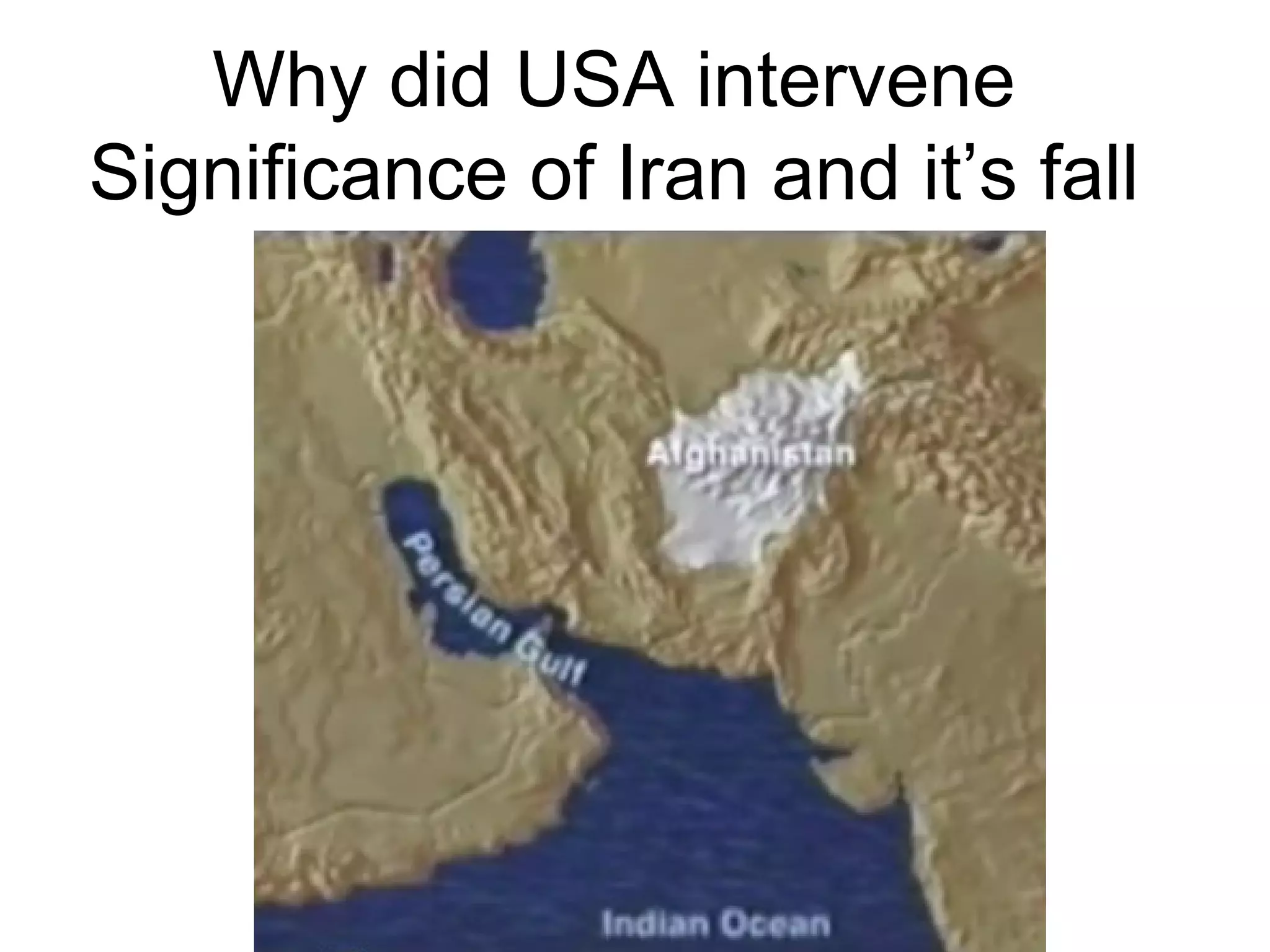
Why did USA intervene
Significance of Iran and it’s fall
Nature
The Soviet’s Vietnam…?
• Identical in political, economic, social and
  military nature
• Soviets with overwhelming military
  advantage, “hope to be over in a few
  weeks”  Guerrillas the Mujahidin
  (“Soldiers of God”) fought against
  overwhelming odds to hold the Soviets
roughly quoted…

“it would be hard to use military force and
succeed in Afghan, one only has to look at
it’s history, it’s geography, and the resilient
nature of the Afghan people
Afghan Geography
Technology
Attitude of Soviets  Direct
        reflection of nature?
• Soviets, much like the USA in Vietnam,
  had no intention more a long war in
  Afghan.
Criticism and Internationally
             Relations
• The Soviet Interference was labeled an
  invasion by Jimmy Carter and heavily
  condemned by the United Nations
• The Afghan War also gave excuses for
  countries in submission to the USSR to
  rise out and rebel
Effect
Physical Loss
• 1 million Afghans died, over 5 million
  misplaced (moved to neighboring
  countries, etc)
• 15000 Soviets died, 37000 injured
Effect on countries:
Soviet Union: Beginning of the End
Afghan: Beginning of no end
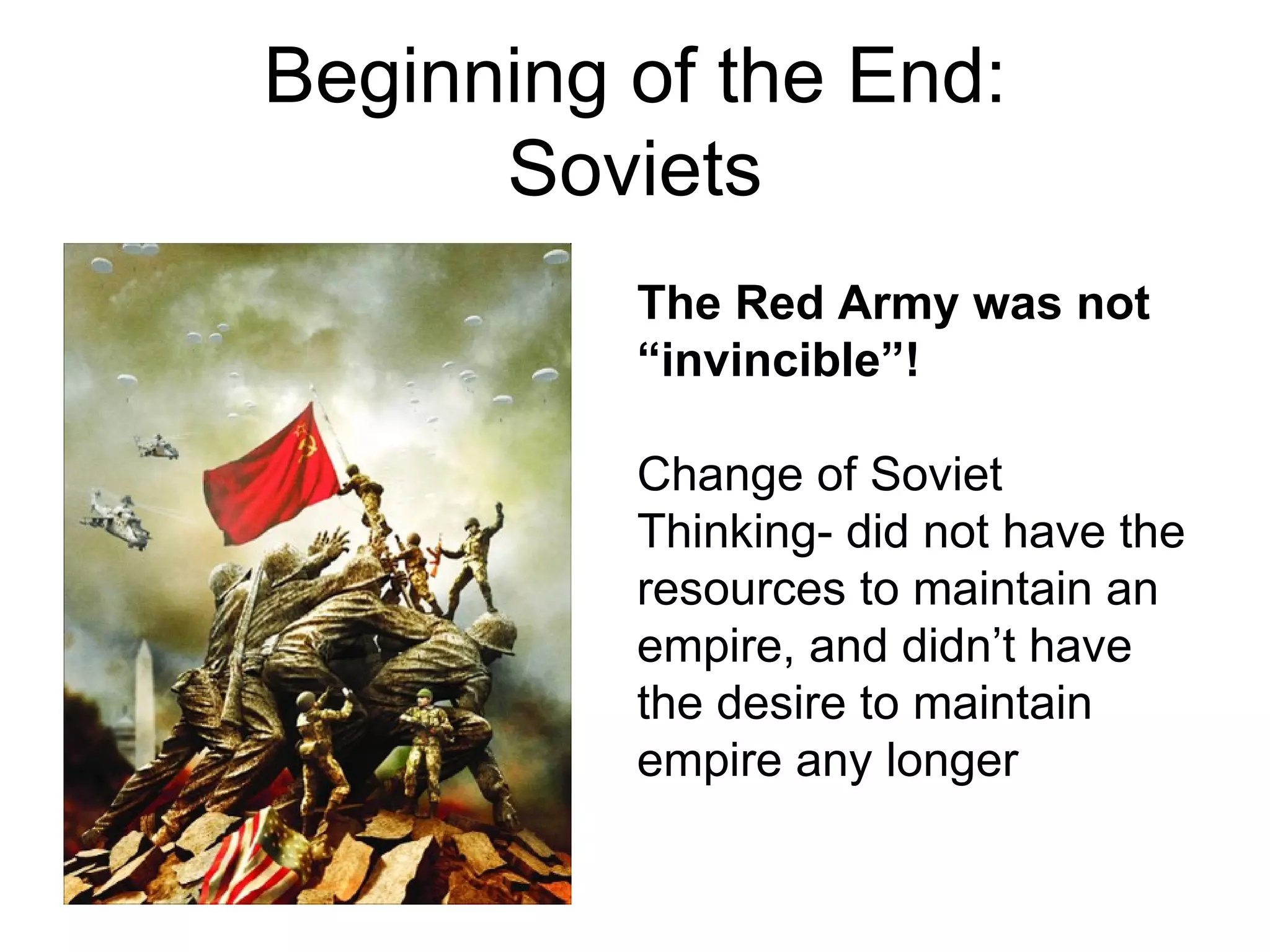
Beginning of the End:
      Soviets
          The Red Army was not
          “invincible”!

          Change of Soviet
          Thinking- did not have the
          resources to maintain an
          empire, and didn’t have
          the desire to maintain
          empire any longer
Beginning of No End:
             Afghan
• The weapons and troops trained by the
  USA, is now at war with the USA.

USSR/Afghanistan War

  • 1.
    USSR Afghan War -the Soviet’s Vietnam- 1978-1992 Daniel Hennessey, with help from various historians and TV documentaries
  • 2.
    VIPs • Prince MohammoudDaoud- King Zahir’s cousin; once Priminister (fired); then again Prime Minister and President (killed) • PDPA- People’s Democratic Party of Afganistan • Babrak Karmal- intellectual, co-founder of PDPA • Hafizullah Amin-PDPA member • Nur Mohammad Taraki- PDPA leader
  • 3.
  • 4.
    Even though Russiaand Afghanistan had a long history, going back to Tsarist expansions, There was no major long term factor(s) that sparked the afghan conflict. Unlike the 1st or 2nd World Wars, the Afghan conflict was a result of short and immediate sparks, not long gradual build up process
  • 5.
  • 6.
    1964: King Zahir initiated liberal constitution that permitted multi-party elections. PDPA formed in January 1965. Babrak Karmal- elected to parliament Hafizullah Amin- elected to parliament • 1973 July 17: Military coup allowed Daoud to return to power; he dissolved the monarchy, and established a Republic with himself as President and Prime Minister. • 1978 Spring Saur Coup: Daoud, already unpopular with economic and social reforms attempts to rid suspected opponents from his government. He tried to eliminate the PDPA by purging it’s leaders, yet was met by a mob and coup and Daoud was killed. PDPA leader Nur Mohammad Taraki declared the establishment of the Democratic Republic of Afghanistan and announced himself as President, with Babrak Karmal as deputy Prime Minister, and Hafizullah Amin as a leader of high position • THIS NEW GOVERNMENT WAS THAT OF A LEFT-WING SOCIALIST GOVERNMENT
  • 7.
    Taraki promoted the establishment of full women's rights and the implementation of land reform. The great majority of the people were peasants and had no jobs, and thus the socialist leaders (abdul rashid for one) felt it a good idea to give the people their land and let them work it, since Afghanistan was a agricultural land. Women were told to not wear the veil, and they were educated side by side with the men, many felt threatened and widespread resistance to them began in the summer of 1978. • Taraki Hafizullah’s prime minister Amin was the “iron man” of the reforms. He was extremely harsh and executed those to resisted the change. Becoming increasingly unpopular amongst the Soviets, Taraki and the people of Afghanistan, with his terror campaigns, Taraki and the Soviet’s met, and decided to oust him. However the plans were leaked, and Amin had Taraki seized and killed when he returned from his meetings.
  • 8.
    • SIGNIFICANCE OFTHE SAUR COUP: socialist government formed
  • 9.
    • Aware thathe was losing favor with the Soviets, Amin began to seek better relationships with the west, and the USSR was increasingly concerned with him “flirting with the Americans” • After NATO had placed hundreds of their missiles near the USSR, the Soviets felt it had little to lose internationally and set their troops in and purged Amin, replacing him with Karmal. THE SOVIETS HAD INTERVEND, AND BECAUSE THE SOVIETS INTERVENED, THE USA ALSO DID
  • 10.
    USA doesn’t likeUSSR • “The purpose of coordinating with the Pakistanis will be to make the Soviets bleed for as much and as long as possible” – Zbigniew Brzenzinski (Former US National Security Adviser) • "It is entirely true that this was a war fought with our gold and their blood”- Frank Anderson (Former CIA Afghan Taskforce)
  • 12.
    Why did USAintervene Significance of Iran and it’s fall
  • 13.
  • 14.
  • 15.
    • Identical inpolitical, economic, social and military nature • Soviets with overwhelming military advantage, “hope to be over in a few weeks”  Guerrillas the Mujahidin (“Soldiers of God”) fought against overwhelming odds to hold the Soviets
  • 16.
    roughly quoted… “it wouldbe hard to use military force and succeed in Afghan, one only has to look at it’s history, it’s geography, and the resilient nature of the Afghan people
  • 17.
  • 18.
  • 20.
    Attitude of Soviets Direct reflection of nature? • Soviets, much like the USA in Vietnam, had no intention more a long war in Afghan.
  • 21.
    Criticism and Internationally Relations • The Soviet Interference was labeled an invasion by Jimmy Carter and heavily condemned by the United Nations • The Afghan War also gave excuses for countries in submission to the USSR to rise out and rebel
  • 22.
  • 23.
    Physical Loss • 1million Afghans died, over 5 million misplaced (moved to neighboring countries, etc) • 15000 Soviets died, 37000 injured
  • 24.
    Effect on countries: SovietUnion: Beginning of the End Afghan: Beginning of no end
  • 25.
    Beginning of theEnd: Soviets The Red Army was not “invincible”! Change of Soviet Thinking- did not have the resources to maintain an empire, and didn’t have the desire to maintain empire any longer
  • 26.
    Beginning of NoEnd: Afghan • The weapons and troops trained by the USA, is now at war with the USA.