Arab Israeli Conflict: the 1967 Six
             Day War
          Laurence Williams
What is this war about?
• ISLAM                • JUDAISM

              VS
WHERE
• The land of Palestine
The underlying problem: why is
  Palestine so important to these two
                religions?
• Judaism:
• Up until the expulsion of the Jews by the Roman Emperor
  Hadrian in AD 135, the land of Palestine had been an important
  cultural and spiritual centre for Judaism for the past 2000 years.
• After their expulsion Jews were scattered all across the world,
  with no homeland.
• Islam:
• Palestine was the place of the emergence of this religion and the
  place of birth of Mohammed the prophet.
• Mohammed dies in Jerusalem and after the re-capture of the
  city from the Byzantines (AD 637), Jerusalem became one of the
  most important centres of Islamic faith.
• In 1518 Palestine was conquered by the
  Ottoman Empire and it remained part of it
  until the fall of the ‘sick man’ of Europe in
  1917.


  THIS IS WHERE WE BEGIN.
LONG TERM CAUSES
• ZIONISM    VS   ARAB NATIONALISM
Zionism
• As a result of mistreatment (especially Russia),
  Jews formed movement known as ‘Lovers of
  Zion’.
• Their aim was to return and settle in Palestine.
WORLD WAR ONE
• War brought Britain into alliance with Arabs
  who wanted to be free from Ottoman Empire
  rule.
• Hussein-McMahon letters: Arab revolt in
  exchange for help in forming Arab state.
• Balfour Declaration: help Zionists create a
  ‘national home’.
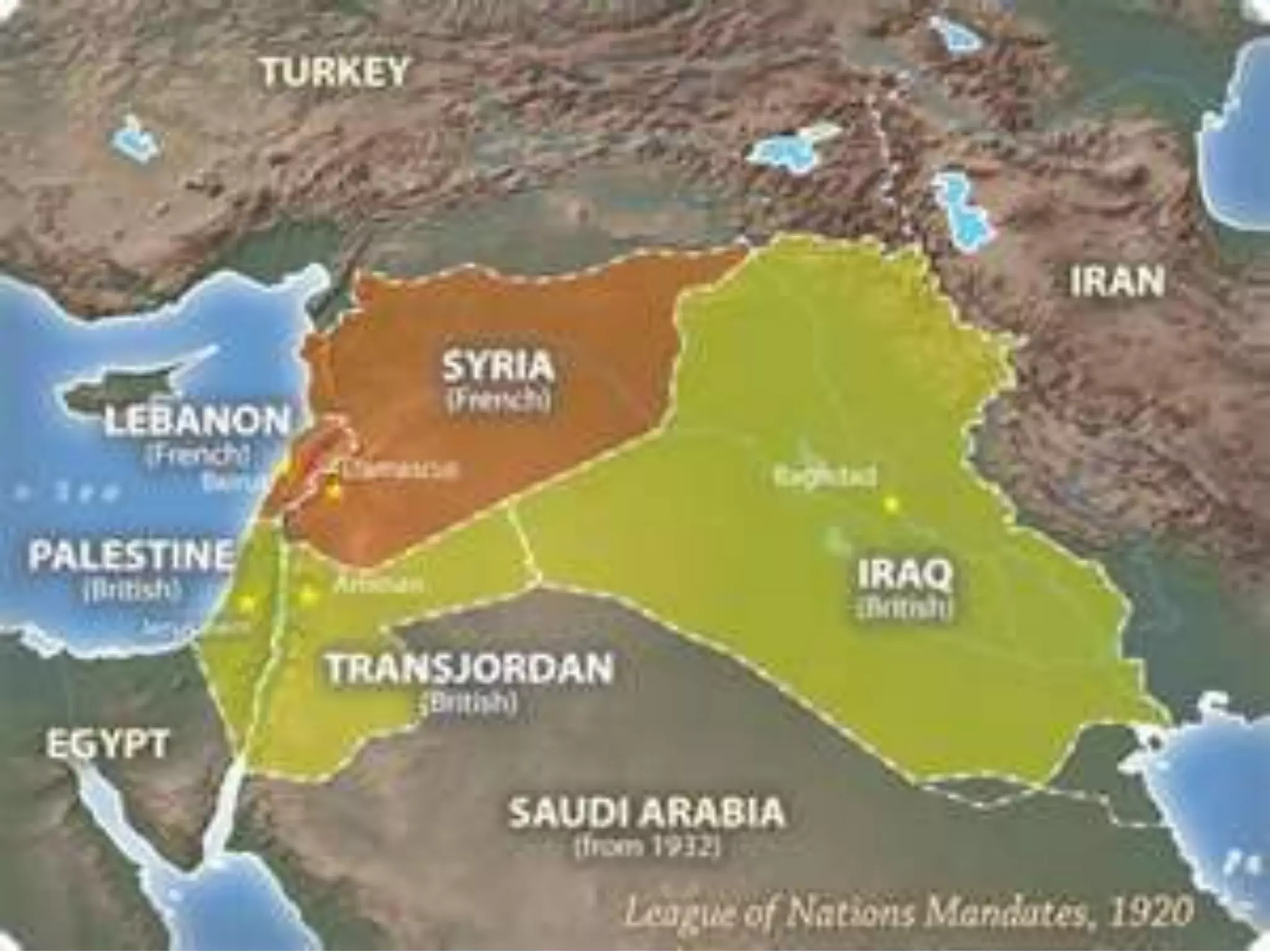
POST WAR MANDATES
• Peacemakers at Paris Peace Conference
  decided that Arabs should have the right to
  national self-determination.
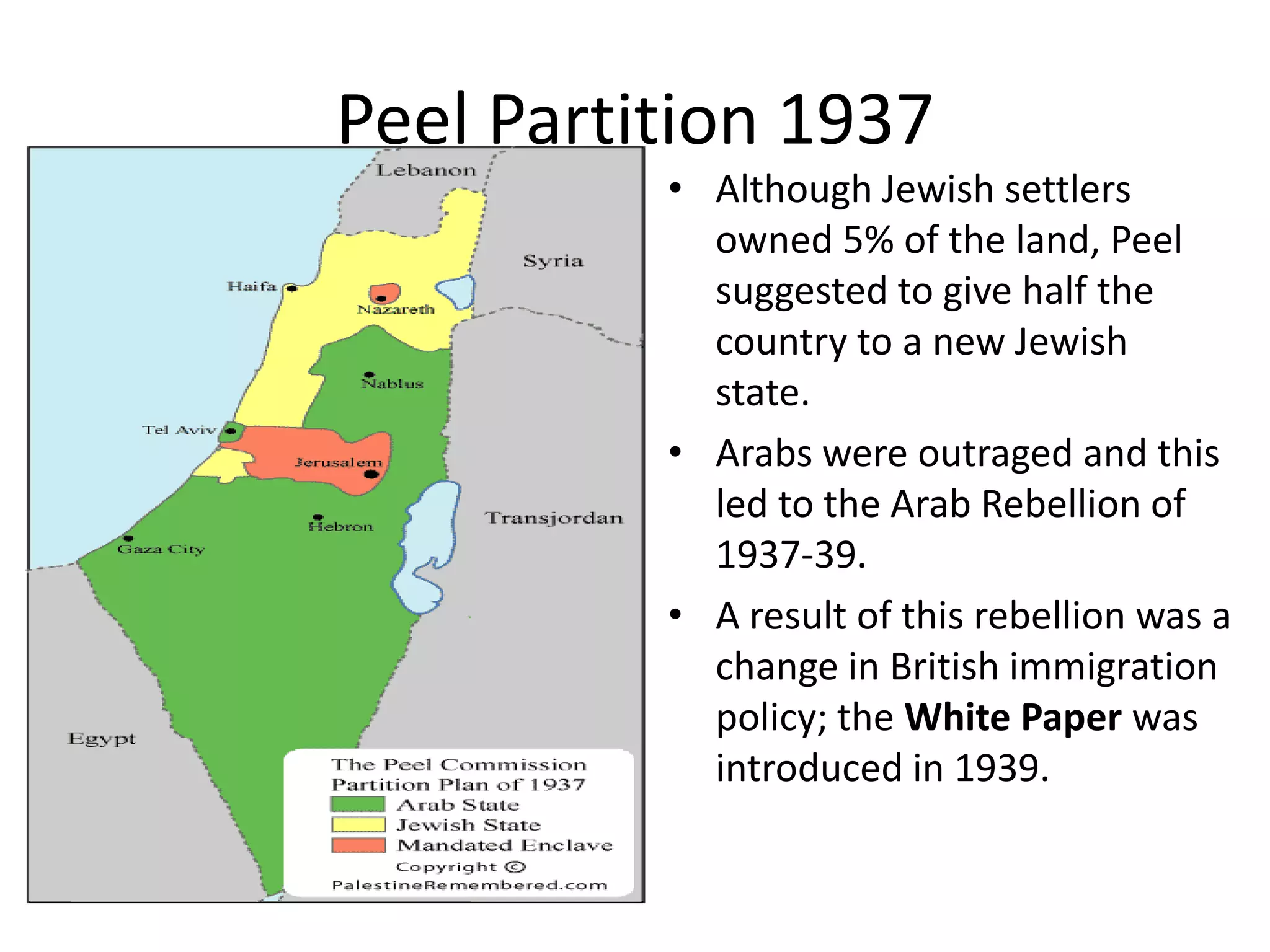
Peel Partition 1937
          • Although Jewish settlers
            owned 5% of the land, Peel
            suggested to give half the
            country to a new Jewish
            state.
          • Arabs were outraged and this
            led to the Arab Rebellion of
            1937-39.
          • A result of this rebellion was a
            change in British immigration
            policy; the White Paper was
            introduced in 1939.
WORLD WAR TWO & HOLOCAUST
• The threatened Jewish revolt did not happen primarily
  because of the outbreak of WW2- many Jews fought
  on Britain’s side in the war against Germany.
• By the end of the war, around 6 million Jews had been
  killed – after this many were sympathetic towards the
  Jewish population.
• A key player was the USA’s President Truman who in
  1946 demanded that 100, 000 Jews should be allowed
  into Palestine at once.
• This severely aggravated tensions between Arabs and
  Israelis.
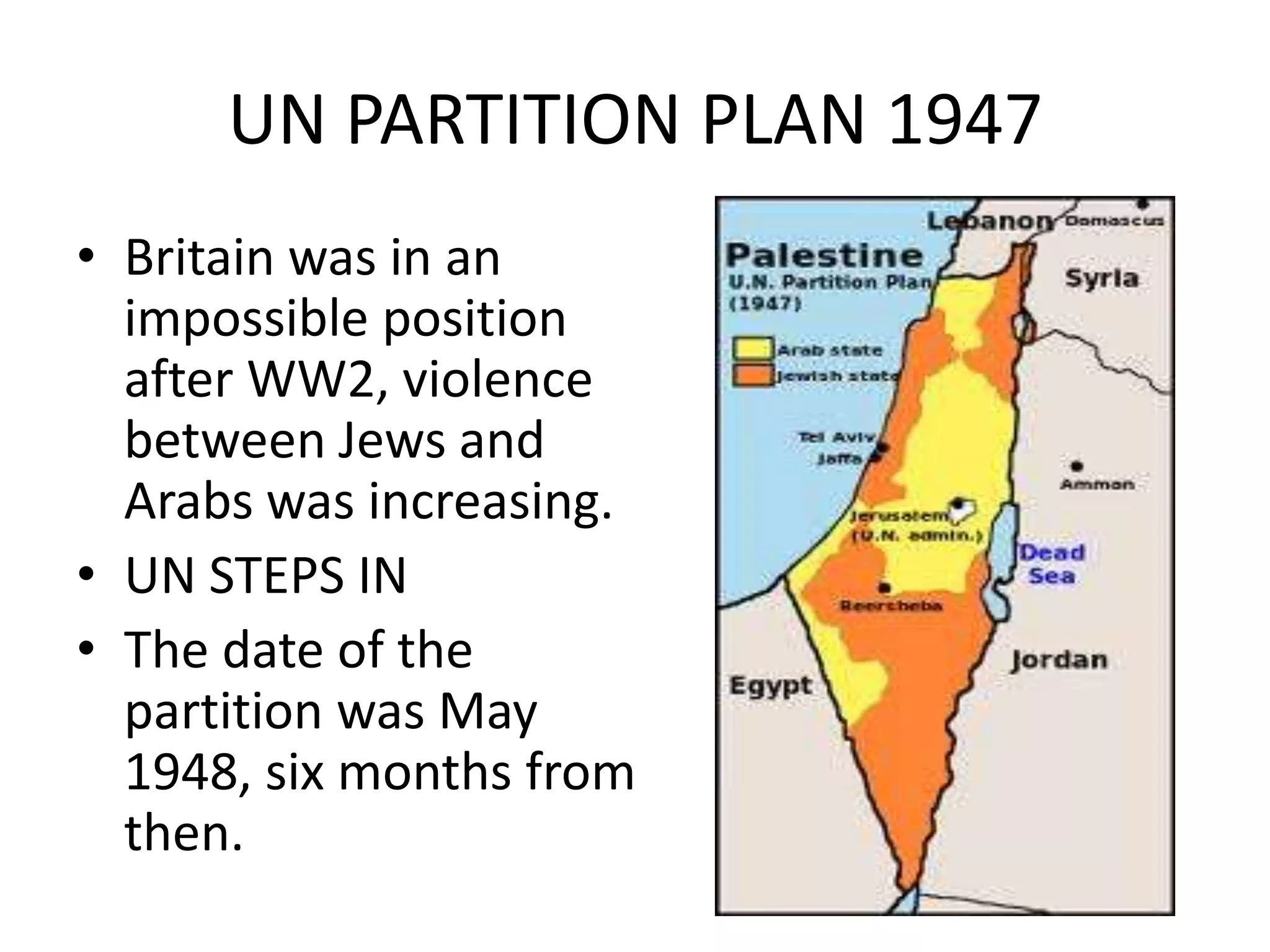
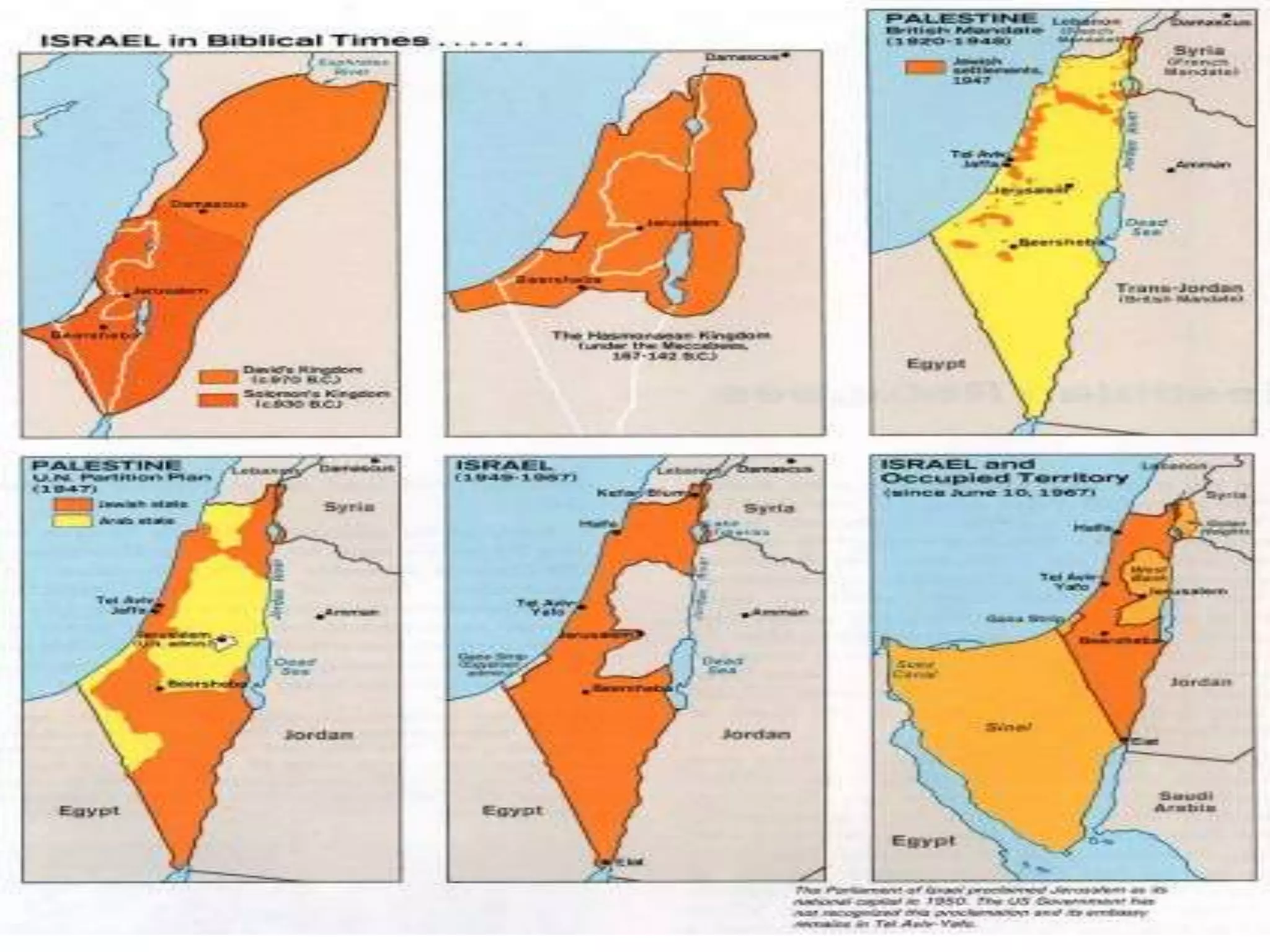
UN PARTITION PLAN 1947
• Britain was in an
  impossible position
  after WW2, violence
  between Jews and
  Arabs was increasing.
• UN STEPS IN
• The date of the
  partition was May
  1948, six months from
  then.
CIVIL WAR IN PALESTINE
• Began May 1948 ended July.
• Arab league could not match the strength of
  the Jews.
• A series of armistice agreements brought the
  war to an end.
• Israelis: ‘Year of Liberation’
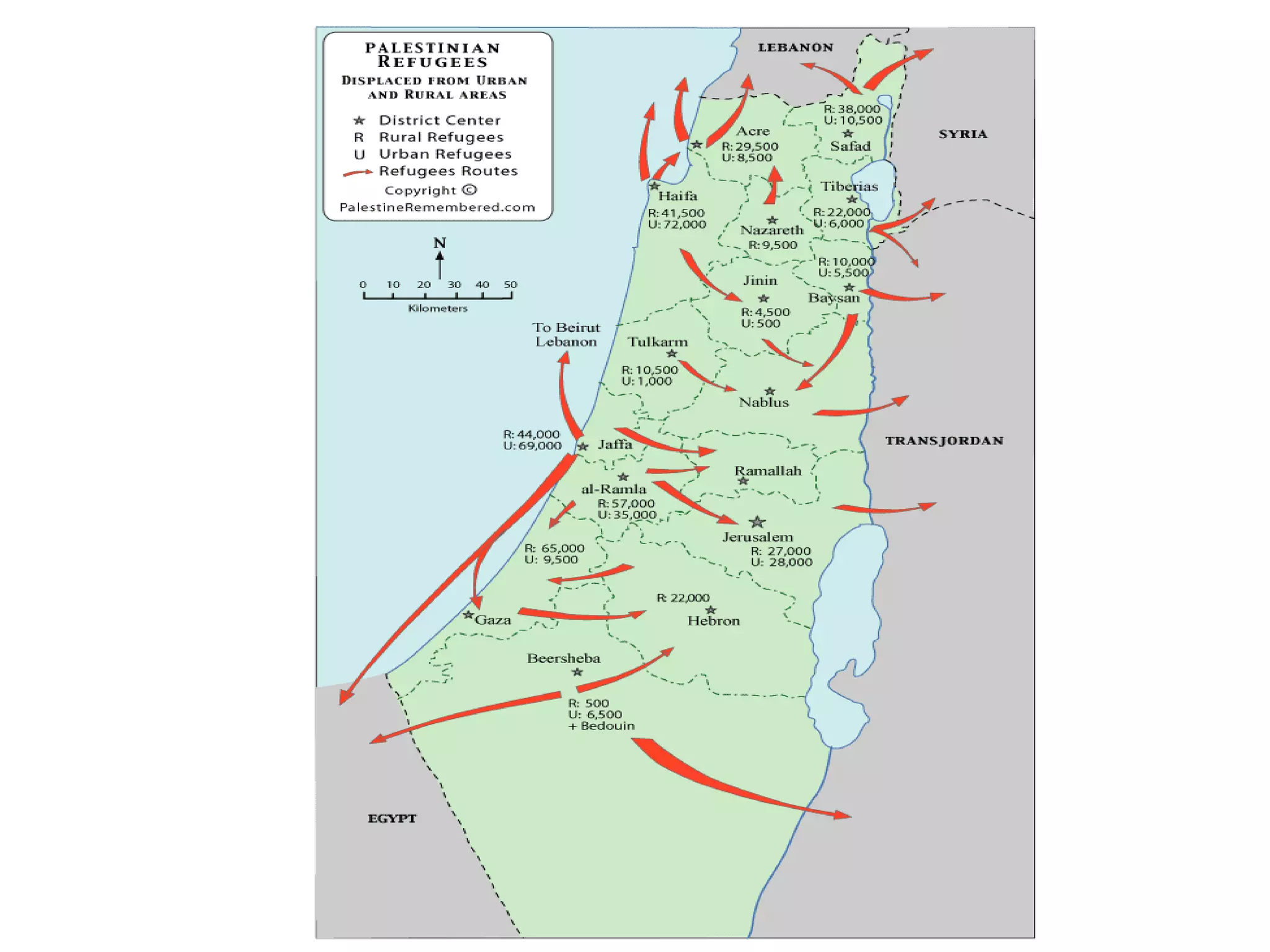
• Palestinians: ‘Year of Catastrophe’
Changes in the Arab World 1950s
• A series of military take-overs, most significant
  one being Colonel Nasser in Egypt
• Emergence of the Fedayeen.
• Economic Warfare: boycott of Israel’s trade
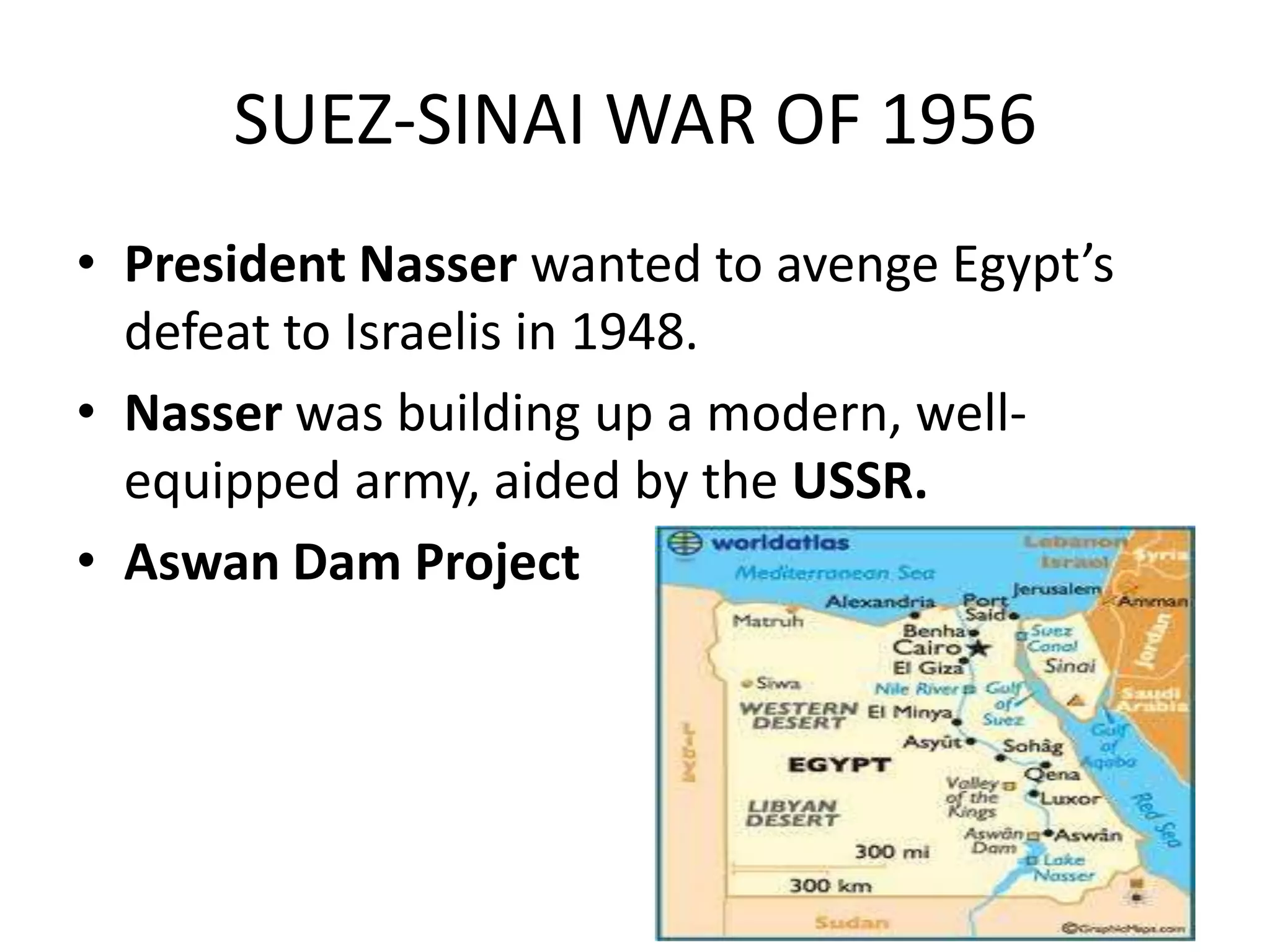
SUEZ-SINAI WAR OF 1956
• President Nasser wanted to avenge Egypt’s
  defeat to Israelis in 1948.
• Nasser was building up a modern, well-
  equipped army, aided by the USSR.
• Aswan Dam Project
Effects
• Israel war victory (aided by British & French).
• In the long run, the war strengthened the
  Arab states and Nasser’s reputation as a
  leader of the Arab world increased and pro-
  Western governments turned against Britain
  and France.
• A United Arab World under Nasser’s control
  and influenced by the USSR emerged.
Reshaping of the Middle East 1960s
• Increasing nationalism in both Israel and Arab
  countries.
• 1964: Palestinian Liberation Organisation
• Palestinian National Liberation
  Movement, aka FATAH
TRIGGERS
• Soviets provided false information about Israeli
  mobilisation.
• Nasser put Egypt’s armed forces on alert and
  moved 100, 000 troops to Sinai.
• 16th of May Nasser ordered UN Emergency force
  to leave Egyptian territory.
• May 28 Jordan and Egypt Defence Pact.
• Nasser declared his intention to strike Israel.
• Israelis struck pre-emptively on the 5th of June, to
  start a war, which they saw as inevitable.
Summary of Causes:
•   Social/Religious differences and Territorial
•   Nationalism
•   Militarism
•   Foreign Involvement
Nature
• At breakfast time Monday, 5th of June, Israeli
  forces were given orders to bomb Egyptian
  airfields. By the end of the day Israel controlled
  the skies in the Middle East.
• Egypt had been forced all the way back to the
  Suez Canal- defeat within 3 days.
• Within three days of the war West bank and city
  of Jerusalem completely captured.
• 9th of June: attacked Syria
• UN-sponsored ceasefire.
                   http://www.youtube.com/watch?v=PYHJFbh2S
                   ls
Role of Technology/Tactics
• Balanced armies numerically, but not skill-
  wise.
• Element of surprise was another key factor.
• Foreign involvement: USSR vs USA battle
  between spheres of influence.
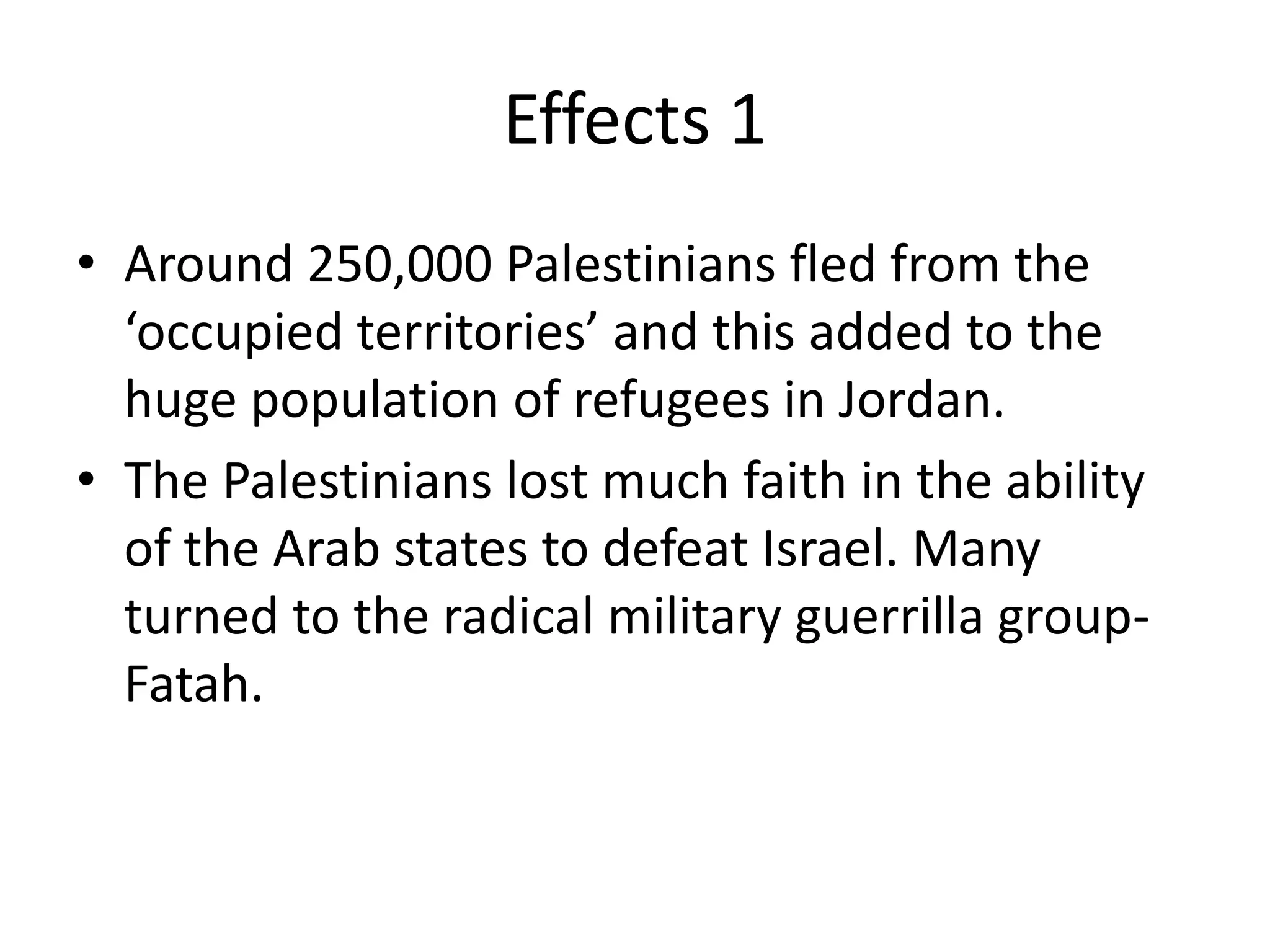
Effects 1
• Around 250,000 Palestinians fled from the
  ‘occupied territories’ and this added to the
  huge population of refugees in Jordan.
• The Palestinians lost much faith in the ability
  of the Arab states to defeat Israel. Many
  turned to the radical military guerrilla group-
  Fatah.
Effects 2
• For those who stayed, Israeli rule meant restrictions on
  lives, including heavy policy surveillance.
• Egypt-Israel begin ‘War of Attrition’ in 1968 and ends in
  1970 as both sides realise that neither could win,
  resulting in a ceasefire.
• Many guerrilla attacks on Israel by Arab extremist
  group- Fatah. Black September Organisation
  assassinated the Prime Minister of Jordan in 1971. The
  following year, the same terrorist group, kidnapped
  eleven Israeli athletes at the Munich Olympic Games.
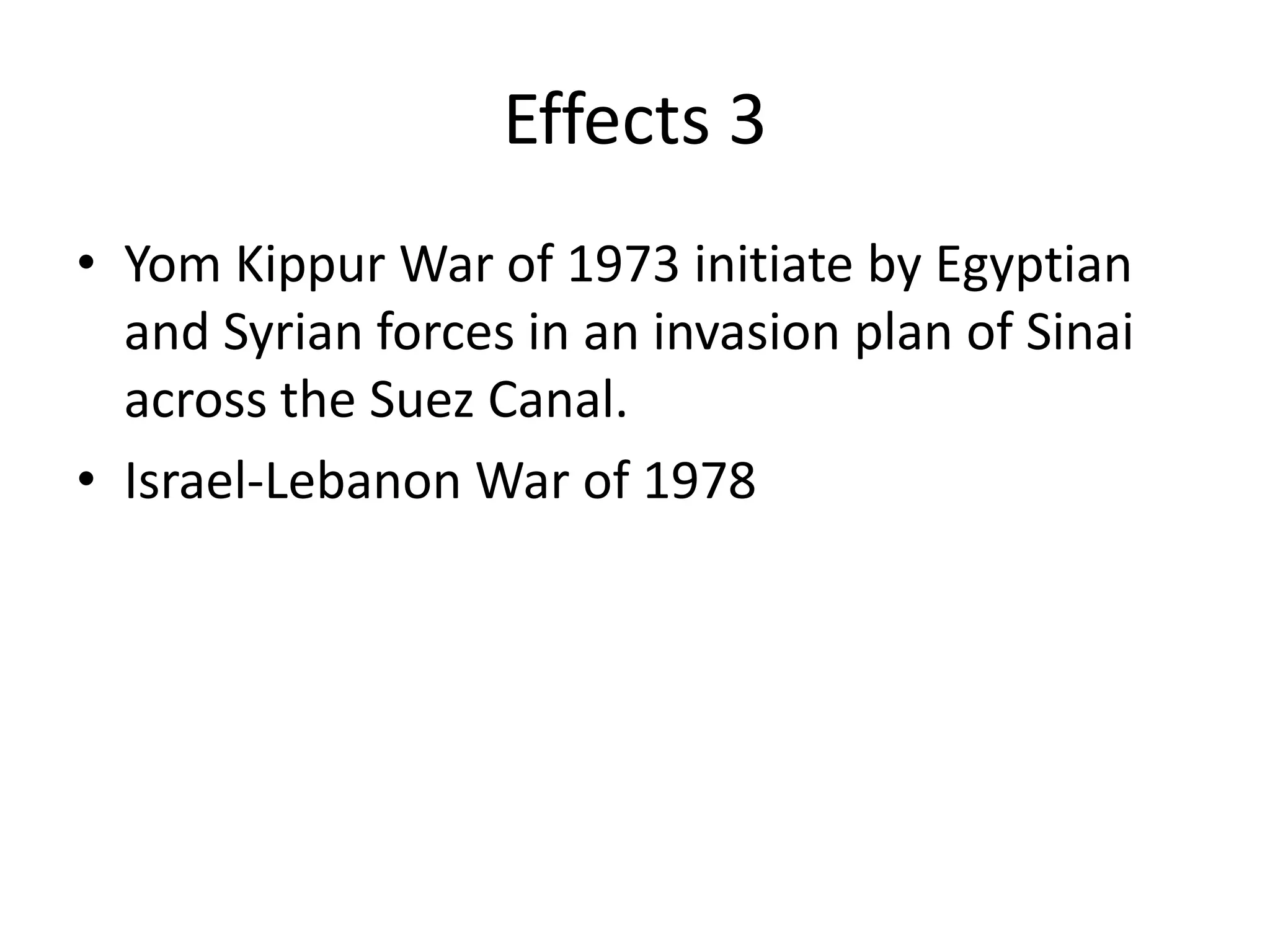
Effects 3
• Yom Kippur War of 1973 initiate by Egyptian
  and Syrian forces in an invasion plan of Sinai
  across the Suez Canal.
• Israel-Lebanon War of 1978
In what ways can we compare and
contrast this war to other 20th century
                wars?
•   BRAINSTORM:
•   World War One
•   World War Two
•   Your Own War

6 Day War

  • 1.
    Arab Israeli Conflict:the 1967 Six Day War Laurence Williams
  • 2.
    What is thiswar about? • ISLAM • JUDAISM VS
  • 3.
    WHERE • The landof Palestine
  • 4.
    The underlying problem:why is Palestine so important to these two religions? • Judaism: • Up until the expulsion of the Jews by the Roman Emperor Hadrian in AD 135, the land of Palestine had been an important cultural and spiritual centre for Judaism for the past 2000 years. • After their expulsion Jews were scattered all across the world, with no homeland. • Islam: • Palestine was the place of the emergence of this religion and the place of birth of Mohammed the prophet. • Mohammed dies in Jerusalem and after the re-capture of the city from the Byzantines (AD 637), Jerusalem became one of the most important centres of Islamic faith.
  • 5.
    • In 1518Palestine was conquered by the Ottoman Empire and it remained part of it until the fall of the ‘sick man’ of Europe in 1917. THIS IS WHERE WE BEGIN.
  • 6.
    LONG TERM CAUSES •ZIONISM VS ARAB NATIONALISM
  • 7.
    Zionism • As aresult of mistreatment (especially Russia), Jews formed movement known as ‘Lovers of Zion’. • Their aim was to return and settle in Palestine.
  • 8.
    WORLD WAR ONE •War brought Britain into alliance with Arabs who wanted to be free from Ottoman Empire rule. • Hussein-McMahon letters: Arab revolt in exchange for help in forming Arab state. • Balfour Declaration: help Zionists create a ‘national home’.
  • 9.
    POST WAR MANDATES •Peacemakers at Paris Peace Conference decided that Arabs should have the right to national self-determination.
  • 11.
    Peel Partition 1937 • Although Jewish settlers owned 5% of the land, Peel suggested to give half the country to a new Jewish state. • Arabs were outraged and this led to the Arab Rebellion of 1937-39. • A result of this rebellion was a change in British immigration policy; the White Paper was introduced in 1939.
  • 12.
    WORLD WAR TWO& HOLOCAUST • The threatened Jewish revolt did not happen primarily because of the outbreak of WW2- many Jews fought on Britain’s side in the war against Germany. • By the end of the war, around 6 million Jews had been killed – after this many were sympathetic towards the Jewish population. • A key player was the USA’s President Truman who in 1946 demanded that 100, 000 Jews should be allowed into Palestine at once. • This severely aggravated tensions between Arabs and Israelis.
  • 13.
    UN PARTITION PLAN1947 • Britain was in an impossible position after WW2, violence between Jews and Arabs was increasing. • UN STEPS IN • The date of the partition was May 1948, six months from then.
  • 14.
    CIVIL WAR INPALESTINE • Began May 1948 ended July. • Arab league could not match the strength of the Jews. • A series of armistice agreements brought the war to an end. • Israelis: ‘Year of Liberation’ • Palestinians: ‘Year of Catastrophe’
  • 16.
    Changes in theArab World 1950s • A series of military take-overs, most significant one being Colonel Nasser in Egypt • Emergence of the Fedayeen. • Economic Warfare: boycott of Israel’s trade
  • 17.
    SUEZ-SINAI WAR OF1956 • President Nasser wanted to avenge Egypt’s defeat to Israelis in 1948. • Nasser was building up a modern, well- equipped army, aided by the USSR. • Aswan Dam Project
  • 18.
    Effects • Israel warvictory (aided by British & French). • In the long run, the war strengthened the Arab states and Nasser’s reputation as a leader of the Arab world increased and pro- Western governments turned against Britain and France. • A United Arab World under Nasser’s control and influenced by the USSR emerged.
  • 19.
    Reshaping of theMiddle East 1960s • Increasing nationalism in both Israel and Arab countries. • 1964: Palestinian Liberation Organisation • Palestinian National Liberation Movement, aka FATAH
  • 20.
    TRIGGERS • Soviets providedfalse information about Israeli mobilisation. • Nasser put Egypt’s armed forces on alert and moved 100, 000 troops to Sinai. • 16th of May Nasser ordered UN Emergency force to leave Egyptian territory. • May 28 Jordan and Egypt Defence Pact. • Nasser declared his intention to strike Israel. • Israelis struck pre-emptively on the 5th of June, to start a war, which they saw as inevitable.
  • 21.
    Summary of Causes: • Social/Religious differences and Territorial • Nationalism • Militarism • Foreign Involvement
  • 23.
    Nature • At breakfasttime Monday, 5th of June, Israeli forces were given orders to bomb Egyptian airfields. By the end of the day Israel controlled the skies in the Middle East. • Egypt had been forced all the way back to the Suez Canal- defeat within 3 days. • Within three days of the war West bank and city of Jerusalem completely captured. • 9th of June: attacked Syria • UN-sponsored ceasefire. http://www.youtube.com/watch?v=PYHJFbh2S ls
  • 24.
    Role of Technology/Tactics •Balanced armies numerically, but not skill- wise. • Element of surprise was another key factor. • Foreign involvement: USSR vs USA battle between spheres of influence.
  • 25.
    Effects 1 • Around250,000 Palestinians fled from the ‘occupied territories’ and this added to the huge population of refugees in Jordan. • The Palestinians lost much faith in the ability of the Arab states to defeat Israel. Many turned to the radical military guerrilla group- Fatah.
  • 26.
    Effects 2 • Forthose who stayed, Israeli rule meant restrictions on lives, including heavy policy surveillance. • Egypt-Israel begin ‘War of Attrition’ in 1968 and ends in 1970 as both sides realise that neither could win, resulting in a ceasefire. • Many guerrilla attacks on Israel by Arab extremist group- Fatah. Black September Organisation assassinated the Prime Minister of Jordan in 1971. The following year, the same terrorist group, kidnapped eleven Israeli athletes at the Munich Olympic Games.
  • 27.
    Effects 3 • YomKippur War of 1973 initiate by Egyptian and Syrian forces in an invasion plan of Sinai across the Suez Canal. • Israel-Lebanon War of 1978
  • 28.
    In what wayscan we compare and contrast this war to other 20th century wars? • BRAINSTORM: • World War One • World War Two • Your Own War