A Joint Program of the Federation of State
Medical Boards of the United States, Inc.,
and the National Board of Medical Examiners®


                                  2011
                                 Step 1
Content Description and
   General Information
Copyright © 2010 by the Federation of State Medical Boards of the United States, Inc. and the National Board
      of Medical Examiners® (NBME®). All rights reserved. Printed in the United States of America.
 The USMLE® is a joint program of the Federation of State Medical Boards of the United States, Inc. and the
                                  National Board of Medical Examiners.

                                                                                                               1
CONTENTS


Introduction …………………………………………………………..                      3
Preparing for the Test, Applying for the Test,
        Scheduling Test Dates, and Testing ………………………....   3
Examination Content ………………………………………………....                 3
Step 1 Test Question Formats ………………………………………… 4
Content Outline ……………………………………………………....                   6
Sample Step 1 ……………………………………………………….. 20
Normal Laboratory Values ………………………………………….. 21
Sample Items ………………………………………………………… 23
Answer Form for Step 1 Sample Questions…………………………. 55
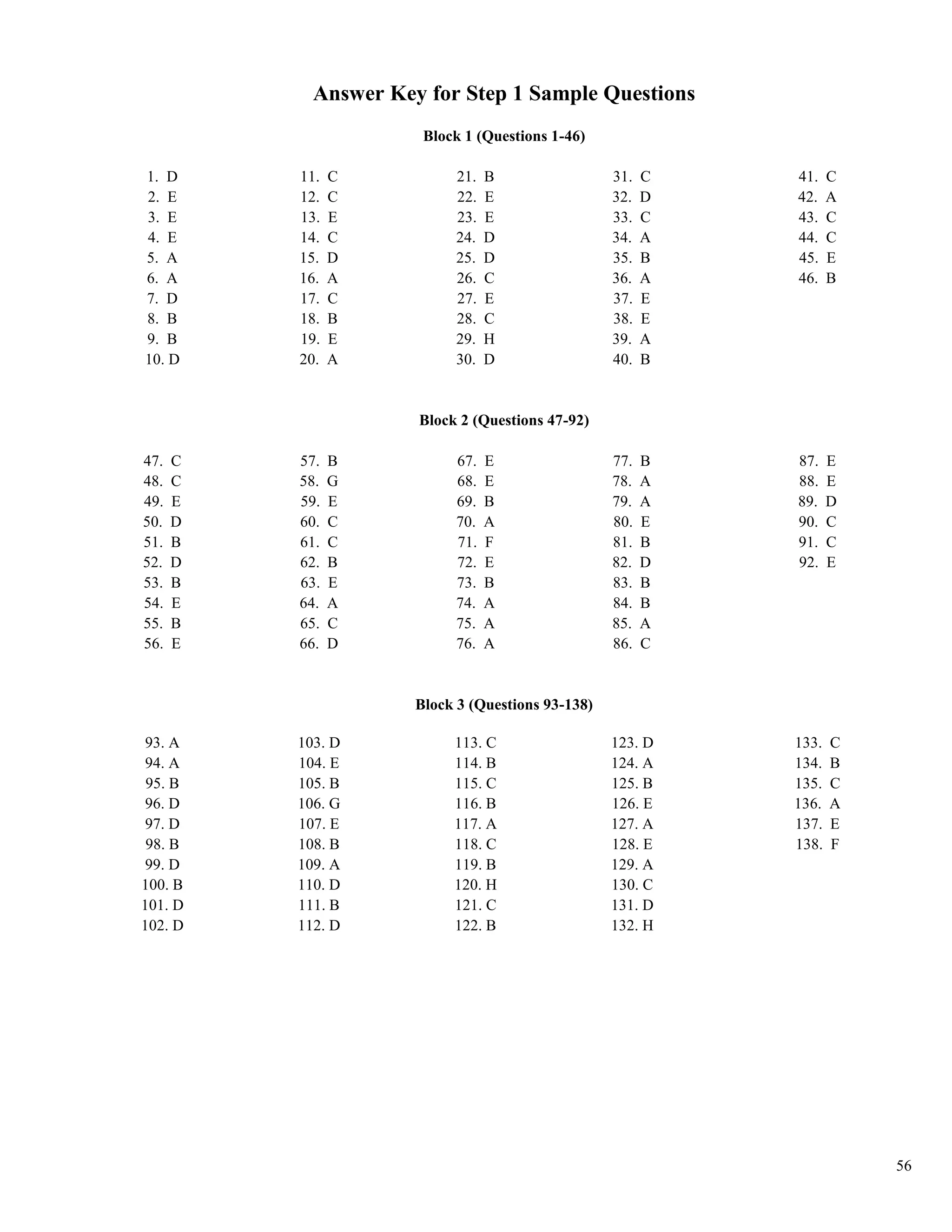
Answer Key for Step 1 Sample Questions…………………………… 56


                                                               2
Introduction                                          The Step 1 examination consists of questions
                                                      ("test items") presented in standard multiple-
This booklet is intended to help you prepare for      choice formats, as described on pages 4 and 5 of
Step 1 of the United States Medical Licensing         this booklet. The test items are divided into
Examination® (USMLE®) if you are an applicant         "blocks" (see the Test Lengths and Formats in the
with an eligibility period that has an ending date    Bulletin). You may want to study the descriptions
in 2011. Eligibility periods are explained in the     of test item formats that follow before you run the
2011 USMLE Bulletin of Information, with which        sample test items. A Normal Laboratory Values
you must become familiar to apply for the             Table,      including     Standard     International
examination. In addition to reading the Bulletin,     conversions, is reproduced on pages 21 and 22 of
you should run the sample Step 1 test materials       this booklet. This table will be available as an on-
and tutorials provided at the USMLE Web site.         line reference when you take the examination.
                                                      Please note that values shown in the actual
The information in this booklet, USMLE sample         examination may differ slightly from those
test materials and software tutorials, and other      printed in this booklet.
informational materials are available at the
USMLE Web site (http://www.usmle.org).                Examination Content
Information regarding any changes in the USMLE
program will also be posted at the USMLE Web          Step 1 consists of multiple-choice questions
site. You must obtain the most recent information     prepared by examination committees composed
to ensure an accurate understanding of current        of faculty members, teachers, investigators, and
USMLE rules.                                          clinicians with recognized prominence in their
                                                      respective fields. Committee members are
Preparing for the Test, Applying for the Test,        selected to provide broad representation from the
Scheduling Test Dates, and Testing                    academic, practice, and licensing communities
                                                      across the United States and Canada. The test is
In addition to the information in this booklet, you   designed to measure basic science knowledge.
should review the sections that appear in the         Some questions test the examinee’s fund of
Bulletin: Preparing for the Test, Applying for the    information per se, but the majority of questions
Test and Scheduling Your Test Date, and Testing.      require the examinee to interpret graphic and
                                                      tabular material, to identify gross and microscopic
Although the sample test materials in this booklet    pathologic and normal specimens, and to solve
are provided in computer format at the USMLE          problems through application of basic science
Web site, you must run the tutorial and sample        principles.
materials to become familiar with the test
software prior to your test date. Please monitor      Step 1 is constructed from an integrated content
the USMLE Web site (http://www.usmle.org)             outline that organizes basic science content
announcements section to access updated               according to general principles and individual
orientation and practice materials. The sample        organ systems. Test questions are classified in one
materials available at the USMLE Web site             of these major areas depending on whether they
include an additional block of items with             focus on concepts and principles that are
associated audio or video findings and a              important across organ systems or within
sequential item set. You should become familiar       individual organ systems.
with test items that have audio or video
components and sequential item sets as these          Sections focusing on individual organ systems are
formats may be used in the actual examination.        subdivided according to normal and abnormal
The block of items with associated audio or video     processes,    principles     of    therapy,     and
and sequential item sets does not appear in this      psychosocial, cultural, and environmental
booklet.                                              considerations. Each examination covers content
                                                      related to the traditionally defined disciplines of

                                                                                                        3
anatomy, behavioral sciences, biochemistry,           Strategies for Answering Single One Best Answer
microbiology, pathology, pharmacology, and            Test Questions
physiology, as well as to interdisciplinary areas
including genetics, aging, immunology, nutrition,           Read each question carefully. It is important
and molecular and cell biology.                             to understand what is being asked.

While not all topics listed in the content outline          Try to generate an answer and then look for it
are included in every examination, overall content          in the option list.
coverage is comparable in the various
examination forms that will be taken by different           Alternatively, read each option carefully,
examinees.                                                  eliminating those that are clearly incorrect.

A full content outline for the USMLE Step 1                 Of the remaining options, select the one that
examination is provided on pages 6 to 19. It                is most correct.
describes the scope of the examination in detail.
To facilitate review, the major categories are              If unsure about an answer, it is better to guess
indicated in bold type, with the subcategories in           since unanswered questions are automatically
regular type.                                               counted as wrong answers.
The content outline is not intended as a              Example Item
curriculum development or study guide. It
provides a flexible structure for test construction   A 32-year-old woman with type 1 diabetes
that can readily accommodate new topics,              mellitus has had progressive renal failure over the
emerging content domains, and shifts in               past 2 years. She has not yet started dialysis.
emphasis. The categorizations and content             Examination shows no abnormalities. Her
coverage are subject to change. Broadly based         hemoglobin concentration is 9 g/dL, hematocrit is
learning that establishes a strong general            28%, and mean corpuscular volume is 94 μm3. A
understanding of concepts and principles in the       blood smear shows normochromic, normocytic
basic sciences is the best preparation for the        cells. Which of the following is the most likely
examination.                                          cause?
Step 1 Test Question Formats                          (A)       Acute blood loss
                                                      (B)       Chronic lymphocytic leukemia
Single One Best Answer Questions                      (C)       Erythrocyte enzyme deficiency
This is the traditional, most frequently used         (D)       Erythropoietin deficiency
multiple-choice format. These items consist of a      (E)       Immunohemolysis
statement or question followed by three to            (F)       Microangiopathic hemolysis
thirteen response options arranged in alphabetical    (G)       Polycythemia vera
or logical order. A portion of the questions          (H)       Sickle cell disease
involves interpretation of graphic or pictorial       (I)       Sideroblastic anemia
materials. The response options for all questions     (J)       β-Thalassemia trait
are lettered (eg, A, B, C, D, E). Examinees are
required to select the best answer to the question.   (Answer: D)
Other options may be partially correct, but there
is only ONE BEST answer.


                                                                                                          4
Sequential Item Sets
A single patient-centered vignette may be
associated with two or three consecutive
questions about the information presented. Each
question is linked to the initial patient vignette but
is testing a different point. Questions are designed
to be answered in sequential order. You are
required to select the one best answer to each
question. Other options may be partially correct,
but there is only ONE BEST answer. You must
click “Proceed to Next Item” to view the next
item in the set; once you click on this button, you
will not be able to add or change an answer to the
displayed (previous) item.


                                                         5
Step 1 Content Outline

                                                Table of Contents


      General Principles …………………………………………………………………………………...                                               7
            Biochemistry and Molecular Biology
            Biology of Cells
            Human Development and Genetics
            Biology of Tissue Response to Disease
            Gender, Ethnic, and Behavioral Considerations Affecting Disease Treatment and Prevention
            Multisystem Processes
            Pharmacodynamic and Pharmacokinetic Processes
            Microbial Biology and Infection
            Quantitative Methods

      Hematopoietic and Lymphoreticular Systems ……………………………………………………… 9

     Central and Peripheral Nervous Systems …………………………………………………………… 10

     Skin and Related Connective Tissue ………………………………………………………………… 11

     Musculoskeletal System ………………………………………………………………………………. 12

     Respiratory System …………………………………………………………………………………… 13

     Cardiovascular System ……………………………………………………………………………….. 14

     Gastrointestinal System ………………………………………………………………………………. 15

     Renal/Urinary System ………………………………………………………………………………… 16

     Reproductive System ………………………………………………………………………………….. 16

     Endocrine System ……………………………………………………………………………………… 18

     Immune System ………………………………………………………………………………………… 18


Examples of diseases and normal processes are listed within this content outline. The purpose of these examples is
only to clarify and illustrate the particular categories they are appended to; they are not intended to direct the
examinee toward preparing for questions on them. Examinees should not focus their studies on the examples only.
The examination encompasses the categories in the content outline, but the examination will not be limited to or
emphasize the examples or the categories for which examples are given.


                                                                                                                     6
General Principles
    Biochemistry and molecular biology
              • gene expression: DNA structure, replication, exchange, and epigenetics
              • gene expression: transcription
              • gene expression: translation, post-translational processing, modifications, and disposition of proteins
                   (degradation), including protein/glycoprotein synthesis, intra/extracellular sorting, and processes/functions
                    related to Golgi complex and rough endoplasmic reticulum
              • structure and function of proteins and enzymes
              • energy metabolism

     Biology of cells
              • adaptive cell responses and cellular homeostasis
              • intracellular accumulations
              • mechanisms of injury and necrosis
              • apoptosis
              • mechanisms of dysregulation
                   - cell biology of cancer, including genetics of cancer
                   - general principles of invasion and metastasis, including cancer staging
              • cell/tissue structure, regulation, and function, including cytoskeleton, organelles, glycolipids, channels, gap
                   junctions, extracellular matrix, and receptors

     Human development and genetics
            • principles of pedigree analysis
                - inheritance patterns
                - occurrence and recurrence risk determination
            • population genetics: Hardy-Weinberg law, founder effects, mutation-selection equilibrium
            • principles of gene therapy
            • genetic testing and counseling
            • genetic mechanisms

     Biology of tissue response to disease
              • acute inflammatory responses (patterns of response)
                    – acute inflammation and mediator systems
                    – vascular response to injury, including mediators
                    – principles of cell adherence and migration
                    – microbicidal mechanisms and tissue injury
                    – clinical manifestations
              • chronic inflammatory responses
              • reparative processes
                    – wound healing, hemostasis, and repair; thrombosis, granulation tissue, angiogenesis, fibrosis, scar/keloid
                        formation
                    – regenerative processes

     Gender, ethnic, and behavioral considerations affecting disease treatment and prevention, including psychosocial,
     cultural, occupational, and environmental
               • progression through the life cycle, including birth through senescence
                   – cognitive, language, motor skills, and social and interpersonal development
                   – sexual development
                   – influence of developmental stage on physician-patient interview
               • psychological and social factors influencing patient behavior
                   – personality traits or coping style, including coping mechanisms
                   – psychodynamic and behavioral factors, related past experience
                   – family and cultural factors, including socioeconomic status, ethnicity, and gender
                   – adaptive behavioral responses to stress and illness
                   – maladaptive behavioral responses to stress and illness
                   – interactions between the patient and the physician or the health care system
                   – patient adherence (general and adolescent)


                                                                                                                                   7
•   patient interviewing, consultation, and interactions with the family
              – establishing and maintaining rapport
              – data gathering
              – approaches to patient education
              – enticing patients to make lifestyle changes
              – communicating bad news
              – “difficult” interviews
              – multicultural ethnic characteristics
          •   medical ethics, jurisprudence, and professional behavior
              – consent and informed consent to treatment
              – physician-patient relationships
              – death and dying
              – birth-related issues
              – issues related to patient participation in research
              – interactions with other health professionals, including impaired physician and patient safety
              – sexuality and the profession; other “boundary” issues
              – ethics of managed care
              – organization and cost of health care delivery

Multisystem processes
         • nutrition
             – generation, expenditure, and storage of energy at the whole-body level
             – assessment of nutritional status across the life span, including calories, protein, essential
                 nutrients, hypoalimentation
             – functions of nutrients
             – protein-calorie malnutrition
             – vitamin deficiencies and/or toxicities (including megaloblastic anemia with other findings)
             – mineral deficiencies and toxicities
         • temperature regulation
         • adaptation to environmental extremes, including occupational exposures
             – physical and associated disorders (including temperature, radiation, burns, decreased atmospheric
                 pressure, high-altitude sickness, increased water pressure)
             – chemical (including gases, vapors, smoke inhalation, agricultural hazards, organic solvents,
                 heavy metals, principles of poisoning and therapy)
         • fluid, electrolyte, and acid-base balance disorders
         • inherited metabolic disorders, including disorders related to amino acids, purines, porphyrins, carnitine, fatty
             acids, and carbohydrates

Pharmacodynamic and pharmacokinetic processes
       • general principles
           – pharmacokinetics: absorption, distribution, metabolism, excretion, dosage intervals
           – mechanisms of drug action, structure-activity relationships (including anticancer drugs)
           – concentration- and dose-effect relationships, types of agonists and antagonists and their actions
           – individual factors altering pharmacokinetics and pharmacodynamics
           – mechanisms of drug adverse effects, overdosage, toxicology
           – mechanisms of drug interactions
           – regulatory issues
           – signal transduction, including structure/function of all components of signal transduction pathway such
              as receptors, ligands
           – cell cycle/cell cycle regulation

Microbial biology and infection
        • microbial identification and classification, including principles, microorganism identification, and non-
             immunologic lab diagnosis
        • bacteria
             – structure
             – processes, replication, and genetics
             – oncogenesis
             – antibacterial agents
        • viruses


                                                                                                                              8
– structure
                   – processes, replication, and genetics
                   – oncogenesis
                   – antiviral agents
              •    fungi
                   – structure
                   – processes, replication, and genetics
                   – antifungal agents
              •    parasites
                   – structure
                   – processes, replication, and genetics
                   – antiparasitic agents
              •    prions
              •    epidemiology, outbreaks, and infection control

     Quantitative methods
              • fundamental concepts of measurement
                  – scales of measurement
                  – distribution, central tendency, variability, probability
                  – disease prevalence and incidence
                  – disease outcomes
                  – associations
                  – health impact
                  – sensitivity, specificity, predictive values
              • fundamental concepts of study design
                  – types of experimental studies
                  – types of observational studies
                  – sampling and sample size
                  – subject selection and exposure allocation
                  – outcome assessment
                  – internal and external validity
              • fundamental concepts of hypothesis testing and statistical inference
                  – confidence intervals
                  – statistical significance and Type I error
                  – statistical power and Type II error

Hematopoietic and Lymphoreticular Systems
   Normal processes
             • embryonic development, fetal maturation, and perinatal changes
             • organ structure and function
             • cell/tissue structure and function
                 – production and function of erythrocytes, hemoglobin, O2 and CO2 transport, transport proteins
                 – production and function of platelets
                 – production and function of coagulation and fibrinolytic factors
             • repair, regeneration, and changes associated with stage of life

     Abnormal processes
            • infectious, inflammatory, and immunologic disorders
                – infections of the blood, reticuloendothelial system, and endothelial cells
                – autoimmunity and autoimmune diseases
                – anemia of chronic disease
                – non-immunologically mediated transfusion complications, transplant rejection
            • traumatic and mechanical injury
            • neoplastic disorders (including lymphoma, leukemia, multiple myeloma, dysproteinemias, amyloidosis)
            • metabolic and regulatory disorders, including acquired
                – nutritional anemias
                – cythemia
                – hemorrhagic and hemostatic disorders


                                                                                                                    9
– bleeding secondary to platelet disorders and disorders of primary hemostasis
               •   vascular and endothelial disorders
               •   systemic disorders affecting the hematopoietic and lymphoreticular system
               •   idiopathic disorders
               •   degenerative disorders
               •   drug-induced adverse effects of the hematopoietic and lymphoreticular systems
               •   congenital and genetic disorders affecting the hematopoietic and lymphoreticular systems

     Principles of therapeutics
              • mechanisms of action and use of drugs for treatment of disorders of the hematopoietic system
                    – blood and blood products
                    – treatment of anemia, drugs stimulating erythrocyte production
                    – drugs stimulating leukocyte production
                    – anticoagulants, thrombolytic drugs
                    – antiplatelet drugs
                    – antimicrobials and antiparasitics
                    – antineoplastic and immunosuppressive drugs in the clinical context of disease
              • other therapeutic modalities

     Gender, ethnic, and behavioral considerations affecting disease treatment and prevention, including psychosocial,
     cultural, occupational, and environmental
               • emotional and behavioral factors
               • influence on person, family, and society
               • occupational and other environmental risk factors
               • gender and ethnic factors

Central and Peripheral Nervous Systems
    Normal processes
              • embryonic development, fetal maturation, and perinatal changes, including neural tube derivatives,
                  cerebral ventricles, neural crest derivatives
              • organ structure and function
                  – spinal cord, including gross anatomy, blood supply, and spinal reflexes
              – brain stem
              – brain, including gross anatomy and blood supply; cognition, language, memory; hypothalamic
                      function; limbic system and emotional behavior; circadian rhythms and sleep; control of eye
                      movement
                  – sensory systems, including proprioception, pain, vision, hearing, balance, taste, and olfaction
                  – motor systems, including brain and spinal cord, basal ganglia, and cerebellum
                  – autonomic nervous system
                  – peripheral nerve
              • cell/tissue structure and function
                  – axonal transport
                  – excitable properties of neurons, axons, and dendrites, including channels
                  – synthesis, storage, release, reuptake, and degradation of neurotransmitters and neuromodulators
                  – pre- and postsynaptic receptor interactions, trophic and growth factors
                  – brain metabolism
                  – glia, myelin
                  – brain homeostasis: blood-brain barrier; cerebrospinal fluid formation and flow; choroid plexus
              • repair, regeneration, and changes associated with stage of life, including definition of brain death

     Abnormal processes
            • infectious, inflammatory, and immunologic disorders (including demyelinating disorders, myasthenia gravis
                and muscle channelopathies, and disorders of the eye and ear)
            • traumatic and mechanical disorders
            • neoplastic disorders, including primary and metastatic
            • metabolic and regulatory disorders
            • vascular disorders
            • systemic disorders affecting the nervous system
            • idiopathic disorders affecting the nervous system
            • congenital and genetic disorders, including metabolic


                                                                                                                          10
•    degenerative disorders
               •    paroxysmal disorders
               •    disorders of special senses
               •    psychopathologic disorders, processes, and their evaluation
                    – early-onset disorders
                    – disorders related to substance use
                    – schizophrenia and other psychotic disorders
                    – mood disorders
                    – anxiety disorders
                    – somatoform disorders
                    – personality disorders
                    – physical and sexual abuse of children, adults, and elders
                    – other disorders
               •    drug-induced adverse effects on the central and peripheral nervous system
               •    neurologic pain syndromes

     Principles of therapeutics
              • mechanisms of action and use of drugs for treatment of disorders of the nervous
                    system
                    – anesthetics
                    – hypnotic sedatives
                    – psychopharmacologic agents
                    – anticonvulsants
                    – analgesics
                    – stimulants, amphetamines
                    – antiparkinsonian drugs and drugs for dementia, Alzheimer type; multiple sclerosis; and restless legs
                         syndrome
                    – skeletal muscle relaxants, botulinum toxin
                    – neuromuscular junction agonists and antagonists
                    – antiglaucoma drugs
                    – drugs used to decrease intracranial pressure
                    – antimigraine agents
                    – drugs affecting the autonomic nervous system, including all general autonomic pharmacology
                    – antimicrobials, antineoplastic drugs, and antiparasitics
                    – drugs used to treat cerebrovascular disorders
                    – treatment for substance abuse disorders
              • other therapeutic modalities

     Gender, ethnic, and behavioral considerations affecting disease treatment and prevention, including psychosocial,
     cultural, occupational, and environmental
               • emotional and behavioral factors
               • influence on person, family, and society
               • occupational and other environmental risk factors
               • gender and ethnic factors

Skin and Related Connective Tissue
     Normal processes
              • embryonic development, fetal maturation, and perinatal changes
              • organ structure and function
              • cell/tissue structure and function, including barrier functions, thermal regulation, eccrine function
              • repair, regeneration, and changes associated with stage of life or ethnicity
              • skin defense mechanisms and normal flora

     Abnormal processes
            • infectious, inflammatory, and immunologic disorders
                – bacterial infections
                – viral infections
                – fungal infections, including mycoses, dermatophytosis


                                                                                                                             11
– parasitic infections, ectoparasitic infestations, and mycobacterial infections
                   – immune and autoimmune disorders
               •   traumatic and mechanical disorders
                    – thermal injury
                   – decubitus ulcers
                   – effects of ultraviolet light and radiation
               •   neoplastic disorders
                   – keratinocytes
                   – melanocytes
                   – vascular neoplasms
                   – other
               •   metabolic, regulatory, and structural disorders
               •   vascular disorders
               •   systemic disorders affecting the skin
               •   idiopathic disorders
               •   degenerative disorders
               •   drug-induced adverse effects on the skin and related connective tissue
               •   congenital and genetic disorders affecting the skin and related connective tissue

     Principles of therapeutics
              • mechanisms of action and use of drugs for treatment of disorders of the skin and
                    connective tissue
                    – anti-inflammatory agents
                    – emollients
                    – sunscreen
                    – retinoids
                    – antimicrobial and antiparasitic agents
                    – cytotoxic and immunologic therapy and antineoplastic drugs
               • other therapeutic modalities

     Gender, ethnic, and behavioral considerations affecting disease treatment and prevention, including psychosocial,
     cultural, occupational, and environmental
               • emotional and behavioral factors
               • influence on person, family, and society
               • occupational and other environmental risk factors
               • gender and ethnic factors

Musculoskeletal System
    Normal processes
             • embryonic development, fetal maturation, and perinatal changes
             • organ structure and function
             • cell/tissue structure and function
                  – biology of bones, joints, tendons, skeletal muscle
                  – exercise and physical conditioning
             • repair, regeneration, and changes associated with stage of life

     Abnormal processes
            • infectious, inflammatory, and immunologic disorders
            • traumatic and mechanical disorders (including fractures, sprains, strains, dislocations, joint injuries, repetitive
                motion injuries, and impingement syndromes)
            • neoplastic disorders
            • metabolic, regulatory, and structural disorders (including osteomalacia,
                osteoporosis, osteodystrophy, gout, and pseudogout)
            • vascular disorders
            • systemic disorders affecting the musculoskeletal system
            • idiopathic disorders
            • degenerative disorders
            • drug-induced adverse effects on the musculoskeletal system
            • congenital and genetic disorders affecting the musculoskeletal system


                                                                                                                                    12
Principles of therapeutics
              • mechanisms of action and use of drugs for treatment of disorders of the
                    musculoskeletal system
                    – nonsteroidal anti-inflammatory drugs and analgesics
                    – muscle relaxants
                    – antigout therapy
                    – immunosuppressive and antineoplastic drugs
                    – drugs affecting bone mineralization
                    – antimicrobial and antiparasitic agents
              • other therapeutic modalities

     Gender, ethnic, and behavioral considerations affecting disease treatment and prevention, including psychosocial,
     cultural, occupational, and environmental
               • emotional and behavioral factors
               • influence on person, family, and society
               • occupational and other environmental risk factors
               • gender and ethnic factors

Respiratory System
     Normal processes
              • embryonic development, fetal maturation, and perinatal changes
              • organ structure and function
                  – airways, including mechanics and regulation of breathing
                  – lung parenchyma, including ventilation, perfusion, gas exchange
                  – pleura
                  – nasopharynx and sinuses
              • cell/tissue structure and function, including surfactant formation, alveolar structure
              • repair, regeneration, and changes associated with stage of life
              • pulmonary defense mechanisms and normal flora

     Abnormal processes
            • infectious, inflammatory, and immunologic disorders
                – infectious diseases
                     – infectious diseases of the upper respiratory tract
                     – pyogenic infectious diseases of the lower respiratory tract and pleura, viral infections, and associated
                       complications
                     – other infectious diseases of the lower respiratory tract
                – immunologic disorders
                     – allergic and hypersensitivity disorders
                     – autoimmune disorders
                – inflammatory disorders
                     – pneumoconioses
                     – acute and chronic alveolar injury
                     – chronic obstructive pulmonary disease
                     – restrictive pulmonary disease
            • traumatic and mechanical disorders
            • neoplastic disorders (including upper airway, lower airway and lung parenchyma, pleura, and metastatic
                tumors)
            • metabolic, regulatory, and structural disorders
            • vascular and circulatory disorders (including thromboembolic disease, pulmonary hypertension, pulmonary
                edema, and pleural effusion)
            • systemic disorders affecting the respiratory system
            • idiopathic disorders
            • degenerative disorders
            • drug-induced adverse effects on the respiratory system
            • congenital and genetic disorders affecting the respiratory system


                                                                                                                                  13
Principles of therapeutics
              • mechanisms of action and use of drugs for treatment of disorders of the respiratory system
                    – decongestants, cough suppressants, expectorants, mucolytics
                    – bronchodilator drugs
                    – anti-inflammatory and cytotoxic drugs
                    – antimicrobial agents and antiparasitic agents
                    – antineoplastic agents
                    – pulmonary vasodilators
              • other therapeutic modalities

     Gender, ethnic, and behavioral considerations affecting disease treatment and prevention, including psychosocial,
     cultural, occupational, and environmental
               • emotional and behavioral factors
               • influence on person, family, and society
               • occupational and other environmental risk factors
               • gender and ethnic factors

Cardiovascular System
    Normal processes
             • embryonic development, fetal maturation, and perinatal changes
             • organ structure and function
                 – chambers, valves
                 – cardiac cycle, mechanics, heart sounds, cardiac conduction
                 – hemodynamics, including systemic, pulmonary, coronary, and blood volume
                 – circulation in specific vascular beds
             • cell/tissue structure and function
                 – heart muscle, metabolism, oxygen consumption, biochemistry, and secretory function
                 – endothelium and secretory function, vascular smooth muscle, microcirculation, and lymph flow
                     (including mechanisms of atherosclerosis)
                 – neural and hormonal regulation of the heart, blood vessels, and blood volume, including responses to
                     change in posture, exercise, and tissue metabolism
             • repair, regeneration, and changes associated with stage of life

     Abnormal processes
            • infectious, inflammatory, and immunologic disorders
            • traumatic and mechanical disorders
            • neoplastic disorders
            • metabolic and regulatory disorders (including dysrhythmias, systolic and diastolic dysfunction, low- and
                high-output heart failure, cor pulmonale, systemic hypertension, ischemic heart disease, myocardial
                infarction, systemic hypotension and shock, and dyslipidemias)
            • vascular disorders
            • systemic diseases affecting the cardiovascular system
            • congenital and genetic disorders of the heart and central vessels
            • idiopathic disorders
            • drug-induced adverse effects on the cardiovascular system
            • degenerative disorders

     Principles of therapeutics
              • mechanisms of action, use, and adverse effects of drugs for treatment of disorders of the
                    cardiovascular system
                    – coronary and peripheral vasodilators
                    – antiarrhythmic drugs
                    – antihypertensive drugs
                    – measures used to combat hypotension and shock
                    – drugs affecting cholesterol and lipid metabolism
                    – drugs affecting blood coagulation, thrombolytic agents, and antiplatelet agents
                    – inotropic agents and treatment of heart failure
                    – immunosuppressive, antimicrobial, antineoplastic, and antiparasitic drugs
                    – drugs to treat peripheral arterial disease
                    – other pharmacotherapy


                                                                                                                          14
•    other therapeutic modalities

     Gender, ethnic, and behavioral considerations affecting disease treatment and prevention, including psychosocial,
     cultural, occupational, and environmental
               • emotional and behavioral factors
               • influence on person, family, and society
               • occupational and other environmental risk factors
               • gender and ethnic factors

Gastrointestinal System
     Normal processes
              • embryonic development, fetal maturation, and perinatal changes
              • organ structure and function, including alimentary canal, liver and biliary system, salivary glands
                   and exocrine pancreas, motility, and digestion and absorption
              • cell/tissue structure and function
                   – endocrine and neural regulatory functions, including GI hormones
                   – salivary, gastrointestinal, pancreatic, hepatic secretory products, including enzymes, proteins, bile salts,
                       and processes
                   – synthetic and metabolic functions of hepatocytes
              • repair, regeneration, and changes associated with stage of life
              • gastrointestinal defense mechanisms and normal flora

     Abnormal processes
            • infectious, inflammatory, and immunologic disorders
            • traumatic and mechanical disorders
                – malocclusion
                – hiatal hernia
                – obstruction
                – perforation of hollow viscus and blunt trauma
                – inguinal, femoral, and abdominal wall hernias
                – esophageal, intestinal, and colonic diverticula
            • neoplastic disorders, including benign and malignant
            • metabolic and regulatory disorders (including motility disorders, malabsorption, hepatic failure,
                cholelithiasis, nutritional disorders)
            • vascular disorders (including portal hypertension, esophageal varices, hemorrhoids, anal fissure, ischemia,
                angiodysplasia, thromboses, vasculitis)
            • systemic disorders affecting the gastrointestinal system
            • idiopathic disorders
            • degenerative disorders
            • drug-induced adverse effects on the gastrointestinal system
            • congenital and genetic disorders affecting the gastrointestinal system

     Principles of therapeutics
              • mechanisms of action and use of drugs for treatment of disorders of the gastrointestinal system
                    – treatment and prophylaxis of peptic ulcer disease and gastroesophageal reflux
                    – drugs to alter gastrointestinal motility
                    – fluid replacement
                    – pancreatic replacement therapy and treatment of pancreatitis
                    – drugs for treatment of hepatic failure and biliary disease
                    – anti-inflammatory, immunosuppressive, antineoplastic, antimicrobial, and antiparasitic drugs
              • other therapeutic modalities

     Gender, ethnic, and behavioral considerations affecting disease treatment and prevention, including psychosocial,
     cultural, occupational, and environmental
               • emotional and behavioral factors
               • influence on person, family, and society
               • occupational and other environmental risk factors
               • gender and ethnic factors


                                                                                                                                15
Renal/Urinary System
    Normal processes
             • embryonic development, fetal maturation, and perinatal changes
             • organ structure and function
                  – kidneys, ureters, bladder, urethra
                  – glomerular filtration and hemodynamics
                  – tubular reabsorption and secretion, including transport processes and proteins
                  – urinary concentration and dilution
                  – renal mechanisms in acid-base balance
                  – renal mechanisms in body fluid homeostasis
                  – micturition
             • cell/tissue structure and function, including renal metabolism and oxygen consumption, hormones
                  produced by or acting on the kidney
             • repair, regeneration, and changes associated with stage of life

     Abnormal processes
            • infectious, inflammatory, and immunologic disorders
                – infectious disorders
                     – upper urinary tract
                     – lower urinary tract
                – inflammatory and immunologic disorders
                     – glomerular disorders
                     – tubular interstitial disease
            • traumatic and mechanical disorders
            • neoplastic disorders, including primary and metastases
            • metabolic and regulatory disorders
                – renal failure, acute and chronic
                – tubular and collecting duct disorders
                – renal calculi
            • vascular disorders
            • systemic diseases affecting the renal system
            • idiopathic disorders
            • degenerative disorders
            • drug-induced adverse effects on the renal/urinary system
            • congenital and genetic disorders affecting the renal/urinary system

     Principles of therapeutics
              • mechanisms of action and use of drugs for treatment of disorders of the renal and urinary system
                    – diuretics, antidiuretic drugs
                    – drugs and fluids used to treat volume, electrolyte, and acid-base disorders
                    – drugs used to enhance renal perfusion
                    – anti-inflammatory, antimicrobial, immunosuppressive, antineoplastic, and antiparasitic drugs
                    – drugs used to treat lower urinary tract system
              • other therapeutic modalities

     Gender, ethnic, and behavioral considerations affecting disease treatment and prevention, including psychosocial,
     cultural, occupational, and environmental
               • emotional and behavioral factors
               • influence on person, family, and society
               • occupational and other environmental risk factors
               • gender and ethnic factors

Reproductive System
    Normal processes
              • embryonic development, fetal maturation, and perinatal changes, including gametogenesis
              • organ structure and function
                  – female structure, including breast
                  – female function
                  – male structure


                                                                                                                         16
– male function
         –   intercourse, orgasm
         –   pregnancy, including ovulation, fertilization, implantation, labor and delivery, the puerperium,
                  lactation, gestational uterus, placenta
         •   cell/tissue structure and function, including hypothalamic-pituitary-gonadal axis, sex steroids, and
             gestational hormones
         •   reproductive system defense mechanisms and normal flora

Abnormal processes
       • infectious, inflammatory, and immunologic disorders (female and male)
       • traumatic and mechanical disorders (female and male)
       • neoplastic disorders (including female reproductive, male reproductive, breast [including fibrocystic
           changes], trophoblastic disease)
       • metabolic and regulatory processes (female and male)
       • prenatal and perinatal counseling and screening
       • systemic disorders affecting reproductive function
       • disorders relating to pregnancy, the puerperium, and the postpartum period
           – obstetric problems
           – complications affecting other organ systems
           – disorders associated with the puerperium
           – antepartum, intrapartum, postpartum disorders of the fetus
       • idiopathic disorders
       • drug-induced adverse effects on the reproductive system
       • degenerative disorders
       • congenital and genetic disorders affecting the reproductive system

Principles of therapeutics
         • mechanisms of action and use of drugs for treatment of disorders of the reproductive system and management
               of normal reproductive function
               – female reproductive tract
                   – fertility drugs
                   – oral contraception, other methods of contraception
                   – estrogen, progesterone replacement, treatment of menopause
                   – stimulants and inhibitors of labor
                   – estrogen and progesterone antagonists
                   – stimulators and inhibitors of lactation
               – male reproductive tract
                   – fertility drugs
                   – androgen replacement and antagonists
               – gonadotropin-releasing hormone and gonadotropin replacement, including all gonadotropin-releasing
                   hormone antagonists
               – abortifacients
               – antimicrobial and antiparasitic agents
               – antineoplastics
               – restoration of potency
         • other therapeutic modalities affecting the reproductive system

Gender, ethnic, and behavioral considerations affecting disease treatment and prevention, including psychosocial,
cultural, occupational, and environmental
          • emotional and behavioral factors
          • influence on person, family, and society
          • occupational and other environmental risk factors
          • family planning and pregnancy
          • gender identity, sexual orientation, sexuality, libido
          • effects of traumatic stress syndrome, violence, rape, child abuse


                                                                                                                    17
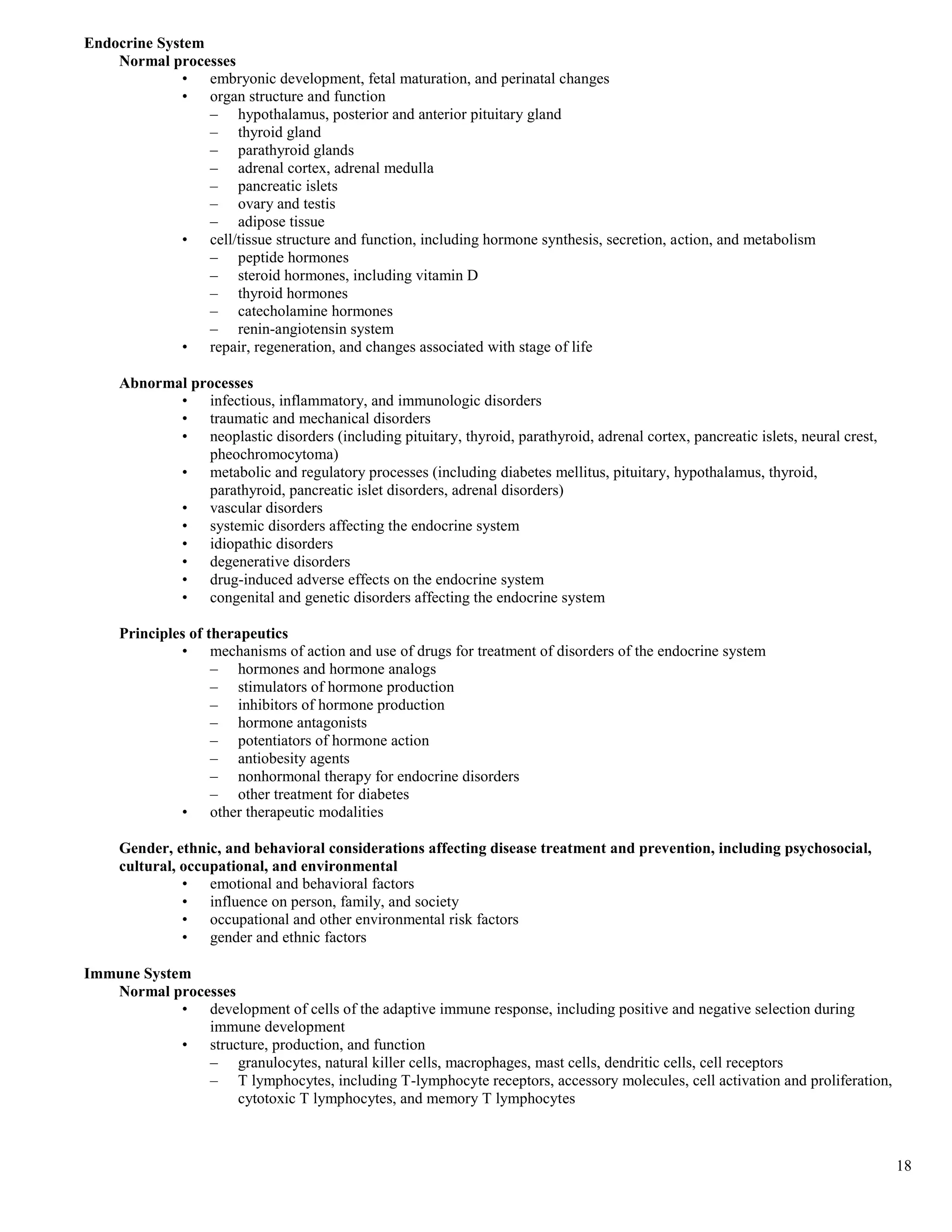
Endocrine System
    Normal processes
              • embryonic development, fetal maturation, and perinatal changes
              • organ structure and function
                 – hypothalamus, posterior and anterior pituitary gland
                 – thyroid gland
                 – parathyroid glands
                 – adrenal cortex, adrenal medulla
                 – pancreatic islets
                 – ovary and testis
                 – adipose tissue
              • cell/tissue structure and function, including hormone synthesis, secretion, action, and metabolism
                 – peptide hormones
                 – steroid hormones, including vitamin D
                 – thyroid hormones
                 – catecholamine hormones
                 – renin-angiotensin system
              • repair, regeneration, and changes associated with stage of life

     Abnormal processes
            • infectious, inflammatory, and immunologic disorders
            • traumatic and mechanical disorders
            • neoplastic disorders (including pituitary, thyroid, parathyroid, adrenal cortex, pancreatic islets, neural crest,
                pheochromocytoma)
            • metabolic and regulatory processes (including diabetes mellitus, pituitary, hypothalamus, thyroid,
                parathyroid, pancreatic islet disorders, adrenal disorders)
            • vascular disorders
            • systemic disorders affecting the endocrine system
            • idiopathic disorders
            • degenerative disorders
            • drug-induced adverse effects on the endocrine system
            • congenital and genetic disorders affecting the endocrine system

     Principles of therapeutics
              • mechanisms of action and use of drugs for treatment of disorders of the endocrine system
                    – hormones and hormone analogs
                    – stimulators of hormone production
                    – inhibitors of hormone production
                    – hormone antagonists
                    – potentiators of hormone action
                    – antiobesity agents
                    – nonhormonal therapy for endocrine disorders
                    – other treatment for diabetes
              • other therapeutic modalities

     Gender, ethnic, and behavioral considerations affecting disease treatment and prevention, including psychosocial,
     cultural, occupational, and environmental
               • emotional and behavioral factors
               • influence on person, family, and society
               • occupational and other environmental risk factors
               • gender and ethnic factors

Immune System
   Normal processes
            • development of cells of the adaptive immune response, including positive and negative selection during
               immune development
            • structure, production, and function
               – granulocytes, natural killer cells, macrophages, mast cells, dendritic cells, cell receptors
               – T lymphocytes, including T-lymphocyte receptors, accessory molecules, cell activation and proliferation,
                    cytotoxic T lymphocytes, and memory T lymphocytes


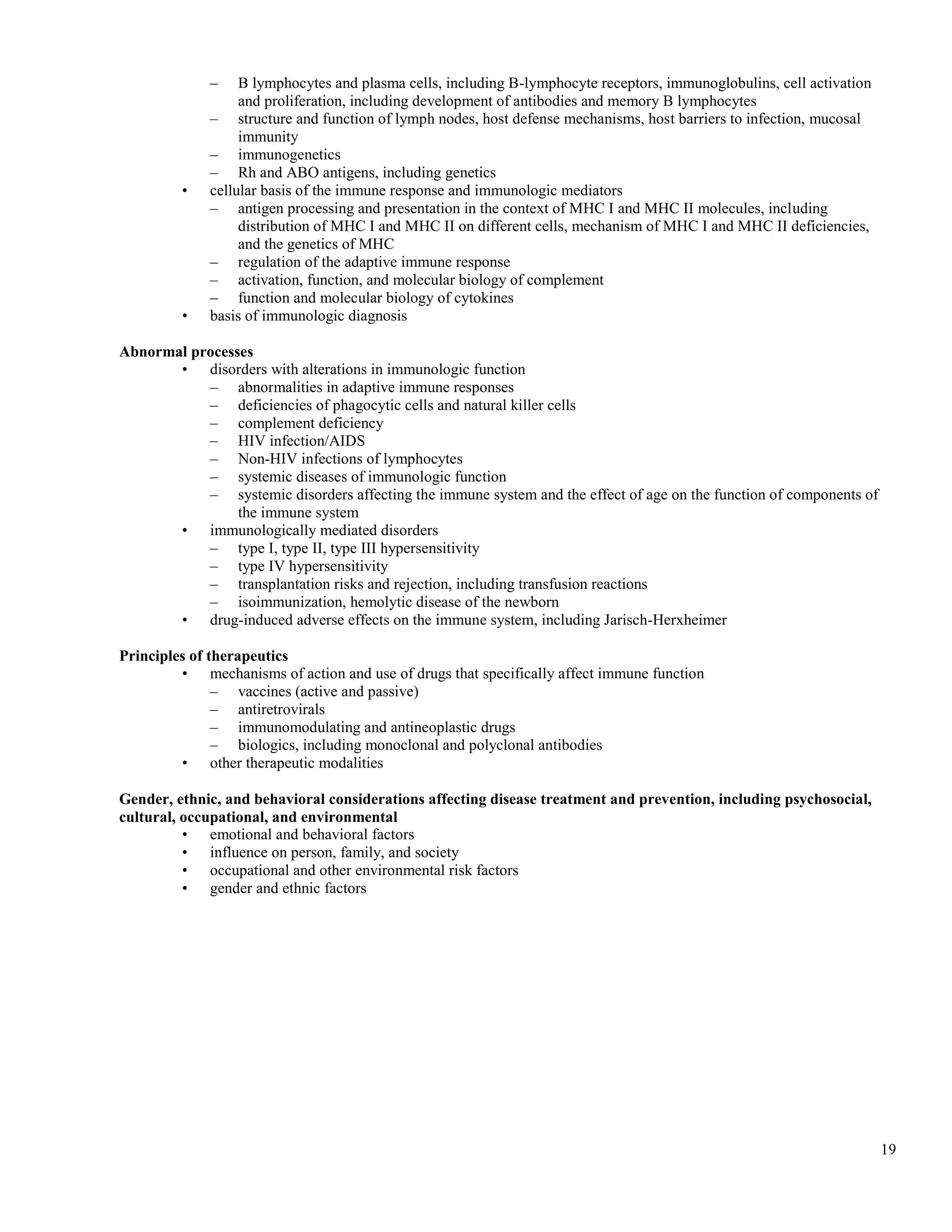
                                                                                                                                  18
–    B lymphocytes and plasma cells, including B-lymphocyte receptors, immunoglobulins, cell activation
                  and proliferation, including development of antibodies and memory B lymphocytes
             – structure and function of lymph nodes, host defense mechanisms, host barriers to infection, mucosal
                  immunity
             – immunogenetics
             – Rh and ABO antigens, including genetics
         •   cellular basis of the immune response and immunologic mediators
             – antigen processing and presentation in the context of MHC I and MHC II molecules, including
                  distribution of MHC I and MHC II on different cells, mechanism of MHC I and MHC II deficiencies,
                  and the genetics of MHC
             – regulation of the adaptive immune response
             – activation, function, and molecular biology of complement
             – function and molecular biology of cytokines
         •   basis of immunologic diagnosis

Abnormal processes
       • disorders with alterations in immunologic function
           – abnormalities in adaptive immune responses
           – deficiencies of phagocytic cells and natural killer cells
           – complement deficiency
           – HIV infection/AIDS
           – Non-HIV infections of lymphocytes
           – systemic diseases of immunologic function
           – systemic disorders affecting the immune system and the effect of age on the function of components of
                the immune system
       • immunologically mediated disorders
           – type I, type II, type III hypersensitivity
           – type IV hypersensitivity
           – transplantation risks and rejection, including transfusion reactions
           – isoimmunization, hemolytic disease of the newborn
       • drug-induced adverse effects on the immune system, including Jarisch-Herxheimer

Principles of therapeutics
         • mechanisms of action and use of drugs that specifically affect immune function
               – vaccines (active and passive)
               – antiretrovirals
               – immunomodulating and antineoplastic drugs
               – biologics, including monoclonal and polyclonal antibodies
         • other therapeutic modalities

Gender, ethnic, and behavioral considerations affecting disease treatment and prevention, including psychosocial,
cultural, occupational, and environmental
          • emotional and behavioral factors
          • influence on person, family, and society
          • occupational and other environmental risk factors
          • gender and ethnic factors


                                                                                                                       19
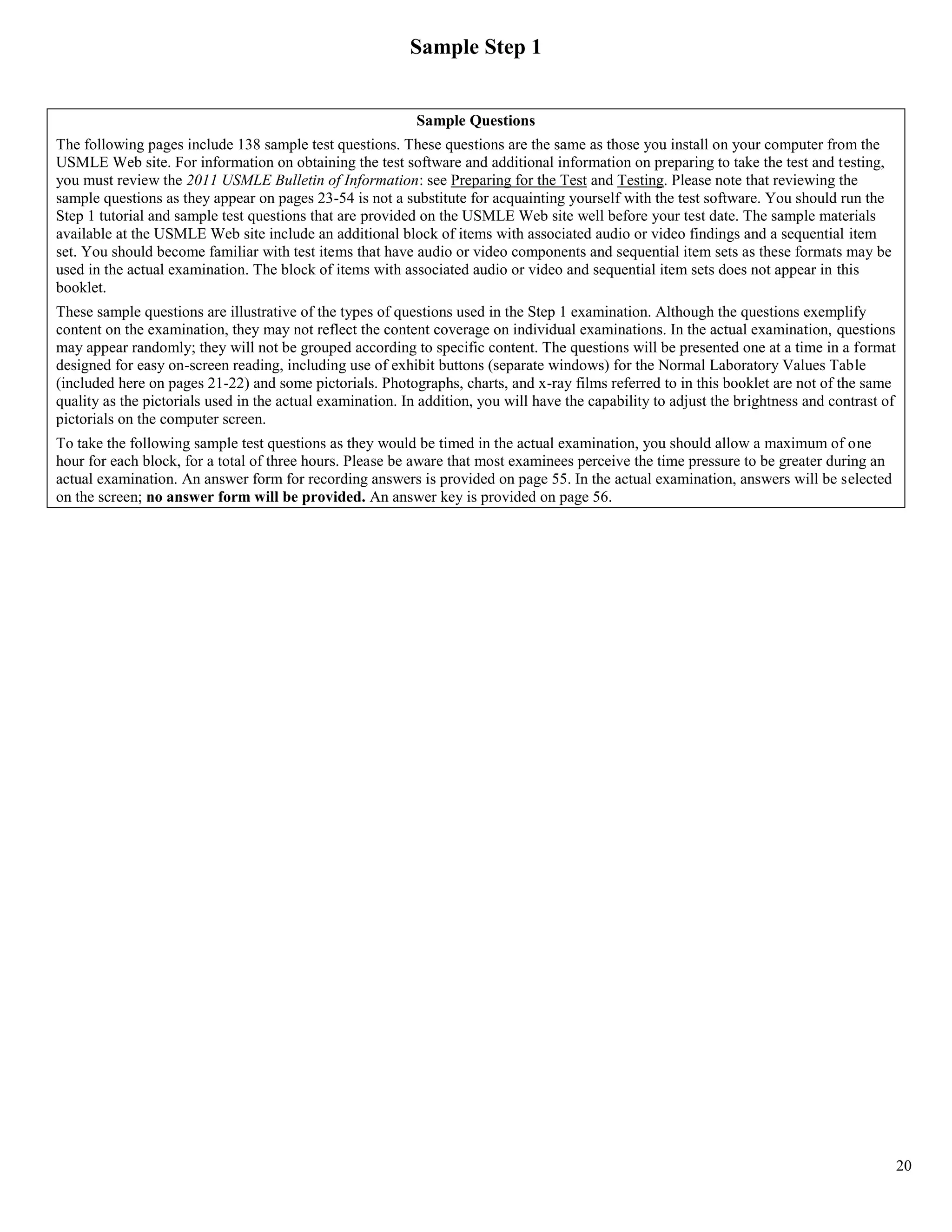
Sample Step 1


                                                            Sample Questions
The following pages include 138 sample test questions. These questions are the same as those you install on your computer from the
USMLE Web site. For information on obtaining the test software and additional information on preparing to take the test and testing,
you must review the 2011 USMLE Bulletin of Information: see Preparing for the Test and Testing. Please note that reviewing the
sample questions as they appear on pages 23-54 is not a substitute for acquainting yourself with the test software. You should run the
Step 1 tutorial and sample test questions that are provided on the USMLE Web site well before your test date. The sample materials
available at the USMLE Web site include an additional block of items with associated audio or video findings and a sequential item
set. You should become familiar with test items that have audio or video components and sequential item sets as these formats may be
used in the actual examination. The block of items with associated audio or video and sequential item sets does not appear in this
booklet.
These sample questions are illustrative of the types of questions used in the Step 1 examination. Although the questions exemplify
content on the examination, they may not reflect the content coverage on individual examinations. In the actual examination, questions
may appear randomly; they will not be grouped according to specific content. The questions will be presented one at a time in a format
designed for easy on-screen reading, including use of exhibit buttons (separate windows) for the Normal Laboratory Values Table
(included here on pages 21-22) and some pictorials. Photographs, charts, and x-ray films referred to in this booklet are not of the same
quality as the pictorials used in the actual examination. In addition, you will have the capability to adjust the brightness and contrast of
pictorials on the computer screen.
To take the following sample test questions as they would be timed in the actual examination, you should allow a maximum of one
hour for each block, for a total of three hours. Please be aware that most examinees perceive the time pressure to be greater during an
actual examination. An answer form for recording answers is provided on page 55. In the actual examination, answers will be selected
on the screen; no answer form will be provided. An answer key is provided on page 56.


                                                                                                                                               20
USMLE Step 1 Laboratory Values
                                                             * Included in the Biochemical Profile (SMA-12)

                                                                                REFERENCE RANGE                                              SI REFERENCE INTERVALS
BLOOD, PLASMA, SERUM
* Alanine aminotransferase (ALT), serum ................. 8-20 U/L ................................................... 8-20 U/L
  Amylase, serum ....................................................... 25-125 U/L ................................................ 25-125 U/L
* Aspartate aminotransferase (AST), serum .............. 8-20 U/L .................................................... 8-20 U/L
  Bilirubin, serum (adult) Total // Direct ................... 0.1-1.0 mg/dL // 0.0-0.3 mg/dL ................ 2-17 μmol/L // 0-5 μmol/L
* Calcium, serum (Ca2+) ............................................ 8.4-10.2 mg/dL .......................................... 2.1-2.8 mmol/L
* Cholesterol, serum .................................................. Rec:<200 mg/dL ...................................... <5.2 mmol/L
  Cortisol, serum ........................................................ 0800 h: 5-23 μg/dL // 1600 h: 3-15 μg/dL 138-635 nmol/L // 82-413 nmol/L
                                                                                2000 h: < 50% of 0800 h ........................... Fraction of 0800 h: < 0.50
  Creatine kinase, serum ............................................ Male: 25-90 U/L ....................................... 25-90 U/L
                                                                                Female: 10-70 U/L ................................... 10-70 U/L
* Creatinine, serum .................................................... 0.6-1.2 mg/dL ........................................... 53-106 μmol/L
  Electrolytes, serum
    Sodium (Na+) ........................................................ 136-145 mEq/L ......................................... 136-145 mmol/L
* Potassium (K+) ...................................................... 3.5-5.0 mEq/L ........................................... 3.5-5.0 mmol/L
    Chloride (Cl–) ........................................................ 95-105 mEq/L .......................................... 95-105 mmol/L
    Bicarbonate (HCO3–) ............................................. 22-28 mEq/L ............................................ 22-28 mmol/L
    Magnesium (Mg2+) ................................................ 1.5-2.0 mEq/L ........................................... 0.75-1.0 mmol/L
  Estriol, total, serum (in pregnancy)
    24-28 wks // 32-36 wks .........................................30-170 ng/mL // 60-280 ng/mL ................ 104-590 nmol/L // 208-970 nmol/L
    28-32 wks // 36-40 wks .........................................40-220 ng/mL // 80-350 ng/mL ................ 140-760 nmol/L // 280-1210 nmol/L
  Ferritin, serum ......................................................... Male: 15-200 ng/mL ................................ 15-200 μg/L
                                                                                Female: 12-150 ng/mL ............................. 12-150 μg/L
  Follicle-stimulating hormone, serum/plasma .........Male: 4-25 mIU/mL ................................. 4-25 U/L
                                                                                Female: premenopause 4-30 mIU/mL ...... 4-30 U/L
                                                                                  midcycle peak 10-90 mIU/mL ............... 10-90 U/L
                                                                                  postmenopause 40-250 mIU/mL ........... 40-250 U/L
  Gases, arterial blood (room air)
    pH .........................................................................7.35-7.45 .................................................. [H+] 36-44 nmol/L
    PCO2 ......................................................................33-45 mm Hg ............................................ 4.4-5.9 kPa
    PO2 ........................................................................75-105 mm Hg .......................................... 10.0-14.0 kPa
* Glucose, serum ........................................................ Fasting: 70-110 mg/dL ............................. 3.8-6.1 mmol/L
                                                                                2-h postprandial: < 120 mg/dL ................ < 6.6 mmol/L
  Growth hormone - arginine stimulation .................. Fasting: < 5 ng/mL ................................... < 5 μg/L
                                                                                  provocative stimuli: > 7 ng/mL ............. > 7 μg/L
  Immunoglobulins, serum
    IgA .......................................................................76-390 mg/dL ............................................ 0.76-3.90 g/L
    IgE ........................................................................0-380 IU/mL ............................................ 0-380 kIU/L
    IgG .......................................................................650-1500 mg/dL ....................................... 6.5-15 g/L
    IgM .......................................................................40-345 mg/dL ........................................... 0.4-3.45 g/L
  Iron .........................................................................50-170 μg/dL ............................................ 9-30 μmol/L
  Lactate dehydrogenase, serum ................................ 45-90 U/L .................................................. 45-90 U/L
  Luteinizing hormone, serum/plasma ...................... Male: 6-23 mIU/mL ................................. 6-23 U/L
                                                                                Female: follicular phase 5-30 mIU/mL .... 5-30 U/L
                                                                                  midcycle 75-150 mIU/mL ...................... 75-150 U/L
                                                                                  postmenopause 30-200 mIU/mL ........... 30-200 U/L
  Osmolality, serum ................................................... 275-295 mOsmol/kg H2O ......................... 275-295 mOsmol/kg H2O
  Parathyroid hormone, serum, N-terminal ............... 230-630 pg/mL ......................................... 230-630 ng/L
* Phosphatase (alkaline), serum (p-NPP at 30 C) ....20-70 U/L ................................................. 20-70 U/L
* Phosphorus (inorganic), serum ................................ 3.0-4.5 mg/dL ........................................... 1.0-1.5 mmol/L
  Prolactin, serum (hPRL) .........................................< 20 ng/mL ............................................... < 20 μg/L
* Proteins, serum
   Total (recumbent) ................................................. 6.0-7.8 g/dL .............................................. 60-78 g/L
    Albumin ................................................................ 3.5-5.5 g/dL ............................................... 35-55 g/L
    Globulin ............................................................... 2.3-3.5 g/dL ............................................... 23-35 g/L
  Thyroid-stimulating hormone, serum or plasma .....0.5-5.0 μU/mL .......................................... 0.5-5.0 mU/L
  Thyroidal iodine (123I) uptake ..................................8%-30% of administered dose/24 h .......... 0.08-0.30/24 h
  Thyroxine (T4), serum ............................................. 5-12 μg/dL ................................................ 64-155 nmol/L
  Triglycerides, serum................................................ 35-160 mg/dL ............................................ 0.4-1.81 mmol/L
  Triiodothyronine (T3), serum (RIA) ....................... 115-190 ng/dL .......................................... 1.8-2.9 nmol/L
  Triiodothyronine (T3) resin uptake .......................... 25%-35% .................................................. 0.25-0.35
* Urea nitrogen, serum .............................................. 7-18 mg/dL ............................................... 1.2-3.0 mmol/L
* Uric acid, serum ...................................................... 3.0-8.2 mg/dL ........................................... 0.18-0.48 mmol/L
                                                                                                                                                                      21
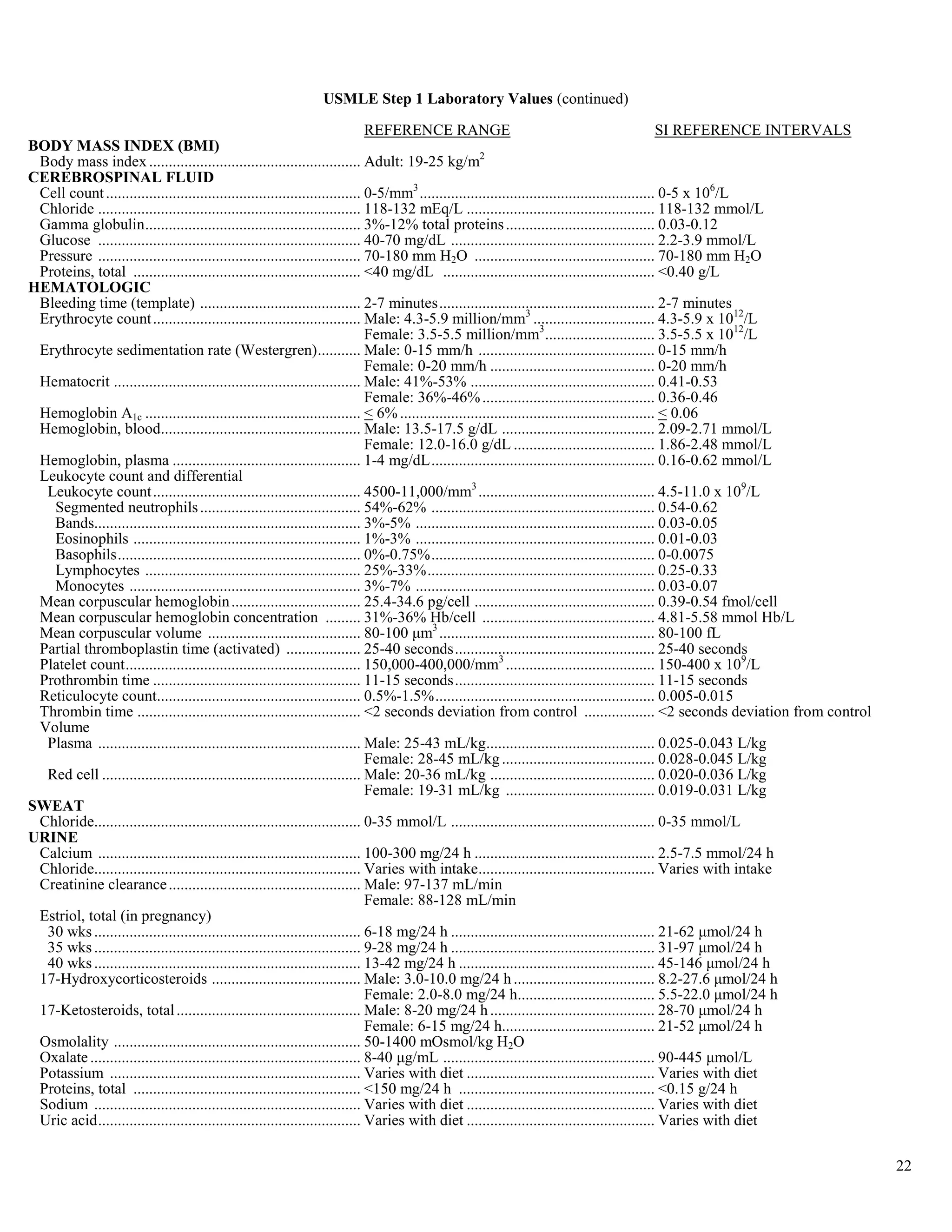
USMLE Step 1 Laboratory Values (continued)

                                                                               REFERENCE RANGE                                                    SI REFERENCE INTERVALS
BODY MASS INDEX (BMI)
 Body mass index ...................................................... Adult: 19-25 kg/m2
CEREBROSPINAL FLUID
 Cell count ................................................................. 0-5/mm3 ............................................................ 0-5 x 10⁶/L
 Chloride ................................................................... 118-132 mEq/L ................................................ 118-132 mmol/L
 Gamma globulin ....................................................... 3%-12% total proteins ...................................... 0.03-0.12
 Glucose ................................................................... 40-70 mg/dL .................................................... 2.2-3.9 mmol/L
 Pressure ................................................................... 70-180 mm H2O .............................................. 70-180 mm H2O
 Proteins, total .......................................................... <40 mg/dL ...................................................... <0.40 g/L
HEMATOLOGIC
 Bleeding time (template) ......................................... 2-7 minutes ....................................................... 2-7 minutes
 Erythrocyte count ..................................................... Male: 4.3-5.9 million/mm3 ............................... 4.3-5.9 x 10¹²/L
                                                                               Female: 3.5-5.5 million/mm3 ............................ 3.5-5.5 x 10¹²/L
 Erythrocyte sedimentation rate (Westergren)........... Male: 0-15 mm/h ............................................. 0-15 mm/h
                                                                               Female: 0-20 mm/h .......................................... 0-20 mm/h
 Hematocrit ............................................................... Male: 41%-53% ............................................... 0.41-0.53
                                                                               Female: 36%-46% ............................................ 0.36-0.46
 Hemoglobin A1c ....................................................... < 6% ................................................................. < 0.06
 Hemoglobin, blood................................................... Male: 13.5-17.5 g/dL ....................................... 2.09-2.71 mmol/L
                                                                               Female: 12.0-16.0 g/dL .................................... 1.86-2.48 mmol/L
 Hemoglobin, plasma ................................................ 1-4 mg/dL ......................................................... 0.16-0.62 mmol/L
 Leukocyte count and differential
  Leukocyte count ..................................................... 4500-11,000/mm3 ............................................. 4.5-11.0 x 10⁹/L
   Segmented neutrophils ......................................... 54%-62% ......................................................... 0.54-0.62
   Bands.................................................................... 3%-5% ............................................................. 0.03-0.05
   Eosinophils .......................................................... 1%-3% ............................................................. 0.01-0.03
   Basophils .............................................................. 0%-0.75% ......................................................... 0-0.0075
   Lymphocytes ....................................................... 25%-33% .......................................................... 0.25-0.33
   Monocytes ........................................................... 3%-7% ............................................................. 0.03-0.07
 Mean corpuscular hemoglobin ................................. 25.4-34.6 pg/cell .............................................. 0.39-0.54 fmol/cell
 Mean corpuscular hemoglobin concentration ......... 31%-36% Hb/cell ............................................ 4.81-5.58 mmol Hb/L
 Mean corpuscular volume ....................................... 80-100 μm3 ....................................................... 80-100 fL
 Partial thromboplastin time (activated) ................... 25-40 seconds ................................................... 25-40 seconds
 Platelet count ............................................................ 150,000-400,000/mm3 ...................................... 150-400 x 109/L
 Prothrombin time ..................................................... 11-15 seconds ................................................... 11-15 seconds
 Reticulocyte count.................................................... 0.5%-1.5% ........................................................ 0.005-0.015
 Thrombin time ......................................................... <2 seconds deviation from control .................. <2 seconds deviation from control
 Volume
  Plasma ................................................................... Male: 25-43 mL/kg........................................... 0.025-0.043 L/kg
                                                                               Female: 28-45 mL/kg ....................................... 0.028-0.045 L/kg
  Red cell .................................................................. Male: 20-36 mL/kg .......................................... 0.020-0.036 L/kg
                                                                               Female: 19-31 mL/kg ...................................... 0.019-0.031 L/kg
SWEAT
 Chloride.................................................................... 0-35 mmol/L .................................................... 0-35 mmol/L
URINE
 Calcium ................................................................... 100-300 mg/24 h .............................................. 2.5-7.5 mmol/24 h
 Chloride.................................................................... Varies with intake ............................................. Varies with intake
 Creatinine clearance ................................................. Male: 97-137 mL/min
                                                                               Female: 88-128 mL/min
 Estriol, total (in pregnancy)
  30 wks .................................................................... 6-18 mg/24 h .................................................... 21-62 μmol/24 h
  35 wks .................................................................... 9-28 mg/24 h .................................................... 31-97 μmol/24 h
  40 wks .................................................................... 13-42 mg/24 h .................................................. 45-146 μmol/24 h
 17-Hydroxycorticosteroids ...................................... Male: 3.0-10.0 mg/24 h .................................... 8.2-27.6 μmol/24 h
                                                                               Female: 2.0-8.0 mg/24 h................................... 5.5-22.0 μmol/24 h
 17-Ketosteroids, total ............................................... Male: 8-20 mg/24 h .......................................... 28-70 μmol/24 h
                                                                               Female: 6-15 mg/24 h....................................... 21-52 μmol/24 h
 Osmolality ............................................................... 50-1400 mOsmol/kg H2O
 Oxalate ..................................................................... 8-40 μg/mL ...................................................... 90-445 μmol/L
 Potassium ................................................................ Varies with diet ................................................ Varies with diet
 Proteins, total .......................................................... <150 mg/24 h .................................................. <0.15 g/24 h
 Sodium .................................................................... Varies with diet ................................................ Varies with diet
 Uric acid ................................................................... Varies with diet ................................................ Varies with diet

                                                                                                                                                                           22
SAMPLE ITEMS

                                            BLOCK 1, ITEMS 1-46

1.   A 25-year-old woman has a 3-day history of           3.   A 50-year-old man with a history of alcoholism
     vomiting and diarrhea. She has postural                   has difficulty with short-term memory. He is
     hypotension and poor tissue turgor. Her serum             unable to recall the date and cannot remember
     sodium concentration is 130 mEq/L. Which of               what he ate for breakfast this morning. He thinks
     the following findings is most likely?                    the examiner is a long-lost friend and carries on a
                                                               conversation with the examiner as if they have
        (A) Decreased serum aldosterone                        known each other for years. His long-term
                concentration                                  memory appears intact. The patient dies shortly
        (B) Increased serum atrial natriuretic                 thereafter of a myocardial infarct. Pathologic
                peptide concentration                          examination of his brain is most likely to
        (C) Increased effective circulating volume             disclose an abnormality involving which of the
        (D) Increased serum ADH (vasopressin)                  following?
                concentration
        (E) Urine osmolality less than serum                      (A)   Amygdala
                osmolality                                        (B)   Caudate nucleus
                                                                  (C)   Hippocampus
                                                                  (D)   Locus caeruleus
2.   A 52-year-old woman comes to the physician                   (E)   Mammillary bodies
     because of a 2-day history of fever and left flank
     pain. She has been treated for multiple episodes
     of pyelonephritis during the past 3 years. Her       4.   A 72-year-old man who is a retired construction
     temperature is 37.8°C (100.1°F). Physical                 worker comes to the physician because he has
     examination shows left flank tenderness.                  had a lesion on his face for 3 months. Physical
     Urinalysis shows 12–18 WBC/hpf with                       examination shows a 6-mm, red, ulcerated lesion
     occasional lymphocytes and mononuclear cells              with heaped borders. A biopsy specimen of the
     with features of macrophages. Cultures of urine           lesion shows atypical, dysplastic keratinocytes
     grow 80,000 colonies/mL of Proteus mirabilis.             within the epidermis and dermis. Which of the
     An x-ray of the abdomen shows a 3-cm mass in              following is the most likely diagnosis?
     the lower pole of the left kidney. Gross
     examination of the mass after it has been                    (A)   Actinic keratosis
     resected shows that it is yellow, 3.2-cm in                  (B)   Discoid lupus erythematosus
     diameter, and centrally but not marginally                   (C)   Melanoma
     necrotic. Histologic examination of the mass                 (D)   Mycosis fungoides
     shows a predominance of epithelioid cells with               (E)   Squamous cell carcinoma
     partially clear and granular-to-foamy cytoplasm.
     Nuclei are eccentric, normochromic, symmetric,
     and without significant pleomorphism. Scattered      5.   A 1-day-old newborn is evaluated for possible
     lymphocytes and plasma cells are intermixed.              sepsis. Blood cultures grow gram-positive cocci
     Which of the following is the most likely                 in pairs and chains that agglutinate with group B
     diagnosis?                                                antiserum. The most likely epidemiologic risk
                                                               factor for this infection involves bacterial
        (A) Acute pyelonephritis                               colonization of which of the following?
        (B) Malacoplakia
        (C) Renal cell carcinoma, clear cell type,                (A)   Mother's vagina
               intermediate grade                                 (B)   Newborn's gastrointestinal tract
        (D) Renal cell carcinoma, granular cell type              (C)   Newborn's nasopharynx
        (E) Xanthogranulomatous pyelonephritis                    (D)   Placenta
                                                                  (E)   Umbilical cord remnant


                                                                                                                     23
6.   A 21-year-old man is brought to the emergency department by friends because of blurred vision, headache,
     abdominal pain, nausea, and vomiting for 30 minutes. His friends say that he drank 60 mL of wood alcohol 1 hour
     ago after a bet at a fraternity house party. His pulse is 58/min and regular, respirations are 28/min and shallow, and
     blood pressure is 130/72 mm Hg. Physical examination shows no other abnormalities. Laboratory studies show:

                   Serum
                     Na+                                              139 mEq/L
                     Cl−                                              85 mEq/L
                     K+                                               4.5 mEq/L
                     HCO3−                                            13 mEq/L
                   Urine
                     pH                                               5
                     Crystals                                         none

                   Arterial blood gas analysis on room air:
                     pH                                               7.28
                     PO2                                              108 mm Hg
                     PCO2                                             22 mm Hg

     Which of the following is the most appropriate initial treatment for this patient?

        (A)   Intravenous ethanol therapy
        (B)   Intravenous sodium bicarbonate therapy
        (C)   Oral acetylcysteine therapy
        (D)   Oral activated charcoal therapy
        (E)   Hemodialysis


7.   A 42-year-old woman, gravida 2, para 2, comes               8.          Three weeks after traveling to California to study
     for a routine examination. She has type                                 desert flowers, a 32-year-old man develops a
     2 diabetes mellitus well controlled with                                fever, chest pain, and sore muscles. Two days
     glyburide. She has a history of vulvar                                  later, red tender nodules appear on the shins, and
     condylomata acuminata successfully treated with                         the right ankle is painful and tender. An x-ray of
     laser ablation 12 years ago. She does not smoke.                        the chest shows a left pleural effusion. Which of
     She drinks a six-pack of beer nightly. She is                           the following is the most likely diagnosis?
     sexually active and uses a diaphragm with
     spermicide for contraception. Her mother had                               (A)   Blastomycosis
     breast cancer at the age of 65 years. The patient                          (B)   Coccidioidomycosis
     is 157 cm (5 ft 2 in) tall and weighs 100 kg (220                          (C)   Histoplasmosis
     lb); BMI is 40 kg/m2. Physical examination                                 (D)   Mycobacterium marinum infection
     shows      no     other     abnormalities. Pelvic                          (E)   Mycoplasma pneumoniae infection
     examination shows a 2-cm ulcer on the cervix. A
     biopsy specimen of the cervical lesion shows
     invasive squamous cell carcinoma. Which of the              9.          A 55-year-old man who has alcoholic cirrhosis is
     following is the most significant predisposing                          brought to the emergency department because he
     factor for this patient's cervical cancer?                              has been vomiting blood for 2 hours. He has a 2-
                                                                             month history of abdominal distention, dilated
        (A)   Alcohol use                                                    veins over the anterior abdominal wall, and
        (B)   Diaphragm and spermicide use                                   internal hemorrhoids. Which of the following
        (C)   Heredity                                                       veins is the most likely origin of the
        (D)   Human papillomavirus infection                                 hematemesis?
        (E)   Obesity
        (F)   Parity                                                            (A)   Inferior mesenteric veins
        (G)   Type 2 diabetes mellitus                                          (B)   Left gastric vein
                                                                                (C)   Periumbilical veins
                                                                                (D)   Superior rectal vein
                                                                                (E)   Superior vena cava


                                                                                                                                  24
10.   A patient being treated with clindamycin for            13.   A 72-year-old man comes to the physician
      aspiration pneumonia develops diarrhea. The                   because of sharp pain of his right thorax for 3
      stool contains a toxin that kills cultured epithelial         days and a rash in a band-like distribution over
      cells. Stool culture grows an anaerobic gram-                 his right chest for 1 day. He babysits his 4-year-
      positive rod. The same organism is cultured from              old grandson who recently developed
      his bedpan. Which of the following is most                    chickenpox. Physical examination shows a
      likely to sterilize the bedpan?                               vesicular rash in a T8 dermatomal distribution.
                                                                    Which of the following is the most likely source
         (A) Boiling for 45 minutes                                 of virus in this patient's infection?
         (B) Exposure to benzalkonium chloride for
                1 hour                                                 (A) Hematogenous dissemination from the
         (C) Exposure to ethyl alcohol for 1 hour                             respiratory tract
         (D) Exposure to saturated steam (121°C) for                   (B) New infection from the grandson by the
                15 minutes                                                    respiratory route
         (E) Heating in an oven at 150°C for 30                        (C) New infection from the skin of the
                minutes                                                       grandson
                                                                       (D) Reactivation of a latent infection from
                                                                              the patient's dermal dendritic cells
11.   A 12-year-old boy is brought to the physician by                 (E) Reactivation of a latent infection from
      his father because of redness and swelling of his                       the patient's dorsal root ganglion
      left foot for 24 hours. Three days ago, the boy
      scraped his foot while wading in a drainage
      ditch. Examination of the left foot shows a             14.   Vascular control is studied in an intact hind
      purulent abrasion with edema, erythema, and                   extremity of an anesthetized experimental
      tenderness on the lateral side. Infection is most             animal. After a normal control period, the blood
      likely to next spread from the lateral side of the            flow to the extremity is completely occluded for
      foot to the regional lymph nodes in which of the              1 minute. When the occlusion is released, blood
      following areas?                                              flow increases abruptly and exceeds the control
                                                                    value for several minutes (reactive hyperemia).
         (A)   Lateral surface of the thigh                         After an appropriate recovery period, the
         (B)   Medial malleolus, posteriorly                        procedure is repeated and the extremity is
         (C)   Popliteal fossa                                      actively exercised during the occlusion period.
         (D)   Sole of the foot                                     Which of the following best describes the
         (E)   Superficial inguinal area                            reactive hyperemia after the second occlusion
                                                                    compared with that after the first occlusion?

12.   A 4-month-old boy is brought to the emergency                    (A)   Abolished
      department       30 minutes     after    becoming                (B)   Decreased but not abolished
      unresponsive. He has a 1-day history of poor                     (C)   Increased
      breast-feeding and vomiting. He is unresponsive                  (D)   Unchanged
      to stimuli. Physical examination shows mild
      hepatomegaly.        Serum       studies      show
      hypoglycemia and absence of ketones. The                15.   A 30-year-old woman has anxiety about episodes
      patient becomes responsive following an                       of abdominal pain that have alternated with
      intravenous bolus of glucose. Urine studies show              diarrhea and constipation over the past year. She
      no ketones and increased concentrations of C6                 often has these episodes when she is stressed or
      and C8 carbon chain dicarboxylic acids. A                     tired. Physical examination and laboratory
      deficiency of which of the following enzyme                   studies are within normal limits during these
      activities is the most likely cause of the findings           episodes. Which of the following is the most
      in this patient?                                              likely diagnosis?

         (A) Fructose-1,6-bisphosphatase                               (A)   Gastroenteritis
         (B) Glucose-6-phosphatase                                     (B)   Generalized anxiety disorder
         (C) Medium-chain acyl-CoA                                     (C)   Hypochondriasis
                dehydrogenase                                          (D)   Irritable bowel syndrome
         (D) Methylmalonyl-CoA mutase                                  (E)   Major depressive disorder
         (E) Ornithine carbamoyltransferase                            (F)   Somatization disorder


                                                                                                                   25
16.   An investigator is studying the effect of the number of hours watching television (Factor A) on the percent of
      hemoglobin A1c in people with type 2 diabetes mellitus. Two different variables, Factor A and hemoglobin A 1c, are
      compared. The results of the study indicate a correlation coefficient of +0.9. Which of the following graphs shown
      best corresponds to these results?


17.   A 25-year-old woman is brought to the                    18.     A 32-year-old woman with schizophrenia is
      emergency department 1 hour after she fainted.                   brought to the physician because of rapid
      She has had mild intermittent vaginal bleeding,                  heartbeats, sweating, muscle rigidity, and
      sometimes associated with lower abdominal                        confusion for 1 day. Medications include
      pain, during the past 3 days. She has had severe                 acetaminophen for dysmenorrhea, haloperidol,
      cramping pain in the right lower abdomen for                     and multivitamins. Her temperature is 40.2°C
      12 hours. She has not had a menstrual period for                 (104.4°F), pulse is 100/min, respirations are
      3 months; previously, menses occurred at regular                 26/min, and blood pressure is 160/80 mm Hg.
      28-day intervals. Abdominal examination shows                    The skin is warm and moist, and the neck is
      mild tenderness to palpation in the right lower                  supple. Funduscopic examination is normal.
      quadrant. Bimanual pelvic examination shows a                    Deep tendon reflexes are 2+ without clonus, and
      tender walnut-sized mass in the right                            plantar reflexes are normal; there is generalized
      parametrium. Which of the following is the most                  muscle      rigidity.  Her    thyroid-stimulating
      likely diagnosis?                                                hormone concentration is 2.8 μU/mL. Which of
                                                                       the following is the most likely cause of this
         (A)   Appendicitis                                            patient's condition?
         (B)   Cancer of the ovary
         (C)   Ectopic pregnancy                                           (A)   Cerebral infarction
         (D)   Endometriosis                                               (B)   Neuroleptic malignant syndrome
         (E)   Ovarian cyst                                                (C)   Sepsis
         (F)   Placenta previa                                             (D)   Serum triiodothyronine (T 3) toxicosis
                                                                           (E)   Substernal toxic multinodular goiter


                                                                                                                           26
19.   A 5-month-old girl has bilateral retinoblastoma. Neither parent has a history of having had retinoblastoma.
      Chromosomal analysis of the patient's stimulated peripheral blood lymphocytes is done; the photograph is of a
      representative karyotype. Which of the following critical events has most likely resulted from an aberration
      involving chromosome 13?

         (A)   Proto-oncogene activation
         (B)   Proto-oncogene amplification
         (C)   Proto-oncogene loss
         (D)   Tumor-suppressor gene activation
         (E)   Tumor-suppressor gene loss


20.   A 37-year-old man comes to the physician              21.     A 4-year-old boy has delayed motor
      because of a 6-month history of chest pain that               development and choreoathetosis. He had normal
      occurs when he swallows food; he has had a 9-                 development at birth. He chews his fingers and
      kg (20-lb) weight loss during this period. He has             lips, which has resulted in tissue loss. He has
      not had heartburn or increased sensitivity in his             arthritis. Serum and urine uric acid
      hands to cold temperatures. He is 178 cm (5 ft 10             concentrations are increased. Which of the
      in) tall and now weighs 59 kg (130 lb); BMI is                following abnormalities is the most likely cause
      19 kg/m2. Physical examination shows no                       of these findings?
      abnormalities. A barium swallow shows
      esophageal dilation. Manometry shows a high                       (A) Adenine phosphoribosyltransferase
      resting pressure at the lower esophageal                                  deficiency
      sphincter; there is little or no decrease in                      (B) Hypoxanthine-guanine
      pressure associated with swallowing. Which of                             phosphoribosyltransferase
      the following is the most likely diagnosis?                               deficiency
                                                                        (C) Increased cellular turnover of nucleic
         (A)   Achalasia                                                        acids
         (B)   Esophagitis                                              (D) Increased conversion of hypoxanthine
         (C)   Gastric ulcer                                                    to inosine monophosphate
         (D)   Gastroesophageal reflux disease                          (E) Phosphoribosylpyrophosphate
         (E)   Hiatal hernia                                                    synthetase deficiency
         (F)   Systemic sclerosis (scleroderma)


                                                                                                                 27
22.   A 2-year-old boy is brought to the emergency department because of shortness of breath and left-sided abdominal
      pain for 3 hours. He appears pale. Physical examination shows hypotension and tachycardia. There is splenomegaly
      with the spleen tip palpated 8 cm below the left costal margin. Laboratory studies show:

                        Hemoglobin                      5.1 g/dL (N=12.1–14.9)
                        Hematocrit                      16% (N=37%–44.4%)
                        Leukocyte count                 4500/mm3 (N=4000–11,500)
                        Platelet count                  87,000/mm3 (N=150,000–400,000)

      A photomicrograph of a Wright-stained peripheral blood smear is shown. Which of the following is the most likely
      cause of this patient's current condition?

         (A)   Aplastic crisis
         (B)   Autoimmune hemolysis
         (C)   Congestive heart failure
         (D)   Salmonellal sepsis
         (E)   Splenic sequestration


23.   A 17-year-old boy comes to the emergency                24.     A 58-year-old woman comes to the physician
      department because of severe thirst and                         because of intermittent vaginal bleeding during
      weakness and a 4-kg (1.8-lb) weight loss over                   the past 3 months. She has been treated with
      the past 36 hours. He began having voluminous                   tamoxifen since having a partial mastectomy and
      painless watery diarrhea on the airplane while                  radiation therapy for a stage II carcinoma of the
      returning from a trip to Thailand 36 hours ago.                 left breast 4 years ago. Her last menstrual period
      He has not vomited. While supine, pulse is                      was at the age of 48 years. She has never had an
      110/min and blood pressure is 110/60 mm Hg.                     abnormal Pap smear. Speculum examination
      While standing, pulse is 170/min and blood                      shows no abnormalities. Bimanual examination
      pressure is 70/40 mm Hg. His abdomen is                         shows no abnormal masses. Which of the
      nontender and bowel sounds are increased.                       following structures is the most likely source of
      Which of the following treatments is most                       the bleeding?
      appropriate at this time?
                                                                          (A)   Cervical canal
         (A)   Ciprofloxacin                                              (B)   Fallopian tube
         (B)   Doxycycline                                                (C)   Ovary
         (C)   Exploratory laparotomy                                     (D)   Uterine endometrium
         (D)   Potassium chloride                                         (E)   Vagina
         (E)   Rehydration
         (F)   Trimethoprim-sulfamethoxazole


                                                                                                                           28
25.   A 26-year-old man with HIV infection comes to the physician for a follow-up examination. Six months ago, he had
      an acute infection characterized by jaundice. Current medications include zidovudine (AZT), delavirdine, and
      ritonavir. Laboratory studies 6 months ago and today show:

                                                                          6 Months Ago      Today
                  Serum
                    Total bilirubin                                       2.5 mg/dL         3.5 mg/dL
                    ALT                                                   68 U/L            45 U/L
                    Hepatitis B surface antigen (HBsAg)                   positive          positive
                    Hepatitis B e antigen (HBeAg)                         positive          negative
                    IgM anti-hepatitis B core antigen (anti-HBcAg)        positive          negative
                    Anti-HBsAg                                            negative          negative
                    Anti-HBeAg                                            negative          positive
                    Anti-HBcAg                                            positive          positive

      This patient's infection is most likely to resolve when he develops antibodies to which of the following?

         (A)   Cytotoxic T lymphocytes
         (B)   HBcAg
         (C)   HBeAg
         (D)   HBsAg
         (E)   Natural killer cells


26.   A 40-year-old man with a 20-year history of                28.      A 32-year-old man with non-Hodgkin lymphoma
      alcohol abuse is brought to the hospital by his                     comes to the physician 6 days after finishing the
      friends because he was difficult to rouse. He ate                   initial chemotherapy regimen. His leukocyte
      a large meal several hours ago. He is emaciated                     count is 1600/mm3, indicating greater bone
      and lethargic. Examination shows severely                           marrow suppression than expected. When
      restricted horizontal eye movements and ataxia                      questioned, the patient says that he has been
      of both upper extremities. The most likely cause                    taking Madagascar periwinkle as an herbal
      of these findings is a deficiency of which of the                   remedy for his condition. He obtains this
      following nutrients?                                                substance from an herbalist. Which of the
                                                                          following is the most appropriate response by the
         (A)   Folic acid                                                 physician?
         (B)   Vitamin A
         (C)   Vitamin B1 (thiamine)                                         (A) Ask the patient to stop using the herbal
         (D)   Vitamin B6 (pyridoxine)                                              supplement because supplements are
         (E)   Vitamin B12 (cobalamin)                                              generally ineffective
                                                                             (B) Continue the patient's chemotherapy
                                                                             (C) Explain the adverse effects this herbal
27.   A 20-year-old woman comes to the physician                                    supplement has on the patient's
      because of a 5-year history of increasingly                                   treatment
      severe, unilateral, throbbing headaches. The                           (D) Report the herbalist to the Food and
      headaches, which are associated with nausea and                               Drug Administration
      occasional vomiting, are exacerbated by loud                           (E) Suggest that the patient take daily
      noises and last approximately 4 hours. Physical                               multivitamin and protein
      and neurologic examinations show no                                           supplements in addition to the
      abnormalities. Treatment with which of the                                    herbal supplement
      following at the onset of a headache is most
      likely to provide pain relief in this patient?

         (A)   Amitriptyline
         (B)   Divalproex
         (C)   Oxygen
         (D)   Phenytoin
         (E)   Sumatriptan


                                                                                                                        29
29.   A 10-month-old girl is brought to the physician because of a 2-day history of diarrhea. She can sit unassisted and has
      started to crawl. Her mother is concerned because she babbles most of the time she is awake, and she becomes very
      upset if her mother leaves the room, "even for just a second." Which of the following best describes the girl's
      development?

                        Cognitive                    Social                Motor
        (A)              Delayed                    delayed                delayed
        (B)              Delayed                    delayed                normal
        (C)              Delayed                    normal                 delayed
        (D)              Delayed                    normal                 normal
        (E)              Normal                     delayed                delayed
        (F)              Normal                     delayed                normal
        (G)              Normal                     normal                 delayed
        (H)              Normal                     normal                 normal


30.   Warfarin is administered to a 56-year-old man              32.      An otherwise healthy 26-year-old woman has
      following placement of a prosthetic cardiac                         had petechiae on her legs during the last 24
      valve. The warfarin dosage is adjusted to                           hours. Laboratory studies show:
      maintain an INR of 2.5. Subsequently,
      trimethoprim-sulfamethoxazole therapy is begun                         Hemoglobin                    13.1 g/dL
      for a recurring urinary tract infection. In addition                   Hematocrit                    39.7%
      to monitoring prothrombin time, which of the                           Leukocyte count               8500/mm3
      following actions should the physician take to                           Neutrophils                 65%
      maintain adequate anticoagulation?                                       Lymphocytes                 30%
                                                                               Monocytes                   5%
         (A) Begin therapy with vitamin K                                    Mean corpuscular volume       82.2 μm3
         (B) Increase the dosage of warfarin                                 Platelet count                20,000/mm3
         (C) Make no alterations in the dosage of
                 warfarin                                                 A peripheral blood smear shows normal red cell
         (D) Decrease the dosage of warfarin                              morphology; a bone marrow smear shows
         (E) Stop the warfarin and change to low-                         mature megakaryocytic hyperplasia. Which of
                 dose aspirin                                             the following is the most likely diagnosis?

                                                                             (A)     Acute megakaryocytic leukemia
31.   A 30-year-old woman whose mother and                                   (B)     Acute myelogenous leukemia
      grandmother have died of carcinoma of the                              (C)     Aplastic anemia
      breast refuses to have mammography. She says                           (D)     Immune thrombocytopenic purpura
      that she knows she is at risk but states, "I hate                      (E)     Epstein-Barr viral infection
      having my breasts squashed–it's uncomfortable."                        (F)     Papovavirus infection
      Her physician would like her to have annual                            (G)     Thrombotic thrombocytopenic purpura
      mammograms. Which of the following is most
      likely to influence her to agree to
      mammography?

         (A) Exaggerate her risk for breast cancer
         (B) Insist that she obtain counseling
                 regarding unresolved grief
         (C) Offer analgesia prior to mammography
         (D) Show her photographs of the results of
                 untreated cancer
         (E) Tell her that the therapeutic relationship
                 will be terminated unless she has
                 annual mammograms


                                                                                                                               30
33.   A 45-year-old woman has a 6-month history of progressive shortness of breath on exertion. She does not smoke.
      Pulmonary function findings are shown (values are given as % of predicted normal):

                 Vital capacity                                                          60
                 Forced expiratory volume in 1 second (FEV1)                             70
                 Diffusing capacity for carbon monoxide                                  50
                 Maximum voluntary ventilation                                           60

      Which of the following most likely explains her limited ability to increase ventilation?

         (A)   Airway obstruction
         (B)   Decreased activation of pulmonary juxtacapillary (J) receptors
         (C)   Decreased lung compliance
         (D)   Depression of central chemoreceptors
         (E)   Depression of peripheral chemoreceptors


34.   A 50-year-old man has had gradually progressive            36.      A 35-year-old man who works at a facility
      weakness of the hands during the past year.                         processing highly radioactive substances
      Physical examination shows atrophy of the                           accidentally receives a high, whole-body dose of
      forearm muscles, fasciculations of the muscles of                   ionizing     radiation     estimated   to     be
      the chest and upper extremities, and                                1500 rads (15 gray). He dies 1 week later. At
      hyperreflexia of the lower extremities. A                           autopsy, histologic examination of the skin
      Babinski sign is present bilaterally. Sensation is                  shows scattered, individual epidermal cells with
      intact. Which of the following is the most likely                   shrunken, markedly eosinophilic cytoplasm and
      diagnosis?                                                          pyknotic, fragmented nuclei. These morphologic
                                                                          changes most likely indicate which of the
         (A)   Amyotrophic lateral sclerosis                              following processes?
         (B)   Dementia, Alzheimer type
         (C)   Guillain-Barré syndrome                                        (A)   Apoptosis
         (D)   Multiple cerebral infarcts                                     (B)   Coagulation necrosis
         (E)   Multiple sclerosis                                             (C)   Liquefaction necrosis
                                                                              (D)   Mutagenesis
                                                                              (E)   Tumor initiation
35.   A 3-month-old male infant is brought to the
      physician because of recurrent viral infections
      and rashes over his trunk. Lymph nodes are                 37.      A 73-year-old woman comes to the physician
      difficult to detect on physical examination;                        because of a 2-month history of diffuse weakness
      imaging studies indicate the lack of a thymus.                      and tingling of her arms and legs. Neurologic
      Urine deoxyadenosine concentration is 100 times                     examination shows weakness of the extensor and
      greater than normal. A peripheral blood smear                       flexor muscles of the lower extremities. Knee
      shows a marked decrease in both mature B and T                      and ankle deep tendon reflexes are exaggerated.
      lymphocytes. A deficiency of which of the                           Sensation to vibration and position is decreased
      following enzymes is most likely in this patient?                   in all extremities, but the decrease is more
                                                                          prominent in the lower extremities than in the
         (A) Adenine phosphoribosyltransferase                            upper extremities. This patient most likely has a
         (B) Adenosine deaminase                                          deficiency of which of the following vitamins?
         (C) Adenosine kinase
         (D) Adenylosuccinate synthetase                                      (A)   Niacin
         (E) Hypoxanthine-guanine                                             (B)   Vitamin B1 (thiamine)
                phosphoribosyltransferase                                     (C)   Vitamin B2 (riboflavin)
         (F) Ribonucleotide reductase                                         (D)   Vitamin B6 (pyridoxine)
                                                                              (E)   Vitamin B12 (cyanocobalamin)


                                                                                                                        31
38.   A comatose 35-year-old man is admitted to the hospital after being involved in a motorcycle collision. He is
      intubated and mechanically ventilated. He dies 8 weeks later. A photomicrograph of tracheal tissue obtained at
      autopsy is shown. Which of the following processes best describes these findings?

         (A)   Atrophy
         (B)   Dysplasia
         (C)   Hyperplasia
         (D)   Hypertrophy
         (E)   Metaplasia
         (F)   Neoplasia


39.   A 76-year-old man with a history of prostatic          40.     A 26-year-old woman is brought to the
      hypertrophy has the recent onset of increased                  emergency department 3 hours after ingesting
      difficulty urinating. Symptoms began shortly                   approximately 50 tablets of aspirin in a suicide
      after he started taking a nasal decongestant orally            attempt. She is nauseated, confused, and sleepy.
      for cold symptoms. Which of the following types                Her pulse is 130/min, respirations are 30/min,
      of receptors is most likely to be involved in these            and blood pressure is 100/60 mm Hg. Which of
      adverse effects?                                               the following sets of laboratory values is most
                                                                     likely on evaluation of blood obtained before
         (A) α1-Adrenergic                                           treatment?
         (B) β2-Adrenergic
         (C) Ganglionic nicotinic                                                 Serum          Arterial Blood
         (D) Nicotinic receptor at the neuromuscular                              HCO3−           pH        PCO2
                junction                                             (A)            ↑              ↓          ↑
         (E) Serotoninergic                                          (B)            ↓              ↓          ↓
                                                                     (C)            ↑              ↑          ↓
                                                                     (D)            ↓              ↓          ↑
                                                                     (E)            ↑              ↑          ↑


                                                                                                                        32
41.   A 43-year-old woman comes to the physician because she has not had a menstrual period for 3 months. Vital signs
      are normal. Examination of the breasts shows expressible galactorrhea bilaterally; there is no tenderness.
      Examination of external genitalia shows no abnormalities. The vaginal mucosa is pink and moist. There is a small
      cervical os with no lesions, drainage, or tenderness; cervical mucus is consistent with the proliferative phase. The
      uterus is small, nontender, and slightly posterior. Examination of the adnexa shows no masses or tenderness. Serum
      studies show:

                        Thyroid-stimulating hormone                    2.1 μU/mL
                        Thyroxine (T4)                                 1.1 μg/dL
                        Estradiol                                      20 pg/mL (N=30–400)
                        Follicle-stimulating hormone                   1 mIU/mL
                        Luteinizing hormone                            1 mIU/mL
                        Prolactin                                      60 ng/mL

      Which of the following is the most likely cause of the amenorrhea in this patient?

         (A)   Adrenal 17α-hydroxylase deficiency
         (B)   Decreased prolactin release from the pituitary gland
         (C)   Lesion of the infundibular stalk
         (D)   Menopause
         (E)   Pregnancy


42.   A full-term female newborn is examined shortly            44.       A 5-year-old girl is brought to the emergency
      after birth. She appears to be small for                            department because of fever and severe
      gestational age, and she has excess skin on the                     abdominal pain. Acute appendicitis is diagnosed.
      nape of the neck and lymphedema of the hands                        In the examination room, she keeps her right hip
      and feet. Chromosomal analysis shows some                           flexed and resists active extension of the hip. The
      cells with a normal 46,XY karyotype and some                        inflamed structure associated with these
      cells with a 45,X karyotype. Which of the                           symptoms is most likely in contact with which of
      following mechanisms best explains this                             the following structures?
      cytogenetic abnormality?
                                                                             (A) Abdominal wall and the external
         (A)   Nondisjunction in mitosis                                            oblique muscle
         (B)   Reciprocal translocation                                      (B) Obturator internus muscle
         (C)   Robertsonian translocation                                    (C) Psoas major muscle
         (D)   Skewed X-inactivation                                         (D) Quadratus lumborum muscle
         (E)   Uniparental disomy                                            (E) Transversus abdominis muscle


43.   A 46-year-old woman receives a non−T-                     45.       A 24-year-old primigravid woman at 28 weeks'
      lymphocyte-depleted, allogeneic bone marrow                         gestation has had nagging headaches, a puffy-
      transplant from a matched, unrelated donor.                         looking face, and swollen legs for the past week.
      Immunosuppressive therapy with cyclosporine is                      Her blood pressure is 180/95 mm Hg; it was
      started. One month later, she has fever. Cytolytic                  within normal limits earlier in the pregnancy.
      destruction of the skin, gastrointestinal tract, and                Urinalysis shows a protein concentration of 0.6
      liver is seen, with associated dermatitis, enteritis,               g/dL. Which of the following is the most likely
      and hepatitis. Which of the following best                          diagnosis?
      explains these findings?
                                                                             (A)   Acute glomerulonephritis
         (A)   C3b deposition                                                (B)   Congestive heart failure
         (B)   Cytomegalovirus infection                                     (C)   Eclampsia
         (C)   Graft-versus-host disease                                     (D)   Nephrotic syndrome
         (D)   Tolerance induction                                           (E)   Preeclampsia
         (E)   Type I (immediate) hypersensitivity


                                                                                                                          33
46.   Hospital discharge of a 75-year-old man is delayed due to unavailability of a bed in a nursing home. He is bedridden
      and unable to attend to his personal needs. During a 3-day period, his pulse increases from 82/min to 125/min, and
      blood pressure decreases from 124/72 mm Hg to 100/55 mm Hg. Laboratory values include:

                                                  Day 1                      Day 3
                        Hemoglobin                16.4 g/dL                  18.4 g/dL
                        Serum
                          Urea nitrogen           18 mg/dL                   56 mg/dL
                          Glucose                 100 mg/dL                  89 mg/dL
                          Na+                     135 mEq/L                  151 mEq/L
                          Creatinine              1.1 mg/dL                  1.2 mg/dL

      Which of the following is the most likely diagnosis?

         (A)   Acute renal failure
         (B)   Dehydration
         (C)   Diabetic ketoacidosis
         (D)   Gastrointestinal hemorrhage
         (E)   Syndrome of inappropriate ADH (vasopressin)


                                                                                                                             34
SAMPLE ITEMS

                                            BLOCK 2, ITEMS 47-92

47.   A 74-year-old man comes to the physician for a      49.   An 18-year-old female athlete reports easy
      follow-up examination. He has a 3-month history           fatigability and weakness. Physical examination
      of severe pain and swelling of the                        shows no abnormalities. Laboratory studies
      metacarpophalangeal joints, wrists, elbows, and           show:
      knees. Previous treatment with aspirin,
      methotrexate, and naproxen has not relieved his              Serum
      symptoms. He has one kidney. Physical                          Na+             141 mEq/L
      examination shows no other abnormalities. His                  Cl−             85 mEq/L
      serum rheumatoid factor is increased, and serum                K+              2.1 mEq/L
      creatinine concentration is 3.8 mg/dL. Which of                HCO3−           35 mEq/L
      the following is the most appropriate                        Urine
      pharmacotherapy?                                               Na+             80 mEq/24 h
                                                                     K+              170 mEq/24 h
         (A)   Acetaminophen
         (B)   Colchicine                                       Which of the following is the most likely
         (C)   Etanercept                                       diagnosis?
         (D)   Gold salts
         (E)   Indomethacin                                        (A)   Aldosterone deficiency
                                                                   (B)   Anxiety reaction with hyperventilation
                                                                   (C)   Diabetic ketoacidosis
48.   A previously healthy 32-year-old woman who                   (D)   Ingestion of anabolic steroids
      works as a nurse comes to the emergency                      (E)   Surreptitious use of diuretics
      department because of a 3-week history of
      episodes of dizziness, nausea, and profuse
      sweating that resolve with eating. She does not     50.   A 15-year-old girl is brought to the physician by
      smoke. She drinks four glasses of wine weekly.            her mother because of an 8-month history of
      Vital signs are within normal limits. Physical            fatigue; she has had a 6.8-kg (15-lb) weight gain
      examination shows no abnormalities. While in              during this period. The mother states that her
      the emergency department, she becomes dizzy               daughter has been depressed for the past
      and diaphoretic; and her serum glucose                    2 months and recently failed a subject in school
      concentration is 45 mg/dL. Laboratory studies             because she did not have the energy to complete
      obtained during the episode show:                         a book report. The patient's dog died 3 months
                                                                ago. Her mother has major depressive disorder
         Serum                                                  treated with paroxetine. The patient is 152 cm (5
           Glucose            35 mg/dL                          ft) tall and weighs 68 kg (150 lb); BMI is
           C peptide          0.5 ng/mL (N=0.5–2.5)             29 kg/m2. Her pulse is 50/min, and blood
           Insulin            20 μU/mL (N=5–20)                 pressure is 100/50 mm Hg. Physical examination
           Cortisol           10 μg/dL                          shows thinning hair and dry skin. Mental status
         Urine sulfonylurea   negative                          examination shows a goal-oriented thought
                                                                process and a depressed mood. Which of the
      Which of the following is the most likely site of         following is the most likely cause of these
      a tumor in this patient?                                  findings?

         (A)   Adrenal cortex                                      (A)   Adjustment disorder
         (B)   Adrenal medulla                                     (B)   Bulimia nervosa
         (C)   Pancreas                                            (C)   Chronic fatigue syndrome
         (D)   Parathyroid gland                                   (D)   Hypothyroidism
         (E)   Pituitary gland                                     (E)   Major depressive disorder
         (F)   Thyroid gland


                                                                                                              35
51.   A 68-year-old woman has the sudden onset of weakness in her right arm and leg. She can speak, but her words are
      not enunciated clearly. Neurologic examination 6 weeks later shows an extensor plantar reflex on the right. When
      she is asked to protrude her tongue, it deviates to the left, and the muscle in the left side of the tongue shows
      considerable atrophy. Which of the following labeled areas in the transverse sections of the brain stem is most likely
      damaged?


52.   A 6-year-old boy is brought to the physician by            53.      A 76-year-old man comes to the emergency
      his parents because of a 3-day history of fever,                    department because of a 12-hour history of fever
      headache, and cough productive of a green, foul-                    and left lower quadrant abdominal pain. He has
      smelling discharge that also exits from his nose.                   not passed a stool for the past 36 hours. His
      He has had repeated episodes of similar                             temperature is 38.3°C (100.9°F). A tender mass
      symptoms during the past 4 years. He appears                        is palpable in the left lower quadrant of the
      pale and lethargic. His height and weight are                       abdomen. Stool is negative for occult blood.
      both below the 10th percentile. Coarse rhonchi                      Laboratory studies show:
      are heard bilaterally. An x-ray of the chest shows
      scattered peripheral opacities, dilated and                            Hemoglobin           13 g/dL
      thickened airways consistent with bronchiectasis,                      Leukocyte count      17,000/mm3
      and a cardiac apex that is directed toward the                                              (84% neutrophils)
      right. The most likely cause of his recurrent                          Platelet count       200,000/mm3
      infections is a dysfunction of which of the                            Serum amylase        115 U/L
      following cell types?                                                  Urinalysis           0 to 1 WBC/hpf

         (A)   Alveolar capillary endothelial cell                        An x-ray of the abdomen shows no
         (B)   Alveolar macrophage                                        abnormalities. The most likely diagnosis is an
         (C)   Chondrocyte                                                acute episode of which of the following
         (D)   Ciliated columnar epithelial cell                          disorders?
         (E)   Clara cell
         (F)   Goblet cell                                                   (A)   Cystitis
         (G)   Kulchitsky cell                                               (B)   Diverticulitis
         (H)   Squamous epithelial cell                                      (C)   Infectious colitis
         (I)   Type I pneumocyte                                             (D)   Ischemic colitis
         (J)   Type II pneumocyte                                            (E)   Pyelonephritis


                                                                                                                               36
54.   A 2-week-old female newborn delivered at term         56.   An 18-year-old woman has gastroenteritis with
      is brought to the physician by her mother                   nausea and vomiting and is able to ingest only
      because of an increasingly severe diaper rash               small amounts of water. After 3 days, she
      since birth. No congenital anomalies were noted             develops light-headedness, especially when
      after delivery. Physical examination shows a red            sitting or standing. Arterial blood gas analysis is
      and swollen umbilical remnant that has not                  most likely to show which of the following sets
      separated. There are ulcerations of the skin but            of values?
      no purulent exudate in the area of the diaper. A
      culture of one of the ulcers grows                                                  PCO2           HCO3−
      Staphylococcus aureus. Despite antibiotic                              pH         (mm Hg)         (mEq/L)
      therapy, 1 month later she develops a perirectal             (A)       7.30          28             15
      fissure, culture of which grows Escherichia coli             (B)       7.30          55             27
      but a smear of which shows scarce segmented                  (C)       7.40          40             24
      neutrophils. Laboratory studies now show:                    (D)       7.50          30             22
                                                                   (E)       7.50          47             35
         Hemoglobin                    12.7 g/dL
         Hematocrit                    38%
         Mean corpuscular volume       98 μm3               57.   A 37-year-old man with pancreatic cancer is
         Leukocyte count               89,790/mm3                 brought to the emergency department because of
           Segmented neutrophils       89%                        fever and muscle aches for 4 days. His
           Bands                       6%                         temperature is 39.7°C (103.5°F), and blood
           Lymphocytes                 3%                         pressure is 70/40 mm Hg. Physical examination
           Monocytes                   2%                         shows no other abnormalities. Blood cultures
         Platelet count                249,000/mm3                grow lactose-positive, motile, gram-negative
         Serum                                                    rods. Which of the following is the most likely
           IgA                         92 mg/dL                   cause of this patient's hypotension?
           IgG                         766 mg/dL
           IgM                         101 mg/dL                     (A)   Endothelial cell cytotoxin
                                                                     (B)   Endotoxin
      A peripheral blood smear shows normochromic,                   (C)   Hemolysin
      normocytic erythrocytes and leukocytes with                    (D)   Protease
      normal morphology. This patient most likely has                (E)   Superantigen
      which of the following conditions?

         (A)   Acute myelogenous leukemia                   58.   A 23-year-old man who is a graduate student
         (B)   AIDS                                               comes to the physician because of a 3-month
         (C)   Chédiak-Higashi syndrome                           history of anxiety. He says that he has difficulty
         (D)   Common variable immunodeficiency                   completing experiments in the laboratory and
         (E)   Leukocyte adhesion deficiency                      that he often worries about germs. He spends
                                                                  more than 2 hours daily cleaning his workbench
                                                                  with 50% hypochlorite solution to reduce his
55.   A 70-year-old man is brought to the emergency               anxiety. He has persistent intrusive concerns that
      department by his wife because of fever and                 he will become infected while working with
      shortness of breath for 2 days. He underwent an             Serratia marcescens isolates. He becomes angry
      oral surgical procedure 6 weeks ago. His                    when others use his equipment or workbench.
      respirations are 22/min, and blood pressure is              Physical examination shows no abnormalities.
      140/60 mm Hg. A soft diastolic murmur is heard.             Which of the following is the most appropriate
      The diagnosis of bacterial endocarditis is made.            pharmacotherapy for this patient?
      Gentamicin therapy is initiated. This patient is at
      increased risk for developing which of the                     (A)   Amoxapine
      following as a result of this therapy?                         (B)   Amoxicillin
                                                                     (C)   Amphetamine
         (A)   Cardiac ischemia                                      (D)   Carbamazepine
         (B)   Hearing loss                                          (E)   Chlorpromazine
         (C)   Hyperglycemia                                         (F)   Desipramine
         (D)   Lung infection                                        (G)   Fluoxetine
         (E)   Torsades de pointes


                                                                                                                  37
59.   A 26-year-old man is brought to the emergency department 45 minutes after sustaining multiple injuries in a motor
      vehicle collision. His respirations are 16/min. Examination of the right side of the chest shows crepitations,
      tenderness to palpation of the ribs, and decreased breath sounds. Chest x-rays confirm several rib fractures, a
      pulmonary contusion, and a right pneumothorax. A chest tube is inserted to reinflate the right lung. A contrast-
      enhanced CT scan of the chest is shown. Which of the following labeled structures best identifies the superior vena
      cava?


60.   An 8-year-old boy needs to be coaxed to go to            62.      A 45-year-old man has a left ventricular ejection
      school and, while there, often complains of                       fraction of 25% (N>55%) with diffuse
      severe headaches or stomach pain. His mother                      hypokinesis. He has a sedentary lifestyle. He eats
      frequently has to take him home because of his                    red meat up to 6 times weekly and drinks 4
      symptoms. At night, he tries to sleep with his                    alcoholic beverages daily. He is 185 cm (6 ft 1
      parents. When they insist that he sleep in his own                in) tall and weighs 86 kg (190 lb); BMI is 25
      room, he says that there are monsters in his                      kg/m2. His blood pressure is 90/60 mm Hg.
      closet. Which of the following best explains this                 Coronary arteriography shows no evidence of
      behavior?                                                         atherosclerosis. To prevent further heart damage,
                                                                        which of the following is the most appropriate
         (A) Childhood schizophrenia                                    recommendation?
         (B) Normal concerns of latency-age
                children                                                   (A) Aerobic exercise program
         (C) Separation anxiety disorder                                   (B) Avoidance of alcohol
         (D) Socialized conduct disorder                                   (C) Ingestion of more vegetables and
         (E) Symbiotic psychosis                                                  decrease in red meat intake
                                                                           (D) Isometric/weight-training exercise
                                                                                  program
61.   A healthy 19-year-old man receives a tetanus                         (E) Weight loss
      immunization booster prior to induction into the
      US Marines. Six hours later, he has pain and
      massive swelling at the site of injection. The           63.      A full-term 2-week-old male newborn has
      following day, the skin breaks down, forming an                   cyanosis. Pregnancy and delivery were
      ulcer at the site. Which of the following events                  uncomplicated. His lungs are clear, and a
      plays a critical role in this reaction?                           midsystolic murmur is heard that is loudest in the
                                                                        left third intercostal space and associated with a
         (A) Accumulation of mononuclear cells at                       thrill. Which of the following is the most likely
                the site of antigen injection                           diagnosis?
         (B) Antigen capture by Langerhans cells in
                the epidermis                                              (A)   Atrial septal defect
         (C) Local fixation of complement by                               (B)   Bicuspid aortic valve
                preformed circulating antibodies                           (C)   Coarctation of the aorta
         (D) Local release of histamine                                    (D)   Patent ductus arteriosus
         (E) Predominant synthesis of IgM                                  (E)   Tetralogy of Fallot
                antibodies


                                                                                                                             38
66.   A 28-year-old man who had rheumatic fever as a
                                                                 child comes to the physician's office because of
                                                                 fatigue and dyspnea for the past 4 months. An
                                                                 early diastolic sound followed by a low-pitched
                                                                 rumbling decrescendo diastolic murmur is
                                                                 present 4 cm left of the sternal border in the
                                                                 fourth intercostal space and is heard best with the
                                                                 patient in the left lateral decubitus position.
                                                                 Which of the following valve defects is most
                                                                 likely in this patient?

                                                                    (A)   Aortic regurgitation
                                                                    (B)   Aortic stenosis
                                                                    (C)   Mitral regurgitation
                                                                    (D)   Mitral stenosis
                                                                    (E)   Pulmonic regurgitation
                                                                    (F)   Pulmonic stenosis
                                                                    (G)   Tricuspid regurgitation
                                                                    (H)   Tricuspid stenosis


                                                           67.   A 25-year-old man is brought to the emergency
                                                                 department because of a 1-week history of fever
64.   During an experiment, an investigator finds a              and cough productive of purulent sputum. His
      point mutation (CGG→TGG) in the gene                       temperature is 38.9°C (102°F), pulse is 110/min,
      encoding the protein kinase regulatory subunit.            respirations are 24/min, and blood pressure is
      The genetic code is shown in the figure. This              110/70 mm Hg. Crackles, decreased breath
      mutation is most likely to alter the amino acid            sounds, and decreased fremitus are present in the
      sequence with which of the following changes?              right lower lobe. A chest x-ray shows a pleural
                                                                 effusion over the lower third of the thorax on the
         (A)   Arg→Trp                                           right in the midscapular line. A thoracocentesis
         (B)   Gly→Arg                                           is scheduled. Which of the following locations in
         (C)   Gly→Trp                                           the midscapular line in this patient would be
         (D)   Thr→Gly                                           most appropriate for insertion of the needle
         (E)   Trp→Arg                                           during this procedure?

                                                                    (A)   Above the 2nd rib
65.   A 30-year-old man is brought to the emergency                 (B)   Below the 2nd rib
      department 30 minutes after being stung by                    (C)   Above the 5th rib
      several wasps. He is confused and has difficulty              (D)   Below the 5th rib
      breathing. His temperature is 38°C (100.4°F),                 (E)   Above the 9th rib
      pulse is 122/min, respirations are 34/min, and                (F)   Below the 9th rib
      blood pressure is 80/40 mm Hg. Physical
      examination shows dry skin and decreased
      capillary refill. There are multiple erythematous,   68.   A 50-year-old woman with a history of ovarian
      inflamed marks on the back and 1+ pitting                  cancer comes to the physician's office because of
      edema of the ankles. In addition to the                    swelling in her right leg for the past month.
      administration of 0.9% saline, the most                    Examination shows edema in the right lower
      appropriate next step in management is                     extremity. Which of the following is the most
      administration of which of the following?                  likely cause of the edema?
         (A)   Atropine                                             (A) Decreased capillary hydrostatic pressure
         (B)   Captopril                                            (B) Decreased interstitial hydrostatic
         (C)   Epinephrine                                                  pressure
         (D)   Losartan                                             (C) Increased capillary oncotic pressure
         (E)   Methacholine                                         (D) Increased capillary permeability
         (F)   Whole blood                                          (E) Obstruction of lymph vessels


                                                                                                                 39
71.   A previously healthy 36-year-old man comes to
                                                                  the emergency department 12 hours after the
                                                                  sudden onset of increasingly severe abdominal
                                                                  pain. He recently returned from a 3-week sailing
                                                                  trip around Central America and several
                                                                  Caribbean islands. His temperature is 38.3°C
                                                                  (100.9°F), pulse is 96/min, respirations are
                                                                  18/min, and blood pressure is 130/72 mm Hg.
                                                                  Abdominal examination shows right lower
                                                                  quadrant tenderness. His leukocyte count is
                                                                  12,200/mm3 (70% segmented neutrophils, 6%
                                                                  bands, 1% eosinophils, 20% lymphocytes, and
                                                                  3% monocytes). Exploratory laparotomy and an
                                                                  appendectomy are done. Examination of the
                                                                  appendix shows multiple mucosal ulcers.
                                                                  Unicellular microorganisms are seen within the
                                                                  exudates at the base of the ulcers. Some of the
                                                                  microorganisms contain erythrocytes. Which of
                                                                  the following is the most likely source of this
                                                                  patient's infection?

                                                                     (A)   Being bitten by a sand fly
                                                                     (B)   Infection from a sexual partner
69.   A 47-year-old man comes to the physician                       (C)   Mosquito bite
      because of a 4-day history of pain in his left foot            (D)   Undercooked freshwater fish
      that began when he tripped over a curb. He has a               (E)   Undercooked saltwater fish
      25-year history of type 2 diabetes mellitus.                   (F)   Water contaminated by human feces
      Examination of the left foot shows tenderness to               (G)   Water contaminated by infected snails
      palpation of the medial aspect of the left great
      toe and a decreased dorsal pedal pulse. The x-ray
      shown was taken to detect any fractures. No           72.   A 60-year-old man has a 5-day history of
      fracture is seen, but the arrow indicates                   productive cough and shortness of breath with
      calcification of which of the following                     exertion. In addition to a normal left lung base,
      structures?                                                 examination of the chest in the area of the right
                                                                  lung base shows:
         (A)   Extensor digitorum longus tendon
         (B)   First dorsal metatarsal artery                        Breath sounds              bronchial
         (C)   Long plantar ligament                                 Percussion note            dull
         (D)   Skin                                                  Tactile fremitus           increased
         (E)   Sural nerve                                           Adventitious sounds        crackles

                                                                  Which of the following is the most likely
70.   A 24-year-old woman who breast-feeds her                    diagnosis?
      infant develops a warm, painful mass and
      erythema of the overlying skin in the upper outer              (A)   Asthmatic bronchitis
      quadrant of the right breast. The pain and redness             (B)   Bullous emphysema
      resolve with antibiotic therapy. Several months                (C)   Chronic bronchitis
      later, the same area is firm and the overlying skin            (D)   Congestive heart failure
      is dimpled. Which of the following is the most                 (E)   Lobar pneumonia
      likely cause of these findings?                                (F)   Pleural effusion
                                                                     (G)   Pleuritis
         (A)   Breast abscess with scarring                          (H)   Pneumothorax
         (B)   Fibroadenoma                                          (I)   Pulmonary embolism
         (C)   Fibrocystic change
         (D)   Infiltrating mammary carcinoma
         (E)   Traumatic fat necrosis


                                                                                                                      40
73.   A 10-year-old boy is brought to the emergency department because of vomiting for 6 hours. He has had excessive
      thirst and excretion of large amounts of urine for 3 weeks. His pulse is 120/min, and respirations are 32/min.
      Physical examination shows sunken eyes and diminished skin turgor. Serum studies show hyperglycemia, ketosis,
      and metabolic acidosis. Urine studies show glucose and ketones. Which of the following sets of hepatic findings is
      most likely in this patient?

                                                        Phosphoprotein
                      Protein Kinase A                   Phosphatase                  cAMP
          (A)                 ↑                               ↑                         ↓
          (B)                 ↑                               ↓                         ↑
          (C)                 ↑                               ↓                         ↓
          (D)                 ↓                               ↑                         ↑
          (E)                 ↓                               ↓                         ↑
          (F)                 ↓                               ↓                         ↓


74.   A 46-year-old man comes to the physician                  76.      A 37-year-old woman comes to the physician
      because of a 2-week history of intermittent                        because of a 2-month history of pain with
      dizziness and difficulty standing up. His                          movement of her hands and feet. Physical
      symptoms began after he started treatment with                     examination shows warmth and swelling of the
      sildenafil for erectile dysfunction. Physical                      metacarpophalangeal and metatarsophalangeal
      examination shows no abnormalities. Which of                       joints. Laboratory studies show increased titers
      the following is the most likely mechanism of                      of antibodies to Fc component of IgG and a
      action of sildenafil causing these adverse effects?                negative antinuclear antibody test result. A drug
                                                                         is prescribed that binds to tumor necrosis factor-
         (A) Decreased basal vascular smooth                             α (TNF-α) and blocks its interaction with cell-
                 muscle tone                                             surface TNF receptors. Her symptoms improve
         (B) Decreased parasympathetic nerve                             within 1 month. She is most likely receiving
                 activity                                                treatment with which of the following drugs?
         (C) Decreased sympathetic nerve activity
         (D) Increased basal vascular smooth muscle                         (A)   Adalimumab
                 tone                                                       (B)   Anakinra
         (E) Increased parasympathetic nerve                                (C)   Gold
                 activity                                                   (D)   Methotrexate
         (F) Increased sympathetic nerve activity                           (E)   Prednisone


75.   A 15-year-old girl is brought to the physician            77.      A 6-year-old boy with glioblastoma has a
      because of a 3-week history of excessive thirst                    recurrence of the tumor despite aggressive
      and voiding excessive amounts of urine. She                        treatment. The physician discusses the patient's
      shows no signs of kidney damage, and she is not                    prognosis with his parents and recommends
      taking any medications. Physical examination                       palliative care. The parents ask how they should
      shows no abnormalities. She undergoes an 8-                        talk with their son about his prognosis and
      hour water deprivation test. She is also given                     possible death. The physician advises that the
      5 units of ADH (vasopressin), subcutaneously.                      parents should be honest and follow the patient's
      Under both conditions, she continues to produce                    lead during the conversation. This patient most
      large volumes of dilute urine. Her symptoms are                    likely has which of the following concepts of
      most likely due to a relative lack of which of the                 death?
      following proteins from the apical membranes of
      collecting duct epithelial cells?                                     (A) Being asleep
                                                                            (B) Being final
         (A)    Aquaporin                                                   (C) Being a long journey
         (B)    Epithelial Na+ channel                                      (D) Being a temporary separation from his
         (C)    Na+–K+-ATPase                                                      parents
         (D)    Na+–K+–2Cl− cotransporter                                   (E) No understanding of death
         (E)    Urea transporter


                                                                                                                        41
78.   A 25-year-old woman comes to the physician because of a 10-year history of frequent occurrences of fever blisters.
      Physical examination shows perioral vesicles. Microscopic examination of culture of scrapings from three vesicles
      shows herpes simplex virus 1. Which of the following patterns in the figure shown was most likely observed when
      the viral DNA from the cultures was examined by restriction enzyme analysis on polyacrylamide gels?


79.   A 26-year-old man who is HIV positive has a              81.     An 84-year-old woman who resides in an
      CD4+ T-lymphocyte count of 250/mm3 (N≥500).                      assisted living facility is brought to the
      After 5 weeks of therapy with two nucleoside                     emergency department because of fever and
      reverse transcriptase inhibitors and a protease                  cough for 1 week. The cough has been
      inhibitor, he feels weak and is easily fatigued.                 productive of foul-smelling, yellow-green
      His hemoglobin concentration has decreased                       sputum for 24 hours. She has a 2-year history of
      from 12.8 g/dL to 8.2 g/dL. Which of the                         dementia, Alzheimer type. Her temperature is
      following is the most likely cause of the anemia                 38.5°C (101.3°F), pulse is 80/min, respirations
      in this patient?                                                 are     20/min,     and   blood     pressure     is
                                                                       116/66 mm Hg. Coarse inspiratory crackles are
         (A) Decreased formation of erythrocytes                       heard over the right lung field. Laboratory
         (B) Folic acid deficiency                                     studies show a leukocyte count of 13,500/mm3
         (C) Increased formation of erythrocyte                        (72% segmented neutrophils, 8% bands, 1%
                 antibodies                                            eosinophils, 16% lymphocytes, and 3%
         (D) Increased fragility of erythrocytes                       monocytes). A CT scan shows a cavitary lesion
         (E) Iron deficiency                                           in the superior segment of the right lower lobe.
                                                                       The lesion has a thick wall and an irregular
                                                                       peripheral margin; there is no displacement of
80.   A 9-month-old girl has had two seizures in the                   the adjacent bronchovascular bundle. Which of
      past month. She was born at home and received                    the following is the most likely cause of the lung
      no state-mandated newborn screening. She has                     lesion in this patient?
      developmental delays. Her skin is fair and her
      hair is a lighter color than that of other family                    (A) Antecedent viral pneumonia
      members. Her diapers have a musty odor. Which                        (B) Aspiration of gastric contents
      of the following is most likely to have an                           (C) Bronchial obstruction by metastatic
      increased concentration in this infant's urine?                             carcinoma
                                                                           (D) Lung infarction secondary to arterial
         (A)   Homocysteine                                                       thrombosis
         (B)   Homogentisic acid                                           (E) Primary carcinoma of the lung
         (C)   Isoleucine                                                  (F) Secondary infection of a congenital
         (D)   Isovaleric acid                                                    lung cyst
         (E)   Phenylacetic acid                                           (G) Septic embolism from an
                                                                                  extrapulmonary site


                                                                                                                             42
82.   A 6-year-old girl has the sudden onset of              85.   A 75-year-old man has had increasing shortness
      swelling of her face, hands, legs, and feet 1 week           of breath with exertion during the past 2 weeks.
      after a viral upper respiratory tract infection. She         He has a 25-year history of hypertension well
      is afebrile and normotensive. Laboratory studies             controlled with diuretics. Two months ago,
      show:                                                        serum      urea     nitrogen    and     creatinine
                                                                   concentrations were within the reference ranges.
         Serum                                                     His pulse is 98/min, respirations are 19/min, and
           Albumin               2.0 g/dL                          blood pressure is 180/100 mm Hg. The lungs are
           Urea nitrogen         6.0 mg/dL                         dull to percussion at the bases, and crackles are
           Creatinine            0.6 mg/dL                         heard one third of the way up bilaterally. Cardiac
           Cholesterol           280 mg/dL                         examination shows increased jugular venous
         Urine protein           4+; 6.0 g/24 h                    pressure, an S3 gallop, and no murmur. There is
                                                                   3+ pitting edema of the lower extremities. Serum
      Which of the following is the most likely                    studies show:
      diagnosis?
                                                                      Na+                           126 mEq/L
         (A) Focal glomerulosclerosis                                 K+                            5.4 mEq/L
         (B) Membranous glomerulonephritis                            Cl−                           108 mEq/L
         (C) Membranoproliferative                                    HCO3−                         16 mEq/L
                glomerulonephritis                                    Urea nitrogen                 75 mg/dL
         (D) Minimal change disease                                   Creatinine                    3 mg/dL
         (E) Rapidly progressive glomerulonephritis
                                                                   This patient most likely has which of the
                                                                   following types of acid-base disturbance?
83.   An 80-year-old man is admitted to the hospital
      for treatment of a burn that covers 20% of his                  (A)   Metabolic acidosis
      total body surface area. Two days after                         (B)   Metabolic alkalosis
      admission, his behavior has changed. He accuses                 (C)   Respiratory acidosis
      the staff of torturing him. He cannot recall why                (D)   Respiratory alkalosis
      he was admitted to the hospital and is not
      oriented to date and place. His wife says he was
      "fine" before the burn. Which of the following is      86.   A 12-year-old girl is brought to the emergency
      the most likely diagnosis?                                   department by her parents because of a 3-day
                                                                   history of fever and a 12-hour history of
         (A)   Adjustment disorder                                 lethargy. Her parents say that she has been
         (B)   Delirium                                            sleeping most of the day and has been
         (C)   Paranoid personality disorder                       unresponsive when awake. Her temperature is
         (D)   Schizophrenia, paranoid type                        39.2°C (102.6°F). Physical examination shows
         (E)   Senile onset of dementia, Alzheimer                 numerous petechial hemorrhages and nuchal
                  type                                             rigidity. A lumbar puncture yields cloudy
                                                                   cerebrospinal fluid (CSF) that clots in the
                                                                   collection tube. Microscopic examination of the
84.   A 30-year-old man with peptic ulcer disease                  CSF shows numerous segmented neutrophils,
      suddenly develops pain, redness, and swelling of             and a Gram stain shows gram-negative
      his right first metatarsophalangeal joint. There is          diplococci. Which of the following is the most
      no history of injury. Serum uric acid                        likely causal organism?
      concentration is 8 mg/dL. Examination of joint
      aspirate shows birefringent crystals. Which of                  (A)   Haemophilus influenzae
      the following drugs is most appropriate to treat                (B)   Mycoplasma pneumoniae
      the acute symptoms in this patient?                             (C)   Neisseria meningitidis
                                                                      (D)   Salmonella typhi
         (A)   Allopurinol                                            (E)   Streptococcus pneumoniae
         (B)   Colchicine
         (C)   Morphine
         (D)   Probenecid
         (E)   Sulfinpyrazone


                                                                                                                  43
87.   A 40-year-old woman receives an intravenous infusion of drug X that selectively constricts the efferent arterioles in
      her kidneys. Following the infusion, total cardiac output and renal afferent arteriolar tone are unchanged, but renal
      efferent arteriolar tone and total renal vascular resistance have both increased. Which of the following sets of
      changes most likely occurred following the infusion of drug X?

                   Glomerular Filtration Rate        Filtration Fraction        Renal Blood Flow
      (A)                     ↓                               ↓                        ↑
      (B)                     ↓                               ↑                        ↓
      (C)                     ↓                               ↑                        ↔
      (D)                     ↑                               ↓                        ↔
      (E)                     ↑                               ↑                        ↓


88.   One day after a 10-km race, a previously healthy          90.        A 52-year-old woman is admitted to the hospital
      42-year-old man has dark urine. Urinalysis                           because of breast cancer metastatic to the liver.
      shows:                                                               Her prognosis is poor. She begs her husband to
                                                                           stay with her at the hospital because she is afraid
            Specific gravity           1.010                               to be left alone. Which of the following defense
            Dipstick                                                       mechanisms best explains her behavior?
              Glucose                  negative
              Blood                    positive                               (A)   Denial
              Nitrates                 negative                               (B)   Displacement
            Microscopic examination                                           (C)   Regression
              WBC                      negative                               (D)   Repression
              RBC                      negative                               (E)   Sublimation

      Which of the following is the most likely cause           91.        A healthy 28-year-old woman comes to the
      of these findings?                                                   physician for advice on losing weight. She is 150
                                                                           cm (4 ft 11 in) tall and weighs 56 kg (124 lb);
            (A)   Acute glomerulonephritis                                 BMI is 25 kg/m2. Physical examination shows no
            (B)   Hypovolemia                                              other abnormalities. The physician recommends
            (C)   Renal infarct                                            a diet that will restrict her daily intake by
            (D)   Renal vein thrombosis                                    500 kilocalories. Which of the following
            (E)   Rhabdomyolysis                                           processes is most likely to increase in this patient
                                                                           as a result of following this diet?

89.   A 50-year-old woman has had a painless mass in                          (A)   Adipocyte glucose uptake
      the parotid gland for the past 8 months. A 2-cm,                        (B)   Cerebral ketone utilization
      discrete, solid mass is found in the parotid gland                      (C)   Hepatic lipid oxidation
      on parotidectomy. Histologic examination shows                          (D)   Muscle glucose uptake
      a neoplastic lesion with uniform epithelial and                         (E)   Resting energy expenditure
      myoepithelial cells; these cells form acini,
      tubules, and ducts supported by myxoid and                92.        An 18-year-old woman comes to the physician
      chondroid stroma. Which of the following is the                      for a health maintenance examination. She has
      most likely complication of this type of parotid                     not had major medical illnesses. She takes no
      lesion?                                                              medications. She does not smoke cigarettes,
                                                                           drink alcohol, or use illicit drugs. Physical
            (A) Contralateral immune-mediated                              examination shows diffuse brownish yellow
                    parotitis                                              discoloration of all teeth. Which of the following
            (B) Hematogenous metastases to lungs and                       most likely occurred during childhood to cause
                    bone                                                   this finding?
            (C) Ipsilateral submaxillary salivary gland
                    neoplasm                                                  (A)   Amelogenesis imperfecta
            (D) Local recurrence                                              (B)   Dentinogenesis imperfecta
            (E) Regional lymph node metastases                                (C)   Rh incompatibility
                                                                              (D)   Syphilis
                                                                              (E)   Tetracycline use
                                                                              (F)   Vitamin D deficiency


                                                                                                                                  44
SAMPLE ITEMS

                                            BLOCK 3, ITEMS 93-138

93.   A 29-year-old man is brought to the physician
      for removal of a cast from his left leg. He          95.   A 7-month-old infant is brought to the
      sustained a fracture of the left lower extremity           physician's office because of poor weight gain
      6 weeks ago and was immobilized in a cast that             despite large food intake. He has had two
      extended from just below the knee to the foot. At          episodes of pneumonia and has frequent bulky
      the time of injury, there was severe pain but              stools. He coughs frequently. X-rays of the lungs
      normal strength in the extremity. When the cast            show increased markings and hyperinflation.
      is removed today, physical examination shows a             Trypsin is absent in a fresh stool sample, and the
      pronounced left footdrop with paresthesia and              fat content is increased. Which of the following
      sensory loss over the dorsum of the left foot and          is the most likely cause of this infant's disorder?
      lateral leg. Injury to which of the following
      nerves is the most likely cause of this patient's             (A) Autoimmune disorder
      condition?                                                    (B) Defective ion transport at epithelial
                                                                            surfaces
         (A)   Common fibular (peroneal)                            (C) Disaccharidase deficiency
         (B)   Femoral                                              (D) Inability to synthesize apolipoprotein B
         (C)   Obturator                                            (E) Villous atrophy of the jejunum
         (D)   Sciatic
         (E)   Tibial
                                                           96.   A 45-year-old man has abnormal circadian
                                                                 variation in body temperature, disruption of the
94.   A 15-year-old girl who is a ballet dancer has not          sleep-wake cycle, and an impaired nocturnal
      had a menstrual period for the past 3 months.              surge of secretion of melatonin. An MRI of the
      Menses were previously regular at 29-day                   brain is most likely to show a lesion involving
      intervals. She has lost weight over the past year;         which of the following nuclei?
      her weight is 70% of that expected for her
      height. She is afebrile and has purpuric lesions              (A)   Accessory optic
      on her extremities and trunk. Platelet, absolute              (B)   Lateral preoptic
      neutrophil, and lymphocyte counts are below the               (C)   Pretectal
      reference range. She has macrocytic anemia. The               (D)   Suprachiasmatic
      most likely cause of these symptoms is a                      (E)   Supraoptic
      deficiency of which of the following nutrients?

         (A)   Folic acid                                  97.   A 33-year-old woman contracts malaria while on
         (B)   Iron                                              a 3-month business trip to a Central American
         (C)   Linoleic acid                                     country. She is treated with a full course of
         (D)   Magnesium                                         chloroquine and recovers uneventfully. Four
         (E)   Niacin                                            months after returning to the USA, she has
         (F)   Protein                                           another febrile illness that resembles malaria. A
         (G)   Vitamin A                                         peripheral blood smear shows ring forms in her
         (H)   Vitamin B6 (pyridoxine)                           erythrocytes. Which of the following species of
         (I)   Vitamin C                                         Plasmodium is most likely to have caused the
         (J)   Vitamin D                                         second febrile illness?
         (K)   Vitamin E
         (L)   Vitamin K                                            (A)   P. falciparum
         (M)   Zinc                                                 (B)   P. knowlesii
                                                                    (C)   P. malariae
                                                                    (D)   P. vivax


                                                                                                                 45
100.   A 75-year-old woman has increasing shortness
                                                               of breath on exertion. Findings on physical
                                                               examination are unremarkable. X-rays of the
                                                               chest show no abnormalities of the heart or
                                                               lungs. Pertinent laboratory findings include:

                                                                  Hematocrit                   28%
                                                                  Hemoglobin                   9 g/dL
                                                                  Mean corpuscular volume      70 μm3

                                                               Which of the following is the most likely basis
                                                               for these findings?

                                                                  (A)   Acquired hemolytic anemia
                                                                  (B)   Chronic blood loss
                                                                  (C)   Folic acid deficiency
                                                                  (D)   β-Thalassemia minor
                                                                  (E)   Pernicious anemia


                                                        101.   A 70-kg (154-lb) man on a fixed NaCl intake
                                                               (200 mmol/day) is given daily injections of a
                                                               potent mineralocorticoid hormone for 4 days. He
                                                               has free access to water and consumes his usual
                                                               caloric intake. Excretion of NaCl is as follows:

                                                                  Day        NaCl (mmol)
                                                                  1          30
                                                                  2          90
                                                                  3          180
98.   A 4-year-old girl has the sudden onset of                   4          200
      abdominal pain and vomiting. She has a mass in
      the right lower quadrant and hyperactive bowel
                                                               Assuming that 1 L of 0.9% saline contains 150
      sounds. A segment of resected bowel is shown in
                                                               mmol of NaCl and weighs 1 kg, how much will
      the photograph. Which of the following is the
                                                               this patient weigh (in kg) at the end of day 4?
      most likely diagnosis?
                                                                  (A)   66
         (A)   Appendicitis                                       (B)   68
         (B)   Intussusception
                                                                  (C)   70
         (C)   Meckel diverticulum
                                                                  (D)   72
         (D)   Necrotizing enterocolitis
                                                                  (E)   74
         (E)   Strangulated hernia

                                                        102.   A 20-year-old man comes to the physician's
99.   A 3-year-old boy has a history of repeated
                                                               office for a scheduled health maintenance
      pyogenic infections. He had normal antibody
                                                               examination. His father died of a myocardial
      responses following childhood immunizations
                                                               infarction at age 55 years. Physical examination
      and normal recovery from chickenpox and
                                                               shows a tendon xanthoma on the elbow. His
      measles. Decreased numbers or functional                 serum total cholesterol concentration is 360
      defects in which of the following cells best
                                                               mg/dL. A mutation is most likely to be found in
      explains the cause of his infections?
                                                               which of the following genes?
         (A)   B lymphocytes
                                                                  (A)   apoA2
         (B)   Eosinophils                                        (B)   apoC2
         (C)   Macrophages
                                                                  (C)   apoE-ε4
         (D)   Neutrophils
                                                                  (D)   LDL receptor
         (E)   T lymphocytes
                                                                  (E)   VLDL receptor


                                                                                                                  46
105.   A 30-year-old woman comes to the emergency
                                                                    department because she thinks she has had a
                                                                    heart attack. One hour ago, she had the sudden
                                                                    onset of chest pain faintness, pounding heart,
                                                                    flushed skin, and nausea that lasted 20 minutes.
                                                                    She now feels better. She has limited her activity
                                                                    because she has had two similar episodes over
                                                                    the past 2 weeks. Medical evaluation is normal.
                                                                    Which of the following is the most appropriate
                                                                    nonpharmacologic therapy?

                                                                       (A)   Assertiveness training
                                                                       (B)   Cognitive behavioral therapy
                                                                       (C)   Dynamic psychotherapy
                                                                       (D)   Psychoanalysis
                                                                       (E)   Psychodrama


                                                             106.   A 52-year-old man with recently diagnosed type
                                                                    2 diabetes mellitus comes to the physician for a
                                                                    follow-up examination. Physical examination
                                                                    shows no abnormalities. Laboratory studies show
                                                                    an increased hemoglobin A1c despite patient
103.   A 64-year-old man comes to the physician                     compliance       with     diet   and    exercise
       because of swelling in his feet for the past                 recommendations. Treatment with a sulfonylurea
       2 years. He says that his skin is dry and itchy and          is started. Which of the following is most likely
       his feet "feel heavy." One of his legs is shown.             to occur in this patient?
       Which of the following is the most likely cause
       of his condition?                                               (A) Decreased entry of glucose into the
                                                                               muscle cells
          (A) Arteriolar constriction and arteriolar                   (B) Decreased production of glucose from
                 hypertension                                                  the liver
          (B) Arteriolar dilation and venous                           (C) Decreased secretion of insulin from the
                 hypertension                                                  pancreas
          (C) Venous constriction and arteriolar                       (D) Decreased speed of carbohydrate
                 constriction                                                  absorption from the intestines
          (D) Venous hypertension and incompetent                      (E) Increased entry of glucose into the
                 valves                                                        muscle cells
          (E) Venous hypertension and venous                           (F) Increased production of glucose from
                 constriction                                                  the liver
                                                                       (G) Increased secretion of insulin from the
                                                                               pancreas
104.   An otherwise healthy 3-week-old boy is brought                  (H) Increased speed of carbohydrate
       to the physician's office because of jaundice and                       absorption from the intestines
       dark urine for the past 2 weeks. He has
       hepatomegaly, and his stools are loose, clay-
       colored, and acholic. Serum conjugated bilirubin
       concentration is increased. Which of the
       following is the most likely cause of the
       hyperbilirubinemia?

          (A)   Defect in cholesterol synthesis
          (B)   Deficiency of glucuronosyltransferase
          (C)   Hemolysis
          (D)   Inflammation of the terminal ileum
          (E)   Obstruction of the biliary system


                                                                                                                   47
107.   Investigators are studying the use of a new laboratory test to identify patients with a particular disease. The table
       below summarizes the results of initial research involving 200 subjects.

                                                                       Disease
                                                        Present           Absent
                                     Positive           60                40                   100
                  Test Result
                                     Negative           20                80                   100
                                                        80                120                  200

       Which of the following is the approximate sensitivity of a positive test result?

          (A)   0.30
          (B)   0.33
          (C)   0.60
          (D)   0.67
          (E)   0.75


108.   A 48-year-old man has hepatic cancer that is                110.     A 68-year-old man has had low back pain over
       unresponsive to standard therapy. He enrolls in a                    the past 2 months. Laboratory studies show a
       clinical study of a novel chemotherapeutic agent                     normochromic,       normocytic      anemia    and
       that, as a side effect, blocks kinesin, a component                  azotemia.     Serum     and      urine    calcium
       of the cellular microtubular transport system.                       concentrations are abnormally increased, and
       One week later, he develops skeletal muscle                          urinalysis shows excessive protein (4+) and
       weakness. An alteration in which of the                              proteinaceous casts. Bone marrow examination
       following components of the neuromuscular                            is most likely to show uncontrolled proliferation
       junction is the most likely cause of the muscle                      of which of the following cells?
       weakness?
                                                                                (A)   Basophils
          (A) A decrease in the number of                                       (B)   Lymphocytes
                 postsynaptic neurotransmitter                                  (C)   Macrophages
                 receptors                                                      (D)   Plasma cells
          (B) A decrease in the number of presynaptic                           (E)   Reticulocytes
                 neurotransmitter vesicles
          (C) A decrease in the presynaptic neuron
                 calcium permeability                              111.     A 32-year-old man is brought to the emergency
          (D) Impaired α-motoneuron action potential                        department because of multiple nonlethal stab
                 conduction                                                 wounds. He is incarcerated and serving a life
          (E) Impaired skeletal muscle action                               sentence for murder and armed robbery. After
                 potential conduction                                       his condition is stabilized, he insists that it is his
                                                                            "right" to remain in the hospital until he is fully
                                                                            "cured." He threatens to harm the attending
109.   After infection with measles virus, a 6-year-old                     physician if she endorses his return to prison.
       boy produces antibodies to all eight viral                           Which of the following is the most likely
       proteins. The next year he is again exposed to                       diagnosis?
       measles virus. Antibodies to which of the
       following viral proteins are most likely to be                           (A) Adjustment disorder with mixed
       protective?                                                                     features
                                                                                (B) Antisocial personality disorder
          (A)   Hemagglutinin                                                   (C) Bipolar disorder, manic
          (B)   Matrix                                                          (D) Borderline personality disorder
          (C)   Nonstructural                                                   (E) Narcissistic personality disorder
          (D)   Nucleocapsid                                                    (F) Paranoid personality disorder
          (E)   Polymerase                                                      (G) Post-traumatic stress disorder
                                                                                (H) Schizophrenia, paranoid type


                                                                                                                                     48
112.   A previously healthy 8-month-old boy is brought to the physician because his eyes have been crossed for 6 days. His
       mother recalls that her maternal grandfather wore an eye patch. Ophthalmologic examination under general
       anesthesia shows a solitary retinal tumor of the right eye approximately 2 optic disc diameters with calcifications
       and vitreous seedings. Physical examination shows strabismus and white pupillary reflex in the right eye. Molecular
       analysis of the tumor shows two faulty copies of a gene for a protein that serves as an important inhibitor of cell-
       cycle progression. This regulatory protein normally exerts its effect in preventing this uncontrolled growth at which
       of the following labeled points in the diagram shown?


113.   A 16-year-old boy is brought to the physician for         115.     A 66-year-old man has become increasingly
       a routine examination. He has a lifelong history                   short-tempered with his wife. He has diarrhea,
       of developmental delays and unusual movements                      weight loss, and weakness in the proximal
       such as hand flapping. He has a meager                             muscles. He has atrial fibrillation and
       vocabulary. Two maternal uncles have mental                        tachycardia. Which of the following is the most
       retardation. Physical examination shows coarse                     likely diagnosis?
       facial features and macro-orchidism. DNA
       testing shows an expansion of a trinucleotide                          (A)   Congestive heart failure
       repeat. The patient comes from a family of                             (B)   Cushing syndrome
       four daughters. If the parents appear healthy, on                      (C)   Hyperthyroidism
       average how many of their daughters are most                           (D)   Mitral valve prolapse
       likely carriers of this gene mutation?                                 (E)   Pheochromocytoma

          (A)   0
          (B)   1                                                116.     A 74-year-old man with urinary frequency and
          (C)   2                                                         urgency has benign prostatic hyperplasia. He
          (D)   3                                                         refuses operative intervention but agrees to a trial
          (E)   4                                                         of finasteride therapy. During the trial, synthesis
                                                                          of which of the following substances is most
                                                                          likely to be inhibited?
114.   A 23-year-old woman has a progressive increase
       in her serum β-human chorionic gonadotropin                            (A)   Androstenedione
       (β-hCG) concentrations during an 8-week                                (B)   Dihydrotestosterone
       period. A hydatidiform mole is removed, but the                        (C)   Estradiol
       β-hCG concentration continues to increase.                             (D)   Estrone
       Which of the following is the most likely                              (E)   Testosterone
       diagnosis?

          (A)   Adrenal adenoma
          (B)   Choriocarcinoma
          (C)   Ectopic pregnancy
          (D)   Pituitary insufficiency
          (E)   A second noninvasive mole


                                                                                                                           49
117.   A 40-year-old woman comes to the physician because of sluggishness and cold intolerance for 3 months. Five years
       ago, she had diffuse thyroid gland enlargement with histology as shown in the photomicrograph. One year later, the
       size of the gland had decreased. She has gained 10 kg (22 lb) during the past 5 years. Physical examination now
       shows no palpable thyroid gland. Serum studies show:

                                                              On Initial Visit           5 Years Later
                Thyroid-stimulating hormone                   1 μU/mL                    10 μU/mL
                Thyroxine (T4)                                5.5 μg/dL                  3.2 μg/dL
                Thyroid-peroxidase antibody                   8 IU/mL (N=0–2)            9 IU/mL

       Which of the following is the most likely diagnosis?

          (A)    Chronic autoimmune (Hashimoto) thyroiditis
          (B)    Diffuse nontoxic goiter
          (C)    Diffuse toxic goiter (Graves disease)
          (D)    Follicular carcinoma
          (E)    Papillary carcinoma
          (F)    Riedel thyroiditis
          (G)    Subacute granulomatous thyroiditis


118.   A 55-year-old man is brought to the emergency             119.    A 63-year-old woman is brought to the physician
       department because of a 4-hour history of                         because of blurred vision in the right eye for
       temperatures to 39.4°C (103°F). He has                            1 day. She also has had a right-sided headache
       completed four courses of chemotherapy for lung                   for the past week and fever with fatigue for the
       cancer. Physical examination shows no other                       past 2 weeks. Physical examination shows a
       abnormalities.      Combination        intravenous                vessel along the right temple that is nodular and
       antibiotic therapy is started, but the patient does               tender. Histologic examination of the vessel
       not significantly improve. A chest x-ray shows a                  shows multinucleated histiocytes infiltrating the
       new pulmonary infiltrate. Bronchoalveolar                         wall of a medium-sized artery. Which of the
       lavage and a lung biopsy specimen confirm a                       following is the most appropriate next step in
       diagnosis of aspergillosis. A regimen of                          management?
       amphotericin B is started. This patient is most
       likely to develop which of the following adverse                     (A) Administration of a β-adrenergic
       effects?                                                                    blocking agent
                                                                            (B) Administration of a corticosteroid
          (A)    Dermal necrosis                                            (C) Administration of sulfone
          (B)    Liver toxicity                                             (D) Cranial angiography
          (C)    Renal impairment                                           (E) Surgical removal of the involved vessel
          (D)    Retinal damage
          (E)    Vestibular toxicity


                                                                                                                             50
120.   A 63-year-old man with a 5-year history of congestive heart failure comes to the emergency department because of a
       1-month history of fatigue and labored breathing. Evaluation shows pulmonary edema. Furosemide is administered.
       Which of the following sets of physiologic changes is most likely following administration of the drug?

                    Na+–K+–Cl− Transport in the                 Osmolarity of the             Water Absorption in the
                   Thick Ascending Loop of Henle              Medullary Interstitium         Descending Loop of Henle
        (A)                      ↑                                      ↑                               ↑
        (B)                      ↑                                      ↑                               ↓
        (C)                      ↑                                      ↓                               ↑
        (D)                      ↑                                      ↓                               ↓
        (E)                      ↓                                      ↑                               ↑
        (F)                      ↓                                      ↑                               ↓
        (G)                      ↓                                      ↓                               ↑
        (H)                      ↓                                      ↓                               ↓


121.   A previously healthy 3-month-old boy is brought            123.    A 30-year-old woman with a 1-week history of
       to the physician because of a runny nose and a                     severe diarrhea feels dizzy when she stands up.
       dry cough for 2 days. Physical examination                         Blood pressure (while supine) is 112/76 mm Hg
       shows tachypnea, a nasal discharge, and                            with a pulse of 88/min; blood pressure (while
       wheezing. An x-ray of the chest shows                              standing) is 80/60 mm Hg with a pulse of
       hyperexpansion but no infiltrates. The causal                      120/min. In addition to controlling her diarrhea,
       virus was most likely transmitted by which of the                  the most appropriate initial therapy is
       following routes?                                                  intravenous administration of which of the
                                                                          following?
          (A)   Blood transfusion
          (B)   Ingestion of contaminated formula                            (A)   Desmopressin
          (C)   Inoculation onto mucous membranes                            (B)   5% Dextrose in water
          (D)   Insect bite                                                  (C)   Fresh frozen plasma
          (E)   Transplacental transfer                                      (D)   0.9% Saline
                                                                             (E)   Methoxamine
                                                                             (F)   Verapamil
122.   A 40-year-old woman comes to the physician
       because of pain in the region of her left jaw, left-
       sided earache, and headache for 3 days. The                124.    A 30-year-old man comes to the clinic because
       patient has not had any trauma to her face or jaw                  of a painful ulcer on his penis for the past week.
       but says she often grinds her teeth. She is                        He has had multiple sexual partners, including
       concerned because she is a singer, and it is                       commercial sex workers. Physical examination
       painful when she opens her mouth wide to sing.                     shows lymphadenopathy in the inguinal region
       There is also a clicking sound when she opens                      and a 1-cm tender ulcer with no induration
       her mouth. Physical examination shows the left                     located on the frenulum. A culture of the ulcer
       side of the jaw deviating slightly to the left on                  grows colonies on supplemented chocolate agar.
       elevation. The area around the left mandibular                     A Gram stain of the colonies shows gram-
       condyle is painful on palpation. Mandibular                        negative coccobacilli. Which of the following is
       depression is difficult to perform because of                      the most likely causal organism?
       pain. This movement also elicits an audible
       clicking sound. There is tightness indicative of a                    (A)   Haemophilus ducreyi
       muscle spasm along the left mandibular ramus.                         (B)   Herpes simplex virus
       Palpation shows no other area of tightness.                           (C)   Neisseria gonorrhoeae
       Spasms of which of the following muscles are                          (D)   Treponema pallidum
       most likely associated with this condition?                           (E)   Trichomonas vaginalis

          (A)   Buccinator
          (B)   Masseter
          (C)   Mylohyoid
          (D)   Posterior belly of the digastric
          (E)   Superior pharyngeal constrictor


                                                                                                                         51
125.   A 25-year-old man is started on clozapine for         128.   A 72-year-old man collapses while playing golf.
       schizophrenia, paranoid type. He had been                    He has a 5-year history of angina and type 2
       unsuccessfully treated for the past 2 months with            diabetes mellitus. Paramedics arrive in 10
       haloperidol. The patient should be monitored for             minutes. Examination shows no respirations or
       which of the following adverse effects?                      blood pressure; an ECG shows asystole.
                                                                    Cardiopulmonary resuscitation is attempted for
          (A)   Decreased erythrocyte count                         10 minutes without success. Which of the
          (B)   Decreased leukocyte count                           following is the most likely cause of death in this
          (C)   Decreased platelet count                            patient?
          (D)   Increased eosinophil count
          (E)   Increased hemolysis                                    (A) Cardiac tamponade
                                                                       (B) Embolus to the right middle cerebral
                                                                              artery
126.   A 74-year-old man has had confusion for 2                       (C) Necrosis of the myocardium
       weeks. He has smoked two packs of cigarettes                    (D) Rupture of the papillary muscle
       daily for 50 years. An x-ray of the chest shows a               (E) Ventricular fibrillation
       5-cm mass in the lung. Laboratory studies of
       serum show:
                                                             129.   A 52-year-old man comes to the emergency
          Na+               110 mEq/L                               department because he has had vomiting, nausea,
          Cl−               72 mEq/L                                and abdominal pain for the past 12 hours. He
          K+                4.5 mEq/L                               says he attempted suicide 3 days ago by "taking
          HCO3−             30 mEq/L                                everything in the medicine cabinet." He was
          Glucose           200 mg/dL                               stuporous for approximately 12 hours after the
          Creatinine        1.4 mg/dL                               overdose but felt better the following day. At this
                                                                    time, he has jaundice and pain in the right upper
       Which of the following is the most likely cause              quadrant. Which of the following drugs is most
       of these findings?                                           likely to have caused the pain, vomiting, and
                                                                    jaundice?
          (A) Adenocarcinoma of the lung
          (B) Craniopharyngioma                                        (A)   Acetaminophen
          (C) Medullary carcinoma of the thyroid                       (B)   Aspirin
                 gland                                                 (C)   Cimetidine
          (D) Renal cell carcinoma                                     (D)   Diphenhydramine
          (E) Small cell carcinoma of the lung                         (E)   Triazolam


127.   A 6-week-old male infant is brought to the            130.   A previously healthy 48-year-old man comes to
       emergency department because of a swollen                    the physician because of fever and cough for 2
       abdomen. He is refusing to eat and has not had a             days. He attended a convention 10 days ago, and
       bowel movement for 3 days. His mother says                   two of his friends who stayed in the same hotel
       that he had constipation since birth and was kept            have similar symptoms. His temperature is
       in the hospital an extra day after birth because of          38.3°C (101°F), pulse is 76/min, respirations are
       delayed passage of stool. Physical examination               20/min, and blood pressure is 130/70 mm Hg.
       shows abdominal distention. An x-ray of the                  Crackles are heard over the right lung base. A
       abdomen shows distended loops of proximal                    chest x-ray shows a patchy infiltrate in the right
       bowel with an abrupt narrowing to a small                    lower lobe. A Gram stain of sputum shows
       caliber of the distal 15-cm segment of colon.                segmented neutrophils and small gram-negative
       Which of the following pathologic findings is                rods that stain poorly. A sputum culture grows
       most likely in a biopsy specimen of the distal               opal-like colonies on yeast extract. Which of the
       rectum in this patient?                                      following is the most likely causal organism?

          (A)   Absent myenteric ganglion cells                        (A)   Campylobacter jejuni
          (B)   Abundant inspissated mucus                             (B)   Eikenella corrodens
          (C)   Hypertrophy of the muscle wall                         (C)   Legionella pneumophila
          (D)   Nodular lymphoid hyperplasia                           (D)   Proteus mirabilis
          (E)   Transmural coagulative necrosis                        (E)   Pseudomonas aeruginosa


                                                                                                                          52
131.   A 12-year-old girl is admitted to the hospital        134.   A 2-year-old girl is brought to the emergency
       because of marked shortness of breath, an                    department because of pain in her right forearm
       erythematous rash, and painful, swollen hip and              after a fall 1 hour ago. She has a history of
       knee joints. She is agitated. A chest x-ray shows            fractures of the left femur and right tibia.
       an enlarged heart and changes consistent with                Physical examination shows blue sclerae. There
       pulmonary edema. Intractable congestive heart                is tenderness to palpation over the distal right
       failure develops, and she dies on the second                 radius. A mutation in which of the following
       hospital day. This child most likely had a recent            genes is the most likely cause of the recurrent
       history of which of the following?                           fractures in this patient?

          (A)   Cyanosis with chest pain                               (A)   Calcitonin
          (B)   Jaundice                                               (B)   Collagen, type I
          (C)   Meningitis                                             (C)   1α-Hydroxylase
          (D)   Pharyngitis                                            (D)   Parathyroid hormone
          (E)   Skin infection                                         (E)   Vitamin D receptor


132.   A 21-year-old man has weight loss and severe          135.   A 25-year-old man comes to the physician
       intermittent bloody diarrhea. A barium enema                 because of progressive weakness and an
       and colonoscopy show multiple ulcers and                     increasingly protuberant abdomen during the
       inflammatory changes extending from the rectum               past 3 years. Physical examination shows
       to the mid-transverse colon. Biopsy specimens                splenomegaly. His hematocrit is 28%, and
       taken from multiple sites show acute and chronic             platelet count is 20,000/mm3. A biopsy specimen
       inflammation restricted to the mucosa. Which of              of bone marrow shows accumulation of lipid-
       the following is the most likely diagnosis?                  laden macrophages. Glucocerebroside has
                                                                    accumulated in the patient's reticuloendothelial
          (A)   AIDS-associated gastroenteritis                     cells (macrophage system). Inheritance of mutant
          (B)   Amebiasis                                           alleles most likely caused impairment of which
          (C)   Crohn disease                                       of the following enzyme activities in this
          (D)   Clostridium difficile-associated colitis            patient?
          (E)   Escherichia coli-associated colitis
          (F)   Ischemic colitis                                       (A)   Ceramidase
          (G)   Salmonella gastroenteritis                             (B)   α-Galactosidase
          (H)   Ulcerative colitis                                     (C)   β-Glucosidase
                                                                       (D)   Hexosaminidase
                                                                       (E)   α-L-Iduronidase
133.   A 29-year-old woman comes to the physician for                  (F)   Sphingomyelinase
       a consultation 1 month after her 7-year-old
       daughter was killed in a motor vehicle collision.
       The patient is upset and restless and wrings her      136.   A 95-year-old woman in a nursing home has had
       hands frequently. She cannot sleep at night, has             advanced vascular dementia, severe dysphagia,
       lost her appetite, and cries easily and frequently.          and a 9-kg (20-lb) weight loss over the past 2
       She is preoccupied with thoughts of her daughter             months. Her four children are divided regarding
       and sometimes thinks she momentarily sees her                the decision to provide artificial feeding through
       daughter sitting in the living room. She says she            a gastrostomy tube. There is no living will. The
       wishes that she had been hit by the car, too. She            oldest son approaches the physician after a
       denies any thoughts of killing herself. Which of             family meeting and says, "You should simply
       the following is the best explanation for these              decide what is best for her and tell the others
       findings?                                                    that's what we should do." Assuming the
                                                                    physician proceeds in this manner, which of the
          (A)   Dysthymic disorder                                  following best describes the physician's action?
          (B)   Major depressive disorder
          (C)   Normal grief reaction                                  (A)   Paternalism
          (D)   Obsessive-compulsive disorder                          (B)   Preserving fairness in use of resources
          (E)   Schizoaffective disorder                               (C)   Protecting patient autonomy
                                                                       (D)   Rationing care
                                                                       (E)   Truth-telling


                                                                                                                   53
137.   A 16-year-old girl is brought to the emergency      138.   A 12-year-old girl with sickle cell disease has
       department after attempting suicide by cutting             pain in her right arm. An x-ray of the right upper
       her wrist. The deepest part of the wound is                extremity shows bony lesions consistent with
       between the tendons of the flexor carpi radialis           osteomyelitis. Which of the following is the most
       and the flexor digitorum superficialis. This               likely causal organism?
       patient is most likely to have a deficit of which
       of the following?                                             (A)   Clostridium septicum
                                                                     (B)   Enterococcus faecalis
          (A) Adduction and abduction of the fingers                 (C)   Listeria monocytogenes
          (B) Extension of the index finger                          (D)   Proteus mirabilis
          (C) Flexion of the ring and small fingers                  (E)   Pseudomonas aeruginosa
          (D) Sensation over the base of the small                   (F)   Salmonella enteritidis
                 finger                                              (G)   Serratia marcescens
          (E) Opposition of the thumb and other
                 fingers


                                                                                                                       54
Answer Form for Step 1 Sample Questions

                               Block 1 (Questions 1-46)


  1.   ___    11.   ___      21.   ___           31.       ___   41.    ___
  2.   ___    12.   ___      22.   ___           32.       ___   42.    ___
  3.   ___    13.   ___      23.   ___           33.       ___   43.    ___
  4.   ___    14.   ___      24.   ___           34.       ___   44.    ___
  5.   ___    15.   ___      25.   ___           35.       ___   45.    ___
  6.   ___    16.   ___      26.   ___           36.       ___   46.    ___
  7.   ___    17.   ___      27.   ___           37.       ___
  8.   ___    18.   ___      28.   ___           38.       ___
  9.   ___    19.   ___      29.   ___           39.       ___
 10.   ___    20.   ___      30.   ___           40.       ___


                              Block 2 (Questions 47-92)


 47.   ___    57.   ___      67.   ___           77.       ___   87.    ___
 48.   ___    58.   ___      68.   ___           78.       ___   88.    ___
 49.   ___    59.   ___      69.   ___           79.       ___   89.    ___
 50.   ___    60.   ___      70.   ___           80.       ___   90.    ___
 51.   ___    61.   ___      71.   ___           81.       ___   91.    ___
 52.   ___    62.   ___      72.   ___           82.       ___   92.    ___
 53.   ___    63.   ___      73.   ___           83.       ___
 54.   ___    64.   ___      74.   ___           84.       ___
 55.   ___    65.   ___      75.   ___           85.       ___
 56.   ___    66.   ___      76.   ___           86.       ___


                              Block 3 (Questions 93-138)


 93.   ___   103.   ___     113.   ___          123.       ___   133.   ___
 94.   ___   104.   ___     114.   ___          124.       ___   134.   ___
 95.   ___   105.   ___     115.   ___          125.       ___   135.   ___
 96.   ___   106.   ___     116.   ___          126.       ___   136.   ___
 97.   ___   107.   ___     117.   ___          127.       ___   137.   ___
 98.   ___   108.   ___     118.   ___          128.       ___   138.   ___
 99.   ___   109.   ___     119.   ___          129.       ___
100.   ___   110.   ___     120.   ___          130.       ___
101.   ___   111.   ___     121.   ___          131.       ___
102.   ___   112.   ___     122.   ___          132.       ___


                                                                              55
Answer Key for Step 1 Sample Questions
                       Block 1 (Questions 1-46)

1. D      11.   C           21.   B                31.   C   41.    C
2. E      12.   C           22.   E                32.   D   42.    A
3. E      13.   E           23.   E                33.   C   43.    C
4. E      14.   C           24.   D                34.   A   44.    C
5. A      15.   D           25.   D                35.   B   45.    E
6. A      16.   A           26.   C                36.   A   46.    B
7. D      17.   C           27.   E                37.   E
8. B      18.   B           28.   C                38.   E
9. B      19.   E           29.   H                39.   A
10. D     20.   A           30.   D                40.   B


                      Block 2 (Questions 47-92)

47.   C   57.   B           67.   E                77.   B   87.    E
48.   C   58.   G           68.   E                78.   A   88.    E
49.   E   59.   E           69.   B                79.   A   89.    D
50.   D   60.   C           70.   A                80.   E   90.    C
51.   B   61.   C           71.   F                81.   B   91.    C
52.   D   62.   B           72.   E                82.   D   92.    E
53.   B   63.   E           73.   B                83.   B
54.   E   64.   A           74.   A                84.   B
55.   B   65.   C           75.   A                85.   A
56.   E   66.   D           76.   A                86.   C


                      Block 3 (Questions 93-138)

 93. A    103. D           113. C                  123. D    133.   C
 94. A    104. E           114. B                  124. A    134.   B
 95. B    105. B           115. C                  125. B    135.   C
 96. D    106. G           116. B                  126. E    136.   A
 97. D    107. E           117. A                  127. A    137.   E
 98. B    108. B           118. C                  128. E    138.   F
 99. D    109. A           119. B                  129. A
100. B    110. D           120. H                  130. C
101. D    111. B           121. C                  131. D
102. D    112. D           122. B                  132. H


                                                                        56

usmle step 1 content

  • 1.
    A Joint Programof the Federation of State Medical Boards of the United States, Inc., and the National Board of Medical Examiners® 2011 Step 1 Content Description and General Information
  • 2.
    Copyright © 2010by the Federation of State Medical Boards of the United States, Inc. and the National Board of Medical Examiners® (NBME®). All rights reserved. Printed in the United States of America. The USMLE® is a joint program of the Federation of State Medical Boards of the United States, Inc. and the National Board of Medical Examiners. 1
  • 3.
    CONTENTS Introduction ………………………………………………………….. 3 Preparing for the Test, Applying for the Test, Scheduling Test Dates, and Testing ……………………….... 3 Examination Content ……………………………………………….... 3 Step 1 Test Question Formats ………………………………………… 4 Content Outline …………………………………………………….... 6 Sample Step 1 ……………………………………………………….. 20 Normal Laboratory Values ………………………………………….. 21 Sample Items ………………………………………………………… 23 Answer Form for Step 1 Sample Questions…………………………. 55 Answer Key for Step 1 Sample Questions…………………………… 56 2
  • 4.
    Introduction The Step 1 examination consists of questions ("test items") presented in standard multiple- This booklet is intended to help you prepare for choice formats, as described on pages 4 and 5 of Step 1 of the United States Medical Licensing this booklet. The test items are divided into Examination® (USMLE®) if you are an applicant "blocks" (see the Test Lengths and Formats in the with an eligibility period that has an ending date Bulletin). You may want to study the descriptions in 2011. Eligibility periods are explained in the of test item formats that follow before you run the 2011 USMLE Bulletin of Information, with which sample test items. A Normal Laboratory Values you must become familiar to apply for the Table, including Standard International examination. In addition to reading the Bulletin, conversions, is reproduced on pages 21 and 22 of you should run the sample Step 1 test materials this booklet. This table will be available as an on- and tutorials provided at the USMLE Web site. line reference when you take the examination. Please note that values shown in the actual The information in this booklet, USMLE sample examination may differ slightly from those test materials and software tutorials, and other printed in this booklet. informational materials are available at the USMLE Web site (http://www.usmle.org). Examination Content Information regarding any changes in the USMLE program will also be posted at the USMLE Web Step 1 consists of multiple-choice questions site. You must obtain the most recent information prepared by examination committees composed to ensure an accurate understanding of current of faculty members, teachers, investigators, and USMLE rules. clinicians with recognized prominence in their respective fields. Committee members are Preparing for the Test, Applying for the Test, selected to provide broad representation from the Scheduling Test Dates, and Testing academic, practice, and licensing communities across the United States and Canada. The test is In addition to the information in this booklet, you designed to measure basic science knowledge. should review the sections that appear in the Some questions test the examinee’s fund of Bulletin: Preparing for the Test, Applying for the information per se, but the majority of questions Test and Scheduling Your Test Date, and Testing. require the examinee to interpret graphic and tabular material, to identify gross and microscopic Although the sample test materials in this booklet pathologic and normal specimens, and to solve are provided in computer format at the USMLE problems through application of basic science Web site, you must run the tutorial and sample principles. materials to become familiar with the test software prior to your test date. Please monitor Step 1 is constructed from an integrated content the USMLE Web site (http://www.usmle.org) outline that organizes basic science content announcements section to access updated according to general principles and individual orientation and practice materials. The sample organ systems. Test questions are classified in one materials available at the USMLE Web site of these major areas depending on whether they include an additional block of items with focus on concepts and principles that are associated audio or video findings and a important across organ systems or within sequential item set. You should become familiar individual organ systems. with test items that have audio or video components and sequential item sets as these Sections focusing on individual organ systems are formats may be used in the actual examination. subdivided according to normal and abnormal The block of items with associated audio or video processes, principles of therapy, and and sequential item sets does not appear in this psychosocial, cultural, and environmental booklet. considerations. Each examination covers content related to the traditionally defined disciplines of 3
  • 5.
    anatomy, behavioral sciences,biochemistry, Strategies for Answering Single One Best Answer microbiology, pathology, pharmacology, and Test Questions physiology, as well as to interdisciplinary areas including genetics, aging, immunology, nutrition, Read each question carefully. It is important and molecular and cell biology. to understand what is being asked. While not all topics listed in the content outline Try to generate an answer and then look for it are included in every examination, overall content in the option list. coverage is comparable in the various examination forms that will be taken by different Alternatively, read each option carefully, examinees. eliminating those that are clearly incorrect. A full content outline for the USMLE Step 1 Of the remaining options, select the one that examination is provided on pages 6 to 19. It is most correct. describes the scope of the examination in detail. To facilitate review, the major categories are If unsure about an answer, it is better to guess indicated in bold type, with the subcategories in since unanswered questions are automatically regular type. counted as wrong answers. The content outline is not intended as a Example Item curriculum development or study guide. It provides a flexible structure for test construction A 32-year-old woman with type 1 diabetes that can readily accommodate new topics, mellitus has had progressive renal failure over the emerging content domains, and shifts in past 2 years. She has not yet started dialysis. emphasis. The categorizations and content Examination shows no abnormalities. Her coverage are subject to change. Broadly based hemoglobin concentration is 9 g/dL, hematocrit is learning that establishes a strong general 28%, and mean corpuscular volume is 94 μm3. A understanding of concepts and principles in the blood smear shows normochromic, normocytic basic sciences is the best preparation for the cells. Which of the following is the most likely examination. cause? Step 1 Test Question Formats (A) Acute blood loss (B) Chronic lymphocytic leukemia Single One Best Answer Questions (C) Erythrocyte enzyme deficiency This is the traditional, most frequently used (D) Erythropoietin deficiency multiple-choice format. These items consist of a (E) Immunohemolysis statement or question followed by three to (F) Microangiopathic hemolysis thirteen response options arranged in alphabetical (G) Polycythemia vera or logical order. A portion of the questions (H) Sickle cell disease involves interpretation of graphic or pictorial (I) Sideroblastic anemia materials. The response options for all questions (J) β-Thalassemia trait are lettered (eg, A, B, C, D, E). Examinees are required to select the best answer to the question. (Answer: D) Other options may be partially correct, but there is only ONE BEST answer. 4
  • 6.
    Sequential Item Sets Asingle patient-centered vignette may be associated with two or three consecutive questions about the information presented. Each question is linked to the initial patient vignette but is testing a different point. Questions are designed to be answered in sequential order. You are required to select the one best answer to each question. Other options may be partially correct, but there is only ONE BEST answer. You must click “Proceed to Next Item” to view the next item in the set; once you click on this button, you will not be able to add or change an answer to the displayed (previous) item. 5
  • 7.
    Step 1 ContentOutline Table of Contents General Principles …………………………………………………………………………………... 7 Biochemistry and Molecular Biology Biology of Cells Human Development and Genetics Biology of Tissue Response to Disease Gender, Ethnic, and Behavioral Considerations Affecting Disease Treatment and Prevention Multisystem Processes Pharmacodynamic and Pharmacokinetic Processes Microbial Biology and Infection Quantitative Methods Hematopoietic and Lymphoreticular Systems ……………………………………………………… 9 Central and Peripheral Nervous Systems …………………………………………………………… 10 Skin and Related Connective Tissue ………………………………………………………………… 11 Musculoskeletal System ………………………………………………………………………………. 12 Respiratory System …………………………………………………………………………………… 13 Cardiovascular System ……………………………………………………………………………….. 14 Gastrointestinal System ………………………………………………………………………………. 15 Renal/Urinary System ………………………………………………………………………………… 16 Reproductive System ………………………………………………………………………………….. 16 Endocrine System ……………………………………………………………………………………… 18 Immune System ………………………………………………………………………………………… 18 Examples of diseases and normal processes are listed within this content outline. The purpose of these examples is only to clarify and illustrate the particular categories they are appended to; they are not intended to direct the examinee toward preparing for questions on them. Examinees should not focus their studies on the examples only. The examination encompasses the categories in the content outline, but the examination will not be limited to or emphasize the examples or the categories for which examples are given. 6
  • 8.
    General Principles Biochemistry and molecular biology • gene expression: DNA structure, replication, exchange, and epigenetics • gene expression: transcription • gene expression: translation, post-translational processing, modifications, and disposition of proteins (degradation), including protein/glycoprotein synthesis, intra/extracellular sorting, and processes/functions related to Golgi complex and rough endoplasmic reticulum • structure and function of proteins and enzymes • energy metabolism Biology of cells • adaptive cell responses and cellular homeostasis • intracellular accumulations • mechanisms of injury and necrosis • apoptosis • mechanisms of dysregulation - cell biology of cancer, including genetics of cancer - general principles of invasion and metastasis, including cancer staging • cell/tissue structure, regulation, and function, including cytoskeleton, organelles, glycolipids, channels, gap junctions, extracellular matrix, and receptors Human development and genetics • principles of pedigree analysis - inheritance patterns - occurrence and recurrence risk determination • population genetics: Hardy-Weinberg law, founder effects, mutation-selection equilibrium • principles of gene therapy • genetic testing and counseling • genetic mechanisms Biology of tissue response to disease • acute inflammatory responses (patterns of response) – acute inflammation and mediator systems – vascular response to injury, including mediators – principles of cell adherence and migration – microbicidal mechanisms and tissue injury – clinical manifestations • chronic inflammatory responses • reparative processes – wound healing, hemostasis, and repair; thrombosis, granulation tissue, angiogenesis, fibrosis, scar/keloid formation – regenerative processes Gender, ethnic, and behavioral considerations affecting disease treatment and prevention, including psychosocial, cultural, occupational, and environmental • progression through the life cycle, including birth through senescence – cognitive, language, motor skills, and social and interpersonal development – sexual development – influence of developmental stage on physician-patient interview • psychological and social factors influencing patient behavior – personality traits or coping style, including coping mechanisms – psychodynamic and behavioral factors, related past experience – family and cultural factors, including socioeconomic status, ethnicity, and gender – adaptive behavioral responses to stress and illness – maladaptive behavioral responses to stress and illness – interactions between the patient and the physician or the health care system – patient adherence (general and adolescent) 7
  • 9.
    patient interviewing, consultation, and interactions with the family – establishing and maintaining rapport – data gathering – approaches to patient education – enticing patients to make lifestyle changes – communicating bad news – “difficult” interviews – multicultural ethnic characteristics • medical ethics, jurisprudence, and professional behavior – consent and informed consent to treatment – physician-patient relationships – death and dying – birth-related issues – issues related to patient participation in research – interactions with other health professionals, including impaired physician and patient safety – sexuality and the profession; other “boundary” issues – ethics of managed care – organization and cost of health care delivery Multisystem processes • nutrition – generation, expenditure, and storage of energy at the whole-body level – assessment of nutritional status across the life span, including calories, protein, essential nutrients, hypoalimentation – functions of nutrients – protein-calorie malnutrition – vitamin deficiencies and/or toxicities (including megaloblastic anemia with other findings) – mineral deficiencies and toxicities • temperature regulation • adaptation to environmental extremes, including occupational exposures – physical and associated disorders (including temperature, radiation, burns, decreased atmospheric pressure, high-altitude sickness, increased water pressure) – chemical (including gases, vapors, smoke inhalation, agricultural hazards, organic solvents, heavy metals, principles of poisoning and therapy) • fluid, electrolyte, and acid-base balance disorders • inherited metabolic disorders, including disorders related to amino acids, purines, porphyrins, carnitine, fatty acids, and carbohydrates Pharmacodynamic and pharmacokinetic processes • general principles – pharmacokinetics: absorption, distribution, metabolism, excretion, dosage intervals – mechanisms of drug action, structure-activity relationships (including anticancer drugs) – concentration- and dose-effect relationships, types of agonists and antagonists and their actions – individual factors altering pharmacokinetics and pharmacodynamics – mechanisms of drug adverse effects, overdosage, toxicology – mechanisms of drug interactions – regulatory issues – signal transduction, including structure/function of all components of signal transduction pathway such as receptors, ligands – cell cycle/cell cycle regulation Microbial biology and infection • microbial identification and classification, including principles, microorganism identification, and non- immunologic lab diagnosis • bacteria – structure – processes, replication, and genetics – oncogenesis – antibacterial agents • viruses 8
  • 10.
    – structure – processes, replication, and genetics – oncogenesis – antiviral agents • fungi – structure – processes, replication, and genetics – antifungal agents • parasites – structure – processes, replication, and genetics – antiparasitic agents • prions • epidemiology, outbreaks, and infection control Quantitative methods • fundamental concepts of measurement – scales of measurement – distribution, central tendency, variability, probability – disease prevalence and incidence – disease outcomes – associations – health impact – sensitivity, specificity, predictive values • fundamental concepts of study design – types of experimental studies – types of observational studies – sampling and sample size – subject selection and exposure allocation – outcome assessment – internal and external validity • fundamental concepts of hypothesis testing and statistical inference – confidence intervals – statistical significance and Type I error – statistical power and Type II error Hematopoietic and Lymphoreticular Systems Normal processes • embryonic development, fetal maturation, and perinatal changes • organ structure and function • cell/tissue structure and function – production and function of erythrocytes, hemoglobin, O2 and CO2 transport, transport proteins – production and function of platelets – production and function of coagulation and fibrinolytic factors • repair, regeneration, and changes associated with stage of life Abnormal processes • infectious, inflammatory, and immunologic disorders – infections of the blood, reticuloendothelial system, and endothelial cells – autoimmunity and autoimmune diseases – anemia of chronic disease – non-immunologically mediated transfusion complications, transplant rejection • traumatic and mechanical injury • neoplastic disorders (including lymphoma, leukemia, multiple myeloma, dysproteinemias, amyloidosis) • metabolic and regulatory disorders, including acquired – nutritional anemias – cythemia – hemorrhagic and hemostatic disorders 9
  • 11.
    – bleeding secondaryto platelet disorders and disorders of primary hemostasis • vascular and endothelial disorders • systemic disorders affecting the hematopoietic and lymphoreticular system • idiopathic disorders • degenerative disorders • drug-induced adverse effects of the hematopoietic and lymphoreticular systems • congenital and genetic disorders affecting the hematopoietic and lymphoreticular systems Principles of therapeutics • mechanisms of action and use of drugs for treatment of disorders of the hematopoietic system – blood and blood products – treatment of anemia, drugs stimulating erythrocyte production – drugs stimulating leukocyte production – anticoagulants, thrombolytic drugs – antiplatelet drugs – antimicrobials and antiparasitics – antineoplastic and immunosuppressive drugs in the clinical context of disease • other therapeutic modalities Gender, ethnic, and behavioral considerations affecting disease treatment and prevention, including psychosocial, cultural, occupational, and environmental • emotional and behavioral factors • influence on person, family, and society • occupational and other environmental risk factors • gender and ethnic factors Central and Peripheral Nervous Systems Normal processes • embryonic development, fetal maturation, and perinatal changes, including neural tube derivatives, cerebral ventricles, neural crest derivatives • organ structure and function – spinal cord, including gross anatomy, blood supply, and spinal reflexes – brain stem – brain, including gross anatomy and blood supply; cognition, language, memory; hypothalamic function; limbic system and emotional behavior; circadian rhythms and sleep; control of eye movement – sensory systems, including proprioception, pain, vision, hearing, balance, taste, and olfaction – motor systems, including brain and spinal cord, basal ganglia, and cerebellum – autonomic nervous system – peripheral nerve • cell/tissue structure and function – axonal transport – excitable properties of neurons, axons, and dendrites, including channels – synthesis, storage, release, reuptake, and degradation of neurotransmitters and neuromodulators – pre- and postsynaptic receptor interactions, trophic and growth factors – brain metabolism – glia, myelin – brain homeostasis: blood-brain barrier; cerebrospinal fluid formation and flow; choroid plexus • repair, regeneration, and changes associated with stage of life, including definition of brain death Abnormal processes • infectious, inflammatory, and immunologic disorders (including demyelinating disorders, myasthenia gravis and muscle channelopathies, and disorders of the eye and ear) • traumatic and mechanical disorders • neoplastic disorders, including primary and metastatic • metabolic and regulatory disorders • vascular disorders • systemic disorders affecting the nervous system • idiopathic disorders affecting the nervous system • congenital and genetic disorders, including metabolic 10
  • 12.
    degenerative disorders • paroxysmal disorders • disorders of special senses • psychopathologic disorders, processes, and their evaluation – early-onset disorders – disorders related to substance use – schizophrenia and other psychotic disorders – mood disorders – anxiety disorders – somatoform disorders – personality disorders – physical and sexual abuse of children, adults, and elders – other disorders • drug-induced adverse effects on the central and peripheral nervous system • neurologic pain syndromes Principles of therapeutics • mechanisms of action and use of drugs for treatment of disorders of the nervous system – anesthetics – hypnotic sedatives – psychopharmacologic agents – anticonvulsants – analgesics – stimulants, amphetamines – antiparkinsonian drugs and drugs for dementia, Alzheimer type; multiple sclerosis; and restless legs syndrome – skeletal muscle relaxants, botulinum toxin – neuromuscular junction agonists and antagonists – antiglaucoma drugs – drugs used to decrease intracranial pressure – antimigraine agents – drugs affecting the autonomic nervous system, including all general autonomic pharmacology – antimicrobials, antineoplastic drugs, and antiparasitics – drugs used to treat cerebrovascular disorders – treatment for substance abuse disorders • other therapeutic modalities Gender, ethnic, and behavioral considerations affecting disease treatment and prevention, including psychosocial, cultural, occupational, and environmental • emotional and behavioral factors • influence on person, family, and society • occupational and other environmental risk factors • gender and ethnic factors Skin and Related Connective Tissue Normal processes • embryonic development, fetal maturation, and perinatal changes • organ structure and function • cell/tissue structure and function, including barrier functions, thermal regulation, eccrine function • repair, regeneration, and changes associated with stage of life or ethnicity • skin defense mechanisms and normal flora Abnormal processes • infectious, inflammatory, and immunologic disorders – bacterial infections – viral infections – fungal infections, including mycoses, dermatophytosis 11
  • 13.
    – parasitic infections,ectoparasitic infestations, and mycobacterial infections – immune and autoimmune disorders • traumatic and mechanical disorders – thermal injury – decubitus ulcers – effects of ultraviolet light and radiation • neoplastic disorders – keratinocytes – melanocytes – vascular neoplasms – other • metabolic, regulatory, and structural disorders • vascular disorders • systemic disorders affecting the skin • idiopathic disorders • degenerative disorders • drug-induced adverse effects on the skin and related connective tissue • congenital and genetic disorders affecting the skin and related connective tissue Principles of therapeutics • mechanisms of action and use of drugs for treatment of disorders of the skin and connective tissue – anti-inflammatory agents – emollients – sunscreen – retinoids – antimicrobial and antiparasitic agents – cytotoxic and immunologic therapy and antineoplastic drugs • other therapeutic modalities Gender, ethnic, and behavioral considerations affecting disease treatment and prevention, including psychosocial, cultural, occupational, and environmental • emotional and behavioral factors • influence on person, family, and society • occupational and other environmental risk factors • gender and ethnic factors Musculoskeletal System Normal processes • embryonic development, fetal maturation, and perinatal changes • organ structure and function • cell/tissue structure and function – biology of bones, joints, tendons, skeletal muscle – exercise and physical conditioning • repair, regeneration, and changes associated with stage of life Abnormal processes • infectious, inflammatory, and immunologic disorders • traumatic and mechanical disorders (including fractures, sprains, strains, dislocations, joint injuries, repetitive motion injuries, and impingement syndromes) • neoplastic disorders • metabolic, regulatory, and structural disorders (including osteomalacia, osteoporosis, osteodystrophy, gout, and pseudogout) • vascular disorders • systemic disorders affecting the musculoskeletal system • idiopathic disorders • degenerative disorders • drug-induced adverse effects on the musculoskeletal system • congenital and genetic disorders affecting the musculoskeletal system 12
  • 14.
    Principles of therapeutics • mechanisms of action and use of drugs for treatment of disorders of the musculoskeletal system – nonsteroidal anti-inflammatory drugs and analgesics – muscle relaxants – antigout therapy – immunosuppressive and antineoplastic drugs – drugs affecting bone mineralization – antimicrobial and antiparasitic agents • other therapeutic modalities Gender, ethnic, and behavioral considerations affecting disease treatment and prevention, including psychosocial, cultural, occupational, and environmental • emotional and behavioral factors • influence on person, family, and society • occupational and other environmental risk factors • gender and ethnic factors Respiratory System Normal processes • embryonic development, fetal maturation, and perinatal changes • organ structure and function – airways, including mechanics and regulation of breathing – lung parenchyma, including ventilation, perfusion, gas exchange – pleura – nasopharynx and sinuses • cell/tissue structure and function, including surfactant formation, alveolar structure • repair, regeneration, and changes associated with stage of life • pulmonary defense mechanisms and normal flora Abnormal processes • infectious, inflammatory, and immunologic disorders – infectious diseases – infectious diseases of the upper respiratory tract – pyogenic infectious diseases of the lower respiratory tract and pleura, viral infections, and associated complications – other infectious diseases of the lower respiratory tract – immunologic disorders – allergic and hypersensitivity disorders – autoimmune disorders – inflammatory disorders – pneumoconioses – acute and chronic alveolar injury – chronic obstructive pulmonary disease – restrictive pulmonary disease • traumatic and mechanical disorders • neoplastic disorders (including upper airway, lower airway and lung parenchyma, pleura, and metastatic tumors) • metabolic, regulatory, and structural disorders • vascular and circulatory disorders (including thromboembolic disease, pulmonary hypertension, pulmonary edema, and pleural effusion) • systemic disorders affecting the respiratory system • idiopathic disorders • degenerative disorders • drug-induced adverse effects on the respiratory system • congenital and genetic disorders affecting the respiratory system 13
  • 15.
    Principles of therapeutics • mechanisms of action and use of drugs for treatment of disorders of the respiratory system – decongestants, cough suppressants, expectorants, mucolytics – bronchodilator drugs – anti-inflammatory and cytotoxic drugs – antimicrobial agents and antiparasitic agents – antineoplastic agents – pulmonary vasodilators • other therapeutic modalities Gender, ethnic, and behavioral considerations affecting disease treatment and prevention, including psychosocial, cultural, occupational, and environmental • emotional and behavioral factors • influence on person, family, and society • occupational and other environmental risk factors • gender and ethnic factors Cardiovascular System Normal processes • embryonic development, fetal maturation, and perinatal changes • organ structure and function – chambers, valves – cardiac cycle, mechanics, heart sounds, cardiac conduction – hemodynamics, including systemic, pulmonary, coronary, and blood volume – circulation in specific vascular beds • cell/tissue structure and function – heart muscle, metabolism, oxygen consumption, biochemistry, and secretory function – endothelium and secretory function, vascular smooth muscle, microcirculation, and lymph flow (including mechanisms of atherosclerosis) – neural and hormonal regulation of the heart, blood vessels, and blood volume, including responses to change in posture, exercise, and tissue metabolism • repair, regeneration, and changes associated with stage of life Abnormal processes • infectious, inflammatory, and immunologic disorders • traumatic and mechanical disorders • neoplastic disorders • metabolic and regulatory disorders (including dysrhythmias, systolic and diastolic dysfunction, low- and high-output heart failure, cor pulmonale, systemic hypertension, ischemic heart disease, myocardial infarction, systemic hypotension and shock, and dyslipidemias) • vascular disorders • systemic diseases affecting the cardiovascular system • congenital and genetic disorders of the heart and central vessels • idiopathic disorders • drug-induced adverse effects on the cardiovascular system • degenerative disorders Principles of therapeutics • mechanisms of action, use, and adverse effects of drugs for treatment of disorders of the cardiovascular system – coronary and peripheral vasodilators – antiarrhythmic drugs – antihypertensive drugs – measures used to combat hypotension and shock – drugs affecting cholesterol and lipid metabolism – drugs affecting blood coagulation, thrombolytic agents, and antiplatelet agents – inotropic agents and treatment of heart failure – immunosuppressive, antimicrobial, antineoplastic, and antiparasitic drugs – drugs to treat peripheral arterial disease – other pharmacotherapy 14
  • 16.
    other therapeutic modalities Gender, ethnic, and behavioral considerations affecting disease treatment and prevention, including psychosocial, cultural, occupational, and environmental • emotional and behavioral factors • influence on person, family, and society • occupational and other environmental risk factors • gender and ethnic factors Gastrointestinal System Normal processes • embryonic development, fetal maturation, and perinatal changes • organ structure and function, including alimentary canal, liver and biliary system, salivary glands and exocrine pancreas, motility, and digestion and absorption • cell/tissue structure and function – endocrine and neural regulatory functions, including GI hormones – salivary, gastrointestinal, pancreatic, hepatic secretory products, including enzymes, proteins, bile salts, and processes – synthetic and metabolic functions of hepatocytes • repair, regeneration, and changes associated with stage of life • gastrointestinal defense mechanisms and normal flora Abnormal processes • infectious, inflammatory, and immunologic disorders • traumatic and mechanical disorders – malocclusion – hiatal hernia – obstruction – perforation of hollow viscus and blunt trauma – inguinal, femoral, and abdominal wall hernias – esophageal, intestinal, and colonic diverticula • neoplastic disorders, including benign and malignant • metabolic and regulatory disorders (including motility disorders, malabsorption, hepatic failure, cholelithiasis, nutritional disorders) • vascular disorders (including portal hypertension, esophageal varices, hemorrhoids, anal fissure, ischemia, angiodysplasia, thromboses, vasculitis) • systemic disorders affecting the gastrointestinal system • idiopathic disorders • degenerative disorders • drug-induced adverse effects on the gastrointestinal system • congenital and genetic disorders affecting the gastrointestinal system Principles of therapeutics • mechanisms of action and use of drugs for treatment of disorders of the gastrointestinal system – treatment and prophylaxis of peptic ulcer disease and gastroesophageal reflux – drugs to alter gastrointestinal motility – fluid replacement – pancreatic replacement therapy and treatment of pancreatitis – drugs for treatment of hepatic failure and biliary disease – anti-inflammatory, immunosuppressive, antineoplastic, antimicrobial, and antiparasitic drugs • other therapeutic modalities Gender, ethnic, and behavioral considerations affecting disease treatment and prevention, including psychosocial, cultural, occupational, and environmental • emotional and behavioral factors • influence on person, family, and society • occupational and other environmental risk factors • gender and ethnic factors 15
  • 17.
    Renal/Urinary System Normal processes • embryonic development, fetal maturation, and perinatal changes • organ structure and function – kidneys, ureters, bladder, urethra – glomerular filtration and hemodynamics – tubular reabsorption and secretion, including transport processes and proteins – urinary concentration and dilution – renal mechanisms in acid-base balance – renal mechanisms in body fluid homeostasis – micturition • cell/tissue structure and function, including renal metabolism and oxygen consumption, hormones produced by or acting on the kidney • repair, regeneration, and changes associated with stage of life Abnormal processes • infectious, inflammatory, and immunologic disorders – infectious disorders – upper urinary tract – lower urinary tract – inflammatory and immunologic disorders – glomerular disorders – tubular interstitial disease • traumatic and mechanical disorders • neoplastic disorders, including primary and metastases • metabolic and regulatory disorders – renal failure, acute and chronic – tubular and collecting duct disorders – renal calculi • vascular disorders • systemic diseases affecting the renal system • idiopathic disorders • degenerative disorders • drug-induced adverse effects on the renal/urinary system • congenital and genetic disorders affecting the renal/urinary system Principles of therapeutics • mechanisms of action and use of drugs for treatment of disorders of the renal and urinary system – diuretics, antidiuretic drugs – drugs and fluids used to treat volume, electrolyte, and acid-base disorders – drugs used to enhance renal perfusion – anti-inflammatory, antimicrobial, immunosuppressive, antineoplastic, and antiparasitic drugs – drugs used to treat lower urinary tract system • other therapeutic modalities Gender, ethnic, and behavioral considerations affecting disease treatment and prevention, including psychosocial, cultural, occupational, and environmental • emotional and behavioral factors • influence on person, family, and society • occupational and other environmental risk factors • gender and ethnic factors Reproductive System Normal processes • embryonic development, fetal maturation, and perinatal changes, including gametogenesis • organ structure and function – female structure, including breast – female function – male structure 16
  • 18.
    – male function – intercourse, orgasm – pregnancy, including ovulation, fertilization, implantation, labor and delivery, the puerperium, lactation, gestational uterus, placenta • cell/tissue structure and function, including hypothalamic-pituitary-gonadal axis, sex steroids, and gestational hormones • reproductive system defense mechanisms and normal flora Abnormal processes • infectious, inflammatory, and immunologic disorders (female and male) • traumatic and mechanical disorders (female and male) • neoplastic disorders (including female reproductive, male reproductive, breast [including fibrocystic changes], trophoblastic disease) • metabolic and regulatory processes (female and male) • prenatal and perinatal counseling and screening • systemic disorders affecting reproductive function • disorders relating to pregnancy, the puerperium, and the postpartum period – obstetric problems – complications affecting other organ systems – disorders associated with the puerperium – antepartum, intrapartum, postpartum disorders of the fetus • idiopathic disorders • drug-induced adverse effects on the reproductive system • degenerative disorders • congenital and genetic disorders affecting the reproductive system Principles of therapeutics • mechanisms of action and use of drugs for treatment of disorders of the reproductive system and management of normal reproductive function – female reproductive tract – fertility drugs – oral contraception, other methods of contraception – estrogen, progesterone replacement, treatment of menopause – stimulants and inhibitors of labor – estrogen and progesterone antagonists – stimulators and inhibitors of lactation – male reproductive tract – fertility drugs – androgen replacement and antagonists – gonadotropin-releasing hormone and gonadotropin replacement, including all gonadotropin-releasing hormone antagonists – abortifacients – antimicrobial and antiparasitic agents – antineoplastics – restoration of potency • other therapeutic modalities affecting the reproductive system Gender, ethnic, and behavioral considerations affecting disease treatment and prevention, including psychosocial, cultural, occupational, and environmental • emotional and behavioral factors • influence on person, family, and society • occupational and other environmental risk factors • family planning and pregnancy • gender identity, sexual orientation, sexuality, libido • effects of traumatic stress syndrome, violence, rape, child abuse 17
  • 19.
    Endocrine System Normal processes • embryonic development, fetal maturation, and perinatal changes • organ structure and function – hypothalamus, posterior and anterior pituitary gland – thyroid gland – parathyroid glands – adrenal cortex, adrenal medulla – pancreatic islets – ovary and testis – adipose tissue • cell/tissue structure and function, including hormone synthesis, secretion, action, and metabolism – peptide hormones – steroid hormones, including vitamin D – thyroid hormones – catecholamine hormones – renin-angiotensin system • repair, regeneration, and changes associated with stage of life Abnormal processes • infectious, inflammatory, and immunologic disorders • traumatic and mechanical disorders • neoplastic disorders (including pituitary, thyroid, parathyroid, adrenal cortex, pancreatic islets, neural crest, pheochromocytoma) • metabolic and regulatory processes (including diabetes mellitus, pituitary, hypothalamus, thyroid, parathyroid, pancreatic islet disorders, adrenal disorders) • vascular disorders • systemic disorders affecting the endocrine system • idiopathic disorders • degenerative disorders • drug-induced adverse effects on the endocrine system • congenital and genetic disorders affecting the endocrine system Principles of therapeutics • mechanisms of action and use of drugs for treatment of disorders of the endocrine system – hormones and hormone analogs – stimulators of hormone production – inhibitors of hormone production – hormone antagonists – potentiators of hormone action – antiobesity agents – nonhormonal therapy for endocrine disorders – other treatment for diabetes • other therapeutic modalities Gender, ethnic, and behavioral considerations affecting disease treatment and prevention, including psychosocial, cultural, occupational, and environmental • emotional and behavioral factors • influence on person, family, and society • occupational and other environmental risk factors • gender and ethnic factors Immune System Normal processes • development of cells of the adaptive immune response, including positive and negative selection during immune development • structure, production, and function – granulocytes, natural killer cells, macrophages, mast cells, dendritic cells, cell receptors – T lymphocytes, including T-lymphocyte receptors, accessory molecules, cell activation and proliferation, cytotoxic T lymphocytes, and memory T lymphocytes 18
  • 20.
    B lymphocytes and plasma cells, including B-lymphocyte receptors, immunoglobulins, cell activation and proliferation, including development of antibodies and memory B lymphocytes – structure and function of lymph nodes, host defense mechanisms, host barriers to infection, mucosal immunity – immunogenetics – Rh and ABO antigens, including genetics • cellular basis of the immune response and immunologic mediators – antigen processing and presentation in the context of MHC I and MHC II molecules, including distribution of MHC I and MHC II on different cells, mechanism of MHC I and MHC II deficiencies, and the genetics of MHC – regulation of the adaptive immune response – activation, function, and molecular biology of complement – function and molecular biology of cytokines • basis of immunologic diagnosis Abnormal processes • disorders with alterations in immunologic function – abnormalities in adaptive immune responses – deficiencies of phagocytic cells and natural killer cells – complement deficiency – HIV infection/AIDS – Non-HIV infections of lymphocytes – systemic diseases of immunologic function – systemic disorders affecting the immune system and the effect of age on the function of components of the immune system • immunologically mediated disorders – type I, type II, type III hypersensitivity – type IV hypersensitivity – transplantation risks and rejection, including transfusion reactions – isoimmunization, hemolytic disease of the newborn • drug-induced adverse effects on the immune system, including Jarisch-Herxheimer Principles of therapeutics • mechanisms of action and use of drugs that specifically affect immune function – vaccines (active and passive) – antiretrovirals – immunomodulating and antineoplastic drugs – biologics, including monoclonal and polyclonal antibodies • other therapeutic modalities Gender, ethnic, and behavioral considerations affecting disease treatment and prevention, including psychosocial, cultural, occupational, and environmental • emotional and behavioral factors • influence on person, family, and society • occupational and other environmental risk factors • gender and ethnic factors 19
  • 21.
    Sample Step 1 Sample Questions The following pages include 138 sample test questions. These questions are the same as those you install on your computer from the USMLE Web site. For information on obtaining the test software and additional information on preparing to take the test and testing, you must review the 2011 USMLE Bulletin of Information: see Preparing for the Test and Testing. Please note that reviewing the sample questions as they appear on pages 23-54 is not a substitute for acquainting yourself with the test software. You should run the Step 1 tutorial and sample test questions that are provided on the USMLE Web site well before your test date. The sample materials available at the USMLE Web site include an additional block of items with associated audio or video findings and a sequential item set. You should become familiar with test items that have audio or video components and sequential item sets as these formats may be used in the actual examination. The block of items with associated audio or video and sequential item sets does not appear in this booklet. These sample questions are illustrative of the types of questions used in the Step 1 examination. Although the questions exemplify content on the examination, they may not reflect the content coverage on individual examinations. In the actual examination, questions may appear randomly; they will not be grouped according to specific content. The questions will be presented one at a time in a format designed for easy on-screen reading, including use of exhibit buttons (separate windows) for the Normal Laboratory Values Table (included here on pages 21-22) and some pictorials. Photographs, charts, and x-ray films referred to in this booklet are not of the same quality as the pictorials used in the actual examination. In addition, you will have the capability to adjust the brightness and contrast of pictorials on the computer screen. To take the following sample test questions as they would be timed in the actual examination, you should allow a maximum of one hour for each block, for a total of three hours. Please be aware that most examinees perceive the time pressure to be greater during an actual examination. An answer form for recording answers is provided on page 55. In the actual examination, answers will be selected on the screen; no answer form will be provided. An answer key is provided on page 56. 20
  • 22.
    USMLE Step 1Laboratory Values * Included in the Biochemical Profile (SMA-12) REFERENCE RANGE SI REFERENCE INTERVALS BLOOD, PLASMA, SERUM * Alanine aminotransferase (ALT), serum ................. 8-20 U/L ................................................... 8-20 U/L Amylase, serum ....................................................... 25-125 U/L ................................................ 25-125 U/L * Aspartate aminotransferase (AST), serum .............. 8-20 U/L .................................................... 8-20 U/L Bilirubin, serum (adult) Total // Direct ................... 0.1-1.0 mg/dL // 0.0-0.3 mg/dL ................ 2-17 μmol/L // 0-5 μmol/L * Calcium, serum (Ca2+) ............................................ 8.4-10.2 mg/dL .......................................... 2.1-2.8 mmol/L * Cholesterol, serum .................................................. Rec:<200 mg/dL ...................................... <5.2 mmol/L Cortisol, serum ........................................................ 0800 h: 5-23 μg/dL // 1600 h: 3-15 μg/dL 138-635 nmol/L // 82-413 nmol/L 2000 h: < 50% of 0800 h ........................... Fraction of 0800 h: < 0.50 Creatine kinase, serum ............................................ Male: 25-90 U/L ....................................... 25-90 U/L Female: 10-70 U/L ................................... 10-70 U/L * Creatinine, serum .................................................... 0.6-1.2 mg/dL ........................................... 53-106 μmol/L Electrolytes, serum Sodium (Na+) ........................................................ 136-145 mEq/L ......................................... 136-145 mmol/L * Potassium (K+) ...................................................... 3.5-5.0 mEq/L ........................................... 3.5-5.0 mmol/L Chloride (Cl–) ........................................................ 95-105 mEq/L .......................................... 95-105 mmol/L Bicarbonate (HCO3–) ............................................. 22-28 mEq/L ............................................ 22-28 mmol/L Magnesium (Mg2+) ................................................ 1.5-2.0 mEq/L ........................................... 0.75-1.0 mmol/L Estriol, total, serum (in pregnancy) 24-28 wks // 32-36 wks .........................................30-170 ng/mL // 60-280 ng/mL ................ 104-590 nmol/L // 208-970 nmol/L 28-32 wks // 36-40 wks .........................................40-220 ng/mL // 80-350 ng/mL ................ 140-760 nmol/L // 280-1210 nmol/L Ferritin, serum ......................................................... Male: 15-200 ng/mL ................................ 15-200 μg/L Female: 12-150 ng/mL ............................. 12-150 μg/L Follicle-stimulating hormone, serum/plasma .........Male: 4-25 mIU/mL ................................. 4-25 U/L Female: premenopause 4-30 mIU/mL ...... 4-30 U/L midcycle peak 10-90 mIU/mL ............... 10-90 U/L postmenopause 40-250 mIU/mL ........... 40-250 U/L Gases, arterial blood (room air) pH .........................................................................7.35-7.45 .................................................. [H+] 36-44 nmol/L PCO2 ......................................................................33-45 mm Hg ............................................ 4.4-5.9 kPa PO2 ........................................................................75-105 mm Hg .......................................... 10.0-14.0 kPa * Glucose, serum ........................................................ Fasting: 70-110 mg/dL ............................. 3.8-6.1 mmol/L 2-h postprandial: < 120 mg/dL ................ < 6.6 mmol/L Growth hormone - arginine stimulation .................. Fasting: < 5 ng/mL ................................... < 5 μg/L provocative stimuli: > 7 ng/mL ............. > 7 μg/L Immunoglobulins, serum IgA .......................................................................76-390 mg/dL ............................................ 0.76-3.90 g/L IgE ........................................................................0-380 IU/mL ............................................ 0-380 kIU/L IgG .......................................................................650-1500 mg/dL ....................................... 6.5-15 g/L IgM .......................................................................40-345 mg/dL ........................................... 0.4-3.45 g/L Iron .........................................................................50-170 μg/dL ............................................ 9-30 μmol/L Lactate dehydrogenase, serum ................................ 45-90 U/L .................................................. 45-90 U/L Luteinizing hormone, serum/plasma ...................... Male: 6-23 mIU/mL ................................. 6-23 U/L Female: follicular phase 5-30 mIU/mL .... 5-30 U/L midcycle 75-150 mIU/mL ...................... 75-150 U/L postmenopause 30-200 mIU/mL ........... 30-200 U/L Osmolality, serum ................................................... 275-295 mOsmol/kg H2O ......................... 275-295 mOsmol/kg H2O Parathyroid hormone, serum, N-terminal ............... 230-630 pg/mL ......................................... 230-630 ng/L * Phosphatase (alkaline), serum (p-NPP at 30 C) ....20-70 U/L ................................................. 20-70 U/L * Phosphorus (inorganic), serum ................................ 3.0-4.5 mg/dL ........................................... 1.0-1.5 mmol/L Prolactin, serum (hPRL) .........................................< 20 ng/mL ............................................... < 20 μg/L * Proteins, serum Total (recumbent) ................................................. 6.0-7.8 g/dL .............................................. 60-78 g/L Albumin ................................................................ 3.5-5.5 g/dL ............................................... 35-55 g/L Globulin ............................................................... 2.3-3.5 g/dL ............................................... 23-35 g/L Thyroid-stimulating hormone, serum or plasma .....0.5-5.0 μU/mL .......................................... 0.5-5.0 mU/L Thyroidal iodine (123I) uptake ..................................8%-30% of administered dose/24 h .......... 0.08-0.30/24 h Thyroxine (T4), serum ............................................. 5-12 μg/dL ................................................ 64-155 nmol/L Triglycerides, serum................................................ 35-160 mg/dL ............................................ 0.4-1.81 mmol/L Triiodothyronine (T3), serum (RIA) ....................... 115-190 ng/dL .......................................... 1.8-2.9 nmol/L Triiodothyronine (T3) resin uptake .......................... 25%-35% .................................................. 0.25-0.35 * Urea nitrogen, serum .............................................. 7-18 mg/dL ............................................... 1.2-3.0 mmol/L * Uric acid, serum ...................................................... 3.0-8.2 mg/dL ........................................... 0.18-0.48 mmol/L 21
  • 23.
    USMLE Step 1Laboratory Values (continued) REFERENCE RANGE SI REFERENCE INTERVALS BODY MASS INDEX (BMI) Body mass index ...................................................... Adult: 19-25 kg/m2 CEREBROSPINAL FLUID Cell count ................................................................. 0-5/mm3 ............................................................ 0-5 x 10⁶/L Chloride ................................................................... 118-132 mEq/L ................................................ 118-132 mmol/L Gamma globulin ....................................................... 3%-12% total proteins ...................................... 0.03-0.12 Glucose ................................................................... 40-70 mg/dL .................................................... 2.2-3.9 mmol/L Pressure ................................................................... 70-180 mm H2O .............................................. 70-180 mm H2O Proteins, total .......................................................... <40 mg/dL ...................................................... <0.40 g/L HEMATOLOGIC Bleeding time (template) ......................................... 2-7 minutes ....................................................... 2-7 minutes Erythrocyte count ..................................................... Male: 4.3-5.9 million/mm3 ............................... 4.3-5.9 x 10¹²/L Female: 3.5-5.5 million/mm3 ............................ 3.5-5.5 x 10¹²/L Erythrocyte sedimentation rate (Westergren)........... Male: 0-15 mm/h ............................................. 0-15 mm/h Female: 0-20 mm/h .......................................... 0-20 mm/h Hematocrit ............................................................... Male: 41%-53% ............................................... 0.41-0.53 Female: 36%-46% ............................................ 0.36-0.46 Hemoglobin A1c ....................................................... < 6% ................................................................. < 0.06 Hemoglobin, blood................................................... Male: 13.5-17.5 g/dL ....................................... 2.09-2.71 mmol/L Female: 12.0-16.0 g/dL .................................... 1.86-2.48 mmol/L Hemoglobin, plasma ................................................ 1-4 mg/dL ......................................................... 0.16-0.62 mmol/L Leukocyte count and differential Leukocyte count ..................................................... 4500-11,000/mm3 ............................................. 4.5-11.0 x 10⁹/L Segmented neutrophils ......................................... 54%-62% ......................................................... 0.54-0.62 Bands.................................................................... 3%-5% ............................................................. 0.03-0.05 Eosinophils .......................................................... 1%-3% ............................................................. 0.01-0.03 Basophils .............................................................. 0%-0.75% ......................................................... 0-0.0075 Lymphocytes ....................................................... 25%-33% .......................................................... 0.25-0.33 Monocytes ........................................................... 3%-7% ............................................................. 0.03-0.07 Mean corpuscular hemoglobin ................................. 25.4-34.6 pg/cell .............................................. 0.39-0.54 fmol/cell Mean corpuscular hemoglobin concentration ......... 31%-36% Hb/cell ............................................ 4.81-5.58 mmol Hb/L Mean corpuscular volume ....................................... 80-100 μm3 ....................................................... 80-100 fL Partial thromboplastin time (activated) ................... 25-40 seconds ................................................... 25-40 seconds Platelet count ............................................................ 150,000-400,000/mm3 ...................................... 150-400 x 109/L Prothrombin time ..................................................... 11-15 seconds ................................................... 11-15 seconds Reticulocyte count.................................................... 0.5%-1.5% ........................................................ 0.005-0.015 Thrombin time ......................................................... <2 seconds deviation from control .................. <2 seconds deviation from control Volume Plasma ................................................................... Male: 25-43 mL/kg........................................... 0.025-0.043 L/kg Female: 28-45 mL/kg ....................................... 0.028-0.045 L/kg Red cell .................................................................. Male: 20-36 mL/kg .......................................... 0.020-0.036 L/kg Female: 19-31 mL/kg ...................................... 0.019-0.031 L/kg SWEAT Chloride.................................................................... 0-35 mmol/L .................................................... 0-35 mmol/L URINE Calcium ................................................................... 100-300 mg/24 h .............................................. 2.5-7.5 mmol/24 h Chloride.................................................................... Varies with intake ............................................. Varies with intake Creatinine clearance ................................................. Male: 97-137 mL/min Female: 88-128 mL/min Estriol, total (in pregnancy) 30 wks .................................................................... 6-18 mg/24 h .................................................... 21-62 μmol/24 h 35 wks .................................................................... 9-28 mg/24 h .................................................... 31-97 μmol/24 h 40 wks .................................................................... 13-42 mg/24 h .................................................. 45-146 μmol/24 h 17-Hydroxycorticosteroids ...................................... Male: 3.0-10.0 mg/24 h .................................... 8.2-27.6 μmol/24 h Female: 2.0-8.0 mg/24 h................................... 5.5-22.0 μmol/24 h 17-Ketosteroids, total ............................................... Male: 8-20 mg/24 h .......................................... 28-70 μmol/24 h Female: 6-15 mg/24 h....................................... 21-52 μmol/24 h Osmolality ............................................................... 50-1400 mOsmol/kg H2O Oxalate ..................................................................... 8-40 μg/mL ...................................................... 90-445 μmol/L Potassium ................................................................ Varies with diet ................................................ Varies with diet Proteins, total .......................................................... <150 mg/24 h .................................................. <0.15 g/24 h Sodium .................................................................... Varies with diet ................................................ Varies with diet Uric acid ................................................................... Varies with diet ................................................ Varies with diet 22
  • 24.
    SAMPLE ITEMS BLOCK 1, ITEMS 1-46 1. A 25-year-old woman has a 3-day history of 3. A 50-year-old man with a history of alcoholism vomiting and diarrhea. She has postural has difficulty with short-term memory. He is hypotension and poor tissue turgor. Her serum unable to recall the date and cannot remember sodium concentration is 130 mEq/L. Which of what he ate for breakfast this morning. He thinks the following findings is most likely? the examiner is a long-lost friend and carries on a conversation with the examiner as if they have (A) Decreased serum aldosterone known each other for years. His long-term concentration memory appears intact. The patient dies shortly (B) Increased serum atrial natriuretic thereafter of a myocardial infarct. Pathologic peptide concentration examination of his brain is most likely to (C) Increased effective circulating volume disclose an abnormality involving which of the (D) Increased serum ADH (vasopressin) following? concentration (E) Urine osmolality less than serum (A) Amygdala osmolality (B) Caudate nucleus (C) Hippocampus (D) Locus caeruleus 2. A 52-year-old woman comes to the physician (E) Mammillary bodies because of a 2-day history of fever and left flank pain. She has been treated for multiple episodes of pyelonephritis during the past 3 years. Her 4. A 72-year-old man who is a retired construction temperature is 37.8°C (100.1°F). Physical worker comes to the physician because he has examination shows left flank tenderness. had a lesion on his face for 3 months. Physical Urinalysis shows 12–18 WBC/hpf with examination shows a 6-mm, red, ulcerated lesion occasional lymphocytes and mononuclear cells with heaped borders. A biopsy specimen of the with features of macrophages. Cultures of urine lesion shows atypical, dysplastic keratinocytes grow 80,000 colonies/mL of Proteus mirabilis. within the epidermis and dermis. Which of the An x-ray of the abdomen shows a 3-cm mass in following is the most likely diagnosis? the lower pole of the left kidney. Gross examination of the mass after it has been (A) Actinic keratosis resected shows that it is yellow, 3.2-cm in (B) Discoid lupus erythematosus diameter, and centrally but not marginally (C) Melanoma necrotic. Histologic examination of the mass (D) Mycosis fungoides shows a predominance of epithelioid cells with (E) Squamous cell carcinoma partially clear and granular-to-foamy cytoplasm. Nuclei are eccentric, normochromic, symmetric, and without significant pleomorphism. Scattered 5. A 1-day-old newborn is evaluated for possible lymphocytes and plasma cells are intermixed. sepsis. Blood cultures grow gram-positive cocci Which of the following is the most likely in pairs and chains that agglutinate with group B diagnosis? antiserum. The most likely epidemiologic risk factor for this infection involves bacterial (A) Acute pyelonephritis colonization of which of the following? (B) Malacoplakia (C) Renal cell carcinoma, clear cell type, (A) Mother's vagina intermediate grade (B) Newborn's gastrointestinal tract (D) Renal cell carcinoma, granular cell type (C) Newborn's nasopharynx (E) Xanthogranulomatous pyelonephritis (D) Placenta (E) Umbilical cord remnant 23
  • 25.
    6. A 21-year-old man is brought to the emergency department by friends because of blurred vision, headache, abdominal pain, nausea, and vomiting for 30 minutes. His friends say that he drank 60 mL of wood alcohol 1 hour ago after a bet at a fraternity house party. His pulse is 58/min and regular, respirations are 28/min and shallow, and blood pressure is 130/72 mm Hg. Physical examination shows no other abnormalities. Laboratory studies show: Serum Na+ 139 mEq/L Cl− 85 mEq/L K+ 4.5 mEq/L HCO3− 13 mEq/L Urine pH 5 Crystals none Arterial blood gas analysis on room air: pH 7.28 PO2 108 mm Hg PCO2 22 mm Hg Which of the following is the most appropriate initial treatment for this patient? (A) Intravenous ethanol therapy (B) Intravenous sodium bicarbonate therapy (C) Oral acetylcysteine therapy (D) Oral activated charcoal therapy (E) Hemodialysis 7. A 42-year-old woman, gravida 2, para 2, comes 8. Three weeks after traveling to California to study for a routine examination. She has type desert flowers, a 32-year-old man develops a 2 diabetes mellitus well controlled with fever, chest pain, and sore muscles. Two days glyburide. She has a history of vulvar later, red tender nodules appear on the shins, and condylomata acuminata successfully treated with the right ankle is painful and tender. An x-ray of laser ablation 12 years ago. She does not smoke. the chest shows a left pleural effusion. Which of She drinks a six-pack of beer nightly. She is the following is the most likely diagnosis? sexually active and uses a diaphragm with spermicide for contraception. Her mother had (A) Blastomycosis breast cancer at the age of 65 years. The patient (B) Coccidioidomycosis is 157 cm (5 ft 2 in) tall and weighs 100 kg (220 (C) Histoplasmosis lb); BMI is 40 kg/m2. Physical examination (D) Mycobacterium marinum infection shows no other abnormalities. Pelvic (E) Mycoplasma pneumoniae infection examination shows a 2-cm ulcer on the cervix. A biopsy specimen of the cervical lesion shows invasive squamous cell carcinoma. Which of the 9. A 55-year-old man who has alcoholic cirrhosis is following is the most significant predisposing brought to the emergency department because he factor for this patient's cervical cancer? has been vomiting blood for 2 hours. He has a 2- month history of abdominal distention, dilated (A) Alcohol use veins over the anterior abdominal wall, and (B) Diaphragm and spermicide use internal hemorrhoids. Which of the following (C) Heredity veins is the most likely origin of the (D) Human papillomavirus infection hematemesis? (E) Obesity (F) Parity (A) Inferior mesenteric veins (G) Type 2 diabetes mellitus (B) Left gastric vein (C) Periumbilical veins (D) Superior rectal vein (E) Superior vena cava 24
  • 26.
    10. A patient being treated with clindamycin for 13. A 72-year-old man comes to the physician aspiration pneumonia develops diarrhea. The because of sharp pain of his right thorax for 3 stool contains a toxin that kills cultured epithelial days and a rash in a band-like distribution over cells. Stool culture grows an anaerobic gram- his right chest for 1 day. He babysits his 4-year- positive rod. The same organism is cultured from old grandson who recently developed his bedpan. Which of the following is most chickenpox. Physical examination shows a likely to sterilize the bedpan? vesicular rash in a T8 dermatomal distribution. Which of the following is the most likely source (A) Boiling for 45 minutes of virus in this patient's infection? (B) Exposure to benzalkonium chloride for 1 hour (A) Hematogenous dissemination from the (C) Exposure to ethyl alcohol for 1 hour respiratory tract (D) Exposure to saturated steam (121°C) for (B) New infection from the grandson by the 15 minutes respiratory route (E) Heating in an oven at 150°C for 30 (C) New infection from the skin of the minutes grandson (D) Reactivation of a latent infection from the patient's dermal dendritic cells 11. A 12-year-old boy is brought to the physician by (E) Reactivation of a latent infection from his father because of redness and swelling of his the patient's dorsal root ganglion left foot for 24 hours. Three days ago, the boy scraped his foot while wading in a drainage ditch. Examination of the left foot shows a 14. Vascular control is studied in an intact hind purulent abrasion with edema, erythema, and extremity of an anesthetized experimental tenderness on the lateral side. Infection is most animal. After a normal control period, the blood likely to next spread from the lateral side of the flow to the extremity is completely occluded for foot to the regional lymph nodes in which of the 1 minute. When the occlusion is released, blood following areas? flow increases abruptly and exceeds the control value for several minutes (reactive hyperemia). (A) Lateral surface of the thigh After an appropriate recovery period, the (B) Medial malleolus, posteriorly procedure is repeated and the extremity is (C) Popliteal fossa actively exercised during the occlusion period. (D) Sole of the foot Which of the following best describes the (E) Superficial inguinal area reactive hyperemia after the second occlusion compared with that after the first occlusion? 12. A 4-month-old boy is brought to the emergency (A) Abolished department 30 minutes after becoming (B) Decreased but not abolished unresponsive. He has a 1-day history of poor (C) Increased breast-feeding and vomiting. He is unresponsive (D) Unchanged to stimuli. Physical examination shows mild hepatomegaly. Serum studies show hypoglycemia and absence of ketones. The 15. A 30-year-old woman has anxiety about episodes patient becomes responsive following an of abdominal pain that have alternated with intravenous bolus of glucose. Urine studies show diarrhea and constipation over the past year. She no ketones and increased concentrations of C6 often has these episodes when she is stressed or and C8 carbon chain dicarboxylic acids. A tired. Physical examination and laboratory deficiency of which of the following enzyme studies are within normal limits during these activities is the most likely cause of the findings episodes. Which of the following is the most in this patient? likely diagnosis? (A) Fructose-1,6-bisphosphatase (A) Gastroenteritis (B) Glucose-6-phosphatase (B) Generalized anxiety disorder (C) Medium-chain acyl-CoA (C) Hypochondriasis dehydrogenase (D) Irritable bowel syndrome (D) Methylmalonyl-CoA mutase (E) Major depressive disorder (E) Ornithine carbamoyltransferase (F) Somatization disorder 25
  • 27.
    16. An investigator is studying the effect of the number of hours watching television (Factor A) on the percent of hemoglobin A1c in people with type 2 diabetes mellitus. Two different variables, Factor A and hemoglobin A 1c, are compared. The results of the study indicate a correlation coefficient of +0.9. Which of the following graphs shown best corresponds to these results? 17. A 25-year-old woman is brought to the 18. A 32-year-old woman with schizophrenia is emergency department 1 hour after she fainted. brought to the physician because of rapid She has had mild intermittent vaginal bleeding, heartbeats, sweating, muscle rigidity, and sometimes associated with lower abdominal confusion for 1 day. Medications include pain, during the past 3 days. She has had severe acetaminophen for dysmenorrhea, haloperidol, cramping pain in the right lower abdomen for and multivitamins. Her temperature is 40.2°C 12 hours. She has not had a menstrual period for (104.4°F), pulse is 100/min, respirations are 3 months; previously, menses occurred at regular 26/min, and blood pressure is 160/80 mm Hg. 28-day intervals. Abdominal examination shows The skin is warm and moist, and the neck is mild tenderness to palpation in the right lower supple. Funduscopic examination is normal. quadrant. Bimanual pelvic examination shows a Deep tendon reflexes are 2+ without clonus, and tender walnut-sized mass in the right plantar reflexes are normal; there is generalized parametrium. Which of the following is the most muscle rigidity. Her thyroid-stimulating likely diagnosis? hormone concentration is 2.8 μU/mL. Which of the following is the most likely cause of this (A) Appendicitis patient's condition? (B) Cancer of the ovary (C) Ectopic pregnancy (A) Cerebral infarction (D) Endometriosis (B) Neuroleptic malignant syndrome (E) Ovarian cyst (C) Sepsis (F) Placenta previa (D) Serum triiodothyronine (T 3) toxicosis (E) Substernal toxic multinodular goiter 26
  • 28.
    19. A 5-month-old girl has bilateral retinoblastoma. Neither parent has a history of having had retinoblastoma. Chromosomal analysis of the patient's stimulated peripheral blood lymphocytes is done; the photograph is of a representative karyotype. Which of the following critical events has most likely resulted from an aberration involving chromosome 13? (A) Proto-oncogene activation (B) Proto-oncogene amplification (C) Proto-oncogene loss (D) Tumor-suppressor gene activation (E) Tumor-suppressor gene loss 20. A 37-year-old man comes to the physician 21. A 4-year-old boy has delayed motor because of a 6-month history of chest pain that development and choreoathetosis. He had normal occurs when he swallows food; he has had a 9- development at birth. He chews his fingers and kg (20-lb) weight loss during this period. He has lips, which has resulted in tissue loss. He has not had heartburn or increased sensitivity in his arthritis. Serum and urine uric acid hands to cold temperatures. He is 178 cm (5 ft 10 concentrations are increased. Which of the in) tall and now weighs 59 kg (130 lb); BMI is following abnormalities is the most likely cause 19 kg/m2. Physical examination shows no of these findings? abnormalities. A barium swallow shows esophageal dilation. Manometry shows a high (A) Adenine phosphoribosyltransferase resting pressure at the lower esophageal deficiency sphincter; there is little or no decrease in (B) Hypoxanthine-guanine pressure associated with swallowing. Which of phosphoribosyltransferase the following is the most likely diagnosis? deficiency (C) Increased cellular turnover of nucleic (A) Achalasia acids (B) Esophagitis (D) Increased conversion of hypoxanthine (C) Gastric ulcer to inosine monophosphate (D) Gastroesophageal reflux disease (E) Phosphoribosylpyrophosphate (E) Hiatal hernia synthetase deficiency (F) Systemic sclerosis (scleroderma) 27
  • 29.
    22. A 2-year-old boy is brought to the emergency department because of shortness of breath and left-sided abdominal pain for 3 hours. He appears pale. Physical examination shows hypotension and tachycardia. There is splenomegaly with the spleen tip palpated 8 cm below the left costal margin. Laboratory studies show: Hemoglobin 5.1 g/dL (N=12.1–14.9) Hematocrit 16% (N=37%–44.4%) Leukocyte count 4500/mm3 (N=4000–11,500) Platelet count 87,000/mm3 (N=150,000–400,000) A photomicrograph of a Wright-stained peripheral blood smear is shown. Which of the following is the most likely cause of this patient's current condition? (A) Aplastic crisis (B) Autoimmune hemolysis (C) Congestive heart failure (D) Salmonellal sepsis (E) Splenic sequestration 23. A 17-year-old boy comes to the emergency 24. A 58-year-old woman comes to the physician department because of severe thirst and because of intermittent vaginal bleeding during weakness and a 4-kg (1.8-lb) weight loss over the past 3 months. She has been treated with the past 36 hours. He began having voluminous tamoxifen since having a partial mastectomy and painless watery diarrhea on the airplane while radiation therapy for a stage II carcinoma of the returning from a trip to Thailand 36 hours ago. left breast 4 years ago. Her last menstrual period He has not vomited. While supine, pulse is was at the age of 48 years. She has never had an 110/min and blood pressure is 110/60 mm Hg. abnormal Pap smear. Speculum examination While standing, pulse is 170/min and blood shows no abnormalities. Bimanual examination pressure is 70/40 mm Hg. His abdomen is shows no abnormal masses. Which of the nontender and bowel sounds are increased. following structures is the most likely source of Which of the following treatments is most the bleeding? appropriate at this time? (A) Cervical canal (A) Ciprofloxacin (B) Fallopian tube (B) Doxycycline (C) Ovary (C) Exploratory laparotomy (D) Uterine endometrium (D) Potassium chloride (E) Vagina (E) Rehydration (F) Trimethoprim-sulfamethoxazole 28
  • 30.
    25. A 26-year-old man with HIV infection comes to the physician for a follow-up examination. Six months ago, he had an acute infection characterized by jaundice. Current medications include zidovudine (AZT), delavirdine, and ritonavir. Laboratory studies 6 months ago and today show: 6 Months Ago Today Serum Total bilirubin 2.5 mg/dL 3.5 mg/dL ALT 68 U/L 45 U/L Hepatitis B surface antigen (HBsAg) positive positive Hepatitis B e antigen (HBeAg) positive negative IgM anti-hepatitis B core antigen (anti-HBcAg) positive negative Anti-HBsAg negative negative Anti-HBeAg negative positive Anti-HBcAg positive positive This patient's infection is most likely to resolve when he develops antibodies to which of the following? (A) Cytotoxic T lymphocytes (B) HBcAg (C) HBeAg (D) HBsAg (E) Natural killer cells 26. A 40-year-old man with a 20-year history of 28. A 32-year-old man with non-Hodgkin lymphoma alcohol abuse is brought to the hospital by his comes to the physician 6 days after finishing the friends because he was difficult to rouse. He ate initial chemotherapy regimen. His leukocyte a large meal several hours ago. He is emaciated count is 1600/mm3, indicating greater bone and lethargic. Examination shows severely marrow suppression than expected. When restricted horizontal eye movements and ataxia questioned, the patient says that he has been of both upper extremities. The most likely cause taking Madagascar periwinkle as an herbal of these findings is a deficiency of which of the remedy for his condition. He obtains this following nutrients? substance from an herbalist. Which of the following is the most appropriate response by the (A) Folic acid physician? (B) Vitamin A (C) Vitamin B1 (thiamine) (A) Ask the patient to stop using the herbal (D) Vitamin B6 (pyridoxine) supplement because supplements are (E) Vitamin B12 (cobalamin) generally ineffective (B) Continue the patient's chemotherapy (C) Explain the adverse effects this herbal 27. A 20-year-old woman comes to the physician supplement has on the patient's because of a 5-year history of increasingly treatment severe, unilateral, throbbing headaches. The (D) Report the herbalist to the Food and headaches, which are associated with nausea and Drug Administration occasional vomiting, are exacerbated by loud (E) Suggest that the patient take daily noises and last approximately 4 hours. Physical multivitamin and protein and neurologic examinations show no supplements in addition to the abnormalities. Treatment with which of the herbal supplement following at the onset of a headache is most likely to provide pain relief in this patient? (A) Amitriptyline (B) Divalproex (C) Oxygen (D) Phenytoin (E) Sumatriptan 29
  • 31.
    29. A 10-month-old girl is brought to the physician because of a 2-day history of diarrhea. She can sit unassisted and has started to crawl. Her mother is concerned because she babbles most of the time she is awake, and she becomes very upset if her mother leaves the room, "even for just a second." Which of the following best describes the girl's development? Cognitive Social Motor (A) Delayed delayed delayed (B) Delayed delayed normal (C) Delayed normal delayed (D) Delayed normal normal (E) Normal delayed delayed (F) Normal delayed normal (G) Normal normal delayed (H) Normal normal normal 30. Warfarin is administered to a 56-year-old man 32. An otherwise healthy 26-year-old woman has following placement of a prosthetic cardiac had petechiae on her legs during the last 24 valve. The warfarin dosage is adjusted to hours. Laboratory studies show: maintain an INR of 2.5. Subsequently, trimethoprim-sulfamethoxazole therapy is begun Hemoglobin 13.1 g/dL for a recurring urinary tract infection. In addition Hematocrit 39.7% to monitoring prothrombin time, which of the Leukocyte count 8500/mm3 following actions should the physician take to Neutrophils 65% maintain adequate anticoagulation? Lymphocytes 30% Monocytes 5% (A) Begin therapy with vitamin K Mean corpuscular volume 82.2 μm3 (B) Increase the dosage of warfarin Platelet count 20,000/mm3 (C) Make no alterations in the dosage of warfarin A peripheral blood smear shows normal red cell (D) Decrease the dosage of warfarin morphology; a bone marrow smear shows (E) Stop the warfarin and change to low- mature megakaryocytic hyperplasia. Which of dose aspirin the following is the most likely diagnosis? (A) Acute megakaryocytic leukemia 31. A 30-year-old woman whose mother and (B) Acute myelogenous leukemia grandmother have died of carcinoma of the (C) Aplastic anemia breast refuses to have mammography. She says (D) Immune thrombocytopenic purpura that she knows she is at risk but states, "I hate (E) Epstein-Barr viral infection having my breasts squashed–it's uncomfortable." (F) Papovavirus infection Her physician would like her to have annual (G) Thrombotic thrombocytopenic purpura mammograms. Which of the following is most likely to influence her to agree to mammography? (A) Exaggerate her risk for breast cancer (B) Insist that she obtain counseling regarding unresolved grief (C) Offer analgesia prior to mammography (D) Show her photographs of the results of untreated cancer (E) Tell her that the therapeutic relationship will be terminated unless she has annual mammograms 30
  • 32.
    33. A 45-year-old woman has a 6-month history of progressive shortness of breath on exertion. She does not smoke. Pulmonary function findings are shown (values are given as % of predicted normal): Vital capacity 60 Forced expiratory volume in 1 second (FEV1) 70 Diffusing capacity for carbon monoxide 50 Maximum voluntary ventilation 60 Which of the following most likely explains her limited ability to increase ventilation? (A) Airway obstruction (B) Decreased activation of pulmonary juxtacapillary (J) receptors (C) Decreased lung compliance (D) Depression of central chemoreceptors (E) Depression of peripheral chemoreceptors 34. A 50-year-old man has had gradually progressive 36. A 35-year-old man who works at a facility weakness of the hands during the past year. processing highly radioactive substances Physical examination shows atrophy of the accidentally receives a high, whole-body dose of forearm muscles, fasciculations of the muscles of ionizing radiation estimated to be the chest and upper extremities, and 1500 rads (15 gray). He dies 1 week later. At hyperreflexia of the lower extremities. A autopsy, histologic examination of the skin Babinski sign is present bilaterally. Sensation is shows scattered, individual epidermal cells with intact. Which of the following is the most likely shrunken, markedly eosinophilic cytoplasm and diagnosis? pyknotic, fragmented nuclei. These morphologic changes most likely indicate which of the (A) Amyotrophic lateral sclerosis following processes? (B) Dementia, Alzheimer type (C) Guillain-Barré syndrome (A) Apoptosis (D) Multiple cerebral infarcts (B) Coagulation necrosis (E) Multiple sclerosis (C) Liquefaction necrosis (D) Mutagenesis (E) Tumor initiation 35. A 3-month-old male infant is brought to the physician because of recurrent viral infections and rashes over his trunk. Lymph nodes are 37. A 73-year-old woman comes to the physician difficult to detect on physical examination; because of a 2-month history of diffuse weakness imaging studies indicate the lack of a thymus. and tingling of her arms and legs. Neurologic Urine deoxyadenosine concentration is 100 times examination shows weakness of the extensor and greater than normal. A peripheral blood smear flexor muscles of the lower extremities. Knee shows a marked decrease in both mature B and T and ankle deep tendon reflexes are exaggerated. lymphocytes. A deficiency of which of the Sensation to vibration and position is decreased following enzymes is most likely in this patient? in all extremities, but the decrease is more prominent in the lower extremities than in the (A) Adenine phosphoribosyltransferase upper extremities. This patient most likely has a (B) Adenosine deaminase deficiency of which of the following vitamins? (C) Adenosine kinase (D) Adenylosuccinate synthetase (A) Niacin (E) Hypoxanthine-guanine (B) Vitamin B1 (thiamine) phosphoribosyltransferase (C) Vitamin B2 (riboflavin) (F) Ribonucleotide reductase (D) Vitamin B6 (pyridoxine) (E) Vitamin B12 (cyanocobalamin) 31
  • 33.
    38. A comatose 35-year-old man is admitted to the hospital after being involved in a motorcycle collision. He is intubated and mechanically ventilated. He dies 8 weeks later. A photomicrograph of tracheal tissue obtained at autopsy is shown. Which of the following processes best describes these findings? (A) Atrophy (B) Dysplasia (C) Hyperplasia (D) Hypertrophy (E) Metaplasia (F) Neoplasia 39. A 76-year-old man with a history of prostatic 40. A 26-year-old woman is brought to the hypertrophy has the recent onset of increased emergency department 3 hours after ingesting difficulty urinating. Symptoms began shortly approximately 50 tablets of aspirin in a suicide after he started taking a nasal decongestant orally attempt. She is nauseated, confused, and sleepy. for cold symptoms. Which of the following types Her pulse is 130/min, respirations are 30/min, of receptors is most likely to be involved in these and blood pressure is 100/60 mm Hg. Which of adverse effects? the following sets of laboratory values is most likely on evaluation of blood obtained before (A) α1-Adrenergic treatment? (B) β2-Adrenergic (C) Ganglionic nicotinic Serum Arterial Blood (D) Nicotinic receptor at the neuromuscular HCO3− pH PCO2 junction (A) ↑ ↓ ↑ (E) Serotoninergic (B) ↓ ↓ ↓ (C) ↑ ↑ ↓ (D) ↓ ↓ ↑ (E) ↑ ↑ ↑ 32
  • 34.
    41. A 43-year-old woman comes to the physician because she has not had a menstrual period for 3 months. Vital signs are normal. Examination of the breasts shows expressible galactorrhea bilaterally; there is no tenderness. Examination of external genitalia shows no abnormalities. The vaginal mucosa is pink and moist. There is a small cervical os with no lesions, drainage, or tenderness; cervical mucus is consistent with the proliferative phase. The uterus is small, nontender, and slightly posterior. Examination of the adnexa shows no masses or tenderness. Serum studies show: Thyroid-stimulating hormone 2.1 μU/mL Thyroxine (T4) 1.1 μg/dL Estradiol 20 pg/mL (N=30–400) Follicle-stimulating hormone 1 mIU/mL Luteinizing hormone 1 mIU/mL Prolactin 60 ng/mL Which of the following is the most likely cause of the amenorrhea in this patient? (A) Adrenal 17α-hydroxylase deficiency (B) Decreased prolactin release from the pituitary gland (C) Lesion of the infundibular stalk (D) Menopause (E) Pregnancy 42. A full-term female newborn is examined shortly 44. A 5-year-old girl is brought to the emergency after birth. She appears to be small for department because of fever and severe gestational age, and she has excess skin on the abdominal pain. Acute appendicitis is diagnosed. nape of the neck and lymphedema of the hands In the examination room, she keeps her right hip and feet. Chromosomal analysis shows some flexed and resists active extension of the hip. The cells with a normal 46,XY karyotype and some inflamed structure associated with these cells with a 45,X karyotype. Which of the symptoms is most likely in contact with which of following mechanisms best explains this the following structures? cytogenetic abnormality? (A) Abdominal wall and the external (A) Nondisjunction in mitosis oblique muscle (B) Reciprocal translocation (B) Obturator internus muscle (C) Robertsonian translocation (C) Psoas major muscle (D) Skewed X-inactivation (D) Quadratus lumborum muscle (E) Uniparental disomy (E) Transversus abdominis muscle 43. A 46-year-old woman receives a non−T- 45. A 24-year-old primigravid woman at 28 weeks' lymphocyte-depleted, allogeneic bone marrow gestation has had nagging headaches, a puffy- transplant from a matched, unrelated donor. looking face, and swollen legs for the past week. Immunosuppressive therapy with cyclosporine is Her blood pressure is 180/95 mm Hg; it was started. One month later, she has fever. Cytolytic within normal limits earlier in the pregnancy. destruction of the skin, gastrointestinal tract, and Urinalysis shows a protein concentration of 0.6 liver is seen, with associated dermatitis, enteritis, g/dL. Which of the following is the most likely and hepatitis. Which of the following best diagnosis? explains these findings? (A) Acute glomerulonephritis (A) C3b deposition (B) Congestive heart failure (B) Cytomegalovirus infection (C) Eclampsia (C) Graft-versus-host disease (D) Nephrotic syndrome (D) Tolerance induction (E) Preeclampsia (E) Type I (immediate) hypersensitivity 33
  • 35.
    46. Hospital discharge of a 75-year-old man is delayed due to unavailability of a bed in a nursing home. He is bedridden and unable to attend to his personal needs. During a 3-day period, his pulse increases from 82/min to 125/min, and blood pressure decreases from 124/72 mm Hg to 100/55 mm Hg. Laboratory values include: Day 1 Day 3 Hemoglobin 16.4 g/dL 18.4 g/dL Serum Urea nitrogen 18 mg/dL 56 mg/dL Glucose 100 mg/dL 89 mg/dL Na+ 135 mEq/L 151 mEq/L Creatinine 1.1 mg/dL 1.2 mg/dL Which of the following is the most likely diagnosis? (A) Acute renal failure (B) Dehydration (C) Diabetic ketoacidosis (D) Gastrointestinal hemorrhage (E) Syndrome of inappropriate ADH (vasopressin) 34
  • 36.
    SAMPLE ITEMS BLOCK 2, ITEMS 47-92 47. A 74-year-old man comes to the physician for a 49. An 18-year-old female athlete reports easy follow-up examination. He has a 3-month history fatigability and weakness. Physical examination of severe pain and swelling of the shows no abnormalities. Laboratory studies metacarpophalangeal joints, wrists, elbows, and show: knees. Previous treatment with aspirin, methotrexate, and naproxen has not relieved his Serum symptoms. He has one kidney. Physical Na+ 141 mEq/L examination shows no other abnormalities. His Cl− 85 mEq/L serum rheumatoid factor is increased, and serum K+ 2.1 mEq/L creatinine concentration is 3.8 mg/dL. Which of HCO3− 35 mEq/L the following is the most appropriate Urine pharmacotherapy? Na+ 80 mEq/24 h K+ 170 mEq/24 h (A) Acetaminophen (B) Colchicine Which of the following is the most likely (C) Etanercept diagnosis? (D) Gold salts (E) Indomethacin (A) Aldosterone deficiency (B) Anxiety reaction with hyperventilation (C) Diabetic ketoacidosis 48. A previously healthy 32-year-old woman who (D) Ingestion of anabolic steroids works as a nurse comes to the emergency (E) Surreptitious use of diuretics department because of a 3-week history of episodes of dizziness, nausea, and profuse sweating that resolve with eating. She does not 50. A 15-year-old girl is brought to the physician by smoke. She drinks four glasses of wine weekly. her mother because of an 8-month history of Vital signs are within normal limits. Physical fatigue; she has had a 6.8-kg (15-lb) weight gain examination shows no abnormalities. While in during this period. The mother states that her the emergency department, she becomes dizzy daughter has been depressed for the past and diaphoretic; and her serum glucose 2 months and recently failed a subject in school concentration is 45 mg/dL. Laboratory studies because she did not have the energy to complete obtained during the episode show: a book report. The patient's dog died 3 months ago. Her mother has major depressive disorder Serum treated with paroxetine. The patient is 152 cm (5 Glucose 35 mg/dL ft) tall and weighs 68 kg (150 lb); BMI is C peptide 0.5 ng/mL (N=0.5–2.5) 29 kg/m2. Her pulse is 50/min, and blood Insulin 20 μU/mL (N=5–20) pressure is 100/50 mm Hg. Physical examination Cortisol 10 μg/dL shows thinning hair and dry skin. Mental status Urine sulfonylurea negative examination shows a goal-oriented thought process and a depressed mood. Which of the Which of the following is the most likely site of following is the most likely cause of these a tumor in this patient? findings? (A) Adrenal cortex (A) Adjustment disorder (B) Adrenal medulla (B) Bulimia nervosa (C) Pancreas (C) Chronic fatigue syndrome (D) Parathyroid gland (D) Hypothyroidism (E) Pituitary gland (E) Major depressive disorder (F) Thyroid gland 35
  • 37.
    51. A 68-year-old woman has the sudden onset of weakness in her right arm and leg. She can speak, but her words are not enunciated clearly. Neurologic examination 6 weeks later shows an extensor plantar reflex on the right. When she is asked to protrude her tongue, it deviates to the left, and the muscle in the left side of the tongue shows considerable atrophy. Which of the following labeled areas in the transverse sections of the brain stem is most likely damaged? 52. A 6-year-old boy is brought to the physician by 53. A 76-year-old man comes to the emergency his parents because of a 3-day history of fever, department because of a 12-hour history of fever headache, and cough productive of a green, foul- and left lower quadrant abdominal pain. He has smelling discharge that also exits from his nose. not passed a stool for the past 36 hours. His He has had repeated episodes of similar temperature is 38.3°C (100.9°F). A tender mass symptoms during the past 4 years. He appears is palpable in the left lower quadrant of the pale and lethargic. His height and weight are abdomen. Stool is negative for occult blood. both below the 10th percentile. Coarse rhonchi Laboratory studies show: are heard bilaterally. An x-ray of the chest shows scattered peripheral opacities, dilated and Hemoglobin 13 g/dL thickened airways consistent with bronchiectasis, Leukocyte count 17,000/mm3 and a cardiac apex that is directed toward the (84% neutrophils) right. The most likely cause of his recurrent Platelet count 200,000/mm3 infections is a dysfunction of which of the Serum amylase 115 U/L following cell types? Urinalysis 0 to 1 WBC/hpf (A) Alveolar capillary endothelial cell An x-ray of the abdomen shows no (B) Alveolar macrophage abnormalities. The most likely diagnosis is an (C) Chondrocyte acute episode of which of the following (D) Ciliated columnar epithelial cell disorders? (E) Clara cell (F) Goblet cell (A) Cystitis (G) Kulchitsky cell (B) Diverticulitis (H) Squamous epithelial cell (C) Infectious colitis (I) Type I pneumocyte (D) Ischemic colitis (J) Type II pneumocyte (E) Pyelonephritis 36
  • 38.
    54. A 2-week-old female newborn delivered at term 56. An 18-year-old woman has gastroenteritis with is brought to the physician by her mother nausea and vomiting and is able to ingest only because of an increasingly severe diaper rash small amounts of water. After 3 days, she since birth. No congenital anomalies were noted develops light-headedness, especially when after delivery. Physical examination shows a red sitting or standing. Arterial blood gas analysis is and swollen umbilical remnant that has not most likely to show which of the following sets separated. There are ulcerations of the skin but of values? no purulent exudate in the area of the diaper. A culture of one of the ulcers grows PCO2 HCO3− Staphylococcus aureus. Despite antibiotic pH (mm Hg) (mEq/L) therapy, 1 month later she develops a perirectal (A) 7.30 28 15 fissure, culture of which grows Escherichia coli (B) 7.30 55 27 but a smear of which shows scarce segmented (C) 7.40 40 24 neutrophils. Laboratory studies now show: (D) 7.50 30 22 (E) 7.50 47 35 Hemoglobin 12.7 g/dL Hematocrit 38% Mean corpuscular volume 98 μm3 57. A 37-year-old man with pancreatic cancer is Leukocyte count 89,790/mm3 brought to the emergency department because of Segmented neutrophils 89% fever and muscle aches for 4 days. His Bands 6% temperature is 39.7°C (103.5°F), and blood Lymphocytes 3% pressure is 70/40 mm Hg. Physical examination Monocytes 2% shows no other abnormalities. Blood cultures Platelet count 249,000/mm3 grow lactose-positive, motile, gram-negative Serum rods. Which of the following is the most likely IgA 92 mg/dL cause of this patient's hypotension? IgG 766 mg/dL IgM 101 mg/dL (A) Endothelial cell cytotoxin (B) Endotoxin A peripheral blood smear shows normochromic, (C) Hemolysin normocytic erythrocytes and leukocytes with (D) Protease normal morphology. This patient most likely has (E) Superantigen which of the following conditions? (A) Acute myelogenous leukemia 58. A 23-year-old man who is a graduate student (B) AIDS comes to the physician because of a 3-month (C) Chédiak-Higashi syndrome history of anxiety. He says that he has difficulty (D) Common variable immunodeficiency completing experiments in the laboratory and (E) Leukocyte adhesion deficiency that he often worries about germs. He spends more than 2 hours daily cleaning his workbench with 50% hypochlorite solution to reduce his 55. A 70-year-old man is brought to the emergency anxiety. He has persistent intrusive concerns that department by his wife because of fever and he will become infected while working with shortness of breath for 2 days. He underwent an Serratia marcescens isolates. He becomes angry oral surgical procedure 6 weeks ago. His when others use his equipment or workbench. respirations are 22/min, and blood pressure is Physical examination shows no abnormalities. 140/60 mm Hg. A soft diastolic murmur is heard. Which of the following is the most appropriate The diagnosis of bacterial endocarditis is made. pharmacotherapy for this patient? Gentamicin therapy is initiated. This patient is at increased risk for developing which of the (A) Amoxapine following as a result of this therapy? (B) Amoxicillin (C) Amphetamine (A) Cardiac ischemia (D) Carbamazepine (B) Hearing loss (E) Chlorpromazine (C) Hyperglycemia (F) Desipramine (D) Lung infection (G) Fluoxetine (E) Torsades de pointes 37
  • 39.
    59. A 26-year-old man is brought to the emergency department 45 minutes after sustaining multiple injuries in a motor vehicle collision. His respirations are 16/min. Examination of the right side of the chest shows crepitations, tenderness to palpation of the ribs, and decreased breath sounds. Chest x-rays confirm several rib fractures, a pulmonary contusion, and a right pneumothorax. A chest tube is inserted to reinflate the right lung. A contrast- enhanced CT scan of the chest is shown. Which of the following labeled structures best identifies the superior vena cava? 60. An 8-year-old boy needs to be coaxed to go to 62. A 45-year-old man has a left ventricular ejection school and, while there, often complains of fraction of 25% (N>55%) with diffuse severe headaches or stomach pain. His mother hypokinesis. He has a sedentary lifestyle. He eats frequently has to take him home because of his red meat up to 6 times weekly and drinks 4 symptoms. At night, he tries to sleep with his alcoholic beverages daily. He is 185 cm (6 ft 1 parents. When they insist that he sleep in his own in) tall and weighs 86 kg (190 lb); BMI is 25 room, he says that there are monsters in his kg/m2. His blood pressure is 90/60 mm Hg. closet. Which of the following best explains this Coronary arteriography shows no evidence of behavior? atherosclerosis. To prevent further heart damage, which of the following is the most appropriate (A) Childhood schizophrenia recommendation? (B) Normal concerns of latency-age children (A) Aerobic exercise program (C) Separation anxiety disorder (B) Avoidance of alcohol (D) Socialized conduct disorder (C) Ingestion of more vegetables and (E) Symbiotic psychosis decrease in red meat intake (D) Isometric/weight-training exercise program 61. A healthy 19-year-old man receives a tetanus (E) Weight loss immunization booster prior to induction into the US Marines. Six hours later, he has pain and massive swelling at the site of injection. The 63. A full-term 2-week-old male newborn has following day, the skin breaks down, forming an cyanosis. Pregnancy and delivery were ulcer at the site. Which of the following events uncomplicated. His lungs are clear, and a plays a critical role in this reaction? midsystolic murmur is heard that is loudest in the left third intercostal space and associated with a (A) Accumulation of mononuclear cells at thrill. Which of the following is the most likely the site of antigen injection diagnosis? (B) Antigen capture by Langerhans cells in the epidermis (A) Atrial septal defect (C) Local fixation of complement by (B) Bicuspid aortic valve preformed circulating antibodies (C) Coarctation of the aorta (D) Local release of histamine (D) Patent ductus arteriosus (E) Predominant synthesis of IgM (E) Tetralogy of Fallot antibodies 38
  • 40.
    66. A 28-year-old man who had rheumatic fever as a child comes to the physician's office because of fatigue and dyspnea for the past 4 months. An early diastolic sound followed by a low-pitched rumbling decrescendo diastolic murmur is present 4 cm left of the sternal border in the fourth intercostal space and is heard best with the patient in the left lateral decubitus position. Which of the following valve defects is most likely in this patient? (A) Aortic regurgitation (B) Aortic stenosis (C) Mitral regurgitation (D) Mitral stenosis (E) Pulmonic regurgitation (F) Pulmonic stenosis (G) Tricuspid regurgitation (H) Tricuspid stenosis 67. A 25-year-old man is brought to the emergency department because of a 1-week history of fever 64. During an experiment, an investigator finds a and cough productive of purulent sputum. His point mutation (CGG→TGG) in the gene temperature is 38.9°C (102°F), pulse is 110/min, encoding the protein kinase regulatory subunit. respirations are 24/min, and blood pressure is The genetic code is shown in the figure. This 110/70 mm Hg. Crackles, decreased breath mutation is most likely to alter the amino acid sounds, and decreased fremitus are present in the sequence with which of the following changes? right lower lobe. A chest x-ray shows a pleural effusion over the lower third of the thorax on the (A) Arg→Trp right in the midscapular line. A thoracocentesis (B) Gly→Arg is scheduled. Which of the following locations in (C) Gly→Trp the midscapular line in this patient would be (D) Thr→Gly most appropriate for insertion of the needle (E) Trp→Arg during this procedure? (A) Above the 2nd rib 65. A 30-year-old man is brought to the emergency (B) Below the 2nd rib department 30 minutes after being stung by (C) Above the 5th rib several wasps. He is confused and has difficulty (D) Below the 5th rib breathing. His temperature is 38°C (100.4°F), (E) Above the 9th rib pulse is 122/min, respirations are 34/min, and (F) Below the 9th rib blood pressure is 80/40 mm Hg. Physical examination shows dry skin and decreased capillary refill. There are multiple erythematous, 68. A 50-year-old woman with a history of ovarian inflamed marks on the back and 1+ pitting cancer comes to the physician's office because of edema of the ankles. In addition to the swelling in her right leg for the past month. administration of 0.9% saline, the most Examination shows edema in the right lower appropriate next step in management is extremity. Which of the following is the most administration of which of the following? likely cause of the edema? (A) Atropine (A) Decreased capillary hydrostatic pressure (B) Captopril (B) Decreased interstitial hydrostatic (C) Epinephrine pressure (D) Losartan (C) Increased capillary oncotic pressure (E) Methacholine (D) Increased capillary permeability (F) Whole blood (E) Obstruction of lymph vessels 39
  • 41.
    71. A previously healthy 36-year-old man comes to the emergency department 12 hours after the sudden onset of increasingly severe abdominal pain. He recently returned from a 3-week sailing trip around Central America and several Caribbean islands. His temperature is 38.3°C (100.9°F), pulse is 96/min, respirations are 18/min, and blood pressure is 130/72 mm Hg. Abdominal examination shows right lower quadrant tenderness. His leukocyte count is 12,200/mm3 (70% segmented neutrophils, 6% bands, 1% eosinophils, 20% lymphocytes, and 3% monocytes). Exploratory laparotomy and an appendectomy are done. Examination of the appendix shows multiple mucosal ulcers. Unicellular microorganisms are seen within the exudates at the base of the ulcers. Some of the microorganisms contain erythrocytes. Which of the following is the most likely source of this patient's infection? (A) Being bitten by a sand fly (B) Infection from a sexual partner 69. A 47-year-old man comes to the physician (C) Mosquito bite because of a 4-day history of pain in his left foot (D) Undercooked freshwater fish that began when he tripped over a curb. He has a (E) Undercooked saltwater fish 25-year history of type 2 diabetes mellitus. (F) Water contaminated by human feces Examination of the left foot shows tenderness to (G) Water contaminated by infected snails palpation of the medial aspect of the left great toe and a decreased dorsal pedal pulse. The x-ray shown was taken to detect any fractures. No 72. A 60-year-old man has a 5-day history of fracture is seen, but the arrow indicates productive cough and shortness of breath with calcification of which of the following exertion. In addition to a normal left lung base, structures? examination of the chest in the area of the right lung base shows: (A) Extensor digitorum longus tendon (B) First dorsal metatarsal artery Breath sounds bronchial (C) Long plantar ligament Percussion note dull (D) Skin Tactile fremitus increased (E) Sural nerve Adventitious sounds crackles Which of the following is the most likely 70. A 24-year-old woman who breast-feeds her diagnosis? infant develops a warm, painful mass and erythema of the overlying skin in the upper outer (A) Asthmatic bronchitis quadrant of the right breast. The pain and redness (B) Bullous emphysema resolve with antibiotic therapy. Several months (C) Chronic bronchitis later, the same area is firm and the overlying skin (D) Congestive heart failure is dimpled. Which of the following is the most (E) Lobar pneumonia likely cause of these findings? (F) Pleural effusion (G) Pleuritis (A) Breast abscess with scarring (H) Pneumothorax (B) Fibroadenoma (I) Pulmonary embolism (C) Fibrocystic change (D) Infiltrating mammary carcinoma (E) Traumatic fat necrosis 40
  • 42.
    73. A 10-year-old boy is brought to the emergency department because of vomiting for 6 hours. He has had excessive thirst and excretion of large amounts of urine for 3 weeks. His pulse is 120/min, and respirations are 32/min. Physical examination shows sunken eyes and diminished skin turgor. Serum studies show hyperglycemia, ketosis, and metabolic acidosis. Urine studies show glucose and ketones. Which of the following sets of hepatic findings is most likely in this patient? Phosphoprotein Protein Kinase A Phosphatase cAMP (A) ↑ ↑ ↓ (B) ↑ ↓ ↑ (C) ↑ ↓ ↓ (D) ↓ ↑ ↑ (E) ↓ ↓ ↑ (F) ↓ ↓ ↓ 74. A 46-year-old man comes to the physician 76. A 37-year-old woman comes to the physician because of a 2-week history of intermittent because of a 2-month history of pain with dizziness and difficulty standing up. His movement of her hands and feet. Physical symptoms began after he started treatment with examination shows warmth and swelling of the sildenafil for erectile dysfunction. Physical metacarpophalangeal and metatarsophalangeal examination shows no abnormalities. Which of joints. Laboratory studies show increased titers the following is the most likely mechanism of of antibodies to Fc component of IgG and a action of sildenafil causing these adverse effects? negative antinuclear antibody test result. A drug is prescribed that binds to tumor necrosis factor- (A) Decreased basal vascular smooth α (TNF-α) and blocks its interaction with cell- muscle tone surface TNF receptors. Her symptoms improve (B) Decreased parasympathetic nerve within 1 month. She is most likely receiving activity treatment with which of the following drugs? (C) Decreased sympathetic nerve activity (D) Increased basal vascular smooth muscle (A) Adalimumab tone (B) Anakinra (E) Increased parasympathetic nerve (C) Gold activity (D) Methotrexate (F) Increased sympathetic nerve activity (E) Prednisone 75. A 15-year-old girl is brought to the physician 77. A 6-year-old boy with glioblastoma has a because of a 3-week history of excessive thirst recurrence of the tumor despite aggressive and voiding excessive amounts of urine. She treatment. The physician discusses the patient's shows no signs of kidney damage, and she is not prognosis with his parents and recommends taking any medications. Physical examination palliative care. The parents ask how they should shows no abnormalities. She undergoes an 8- talk with their son about his prognosis and hour water deprivation test. She is also given possible death. The physician advises that the 5 units of ADH (vasopressin), subcutaneously. parents should be honest and follow the patient's Under both conditions, she continues to produce lead during the conversation. This patient most large volumes of dilute urine. Her symptoms are likely has which of the following concepts of most likely due to a relative lack of which of the death? following proteins from the apical membranes of collecting duct epithelial cells? (A) Being asleep (B) Being final (A) Aquaporin (C) Being a long journey (B) Epithelial Na+ channel (D) Being a temporary separation from his (C) Na+–K+-ATPase parents (D) Na+–K+–2Cl− cotransporter (E) No understanding of death (E) Urea transporter 41
  • 43.
    78. A 25-year-old woman comes to the physician because of a 10-year history of frequent occurrences of fever blisters. Physical examination shows perioral vesicles. Microscopic examination of culture of scrapings from three vesicles shows herpes simplex virus 1. Which of the following patterns in the figure shown was most likely observed when the viral DNA from the cultures was examined by restriction enzyme analysis on polyacrylamide gels? 79. A 26-year-old man who is HIV positive has a 81. An 84-year-old woman who resides in an CD4+ T-lymphocyte count of 250/mm3 (N≥500). assisted living facility is brought to the After 5 weeks of therapy with two nucleoside emergency department because of fever and reverse transcriptase inhibitors and a protease cough for 1 week. The cough has been inhibitor, he feels weak and is easily fatigued. productive of foul-smelling, yellow-green His hemoglobin concentration has decreased sputum for 24 hours. She has a 2-year history of from 12.8 g/dL to 8.2 g/dL. Which of the dementia, Alzheimer type. Her temperature is following is the most likely cause of the anemia 38.5°C (101.3°F), pulse is 80/min, respirations in this patient? are 20/min, and blood pressure is 116/66 mm Hg. Coarse inspiratory crackles are (A) Decreased formation of erythrocytes heard over the right lung field. Laboratory (B) Folic acid deficiency studies show a leukocyte count of 13,500/mm3 (C) Increased formation of erythrocyte (72% segmented neutrophils, 8% bands, 1% antibodies eosinophils, 16% lymphocytes, and 3% (D) Increased fragility of erythrocytes monocytes). A CT scan shows a cavitary lesion (E) Iron deficiency in the superior segment of the right lower lobe. The lesion has a thick wall and an irregular peripheral margin; there is no displacement of 80. A 9-month-old girl has had two seizures in the the adjacent bronchovascular bundle. Which of past month. She was born at home and received the following is the most likely cause of the lung no state-mandated newborn screening. She has lesion in this patient? developmental delays. Her skin is fair and her hair is a lighter color than that of other family (A) Antecedent viral pneumonia members. Her diapers have a musty odor. Which (B) Aspiration of gastric contents of the following is most likely to have an (C) Bronchial obstruction by metastatic increased concentration in this infant's urine? carcinoma (D) Lung infarction secondary to arterial (A) Homocysteine thrombosis (B) Homogentisic acid (E) Primary carcinoma of the lung (C) Isoleucine (F) Secondary infection of a congenital (D) Isovaleric acid lung cyst (E) Phenylacetic acid (G) Septic embolism from an extrapulmonary site 42
  • 44.
    82. A 6-year-old girl has the sudden onset of 85. A 75-year-old man has had increasing shortness swelling of her face, hands, legs, and feet 1 week of breath with exertion during the past 2 weeks. after a viral upper respiratory tract infection. She He has a 25-year history of hypertension well is afebrile and normotensive. Laboratory studies controlled with diuretics. Two months ago, show: serum urea nitrogen and creatinine concentrations were within the reference ranges. Serum His pulse is 98/min, respirations are 19/min, and Albumin 2.0 g/dL blood pressure is 180/100 mm Hg. The lungs are Urea nitrogen 6.0 mg/dL dull to percussion at the bases, and crackles are Creatinine 0.6 mg/dL heard one third of the way up bilaterally. Cardiac Cholesterol 280 mg/dL examination shows increased jugular venous Urine protein 4+; 6.0 g/24 h pressure, an S3 gallop, and no murmur. There is 3+ pitting edema of the lower extremities. Serum Which of the following is the most likely studies show: diagnosis? Na+ 126 mEq/L (A) Focal glomerulosclerosis K+ 5.4 mEq/L (B) Membranous glomerulonephritis Cl− 108 mEq/L (C) Membranoproliferative HCO3− 16 mEq/L glomerulonephritis Urea nitrogen 75 mg/dL (D) Minimal change disease Creatinine 3 mg/dL (E) Rapidly progressive glomerulonephritis This patient most likely has which of the following types of acid-base disturbance? 83. An 80-year-old man is admitted to the hospital for treatment of a burn that covers 20% of his (A) Metabolic acidosis total body surface area. Two days after (B) Metabolic alkalosis admission, his behavior has changed. He accuses (C) Respiratory acidosis the staff of torturing him. He cannot recall why (D) Respiratory alkalosis he was admitted to the hospital and is not oriented to date and place. His wife says he was "fine" before the burn. Which of the following is 86. A 12-year-old girl is brought to the emergency the most likely diagnosis? department by her parents because of a 3-day history of fever and a 12-hour history of (A) Adjustment disorder lethargy. Her parents say that she has been (B) Delirium sleeping most of the day and has been (C) Paranoid personality disorder unresponsive when awake. Her temperature is (D) Schizophrenia, paranoid type 39.2°C (102.6°F). Physical examination shows (E) Senile onset of dementia, Alzheimer numerous petechial hemorrhages and nuchal type rigidity. A lumbar puncture yields cloudy cerebrospinal fluid (CSF) that clots in the collection tube. Microscopic examination of the 84. A 30-year-old man with peptic ulcer disease CSF shows numerous segmented neutrophils, suddenly develops pain, redness, and swelling of and a Gram stain shows gram-negative his right first metatarsophalangeal joint. There is diplococci. Which of the following is the most no history of injury. Serum uric acid likely causal organism? concentration is 8 mg/dL. Examination of joint aspirate shows birefringent crystals. Which of (A) Haemophilus influenzae the following drugs is most appropriate to treat (B) Mycoplasma pneumoniae the acute symptoms in this patient? (C) Neisseria meningitidis (D) Salmonella typhi (A) Allopurinol (E) Streptococcus pneumoniae (B) Colchicine (C) Morphine (D) Probenecid (E) Sulfinpyrazone 43
  • 45.
    87. A 40-year-old woman receives an intravenous infusion of drug X that selectively constricts the efferent arterioles in her kidneys. Following the infusion, total cardiac output and renal afferent arteriolar tone are unchanged, but renal efferent arteriolar tone and total renal vascular resistance have both increased. Which of the following sets of changes most likely occurred following the infusion of drug X? Glomerular Filtration Rate Filtration Fraction Renal Blood Flow (A) ↓ ↓ ↑ (B) ↓ ↑ ↓ (C) ↓ ↑ ↔ (D) ↑ ↓ ↔ (E) ↑ ↑ ↓ 88. One day after a 10-km race, a previously healthy 90. A 52-year-old woman is admitted to the hospital 42-year-old man has dark urine. Urinalysis because of breast cancer metastatic to the liver. shows: Her prognosis is poor. She begs her husband to stay with her at the hospital because she is afraid Specific gravity 1.010 to be left alone. Which of the following defense Dipstick mechanisms best explains her behavior? Glucose negative Blood positive (A) Denial Nitrates negative (B) Displacement Microscopic examination (C) Regression WBC negative (D) Repression RBC negative (E) Sublimation Which of the following is the most likely cause 91. A healthy 28-year-old woman comes to the of these findings? physician for advice on losing weight. She is 150 cm (4 ft 11 in) tall and weighs 56 kg (124 lb); (A) Acute glomerulonephritis BMI is 25 kg/m2. Physical examination shows no (B) Hypovolemia other abnormalities. The physician recommends (C) Renal infarct a diet that will restrict her daily intake by (D) Renal vein thrombosis 500 kilocalories. Which of the following (E) Rhabdomyolysis processes is most likely to increase in this patient as a result of following this diet? 89. A 50-year-old woman has had a painless mass in (A) Adipocyte glucose uptake the parotid gland for the past 8 months. A 2-cm, (B) Cerebral ketone utilization discrete, solid mass is found in the parotid gland (C) Hepatic lipid oxidation on parotidectomy. Histologic examination shows (D) Muscle glucose uptake a neoplastic lesion with uniform epithelial and (E) Resting energy expenditure myoepithelial cells; these cells form acini, tubules, and ducts supported by myxoid and 92. An 18-year-old woman comes to the physician chondroid stroma. Which of the following is the for a health maintenance examination. She has most likely complication of this type of parotid not had major medical illnesses. She takes no lesion? medications. She does not smoke cigarettes, drink alcohol, or use illicit drugs. Physical (A) Contralateral immune-mediated examination shows diffuse brownish yellow parotitis discoloration of all teeth. Which of the following (B) Hematogenous metastases to lungs and most likely occurred during childhood to cause bone this finding? (C) Ipsilateral submaxillary salivary gland neoplasm (A) Amelogenesis imperfecta (D) Local recurrence (B) Dentinogenesis imperfecta (E) Regional lymph node metastases (C) Rh incompatibility (D) Syphilis (E) Tetracycline use (F) Vitamin D deficiency 44
  • 46.
    SAMPLE ITEMS BLOCK 3, ITEMS 93-138 93. A 29-year-old man is brought to the physician for removal of a cast from his left leg. He 95. A 7-month-old infant is brought to the sustained a fracture of the left lower extremity physician's office because of poor weight gain 6 weeks ago and was immobilized in a cast that despite large food intake. He has had two extended from just below the knee to the foot. At episodes of pneumonia and has frequent bulky the time of injury, there was severe pain but stools. He coughs frequently. X-rays of the lungs normal strength in the extremity. When the cast show increased markings and hyperinflation. is removed today, physical examination shows a Trypsin is absent in a fresh stool sample, and the pronounced left footdrop with paresthesia and fat content is increased. Which of the following sensory loss over the dorsum of the left foot and is the most likely cause of this infant's disorder? lateral leg. Injury to which of the following nerves is the most likely cause of this patient's (A) Autoimmune disorder condition? (B) Defective ion transport at epithelial surfaces (A) Common fibular (peroneal) (C) Disaccharidase deficiency (B) Femoral (D) Inability to synthesize apolipoprotein B (C) Obturator (E) Villous atrophy of the jejunum (D) Sciatic (E) Tibial 96. A 45-year-old man has abnormal circadian variation in body temperature, disruption of the 94. A 15-year-old girl who is a ballet dancer has not sleep-wake cycle, and an impaired nocturnal had a menstrual period for the past 3 months. surge of secretion of melatonin. An MRI of the Menses were previously regular at 29-day brain is most likely to show a lesion involving intervals. She has lost weight over the past year; which of the following nuclei? her weight is 70% of that expected for her height. She is afebrile and has purpuric lesions (A) Accessory optic on her extremities and trunk. Platelet, absolute (B) Lateral preoptic neutrophil, and lymphocyte counts are below the (C) Pretectal reference range. She has macrocytic anemia. The (D) Suprachiasmatic most likely cause of these symptoms is a (E) Supraoptic deficiency of which of the following nutrients? (A) Folic acid 97. A 33-year-old woman contracts malaria while on (B) Iron a 3-month business trip to a Central American (C) Linoleic acid country. She is treated with a full course of (D) Magnesium chloroquine and recovers uneventfully. Four (E) Niacin months after returning to the USA, she has (F) Protein another febrile illness that resembles malaria. A (G) Vitamin A peripheral blood smear shows ring forms in her (H) Vitamin B6 (pyridoxine) erythrocytes. Which of the following species of (I) Vitamin C Plasmodium is most likely to have caused the (J) Vitamin D second febrile illness? (K) Vitamin E (L) Vitamin K (A) P. falciparum (M) Zinc (B) P. knowlesii (C) P. malariae (D) P. vivax 45
  • 47.
    100. A 75-year-old woman has increasing shortness of breath on exertion. Findings on physical examination are unremarkable. X-rays of the chest show no abnormalities of the heart or lungs. Pertinent laboratory findings include: Hematocrit 28% Hemoglobin 9 g/dL Mean corpuscular volume 70 μm3 Which of the following is the most likely basis for these findings? (A) Acquired hemolytic anemia (B) Chronic blood loss (C) Folic acid deficiency (D) β-Thalassemia minor (E) Pernicious anemia 101. A 70-kg (154-lb) man on a fixed NaCl intake (200 mmol/day) is given daily injections of a potent mineralocorticoid hormone for 4 days. He has free access to water and consumes his usual caloric intake. Excretion of NaCl is as follows: Day NaCl (mmol) 1 30 2 90 3 180 98. A 4-year-old girl has the sudden onset of 4 200 abdominal pain and vomiting. She has a mass in the right lower quadrant and hyperactive bowel Assuming that 1 L of 0.9% saline contains 150 sounds. A segment of resected bowel is shown in mmol of NaCl and weighs 1 kg, how much will the photograph. Which of the following is the this patient weigh (in kg) at the end of day 4? most likely diagnosis? (A) 66 (A) Appendicitis (B) 68 (B) Intussusception (C) 70 (C) Meckel diverticulum (D) 72 (D) Necrotizing enterocolitis (E) 74 (E) Strangulated hernia 102. A 20-year-old man comes to the physician's 99. A 3-year-old boy has a history of repeated office for a scheduled health maintenance pyogenic infections. He had normal antibody examination. His father died of a myocardial responses following childhood immunizations infarction at age 55 years. Physical examination and normal recovery from chickenpox and shows a tendon xanthoma on the elbow. His measles. Decreased numbers or functional serum total cholesterol concentration is 360 defects in which of the following cells best mg/dL. A mutation is most likely to be found in explains the cause of his infections? which of the following genes? (A) B lymphocytes (A) apoA2 (B) Eosinophils (B) apoC2 (C) Macrophages (C) apoE-ε4 (D) Neutrophils (D) LDL receptor (E) T lymphocytes (E) VLDL receptor 46
  • 48.
    105. A 30-year-old woman comes to the emergency department because she thinks she has had a heart attack. One hour ago, she had the sudden onset of chest pain faintness, pounding heart, flushed skin, and nausea that lasted 20 minutes. She now feels better. She has limited her activity because she has had two similar episodes over the past 2 weeks. Medical evaluation is normal. Which of the following is the most appropriate nonpharmacologic therapy? (A) Assertiveness training (B) Cognitive behavioral therapy (C) Dynamic psychotherapy (D) Psychoanalysis (E) Psychodrama 106. A 52-year-old man with recently diagnosed type 2 diabetes mellitus comes to the physician for a follow-up examination. Physical examination shows no abnormalities. Laboratory studies show an increased hemoglobin A1c despite patient 103. A 64-year-old man comes to the physician compliance with diet and exercise because of swelling in his feet for the past recommendations. Treatment with a sulfonylurea 2 years. He says that his skin is dry and itchy and is started. Which of the following is most likely his feet "feel heavy." One of his legs is shown. to occur in this patient? Which of the following is the most likely cause of his condition? (A) Decreased entry of glucose into the muscle cells (A) Arteriolar constriction and arteriolar (B) Decreased production of glucose from hypertension the liver (B) Arteriolar dilation and venous (C) Decreased secretion of insulin from the hypertension pancreas (C) Venous constriction and arteriolar (D) Decreased speed of carbohydrate constriction absorption from the intestines (D) Venous hypertension and incompetent (E) Increased entry of glucose into the valves muscle cells (E) Venous hypertension and venous (F) Increased production of glucose from constriction the liver (G) Increased secretion of insulin from the pancreas 104. An otherwise healthy 3-week-old boy is brought (H) Increased speed of carbohydrate to the physician's office because of jaundice and absorption from the intestines dark urine for the past 2 weeks. He has hepatomegaly, and his stools are loose, clay- colored, and acholic. Serum conjugated bilirubin concentration is increased. Which of the following is the most likely cause of the hyperbilirubinemia? (A) Defect in cholesterol synthesis (B) Deficiency of glucuronosyltransferase (C) Hemolysis (D) Inflammation of the terminal ileum (E) Obstruction of the biliary system 47
  • 49.
    107. Investigators are studying the use of a new laboratory test to identify patients with a particular disease. The table below summarizes the results of initial research involving 200 subjects. Disease Present Absent Positive 60 40 100 Test Result Negative 20 80 100 80 120 200 Which of the following is the approximate sensitivity of a positive test result? (A) 0.30 (B) 0.33 (C) 0.60 (D) 0.67 (E) 0.75 108. A 48-year-old man has hepatic cancer that is 110. A 68-year-old man has had low back pain over unresponsive to standard therapy. He enrolls in a the past 2 months. Laboratory studies show a clinical study of a novel chemotherapeutic agent normochromic, normocytic anemia and that, as a side effect, blocks kinesin, a component azotemia. Serum and urine calcium of the cellular microtubular transport system. concentrations are abnormally increased, and One week later, he develops skeletal muscle urinalysis shows excessive protein (4+) and weakness. An alteration in which of the proteinaceous casts. Bone marrow examination following components of the neuromuscular is most likely to show uncontrolled proliferation junction is the most likely cause of the muscle of which of the following cells? weakness? (A) Basophils (A) A decrease in the number of (B) Lymphocytes postsynaptic neurotransmitter (C) Macrophages receptors (D) Plasma cells (B) A decrease in the number of presynaptic (E) Reticulocytes neurotransmitter vesicles (C) A decrease in the presynaptic neuron calcium permeability 111. A 32-year-old man is brought to the emergency (D) Impaired α-motoneuron action potential department because of multiple nonlethal stab conduction wounds. He is incarcerated and serving a life (E) Impaired skeletal muscle action sentence for murder and armed robbery. After potential conduction his condition is stabilized, he insists that it is his "right" to remain in the hospital until he is fully "cured." He threatens to harm the attending 109. After infection with measles virus, a 6-year-old physician if she endorses his return to prison. boy produces antibodies to all eight viral Which of the following is the most likely proteins. The next year he is again exposed to diagnosis? measles virus. Antibodies to which of the following viral proteins are most likely to be (A) Adjustment disorder with mixed protective? features (B) Antisocial personality disorder (A) Hemagglutinin (C) Bipolar disorder, manic (B) Matrix (D) Borderline personality disorder (C) Nonstructural (E) Narcissistic personality disorder (D) Nucleocapsid (F) Paranoid personality disorder (E) Polymerase (G) Post-traumatic stress disorder (H) Schizophrenia, paranoid type 48
  • 50.
    112. A previously healthy 8-month-old boy is brought to the physician because his eyes have been crossed for 6 days. His mother recalls that her maternal grandfather wore an eye patch. Ophthalmologic examination under general anesthesia shows a solitary retinal tumor of the right eye approximately 2 optic disc diameters with calcifications and vitreous seedings. Physical examination shows strabismus and white pupillary reflex in the right eye. Molecular analysis of the tumor shows two faulty copies of a gene for a protein that serves as an important inhibitor of cell- cycle progression. This regulatory protein normally exerts its effect in preventing this uncontrolled growth at which of the following labeled points in the diagram shown? 113. A 16-year-old boy is brought to the physician for 115. A 66-year-old man has become increasingly a routine examination. He has a lifelong history short-tempered with his wife. He has diarrhea, of developmental delays and unusual movements weight loss, and weakness in the proximal such as hand flapping. He has a meager muscles. He has atrial fibrillation and vocabulary. Two maternal uncles have mental tachycardia. Which of the following is the most retardation. Physical examination shows coarse likely diagnosis? facial features and macro-orchidism. DNA testing shows an expansion of a trinucleotide (A) Congestive heart failure repeat. The patient comes from a family of (B) Cushing syndrome four daughters. If the parents appear healthy, on (C) Hyperthyroidism average how many of their daughters are most (D) Mitral valve prolapse likely carriers of this gene mutation? (E) Pheochromocytoma (A) 0 (B) 1 116. A 74-year-old man with urinary frequency and (C) 2 urgency has benign prostatic hyperplasia. He (D) 3 refuses operative intervention but agrees to a trial (E) 4 of finasteride therapy. During the trial, synthesis of which of the following substances is most likely to be inhibited? 114. A 23-year-old woman has a progressive increase in her serum β-human chorionic gonadotropin (A) Androstenedione (β-hCG) concentrations during an 8-week (B) Dihydrotestosterone period. A hydatidiform mole is removed, but the (C) Estradiol β-hCG concentration continues to increase. (D) Estrone Which of the following is the most likely (E) Testosterone diagnosis? (A) Adrenal adenoma (B) Choriocarcinoma (C) Ectopic pregnancy (D) Pituitary insufficiency (E) A second noninvasive mole 49
  • 51.
    117. A 40-year-old woman comes to the physician because of sluggishness and cold intolerance for 3 months. Five years ago, she had diffuse thyroid gland enlargement with histology as shown in the photomicrograph. One year later, the size of the gland had decreased. She has gained 10 kg (22 lb) during the past 5 years. Physical examination now shows no palpable thyroid gland. Serum studies show: On Initial Visit 5 Years Later Thyroid-stimulating hormone 1 μU/mL 10 μU/mL Thyroxine (T4) 5.5 μg/dL 3.2 μg/dL Thyroid-peroxidase antibody 8 IU/mL (N=0–2) 9 IU/mL Which of the following is the most likely diagnosis? (A) Chronic autoimmune (Hashimoto) thyroiditis (B) Diffuse nontoxic goiter (C) Diffuse toxic goiter (Graves disease) (D) Follicular carcinoma (E) Papillary carcinoma (F) Riedel thyroiditis (G) Subacute granulomatous thyroiditis 118. A 55-year-old man is brought to the emergency 119. A 63-year-old woman is brought to the physician department because of a 4-hour history of because of blurred vision in the right eye for temperatures to 39.4°C (103°F). He has 1 day. She also has had a right-sided headache completed four courses of chemotherapy for lung for the past week and fever with fatigue for the cancer. Physical examination shows no other past 2 weeks. Physical examination shows a abnormalities. Combination intravenous vessel along the right temple that is nodular and antibiotic therapy is started, but the patient does tender. Histologic examination of the vessel not significantly improve. A chest x-ray shows a shows multinucleated histiocytes infiltrating the new pulmonary infiltrate. Bronchoalveolar wall of a medium-sized artery. Which of the lavage and a lung biopsy specimen confirm a following is the most appropriate next step in diagnosis of aspergillosis. A regimen of management? amphotericin B is started. This patient is most likely to develop which of the following adverse (A) Administration of a β-adrenergic effects? blocking agent (B) Administration of a corticosteroid (A) Dermal necrosis (C) Administration of sulfone (B) Liver toxicity (D) Cranial angiography (C) Renal impairment (E) Surgical removal of the involved vessel (D) Retinal damage (E) Vestibular toxicity 50
  • 52.
    120. A 63-year-old man with a 5-year history of congestive heart failure comes to the emergency department because of a 1-month history of fatigue and labored breathing. Evaluation shows pulmonary edema. Furosemide is administered. Which of the following sets of physiologic changes is most likely following administration of the drug? Na+–K+–Cl− Transport in the Osmolarity of the Water Absorption in the Thick Ascending Loop of Henle Medullary Interstitium Descending Loop of Henle (A) ↑ ↑ ↑ (B) ↑ ↑ ↓ (C) ↑ ↓ ↑ (D) ↑ ↓ ↓ (E) ↓ ↑ ↑ (F) ↓ ↑ ↓ (G) ↓ ↓ ↑ (H) ↓ ↓ ↓ 121. A previously healthy 3-month-old boy is brought 123. A 30-year-old woman with a 1-week history of to the physician because of a runny nose and a severe diarrhea feels dizzy when she stands up. dry cough for 2 days. Physical examination Blood pressure (while supine) is 112/76 mm Hg shows tachypnea, a nasal discharge, and with a pulse of 88/min; blood pressure (while wheezing. An x-ray of the chest shows standing) is 80/60 mm Hg with a pulse of hyperexpansion but no infiltrates. The causal 120/min. In addition to controlling her diarrhea, virus was most likely transmitted by which of the the most appropriate initial therapy is following routes? intravenous administration of which of the following? (A) Blood transfusion (B) Ingestion of contaminated formula (A) Desmopressin (C) Inoculation onto mucous membranes (B) 5% Dextrose in water (D) Insect bite (C) Fresh frozen plasma (E) Transplacental transfer (D) 0.9% Saline (E) Methoxamine (F) Verapamil 122. A 40-year-old woman comes to the physician because of pain in the region of her left jaw, left- sided earache, and headache for 3 days. The 124. A 30-year-old man comes to the clinic because patient has not had any trauma to her face or jaw of a painful ulcer on his penis for the past week. but says she often grinds her teeth. She is He has had multiple sexual partners, including concerned because she is a singer, and it is commercial sex workers. Physical examination painful when she opens her mouth wide to sing. shows lymphadenopathy in the inguinal region There is also a clicking sound when she opens and a 1-cm tender ulcer with no induration her mouth. Physical examination shows the left located on the frenulum. A culture of the ulcer side of the jaw deviating slightly to the left on grows colonies on supplemented chocolate agar. elevation. The area around the left mandibular A Gram stain of the colonies shows gram- condyle is painful on palpation. Mandibular negative coccobacilli. Which of the following is depression is difficult to perform because of the most likely causal organism? pain. This movement also elicits an audible clicking sound. There is tightness indicative of a (A) Haemophilus ducreyi muscle spasm along the left mandibular ramus. (B) Herpes simplex virus Palpation shows no other area of tightness. (C) Neisseria gonorrhoeae Spasms of which of the following muscles are (D) Treponema pallidum most likely associated with this condition? (E) Trichomonas vaginalis (A) Buccinator (B) Masseter (C) Mylohyoid (D) Posterior belly of the digastric (E) Superior pharyngeal constrictor 51
  • 53.
    125. A 25-year-old man is started on clozapine for 128. A 72-year-old man collapses while playing golf. schizophrenia, paranoid type. He had been He has a 5-year history of angina and type 2 unsuccessfully treated for the past 2 months with diabetes mellitus. Paramedics arrive in 10 haloperidol. The patient should be monitored for minutes. Examination shows no respirations or which of the following adverse effects? blood pressure; an ECG shows asystole. Cardiopulmonary resuscitation is attempted for (A) Decreased erythrocyte count 10 minutes without success. Which of the (B) Decreased leukocyte count following is the most likely cause of death in this (C) Decreased platelet count patient? (D) Increased eosinophil count (E) Increased hemolysis (A) Cardiac tamponade (B) Embolus to the right middle cerebral artery 126. A 74-year-old man has had confusion for 2 (C) Necrosis of the myocardium weeks. He has smoked two packs of cigarettes (D) Rupture of the papillary muscle daily for 50 years. An x-ray of the chest shows a (E) Ventricular fibrillation 5-cm mass in the lung. Laboratory studies of serum show: 129. A 52-year-old man comes to the emergency Na+ 110 mEq/L department because he has had vomiting, nausea, Cl− 72 mEq/L and abdominal pain for the past 12 hours. He K+ 4.5 mEq/L says he attempted suicide 3 days ago by "taking HCO3− 30 mEq/L everything in the medicine cabinet." He was Glucose 200 mg/dL stuporous for approximately 12 hours after the Creatinine 1.4 mg/dL overdose but felt better the following day. At this time, he has jaundice and pain in the right upper Which of the following is the most likely cause quadrant. Which of the following drugs is most of these findings? likely to have caused the pain, vomiting, and jaundice? (A) Adenocarcinoma of the lung (B) Craniopharyngioma (A) Acetaminophen (C) Medullary carcinoma of the thyroid (B) Aspirin gland (C) Cimetidine (D) Renal cell carcinoma (D) Diphenhydramine (E) Small cell carcinoma of the lung (E) Triazolam 127. A 6-week-old male infant is brought to the 130. A previously healthy 48-year-old man comes to emergency department because of a swollen the physician because of fever and cough for 2 abdomen. He is refusing to eat and has not had a days. He attended a convention 10 days ago, and bowel movement for 3 days. His mother says two of his friends who stayed in the same hotel that he had constipation since birth and was kept have similar symptoms. His temperature is in the hospital an extra day after birth because of 38.3°C (101°F), pulse is 76/min, respirations are delayed passage of stool. Physical examination 20/min, and blood pressure is 130/70 mm Hg. shows abdominal distention. An x-ray of the Crackles are heard over the right lung base. A abdomen shows distended loops of proximal chest x-ray shows a patchy infiltrate in the right bowel with an abrupt narrowing to a small lower lobe. A Gram stain of sputum shows caliber of the distal 15-cm segment of colon. segmented neutrophils and small gram-negative Which of the following pathologic findings is rods that stain poorly. A sputum culture grows most likely in a biopsy specimen of the distal opal-like colonies on yeast extract. Which of the rectum in this patient? following is the most likely causal organism? (A) Absent myenteric ganglion cells (A) Campylobacter jejuni (B) Abundant inspissated mucus (B) Eikenella corrodens (C) Hypertrophy of the muscle wall (C) Legionella pneumophila (D) Nodular lymphoid hyperplasia (D) Proteus mirabilis (E) Transmural coagulative necrosis (E) Pseudomonas aeruginosa 52
  • 54.
    131. A 12-year-old girl is admitted to the hospital 134. A 2-year-old girl is brought to the emergency because of marked shortness of breath, an department because of pain in her right forearm erythematous rash, and painful, swollen hip and after a fall 1 hour ago. She has a history of knee joints. She is agitated. A chest x-ray shows fractures of the left femur and right tibia. an enlarged heart and changes consistent with Physical examination shows blue sclerae. There pulmonary edema. Intractable congestive heart is tenderness to palpation over the distal right failure develops, and she dies on the second radius. A mutation in which of the following hospital day. This child most likely had a recent genes is the most likely cause of the recurrent history of which of the following? fractures in this patient? (A) Cyanosis with chest pain (A) Calcitonin (B) Jaundice (B) Collagen, type I (C) Meningitis (C) 1α-Hydroxylase (D) Pharyngitis (D) Parathyroid hormone (E) Skin infection (E) Vitamin D receptor 132. A 21-year-old man has weight loss and severe 135. A 25-year-old man comes to the physician intermittent bloody diarrhea. A barium enema because of progressive weakness and an and colonoscopy show multiple ulcers and increasingly protuberant abdomen during the inflammatory changes extending from the rectum past 3 years. Physical examination shows to the mid-transverse colon. Biopsy specimens splenomegaly. His hematocrit is 28%, and taken from multiple sites show acute and chronic platelet count is 20,000/mm3. A biopsy specimen inflammation restricted to the mucosa. Which of of bone marrow shows accumulation of lipid- the following is the most likely diagnosis? laden macrophages. Glucocerebroside has accumulated in the patient's reticuloendothelial (A) AIDS-associated gastroenteritis cells (macrophage system). Inheritance of mutant (B) Amebiasis alleles most likely caused impairment of which (C) Crohn disease of the following enzyme activities in this (D) Clostridium difficile-associated colitis patient? (E) Escherichia coli-associated colitis (F) Ischemic colitis (A) Ceramidase (G) Salmonella gastroenteritis (B) α-Galactosidase (H) Ulcerative colitis (C) β-Glucosidase (D) Hexosaminidase (E) α-L-Iduronidase 133. A 29-year-old woman comes to the physician for (F) Sphingomyelinase a consultation 1 month after her 7-year-old daughter was killed in a motor vehicle collision. The patient is upset and restless and wrings her 136. A 95-year-old woman in a nursing home has had hands frequently. She cannot sleep at night, has advanced vascular dementia, severe dysphagia, lost her appetite, and cries easily and frequently. and a 9-kg (20-lb) weight loss over the past 2 She is preoccupied with thoughts of her daughter months. Her four children are divided regarding and sometimes thinks she momentarily sees her the decision to provide artificial feeding through daughter sitting in the living room. She says she a gastrostomy tube. There is no living will. The wishes that she had been hit by the car, too. She oldest son approaches the physician after a denies any thoughts of killing herself. Which of family meeting and says, "You should simply the following is the best explanation for these decide what is best for her and tell the others findings? that's what we should do." Assuming the physician proceeds in this manner, which of the (A) Dysthymic disorder following best describes the physician's action? (B) Major depressive disorder (C) Normal grief reaction (A) Paternalism (D) Obsessive-compulsive disorder (B) Preserving fairness in use of resources (E) Schizoaffective disorder (C) Protecting patient autonomy (D) Rationing care (E) Truth-telling 53
  • 55.
    137. A 16-year-old girl is brought to the emergency 138. A 12-year-old girl with sickle cell disease has department after attempting suicide by cutting pain in her right arm. An x-ray of the right upper her wrist. The deepest part of the wound is extremity shows bony lesions consistent with between the tendons of the flexor carpi radialis osteomyelitis. Which of the following is the most and the flexor digitorum superficialis. This likely causal organism? patient is most likely to have a deficit of which of the following? (A) Clostridium septicum (B) Enterococcus faecalis (A) Adduction and abduction of the fingers (C) Listeria monocytogenes (B) Extension of the index finger (D) Proteus mirabilis (C) Flexion of the ring and small fingers (E) Pseudomonas aeruginosa (D) Sensation over the base of the small (F) Salmonella enteritidis finger (G) Serratia marcescens (E) Opposition of the thumb and other fingers 54
  • 56.
    Answer Form forStep 1 Sample Questions Block 1 (Questions 1-46) 1. ___ 11. ___ 21. ___ 31. ___ 41. ___ 2. ___ 12. ___ 22. ___ 32. ___ 42. ___ 3. ___ 13. ___ 23. ___ 33. ___ 43. ___ 4. ___ 14. ___ 24. ___ 34. ___ 44. ___ 5. ___ 15. ___ 25. ___ 35. ___ 45. ___ 6. ___ 16. ___ 26. ___ 36. ___ 46. ___ 7. ___ 17. ___ 27. ___ 37. ___ 8. ___ 18. ___ 28. ___ 38. ___ 9. ___ 19. ___ 29. ___ 39. ___ 10. ___ 20. ___ 30. ___ 40. ___ Block 2 (Questions 47-92) 47. ___ 57. ___ 67. ___ 77. ___ 87. ___ 48. ___ 58. ___ 68. ___ 78. ___ 88. ___ 49. ___ 59. ___ 69. ___ 79. ___ 89. ___ 50. ___ 60. ___ 70. ___ 80. ___ 90. ___ 51. ___ 61. ___ 71. ___ 81. ___ 91. ___ 52. ___ 62. ___ 72. ___ 82. ___ 92. ___ 53. ___ 63. ___ 73. ___ 83. ___ 54. ___ 64. ___ 74. ___ 84. ___ 55. ___ 65. ___ 75. ___ 85. ___ 56. ___ 66. ___ 76. ___ 86. ___ Block 3 (Questions 93-138) 93. ___ 103. ___ 113. ___ 123. ___ 133. ___ 94. ___ 104. ___ 114. ___ 124. ___ 134. ___ 95. ___ 105. ___ 115. ___ 125. ___ 135. ___ 96. ___ 106. ___ 116. ___ 126. ___ 136. ___ 97. ___ 107. ___ 117. ___ 127. ___ 137. ___ 98. ___ 108. ___ 118. ___ 128. ___ 138. ___ 99. ___ 109. ___ 119. ___ 129. ___ 100. ___ 110. ___ 120. ___ 130. ___ 101. ___ 111. ___ 121. ___ 131. ___ 102. ___ 112. ___ 122. ___ 132. ___ 55
  • 57.
    Answer Key forStep 1 Sample Questions Block 1 (Questions 1-46) 1. D 11. C 21. B 31. C 41. C 2. E 12. C 22. E 32. D 42. A 3. E 13. E 23. E 33. C 43. C 4. E 14. C 24. D 34. A 44. C 5. A 15. D 25. D 35. B 45. E 6. A 16. A 26. C 36. A 46. B 7. D 17. C 27. E 37. E 8. B 18. B 28. C 38. E 9. B 19. E 29. H 39. A 10. D 20. A 30. D 40. B Block 2 (Questions 47-92) 47. C 57. B 67. E 77. B 87. E 48. C 58. G 68. E 78. A 88. E 49. E 59. E 69. B 79. A 89. D 50. D 60. C 70. A 80. E 90. C 51. B 61. C 71. F 81. B 91. C 52. D 62. B 72. E 82. D 92. E 53. B 63. E 73. B 83. B 54. E 64. A 74. A 84. B 55. B 65. C 75. A 85. A 56. E 66. D 76. A 86. C Block 3 (Questions 93-138) 93. A 103. D 113. C 123. D 133. C 94. A 104. E 114. B 124. A 134. B 95. B 105. B 115. C 125. B 135. C 96. D 106. G 116. B 126. E 136. A 97. D 107. E 117. A 127. A 137. E 98. B 108. B 118. C 128. E 138. F 99. D 109. A 119. B 129. A 100. B 110. D 120. H 130. C 101. D 111. B 121. C 131. D 102. D 112. D 122. B 132. H 56