USMLEs 2010
UCD Medical Society
Thursday 29th October
Outline of talk
 What the USMLEs are
 Why do them
 What’s involved
 How to apply
 When to do them
 Kaplan session
 Focus of this talk
– Study skills and tips later session
(Slides to go up on Medsoc website)
What are the USMLEs?
 USMLE = United States Medical Licensing Exam
– NBME and FSMB joint endeavour
 3 parts – Step 1, 2 CK + CS, 3
 ECFMG certification; 1 + 2 CK+ CS + degree
 Must pass to be allowed practise medicine in US
 Canada
– Single exam
 Time frame – 7 years
USMLE 2009 Bulletin of Information
“The USMLE assesses a physicians ability to
apply knowledge, concepts, and principles,
and to demonstrate fundamental patient-
centred skills, that are important in health
and disease and that constitute the basis of
safe and effective patient care”
Purpose of Step 1
“assesses whether you understand and can apply
important concepts of the sciences basic to the practice
of medicine, with special emphasis on principles
and mechanisms underlying health, disease, and
modes of therapy. Step 1 ensures mastery of not only
the sciences that provide a foundation for the safe and
competent practice of medicine in the present, but
also the scientific principles required for maintenance
of competence through lifelong learning”
“Whoop-de-doo, what does it all mean Basil???”
What are you being assessed on?
 Your ability to apply concepts of medical
science in an attempt to solve medical
problems
 Not simply rote learning
 Thinking required!!
Why do the USMLEs?
 Have option to work there in future
– Training
– Research
– Fellowship
 Revision of coursework to date
– Learn topics/concepts not covered previously!
So what the hell is the
exam??
Step 1
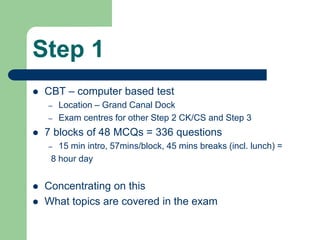
 CBT – computer based test
– Location – Grand Canal Dock
– Exam centres for other Step 2 CK/CS and Step 3
 7 blocks of 48 MCQs = 336 questions
– 15 min intro, 57mins/block, 45 mins breaks (incl. lunch) =
8 hour day
 Concentrating on this
 What topics are covered in the exam
Content
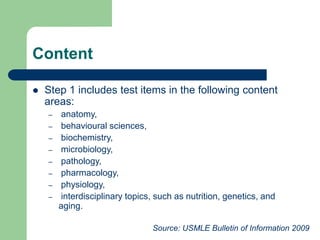
 Step 1 includes test items in the following content
areas:
– anatomy,
– behavioural sciences,
– biochemistry,
– microbiology,
– pathology,
– pharmacology,
– physiology,
– interdisciplinary topics, such as nutrition, genetics, and
aging.
Source: USMLE Bulletin of Information 2009
Recent changes to format of exam
 Number of questions reduced
 New types of questions being asked
– Auscultation!!
Time for a test….
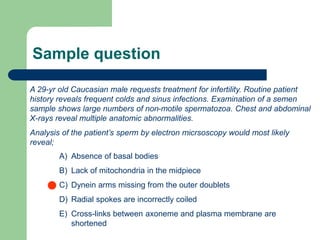
Sample question
A 29-yr old Caucasian male requests treatment for infertility. Routine patient
history reveals frequent colds and sinus infections. Examination of a semen
sample shows large numbers of non-motile spermatozoa. Chest and abdominal
X-rays reveal multiple anatomic abnormalities.
Analysis of the patient’s sperm by electron micrsoscopy would most likely
reveal;
A) Absence of basal bodies
B) Lack of mitochondria in the midpiece
C) Dynein arms missing from the outer doublets
D) Radial spokes are incorrectly coiled
E) Cross-links between axoneme and plasma membrane are
shortened
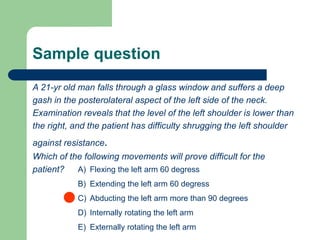
A 21-yr old man falls through a glass window and suffers a deep
gash in the posterolateral aspect of the left side of the neck.
Examination reveals that the level of the left shoulder is lower than
the right, and the patient has difficulty shrugging the left shoulder
against resistance.
Which of the following movements will prove difficult for the
patient?
Sample question
A) Flexing the left arm 60 degress
B) Extending the left arm 60 degress
C) Abducting the left arm more than 90 degrees
D) Internally rotating the left arm
E) Externally rotating the left arm
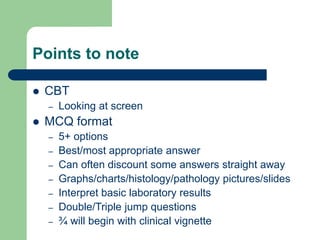
Points to note
 CBT
– Looking at screen
 MCQ format
– 5+ options
– Best/most appropriate answer
– Can often discount some answers straight away
– Graphs/charts/histology/pathology pictures/slides
– Interpret basic laboratory results
– Double/Triple jump questions
– ¾ will begin with clinical vignette
IMPORTANT
 Not every question asked will count towards
your final mark
 Test questions
 Weird/ridiculously difficult stuff
– Test – for future exams
 WILL NOT BE TOLD WHICH ONES DO NOT
COUNT
 Will be notified that your report is ready for
viewing
– Requires login to website
– Usually about 3 weeks after you sat it
 Given two numbers and a breakdown of how
you did by topic
 Complicated!
Step 1 Score
 Three digit number e.g. 210 (max 300?)
– Minimum to pass is 185
– Equivalent to answering about 60-70% of the
answers correctly
 Two digit number e.g. 87 (max 99)
– Minimum to pass is 75 (=185 on 3-digit)
– For each 1 point increase, your 3-digit score has
to go up by about 3
Step 1 Score
 What the scores are NOT:
– A percentage (e.g. you answered 95% correct)
– A percentile (e.g. you did better than 67% of the other
people who sat it)
 First Aid: “gauges how well you have performed with respect to
the content of the exam”
– Content of the exam is standardised; you get a mix of easy,
medium and hard questions
– Everyone who has sat it in the new format has gotten a
similar mix
– Scores should be comparable across different years
– Measures what level of knowledge you have
What does the score mean?
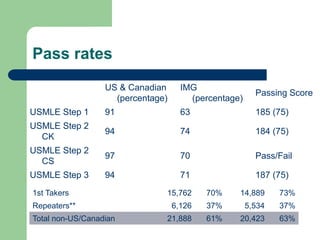
Pass rates
US & Canadian
(percentage)
IMG
(percentage)
Passing Score
USMLE Step 1 91 63 185 (75)
USMLE Step 2
CK
94 74 184 (75)
USMLE Step 2
CS
97 70 Pass/Fail
USMLE Step 3 94 71 187 (75)
1st Takers 15,762 70% 14,889 73%
Repeaters** 6,126 37% 5,534 37%
Total non-US/Canadian 21,888 61% 20,423 63%
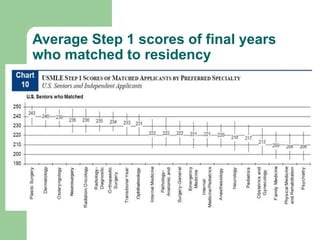
Average Step 1 scores of final years
who matched to residency
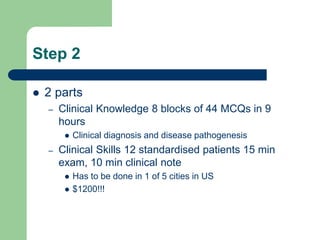
Step 2
 2 parts
– Clinical Knowledge 8 blocks of 44 MCQs in 9
hours
 Clinical diagnosis and disease pathogenesis
– Clinical Skills 12 standardised patients 15 min
exam, 10 min clinical note
 Has to be done in 1 of 5 cities in US
 $1200!!!
Step 3
 Examines ability to provide unsupervised
medical care
– Generally at the end of first year of residency
– 2 day exam
– Way down the line!!
– Does not have to be done in the 7 year period
 But recommended to do it within seven years of step 1?
Residency and the match
 Regina Lee
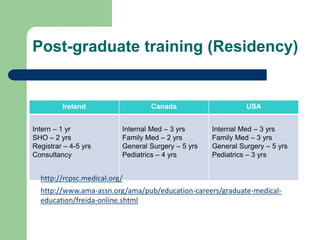
Post-graduate training (Residency)
Ireland Canada USA
Intern – 1 yr
SHO – 2 yrs
Registrar – 4-5 yrs
Consultancy
Internal Med – 3 yrs
Family Med – 2 yrs
General Surgery – 5 yrs
Pediatrics – 4 yrs
Internal Med – 3 yrs
Family Med – 3 yrs
General Surgery – 5 yrs
Pediatrics – 3 yrs
http://rcpsc.medical.org/
http://www.ama-assn.org/ama/pub/education-careers/graduate-medical-
education/freida-online.shtml
Match
 Organized by NRMP (USA)
 ERAS (USA), CaRMS (Canada)
 Apply to programs that interest you
 Those programs who are interested in you will contact
you for an interview
 After interviews, you rank the hospital programs you
want and the programs rank their candidates
 Computer (March) matches the hospitals with
applicants
 … What happens if you don’t match?
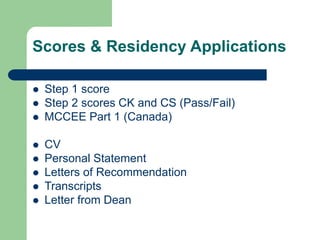
Scores & Residency Applications
 Step 1 score
 Step 2 scores CK and CS (Pass/Fail)
 MCCEE Part 1 (Canada)
 CV
 Personal Statement
 Letters of Recommendation
 Transcripts
 Letter from Dean
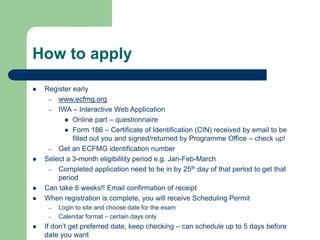
How to apply
 Register early
– www.ecfmg.org
– IWA – Interactive Web Application
 Online part – questionnaire
 Form 186 – Certificate of Identification (CIN) received by email to be
filled out you and signed/returned by Programme Office – check up!
– Get an ECFMG identification number
 Select a 3-month eligibilility period e.g. Jan-Feb-March
– Completed application need to be in by 25th day of that period to get that
period
 Can take 6 weeks!! Email confirmation of receipt
 When registration is complete, you will receive Scheduling Permit
– Login to site and choose date for the exam
– Calendar format – certain days only
 If don’t get preferred date, keep checking – can schedule up to 5 days before
date you want
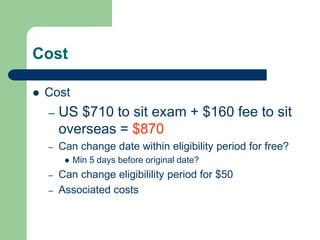
 Cost
– US $710 to sit exam + $160 fee to sit
overseas = $870
– Can change date within eligibility period for free?
 Min 5 days before original date?
– Can change eligibilility period for $50
– Associated costs
Cost
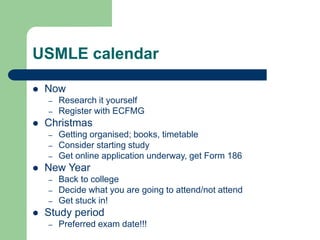
USMLE calendar
 Now
– Research it yourself
– Register with ECFMG
 Christmas
– Getting organised; books, timetable
– Consider starting study
– Get online application underway, get Form 186
 New Year
– Back to college
– Decide what you are going to attend/not attend
– Get stuck in!
 Study period
– Preferred exam date!!!
Setting an exam date
 Before Clinical Skills exams
– Fitting it in around skills sessions etc.
 During Clinical 1
 Summer
– Michael O’Reilly
If considering doing them….
 Definitely do them!
 Planning is key!!!
 Timetable
 Fix an exam date – AND STICK TO IT
– NBME test – are you ready??
 Don’t do them lightly
– Financial, time, social
How not do the USMLE step 1
 Not to be done lightly
 Think they are a walk in the park
– Topics not covered
 Do them because other people are
 Plan to take time off studying
– Short term memory
 Think you can do them part-time
– Social life, sport, recreation
Further information
 Study skills session in December
 www.ucdmedsoc.com
– Dedicated information page
 www.ecfmg.org
 http://rumorsweretrue.wordpress.com/usmle-
step-1/
 http://www.usmle.org/
Don’t forget!!
 Kaplan session – November
 Skills session – December
Questions?

USMLE_presentation.ppt

  • 1.
    USMLEs 2010 UCD MedicalSociety Thursday 29th October
  • 2.
    Outline of talk What the USMLEs are  Why do them  What’s involved  How to apply  When to do them  Kaplan session  Focus of this talk – Study skills and tips later session (Slides to go up on Medsoc website)
  • 3.
    What are theUSMLEs?  USMLE = United States Medical Licensing Exam – NBME and FSMB joint endeavour  3 parts – Step 1, 2 CK + CS, 3  ECFMG certification; 1 + 2 CK+ CS + degree  Must pass to be allowed practise medicine in US  Canada – Single exam  Time frame – 7 years
  • 4.
    USMLE 2009 Bulletinof Information “The USMLE assesses a physicians ability to apply knowledge, concepts, and principles, and to demonstrate fundamental patient- centred skills, that are important in health and disease and that constitute the basis of safe and effective patient care”
  • 5.
    Purpose of Step1 “assesses whether you understand and can apply important concepts of the sciences basic to the practice of medicine, with special emphasis on principles and mechanisms underlying health, disease, and modes of therapy. Step 1 ensures mastery of not only the sciences that provide a foundation for the safe and competent practice of medicine in the present, but also the scientific principles required for maintenance of competence through lifelong learning”
  • 6.
    “Whoop-de-doo, what doesit all mean Basil???”
  • 7.
    What are youbeing assessed on?  Your ability to apply concepts of medical science in an attempt to solve medical problems  Not simply rote learning  Thinking required!!
  • 8.
    Why do theUSMLEs?  Have option to work there in future – Training – Research – Fellowship  Revision of coursework to date – Learn topics/concepts not covered previously!
  • 9.
    So what thehell is the exam??
  • 10.
    Step 1  CBT– computer based test – Location – Grand Canal Dock – Exam centres for other Step 2 CK/CS and Step 3  7 blocks of 48 MCQs = 336 questions – 15 min intro, 57mins/block, 45 mins breaks (incl. lunch) = 8 hour day  Concentrating on this  What topics are covered in the exam
  • 11.
    Content  Step 1includes test items in the following content areas: – anatomy, – behavioural sciences, – biochemistry, – microbiology, – pathology, – pharmacology, – physiology, – interdisciplinary topics, such as nutrition, genetics, and aging. Source: USMLE Bulletin of Information 2009
  • 12.
    Recent changes toformat of exam  Number of questions reduced  New types of questions being asked – Auscultation!!
  • 13.
    Time for atest….
  • 14.
    Sample question A 29-yrold Caucasian male requests treatment for infertility. Routine patient history reveals frequent colds and sinus infections. Examination of a semen sample shows large numbers of non-motile spermatozoa. Chest and abdominal X-rays reveal multiple anatomic abnormalities. Analysis of the patient’s sperm by electron micrsoscopy would most likely reveal; A) Absence of basal bodies B) Lack of mitochondria in the midpiece C) Dynein arms missing from the outer doublets D) Radial spokes are incorrectly coiled E) Cross-links between axoneme and plasma membrane are shortened
  • 15.
    A 21-yr oldman falls through a glass window and suffers a deep gash in the posterolateral aspect of the left side of the neck. Examination reveals that the level of the left shoulder is lower than the right, and the patient has difficulty shrugging the left shoulder against resistance. Which of the following movements will prove difficult for the patient? Sample question A) Flexing the left arm 60 degress B) Extending the left arm 60 degress C) Abducting the left arm more than 90 degrees D) Internally rotating the left arm E) Externally rotating the left arm
  • 16.
    Points to note CBT – Looking at screen  MCQ format – 5+ options – Best/most appropriate answer – Can often discount some answers straight away – Graphs/charts/histology/pathology pictures/slides – Interpret basic laboratory results – Double/Triple jump questions – ¾ will begin with clinical vignette
  • 17.
    IMPORTANT  Not everyquestion asked will count towards your final mark  Test questions  Weird/ridiculously difficult stuff – Test – for future exams  WILL NOT BE TOLD WHICH ONES DO NOT COUNT
  • 18.
     Will benotified that your report is ready for viewing – Requires login to website – Usually about 3 weeks after you sat it  Given two numbers and a breakdown of how you did by topic  Complicated! Step 1 Score
  • 19.
     Three digitnumber e.g. 210 (max 300?) – Minimum to pass is 185 – Equivalent to answering about 60-70% of the answers correctly  Two digit number e.g. 87 (max 99) – Minimum to pass is 75 (=185 on 3-digit) – For each 1 point increase, your 3-digit score has to go up by about 3 Step 1 Score
  • 20.
     What thescores are NOT: – A percentage (e.g. you answered 95% correct) – A percentile (e.g. you did better than 67% of the other people who sat it)  First Aid: “gauges how well you have performed with respect to the content of the exam” – Content of the exam is standardised; you get a mix of easy, medium and hard questions – Everyone who has sat it in the new format has gotten a similar mix – Scores should be comparable across different years – Measures what level of knowledge you have What does the score mean?
  • 22.
    Pass rates US &Canadian (percentage) IMG (percentage) Passing Score USMLE Step 1 91 63 185 (75) USMLE Step 2 CK 94 74 184 (75) USMLE Step 2 CS 97 70 Pass/Fail USMLE Step 3 94 71 187 (75) 1st Takers 15,762 70% 14,889 73% Repeaters** 6,126 37% 5,534 37% Total non-US/Canadian 21,888 61% 20,423 63%
  • 23.
    Average Step 1scores of final years who matched to residency
  • 24.
    Step 2  2parts – Clinical Knowledge 8 blocks of 44 MCQs in 9 hours  Clinical diagnosis and disease pathogenesis – Clinical Skills 12 standardised patients 15 min exam, 10 min clinical note  Has to be done in 1 of 5 cities in US  $1200!!!
  • 25.
    Step 3  Examinesability to provide unsupervised medical care – Generally at the end of first year of residency – 2 day exam – Way down the line!! – Does not have to be done in the 7 year period  But recommended to do it within seven years of step 1?
  • 26.
    Residency and thematch  Regina Lee
  • 27.
    Post-graduate training (Residency) IrelandCanada USA Intern – 1 yr SHO – 2 yrs Registrar – 4-5 yrs Consultancy Internal Med – 3 yrs Family Med – 2 yrs General Surgery – 5 yrs Pediatrics – 4 yrs Internal Med – 3 yrs Family Med – 3 yrs General Surgery – 5 yrs Pediatrics – 3 yrs http://rcpsc.medical.org/ http://www.ama-assn.org/ama/pub/education-careers/graduate-medical- education/freida-online.shtml
  • 28.
    Match  Organized byNRMP (USA)  ERAS (USA), CaRMS (Canada)  Apply to programs that interest you  Those programs who are interested in you will contact you for an interview  After interviews, you rank the hospital programs you want and the programs rank their candidates  Computer (March) matches the hospitals with applicants  … What happens if you don’t match?
  • 29.
    Scores & ResidencyApplications  Step 1 score  Step 2 scores CK and CS (Pass/Fail)  MCCEE Part 1 (Canada)  CV  Personal Statement  Letters of Recommendation  Transcripts  Letter from Dean
  • 30.
    How to apply Register early – www.ecfmg.org – IWA – Interactive Web Application  Online part – questionnaire  Form 186 – Certificate of Identification (CIN) received by email to be filled out you and signed/returned by Programme Office – check up! – Get an ECFMG identification number  Select a 3-month eligibilility period e.g. Jan-Feb-March – Completed application need to be in by 25th day of that period to get that period  Can take 6 weeks!! Email confirmation of receipt  When registration is complete, you will receive Scheduling Permit – Login to site and choose date for the exam – Calendar format – certain days only  If don’t get preferred date, keep checking – can schedule up to 5 days before date you want
  • 31.
     Cost – US$710 to sit exam + $160 fee to sit overseas = $870 – Can change date within eligibility period for free?  Min 5 days before original date? – Can change eligibilility period for $50 – Associated costs Cost
  • 32.
    USMLE calendar  Now –Research it yourself – Register with ECFMG  Christmas – Getting organised; books, timetable – Consider starting study – Get online application underway, get Form 186  New Year – Back to college – Decide what you are going to attend/not attend – Get stuck in!  Study period – Preferred exam date!!!
  • 33.
    Setting an examdate  Before Clinical Skills exams – Fitting it in around skills sessions etc.  During Clinical 1  Summer – Michael O’Reilly
  • 34.
    If considering doingthem….  Definitely do them!  Planning is key!!!  Timetable  Fix an exam date – AND STICK TO IT – NBME test – are you ready??  Don’t do them lightly – Financial, time, social
  • 35.
    How not dothe USMLE step 1  Not to be done lightly  Think they are a walk in the park – Topics not covered  Do them because other people are  Plan to take time off studying – Short term memory  Think you can do them part-time – Social life, sport, recreation
  • 36.
    Further information  Studyskills session in December  www.ucdmedsoc.com – Dedicated information page  www.ecfmg.org  http://rumorsweretrue.wordpress.com/usmle- step-1/  http://www.usmle.org/
  • 37.
    Don’t forget!!  Kaplansession – November  Skills session – December
  • 38.