THE EAQUALS FRAMEWORK FOR
LANGUAGE TEACHER TRAINING
AND DEVELOPMENT
Presentation by
Sue Hackett, Laura Muresan and Deniz Kurtoglu-Eken
Core project team, Sharon Celtek, Deniz Kurtoglu-Eken, Laura
Muresan, Frank Heyworth, Agnieszka Split, Jim Ferguson, Sue
Hackett. Project Coordinator: Richard Rossner
‘I observed a lot of teaching but is it equally
effective learning?’ Jim Scrivener, EAQUALS, April
2012

‘The

dictatorship of the communicative
classroom.’ Michael Swan, Dublin, 2011

• ‘20 years experience or one year repeated
20 times?’ George Pickering, IATEFL LAMSIG &
ACELS conference, Dublin 2008
Reflective practice:
‘the capacity to reflect on action so as to
engage in a process of continuous
learning’
Donald Schon

Critical in practice-based professional learning
where individuals are learning from their own
professional experience.
So what is the EAQUALS TD-FRAM?
• An open-ended inventory of descriptors for LT

professional competences across core stages of
development
• A pathway for professional development not
predicated by qualifications
• A multi-faceted guide to enable and foster selfassessment and self-awareness for the LT
practitioner
• A mechanism for the enhancement of professional
standing and reputation
Aims
 to help practising teachers to assess and reflect on
their own language teaching competences, but in
more detail and depth than with the EPG
 to assist in identifying training needs and plan
professional development for LT practitioners
 to encourage and motivate LTPs to continue their
professional development both independently and
with the support of their institutions
 to help document and support the design of public
training courses for LTPs
 to serve as a tool for evaluating and accrediting TT/

TD courses
What does the framework consist of?
 Three broad bands of professional development
 a set of principles expressed as Values and
Attitudes
 Five main areas with descriptors for knowledge
and skills for each
 Also a Glossary of terms, Case Studies,
Resources for familiarisation training
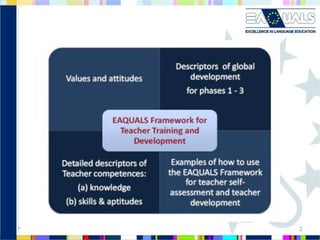
Values & Attitudes

Global Development
Descriptors
for Phases 1 - 3

EAQUALS Framework for
Teacher Self-assessment
& Teacher Development
Detailed Descriptors of
Teacher Competences:

(a) Knowledge
(b) Skills & aptitudes

Examples of how to use
the EAQUALS Framework
for Teacher Selfassessment & Teacher
Development
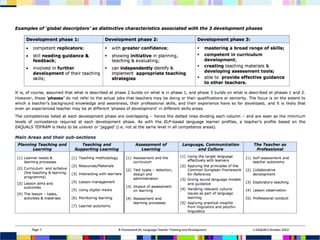
DEVELOPMENT PHASES
Overview of teaching competencies
across the 3 phases of development
From the detailed descriptions given in the
EAQUALS Framework for Self-Assessment, I
consider myself to be passing from the first
stage to the second. I still rely on examples of
good practice and I am very responsive to
feedback. […]
For the last main descriptor, the teacher as
professional, there are five key areas to cover:
self-assessment and teacher autonomy,
collaborative development, exploratory
teaching, lesson observation and professional
conduct.
All those five key areas are very important. I
try, although not always successfully, to
manage self development independently […]
With some of my colleagues, even when we go
out for leisure activities, over a cup of coffee
we still discuss job-related issues. I take this
opportunity to learn from them, from their
activity and experience (which is not only local
but also from abroad).
Teacher Training and Development
Framework (TDFRAM)

2013

1
*

2
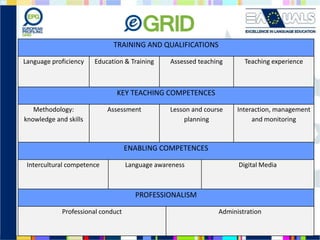
TRAINING AND QUALIFICATIONS
Language proficiency

Education & Training

Assessed teaching

Teaching experience

KEY TEACHING COMPETENCES
Methodology:
knowledge and skills

Assessment

Lesson and course
planning

Interaction, management
and monitoring

ENABLING COMPETENCES
Intercultural competence

Language awareness

Digital Media

PROFESSIONALISM
Professional conduct
*

Administration
3
*

4
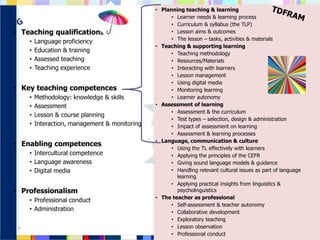
• Teaching qualifications
•
•
•
•

Language proficiency
Education & training
Assessed teaching
Teaching experience

• Key teaching competences
•
•
•
•

Methodology: knowledge & skills
Assessment
Lesson & course planning
Interaction, management & monitoring

• Enabling competences
• Intercultural competence
• Language awareness
• Digital media

• Professionalism
• Professional conduct
• Administration
*

.

• Planning teaching & learning
• Learner needs & learning process
• Curriculum & syllabus (the TLP)
• Lesson aims & outcomes
• The lesson – tasks, activities & materials
• Teaching & supporting learning
• Teaching methodology
• Resources/Materials
• Interacting with learners
• Lesson management
• Using digital media
• Monitoring learning
• Learner autonomy
• Assessment of learning
• Assessment & the curriculum
• Test types – selection, design & administration
• Impact of assessment on learning
• Assessment & learning processes
• Language, communication & culture
• Using the TL effectively with learners
• Applying the principles of the CEFR
• Giving sound language models & guidance
• Handling relevant cultural issues as part of language
learning
• Applying practical insights from linguistics &
psycholinguistics
• The teacher as professional
• Self-assessment & teacher autonomy
• Collaborative development
• Exploratory teaching
• Lesson observation
• Professional conduct
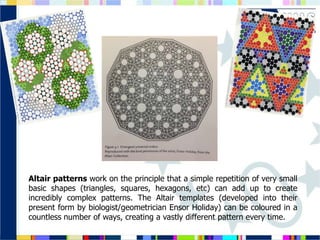
Altair patterns work on the principle that a simple repetition of very small
basic shapes (triangles, squares, hexagons, etc) can add up to create
incredibly complex patterns. The Altair templates (developed into their
present form by biologist/geometrician Ensor Holiday) can be coloured in a
countless number of ways, creating a vastly different pattern every time.
T h a n k

y o u !
7

Using the Teacher Development Framework

  • 1.
    THE EAQUALS FRAMEWORKFOR LANGUAGE TEACHER TRAINING AND DEVELOPMENT Presentation by Sue Hackett, Laura Muresan and Deniz Kurtoglu-Eken Core project team, Sharon Celtek, Deniz Kurtoglu-Eken, Laura Muresan, Frank Heyworth, Agnieszka Split, Jim Ferguson, Sue Hackett. Project Coordinator: Richard Rossner
  • 2.
    ‘I observed alot of teaching but is it equally effective learning?’ Jim Scrivener, EAQUALS, April 2012 ‘The dictatorship of the communicative classroom.’ Michael Swan, Dublin, 2011 • ‘20 years experience or one year repeated 20 times?’ George Pickering, IATEFL LAMSIG & ACELS conference, Dublin 2008
  • 3.
    Reflective practice: ‘the capacityto reflect on action so as to engage in a process of continuous learning’ Donald Schon Critical in practice-based professional learning where individuals are learning from their own professional experience.
  • 4.
    So what isthe EAQUALS TD-FRAM? • An open-ended inventory of descriptors for LT professional competences across core stages of development • A pathway for professional development not predicated by qualifications • A multi-faceted guide to enable and foster selfassessment and self-awareness for the LT practitioner • A mechanism for the enhancement of professional standing and reputation
  • 5.
    Aims  to helppractising teachers to assess and reflect on their own language teaching competences, but in more detail and depth than with the EPG  to assist in identifying training needs and plan professional development for LT practitioners  to encourage and motivate LTPs to continue their professional development both independently and with the support of their institutions  to help document and support the design of public training courses for LTPs  to serve as a tool for evaluating and accrediting TT/ TD courses
  • 6.
    What does theframework consist of?  Three broad bands of professional development  a set of principles expressed as Values and Attitudes  Five main areas with descriptors for knowledge and skills for each  Also a Glossary of terms, Case Studies, Resources for familiarisation training
  • 7.
    Values & Attitudes GlobalDevelopment Descriptors for Phases 1 - 3 EAQUALS Framework for Teacher Self-assessment & Teacher Development Detailed Descriptors of Teacher Competences: (a) Knowledge (b) Skills & aptitudes Examples of how to use the EAQUALS Framework for Teacher Selfassessment & Teacher Development
  • 8.
  • 9.
    Overview of teachingcompetencies across the 3 phases of development From the detailed descriptions given in the EAQUALS Framework for Self-Assessment, I consider myself to be passing from the first stage to the second. I still rely on examples of good practice and I am very responsive to feedback. […] For the last main descriptor, the teacher as professional, there are five key areas to cover: self-assessment and teacher autonomy, collaborative development, exploratory teaching, lesson observation and professional conduct. All those five key areas are very important. I try, although not always successfully, to manage self development independently […] With some of my colleagues, even when we go out for leisure activities, over a cup of coffee we still discuss job-related issues. I take this opportunity to learn from them, from their activity and experience (which is not only local but also from abroad).
  • 10.
    Teacher Training andDevelopment Framework (TDFRAM) 2013 1
  • 11.
  • 12.
    TRAINING AND QUALIFICATIONS Languageproficiency Education & Training Assessed teaching Teaching experience KEY TEACHING COMPETENCES Methodology: knowledge and skills Assessment Lesson and course planning Interaction, management and monitoring ENABLING COMPETENCES Intercultural competence Language awareness Digital Media PROFESSIONALISM Professional conduct * Administration 3
  • 13.
  • 14.
    • Teaching qualifications • • • • Languageproficiency Education & training Assessed teaching Teaching experience • Key teaching competences • • • • Methodology: knowledge & skills Assessment Lesson & course planning Interaction, management & monitoring • Enabling competences • Intercultural competence • Language awareness • Digital media • Professionalism • Professional conduct • Administration * . • Planning teaching & learning • Learner needs & learning process • Curriculum & syllabus (the TLP) • Lesson aims & outcomes • The lesson – tasks, activities & materials • Teaching & supporting learning • Teaching methodology • Resources/Materials • Interacting with learners • Lesson management • Using digital media • Monitoring learning • Learner autonomy • Assessment of learning • Assessment & the curriculum • Test types – selection, design & administration • Impact of assessment on learning • Assessment & learning processes • Language, communication & culture • Using the TL effectively with learners • Applying the principles of the CEFR • Giving sound language models & guidance • Handling relevant cultural issues as part of language learning • Applying practical insights from linguistics & psycholinguistics • The teacher as professional • Self-assessment & teacher autonomy • Collaborative development • Exploratory teaching • Lesson observation • Professional conduct
  • 15.
    Altair patterns workon the principle that a simple repetition of very small basic shapes (triangles, squares, hexagons, etc) can add up to create incredibly complex patterns. The Altair templates (developed into their present form by biologist/geometrician Ensor Holiday) can be coloured in a countless number of ways, creating a vastly different pattern every time.
  • 16.
    T h an k y o u ! 7

Editor's Notes

  • #3 JS quote: Good teaching but is it good learning – has standardising teaching practised according to assessment standards set by international ELT qualification bodies resulted in suppressing learning? Is good teaching as defined for a new teacher the same as for a more experienced teacher? Lesson plan example ... Is challenge being overlooked in preference to happy learners? Is student satisfaction taking the place of evaluating learning? Is teacher development/ training being constrained by standards set by a few qualification bodies whose concerns are also consistency and equity across a large range of contexts internationally?MS: language as communication not as knowledge of linguistics – practical, applicable, interactive, unpredictable, authentic etc – but how has this been translated into the LL CR? How many of us see pairwork/ groupwork being used for no apparent purpose? How many of us see tasks described like this in coursebooks without a clear rationale why? In the quest for quality delivery mechanisms have we allowed ourselves to become bound to arbitrary procedures which are not always fit for context or purpose and forget the real purpose of effecting learning.GP: tchrs are not classifiable into a homogeneous group – in any group there will be an unpredictable range of interests, motivations, expectations. CPD is inevitable – it is simply how it is managed and directed to be as stimulating appropriate and useful as possible. The conundrum of experience as a single measure of PD – richness, variety, blend of old and new, contexts, risks etc
  • #6 Acts as a complement to the EAQUALS Profiling Grid