The new world of special EdInclusion and StandardsBlake Plankers SPED 413
Critical Legislative and Federal initiativesThe world of Special Education would not exist as it does today without various legislation and federal programs. These acts ultimately set the standard for how Special Ed. Programs operate.
No child left behind actReinforced standards based movement that had been going on for years priorHeld educators more accountable for performance and application of standardsProvides funds for students to seek supplemental education (ie. Tutor)Emphasis on reading.Makes sure all teachers are fully qualified and competentTeacher’s work is evaluated through high stakes testingConflict of compatibility between standards and individual needs of students
PL 94-142/ IDEAThis law is meant to ensure that all students, with or without disability, receive a free, appropriate education based on their individual needsSchools must provide services necessary to students with disabilities through the use of an Individualized Education Program (IEP)Parents work in conjunction with an IEP team to decide the best approach to their child’s educationSchools provide transitional services at age 16 to prepare students for the post-school life
Section 504Expands supplemental services for student who may not qualify under IDEA but still experiences difficulty learning.Protects a greater array of students by providing accommodations to help them learn.
Americans with disabilities actExpands on IDEA and Section 504 by ensuring the rights of people with disabilities beyond the school system.Establishes guidelines for employment, public accommodations, state and local governmental operations, and telecommunications systemsProtects from discrimination
Main components in special education of todayIngredients for success
Standards-based EducationState-created goals and content that all children must learn in the core areas of Language Arts, Math, Social Studies, and ScienceStandards fall into 2 categories: Content (comprehended knowledge) and Performance (demonstration of knowledge)Standards are also dissected into three main components: Standard (what student must learn), Benchmark (specific statement of what student must do to show he/she learned), and Indicator (evidence that student has completed the standard)
Student accountability Ensures that students are learning the standards through high-stakes testingAnnual testing in grades 3-8 in reading and mathStudents with disabilities  are often given an alternative assessment as decided upon by their IEP team
InclusionA philosophy designed to create a sense of belonging, solidarity, and understanding among students with or without disabilityEnsures that all students have access to general curriculum with consideration to their specific needs and goalsThis is accomplished through a multitiered system of addressing individual needs
Response to Intervention (RTI)Provides an appropriate level of intervention based upon the individual needs of students at-risk and/or with disability through a three tiered systemTier 1: All students receive differentiated instruction by a general ed teacher. Tier 2: Builds upon instruction in tier one to meet the needs of those who don’t respond to tier one. This supplemental instruction is delivered in small groups to few students.Tier 3: More intensive, evidence-based instruction is provided to individuals who require more accommodations to their learning process.Tiers 2 and 3 do not replace the core curriculum but rather supplement it.
Universal Design for learningOperates under the assumption that everyone has individual learning preferences and expresses said learning through multiple facets “as unique as one’s fingerprint” (UDL At a Glance)UDL is utilized to systematically design curriculum for a diverse student population through multi-modal activities, giving students a variety of options to show what they’ve learned, and engaging students in a way that makes them enthusiastic and interested in the curriculum.
Differentiated instructionAn approach to education, most heavily advocated by Carol Ann Tomlinson, that calls for more individualized instructionIt is a process that involves discovering and assessing individual student needs in order to more accurately determine an appropriate approach to standards/curriculum.For example, if a student responds more to visual stimuli, a teacher might show a video or demonstrate what he/she is teaching.
Evidence-Based PracticeSeeks to align research data and practiceApplies the scientific method to determine the effectiveness of pedagogyAll instructional practices should have their basis in empirical research.
Diversity ConsiderationsClosely tied with differentiation and UDL, diversity considerations expand upon factors that merit specialized instruction or RTI.Goes beyond the traditional factors such as behavioral, physical, and cognitive abilities and includes socio-economic status, sexual orientation, cultural, and racial factorsIt has been determined that these features within an individual have an effect on how he/she learns thus requiring differentiated instruction.
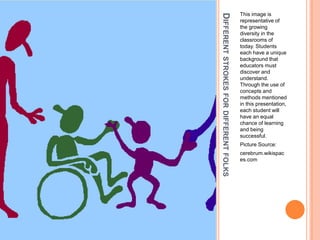
Different strokes for different folksThis image is representative of the growing diversity in the classrooms of today. Students each have a unique background that educators must discover and understand. Through the use of concepts and methods mentioned in this presentation, each student will have an equal chance of learning and being successful. Picture Source:cerebrum.wikispaces.com
ReferencesPolloway, E. A., Patton, J. R., & Serna, L. (2008). Strategies for Teaching Learners with Special Needs (9th ed.). Upper  Saddle River, NJ: Pearson. 3-21.http://www.youtube.com/watch?v=bDvKnY0g6e4&feature=player_embeddedhttp://www.youtube.com/watch?v=nkK1bT8ls0M&feature=player_embedded

Chapter one in review

  • 1.
    The new worldof special EdInclusion and StandardsBlake Plankers SPED 413
  • 2.
    Critical Legislative andFederal initiativesThe world of Special Education would not exist as it does today without various legislation and federal programs. These acts ultimately set the standard for how Special Ed. Programs operate.
  • 3.
    No child leftbehind actReinforced standards based movement that had been going on for years priorHeld educators more accountable for performance and application of standardsProvides funds for students to seek supplemental education (ie. Tutor)Emphasis on reading.Makes sure all teachers are fully qualified and competentTeacher’s work is evaluated through high stakes testingConflict of compatibility between standards and individual needs of students
  • 4.
    PL 94-142/ IDEAThislaw is meant to ensure that all students, with or without disability, receive a free, appropriate education based on their individual needsSchools must provide services necessary to students with disabilities through the use of an Individualized Education Program (IEP)Parents work in conjunction with an IEP team to decide the best approach to their child’s educationSchools provide transitional services at age 16 to prepare students for the post-school life
  • 5.
    Section 504Expands supplementalservices for student who may not qualify under IDEA but still experiences difficulty learning.Protects a greater array of students by providing accommodations to help them learn.
  • 6.
    Americans with disabilitiesactExpands on IDEA and Section 504 by ensuring the rights of people with disabilities beyond the school system.Establishes guidelines for employment, public accommodations, state and local governmental operations, and telecommunications systemsProtects from discrimination
  • 7.
    Main components inspecial education of todayIngredients for success
  • 8.
    Standards-based EducationState-created goalsand content that all children must learn in the core areas of Language Arts, Math, Social Studies, and ScienceStandards fall into 2 categories: Content (comprehended knowledge) and Performance (demonstration of knowledge)Standards are also dissected into three main components: Standard (what student must learn), Benchmark (specific statement of what student must do to show he/she learned), and Indicator (evidence that student has completed the standard)
  • 9.
    Student accountability Ensuresthat students are learning the standards through high-stakes testingAnnual testing in grades 3-8 in reading and mathStudents with disabilities are often given an alternative assessment as decided upon by their IEP team
  • 10.
    InclusionA philosophy designedto create a sense of belonging, solidarity, and understanding among students with or without disabilityEnsures that all students have access to general curriculum with consideration to their specific needs and goalsThis is accomplished through a multitiered system of addressing individual needs
  • 11.
    Response to Intervention(RTI)Provides an appropriate level of intervention based upon the individual needs of students at-risk and/or with disability through a three tiered systemTier 1: All students receive differentiated instruction by a general ed teacher. Tier 2: Builds upon instruction in tier one to meet the needs of those who don’t respond to tier one. This supplemental instruction is delivered in small groups to few students.Tier 3: More intensive, evidence-based instruction is provided to individuals who require more accommodations to their learning process.Tiers 2 and 3 do not replace the core curriculum but rather supplement it.
  • 12.
    Universal Design forlearningOperates under the assumption that everyone has individual learning preferences and expresses said learning through multiple facets “as unique as one’s fingerprint” (UDL At a Glance)UDL is utilized to systematically design curriculum for a diverse student population through multi-modal activities, giving students a variety of options to show what they’ve learned, and engaging students in a way that makes them enthusiastic and interested in the curriculum.
  • 13.
    Differentiated instructionAn approachto education, most heavily advocated by Carol Ann Tomlinson, that calls for more individualized instructionIt is a process that involves discovering and assessing individual student needs in order to more accurately determine an appropriate approach to standards/curriculum.For example, if a student responds more to visual stimuli, a teacher might show a video or demonstrate what he/she is teaching.
  • 14.
    Evidence-Based PracticeSeeks toalign research data and practiceApplies the scientific method to determine the effectiveness of pedagogyAll instructional practices should have their basis in empirical research.
  • 15.
    Diversity ConsiderationsClosely tiedwith differentiation and UDL, diversity considerations expand upon factors that merit specialized instruction or RTI.Goes beyond the traditional factors such as behavioral, physical, and cognitive abilities and includes socio-economic status, sexual orientation, cultural, and racial factorsIt has been determined that these features within an individual have an effect on how he/she learns thus requiring differentiated instruction.
  • 16.
    Different strokes fordifferent folksThis image is representative of the growing diversity in the classrooms of today. Students each have a unique background that educators must discover and understand. Through the use of concepts and methods mentioned in this presentation, each student will have an equal chance of learning and being successful. Picture Source:cerebrum.wikispaces.com
  • 17.
    ReferencesPolloway, E. A.,Patton, J. R., & Serna, L. (2008). Strategies for Teaching Learners with Special Needs (9th ed.). Upper Saddle River, NJ: Pearson. 3-21.http://www.youtube.com/watch?v=bDvKnY0g6e4&feature=player_embeddedhttp://www.youtube.com/watch?v=nkK1bT8ls0M&feature=player_embedded