2
TARGETED MARKETING
Often when you ask a small business owner who they are targeting as customers, their response is “Everyone”,
or “Anybody interested in…” They might refine this down to “homeowners” or “people who go to the gym”.
This is still too broad. The problem is with this is, not all consumers think alike, and not everyone is going to
purchase your product. Because of this broad focus, marketing can miss the mark.
Instead of trying to market to everybody, targeted marketing makes your product or service as attractive as
possible to certain groups of people. Firms focus their marketing efforts on a specific and defined audience.
Targeting focuses all marketing efforts on the defined group or groups of people MOST LIKELY to become
profitable customers. These groups of customers will have common characteristics and interests .
3
THE BENEFITS OF TARGETING
Targeted marketing is more affordable, efficient and effective at generating customer leads than mass
marketing. Businesses save money and have a better return on investment as they are not wasting time and
money marketing to people who will never be a customer or be a profitable customer. Instead, the target
audience is consumers who are more likely to become profitable customers.
This is especially important for small businesses with frugal marketing budgets. If we understand who our most
profitable customers are, we will know which customers are not profitable, and we can also overlook them with
our marketing which is important with paid advertising (why waste your money!?). Focusing on certain groups
of customers and their needs also helps creates a strategic focus as the firm must take a realistic and well
thought out approach to their product or service offering and their marketing.
4
WHAT IS A TARGET MARKET?
Identifying their target market/s is a crucial step for any firm when developing their strategic marketing plan. A
target market is the group/s of customers that a business focuses their marketing efforts on. It is a segment of
the total market for a good or service made up of people who share similar characteristics, defined by
demographics such as gender, location and age as well as criteria based on their consumer behaviour.
This target market determines other key factors for a product or service such as distribution and pricing, or it
can influence aspects of the product or service itself. After identifying what group/s of customers you wish to
target, you must learn their values and consumption habits. This will help you strategize how to communicate
with them effectively and ensure your offering best fits their requirements.
5
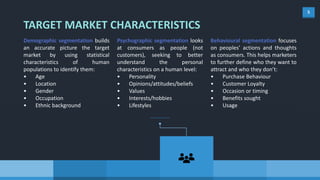
Demographic segmentation builds
an accurate picture the target
market by using statistical
characteristics of human
populations to identify them:
• Age
• Location
• Gender
• Occupation
• Ethnic background
Psychographic segmentation looks
at consumers as people (not
customers), seeking to better
understand the personal
characteristics on a human level:
• Personality
• Opinions/attitudes/beliefs
• Values
• Interests/hobbies
• Lifestyles
Behavioural segmentation focuses
on peoples’ actions and thoughts
as consumers. This helps marketers
to further define who they want to
attract and who they don’t:
• Purchase Behaviour
• Customer Loyalty
• Occasion or timing
• Benefits sought
• Usage
TARGET MARKET CHARACTERISTICS
6
Targeted advertising helps improve the efficiency of matching a brand’s products or services with customers. To
reach their target audience, marketers must consider how and where to communicate, to reach these people
and have them listen. Do they read the local paper every day? Are they browsing Facebook? They might watch
a lot of television. Once you have chosen where to advertise, what marketing message will best resonate with
them? Marketing must match customers preferences and behaviours. You will only learn this through trial and
error or market research.
Traditional marketing communications include television, radio or film advertising or product placements,
sponsorship of events or live sport, billboards, point of purchase placement, print advertising such as flyers,
business cards or newspaper and magazine adverts.
COMMUNICATING WITH YOUR TARGET MARKET
7
ADVANCES IN DIGITAL MARKETING
Digital marketing provides many targeted marketing tools such as email marketing, blogging and search engine
marketing or optimization and gives marketers a higher capacity for in-depth analysis of consumer behaviour
than was possible through traditional means of marketing. The growth and popularity of social media has
helped business to create highly customised and personalised targeted advertising based on the behaviours we
learn from peoples’ habits online.
Facebook is very popular for using targeted marketing. A big strength of Facebook is the huge audience (1.79
billion daily users) and the ability to create hyper-targeted advertising based on a vast number of attributes.
There are more than 240,000 attributes that marketers can combine to reach highly-specific audiences.
Daniel Hopper
Marketing Specialist - BYB MARKETING
#50WEEKSOFMARKETING
50 weeks of 50 marketing topics

Using targeted marketing to increase your ROI

  • 2.
    2 TARGETED MARKETING Often whenyou ask a small business owner who they are targeting as customers, their response is “Everyone”, or “Anybody interested in…” They might refine this down to “homeowners” or “people who go to the gym”. This is still too broad. The problem is with this is, not all consumers think alike, and not everyone is going to purchase your product. Because of this broad focus, marketing can miss the mark. Instead of trying to market to everybody, targeted marketing makes your product or service as attractive as possible to certain groups of people. Firms focus their marketing efforts on a specific and defined audience. Targeting focuses all marketing efforts on the defined group or groups of people MOST LIKELY to become profitable customers. These groups of customers will have common characteristics and interests .
  • 3.
    3 THE BENEFITS OFTARGETING Targeted marketing is more affordable, efficient and effective at generating customer leads than mass marketing. Businesses save money and have a better return on investment as they are not wasting time and money marketing to people who will never be a customer or be a profitable customer. Instead, the target audience is consumers who are more likely to become profitable customers. This is especially important for small businesses with frugal marketing budgets. If we understand who our most profitable customers are, we will know which customers are not profitable, and we can also overlook them with our marketing which is important with paid advertising (why waste your money!?). Focusing on certain groups of customers and their needs also helps creates a strategic focus as the firm must take a realistic and well thought out approach to their product or service offering and their marketing.
  • 4.
    4 WHAT IS ATARGET MARKET? Identifying their target market/s is a crucial step for any firm when developing their strategic marketing plan. A target market is the group/s of customers that a business focuses their marketing efforts on. It is a segment of the total market for a good or service made up of people who share similar characteristics, defined by demographics such as gender, location and age as well as criteria based on their consumer behaviour. This target market determines other key factors for a product or service such as distribution and pricing, or it can influence aspects of the product or service itself. After identifying what group/s of customers you wish to target, you must learn their values and consumption habits. This will help you strategize how to communicate with them effectively and ensure your offering best fits their requirements.
  • 5.
    5 Demographic segmentation builds anaccurate picture the target market by using statistical characteristics of human populations to identify them: • Age • Location • Gender • Occupation • Ethnic background Psychographic segmentation looks at consumers as people (not customers), seeking to better understand the personal characteristics on a human level: • Personality • Opinions/attitudes/beliefs • Values • Interests/hobbies • Lifestyles Behavioural segmentation focuses on peoples’ actions and thoughts as consumers. This helps marketers to further define who they want to attract and who they don’t: • Purchase Behaviour • Customer Loyalty • Occasion or timing • Benefits sought • Usage TARGET MARKET CHARACTERISTICS
  • 6.
    6 Targeted advertising helpsimprove the efficiency of matching a brand’s products or services with customers. To reach their target audience, marketers must consider how and where to communicate, to reach these people and have them listen. Do they read the local paper every day? Are they browsing Facebook? They might watch a lot of television. Once you have chosen where to advertise, what marketing message will best resonate with them? Marketing must match customers preferences and behaviours. You will only learn this through trial and error or market research. Traditional marketing communications include television, radio or film advertising or product placements, sponsorship of events or live sport, billboards, point of purchase placement, print advertising such as flyers, business cards or newspaper and magazine adverts. COMMUNICATING WITH YOUR TARGET MARKET
  • 7.
    7 ADVANCES IN DIGITALMARKETING Digital marketing provides many targeted marketing tools such as email marketing, blogging and search engine marketing or optimization and gives marketers a higher capacity for in-depth analysis of consumer behaviour than was possible through traditional means of marketing. The growth and popularity of social media has helped business to create highly customised and personalised targeted advertising based on the behaviours we learn from peoples’ habits online. Facebook is very popular for using targeted marketing. A big strength of Facebook is the huge audience (1.79 billion daily users) and the ability to create hyper-targeted advertising based on a vast number of attributes. There are more than 240,000 attributes that marketers can combine to reach highly-specific audiences.
  • 8.
    Daniel Hopper Marketing Specialist- BYB MARKETING #50WEEKSOFMARKETING 50 weeks of 50 marketing topics