Understanding your customers
to achieve business success
Sandeep Das, Independent Brand
Strategy Consultant
Defining who ‘you are selling to’ is critical
“Get closer than
ever to your
customers. So
close, in fact,
that you tell
them what they
need well
before they
realize it
themselves.” –
Steve Jobs
“Increasingly,
the mass
marketing is
turning into a
mass of niches”
– Chris
Anderson,
author of The
Long Tail
“Understand
why and how
your customers
interact with
brands they
already know
and then start
trying to align
your messaging
with those
partners” – Kurt
Uhlir, CEO
Sideqik
Identifying ‘who your customer is’ starts
at why you decided to start your business
The snap of inspiration
The ‘problem’ that you wanted to solve
Why you thought the ‘problem’ was relevant?
What did you intend to offer differently?
Why did you think it would have appeal?
How did you intend to add ‘value’?
Why did you think your solution was different?
Some aspects to understand while
defining your customer
Be very
narrow
Targeting is most
effective in
‘niches’. If you
have a product
with a broad
target group,
define the edges
very sharply
Choose
multiple
dimensions
Define your
customer using a
combination of
demographic,
psychographic
and attitudinal
metrics
Stay away
from
oversimplif
-ication
Ignore all the
hype and hoopla
around
Millennials, Gen
X, Gen Z etc.
Understand
broader
trends
No one lives in a
vacuum and
neither does your
customer
Observe
In this age of
digital driven
fleeting
engagement,
deep
observations still
have immense
value
Assess
market
viability
Your product
needs a market
and the market
needs to have
future viability
Assess
longevity
of appeal
Is your product a
‘one use’ wonder
or does it have
repeat value and
appeal?
What stage
is your
product?
Your target
customer expects
a finished product
that delivers on
all promised
dimensions
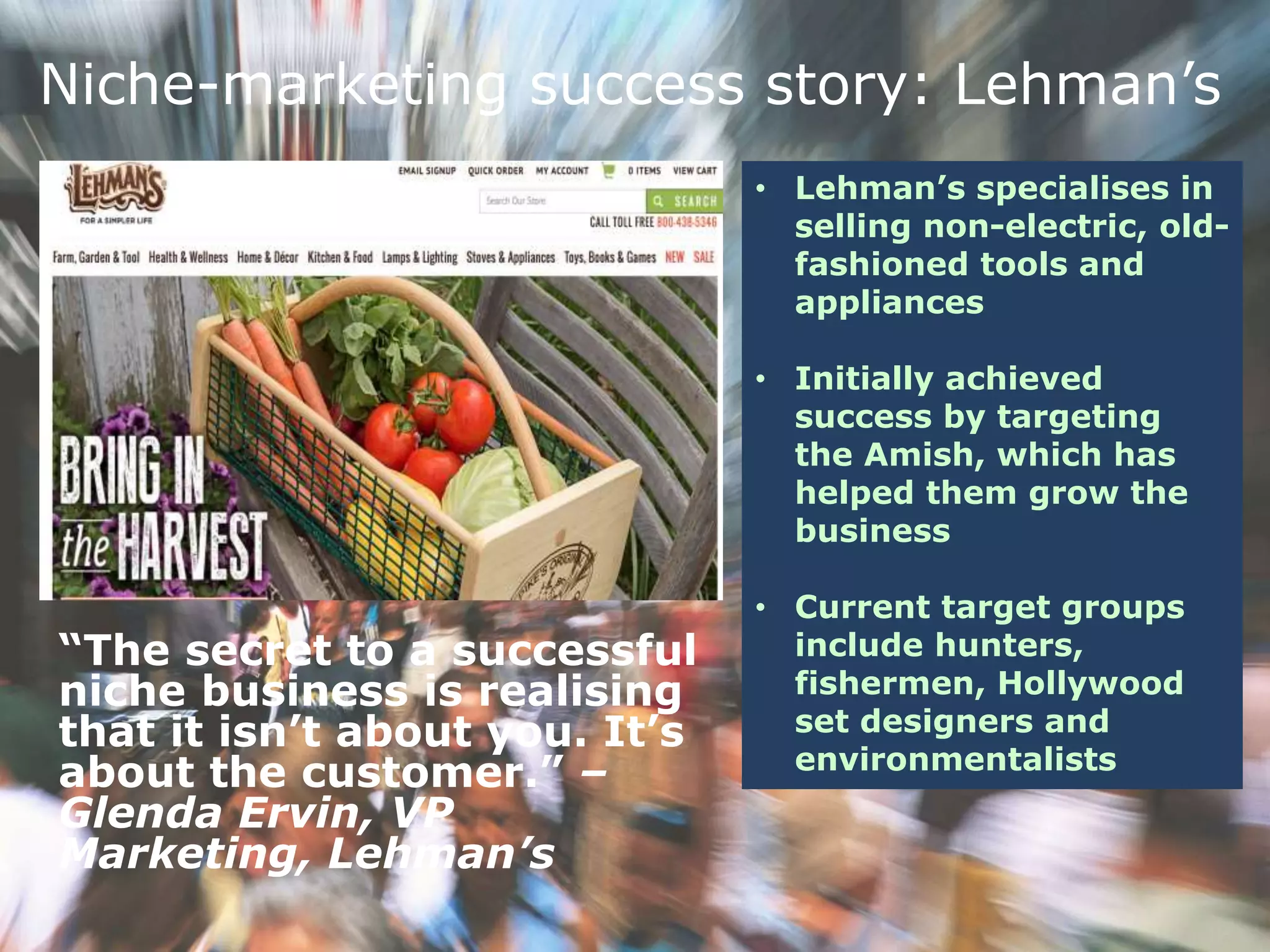
Niche-marketing success story: Lehman’s
• Lehman’s specialises in
selling non-electric, old-
fashioned tools and
appliances
• Initially achieved
success by targeting
the Amish, which has
helped them grow the
business
• Current target groups
include hunters,
fishermen, Hollywood
set designers and
environmentalists
“The secret to a successful
niche business is realising
that it isn’t about you. It’s
about the customer.” –
Glenda Ervin, VP
Marketing, Lehman’s
Creating a typology / description of your
target customer
Create a visual typology of your target customer.
But use the typology as a guiding tool, and not as a
set of rules and regulations.
Demographic
• Age
• Gender
• Education
• Socio-economic
status
• Income
• Presence / absence
of children
• Region / City
• Urban / Rural
• Household
responsibilities
• Household status
Psychographic
• Attitudes towards life
in general
• Media consumption
habits
• Shopping habits
• Social habits
• Community
involvement
• Charitable causes
• Environmental
causes
• Social causes
Attitudinal
• Specific attitudes
towards the category
of your product
• Shopping habits
towards specific
category
• Views towards
brands and products
• How brands are
selected? What
drives brand
selection?
Researching your target customer
Before you conduct any form of research to
understand your customer, you need to finalise the
questions you are looking for answers for:
How big is
your target
customer
base?
What trends
impact them?
What are their
biggest
challenges?
What solutions
are they
looking for?
What options
do they have
currently in
the market?
Are there new
opportunity
areas?
Does your
product tap
into any of
these
opportunity
areas?
How uniquely
differentiated
are you to the
competition?
How to research your target customer?
There are multiple ways and none of them break the
bank!!
Secondary
research
Consulting
with friends /
family /
colleagues
Deep
observations
Attending
network
groups /
startup
communities
Trade /
industry
publications
Attending
themed
conferences
Primary
research*
Keeping
abreast of and
analysing
trends
Expert
interviews /
conversations
Reading
theoretical /
industry
papers
Attending
breakfast and
lunch briefings
Following
influencers on
social media
Using Google Consumer Surveys
Identify the size of
consumer target group
Assess the size of the
problem that you are
trying to solve
Assess how
competitors are
faring in solving the
problem?
Your target consumer is defined, then
what?
Effective
targeting of
consumers
requires an
understanding of
2 key factors:
• Level of
fragmentation in
the market
• What are your
competitors up
to?
Unless you are
bringing a
disruptive
invention or
innovation into
the market, you
need to accept
and embrace
competition in
your product
development and
marketing
process
Absence of any
competition can
actually indicate
two issues:
• Is the problem
that you are
trying solve big
enough?
• If yes, what is
the nature of the
barriers to entry
and how big are
they?
Shaping your product in light of competition
(and when you know your target customer)
Positioning  Are there differentiating
elements you can own and communicate?
Value  What is your value equation? This is
not about the money but the impact on the
customers’ life
Problem  What emotional and functional
benefits is the customer going to derive?
Distinctiveness  How is your product different
from competition on functional and emotional
delivery?
1
2
3
4
Creating a differentiated product for an
identified target group
Innovation does not need to be a multi-million
dollar activity that only big corporations can afford
Setup Twitter
/ Facebook
polls
Google
Consumer
Surveys – Mini
U&As
Industry /
expert
interviews or
conversations
Involved in a
startup
community
Feedback on
Bulletin
Boards /
review sites
Product
reviews on
retailer,
aggregator
sites
Evolving
trends in a
specific
market or
category
If you a
sizeable
budget,
commission a
research
agency!!
Positioning a differentiated product to an
identified target group
No gaps in the
market but
existing
products not
delivering on
expectations
Significant gaps
in the market
exist and no
current
products deliver
on them
Create a new
market
altogether –
Does your
product have it?
Thank you & Questions
Sandeep Das, Independent Brand
Strategy Consultant
E: contact@sandeepdas.co
M: +44 750 3935 142

Understanding your consumers to achieve business success

  • 1.
    Understanding your customers toachieve business success Sandeep Das, Independent Brand Strategy Consultant
  • 2.
    Defining who ‘youare selling to’ is critical “Get closer than ever to your customers. So close, in fact, that you tell them what they need well before they realize it themselves.” – Steve Jobs “Increasingly, the mass marketing is turning into a mass of niches” – Chris Anderson, author of The Long Tail “Understand why and how your customers interact with brands they already know and then start trying to align your messaging with those partners” – Kurt Uhlir, CEO Sideqik
  • 3.
    Identifying ‘who yourcustomer is’ starts at why you decided to start your business The snap of inspiration The ‘problem’ that you wanted to solve Why you thought the ‘problem’ was relevant? What did you intend to offer differently? Why did you think it would have appeal? How did you intend to add ‘value’? Why did you think your solution was different?
  • 4.
    Some aspects tounderstand while defining your customer Be very narrow Targeting is most effective in ‘niches’. If you have a product with a broad target group, define the edges very sharply Choose multiple dimensions Define your customer using a combination of demographic, psychographic and attitudinal metrics Stay away from oversimplif -ication Ignore all the hype and hoopla around Millennials, Gen X, Gen Z etc. Understand broader trends No one lives in a vacuum and neither does your customer Observe In this age of digital driven fleeting engagement, deep observations still have immense value Assess market viability Your product needs a market and the market needs to have future viability Assess longevity of appeal Is your product a ‘one use’ wonder or does it have repeat value and appeal? What stage is your product? Your target customer expects a finished product that delivers on all promised dimensions
  • 5.
    Niche-marketing success story:Lehman’s • Lehman’s specialises in selling non-electric, old- fashioned tools and appliances • Initially achieved success by targeting the Amish, which has helped them grow the business • Current target groups include hunters, fishermen, Hollywood set designers and environmentalists “The secret to a successful niche business is realising that it isn’t about you. It’s about the customer.” – Glenda Ervin, VP Marketing, Lehman’s
  • 6.
    Creating a typology/ description of your target customer Create a visual typology of your target customer. But use the typology as a guiding tool, and not as a set of rules and regulations. Demographic • Age • Gender • Education • Socio-economic status • Income • Presence / absence of children • Region / City • Urban / Rural • Household responsibilities • Household status Psychographic • Attitudes towards life in general • Media consumption habits • Shopping habits • Social habits • Community involvement • Charitable causes • Environmental causes • Social causes Attitudinal • Specific attitudes towards the category of your product • Shopping habits towards specific category • Views towards brands and products • How brands are selected? What drives brand selection?
  • 7.
    Researching your targetcustomer Before you conduct any form of research to understand your customer, you need to finalise the questions you are looking for answers for: How big is your target customer base? What trends impact them? What are their biggest challenges? What solutions are they looking for? What options do they have currently in the market? Are there new opportunity areas? Does your product tap into any of these opportunity areas? How uniquely differentiated are you to the competition?
  • 8.
    How to researchyour target customer? There are multiple ways and none of them break the bank!! Secondary research Consulting with friends / family / colleagues Deep observations Attending network groups / startup communities Trade / industry publications Attending themed conferences Primary research* Keeping abreast of and analysing trends Expert interviews / conversations Reading theoretical / industry papers Attending breakfast and lunch briefings Following influencers on social media
  • 9.
    Using Google ConsumerSurveys Identify the size of consumer target group Assess the size of the problem that you are trying to solve Assess how competitors are faring in solving the problem?
  • 10.
    Your target consumeris defined, then what? Effective targeting of consumers requires an understanding of 2 key factors: • Level of fragmentation in the market • What are your competitors up to? Unless you are bringing a disruptive invention or innovation into the market, you need to accept and embrace competition in your product development and marketing process Absence of any competition can actually indicate two issues: • Is the problem that you are trying solve big enough? • If yes, what is the nature of the barriers to entry and how big are they?
  • 11.
    Shaping your productin light of competition (and when you know your target customer) Positioning  Are there differentiating elements you can own and communicate? Value  What is your value equation? This is not about the money but the impact on the customers’ life Problem  What emotional and functional benefits is the customer going to derive? Distinctiveness  How is your product different from competition on functional and emotional delivery? 1 2 3 4
  • 12.
    Creating a differentiatedproduct for an identified target group Innovation does not need to be a multi-million dollar activity that only big corporations can afford Setup Twitter / Facebook polls Google Consumer Surveys – Mini U&As Industry / expert interviews or conversations Involved in a startup community Feedback on Bulletin Boards / review sites Product reviews on retailer, aggregator sites Evolving trends in a specific market or category If you a sizeable budget, commission a research agency!!
  • 13.
    Positioning a differentiatedproduct to an identified target group No gaps in the market but existing products not delivering on expectations Significant gaps in the market exist and no current products deliver on them Create a new market altogether – Does your product have it?
  • 14.
    Thank you &Questions Sandeep Das, Independent Brand Strategy Consultant E: contact@sandeepdas.co M: +44 750 3935 142