MARKETING TERMINOLOGY
Demographics are quantifiable characteristics of a given population. Demographic analysis can cover whole societies or
groups defined by criteria such as education, nationality, religion, and ethnicity.
• Determine the age group your product or service will appeal to. Determine if one gender will be more likely to buy than
the other. Think about the income level of your target customer, which may go along with education level. If you do some
product research, select trial customers according to exclusive demographic categories. For example, if you are
interested in determining the best age group, don't mix seniors with teens.
• A sample target market profile focusing on demographics might read, "male teens with parents who are college-
educated and have incomes above $50,000." As a second example, you could write, "married women with children who
live in households with an income of less than $40,000."
MARKETING TERMINOLOGY
Geographic location
• Your products or services may appeal to people who live in specific regions. This would certainly
be true of fans of sports teams, but you might be surprised to find that consumers in rural areas
appreciate your products more than city dwellers, or that residents of southern states especially
like your products, to give some examples. The geographic portion of your target market profile
might say, "people who live in the rural areas of Oklahoma," or, "residents of the cities in
California."
MARKETING TERMINOLOGY
Psychographics
• Psychographics deals with lifestyle issues. Although it is clearly related to demographics,
psychographics is more concerned with the types of activities and interests your target customer
likes. Your target market profile dealing with psychographics might read, "people who like to play
tennis and tend to participate in political causes." You might also write, "motorcycle enthusiasts
who tend to go to road rallies."
MARKETING TERMINOLOGY
Behaviors
• The goal of looking at behaviors is to identify the kinds of problems your customers want to solve or the
needs they seek to identify. Once you understand how your product or service satisfies a customer's desire,
you can include a description of this function in your target profile. You could write, "target customers tend
to make impulse buys to satisfy their desire not to be left out of a good deal." You could also say, "my target
customer is a thoughtful person who carefully weighs the benefits of a purchase before buying."
MARKETING TERMINOLOGY
PUTTING IT ALL TOGETHER
• Your complete target market profile will use all the information you've gathered or surmised.
• A thorough profile could read, "males between ages 35 and 50 who live in suburban areas, enjoy golfing
and want to look stylish."
• Another example might say, "teenage girls living in the inner city who tend to idolize pop stars and buy
items that boost their status among their peers."
GETTING STARTED
MARKETING REVIEW
WHY TARGET A MARKET?
• In order to market a product or service, it is imperative that you tailor your marketing and sales
efforts to specifically reach the segment of population that will most likely buy your product or
service.
• It is critical that you first determine or clearly identify your primary market.
• Energies and funds can then can spent more efficiently.
WHY TARGET A MARKET?
• If you don’t know who your market is, how will you be able to assess whether you are meeting
their needs? Success in business and communications depends on meeting customers’ needs
and desires, you must know who your customers are, what they want, where they live and what
they can afford.
• Many small (and large) business owners say, ”My product is terrific! It appeals to everyone."
Many of us have also seen small businesses that try to be all things to all people. This is a
difficult, if not impossible, bridge to cross in design and marketing.
• Targeting your market is simply defining who your primary customer will be.
WHY TARGET A MARKET?
• Many small businesses survive by adapting to an explicit niche market (perhaps their
neighborhood) and survive by paying close attention to the needs of their existing clientele –
business that run on this model can be highly successful as long as they do not try to expand
outside of their niche.
• It is at the point when they decide to cross over to franchise or expanded locations that
marketing becomes critical to them – and many fail in their efforts because they do not
recognize this.
THE MARKET SHOULD BE MEASURABLE,
SUFFICIENTLY LARGE AND REACHABLE.
• For example, a printer’s target of mid-sized firms with mid-size projects is not a measurable
definition. However, a target market of firms within a radius of 20 miles, with annual revenues of
$10 to $25 million and a need for four-color printing runs of approximately 5,000 pieces is a
clear definition.
THERE MUST BE WAYS OF TALKING TO YOUR
TARGET AUDIENCE.
• Once your target market is defined through your knowledge of product appeals and market
analysis, and can be measured, you should determine whether that target market is large
enough to sustain your business on an ongoing basis. In addition, your target market needs to be
reachable.
TYPES OF MARKETS
A market is simply any group of actual or potential buyers of a product.
There are three major types of markets.
• The consumer market. Individuals and households who buy goods for their own use or benefit are
part of the consumer market. Drug and grocery items are the most common types of consumer
products.
• The industrial market. Individuals, groups or organizations that purchase your product or service for
direct use in producing other products or for use in their day-to-day operations.
• Middlemen or intermediaries, such as wholesalers and retailers, who buy finished goods and resell
them for a profit.
TYPES OF MARKETS
THERE ARE THREE STEPS TO FOLLOW WHEN IDENTIFYING YOUR MARKET:
1. IDENTIFY WHY A CUSTOMER WOULD WANT TO BUY YOUR PRODUCT/SERVICE
2. SEGMENT YOUR OVERALL MARKET
3. RESEARCH YOUR MARKET
STEP ONE — IDENTIFY WHY A CUSTOMER
WOULD WANT TO BUY YOUR PRODUCT/SERVICE
FEATURES AND BENEFITS
• The first step in identifying your target market is understanding what your products/services
have to offer to a group of people or businesses.
• To do this, identify your product or service’s features and benefits. A feature is a characteristic of
a product/service that automatically comes with it.
• For example: If a toothpaste has a stain-removing formula, that’s a feature.
• The benefit to the customer, however, is whiter teeth.
FEATURES AND BENEFITS
While features are valuable and can certainly enhance your product, benefits motivate people to
buy.
• An example is anti-lock brakes; they are features on a car.
• but the benefit to the consumer is safety.
By knowing what your product/service has to offer and what will make customers respond, you
can begin to identify common characteristics of your potential market.
FEATURES AND BENEFITS
For example, there are many different consumers who desire safety as a benefit when purchasing
a car.
• Rather than targeting everyone in their promotional strategy, a car manufacturer may opt to
target a specific group of consumers with similar characteristics, such as families with young
children. This is an example of market segmentation.
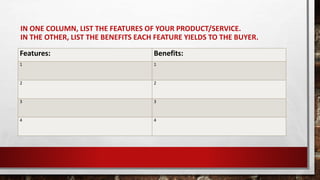
IN ONE COLUMN, LIST THE FEATURES OF YOUR PRODUCT/SERVICE.
IN THE OTHER, LIST THE BENEFITS EACH FEATURE YIELDS TO THE BUYER.
Features: Benefits:
1 1
2 2
3 3
4 4
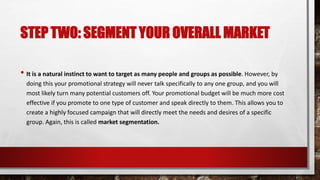
STEP TWO: SEGMENT YOUR OVERALL MARKET
• It is a natural instinct to want to target as many people and groups as possible. However, by
doing this your promotional strategy will never talk specifically to any one group, and you will
most likely turn many potential customers off. Your promotional budget will be much more cost
effective if you promote to one type of customer and speak directly to them. This allows you to
create a highly focused campaign that will directly meet the needs and desires of a specific
group. Again, this is called market segmentation.
Case study: Market Segmentation
CASE STUDY. A president of a management training firm had been marketing to fortune 500
companies more than a year. She received some business, but the competition was fierce. One
day, she received a call from the owner of a manufacturing plant who needed to have managers
trained.
The president agreed to take the job and found out there was virtually no competition for plant
manufacturing training services, because it was less glamorous to train in a manufacturing plant
than in executive offices of the fortune 500 companies.
Case study: Market Segmentation
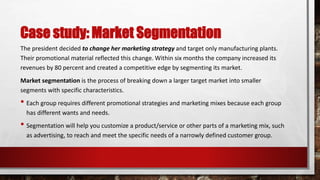
The president decided to change her marketing strategy and target only manufacturing plants.
Their promotional material reflected this change. Within six months the company increased its
revenues by 80 percent and created a competitive edge by segmenting its market.
Market segmentation is the process of breaking down a larger target market into smaller
segments with specific characteristics.
• Each group requires different promotional strategies and marketing mixes because each group
has different wants and needs.
• Segmentation will help you customize a product/service or other parts of a marketing mix, such
as advertising, to reach and meet the specific needs of a narrowly defined customer group.
Case study: Market Segmentation
Case study Career Options, a job placement firm, has a target market of the unemployed.
• While it’s true that anyone looking for a job is a potential customer, developing a focused
marketing strategy to reach such a broad market would be difficult, if not impossible.
Case study: Market Segmentation
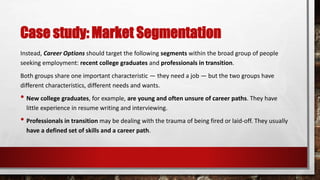
Instead, Career Options should target the following segments within the broad group of people
seeking employment: recent college graduates and professionals in transition.
Both groups share one important characteristic — they need a job — but the two groups have
different characteristics, different needs and wants.
• New college graduates, for example, are young and often unsure of career paths. They have
little experience in resume writing and interviewing.
• Professionals in transition may be dealing with the trauma of being fired or laid-off. They usually
have a defined set of skills and a career path.
Case study: Market Segmentation
Another example of market segmentation is the athletic shoe industry.
• Major manufactures of athletic shoes have several segmented markets.
• One segment is based on gender
• The other segment is based on the type of sport or activity.
• They have different promotional campaigns for each market segment.
Case study: Market Segmentation
Larger markets are most typically divided into smaller target market segments on the basis of
geographic, demographic, psychographic and behavioristic characteristics:
Geographic. Potential customers are in a local, state, regional or national marketplace segment. If you
are selling a product such as farm equipment, geographic location will remain a major factor in
segmenting your target markets since your customers are located in particular rural areas. Or, if you own
a retail store, geographic location of the store is one of the most important considerations.
• Climate is a commonly used geographic segmentation variable that affects industries such as heating
and air conditioning, sporting equipment, lawn equipment and building materials.
Decide if your business is going to do business on a local, regional, national or international level.
Identify the geographic region where your market is located. Identify specific boundaries within which
you will do business.
Case study: Market Segmentation
Demographic. Potential customers are identified by criteria such as age, race, religion, gender, income
level, family size, occupation, education level and marital status. Choose those characteristics of your
demographic target market that relates to the interest, need and ability of the customer to purchase
your product or service.
• For example, a target market for a real estate developer selling luxury vacation homes near Walt
Disney World would include professional married couples approximately 30 to 45 years old with young
children, and with incomes of more than $100,000.
Another example of targeting through demographics is Liz Claiborne apparel company.
• They have named their target market: her name is Liz Lady.
• They know Liz lady’s age, income range, professional status, family status, hobbies and interests.
• Every decision from marketing to design is based on liz lady’s profile.
Case study: Market Segmentation
Demographic. Potential customers are identified by criteria such as age, race, religion, gender, income
level, family size, occupation, education level and marital status. Choose those characteristics of your
demographic target market that relates to the interest, need and ability of the customer to purchase
your product or service.
• For example, a target market for a real estate developer selling luxury vacation homes near Walt
Disney World would include professional married couples approximately 30 to 45 years old with young
children, and with incomes of more than $100,000.
Another example of targeting through demographics is Liz Claiborne apparel company.
• They have named their target market: her name is Liz Lady.
• They know Liz lady’s age, income range, professional status, family status, hobbies and interests.
• Every decision from marketing to design is based on liz lady’s profile.
Case study: Market Segmentation
Business Market
• Geographic location
• Size of Company
• Annual revenue
• Number of Branches
• Number of Employees
• Industry
• Age of Company
Consumer Market
• Age
• Income
• Gender
• Profession
• Education
• Family Size
• Homeowner
• Marital Status
A demographic profile for a business would include
such factors as customer size, number of employees,
type of products, and annual revenue. If you are a
business-to-business marketer for example, you may
want to consider segmenting according to your target
customer’s size. A printing company may decide to
target only magazine publishers that publish more
than one magazine because they need high volume
accounts to make a profit.
Identify the demographic characteristics of your
market.
Case study: Market Segmentation
Psychographic. Many businesses offer products based on the attitudes, beliefs and emotions of their target market.
The desire for status, enhanced appearance and more money are examples of psychographic variables. They are
the factors that influence your customers’ purchasing decision. A seller of luxury items would appeal to an
individual’s desire for status symbols.
Business customers, as well as consumers, can be described in psychographic terms. Some companies view
themselves as cutting edge or high tech, while others consider themselves socially responsible, stable and strong.
Still others see themselves as innovative and creative. These distinctions help in determining how your company is
positioned and how you can use the company’s position as a marketing tactic.
• For example: southwest airlines has positioned itself as an innovative and fun airline that takes passengers on
short, inexpensive excursions, whereas delta chooses to promote reliability and safety.
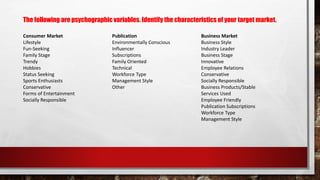
The following are psychographic variables. Identify the characteristics of your target market.
Consumer Market
Lifestyle
Fun-Seeking
Family Stage
Trendy
Hobbies
Status Seeking
Sports Enthusiasts
Conservative
Forms of Entertainment
Socially Responsible
Publication
Environmentally Conscious
Influencer
Subscriptions
Family Oriented
Technical
Workforce Type
Management Style
Other
Business Market
Business Style
Industry Leader
Business Stage
Innovative
Employee Relations
Conservative
Socially Responsible
Business Products/Stable
Services Used
Employee Friendly
Publication Subscriptions
Workforce Type
Management Style
Case study: Market Segmentation
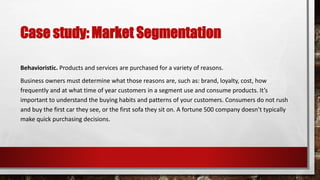
Behavioristic. Products and services are purchased for a variety of reasons.
Business owners must determine what those reasons are, such as: brand, loyalty, cost, how
frequently and at what time of year customers in a segment use and consume products. It’s
important to understand the buying habits and patterns of your customers. Consumers do not rush
and buy the first car they see, or the first sofa they sit on. A fortune 500 company doesn’t typically
make quick purchasing decisions.
Case study: Market Segmentation
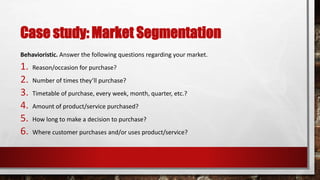
Behavioristic. Answer the following questions regarding your market.
1. Reason/occasion for purchase?
2. Number of times they’ll purchase?
3. Timetable of purchase, every week, month, quarter, etc.?
4. Amount of product/service purchased?
5. How long to make a decision to purchase?
6. Where customer purchases and/or uses product/service?
Case study: Market Segmentation
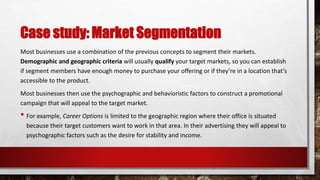
Most businesses use a combination of the previous concepts to segment their markets.
Demographic and geographic criteria will usually qualify your target markets, so you can establish
if segment members have enough money to purchase your offering or if they’re in a location that’s
accessible to the product.
Most businesses then use the psychographic and behavioristic factors to construct a promotional
campaign that will appeal to the target market.
• For example, Career Options is limited to the geographic region where their office is situated
because their target customers want to work in that area. In their advertising they will appeal to
psychographic factors such as the desire for stability and income.
Case study: Market Segmentation
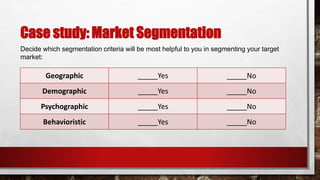
Decide which segmentation criteria will be most helpful to you in segmenting your target
market:
Geographic _____Yes _____No
Demographic _____Yes _____No
Psychographic _____Yes _____No
Behavioristic _____Yes _____No
Case study: Market Segmentation
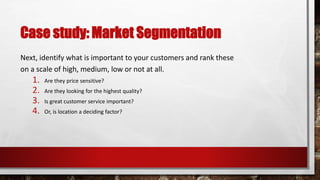
Next, identify what is important to your customers and rank these
on a scale of high, medium, low or not at all.
1. Are they price sensitive?
2. Are they looking for the highest quality?
3. Is great customer service important?
4. Or, is location a deciding factor?
Case study: Market Segmentation
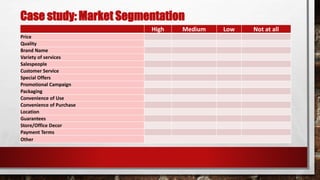
High Medium Low Not at all
Price
Quality
Brand Name
Variety of services
Salespeople
Customer Service
Special Offers
Promotional Campaign
Packaging
Convenience of Use
Convenience of Purchase
Location
Guarantees
Store/Office Decor
Payment Terms
Other
STEP THREE: RESEARCH YOUR MARKET
Data: for demographic and commercial sales information – you will
need to refer to ministry websites and other governmental
publications specific to KSA.
STEP THREE: RESEARCH YOUR MARKET
• Demographic, psychographic and behavioristic: surveys and focus groups
• The primary vehicles to obtain this information are surveys and focus groups. Surveys are
typically anonymous and try to reach as many members of a target market as possible. Focus
groups, on the other hand, attempt to get an understanding of a specific market segment by
questioning eight to 12 members of that group to discover what psychographic and
behavioristic factors might motivate the entire group. [You should consider hiring a marketing
research firm, since executing both questionnaires and focus groups can be complex
undertakings.] If hiring a marketing research firm is out of the question for your business at this
time, here are some suggestions for conducting your own survey research:
STEP THREE: RESEARCH YOUR MARKET
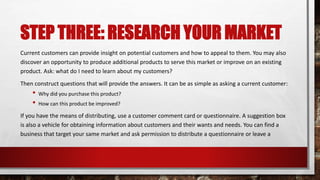
Current customers can provide insight on potential customers and how to appeal to them. You may also
discover an opportunity to produce additional products to serve this market or improve on an existing
product. Ask: what do I need to learn about my customers?
Then construct questions that will provide the answers. It can be as simple as asking a current customer:
• Why did you purchase this product?
• How can this product be improved?
If you have the means of distributing, use a customer comment card or questionnaire. A suggestion box
is also a vehicle for obtaining information about customers and their wants and needs. You can find a
business that target your same market and ask permission to distribute a questionnaire or leave a
STEP THREE: RESEARCH YOUR MARKET
After identifying and defining the possible segments within your target market, you must face the critical question of
whether it would be profitable and feasible for you to pursue each identified segment or choose one or two. To make this
decision, you must answer the following questions:
• What is the financial condition of my project? If you have limited resources, you may want to direct your marketing
efforts to only one segment. A concentrated advertising campaign to reach one market segment is likely to be more
effective than a diffuse campaign attempting to reach two.
• What segments are my competitors covering? Are they ignoring smaller segments that I can possibly exploit? The
printing company previously mentioned may decide to pursue small magazine publishers because there are many
competitors currently serving the needs of larger publishers. Or, career options may discover that since in their
geographic location there are several firms that specialize in helping professionals in transition, they should specialize in
the recent college graduate market.
• Is the project concept new to the area/region? If so, it may be better for you to concentrate on one segment for now and
expand to others when your initial segment has been successfully penetrated. Developing new markets takes a greater
commitment of time, money and energy.]
STEP THREE: RESEARCH YOUR MARKET
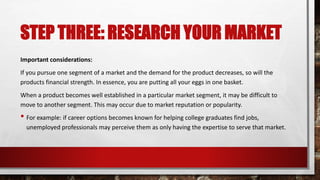
Important considerations:
If you pursue one segment of a market and the demand for the product decreases, so will the
products financial strength. In essence, you are putting all your eggs in one basket.
When a product becomes well established in a particular market segment, it may be difficult to
move to another segment. This may occur due to market reputation or popularity.
• For example: if career options becomes known for helping college graduates find jobs,
unemployed professionals may perceive them as only having the expertise to serve that market.
STEP THREE: RESEARCH YOUR MARKET
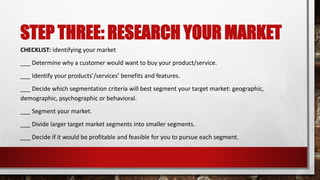
CHECKLIST: identifying your market
___ Determine why a customer would want to buy your product/service.
___ Identify your products’/services’ benefits and features.
___ Decide which segmentation criteria will best segment your target market: geographic,
demographic, psychographic or behavioral.
___ Segment your market.
___ Divide larger target market segments into smaller segments.
___ Decide if it would be profitable and feasible for you to pursue each segment.

Marketing

  • 2.
    MARKETING TERMINOLOGY Demographics arequantifiable characteristics of a given population. Demographic analysis can cover whole societies or groups defined by criteria such as education, nationality, religion, and ethnicity. • Determine the age group your product or service will appeal to. Determine if one gender will be more likely to buy than the other. Think about the income level of your target customer, which may go along with education level. If you do some product research, select trial customers according to exclusive demographic categories. For example, if you are interested in determining the best age group, don't mix seniors with teens. • A sample target market profile focusing on demographics might read, "male teens with parents who are college- educated and have incomes above $50,000." As a second example, you could write, "married women with children who live in households with an income of less than $40,000."
  • 3.
    MARKETING TERMINOLOGY Geographic location •Your products or services may appeal to people who live in specific regions. This would certainly be true of fans of sports teams, but you might be surprised to find that consumers in rural areas appreciate your products more than city dwellers, or that residents of southern states especially like your products, to give some examples. The geographic portion of your target market profile might say, "people who live in the rural areas of Oklahoma," or, "residents of the cities in California."
  • 4.
    MARKETING TERMINOLOGY Psychographics • Psychographicsdeals with lifestyle issues. Although it is clearly related to demographics, psychographics is more concerned with the types of activities and interests your target customer likes. Your target market profile dealing with psychographics might read, "people who like to play tennis and tend to participate in political causes." You might also write, "motorcycle enthusiasts who tend to go to road rallies."
  • 5.
    MARKETING TERMINOLOGY Behaviors • Thegoal of looking at behaviors is to identify the kinds of problems your customers want to solve or the needs they seek to identify. Once you understand how your product or service satisfies a customer's desire, you can include a description of this function in your target profile. You could write, "target customers tend to make impulse buys to satisfy their desire not to be left out of a good deal." You could also say, "my target customer is a thoughtful person who carefully weighs the benefits of a purchase before buying."
  • 6.
    MARKETING TERMINOLOGY PUTTING ITALL TOGETHER • Your complete target market profile will use all the information you've gathered or surmised. • A thorough profile could read, "males between ages 35 and 50 who live in suburban areas, enjoy golfing and want to look stylish." • Another example might say, "teenage girls living in the inner city who tend to idolize pop stars and buy items that boost their status among their peers."
  • 7.
  • 8.
    WHY TARGET AMARKET? • In order to market a product or service, it is imperative that you tailor your marketing and sales efforts to specifically reach the segment of population that will most likely buy your product or service. • It is critical that you first determine or clearly identify your primary market. • Energies and funds can then can spent more efficiently.
  • 9.
    WHY TARGET AMARKET? • If you don’t know who your market is, how will you be able to assess whether you are meeting their needs? Success in business and communications depends on meeting customers’ needs and desires, you must know who your customers are, what they want, where they live and what they can afford. • Many small (and large) business owners say, ”My product is terrific! It appeals to everyone." Many of us have also seen small businesses that try to be all things to all people. This is a difficult, if not impossible, bridge to cross in design and marketing. • Targeting your market is simply defining who your primary customer will be.
  • 10.
    WHY TARGET AMARKET? • Many small businesses survive by adapting to an explicit niche market (perhaps their neighborhood) and survive by paying close attention to the needs of their existing clientele – business that run on this model can be highly successful as long as they do not try to expand outside of their niche. • It is at the point when they decide to cross over to franchise or expanded locations that marketing becomes critical to them – and many fail in their efforts because they do not recognize this.
  • 11.
    THE MARKET SHOULDBE MEASURABLE, SUFFICIENTLY LARGE AND REACHABLE. • For example, a printer’s target of mid-sized firms with mid-size projects is not a measurable definition. However, a target market of firms within a radius of 20 miles, with annual revenues of $10 to $25 million and a need for four-color printing runs of approximately 5,000 pieces is a clear definition.
  • 12.
    THERE MUST BEWAYS OF TALKING TO YOUR TARGET AUDIENCE. • Once your target market is defined through your knowledge of product appeals and market analysis, and can be measured, you should determine whether that target market is large enough to sustain your business on an ongoing basis. In addition, your target market needs to be reachable.
  • 13.
    TYPES OF MARKETS Amarket is simply any group of actual or potential buyers of a product. There are three major types of markets. • The consumer market. Individuals and households who buy goods for their own use or benefit are part of the consumer market. Drug and grocery items are the most common types of consumer products. • The industrial market. Individuals, groups or organizations that purchase your product or service for direct use in producing other products or for use in their day-to-day operations. • Middlemen or intermediaries, such as wholesalers and retailers, who buy finished goods and resell them for a profit.
  • 14.
    TYPES OF MARKETS THEREARE THREE STEPS TO FOLLOW WHEN IDENTIFYING YOUR MARKET: 1. IDENTIFY WHY A CUSTOMER WOULD WANT TO BUY YOUR PRODUCT/SERVICE 2. SEGMENT YOUR OVERALL MARKET 3. RESEARCH YOUR MARKET
  • 15.
    STEP ONE —IDENTIFY WHY A CUSTOMER WOULD WANT TO BUY YOUR PRODUCT/SERVICE FEATURES AND BENEFITS • The first step in identifying your target market is understanding what your products/services have to offer to a group of people or businesses. • To do this, identify your product or service’s features and benefits. A feature is a characteristic of a product/service that automatically comes with it. • For example: If a toothpaste has a stain-removing formula, that’s a feature. • The benefit to the customer, however, is whiter teeth.
  • 16.
    FEATURES AND BENEFITS Whilefeatures are valuable and can certainly enhance your product, benefits motivate people to buy. • An example is anti-lock brakes; they are features on a car. • but the benefit to the consumer is safety. By knowing what your product/service has to offer and what will make customers respond, you can begin to identify common characteristics of your potential market.
  • 17.
    FEATURES AND BENEFITS Forexample, there are many different consumers who desire safety as a benefit when purchasing a car. • Rather than targeting everyone in their promotional strategy, a car manufacturer may opt to target a specific group of consumers with similar characteristics, such as families with young children. This is an example of market segmentation.
  • 18.
    IN ONE COLUMN,LIST THE FEATURES OF YOUR PRODUCT/SERVICE. IN THE OTHER, LIST THE BENEFITS EACH FEATURE YIELDS TO THE BUYER. Features: Benefits: 1 1 2 2 3 3 4 4
  • 19.
    STEP TWO: SEGMENTYOUR OVERALL MARKET • It is a natural instinct to want to target as many people and groups as possible. However, by doing this your promotional strategy will never talk specifically to any one group, and you will most likely turn many potential customers off. Your promotional budget will be much more cost effective if you promote to one type of customer and speak directly to them. This allows you to create a highly focused campaign that will directly meet the needs and desires of a specific group. Again, this is called market segmentation.
  • 20.
    Case study: MarketSegmentation CASE STUDY. A president of a management training firm had been marketing to fortune 500 companies more than a year. She received some business, but the competition was fierce. One day, she received a call from the owner of a manufacturing plant who needed to have managers trained. The president agreed to take the job and found out there was virtually no competition for plant manufacturing training services, because it was less glamorous to train in a manufacturing plant than in executive offices of the fortune 500 companies.
  • 21.
    Case study: MarketSegmentation The president decided to change her marketing strategy and target only manufacturing plants. Their promotional material reflected this change. Within six months the company increased its revenues by 80 percent and created a competitive edge by segmenting its market. Market segmentation is the process of breaking down a larger target market into smaller segments with specific characteristics. • Each group requires different promotional strategies and marketing mixes because each group has different wants and needs. • Segmentation will help you customize a product/service or other parts of a marketing mix, such as advertising, to reach and meet the specific needs of a narrowly defined customer group.
  • 22.
    Case study: MarketSegmentation Case study Career Options, a job placement firm, has a target market of the unemployed. • While it’s true that anyone looking for a job is a potential customer, developing a focused marketing strategy to reach such a broad market would be difficult, if not impossible.
  • 23.
    Case study: MarketSegmentation Instead, Career Options should target the following segments within the broad group of people seeking employment: recent college graduates and professionals in transition. Both groups share one important characteristic — they need a job — but the two groups have different characteristics, different needs and wants. • New college graduates, for example, are young and often unsure of career paths. They have little experience in resume writing and interviewing. • Professionals in transition may be dealing with the trauma of being fired or laid-off. They usually have a defined set of skills and a career path.
  • 24.
    Case study: MarketSegmentation Another example of market segmentation is the athletic shoe industry. • Major manufactures of athletic shoes have several segmented markets. • One segment is based on gender • The other segment is based on the type of sport or activity. • They have different promotional campaigns for each market segment.
  • 25.
    Case study: MarketSegmentation Larger markets are most typically divided into smaller target market segments on the basis of geographic, demographic, psychographic and behavioristic characteristics: Geographic. Potential customers are in a local, state, regional or national marketplace segment. If you are selling a product such as farm equipment, geographic location will remain a major factor in segmenting your target markets since your customers are located in particular rural areas. Or, if you own a retail store, geographic location of the store is one of the most important considerations. • Climate is a commonly used geographic segmentation variable that affects industries such as heating and air conditioning, sporting equipment, lawn equipment and building materials. Decide if your business is going to do business on a local, regional, national or international level. Identify the geographic region where your market is located. Identify specific boundaries within which you will do business.
  • 26.
    Case study: MarketSegmentation Demographic. Potential customers are identified by criteria such as age, race, religion, gender, income level, family size, occupation, education level and marital status. Choose those characteristics of your demographic target market that relates to the interest, need and ability of the customer to purchase your product or service. • For example, a target market for a real estate developer selling luxury vacation homes near Walt Disney World would include professional married couples approximately 30 to 45 years old with young children, and with incomes of more than $100,000. Another example of targeting through demographics is Liz Claiborne apparel company. • They have named their target market: her name is Liz Lady. • They know Liz lady’s age, income range, professional status, family status, hobbies and interests. • Every decision from marketing to design is based on liz lady’s profile.
  • 27.
    Case study: MarketSegmentation Demographic. Potential customers are identified by criteria such as age, race, religion, gender, income level, family size, occupation, education level and marital status. Choose those characteristics of your demographic target market that relates to the interest, need and ability of the customer to purchase your product or service. • For example, a target market for a real estate developer selling luxury vacation homes near Walt Disney World would include professional married couples approximately 30 to 45 years old with young children, and with incomes of more than $100,000. Another example of targeting through demographics is Liz Claiborne apparel company. • They have named their target market: her name is Liz Lady. • They know Liz lady’s age, income range, professional status, family status, hobbies and interests. • Every decision from marketing to design is based on liz lady’s profile.
  • 28.
    Case study: MarketSegmentation Business Market • Geographic location • Size of Company • Annual revenue • Number of Branches • Number of Employees • Industry • Age of Company Consumer Market • Age • Income • Gender • Profession • Education • Family Size • Homeowner • Marital Status A demographic profile for a business would include such factors as customer size, number of employees, type of products, and annual revenue. If you are a business-to-business marketer for example, you may want to consider segmenting according to your target customer’s size. A printing company may decide to target only magazine publishers that publish more than one magazine because they need high volume accounts to make a profit. Identify the demographic characteristics of your market.
  • 29.
    Case study: MarketSegmentation Psychographic. Many businesses offer products based on the attitudes, beliefs and emotions of their target market. The desire for status, enhanced appearance and more money are examples of psychographic variables. They are the factors that influence your customers’ purchasing decision. A seller of luxury items would appeal to an individual’s desire for status symbols. Business customers, as well as consumers, can be described in psychographic terms. Some companies view themselves as cutting edge or high tech, while others consider themselves socially responsible, stable and strong. Still others see themselves as innovative and creative. These distinctions help in determining how your company is positioned and how you can use the company’s position as a marketing tactic. • For example: southwest airlines has positioned itself as an innovative and fun airline that takes passengers on short, inexpensive excursions, whereas delta chooses to promote reliability and safety.
  • 30.
    The following arepsychographic variables. Identify the characteristics of your target market. Consumer Market Lifestyle Fun-Seeking Family Stage Trendy Hobbies Status Seeking Sports Enthusiasts Conservative Forms of Entertainment Socially Responsible Publication Environmentally Conscious Influencer Subscriptions Family Oriented Technical Workforce Type Management Style Other Business Market Business Style Industry Leader Business Stage Innovative Employee Relations Conservative Socially Responsible Business Products/Stable Services Used Employee Friendly Publication Subscriptions Workforce Type Management Style
  • 31.
    Case study: MarketSegmentation Behavioristic. Products and services are purchased for a variety of reasons. Business owners must determine what those reasons are, such as: brand, loyalty, cost, how frequently and at what time of year customers in a segment use and consume products. It’s important to understand the buying habits and patterns of your customers. Consumers do not rush and buy the first car they see, or the first sofa they sit on. A fortune 500 company doesn’t typically make quick purchasing decisions.
  • 32.
    Case study: MarketSegmentation Behavioristic. Answer the following questions regarding your market. 1. Reason/occasion for purchase? 2. Number of times they’ll purchase? 3. Timetable of purchase, every week, month, quarter, etc.? 4. Amount of product/service purchased? 5. How long to make a decision to purchase? 6. Where customer purchases and/or uses product/service?
  • 33.
    Case study: MarketSegmentation Most businesses use a combination of the previous concepts to segment their markets. Demographic and geographic criteria will usually qualify your target markets, so you can establish if segment members have enough money to purchase your offering or if they’re in a location that’s accessible to the product. Most businesses then use the psychographic and behavioristic factors to construct a promotional campaign that will appeal to the target market. • For example, Career Options is limited to the geographic region where their office is situated because their target customers want to work in that area. In their advertising they will appeal to psychographic factors such as the desire for stability and income.
  • 34.
    Case study: MarketSegmentation Decide which segmentation criteria will be most helpful to you in segmenting your target market: Geographic _____Yes _____No Demographic _____Yes _____No Psychographic _____Yes _____No Behavioristic _____Yes _____No
  • 35.
    Case study: MarketSegmentation Next, identify what is important to your customers and rank these on a scale of high, medium, low or not at all. 1. Are they price sensitive? 2. Are they looking for the highest quality? 3. Is great customer service important? 4. Or, is location a deciding factor?
  • 36.
    Case study: MarketSegmentation High Medium Low Not at all Price Quality Brand Name Variety of services Salespeople Customer Service Special Offers Promotional Campaign Packaging Convenience of Use Convenience of Purchase Location Guarantees Store/Office Decor Payment Terms Other
  • 37.
    STEP THREE: RESEARCHYOUR MARKET Data: for demographic and commercial sales information – you will need to refer to ministry websites and other governmental publications specific to KSA.
  • 38.
    STEP THREE: RESEARCHYOUR MARKET • Demographic, psychographic and behavioristic: surveys and focus groups • The primary vehicles to obtain this information are surveys and focus groups. Surveys are typically anonymous and try to reach as many members of a target market as possible. Focus groups, on the other hand, attempt to get an understanding of a specific market segment by questioning eight to 12 members of that group to discover what psychographic and behavioristic factors might motivate the entire group. [You should consider hiring a marketing research firm, since executing both questionnaires and focus groups can be complex undertakings.] If hiring a marketing research firm is out of the question for your business at this time, here are some suggestions for conducting your own survey research:
  • 39.
    STEP THREE: RESEARCHYOUR MARKET Current customers can provide insight on potential customers and how to appeal to them. You may also discover an opportunity to produce additional products to serve this market or improve on an existing product. Ask: what do I need to learn about my customers? Then construct questions that will provide the answers. It can be as simple as asking a current customer: • Why did you purchase this product? • How can this product be improved? If you have the means of distributing, use a customer comment card or questionnaire. A suggestion box is also a vehicle for obtaining information about customers and their wants and needs. You can find a business that target your same market and ask permission to distribute a questionnaire or leave a
  • 40.
    STEP THREE: RESEARCHYOUR MARKET After identifying and defining the possible segments within your target market, you must face the critical question of whether it would be profitable and feasible for you to pursue each identified segment or choose one or two. To make this decision, you must answer the following questions: • What is the financial condition of my project? If you have limited resources, you may want to direct your marketing efforts to only one segment. A concentrated advertising campaign to reach one market segment is likely to be more effective than a diffuse campaign attempting to reach two. • What segments are my competitors covering? Are they ignoring smaller segments that I can possibly exploit? The printing company previously mentioned may decide to pursue small magazine publishers because there are many competitors currently serving the needs of larger publishers. Or, career options may discover that since in their geographic location there are several firms that specialize in helping professionals in transition, they should specialize in the recent college graduate market. • Is the project concept new to the area/region? If so, it may be better for you to concentrate on one segment for now and expand to others when your initial segment has been successfully penetrated. Developing new markets takes a greater commitment of time, money and energy.]
  • 41.
    STEP THREE: RESEARCHYOUR MARKET Important considerations: If you pursue one segment of a market and the demand for the product decreases, so will the products financial strength. In essence, you are putting all your eggs in one basket. When a product becomes well established in a particular market segment, it may be difficult to move to another segment. This may occur due to market reputation or popularity. • For example: if career options becomes known for helping college graduates find jobs, unemployed professionals may perceive them as only having the expertise to serve that market.
  • 42.
    STEP THREE: RESEARCHYOUR MARKET CHECKLIST: identifying your market ___ Determine why a customer would want to buy your product/service. ___ Identify your products’/services’ benefits and features. ___ Decide which segmentation criteria will best segment your target market: geographic, demographic, psychographic or behavioral. ___ Segment your market. ___ Divide larger target market segments into smaller segments. ___ Decide if it would be profitable and feasible for you to pursue each segment.