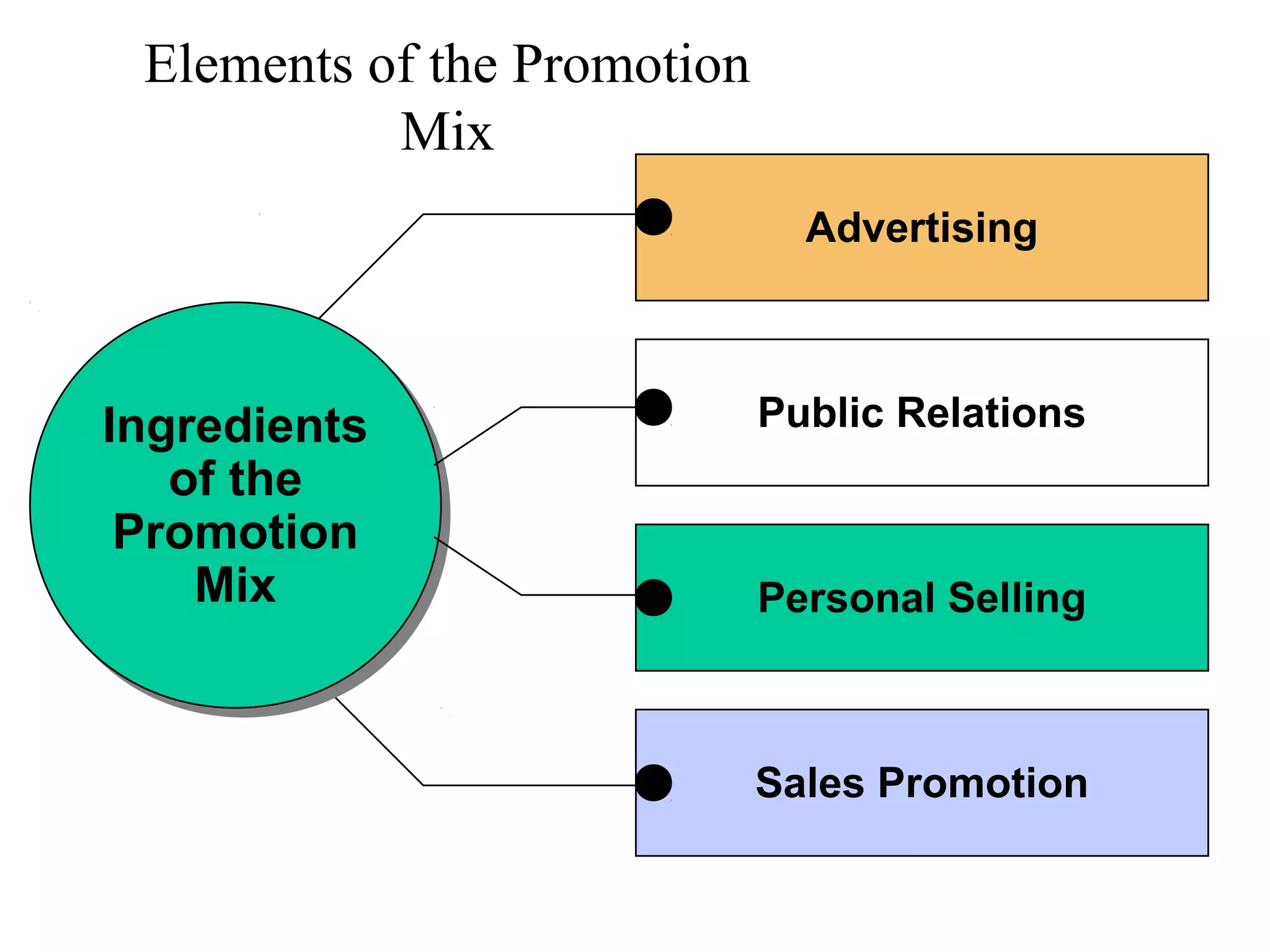
Elements of the Promotion
Mix
Advertising

Ingredients
Ingredients
of the
of the
Promotion
Promotion
Mix
Mix

Public Relations

Personal Selling

Sales Promotion
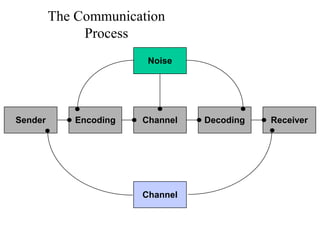
The Communication
Process
Noise

Sender

Encoding

Channel

Channel

Decoding

Receiver
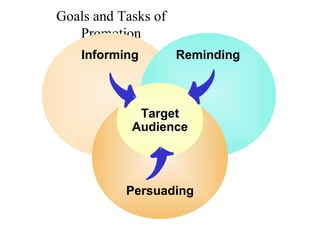
Goals and Tasks of
Promotion
Informing

Reminding

Target
Audience

Persuading
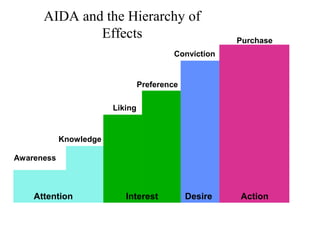
AIDA and the Hierarchy of
Effects

Purchase

Conviction

Preference
Liking

Knowledge
Awareness

Attention

Interest

Desire

Action
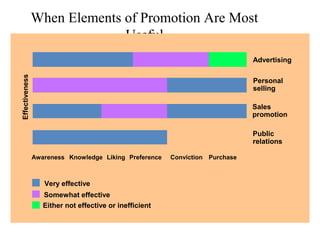
When Elements of Promotion Are Most
Useful
Effectiveness

Advertising
Personal
selling
Sales
promotion
Public
relations
Awareness Knowledge Liking Preference

Very effective
Somewhat effective
Either not effective or inefficient

Conviction Purchase
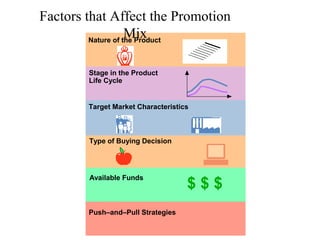
Factors that Affect the Promotion
Mix
Nature of the Product
Stage in the Product
Life Cycle

Target Market Characteristics

Type of Buying Decision

Available Funds

Push–and–Pull Strategies

$$$
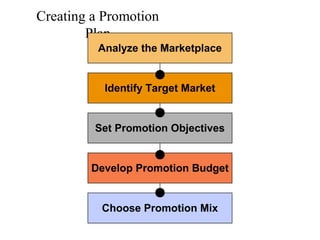
Creating a Promotion
Plan
Analyze the Marketplace

Identify Target Market

Set Promotion Objectives

Develop Promotion Budget

Choose Promotion Mix
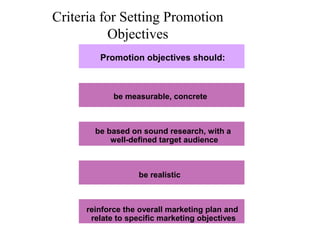
Criteria for Setting Promotion
Objectives
Promotion objectives should:

be measurable, concrete

be based on sound research, with a
well-defined target audience

be realistic

reinforce the overall marketing plan and
relate to specific marketing objectives
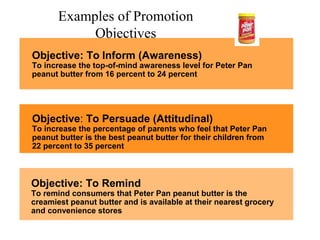
Examples of Promotion
Objectives
Objective: To Inform (Awareness)

To increase the top-of-mind awareness level for Peter Pan
peanut butter from 16 percent to 24 percent

Objective: To Persuade (Attitudinal)

To increase the percentage of parents who feel that Peter Pan
peanut butter is the best peanut butter for their children from
22 percent to 35 percent

Objective: To Remind

To remind consumers that Peter Pan peanut butter is the
creamiest peanut butter and is available at their nearest grocery
and convenience stores
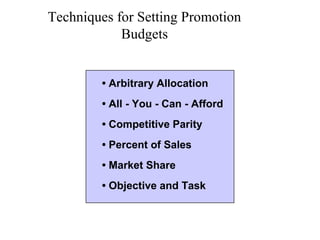
Techniques for Setting Promotion
Budgets

• Arbitrary Allocation
• All - You - Can - Afford
• Competitive Parity
• Percent of Sales
• Market Share
• Objective and Task
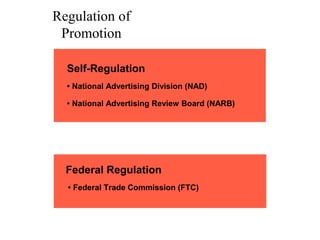
Regulation of
Promotion
Self-Regulation
• National Advertising Division (NAD)
• National Advertising Review Board (NARB)

Federal Regulation
• Federal Trade Commission (FTC)
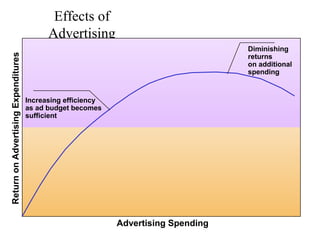
Return on Advertising Expenditures

Effects of
Advertising
Diminishing
returns
on additional
spending

Increasing efficiency
as ad budget becomes
sufficient

Advertising Spending
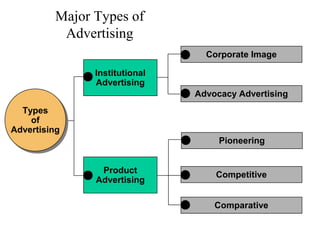
Major Types of
Advertising
Corporate Image
Institutional
Advertising
Advocacy Advertising
Types
Types
of
of
Advertising
Advertising

Pioneering
Product
Advertising

Competitive
Comparative
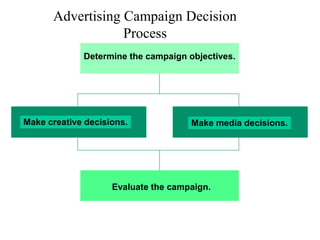
Advertising Campaign Decision
Process
Determine the campaign objectives.

Make creative decisions.

Make media decisions.

Evaluate the campaign.
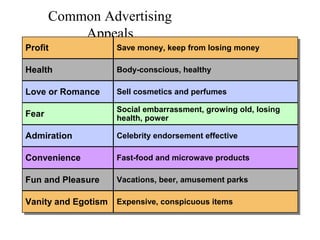
Common Advertising
Appeals
Profit
Profit

Save money, keep from losing money

Health
Health

Body-conscious, healthy

Love or Romance
Love or Romance

Sell cosmetics and perfumes

Fear
Fear

Social embarrassment, growing old, losing
health, power
health, power

Admiration
Admiration

Celebrity endorsement effective

Convenience
Convenience

Fast-food and microwave products

Fun and Pleasure
Fun and Pleasure

Vacations, beer, amusement parks

Vanity and Egotism Expensive, conspicuous items
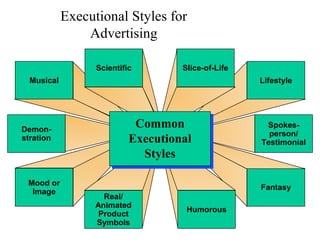
Executional Styles for
Advertising
Scientific

Slice-of-Life

Musical

Demonstration

Mood or
Image

Lifestyle

Common
Common
Executional
Executional
Styles
Styles

Spokesperson/
Testimonial

Fantasy
Real/
Animated
Product
Symbols

Humorous
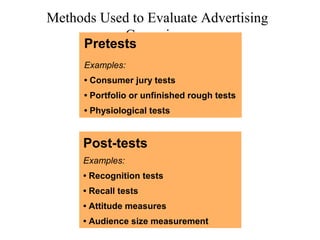
Methods Used to Evaluate Advertising
Campaigns
Pretests
Examples:
• Consumer jury tests
• Portfolio or unfinished rough tests
• Physiological tests

Post-tests
Examples:
• Recognition tests
• Recall tests
• Attitude measures
• Audience size measurement
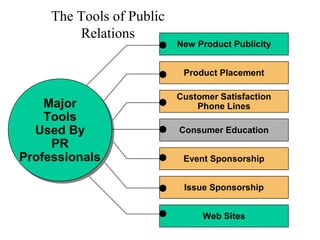
The Tools of Public
Relations

New Product Publicity
Product Placement

Major
Major
Tools
Tools
Used By
Used By
PR
PR
Professionals
Professionals

Customer Satisfaction
Phone Lines
Consumer Education
Event Sponsorship
Issue Sponsorship
Web Sites
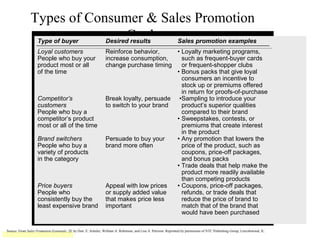
Types of Consumer & Sales Promotion
Goals Sales promotion examples
Type of buyer
Desired results
Loyal customers
People who buy your
product most or all
of the time

Competitor’s
customers
People who buy a
competitor’s product
most or all of the time
Brand switchers
People who buy a
variety of products
in the category

Price buyers
People who
consistently buy the
least expensive brand

Reinforce behavior,
• Loyalty marketing programs,
increase consumption,
such as frequent-buyer cards
change purchase timing
or frequent-shopper clubs
• Bonus packs that give loyal
consumers an incentive to
stock up or premiums offered
in return for proofs-of-purchase
Break loyalty, persuade •Sampling to introduce your
to switch to your brand
product’s superior qualities
compared to their brand
• Sweepstakes, contests, or
premiums that create interest
in the product
Persuade to buy your
• Any promotion that lowers the
brand more often
price of the product, such as
coupons, price-off packages,
and bonus packs
• Trade deals that help make the
product more readily available
than competing products
Appeal with low prices
• Coupons, price-off packages,
or supply added value
refunds, or trade deals that
that makes price less
reduce the price of brand to
important
match that of the brand that
would have been purchased

Source: From Sales Promotion Essentials, 2E by Don. E. Schultz, William A. Robinson, and Lisa A. Petrison. Reprinted by permission of NTC Publishing Group, Lincolnwood, IL.
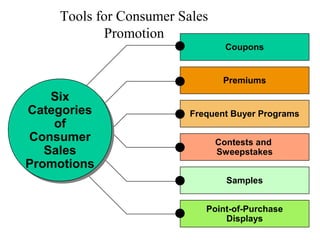
Tools for Consumer Sales
Promotion
Coupons

Premiums

Six
Six
Categories
Categories
of
of
Consumer
Consumer
Sales
Sales
Promotions
Promotions

Frequent Buyer Programs
Contests and
Sweepstakes
Samples
Point-of-Purchase
Displays
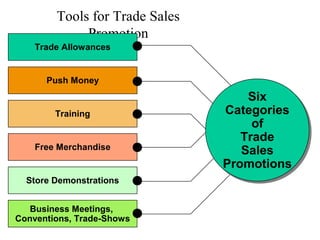
Tools for Trade Sales
Promotion
Trade Allowances

Push Money

Training

Free Merchandise

Store Demonstrations
Business Meetings,
Conventions, Trade-Shows

Six
Six
Categories
Categories
of
of
Trade
Trade
Sales
Sales
Promotions
Promotions
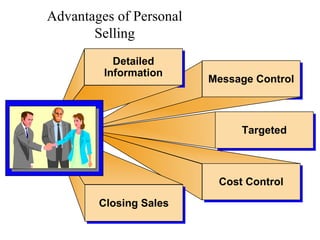
Advantages of Personal
Selling
Detailed
Detailed
Information
Information

Message Control
Message Control

Targeted
Targeted

Cost Control
Cost Control
Closing Sales
Closing Sales
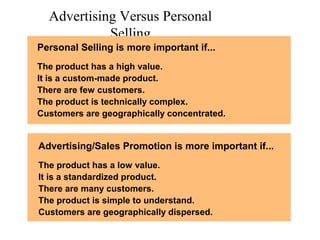
Advertising Versus Personal
Selling
Personal Selling is more important if...
The product has a high value.
It is a custom-made product.
There are few customers.
The product is technically complex.
Customers are geographically concentrated.

Advertising/Sales Promotion is more important if...
The product has a low value.
It is a standardized product.
There are many customers.
The product is simple to understand.
Customers are geographically dispersed.
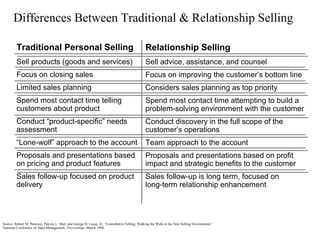
Differences Between Traditional & Relationship Selling
Traditional Personal Selling

Relationship Selling

Sell products (goods and services)

Sell advice, assistance, and counsel

Focus on closing sales

Focus on improving the customer’s bottom line

Limited sales planning

Considers sales planning as top priority

Spend most contact time telling
customers about product

Spend most contact time attempting to build a
problem-solving environment with the customer

Conduct “product-specific” needs
assessment

Conduct discovery in the full scope of the
customer’s operations

“Lone-wolf” approach to the account

Team approach to the account

Proposals and presentations based
on pricing and product features

Proposals and presentations based on profit
impact and strategic benefits to the customer

Sales follow-up focused on product
delivery

Sales follow-up is long term, focused on
long-term relationship enhancement

Source: Robert M. Peterson, Patrick L. Shul, and George H. Lucas, Jr., “Consultative Selling: Walking the Walk in the New Selling Environment,”
National Conference on Sales Management, Proceedings, March 1996.
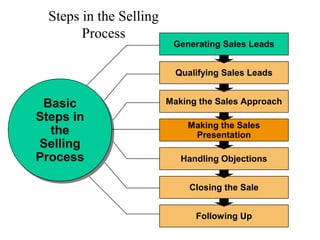
Steps in the Selling
Process

Generating Sales Leads
Qualifying Sales Leads

Basic
Basic
Steps in
Steps in
the
the
Selling
Selling
Process
Process

Making the Sales Approach
Making the Sales
Presentation
Handling Objections
Closing the Sale
Following Up
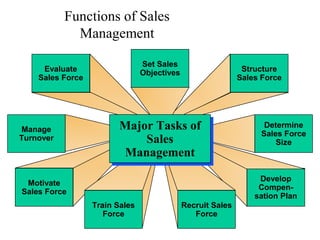
Functions of Sales
Management
Set Sales
Objectives

Evaluate
Sales Force

Manage
Turnover

Structure
Sales Force

Major Tasks of
Major Tasks of
Sales
Sales
Management
Management

Determine
Sales Force
Size

Develop
Compensation Plan

Motivate
Sales Force
Train Sales
Force

Recruit Sales
Force
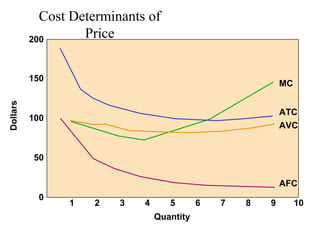
Cost Determinants of
Price
200

Dollars

150

MC
ATC
AVC

100

50
AFC
0

1

2

3

4

5
Quantity

6

7

8

9

10
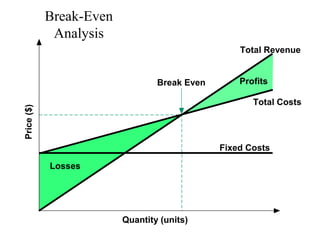
Break-Even
Analysis
Total Revenue

Break Even

Profits

Price ($)

Total Costs

Fixed Costs
Losses

Quantity (units)
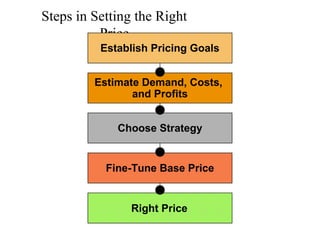
Steps in Setting the Right
Price
Establish Pricing Goals
Estimate Demand, Costs,
and Profits
Choose Strategy

Fine-Tune Base Price
Right $ $
$ $ $ $ Price $ $
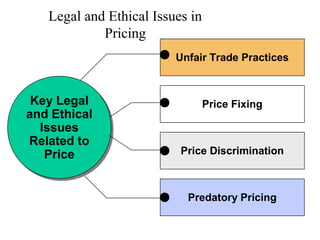
Legal and Ethical Issues in
Pricing
Unfair Trade Practices

Key Legal
Key Legal
and Ethical
and Ethical
Issues
Issues
Related to
Related to
Price
Price

Price Fixing

Price Discrimination

Predatory Pricing
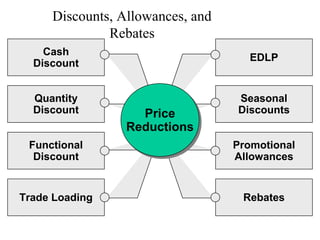
Discounts, Allowances, and
Rebates
Cash
Discount

EDLP

Quantity
Discount

Seasonal
Discounts

Price
Price
Reductions
Reductions

Functional
Discount

Promotional
Allowances

Trade Loading

Rebates
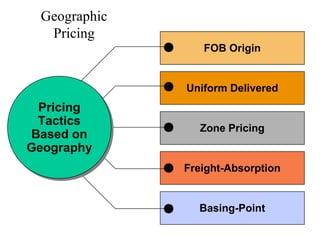
Geographic
Pricing
FOB Origin

Uniform Delivered

Pricing
Pricing
Tactics
Tactics
Based on
Based on
Geography
Geography

Zone Pricing

Freight-Absorption

Basing-Point
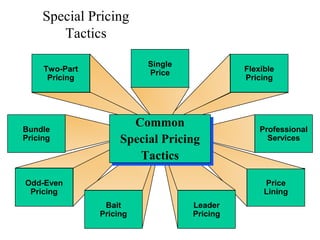
Special Pricing
Tactics
Single
Price

Two-Part
Pricing

Bundle
Pricing

Flexible
Pricing

Common
Common
Special Pricing
Special Pricing
Tactics
Tactics

Odd-Even
Pricing

Professional
Services

Price
Lining
Bait
Pricing

Leader
Pricing

Promotional selling pricing

  • 1.
    Elements of thePromotion Mix Advertising Ingredients Ingredients of the of the Promotion Promotion Mix Mix Public Relations Personal Selling Sales Promotion
  • 2.
  • 3.
    Goals and Tasksof Promotion Informing Reminding Target Audience Persuading
  • 4.
    AIDA and theHierarchy of Effects Purchase Conviction Preference Liking Knowledge Awareness Attention Interest Desire Action
  • 5.
    When Elements ofPromotion Are Most Useful Effectiveness Advertising Personal selling Sales promotion Public relations Awareness Knowledge Liking Preference Very effective Somewhat effective Either not effective or inefficient Conviction Purchase
  • 6.
    Factors that Affectthe Promotion Mix Nature of the Product Stage in the Product Life Cycle Target Market Characteristics Type of Buying Decision Available Funds Push–and–Pull Strategies $$$
  • 7.
    Creating a Promotion Plan Analyzethe Marketplace Identify Target Market Set Promotion Objectives Develop Promotion Budget Choose Promotion Mix
  • 8.
    Criteria for SettingPromotion Objectives Promotion objectives should: be measurable, concrete be based on sound research, with a well-defined target audience be realistic reinforce the overall marketing plan and relate to specific marketing objectives
  • 9.
    Examples of Promotion Objectives Objective:To Inform (Awareness) To increase the top-of-mind awareness level for Peter Pan peanut butter from 16 percent to 24 percent Objective: To Persuade (Attitudinal) To increase the percentage of parents who feel that Peter Pan peanut butter is the best peanut butter for their children from 22 percent to 35 percent Objective: To Remind To remind consumers that Peter Pan peanut butter is the creamiest peanut butter and is available at their nearest grocery and convenience stores
  • 10.
    Techniques for SettingPromotion Budgets • Arbitrary Allocation • All - You - Can - Afford • Competitive Parity • Percent of Sales • Market Share • Objective and Task
  • 11.
    Regulation of Promotion Self-Regulation • NationalAdvertising Division (NAD) • National Advertising Review Board (NARB) Federal Regulation • Federal Trade Commission (FTC)
  • 12.
    Return on AdvertisingExpenditures Effects of Advertising Diminishing returns on additional spending Increasing efficiency as ad budget becomes sufficient Advertising Spending
  • 13.
    Major Types of Advertising CorporateImage Institutional Advertising Advocacy Advertising Types Types of of Advertising Advertising Pioneering Product Advertising Competitive Comparative
  • 14.
    Advertising Campaign Decision Process Determinethe campaign objectives. Make creative decisions. Make media decisions. Evaluate the campaign.
  • 15.
    Common Advertising Appeals Profit Profit Save money,keep from losing money Save money, keep from losing money Health Health Body-conscious, healthy Body-conscious, healthy Love or Romance Love or Romance Sell cosmetics and perfumes Sell cosmetics and perfumes Fear Fear Social embarrassment, growing old, losing Social embarrassment, growing old, losing health, power health, power Admiration Admiration Celebrity endorsement effective Celebrity endorsement effective Convenience Convenience Fast-food and microwave products Fast-food and microwave products Fun and Pleasure Fun and Pleasure Vacations, beer, amusement parks Vacations, beer, amusement parks Vanity and Egotism Expensive, conspicuous items Vanity and Egotism Expensive, conspicuous items
  • 16.
    Executional Styles for Advertising Scientific Slice-of-Life Musical Demonstration Moodor Image Lifestyle Common Common Executional Executional Styles Styles Spokesperson/ Testimonial Fantasy Real/ Animated Product Symbols Humorous
  • 17.
    Methods Used toEvaluate Advertising Campaigns Pretests Examples: • Consumer jury tests • Portfolio or unfinished rough tests • Physiological tests Post-tests Examples: • Recognition tests • Recall tests • Attitude measures • Audience size measurement
  • 18.
    The Tools ofPublic Relations New Product Publicity Product Placement Major Major Tools Tools Used By Used By PR PR Professionals Professionals Customer Satisfaction Phone Lines Consumer Education Event Sponsorship Issue Sponsorship Web Sites
  • 19.
    Types of Consumer& Sales Promotion Goals Sales promotion examples Type of buyer Desired results Loyal customers People who buy your product most or all of the time Competitor’s customers People who buy a competitor’s product most or all of the time Brand switchers People who buy a variety of products in the category Price buyers People who consistently buy the least expensive brand Reinforce behavior, • Loyalty marketing programs, increase consumption, such as frequent-buyer cards change purchase timing or frequent-shopper clubs • Bonus packs that give loyal consumers an incentive to stock up or premiums offered in return for proofs-of-purchase Break loyalty, persuade •Sampling to introduce your to switch to your brand product’s superior qualities compared to their brand • Sweepstakes, contests, or premiums that create interest in the product Persuade to buy your • Any promotion that lowers the brand more often price of the product, such as coupons, price-off packages, and bonus packs • Trade deals that help make the product more readily available than competing products Appeal with low prices • Coupons, price-off packages, or supply added value refunds, or trade deals that that makes price less reduce the price of brand to important match that of the brand that would have been purchased Source: From Sales Promotion Essentials, 2E by Don. E. Schultz, William A. Robinson, and Lisa A. Petrison. Reprinted by permission of NTC Publishing Group, Lincolnwood, IL.
  • 20.
    Tools for ConsumerSales Promotion Coupons Premiums Six Six Categories Categories of of Consumer Consumer Sales Sales Promotions Promotions Frequent Buyer Programs Contests and Sweepstakes Samples Point-of-Purchase Displays
  • 21.
    Tools for TradeSales Promotion Trade Allowances Push Money Training Free Merchandise Store Demonstrations Business Meetings, Conventions, Trade-Shows Six Six Categories Categories of of Trade Trade Sales Sales Promotions Promotions
  • 22.
    Advantages of Personal Selling Detailed Detailed Information Information MessageControl Message Control Targeted Targeted Cost Control Cost Control Closing Sales Closing Sales
  • 23.
    Advertising Versus Personal Selling PersonalSelling is more important if... The product has a high value. It is a custom-made product. There are few customers. The product is technically complex. Customers are geographically concentrated. Advertising/Sales Promotion is more important if... The product has a low value. It is a standardized product. There are many customers. The product is simple to understand. Customers are geographically dispersed.
  • 24.
    Differences Between Traditional& Relationship Selling Traditional Personal Selling Relationship Selling Sell products (goods and services) Sell advice, assistance, and counsel Focus on closing sales Focus on improving the customer’s bottom line Limited sales planning Considers sales planning as top priority Spend most contact time telling customers about product Spend most contact time attempting to build a problem-solving environment with the customer Conduct “product-specific” needs assessment Conduct discovery in the full scope of the customer’s operations “Lone-wolf” approach to the account Team approach to the account Proposals and presentations based on pricing and product features Proposals and presentations based on profit impact and strategic benefits to the customer Sales follow-up focused on product delivery Sales follow-up is long term, focused on long-term relationship enhancement Source: Robert M. Peterson, Patrick L. Shul, and George H. Lucas, Jr., “Consultative Selling: Walking the Walk in the New Selling Environment,” National Conference on Sales Management, Proceedings, March 1996.
  • 25.
    Steps in theSelling Process Generating Sales Leads Qualifying Sales Leads Basic Basic Steps in Steps in the the Selling Selling Process Process Making the Sales Approach Making the Sales Presentation Handling Objections Closing the Sale Following Up
  • 26.
    Functions of Sales Management SetSales Objectives Evaluate Sales Force Manage Turnover Structure Sales Force Major Tasks of Major Tasks of Sales Sales Management Management Determine Sales Force Size Develop Compensation Plan Motivate Sales Force Train Sales Force Recruit Sales Force
  • 27.
  • 28.
    Break-Even Analysis Total Revenue Break Even Profits Price($) Total Costs Fixed Costs Losses Quantity (units)
  • 29.
    Steps in Settingthe Right Price Establish Pricing Goals Estimate Demand, Costs, and Profits Choose Strategy Fine-Tune Base Price Right $ $ $ $ $ $ Price $ $
  • 30.
    Legal and EthicalIssues in Pricing Unfair Trade Practices Key Legal Key Legal and Ethical and Ethical Issues Issues Related to Related to Price Price Price Fixing Price Discrimination Predatory Pricing
  • 31.
  • 32.
    Geographic Pricing FOB Origin Uniform Delivered Pricing Pricing Tactics Tactics Basedon Based on Geography Geography Zone Pricing Freight-Absorption Basing-Point
  • 33.
    Special Pricing Tactics Single Price Two-Part Pricing Bundle Pricing Flexible Pricing Common Common Special Pricing SpecialPricing Tactics Tactics Odd-Even Pricing Professional Services Price Lining Bait Pricing Leader Pricing

Editor's Notes