Using	MOOCs	within	tradi0onal	courses:	
students’	perspec0ve	
Dr.	Diana	Andone	
Vlad	Mihaescu,	Prof.dr.	Radu	Vasiu	
Politehnica	University	of	Timisoara,	Romania	
#eLEARN2015	h.p://www.slideshare.net/diando70/
OPEN	….
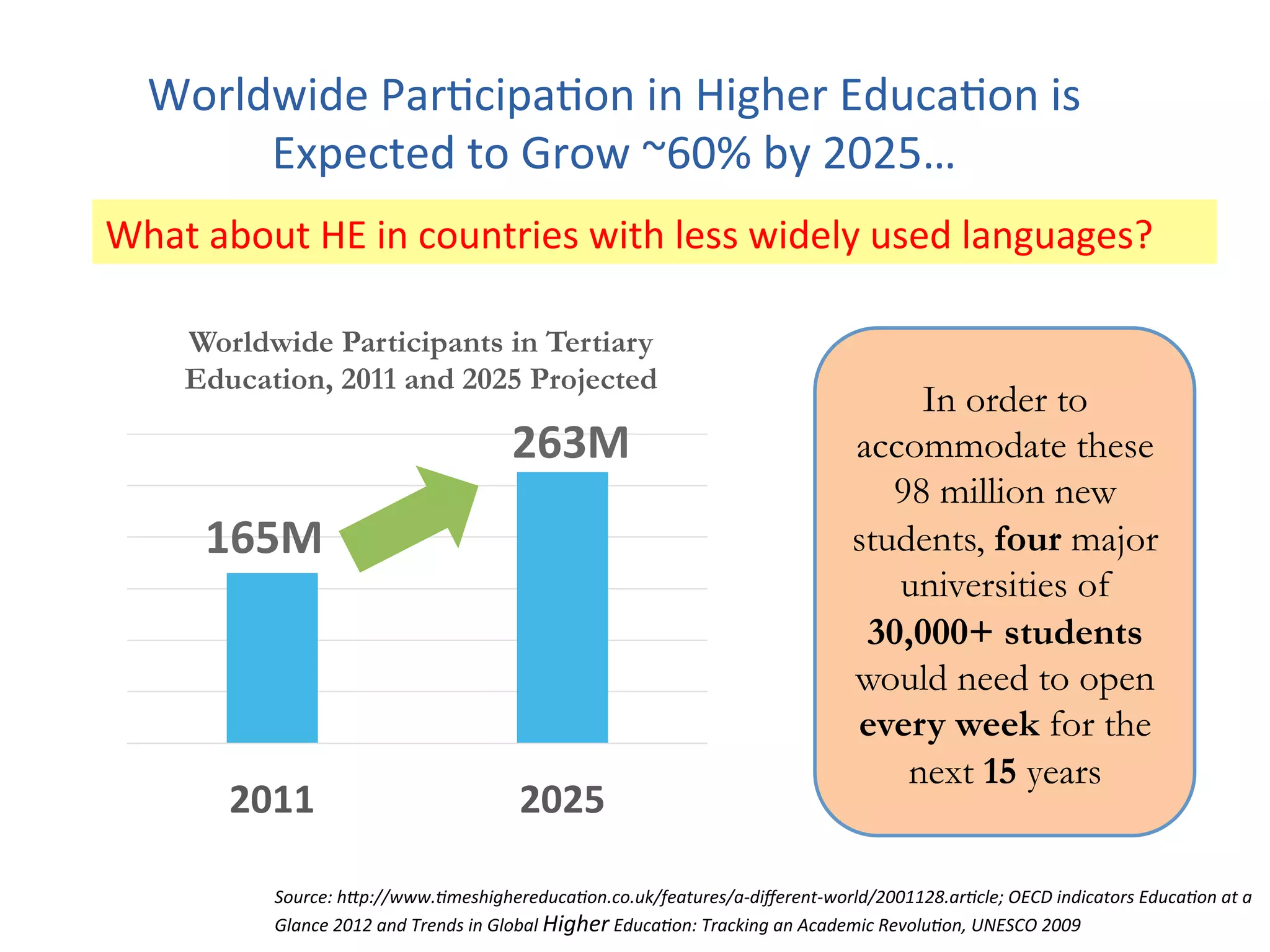
Worldwide	ParBcipaBon	in	Higher	EducaBon	is	
Expected	to	Grow	~60%	by	2025…	
2011	 2025	
Worldwide Participants in Tertiary
Education, 2011 and 2025 Projected
In order to
accommodate these
98 million new
students, four major
universities of
30,000+ students
would need to open
every week for the
next 15 years
Source:	h*p://www./meshighereduca/on.co.uk/features/a-different-world/2001128.ar/cle;	OECD	indicators	Educa/on	at	a	
Glance	2012	and	Trends	in	Global	Higher	Educa/on:	Tracking	an	Academic	Revolu/on,	UNESCO	2009	
165M	
263M	
What	about	HE	in	countries	with	less	widely	used	languages?
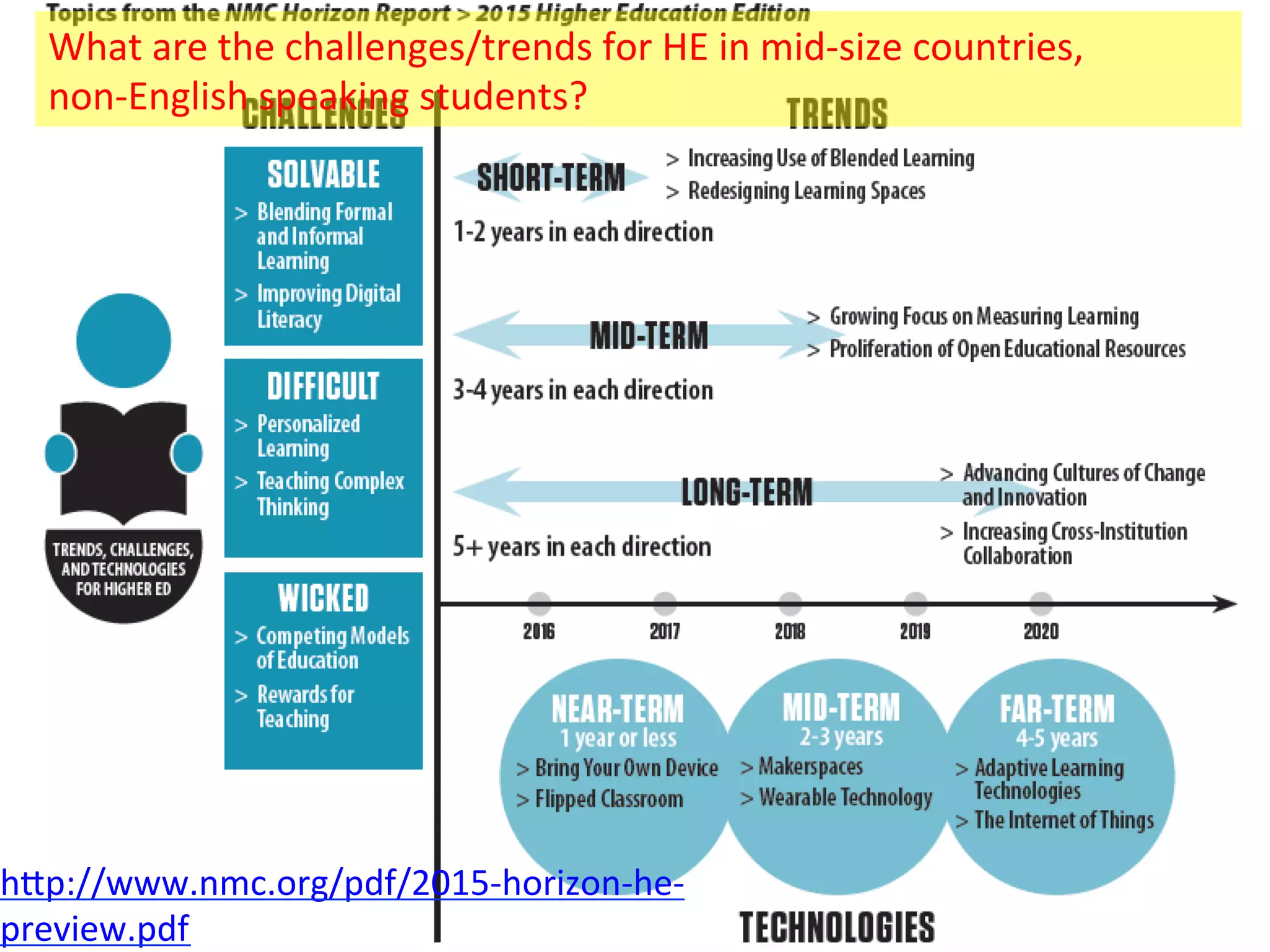
NMC	Horizon	2015	
h.p://www.nmc.org/pdf/2015-horizon-he-
preview.pdf	
What	are	the	challenges/trends	for	HE	in	mid-size	countries,		
non-English	speaking	students?
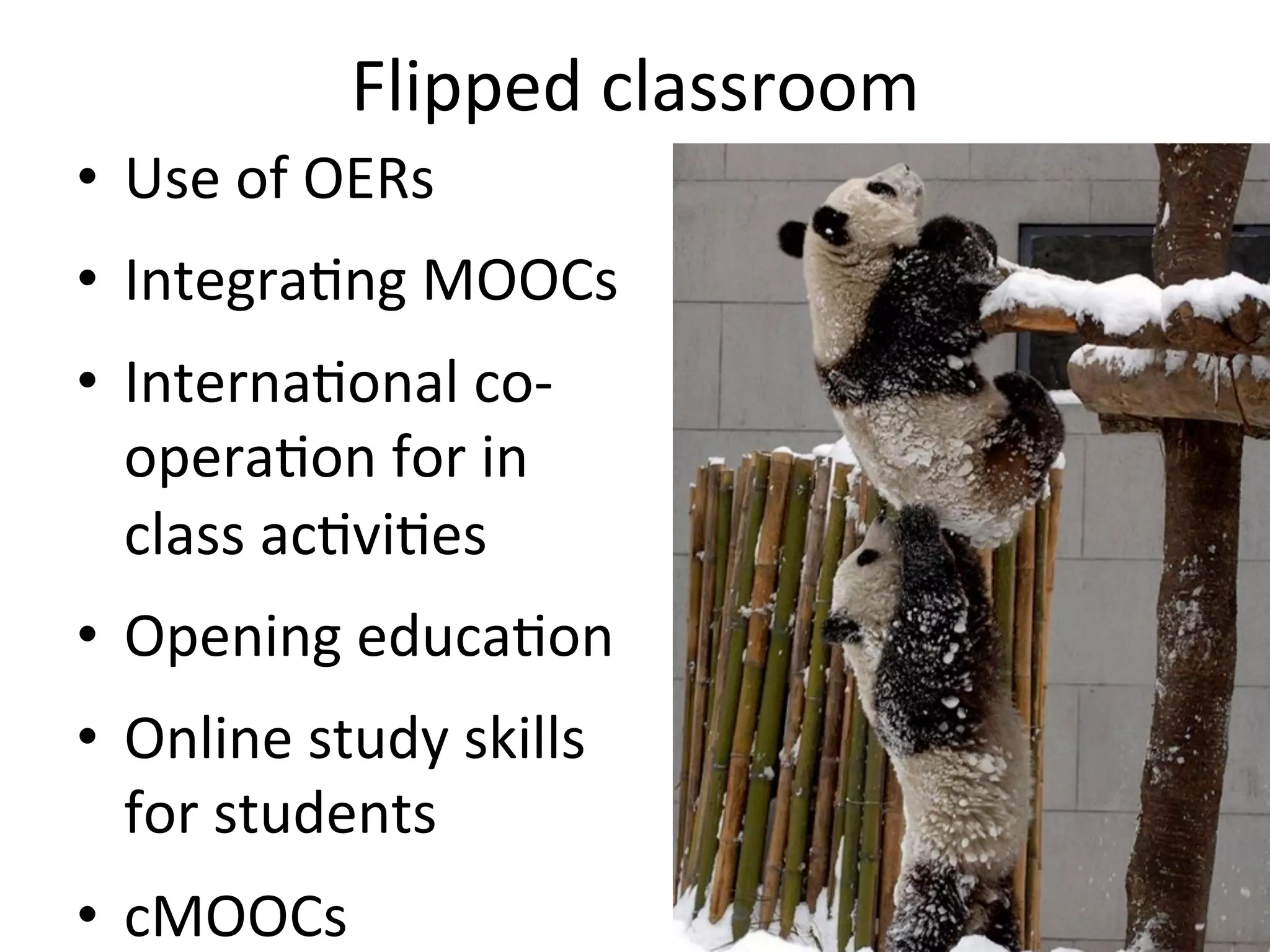
Flipped	classroom		
•  Use	of	OERs	
•  IntegraBng	MOOCs	
•  InternaBonal	co-
operaBon	for	in	
class	acBviBes	
•  Opening	educaBon	
•  Online	study	skills	
for	students	
•  cMOOCs
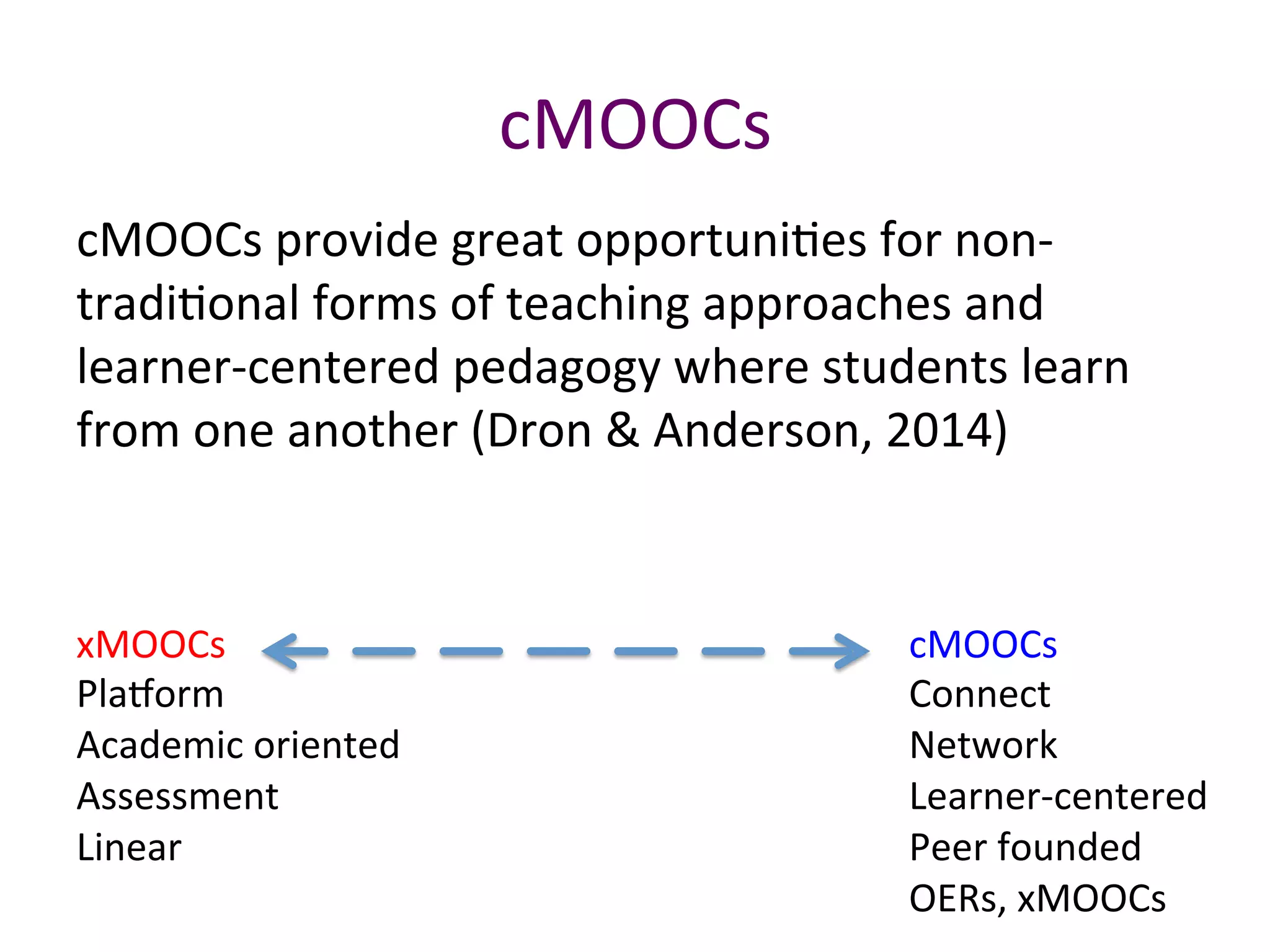
cMOOCs	
cMOOCs	provide	great	opportuniBes	for	non-
tradiBonal	forms	of	teaching	approaches	and	
learner-centered	pedagogy	where	students	learn	
from	one	another	(Dron	&	Anderson,	2014)		
cMOOCs	
Connect	
Network	
Learner-centered	
Peer	founded	
OERs,	xMOOCs	
xMOOCs	
Pla`orm	
Academic	oriented	
Assessment	
Linear
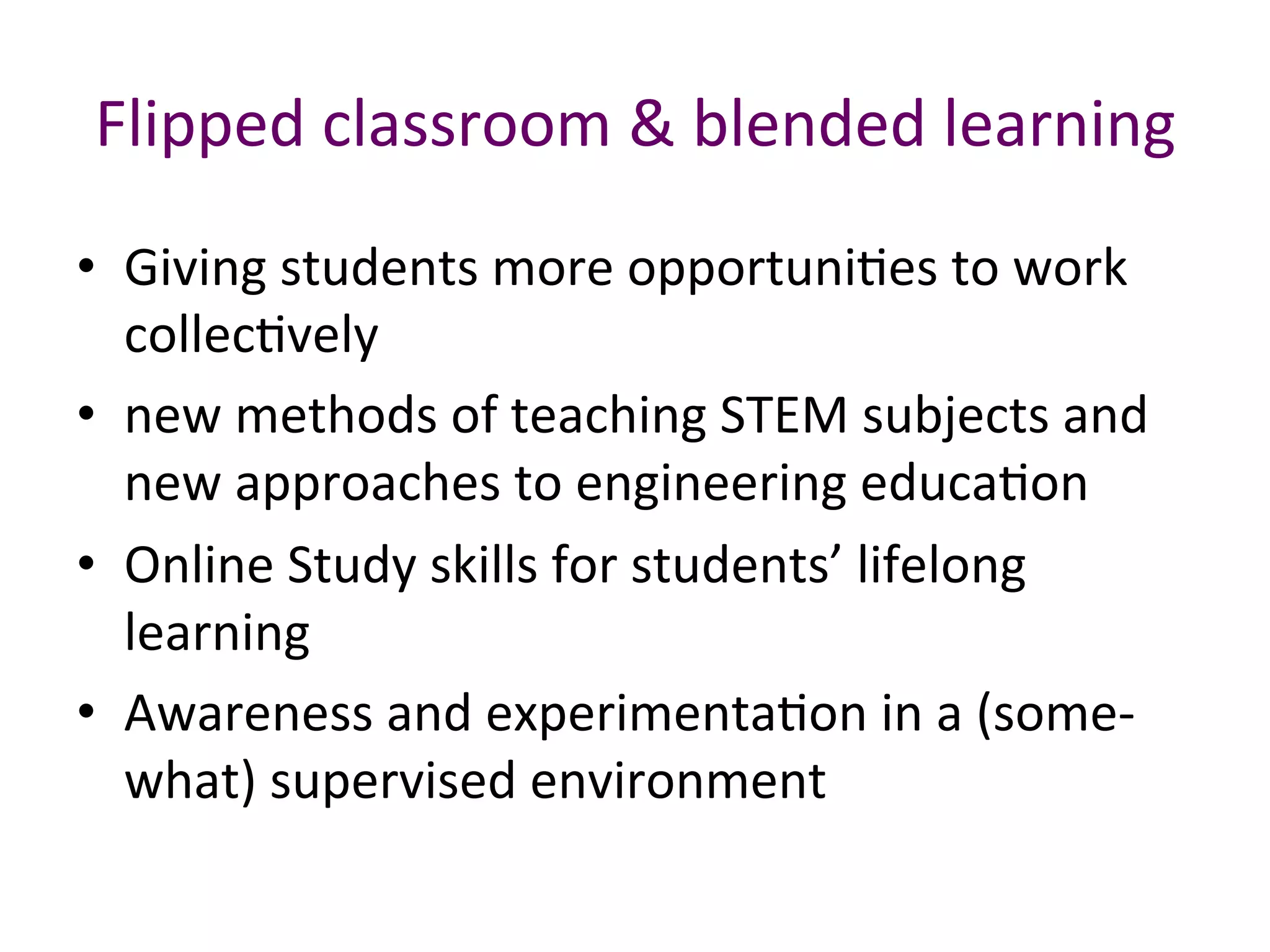
Flipped	classroom	&	blended	learning	
•  Giving	students	more	opportuniBes	to	work	
collecBvely		
•  new	methods	of	teaching	STEM	subjects	and	
new	approaches	to	engineering	educaBon		
•  Online	Study	skills	for	students’	lifelong	
learning	
•  Awareness	and	experimentaBon	in	a	(some-
what)	supervised	environment
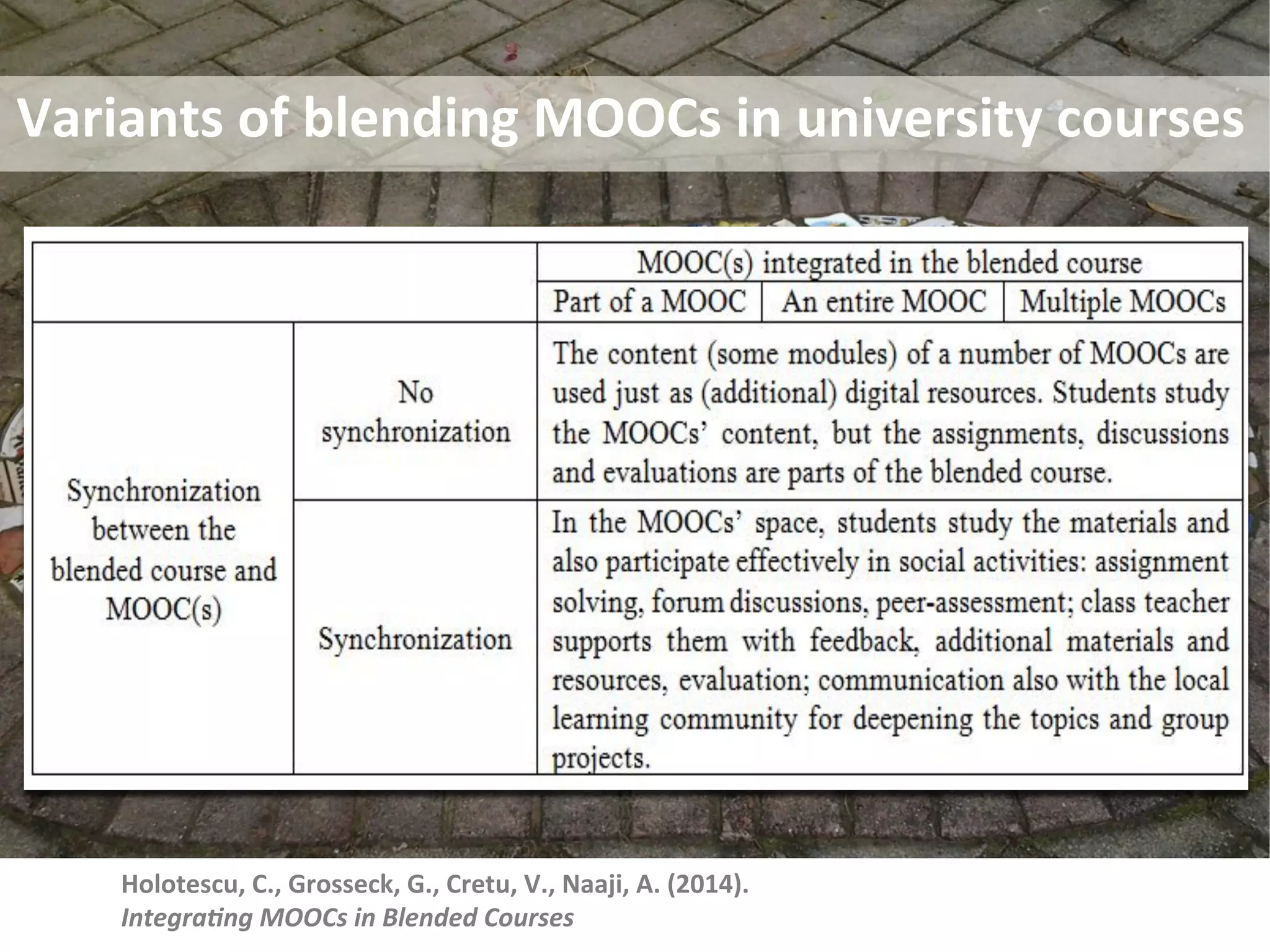
Variants	of	blending	MOOCs	in	university	courses		
Holotescu,	C.,	Grosseck,	G.,	Cretu,	V.,	Naaji,	A.	(2014).		
Integra(ng	MOOCs	in	Blended	Courses
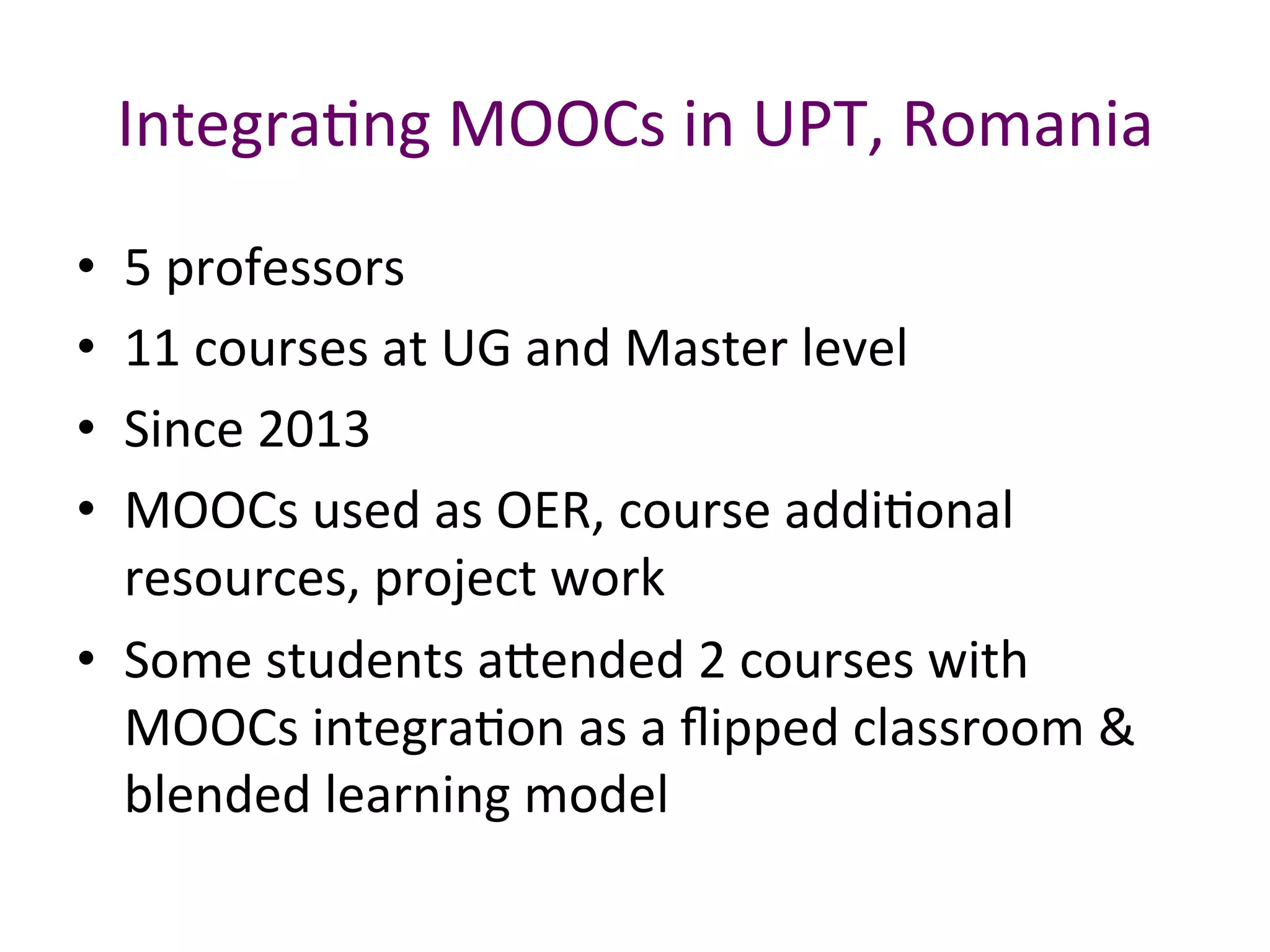
IntegraBng	MOOCs	in	UPT,	Romania	
•  5	professors	
•  11	courses	at	UG	and	Master	level	
•  Since	2013	
•  MOOCs	used	as	OER,	course	addiBonal	
resources,	project	work		
•  Some	students	a.ended	2	courses	with	
MOOCs	integraBon	as	a	flipped	classroom	&	
blended	learning	model
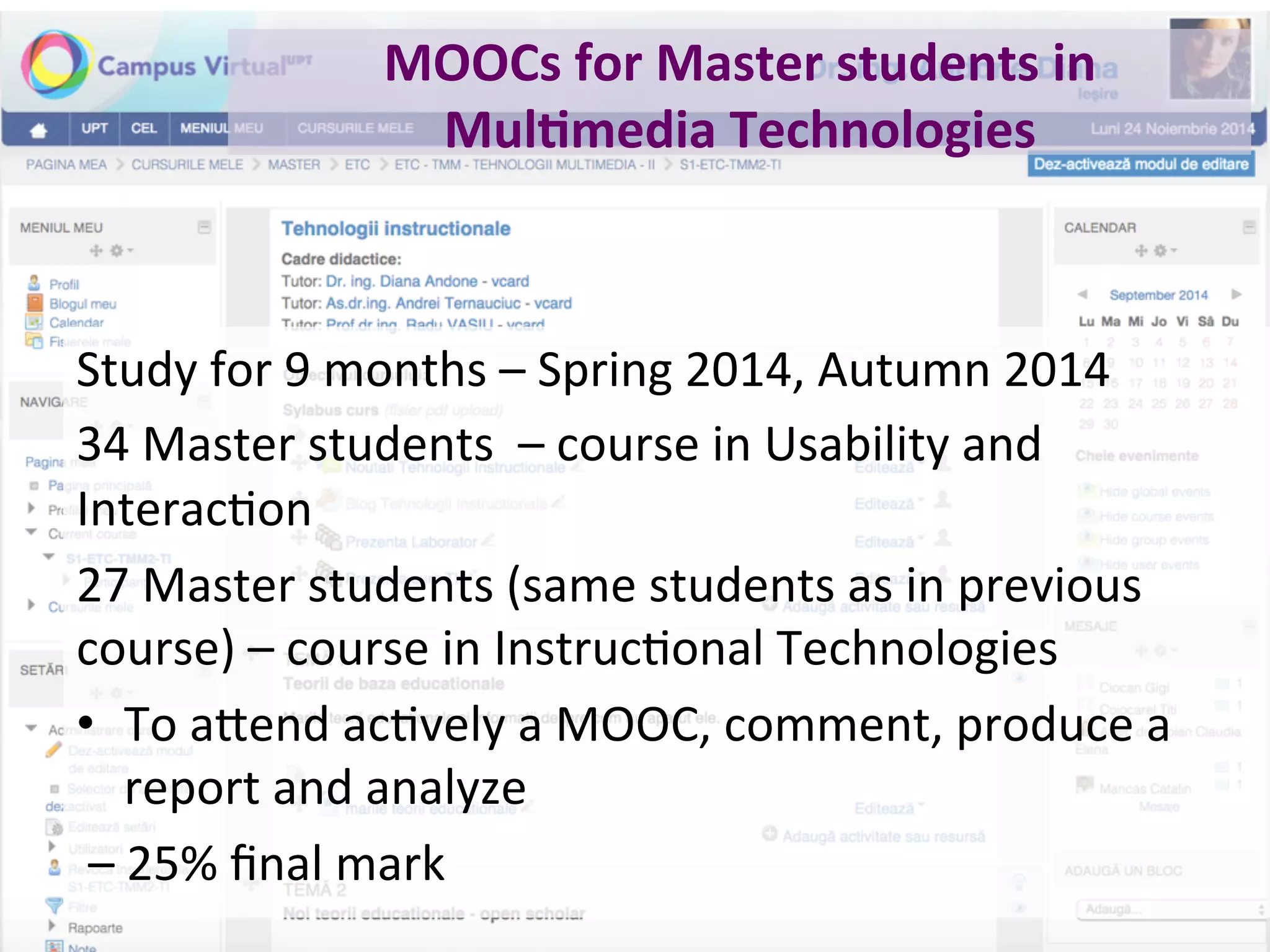
MOOCs	for	Master	students	in	
Mul0media	Technologies	
Study	for	9	months	–	Spring	2014,	Autumn	2014	
34	Master	students		–	course	in	Usability	and	
InteracBon	
27	Master	students	(same	students	as	in	previous	
course)	–	course	in	InstrucBonal	Technologies		
•  To	a.end	acBvely	a	MOOC,	comment,	produce	a	
report	and	analyze	
	–	25%	final	mark
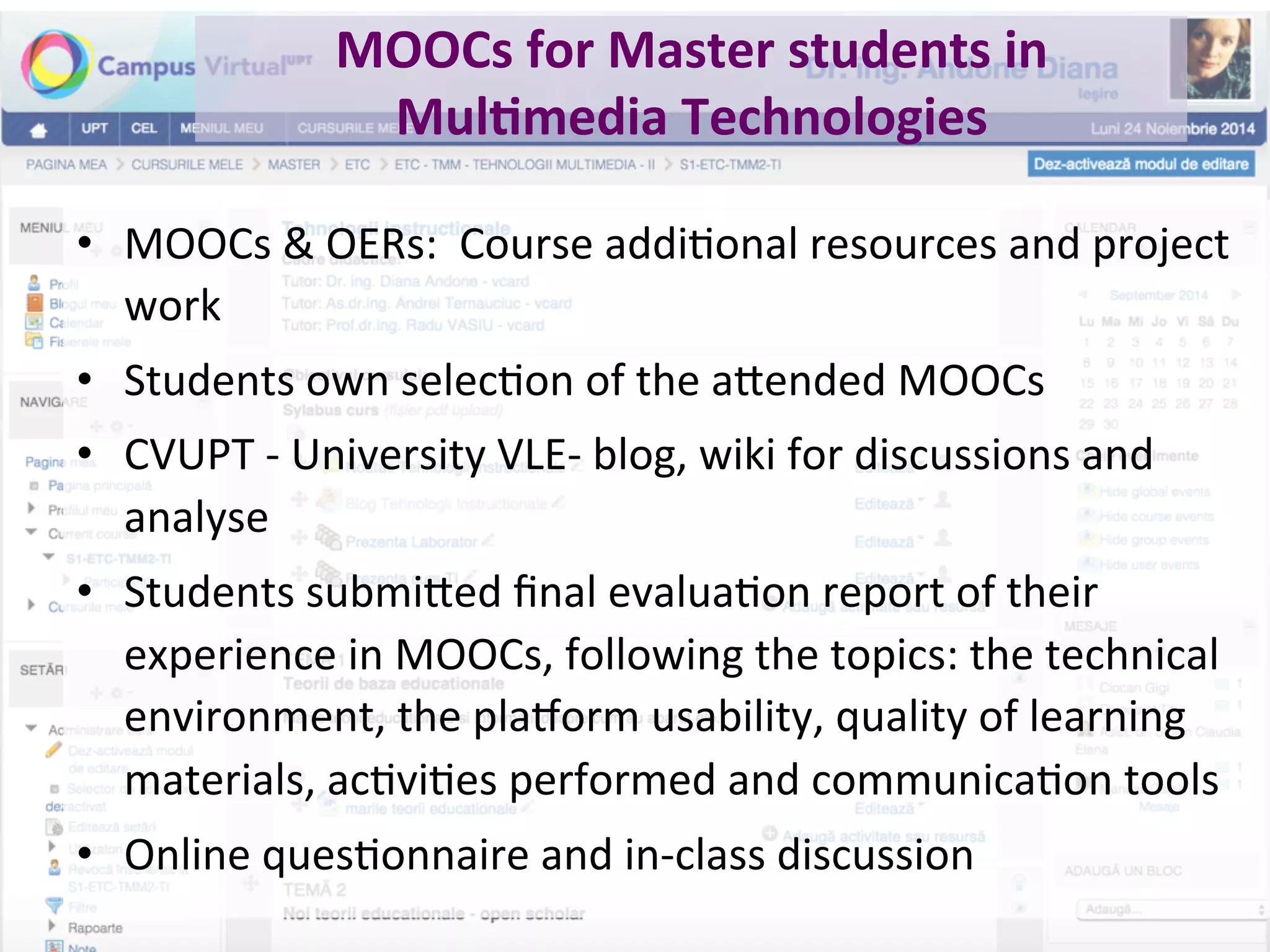
MOOCs	for	Master	students	in	
Mul0media	Technologies	
•  MOOCs	&	OERs:		Course	addiBonal	resources	and	project	
work		
•  Students	own	selecBon	of	the	a.ended	MOOCs	
•  CVUPT	-	University	VLE-	blog,	wiki	for	discussions	and	
analyse	
•  Students	submi.ed	final	evaluaBon	report	of	their	
experience	in	MOOCs,	following	the	topics:	the	technical	
environment,	the	pla`orm	usability,	quality	of	learning	
materials,	acBviBes	performed	and	communicaBon	tools	
•  Online	quesBonnaire	and	in-class	discussion
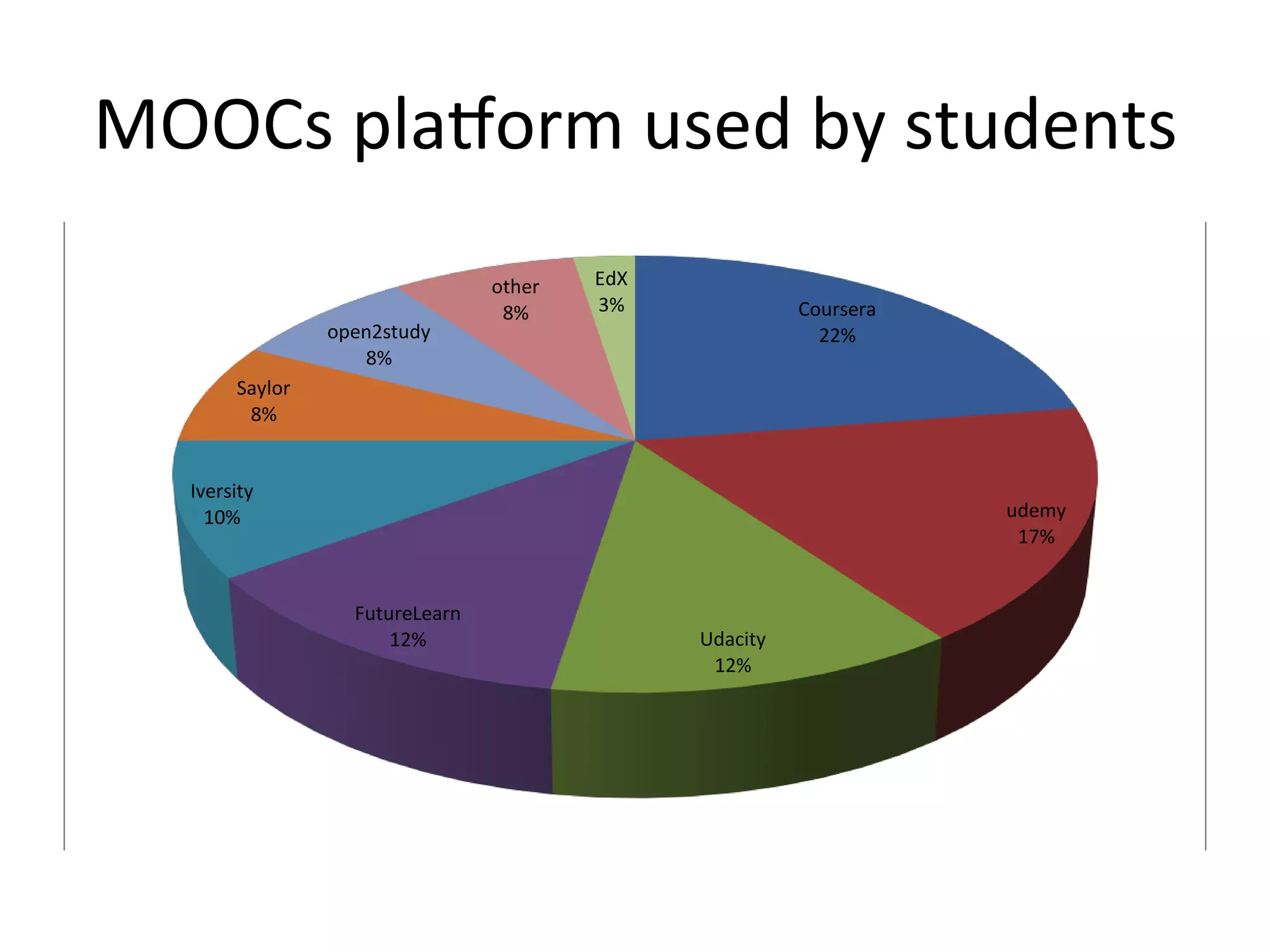
MOOCs	pla`orm	used	by	students	
Coursera
22%
udemy
17%
Udacity
12%
FutureLearn
12%
Iversity
10%
Saylor
8%
open2study
8%
other
8%
EdX
3%
MOOCs	for	Master	students	in	
Mul0media	Technologies	
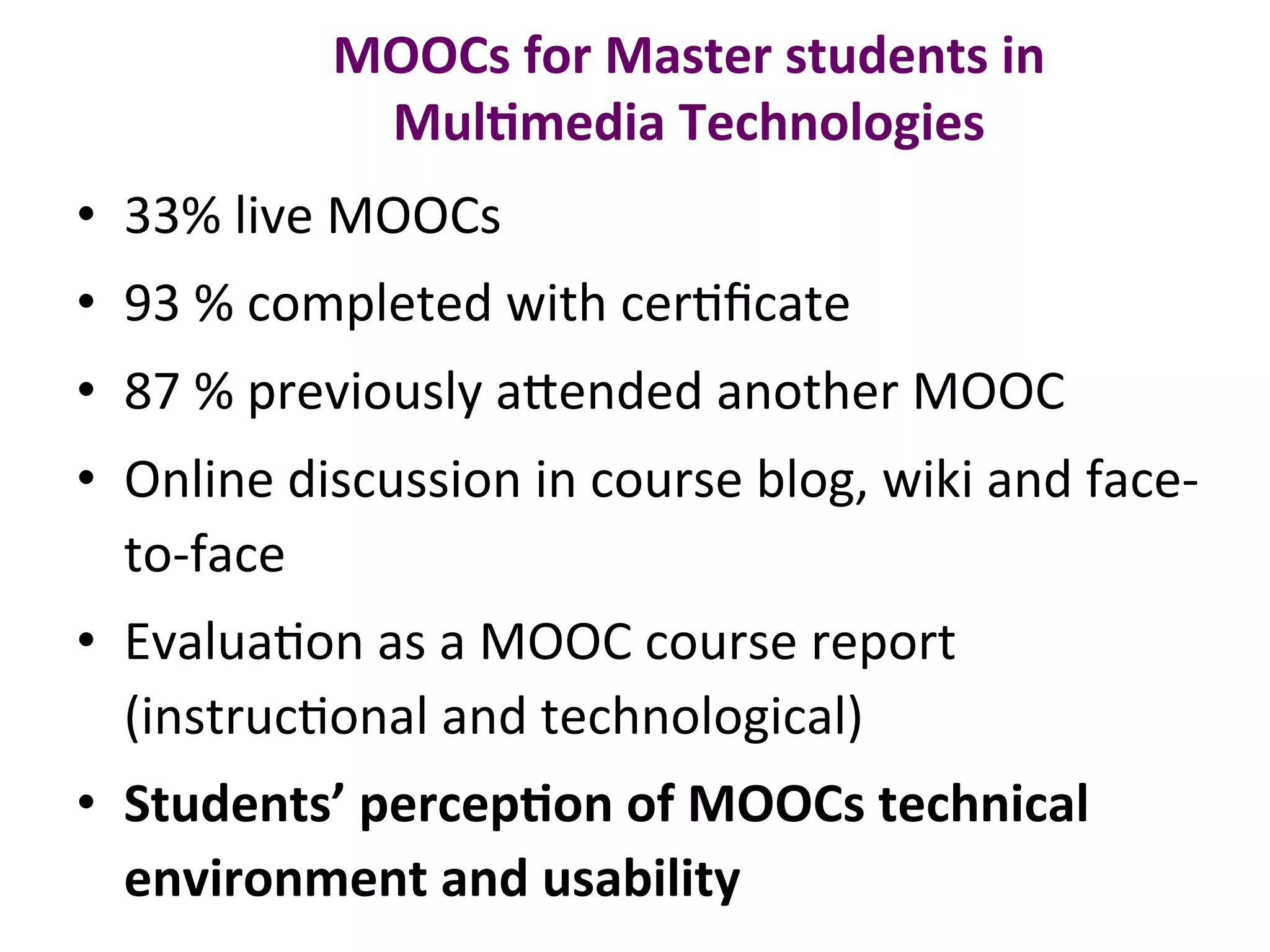
•  33%	live	MOOCs	
•  93	%	completed	with	cerBficate	
•  87	%	previously	a.ended	another	MOOC	
•  Online	discussion	in	course	blog,	wiki	and	face-
to-face			
•  EvaluaBon	as	a	MOOC	course	report	
(instrucBonal	and	technological)	
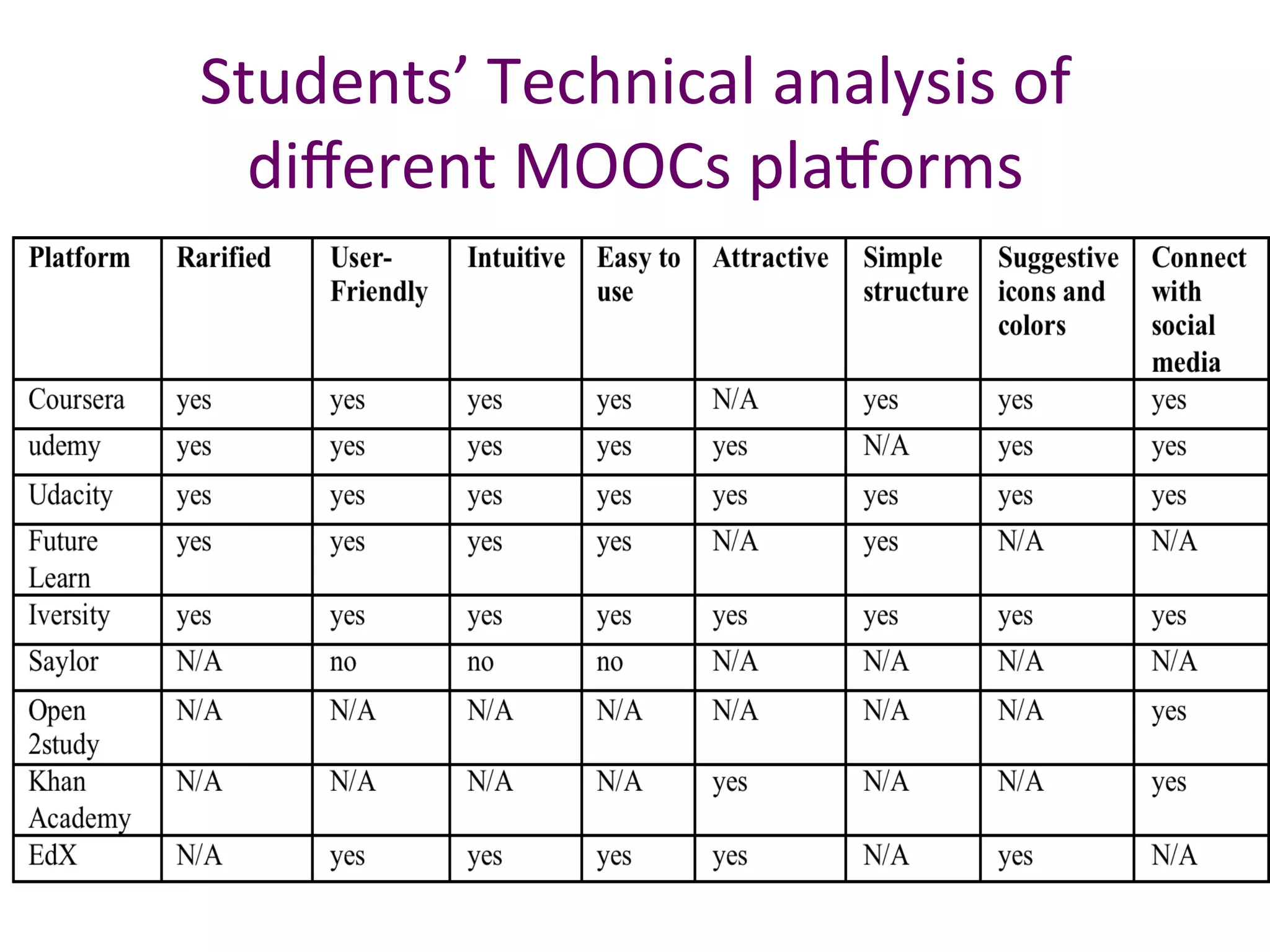
•  Students’	percep0on	of	MOOCs	technical	
environment	and	usability
Students’	Technical	analysis	of	
different	MOOCs	pla`orms
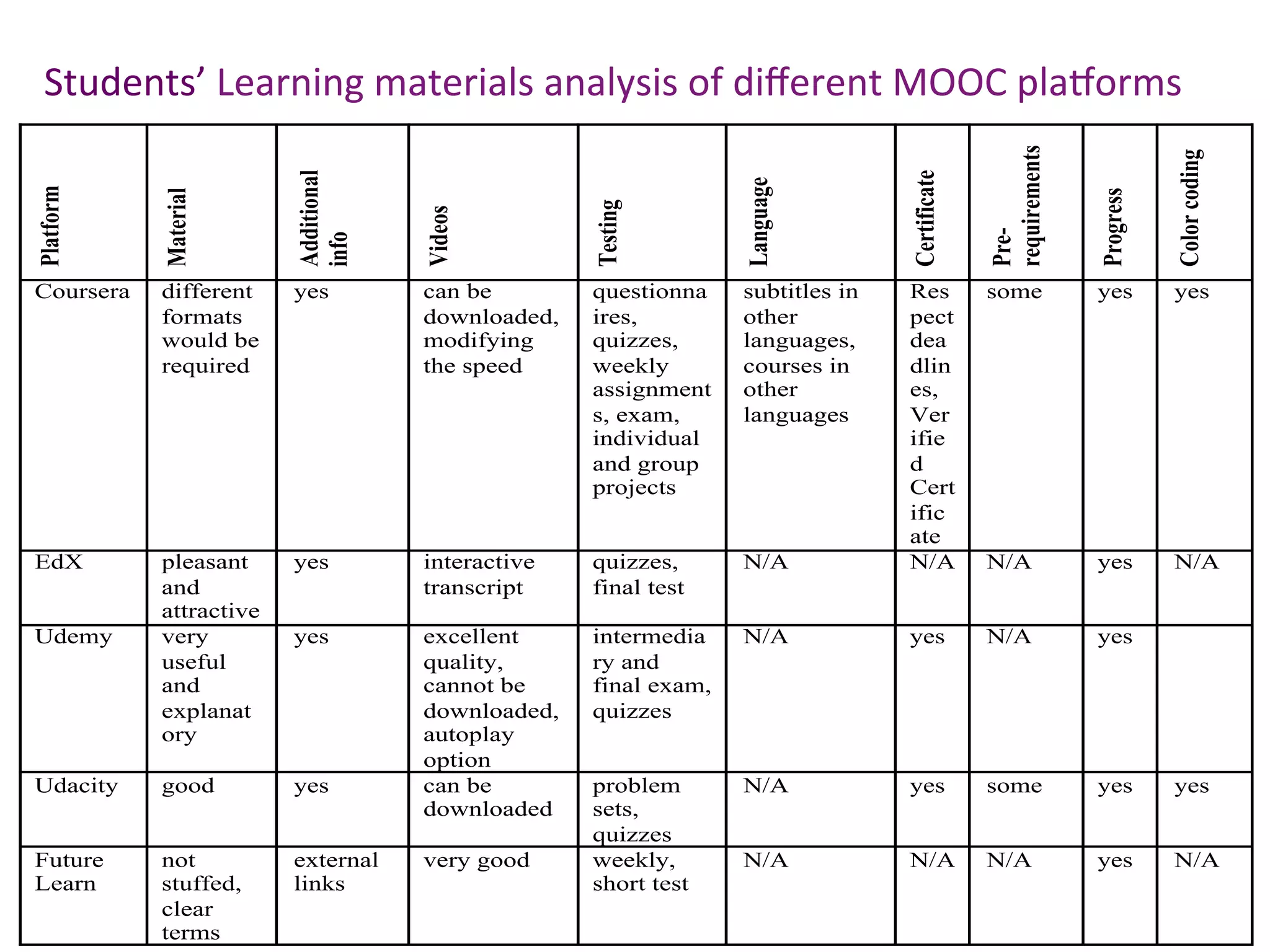
Students’	Learning	materials	analysis	of	different	MOOC	pla`orms		
Platform
Material
Additional
info
Videos
Testing
Language
Certificate
Pre-
requirements
Progress
Colorcoding
Coursera different
formats
would be
required
yes can be
downloaded,
modifying
the speed
questionna
ires,
quizzes,
weekly
assignment
s, exam,
individual
and group
projects
subtitles in
other
languages,
courses in
other
languages
Res
pect
dea
dlin
es,
Ver
ifie
d
Cert
ific
ate
some yes yes
EdX pleasant
and
attractive
yes interactive
transcript
quizzes,
final test
N/A N/A N/A yes N/A
Udemy very
useful
and
explanat
ory
yes excellent
quality,
cannot be
downloaded,
autoplay
option
intermedia
ry and
final exam,
quizzes
N/A yes N/A yes
Udacity good yes can be
downloaded
problem
sets,
quizzes
N/A yes some yes yes
Future
Learn
not
stuffed,
clear
terms
external
links
very good weekly,
short test
N/A N/A N/A yes N/A
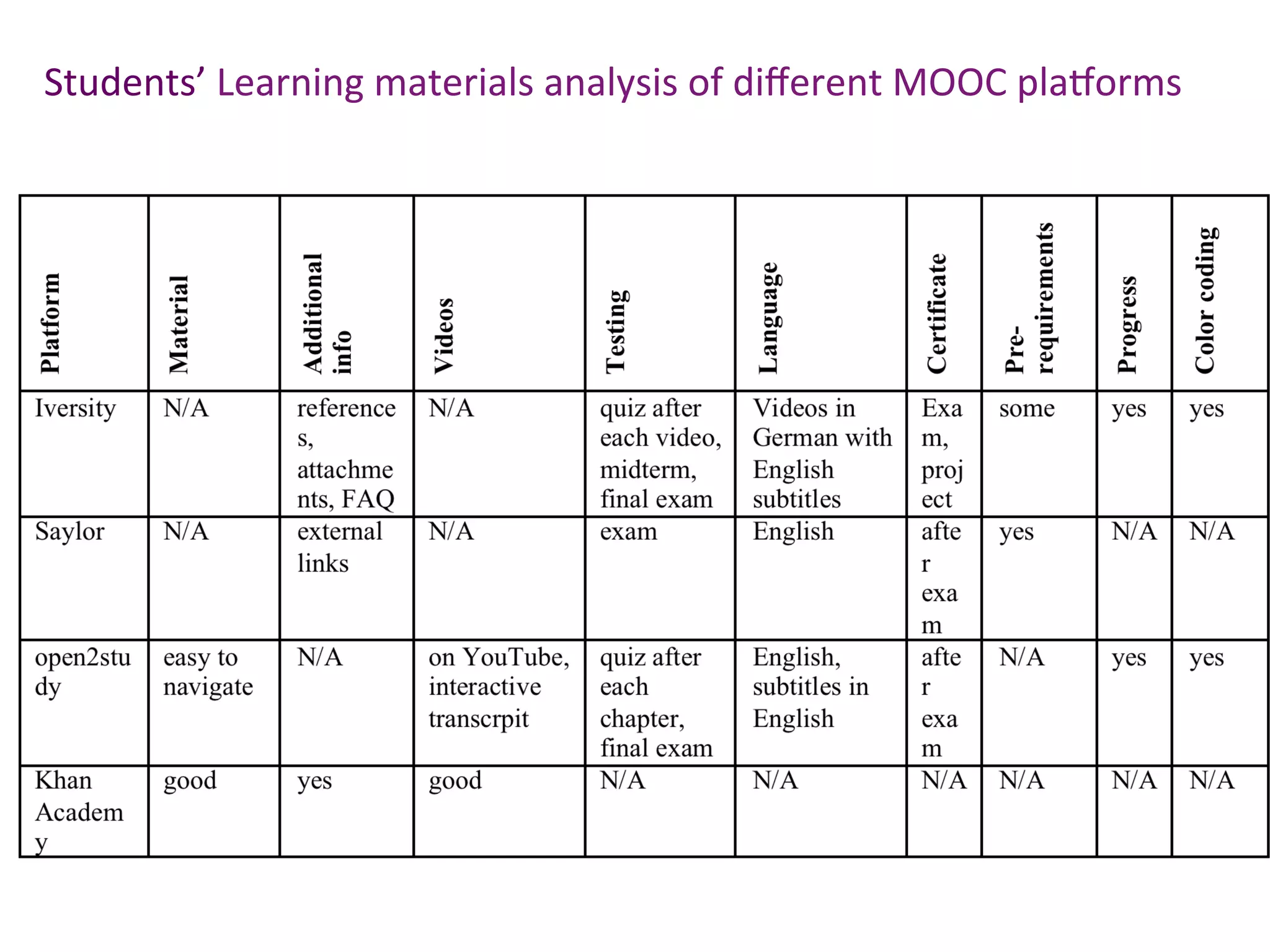
Students’	Learning	materials	analysis	of	different	MOOC	pla`orms
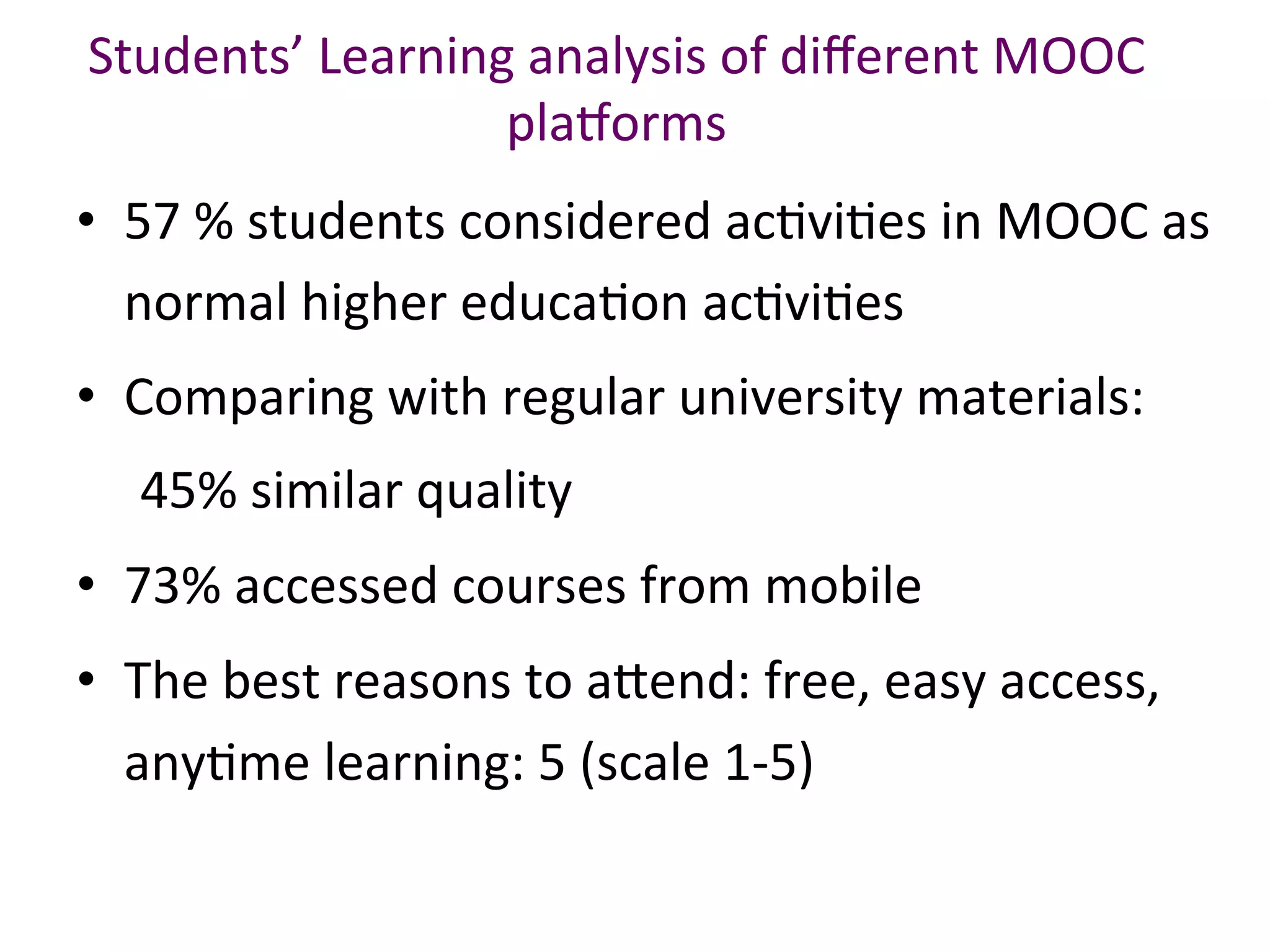
•  57	%	students	considered	acBviBes	in	MOOC	as	
normal	higher	educaBon	acBviBes	
•  Comparing	with	regular	university	materials:		
					45%	similar	quality		
•  73%	accessed	courses	from	mobile		
•  The	best	reasons	to	a.end:	free,	easy	access,	
anyBme	learning:	5	(scale	1-5)	
Students’	Learning	analysis	of	different	MOOC	
pla`orms
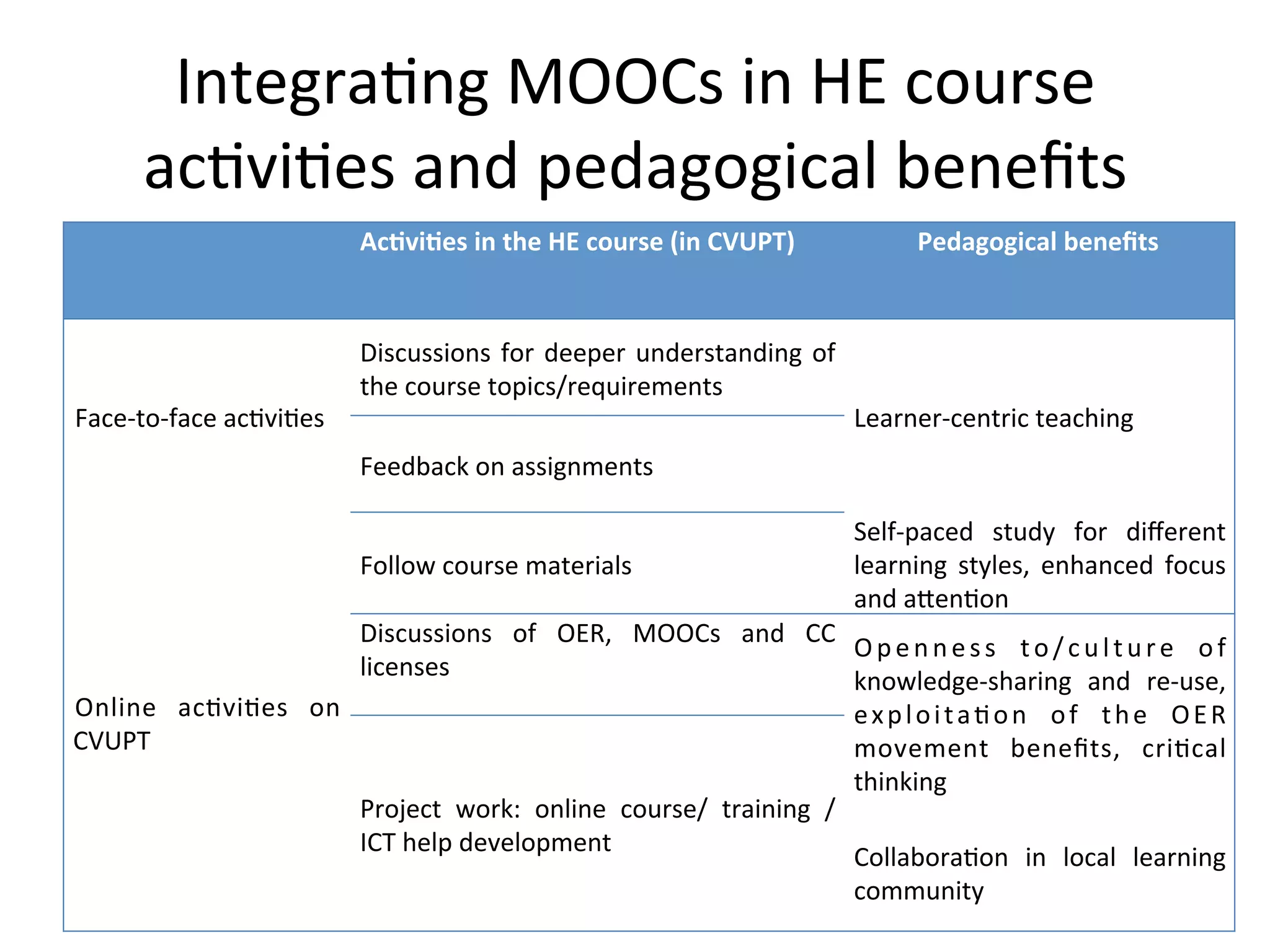
IntegraBng	MOOCs	in	HE	course	
acBviBes	and	pedagogical	benefits		
	 Ac0vi0es	in	the	HE	course	(in	CVUPT) Pedagogical	benefits
Face-to-face	acBviBes
Discussions	for	deeper	understanding	of	
the	course	topics/requirements
Learner-centric	teaching
Feedback	on	assignments
Online	 acBviBes	 on	
CVUPT
Follow	course	materials	
Self-paced	 study	 for	 different	
learning	 styles,	 enhanced	 focus	
and	a.enBon
Discussions	 of	 OER,	 MOOCs	 and	 CC	
licenses		
	
Openness	 to/culture	 of	
knowledge-sharing	 and	 re-use,		
exploitaBon	 of	 the	 OER	
movement	 benefits,	 criBcal	
thinking
Project	 work:	 online	 course/	 training	 /	
ICT	help	development
CollaboraBon	 in	 local	 learning	
community
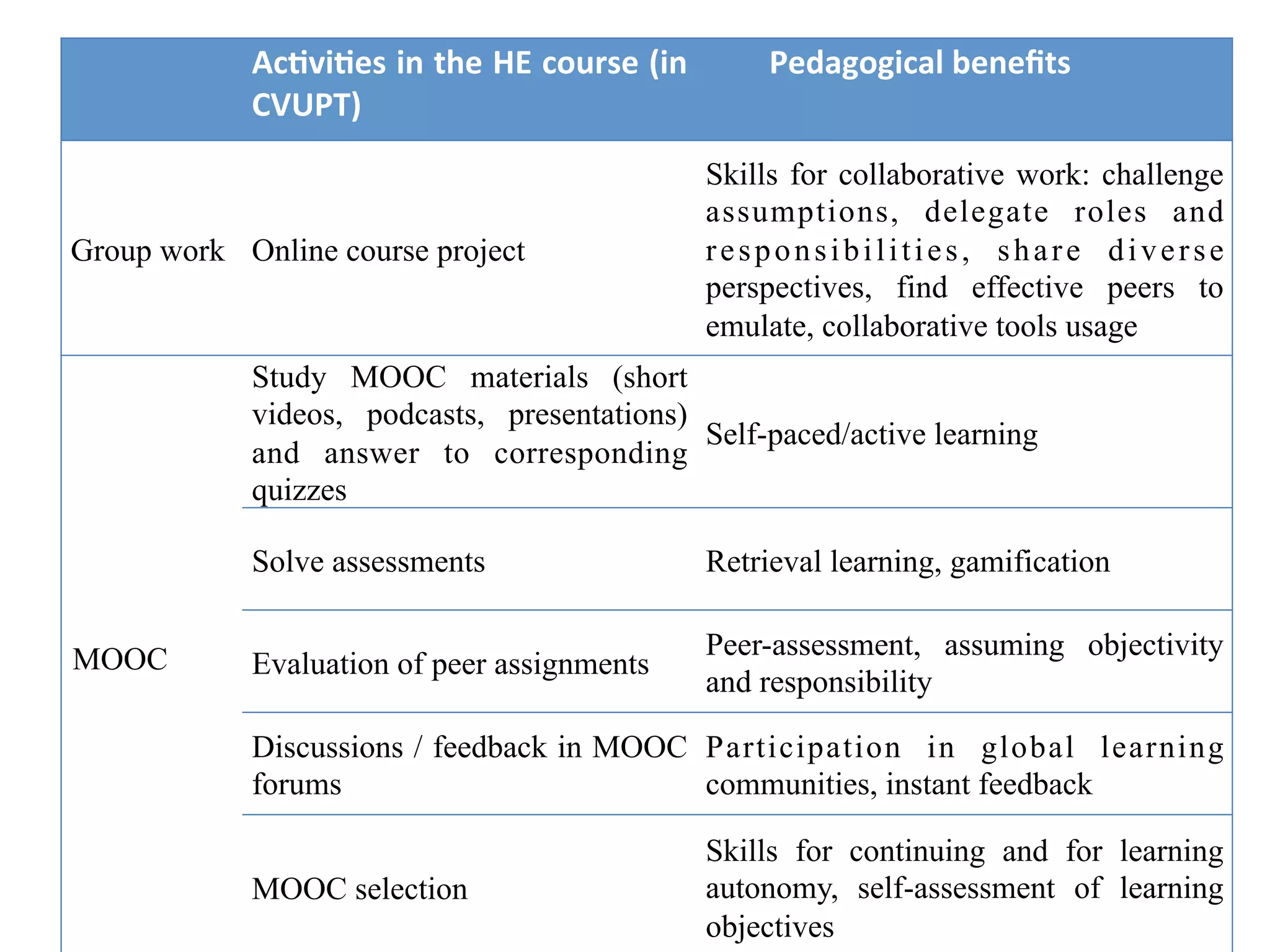
Ac0vi0es	in	the	HE	course	(in	
CVUPT)
Pedagogical	benefits
Group work Online course project
Skills for collaborative work: challenge
assumptions, delegate roles and
responsibilities, share diverse
perspectives, find effective peers to
emulate, collaborative tools usage
MOOC
Study MOOC materials (short
videos, podcasts, presentations)
and answer to corresponding
quizzes
Self-paced/active learning
Solve assessments Retrieval learning, gamification
Evaluation of peer assignments
Peer-assessment, assuming objectivity
and responsibility
Discussions / feedback in MOOC
forums
Participation in global learning
communities, instant feedback
MOOC selection
Skills for continuing and for learning
autonomy, self-assessment of learning
objectives
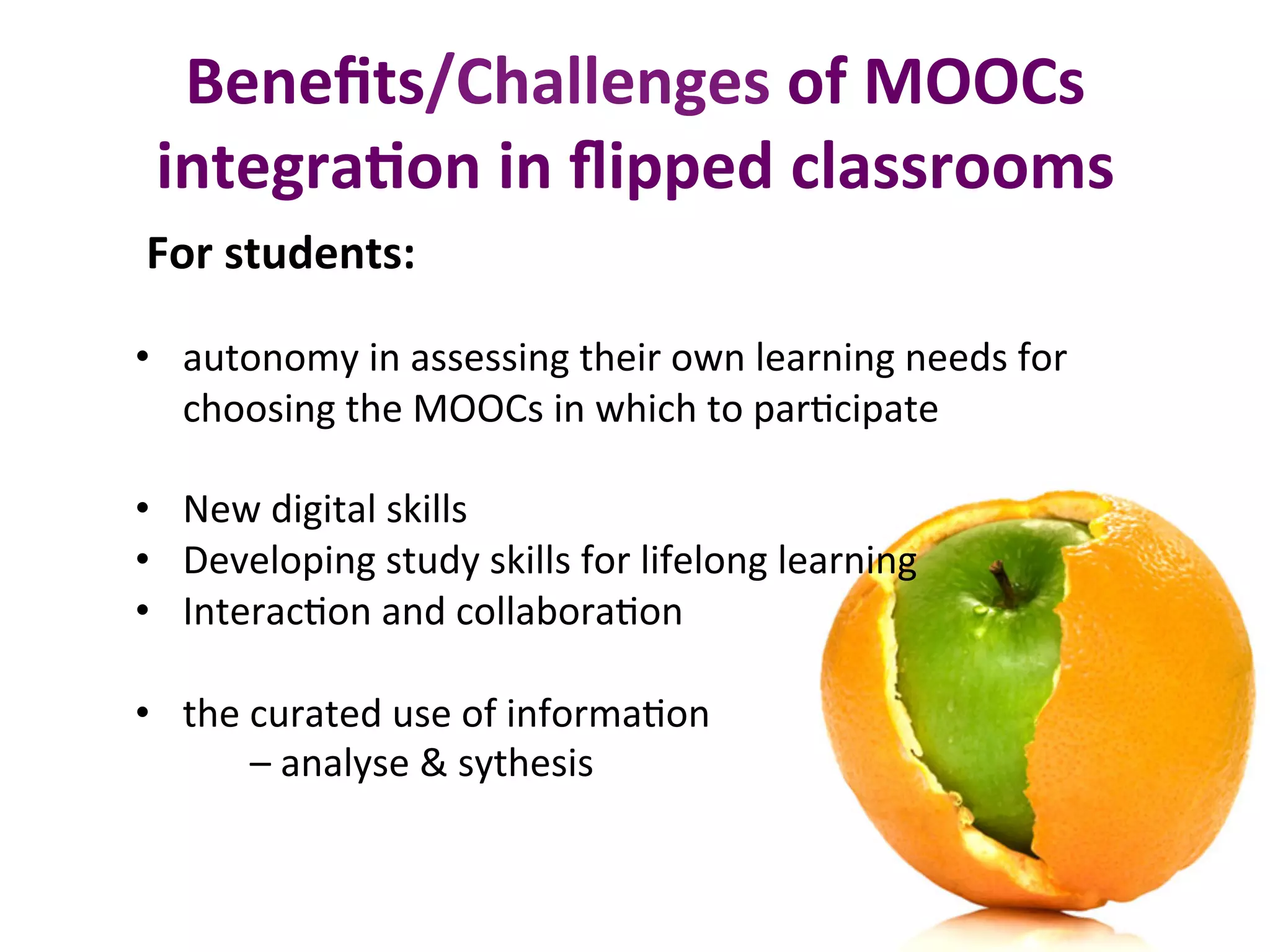
For	students:	
•  autonomy	in	assessing	their	own	learning	needs	for	
choosing	the	MOOCs	in	which	to	parBcipate	
•  New	digital	skills	
•  Developing	study	skills	for	lifelong	learning	
•  InteracBon	and	collaboraBon		
•  the	curated	use	of	informaBon		
												–	analyse	&	sythesis	
Benefits/Challenges	of	MOOCs	
integra0on	in	flipped	classrooms
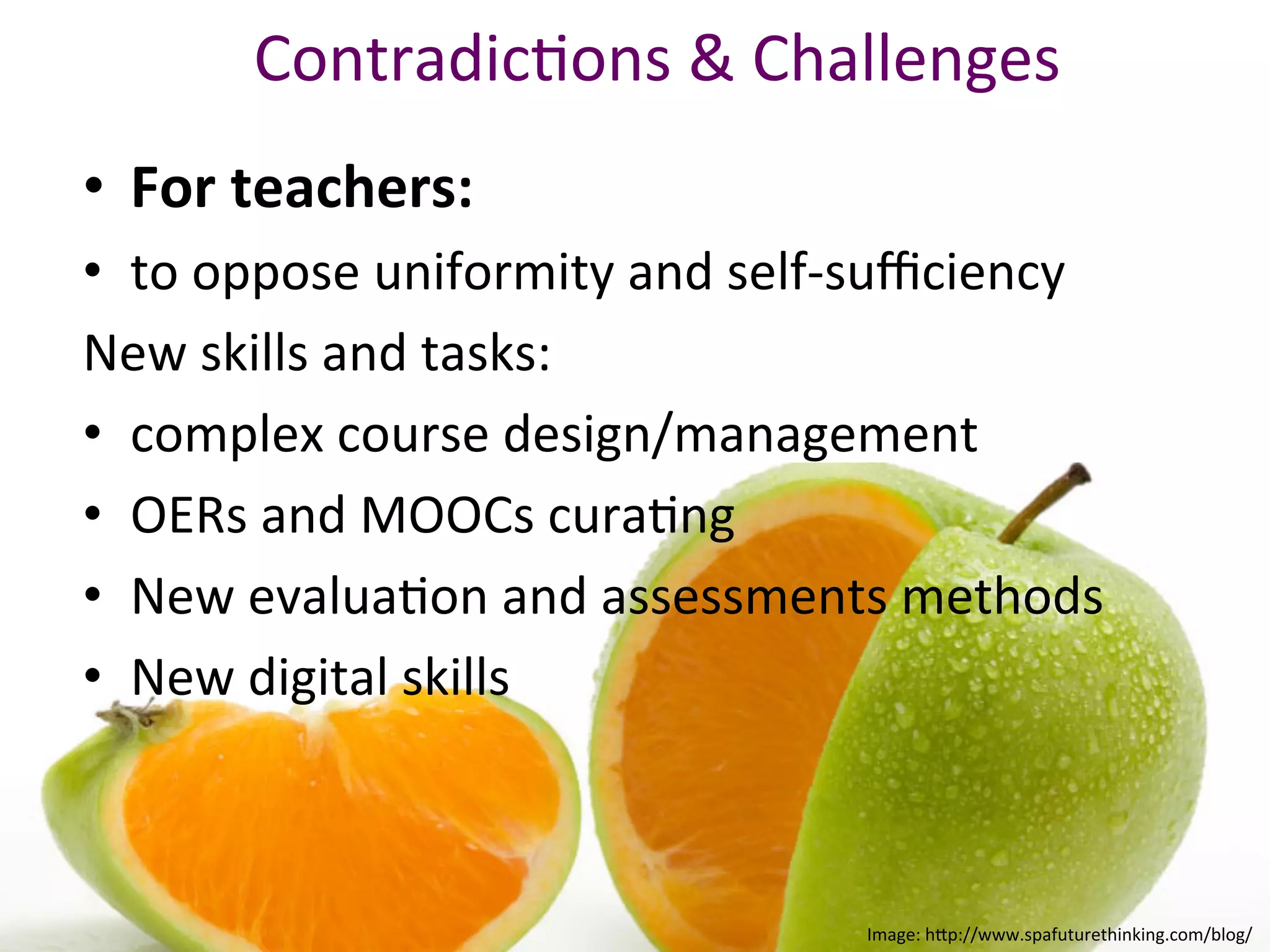
ContradicBons	&	Challenges		
	
•  For	teachers:	
•  to	oppose	uniformity	and	self-sufficiency		
New	skills	and	tasks:	
•  complex	course	design/management	
•  OERs	and	MOOCs	curaBng	
•  New	evaluaBon	and	assessments	methods	
•  New	digital	skills	
Image:	h.p://www.spafuturethinking.com/blog/
Advantages	
•  Fading	tradiBonal	educaBon	barrier	
•  developing/improving	digital	skills	
•  always	connected	to	real-life	situaBons	
•  access	to	latest	technology	
•  	experiencing	a	more	fundamental	form	of	
self–educaBon	and	open-educaBon	
•  learning	from	the	stream:	there	are	thousands	
of	colleagues/pracBBoners/experts	from	all	
over	the	world	to	interact	with
Wicked	
•  eliminaBng	the	confusion	with	distance	
educaBon:	universiBes	that	already	have	
implemented	this	model,	use	informaBon	
technology	as	a	support	for	educaBon,	and	not	
as	an	alternaBve	
•  for	MOOCs	in	HE	facilitators,	prior	experience	
in	designing	and	running	online	courses	is	
needed	
•  a	strategy	for	assessment		
•  Credits	transfer
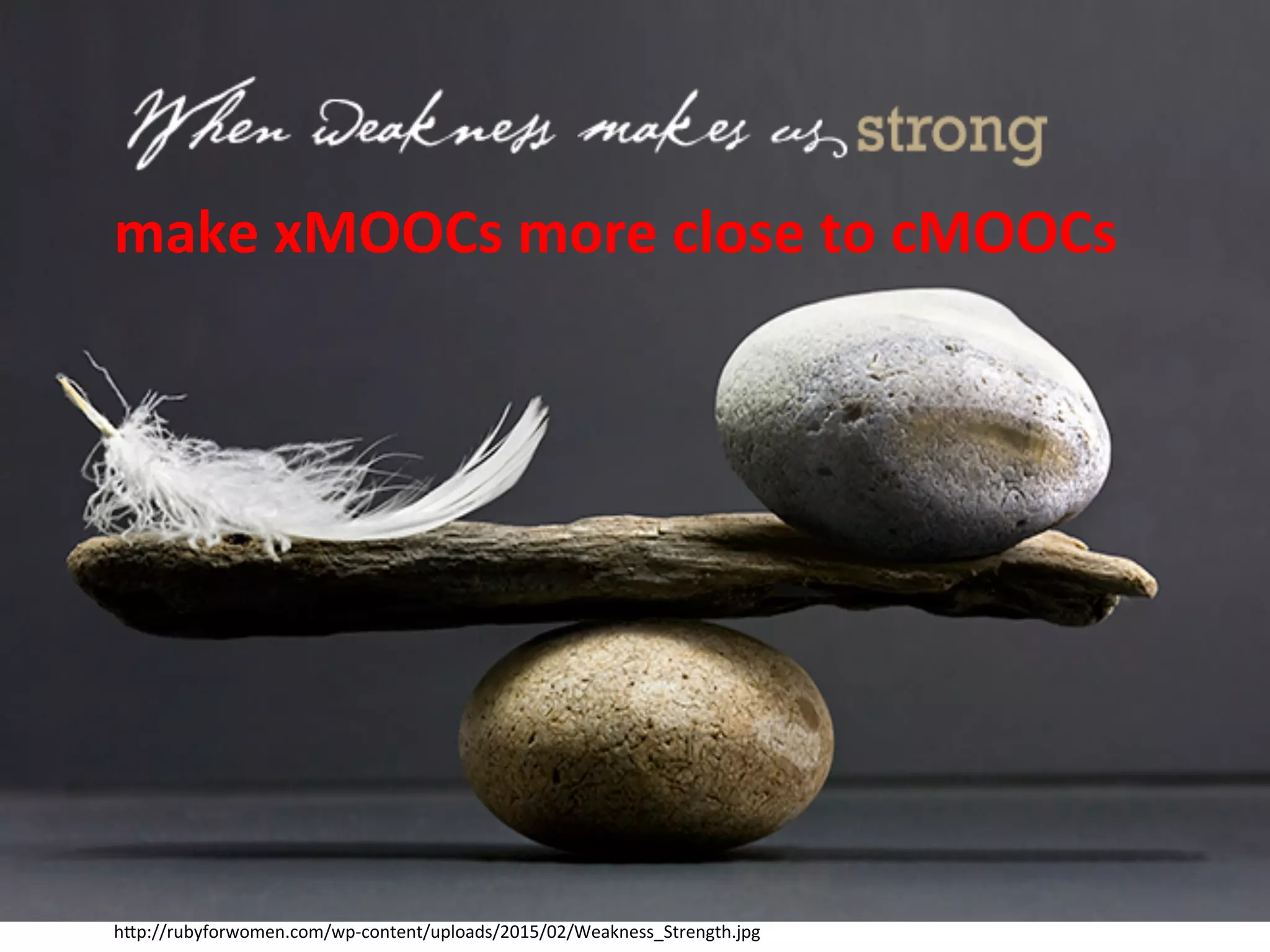
ENGAGE
make	xMOOCs	more	close	to	cMOOCs	
h.p://rubyforwomen.com/wp-content/uploads/2015/02/Weakness_Strength.jpg
CONTACT
Dr. Diana Andone
Director
e-Learning Center
Email: diana.andone@upt.ro
Web
Elearning.upt.ro/diana.andone
@diando70
h.p://www.slideshare.net/diando70/		
EDEN Fellow 2011
#eLEARN2015,	Kona

Using MOOCs within traditional courses: students’ perspective