Horizon Report > 2015 Higher Education Edition
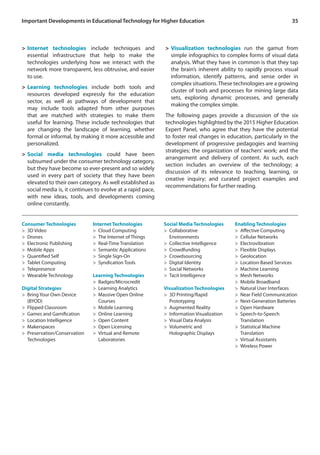
Interested in these emerging technology topics? Learn more about them and other edtech insights by“liking”
us on Facebook at facebook.com/newmediaconsortium and on Twitter at twitter.com/nmcorg.
iii
Executive Summary	1
Introduction	3
Key Trends Accelerating Technology Adoption in Higher Education	6
	 Long-Term Trends: Driving Ed Tech adoption in higher education for five or more years
		> Advancing Cultures of Change and Innovation	8
		> Increasing Cross-Institution Collaboration	10
	 Mid-Term Trends: Driving Ed Tech adoption in higher education for three to five years
		> Growing Focus on Measuring Learning	12
		> Proliferation of Open Educational Resources	14
	 Short-Term Trends: Driving Ed Tech adoption in higher education for the next one to two years
		> Increasing Use of Blended Learning	16
		> Redesigning Learning Spaces	18
Significant Challenges Impeding Technology Adoption in Higher Education	20
	 Solvable Challenges: Those that we understand and know how to solve
		> Blending Formal and Informal Learning	22
		> Improving Digital Literacy	24
	 Difficult Challenges: Those we understand but for which solutions are elusive
		> Personalizing Learning	26
		> Teaching Complex Thinking	28
	 Wicked Challenges: Those that are complex to even define, much less address
		> Competing Models of Education	30
		> Rewarding Teaching	32
Important Developments in Educational Technology for Higher Education	34
	 Time-to-Adoption Horizon: One Year or Less
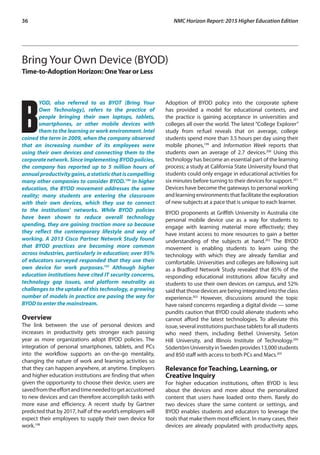
		> Bring Your Own Device (BYOD)	36
		> Flipped Classroom	38
	 Time-to-Adoption Horizon: Two to Three Years
		> Makerspaces	40
		> Wearable Technology 	42
	 Time-to-Adoption Horizon: Four to Five Years
		> Adaptive Learning Technologies	44
		> The Internet of Things	46
The 2015 Higher Education Expert Panel	48
Endnotes	49
Table of Contents	 > Click on a topic to jump to that page.
The NMC Horizon Report: 2015 Higher Education Edition
is a collaboration between The NEW MEDIA CONSORTIUM and The EDUCAUSE
Learning Initiative, an EDUCAUSE Program.
The research behind the NMC Horizon Report: 2015 Higher
Education Edition is jointly conducted by the New Media
Consortium (NMC) and the EDUCAUSE Learning Initiative
(ELI), an EDUCAUSE Program. The ELI’s critical participation in
the production of this report and their strong support for the
NMC Horizon Project is gratefully acknowledged.To learn more
about ELI, visit www.educause.edu/eli; to learn more about the
NMC, visit www.nmc.org.
© 2015, The New Media Consortium
ISBN 978-0-9906415-8-2
Permission is granted under a Creative Commons Attribution
4.0 International License to replicate, copy, distribute, transmit,
or adapt this report freely provided that attribution is provided
as illustrated in the citation below. To view a copy of this
license, visit creativecommons.org/licenses/by/4.0.
Citation
Johnson, L., Adams Becker, S., Estrada, V., and Freeman, A.
(2015). NMC Horizon Report: 2015 Higher Education Edition.
Austin, Texas: The New Media Consortium.
Photographs
Cover, Inside Cover, and Back Cover by BigStock Photography
Acknowledgements
The NMC is extremely grateful to the following people and
companies who made generous contributions to support this
project:
Autodesk
Carole Burns
Mark Fink
Maya Georgieva
Tim Logan
Liz Neely
Ruben Puentedura
Barry Silverberg
Peggy Snyder
Daniel Torres
1
Executive Summary
W
hat is on the five-year horizon for higher
education institutions? Which trends and
technologies will drive educational change?
What are the challenges that we consider as
solvable or difficult to overcome, and how
can we strategize effective solutions? These questions
andsimilarinquiriesregardingtechnologyadoptionand
educational change steered the collaborative research
and discussions of a body of 56 experts to produce
the NMC Horizon Report: 2015 Higher Education Edition,
in partnership with the EDUCAUSE Learning Initiative
(ELI). The NMC Horizon Report series charts the five-year
horizon for the impact of emerging technologies in
learning communities across the globe. With more than
13 years of research and publications, it can be regarded
as the world’s longest-running exploration of emerging
technology trends and uptake in education.
The experts agreed on two long-term trends: advancing
learning environments that are flexible and drive
innovation, as well as increasing the collaboration that
takes place between higher education institutions.
These are just two of the 18 topics analyzed in the NMC
Horizon Report: 2015 Higher Education Edition, indicating
the key trends, significant challenges, and important
technological developments that are very likely to
impact changes in higher education across the world
over the next five years.
Regarding the challenges for universities and colleges,
improving digital literacy is considered one of the
solvable challenges. It is already being addressed by
actions at individual institutions. AtThe Open University
in the UK, they developed the “Digital and Information
Framework” to standardize and implement better
digital literacy training in their curriculum. Cornell
University also has made available online resources for
learning key technology skills. On the other hand, the
experts identified rewarding teachers for innovative
and effective pedagogy as a wicked challenge — one
that is impossible to define, let alone solve. Many
institutions provide more incentives for research over
exemplary teaching.
In view of the trends and challenges observed, the
panel also signalled the technological developments
that could support these drivers of innovation and
change. Bring Your Own Device (BYOD) and the flipped
classroom are expected to be increasingly adopted by
institutions in one year’s time or less to make use of
mobile and online learning. The time-to-adoption for
makerspaces and wearable technology are estimated
within two to three years, while adaptive learning
technologies and the Internet of Things is expected to
be mainstream in universities and colleges within four
to five years.
The three key sections of this report constitute a
reference and straightforward technology-planning
guide for educators, higher education leaders,
administrators, policymakers, and technologists. It
is our hope that this research will help to inform the
choices that institutions are making about technology
to improve, support, or extend teaching, learning, and
creative inquiry in higher education across the globe.
Education leaders worldwide look to the NMC Horizon
Project and both its global and regional reports as key
strategic technology planning references, and it is for
that purpose that the NMC Horizon Report: 2015 Higher
Education Edition is presented.
Withmorethan13yearsofresearch
andpublications,theNMCHorizon
Projectcanberegardedasthe
world’slongest-runningexploration
ofemergingtechnologytrendsand
uptakeineducation.
2	 NMC Horizon Report: 2015 Higher Education Edition
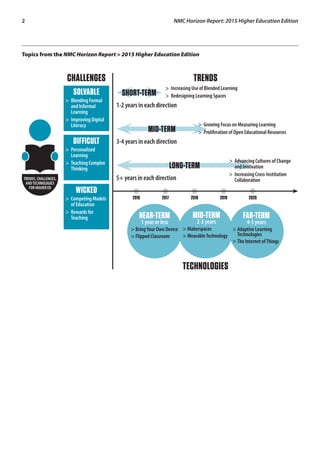
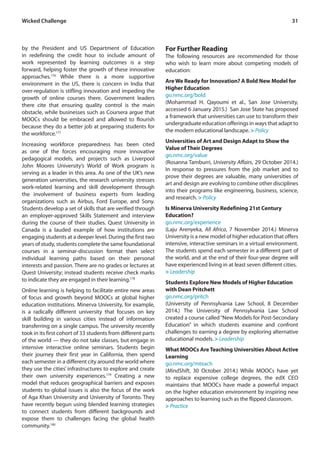
Topics from the NMC Horizon Report > 2015 Higher Education Edition
TRENDS
SOLVABLE
>	 Blending Formal
and Informal
Learning
>	 Improving Digital
Literacy
DIFFICULT
>	Personalized
Learning
>	 Teaching Complex
Thinking
WICKED
>	 Competing Models
of Education
>	 Rewards for
Teaching
TRENDS, CHALLENGES,
ANDTECHNOLOGIES
FOR HIGHER ED
CHALLENGES
>	 Increasing Use of Blended Learning
>	 Redesigning Learning Spaces
1-2 years in each direction
SHORT-TERM
>	 Growing Focus on Measuring Learning
>	 Proliferation of Open Educational Resources
3-4 years in each direction
MID-TERM
>	 Advancing Cultures of Change
and Innovation
>	 Increasing Cross-Institution
Collaboration5+ years in each direction
LONG-TERM
	2016	 2017	 2018	 2019	 2020
TECHNOLOGIES
NEAR-TERM
1 year or less
>	BringYour Own Device
>	Flipped Classroom
MID-TERM
2-3 years
>	Makerspaces
>	WearableTechnology
FAR-TERM
4-5 years
>	Adaptive Learning
Technologies
>	The Internet ofThings
3
Introduction
I
n the pages that follow, 18 topics carefully selected
by the 2015 Horizon Project Higher Education
Expert Panel related to the educational applications
of technology are examined, all of them areas very
likely to impact technology planning and decision-
making over the next five years (2015-2019). Six key
trends, six significant challenges, and six important
developments in educational technology are placed
directly in the context of their likely impact on the core
missions of universities and colleges, and detailed in
succinct, non-technical, and unbiased presentations.
Each has been tied to essential questions of relevance,
policy, leadership, and practice.
The NMC Horizon Report: 2015 Higher Education Edition
was produced by the NMC in collaboration with the
EDUCAUSE Learning Initiative. The internationally
recognized NMC Horizon Report series and regional NMC
TechnologyOutlooksarepartoftheNMCHorizonProject,
a comprehensive effort established in 2002 by the NMC
that identifies and describes emerging technologies
likely to have a large impact over the coming five years
in education around the globe.The NMC Horizon Report:
2015 Higher Education Edition is the 12th in the annual
higher education series of reports and is produced by
the NMC in collaboration with the EDUCAUSE Learning
Initiative (ELI).
Key trends, challenges, and technological
developments that are detailed here will directly inform
policy, leadership, and practice at all levels impacting
universities and colleges. This report aims to help
universities, governing boards, and education leaders
to strategically approach the further evolution of
teaching, learning, and creative inquiry. Each topic has
been carefully researched and framed in the context of
its potential impact on global higher education.
The report’s first two sections focus on an analysis
of trends driving technology decision-making and
planning, and the challenges likely to impede the
adoption of new technologies, respectively. Each
includesanexplicitdiscussionofthetrendorchallenge’s
implications for policy, leadership, and practice in
universities and colleges, along with examples and
relevant readings.
The third section, in which six important developments
in educational technology are described, is ultimately
framed by these trends and challenges. The adoption
or abandonment of these technologies by higher
education institutions will be very much determined by
the responses taken across the globe to these drivers of
and obstacles to innovation and change.
Each of the four global editions of the NMC Horizon
Report — higher education, primary and secondary
education (K-12), museum, and library — highlights
six emerging technologies or practices that are likely
to enter mainstream use within their focus sectors over
the next five years. Key trends and challenges that will
affect current practice over the same period frame these
discussions. The discussions of trends and technologies
have been organized into three time-related categories;
challenges are discussed within a similar three-part
framework related to the scope of the challenge.
Keytrends,challenges,and
technologicaldevelopments
thataredetailedherewilldirectly
informpolicy,leadership,and
practiceatalllevelsimpacting
universitiesandcolleges.
Each topic closes with an annotated list of suggested
readings and additional examples that expand on the
discussion in the report. These resources, along with a
wide collection of other helpful projects and readings,
can all be found in the project’s open content database
that is accessible via the free NMC Horizon EdTech
Weekly App for iOS1
and Android devices.2
All the
background materials for the NMC Horizon Report: 2015
Higher Education Edition, including the research data,
the preliminary selections, the topic preview, and this
publication, can be downloaded for free on iTunes U.3
4	 NMC Horizon Report: 2015 Higher Education Edition
The process used to research and create the NMC
Horizon Report: 2015 Higher Education Edition is rooted
in the methods used across all the research conducted
within the NMC Horizon Project. All editions of the
NMC Horizon Report are informed by both primary
and secondary research. Dozens of meaningful trends,
challenges, and emerging technologies are examined
for possible inclusion in the report for each edition.
Every report draws on the considerable expertise of an
international expert panel that first considers a broad
set of important trends, challenges, and emerging
technologies, and then examines each of them in
progressively more detail, reducing the set until the
final listing of trends, challenges, and technologies is
selected. This process takes place online, where it is
captured in the NMC Horizon Project wiki. The wiki is
intended to be a completely transparent window into
the work of the project, one that not only provides
a real-time view of the work as it happens, but also
contains the entire record of the process for each of the
various editions published since 2006. The wiki used for
the NMC Horizon Report: 2015 Higher Education Edition
can be found at horizon.wiki.nmc.org.
The panel was composed of 56 technology experts
from 17 countries on six continents this year; their
names and affiliations are listed at the end of this report.
Despite their diversity of backgrounds and experience,
they share a consensus view that each of the profiled
technologies is going to have a significant impact on
the practice of higher education around the globe over
the next five years. The key trends driving interest in
their adoption, and the significant challenges higher
education institutions will need to address if they are to
reach their potential, also represent their perspective.
The procedure for selecting the topics in the report is
based on a modified Delphi process refined over the
now 13 years of producing the NMC Horizon Report
series, and began with the assembly of the panel.
The panel represents a wide range of backgrounds,
nationalities, and interests, yet each member brings a
relevant expertise. Over the decade of the NMC Horizon
Project research, more than 1,200 internationally
recognized practitioners and experts have participated
on the panels; in any given year, a third of panel
members are new, ensuring a flow of fresh perspectives
each year. Nominations to serve on the expert panel are
encouraged; see go.nmc.org/horizon-nominate.
Once the panel for a particular edition is constituted,
their work begins with a systematic review of the
literature — press clippings, reports, essays, and other
materials — that pertains to emerging technology.
Members are provided with an extensive set of
background materials when the project begins, and
are then asked to comment on them, identify those
that seem especially worthwhile, and add to the set.
The group discusses existing applications of emerging
technology and brainstorms new ones. A key criterion
for the inclusion of a topic in this edition is its potential
relevance to teaching, learning, and creative inquiry
in higher education. A carefully selected set of RSS
feeds from hundreds of relevant publications ensures
that background resources stay current as the project
progresses. They are used to inform the thinking of the
participants.
Following the review of the literature, the expert panel
engages in the central focus of the research — the
research questions that are at the core of the NMC
Horizon Project.These questions were designed to elicit
a comprehensive listing of interesting technologies,
challenges, and trends from the panel:
1Which of the key technologies catalogued in
the NMC Horizon Project Listing will be most
important to teaching, learning, or creative inquiry
within the next five years?
2What key technologies are missing from our list?
Consider these related questions:
> What would you list among the established
technologies that some higher education
institutions are using today that arguably
all institutions should be using broadly to
support or enhance teaching, learning, or
creative inquiry?
>	What technologies that have a solid user
base in consumer, entertainment, or other
industriesshouldhighereducationinstitutions
be actively looking for ways to apply?
>	What are the key emerging technologies
you see developing to the point that higher
education institutions should begin to take
notice during the next four to five years?
3What trends do you expect to have a significant
impact on the ways in which higher education
institutions approach our core missions of teaching,
learning, and creative inquiry?
4What do you see as the key challenges related to
teaching, learning, or creative inquiry that higher
education institutions will face during the next five
years?
In the first step of this approach, the responses to
the research questions are systematically ranked and
5
placed into adoption horizons by each expert panel
member using a multi-vote system that allows members
to weight and categorize their selections. These are
compiled into a collective ranking, and inevitably, the
ones around which there is the most agreement are
quickly apparent.
From the comprehensive list of trends, challenges,
and technologies originally considered for any report,
the dozen that emerge at the top of the initial ranking
process in each area are further researched and
expanded. Once these interim results are identified, the
group explores the ways in which these topics impact
teaching and learning in higher education institutions.
A significant amount of time is spent researching real
and potential applications for each of the topics that
would be of interest to practitioners. For every edition,
when that work is done, each of these interim results
topics is written up in the format of the NMC Horizon
Report. With the benefit of the full picture of how the
topic will look in the report, the topics in the interim
results are then ranked yet again, this time in reverse.
The final topics selected by the expert panel are those
detailed here in the NMC Horizon Report: 2015 Higher
Education Edition.
Introduction
6	 NMC Horizon Report: 2015 Higher Education Edition
Key Trends Accelerating Technology Adoption in Higher
Education
T
he sixtrendsdescribedinthefollowingpages were
selected by the project’s expert panel in a series of
Delphi-based voting cycles, each accompanied
by rounds of desktop research, discussions, and
further refinements of the topics. These trends,
which the members of the expert panel agreed are very
likely to drive technology planning and decision-making
over the next five years, are sorted into three movement-
related categories — long-term trends that typically
have already been impacting decision-making, and
will continue to be important for more than five years;
mid-term trends that will likely continue to be a factor
in decision-making for the next three to five years; and
short-term trends that are driving edtech adoption now,
but will likely remain important for only one to two years,
becoming commonplace or fading away in that time.
While long-term trends have already been the topic
of many education leaders’ discussions and extensive
research, short-term trends often do not have an
abundance of concrete evidence pointing to their
effectiveness and future directions. All of the trends
listed here were explored for their implications for
higher education in a series of online discussions that
can be viewed at horizon.wiki.nmc.org/Trends.
The NMC Horizon Project model derived three meta-di-
mensions that were used to focus the discussions of
each trend and challenge: policy, leadership, and prac-
tice. Policy, in this context, refers to the formal laws, reg-
ulations, rules, and guidelines that govern universities
and colleges; leadership is the product of experts’visions
of the future of learning, based on research and deep
consideration; and practice is where new ideas and ped-
agogies take action, in universities and related settings.
Policy. While all of the identified trends had policy
implications, two trends in particular are expected to
have a strong impact on policy decisions in the next five
years. The proliferation of open educational resources
has emerged as a major topic of interest to national
governments and universities, but requires effective
policy to become mainstream in practice. The European
Commission’s Institute for Prospective Technological
Studies (IPTS) launched the “Opening Up Education” to
assist in the formulation of guidelines in OER adoption
and implementation.4
Likewise, measuring learning through data-driven
practice and assessment, currently on the rise in
universities in the developed world, will reach its
maximum impact in higher education in about three
to five years, but many leading institutions are moving
considerably faster. The Open University in the UK has
created policies that support the ethical use of learning
analytics,5
and in the US, the recent Asilomar Conference
convened educators, data scientists, and legal scholars
to develop a framework to influence policy.6
Thesetrends,whichthemembers
oftheexpertpanelagreedarevery
likelytodrivetechnologyplanning
anddecision-makingoverthenext
fiveyears,aresortedintothree
movement-relatedcategories.
Leadership. While there are leadership implications
for all the identified trends that are discussed in the
following pages, two trends stand out as unique
opportunities for vision and leadership. The redesign of
learning spaces requires initiative to imagine how the
physical set-up of classrooms can better accommodate
progressive teaching, but also how to share those ideas
broadly. Launched by SUNY’s University at Buffalo,
FLEXspace is an interactive online database that
highlights best practices in design from universities all
over the world.7
A long-term trend is the growth of collaboration
between different higher education institutions. This
trend reflects the notion that innovation can scale
better when ideas are shared between institutions. The
University of California Riverside is a notable example,
co-founding the University Innovation Alliance with ten
other universities to investigate emerging technologies
and determine how they can best scale.8
7
Practice. Each of the six trends identified by the
expert panel has numerous implications for teaching
and learning practice, and current examples are easy
to find. The increase of blended learning, highlighted
as one of two developing short-term trends in the
following pages, is bringing both technical and
pedagogical enhancements to online and blended
learning. Channel 9, for example, is a website that
encompasses a library of training resources in computer
coding and programming, with streaming videos and
interactive events.9
All over the world, universities and colleges have
been gradually rethinking how their organizations
and infrastructures can be more agile. The thought is
that if institutions are more flexible, they will be better
able to support and promote entrepreneurial thinking
— a long-term trend. At the University of Florida, the
Innovation Academy acts as an incubator for students
to plan and develop products and businesses, and even
seek external funding.10
The following pages provide a discussion of each of
the trends highlighted by this year’s expert panel that
includes an overview of the trend, its implications, and
a set of curated recommendations for further reading
on the topic.
Key Trends
8	 NMC Horizon Report: 2015 Higher Education Edition
Advancing Cultures of Change and Innovation
Long-TermTrend: Driving EdTech adoption in higher education for five or more years
M
any thought leaders have long believed
that universities can play a major role
in the growth of national economies.
Research universities are generally
perceived as incubators for new discoveries
and innovations that directly impact their local
communitiesandeventhegloballandscape.11
Inorder
to breed innovation and adapt to economic needs,
higher education institutions must be structured in
ways that allow for flexibility, and spur creativity
and entrepreneurial thinking. There is a growing
consensus among many higher education thought
leaders that institutional leadership and curricula
couldbenefitfromagilestartupmodels.Educatorsare
working to develop new approaches and programs
based on these models that stimulate top-down
change and can be implemented across a broad range
of institutional settings.12
In the business realm, the
Lean Startup movement uses technology as a catalyst
for promoting a culture of innovation in a more
widespread, cost-effective manner, and provides
compelling models for higher education leaders to
consider.13
Overview
This topic reflects a broader trend in society in which
businesses are adapting their strategies to remain
relevant to consumers. A well-known example is the
publishing industry, which has transitioned their focus
in the past decade from print to digital to keep pace with
the rapidly changing technology landscape. Similarly,
many companies that once manufactured hardware
and software packages have shifted to providing cloud-
based services. In the business of higher education,
the consumers are the students, and there is a need to
better cater to them as their expectations and behaviors
evolve. In many ways, this shift is being driven by the
technologies that students use in their daily lives and
that extend to learning. For example, once it was clear
that smartphones could play a major role in teaching
and learning, institutions updated their infrastructures
to accommodate BYOD programs. In this sense, it has
become the responsibility of universities to foster
environments that accelerate learning and creativity.14
The onus is on universities to create the conditions
for innovation to happen. In a recent speech to the
Detroit Economics Club, the outgoing University of
Michigan president asserted that the institution could
be paramount in promoting more entrepreneurship
throughout the state.15
She emphasized the need for
universitiestoestablishpoliciesthatspurmorecreativity
and encourage more risk-taking, collaboration, and
activities that more accurately reflect the contemporary
workplace. Bringing university organizational models
into the future can translate into advancing local and
global economies and cultures. A university lecturer and
researcher from the University of Tampere in Finland
published “The Roles of Universities in the Chinese
Innovation Systems,” which showed a correlation
between universities that emphasize technology use
in improving China’s economy, especially in cultivating
more technologically savvy graduates.16
Attitude is also key in adopting more organizational
flexibility and innovative practices. The SUNY System
hosted a conference in late 2014 — “Higher Education
Reconsidered: Executing Change to Drive Collective
Impact”— to identify tactics for SUNY universities to be
moreagileandforward-thinking.Theirgoalistodevelop
leadership that “understands the science of change,”
systems that are more adaptive, and a culture that relies
more on real evidence and data for decision making.17
The US Department of Commerce published a report
entitled“The Innovative and Entrepreneurial University,”
which depicted the ways in which universities around
the country are nurturing entrepreneurship within their
infrastructure. Many examples highlight partnerships
between the institutions with businesses and
government agencies, including Clemson University’s
International Center for Automotive Research.18
Implications for Policy, Leadership, or
Practice
Thereisaneedforpoliciesthatmoreaggressivelysupport
agility. The European Commission’s “Modernizing
Universities”agenda focuses on implementing reform in
higher education by restructuring institutions to enable
faculty and students to be more active participants in
the global marketplace of research and innovation.
The EC’s goals include stimulating a more open
research environment, fostering stronger partnerships
with businesses, and rethinking how qualifications
are recognized.19
In the US, university consortia are
9
leading the charge. The Association of American
Universities is dedicated to spreading innovation across
campuses. They are championing a number of agendas
and policies, including the Task Force on American
Innovation, which advocates for greater government
investments in innovative research projects in the fields
of physical science and engineering.20
They also work
with universities, government agencies, and businesses
to implement more policies and university competitions
that stimulate innovation and economic growth.21
It will require visionary leadership to build higher
education environments that are equipped to quickly
change processes and strategies as startups do. If these
organizational models are designed well, universities
can experience more efficient implementation of
new practices and pedagogies. Aalborg University
in Denmark is designed to spur more creativity and
entrepreneurship,asitisaproblem-basedlearning(PBL)
university with the central values of interdisciplinary
studies and innovation.22
UNESCO has placed its only
Danish Chair at the university to oversee the continued
development of the PBL model as it relates to students
and faculty solving local and global issues.23
There are many opportunities for higher education
institutions to become leaders in promoting innovation
across their campuses. The University of Florida,
for example, launched the Innovation Academy, a
community of students from more than 30 majors
who are mentored in the areas of entrepreneurship
and creativity. These students are encouraged to
start and grow their own small businesses.24
Similarly,
the Singapore Management University’s Institute of
Innovation and Entrepreneurship helps faculty and
students grow their own businesses through a variety
of competitions and initiatives. Thus far, they have
raised $3.7 million in grant funding and $9.4 million
more in follow-up funding to further invest in the 110
companies they have helped generate.25
For Further Reading
The following resources are recommended for those
who wish to learn more about advancing cultures of
change and innovation:
A New Vision for California Higher Education:
A Model Public Agenda
go.nmc.org/vision
(Nancy Shulock et al., Institute for Higher Education
Leadership & Policy, March 2014.) This report constructs
a model public agenda for California higher education
that is more dynamic than the current state. > Policy
Report to the European Commission on New Modes
of Learning and Teaching in Higher Education
go.nmc.org/highlev
(European Commission, October 2014.) The European
Commission’s High-Level Group on the Modernization
of Higher Education has created guidelines for
governmentsandinstitutionstodevelopcomprehensive
strategies at both the national and institutional level for
the adoption of new modes of learning and teaching.
> Policy
Creating an Ever-Flexible Center for Tech Innovation
go.nmc.org/everflex
(Avi Wolfman-Arent, 10 August 2014.) A collaboration
between Cornell University and the Technion-Israel In-
stitute of Technology seeks to create an environment
that allows for repurposing of materials, supports vari-
ety and accessibility, and promotes agility in technology
experimentation. > Leadership
Looking to Future, Educators and Policymakers See
Universities as Agents for Change
go.nmc.org/agents
(Daniel Day, Princeton University, 11 April 2014.) Leaders
and policymakers from across the globe met this past
year in Paris at the Princeton-Fung Global Forum to
discuss how universities can anticipate, influence, and
drive change. > Leadership
Universities Must Adapt to Evolution of Student Body
go.nmc.org/must
(Anthony Davis and Michael Whalen, The Chronicle
Herald, 18 November 2014.) This article argues that
universities in Nova Scotia transferring to hybrid
delivery could eliminate the need for multiple small
departments across each university campus in favor of
significant centers of excellence at each institution.
> Leadership
Education-as-a-Service: 5 Ways Higher Ed Must
Adapt to a Changing Market
go.nmc.org/eaas
(Ryan Craig, Venture Beat, 11 May 2014.) This article
argues that higher education will soon transition from
selling expensive degree programs to “Education-as-a-
Service,” and explains lessons colleges and universities
can learn from SaaS market leader Salesforce. > Practice
Online Skills Mastery - Training for Faculty
go.nmc.org/osm
(University of Colorado Denver, accessed 8 January
2015.) University of Colorado Denver created and
implemented a ten-week Online Skills Mastery training
program to prepare online instructors to excel in
teachingandrewardthemforprofessionaldevelopment
through a badging program. > Practice
Long-Term Trend
10	 NMC Horizon Report: 2015 Higher Education Edition
Increasing Cross-Institution Collaboration
Long-TermTrend: Driving EdTech adoption in higher education for five or more years
C
ollective action among universities is growing
in importance for the future of higher
education. More and more, institutions are
joining consortia — associations of two or
more organizations — to combine resources
or to align themselves strategically with innovation
in higher education. Today’s global environment is
allowing universities to unite across international
borders and work toward common goals concerning
technology,research,orsharedvalues.Supportbehind
technology-enabled learning in higher education
classrooms has reinforced the trend toward open
communities and university consortia, as educators
and administrators recognize collective action as
a sustainable method of supporting upgrades in
technological infrastructure and IT services.
Overview
The tradition of university associations and consortia
originates in the early 20th century in the US, when
universities began aligning with one another to
meet common goals. Although purposes for creating
consortium have grown more varied over time, the
oldest collegiate partnerships were based on creating
a network for which every associated institution could
benefit from a collective pool of resources. One of the
oldest consortia, Claremont Colleges, was established
in 1925 and today joins five undergraduate colleges
and two graduate universities. While each institution
rewards degrees independently, enrolled students have
access to specialized programs and expensive facilities
of the partner schools outside of their institution.
A sense of solidarity with learners is leading institutions
to join together with the objective of increasing
accessibility, affordability, and the quality of education
on a global scale. The World University Consortium,
for example, operates under these values, adopting
a human-centric approach to education, developing
a system that leverages online and hybrid learning
strategies to reach people of all ages globally.26
Technology also plays a key role in the creation of
consortia. Universities are increasingly competitive
environments, and campuses must constantly review
and upgrade infrastructure to optimize their capacity.
Deemed as a long-term trend, the prevalence of
consortia underscores a vision of institutions as
belonging to part of a larger ecosystem in which long-
term survival and relevance in higher education relies
on the mutually beneficial partnerships.
Emerging consortia are founded with the express
purpose of helping institutions continuously adopt best
practices for digital learning. Founded in 2014, Unizin is
a non-profit association that aims to create a common,
scalable digital infrastructure through its role as a cloud-
based services operator.27
Steered by its members,
Unizin offers content, platforms, and analytics that are
sourced from its community of the nation’s top research
institutions.Amongthefirstcommercialservicesoffered
to its members at scale is Canvas by Infrastructure, an
open source LMS that aligns with Unizin’s commitment
to global open standards.28
Guided by its focus on
interoperability and open standards, Unizin will
continue to develop services that help members to
manage content their students and faculty create; to
share this content across universities cost effectively; to
promote interoperability among systems for teaching
and learning; and to facilitate learning analytics with the
aim of improving student outcomes.29
Implications for Policy, Leadership, or
Practice
Institutional policies often dictate the nature of
consortia that university leaders are seeking. Carnegie
Mellon University (CMU), for example, has a strong
ethos about open access and open data for scholarly
communications.Thisapproachhasbeencalledstrategic
by the institution’s president who has underlined the
importance of developing sustainable financial models
for open access in order to disseminate works as broadly
as possible.30
This is underscored by CMU’s membership
in the Open Cloud Consortium (OCC), an open cloud
computing infrastructure that facilitates community
based science, in which researchers from member
institutions, including the University of Chicago and
Johns Hopkins University among others, can compile,
analyze, and share huge data sets via the Open Science
Data Cloud. Bolstered by the shared cloud computing
service, researchers from CMU can work collaboratively
with other scientists in a common area, increasing the
efficacy and speed of research activities.
Joining a consortium is often an institution’s way of
11Long-Term Trend
defining its position as a leader of innovation and
progress in a certain area. In a recent interview with
The Chronicle of Higher Education, the Chancellor of
University of California at Riverside discussed how the
institution has managed to evolve with student success
asafocalpoint.31
UCRiversideisalargepublicinstitution
with a socio-economically diverse student population,
yet it has fostered a system in which the number of
underrepresented minority and low-income students
graduate at the same rate as the campus average.
In 2014, UC Riverside became one of 11 founding
members of the University Innovation Alliance, a
consortium dedicated to making high-quality degrees
accessible to all students regardless of background. This
specialized group of large, public research universities
will be experimenting with new technologies, such as
predictive analytics, in order to build on their success
and bring innovation to scale.32
BCNET is a consortium that has a long history of helping
its members upgrade and maintain their technological
infrastructure and IT services. Since 1998, BCNET has
been unifying British Columbia’s public, post secondary
sector as they explore and develop solutions to mutual
IT challenges, bringing together 25 public universities
and 18 research institutions in the region. In BCNET’s
2014 annual report, ROC: Return on Collaboration, the
consortium presented several examples of successful
initiatives at member sites, including an account of
how BCNET engineers helped Kwantlen Polytechnic
University (KPU) build the IT foundation to realize its
vision for 2018. In order to achieve its goals of 5% annual
growth, expansion of continuing and professional
studies, and improvement in learner engagement and
retention, KPU turned to BCNET to support them as they
planned and implemented a strategy that incorporates
a high-capacity campus network and cloud video
conferencing services at scale.33
For Further Reading
The following resources are recommended for those
who wish to learn more about increasing cross-
institution collaboration:
More Collaboration Needed to Fix Higher
Education, Experts Say
go.nmc.org/morecoll
(Carla Rivera, Los Angeles Times, 23 January 2014.) A
recent report by the nonprofit California Competes
proposes the creation of an autonomous citizens’
Higher Education Investment Board that would collect
data and help inform policy decisions by the governor,
legislature,andleadersofpublicandprivateinstitutions.
> Policy
Competency-Based Education Network
go.nmc.org/c-ben
(Competency-Based Education Network, accessed
4 January 2015.) The Competency-Based Education
Network is a group of colleges and universities working
to address challenges in designing, developing, and
scaling competency-based degree programs.
> Leadership
Global University Network for Innovation
go.nmc.org/guni
(GUNi,accessed4January2015.)GUNiisaninternational
network supported by three partner institutions —
UNESCO, the United Nations University, and the Catalan
Association of Public Universities — that encourages
higher education institutions to redefine their role,
embrace the process of transformation, and strengthen
their critical stance within society. > Leadership
Innovative Internet Drives Collaborative EU-Central
Asian Research and Education
go.nmc.org/caren
(Central Asia Research and Education Network, 1
October 2014.) The data network for research and
education in Central Asia, CAREN, has connected with
GÉANT, a pan-European network that will increase
the capacity and efficiency of over 300 universities
and research centers across Kazakhstan, Kyrgyzstan,
Tajikistan, and Turkmenistan. > Leadership
The Open Education Consortium
go.nmc.org/oec
(OE Consortium, accessed 5 January 2015.) The Open
Education Consortium is a worldwide community
of hundreds of higher education institutions and
associated organizations committed to advancing open
education and its impact on global education.
> Leadership
University Innovation Alliance
go.nmc.org/uia
(University Innovation Alliance, accessed 12 January
2015.) The University Innovation Alliance is a group of
11 universities across the country that have organized
to test and scale solutions to problems of access and
graduation in higher education. > Leadership
7 Ways Higher Ed Institutions are Increasingly
Joining Forces
go.nmc.org/seven
(Keith Button, Education Dive, 18 December 2014.)
Collaboration between institutions is key to scaling
sustainabletechnologyefforts.Collegesanduniversities
are sharing cloud-based supercomputing tools, data
storage, and online course material and platforms.
> Practice
12	 NMC Horizon Report: 2015 Higher Education Edition
Growing Focus on Measuring Learning
Mid-TermTrend:DrivingEdTechadoptioninhighereducationforthreetofiveyears
T
here is an increasing interest in using new
sources of data for personalizing the learning
experience, for ongoing formative assessment
of learning, and for performance measurement;
this interest is spurring the development of
a relatively new field — data-driven learning and
assessment. A key element of this trend is learning
analytics, the application of web analytics, a science
used by businesses to analyze commercial activities
that leverages big data to identify spending trends and
predict consumer behavior. Education is embarking on
asimilarpursuitintodatasciencewiththeaimoflearner
profiling, a process of gathering and analyzing large
amountsofdetailaboutindividualstudentinteractions
in online learning activities.34
The goal is to build better
pedagogies, empower students to take an active part
in their learning, target at-risk student populations,
and assess factors affecting completion and student
success. For learners, educators, and researchers,
learning analytics is already starting to provide crucial
insights into student progress and interaction with
online texts, courseware, and learning environments
used to deliver instruction. Data-driven learning and
assessment will build on those early efforts.
Overview
Data are routinely collected, measured, and analyzed in
the consumer sector to inform companies about nearly
every aspect of customer behavior and preferences. A
number of researchers and companies are working to
design similar analytics that reveal patterns in learning-
related data that can be used to improve learning both
for individual students, and across institutions and
systems. The types of student data being analyzed vary,
but include institutional information such as student
profile information (age, address, and ethnicity),
course selections, and pace of program completion;
engagement data such as number of page views,
contributions by students to discussion threads,
percentage of students completing assignments,
and number of logins; and learning analytics such as
which concepts were mastered and which concepts
were particularly difficult for a student.35
While many
experiments are underway, leaders are just beginning to
understand which data is useful for advancing learning,
as well as the scope of privacy and ethics issues.36
The emerging science of learning analytics is providing
the statistical and data mining tools to recognize
challenges early, improve student outcomes, and
personalize the learning experience. With recent
developments in online learning in particular,
students are generating an exponential amount of
data that can offer a more comprehensive look at their
learning.37
A recent report by the National Institute
for Learning Outcomes and Assessment found that
student assessment is emerging as a leading priority
for institutions of higher education because of pressure
from accrediting and governing entities and the
growing need for more and better evidence of student
achievement. They reported that in 2013, nearly 84%
of colleges and universities surveyed adopted stated
learning outcomes for all of their undergraduates, up
from 10% in 2009, and the range of tools and measures
used to assess student learning has expanded greatly.38
While maintaining its position as a mid-term trend from
last year’s report, this topic is experiencing increasing
activity as projects around the world launch pilots
and implementations. Victoria University in Australia,
for example, moved to a blended learning strategy
that required a change in their LMS. They revitalized
their e-learning environment by using the data
analytics platform Brightspace for detailed reporting,
assessment, and collaboration.39
After a pilot of four
courses confirmed the potential high value of adopting
learning analytics, Nottingham Trent University (NTU)
in the UK introduced the NTU student dashboard that
features learning analytics software that aggregates
data on library use, attendance, and grades.40
In the US,
California State University is also developing a Student
Success Dashboard to help university leaders better
understand problematic areas and assist in determining
the effectiveness of specific interventions they have
implemented.41
Implications for Policy, Leadership, or
Practice
In online environments especially, students are
generating a large amount of learning-related data
that could inform important decisions in addition to
the learning process, but there is more work needed
to structure appropriate policies to protect student
privacy. There is a growing concern that ethical and
13
privacy considerations are not advancing as quickly
as practice.42
The Open University in the UK produced
policy on the ethical use of student data for learning
analytics, grounded on eight key principles that are
linked to particular facets of collecting and analyzing
student data.43
Progress is also being made in the US.
In 2014, educators, scientists, and legal/ethical scholars
gathered at the Asilomar Conference in California to
develop a framework that will inform the ethical use of
data and technology in learning research. Six principles
emerged: respect for the rights of learners, beneficence,
justice, openness, the humanity of learning, and
continuous consideration.44
University leaders are demonstrating their commitment
to the use of learning data through the addition of
new offices and partnerships, including the University
of Maryland’s new Office of Analytics and their
cooperation with the Predictive Analytics Reporting
(PAR) Framework, Civitas Learning, and Transfer
Data Repository. By sharing data on retention and
progression with other institutions, universities can
benchmark their progress. In the PAR project, the
University of Maryland found that they had higher
freshman retention rates than many of their peers,
but fell behind others for students in years two and
three.45
Similarly, the Marist College and University of
Amsterdam announced the Apereo Learning Analytics
community in 2014 to accelerate the operationalization
of learning analytics software and frameworks, support
cross-institutional pilots, and avoid duplication.46
The
sharing of best practices, research, emerging tools, and
proven strategies are hallmarks of this trend.47
Data-driven projects at universities are beginning to
mature and are revealing promising results. At the
UniversityofWisconsin,theStudentSuccessSystempilot
program was initiated to identify struggling students
and behavioral patterns. In addition to expanding
pilot courses and institutional partners in the project’s
second year, there is an effort to foster a community of
interest and practice, which is being accomplished by
incorporating data analytics discussions into faculty
professional development and inviting experts in the
field of learning analytics to engage with the faculty
community.48
Dashboards, visual representations of
data that are integrated in many management systems,
are also currently being used by a number of universities
as a way to personalize the learning experience. These
sorts of tools can provide students with the means
of understanding their progress.49
Examples of new
commercially available dashboards include Enterprise
Analytics,50
Campus Quad Engage,51
and Jenzabar
Analytics.52
For Further Reading
The following resources are recommended for those
who wish to learn more about the growing focus on
measuring learning:
Code of Practice for Learning Analytics
go.nmc.org/codeof
(Niall Sclater, JISC, November 2014.) The complex
ethical and legal issues surrounding student data are
creating barriers to the development and adoption of
learning analytics. In response, this review draws from
86 publications to express the questions raised on the
subject, and extract the ethical principles that can be
used to advise a code of practice. > Policy
Lecturer Calls for Clarity in Use of Learning Analytics
go.nmc.org/clar
(Chris Parr, Times Higher Education, 6 November 2014.)
The Open University has produced a publicly available
written policy on the ethical use of student data for
learning analytics and hopes the new policy will begin a
debate in higher education about what level of consent
is required from students before universities can use
their data. > Policy
Carnegie Mellon Leads New NSF Project Mining
Educational Data To Improve Learning
go.nmc.org/sphere
(Carnegie Mellon University, 2 October 2014.) The
National Science Foundation is sponsoring Carnegie
Mellon University in creating a distributed storage
system that will serve as an enabling and collaborative
data infrastructure that gives researchers control
over which elements of their data can be accessed by
outsiders. > Leadership
Iowa Community College Online Consortium
go.nmc.org/ean
(Next Generation Learning, accessed 4 January 2015.)
The Iowa Community College Online Consortium’s
eAnalytics system provides instructors with the ability
to identify at-risk students and provide support to
improve their performance. > Practice
Learning Analytics Don’t Just Measure Students’
Progress – They Can Shape It
go.nmc.org/learnan
(Rebecca Ferguson, The Guardian, 26 March 2014.) This
article describes how learning analytics can combine
data analysis and visualization to offer ways for learners
to improve while a course is in progress. > Practice
Mid-Term Trend
14	 NMC Horizon Report: 2015 Higher Education Edition
Proliferation of Open Educational Resources
Mid-TermTrend:DrivingEdTechadoptioninhighereducationforthreetofiveyears
D
efinedbytheHewlettFoundationin2002,open
educational resources (OER) are “teaching,
learning, and research resources that reside
in the public domain or have been released
under an intellectual property license that
permits their free use and re-purposing by others.”53
Momentum behind OER began early on, getting a
major boost when the Massachusetts Institute of
Technology founded the MIT OpenCourseWare (OCW)
initiative in 2001, making MIT instruction materials
for over 2,200 of its courses available online, free of
charge. Soon after, prestigious universities including
Carnegie Mellon University and Harvard University,
amongothers,pushedforwardtheirownopenlearning
initiatives. Understanding that the term “open” is
a multifaceted concept is essential to following this
trend in higher education; often mistaken to simply
mean “free of charge,” advocates of openness have
worked towards a common vision that defines it more
broadly — not just free in economic terms, but also in
terms of ownership and usage rights.
Overview
Altogether, OER represents a broad variety of digital
content, including full courses, course materials,
modules, textbooks, videos, tests, software, and any
other means of conveying knowledge. OER uses
Creative Commons and alternative licensing schemes
to more easily distribute knowledge, media, and
educational resources, which guarantees that content
is freely copiable, freely remixable, and free of barriers
to access, cultural sensitivities, sharing, and educational
use. Open textbooks are being considered as a viable
means for cutting excess costs with the goal of making
education more affordable for students. According
to a 2014 study by US PIRG Education Fund and the
Student PIRGs, of 2,039 students surveyed, 65% said
that they had not bought a textbook due to its high
price. Open textbooks are open-source e-books that are
freely available with nonrestrictive licenses, and have
been popularized by projects such as Rice University’s
Open Stax College54
and College Open Textbooks,55
a
non-profit collaborative of over 200 universities and 29
organizations.
While OER is gaining traction across campuses, its
broader acceptance into higher education hinges on
the issue of awareness and accessibility.56
Babson Survey
Research Group published an in-depth exploration of
OER uptake in higher education throughout the US and
found that among 2,144 faculty members surveyed,
the majority demonstrated benevolent attitudes about
using OER, unlike other technological advances in
teaching.57
Yet the survey revealed that awareness of
OER and related issues was significantly scarce, with
only 5.1% of respondents answering that they were
“very aware”of OER and its use in the classroom.58
More
than half of the respondents said they were deterred by
the lack of search tools or a comprehensive catalog of
materials.59
While understanding about OER is lacking,
Babson researchers highlighted why knowledge in
this area has the potential to increase greatly over the
next three years; more than three-quarters of faculty
members indicated that they expected to use OER or
would consider using OER in the future.60
There are a number of existing OER repositories
and search tools in place for the higher education
community. Among the first, MERLOT was started in
1997 by California State University, and has since been
offering its members a platform to create, share, and
curate online learning materials.61
Similarly, Jorum is
a portal for university educators in the UK to collect
and share OER.62
Funded by JISC, Jorum allows users
to filter materials based on community, institution,
author, keyword, and license, among other search
criteria.63
Mexico’s Tecnológico de Monterrey has been
compiling and sharing OER through “Temoa,” an online
portal with over 500,000 learning materials, each
subject to different conditions related to control of use,
reproduction, interpretation, and material distribution
established by each author. Started in 2008, “Temoa”
invites users to participate as collaborators, cataloguers,
and auditors, to evaluate the credibility of materials in
their areas of expertise.64
Implications for Policy, Leadership, or
Practice
Governmental policies have done much to shape
OER’s path through higher education environments
around the world. Researchers from IPTS documented
the trajectory of OER policies, attitudes, and trends in
“OER: A European Policy Perspective.” They highlight
the creation of the “Opening Up Education” initiative in
15Mid-Term Trend
2013 as an essential framework to develop integrated
economies of access and unimpeded exchange of
knowledge across borders in order for Europe to remain
competitive.65
Experts point out that although the
OER has solid footing in secondary schools, policies
for higher education are scarcer due to institutional
autonomy. Yet top-down initiatives funded by public
institutions and foundations exist to help universities
pursue large-scale OER integration, such as the Support
Centre for Open Resources in Education led by the Open
University.
While data shows that some faculty are integrating OER
on their own,66
institutional leadership can reinforce the
use of open content. Produced by the Office of the Pro
Vice Chancellor, the University of South Africa (Unisa)
developed an Open Education Resources Strategy for
2014-2016 to introduce a new business model and
detailed plan for the assimilation of open resources into
courses. TheUnisastrategyacknowledgesthatemerging
technologies, such as MOOCs and open badges, have
disrupted the institution’s traditional means of earning
revenue, and emphasizes OER’s potential for helping
the university redirect its focus from content delivery
to the improvement of academic and administrative
services. Furthermore, Unisa highlights open licensing
and sharing as a method of promoting their learning
experience to prospective students, with the larger goal
of becoming a major producer and distributor of high-
quality instructional materials and information.67
Regional communities of practice have formed to
provide a foundation of knowledge and tools for
educators as they integrate OER into their instruction.
The North-West OER Network, for example, is an online
resource that encourages collaboration between 13
higher education institutions in the North-West of
England.68
The project began in Spring 2014 with a five-
day open online course called “Openness in Education”
as a way of on-boarding its member institutions during
Open Education Week. Learners were encouraged to
participate in Google Hangouts, share their thoughts
in Twitter discussions, or reflect on their learning via
the Facebook community page.69
Led by the Centre
for Excellence in Teaching and Learning at Manchester
Metropolitan University, the project maintains a website
that offers several ways for member institutions to stay
informed including a dedicated Google+ community
and a comprehensive list of OER search engines.70
For Further Reading
The following resources are recommended for those
who wish to learn more about the proliferation of open
educational resources:
European Open Edu Policy Project
go.nmc.org/oerpolicy
(OER Policy, accessed 5 December 2014.) Open
Educational Resources Policy in Europe is a Creative
Commons project that launched a coalition of
international experts to strengthen the implementation
of open education policies across Europe. > Policy
North Shore Community College Library Action
Plan: 2014–2015
go.nmc.org/northshore
(North Shore Community College, accessed 4 January
2015.) The North Shore Community College Library
plans to collaborate with the academic technology
department to help faculty develop and promote open
educational resources in an effort to ensure students
across all disciplines have access to a full range of
information resources and services. > Policy
Online Einstein Project Reveals Scientist’s
Magnitude and Minutiae
go.nmc.org/onein
(Peter Monaghan, The Chronicle of Higher Education,
5 December 2014.) The Princeton University Press
has made freely available online a digital edition of
The Collected Papers of Albert Einstein that permits
seamless searching and comparison among Einstein’s
papers. > Leadership
Opening the Curriculum: Open Education Resources
in US Higher Education, 2014
go.nmc.org/babson
(I. Elaine Allen and Jeff Seaman, Babson Survey Research
Group, 2014.) Funded by The William and Flora Hewlett
Foundation, this study found that the majority of
faculty in higher education are not very aware of open
educational resources, though they appreciate the
concepts. > Leadership
Open Washington
go.nmc.org/opwa
(Open Washington, 3 December 2014.) “Open
Washington” is an open educational resources
network managed by the Washington State Board for
Community and Technical Colleges and is dedicated to
providing pathways for faculty to learn, find, use, and
apply OER. > Leadership
US PIRG Report Finds Students Would Perform
Better with Open Textbooks
go.nmc.org/PIRG
(Jane Park, Creative Commons, 30 January 2014.) A
report released by the US PIRG Education Fund revealed
that in the over 2,000 college students surveyed, 65%
refuse to buy a college textbook if it is too expensive,
and 94% said they suffered academically because of this
choice. > Practice
16	 NMC Horizon Report: 2015 Higher Education Edition
Increasing Use of Blended Learning 
Short-TermTrend: Driving EdTech adoption in higher education for the next one to two years
O
ver the past several years, perceptions of
online learning have been shifting in its favor
as more learners and educators see it as a
viable alternative to some forms of face-to-face
learning. Drawing from best practices in online
andface-to-facemethods,blendedlearningisontherise
at universities and colleges. The affordances blended
learningoffersarenowwellunderstood,anditsflexibility,
ease of access, and the integration of sophisticated
multimedia and technologies are high among the list of
appeals. Recent developments of business models for
universities are upping the ante of innovation in these
digital environments, which are now widely considered
to be ripe for new ideas, services, and products. While
growing steadily, the recent focus in many education
circles on the rapid rise and burnout of massive open
online courses (MOOCs) has led to the view that these
sorts of offerings may be fad-like. However, progress in
learninganalytics;adaptivelearning;andacombination
ofcutting-edgeasynchronousandsynchronoustoolswill
continuetoadvancethestateofonlinelearningandkeep
itcompelling,thoughmanyofthesemethodsarestillthe
subjects of experiments and research by online learning
providersandhighereducationinstitutions.
Overview
Recently, the US National Center for Education Statistics
reported that one in ten students were enrolled
exclusively in online courses.71
Studies conducted by the
Babson Research Group reveal that 7.1 million American
students are engaged in online learning in some form.72
As online learning garners increasing interest, higher
education institutions are developing more online
courses to both replace and supplement existing
courses. While the effectiveness varies from course to
course, it has become clear that there is a demand from
students for more accessible learning opportunities,
and blended learning — the combination of online and
face-to-face instruction — is a model currently being
explored by many higher education institutions.
The University of Central Florida examined face-to-face,
blended,andfullyonlinemodelsandfoundthatblended
approaches were most successful in “unbundling” the
classroom — students felt that instructors were more
accessible when learning materials and discussion
forumswereplacedonlineandtherewasaltogethermore
persistent communication through the use of virtual
learning environments.73
When assessing the quality
of courses, researchers pinpointed clarity, authenticity,
unity, suspense, economy, depth, proportion, vividness,
brilliance, sensitivity, emphasis, authority, flow, and
precision as the ultimate benchmarks. Institutions and
instructors now have a better understanding that online
learning opportunities need to encompass each of these
characteristics; the task for higher education leaders for
the next two years will revolve around how courses can
be better designed, from conception to execution.
According to the University of Illinois, effective blended
learning instructors must find ways to stimulate
social activities and critical thinking within an online
environment — just as they are expected to do in face-
to-face experiences.74
They also emphasize the need
to support different learning preferences by enabling
multiple ways for learners to engage with a concept.75
Some students may absorb the material better through
reading passages in online textbooks, while others may
respondbetterbyprogressingthroughaplaylistofvideo
lectures and other supporting media. Furthermore,
instructors are thinking more deeply about mimicking
the types of interactions learners are accustomed to in
brick-and-mortar settings. Cloud-based audio tools such
as VoiceThread76
and SoundCloud,77
along with video
creation tools such as iMovie78
and Dropcam,79
allow
faculty to capture important human gestures, including
voice, eye contact, and body language, which all foster
an unspoken connection with learners.
Implications for Policy, Leadership, or
Practice
Many higher education institutions recognize the
need for concrete online learning guidelines and are
taking it upon themselves to devise effective policies.
The University of Glasgow, for example, released
“E-Learning Strategy 2013-2020,” a whitepaper that
outlines best practices for the campus and increases the
range and accessibility of the online learning methods
that faculty can adopt.80
Among their priorities is the
use of a flexible virtual environment that incorporates
interactive features to make learning more social for
students. In regards to how online learning programs
can be best managed and organized at an institutional
and departmental level, California State University,
17
Sacramento has published their own policies.81
On their
campus, online course evaluation has been standardized
to mirror face-to-face evaluation, and all resources that
are placed online must satisfy current CSU policy to
improve accessibility for students with disabilities.
Advancing the field of blended learning will require
continuous visionary leadership. The European Distance
and E-Learning Network (EDEN) consists of 200 member
institutions and was founded to spread knowledge and
best practices across the continent. EDEN is currently
involved in a number of online initiatives that promote
the use of emerging technologies and pedagogies for
online learning, including LACE (Learning Analytics
Community Exchange) and POERUP, which focuses
on the integration of open educational resources in
learning. The European Journal of Open, Distance and
E-Learning is also supported by EDEN as a forum for
sharing the latest research and development in online
learning practices.82
In the US, Penn State University and
the Sloan Consortium are advancing a similar push for
innovation in blended learning. The two organizations
joined forces to launch the Institute for Engaged
Leadership in Online Learning — a blended learning
leadership development program that identifies key
challenges and focus areas for the field.83
In practice, there are a number of innovative examples
of online learning programs, some of which specialize in
helping students acquire in-demand skill sets. Channel
9 provides users with a growing library of training
resources in nearly any type of computer coding
and programming, and offers streaming videos and
interactive events.84
While they remain a controversial
topic laden with mixed reviews and opinions, MOOCs
haveenabledstudentstoengageinlearningattheirown
pace. Johns Hopkins University offers a MOOC through
Coursera — “Getting and Cleaning Data.”Video lectures
and online quizzes help students learn about obtaining
data through API’s and databases, and includes peer-to-
peer assessments to make for a more social experience.85
For Further Reading
The following resources are recommended for those
who wish to learn more about the increasing use of
blended learning:
Trends and Policy Issues for the e-Learning
Implementation in Libyan Universities
go.nmc.org/libyan
(Thuraya Kenan et al., International Journal of Trade,
Economics and Finance, February 2014.) This paper
describes trends and policy issues for e-learning
implementation in Libyan universities and provides
recommendations for how higher education institutions
can influence governmental policies. > Policy
When MOOC Profs Move
go.nmc.org/profs
(Carl Straumsheim, Inside Higher Education, 18 March
2014.) Many universities are realizing they must create
policies to clarify who has intellectual property rights to
online courses. This article describes how a few major
universities have addressed the issue. > Policy
A Catalyst For Change: Developing A Blended
Training Model For The Liberal Arts Institution
go.nmc.org/Roll
(Carrie Schulz et al., The Academic Commons, 2013.)
Rollins College created a professional development
program to assist faculty in redesigning existing courses
as blended learning offerings. > Leadership
CSU Innovation in Online Learning
go.nmc.org/uim
(Charles Sturt University News, 1 September 2014.) The
“uImagine Digital Learning Innovation Laboratory” at
Charles Sturt University is bringing together leading
academic staff, educational designers, and students to
drive innovation in digital learning by investigating new
technologies and online teaching practices. > Leadership
Google Sponsors Carnegie Mellon Research To
Improve Effectiveness of Online Education
go.nmc.org/cmu
(Byron Spice, Carnegie Mellon University, 24 June 2014.)
A new Google-sponsored effort will allow Carnegie
Mellon University to develop its online courses through
techniques that automatically analyze and provide
feedback on student work. > Leadership
ARTé
go.nmc.org/arte
(Texas A&M Live Lab, accessed 8 January 2015.) Art
History faculty at Texas A&M University have created an
online game to complement the classroom experience
in Art History survey classes for undergraduate students.
> Practice
Innovation in Online Learning (Video)
go.nmc.org/seel
(World Economic Forum, 4 March 2014.) Tina Seelig
from Stanford University explains her role as instigator
in her online course, presenting challenges to thousands
of students as they worked together in the virtual
environment to create solutions. > Practice
What is E-Learning?
go.nmc.org/elearning
(NicoleLegault,E-LearningHeroes,accessed16December
2014.) This overview of online learning describes how it
has evolved over time and provides examples of both
form-based and free-form authoring tools, methods for
tracking learner results, and more. > Practice
Short-Term Trend
18	 NMC Horizon Report: 2015 Higher Education Edition
Redesigning Learning Spaces
Short-TermTrend: Driving EdTech adoption in higher education for the next one to two years
S
ome thought leaders believe that new forms of
teaching and learning require new spaces for
teaching and learning. More universities are
helping to facilitate these emerging models of
education, such as the flipped classroom, by
rearranging learning environments to accommodate
more active learning.86
Educational settings are
increasingly designed to facilitate project-based
interactions with attention to mobility, flexibility, and
multiple device usage. Wireless bandwidth is being
upgraded in institutions to create “smart rooms”
that support web conferencing and other methods of
remote, collaborative communication. Large displays
andscreensarebeinginstalledtoenablecollaboration
on digital projects and informal presentations. As
higher education continues to move away from
traditional lecture-based programming and to more
hands-on scenarios, university classrooms will start
to resemble real-world work and social environments
that facilitate organic interactions and cross-
disciplinary problem solving.
Overview
A student-centered approach to education has taken
root, prompting many higher education professionals
to rethink how learning spaces should be configured.87
The mold of the traditional classroom is being broken by
several institutions to accommodate new pedagogies;
instead of the traditional rows of chairs with writing
surfaces facing a podium, universities are creating
more dynamic classroom layouts, often with seating
arrangements that foster collaborative work. These
redesigned spaces support what is often referred to as
flexible or active learning.88
While active learning spaces
vary, they share many common features. The typical
podium is moved from the front of the classroom to the
center and is surrounded by round or oval tables with
movable chairs that enable students to shift between
groups as needed. Each table may be technology-
enabled, with interactive whiteboards or other marking
surfaces. Many examples of these arrangements, such as
at McGill University and Dawson College in Canada, have
been in use for several years.89
This shift is also requiring universities to examine how
informal campus environments can be modified to
become theaters for learning.90
Casual spaces in high-
traffic areas such as lobbies, atriums, and hallways are
being purposefully redesigned so that they can become
locations where students congregate and work more
productively. They often feature comfortable furniture,
power outlets for charging mobile devices, and LCD
monitors for connecting laptops.91
Loughborough
University in the UK has created three distinct informal
learning areas where students can work collaboratively
or independently.Their Learning Lounge features 16 PCs
and an interactive Utouch display; the Learning Zone is
outfitted with 12 PCs, two interactive whiteboards with
connected PCs, two group tables, and flipcharts; and the
Learning Lab contains three collaborative work zones,
a group table, and vending facilities to keep students
fueled during their study sessions.92
Academic libraries across the globe are seeing a flurry
of activity as their informal learning spaces are being
reimagined to take advantage of the emerging maker
movement. Libraries have always been spaces to find
tools for learning and some argue that in addition
to books, 3D printers, laser cutters, and even sewing
machines should be available to students. The physical
layout of university libraries is currently being redrawn
so that row upon row of stacks containing books that
have not been touched in decades can be archived to
make room for more productive use of floor space.93
The DeLaMare Science and Engineering Library at the
University of Nevada Reno, for example, was recently
named one of the most interesting makerspaces in
America by Make magazine. Over the summer of 2014,
the ground floor of their facility was remodeled to create
a more functional space for self-directed learning using
new visualization hardware and software.94
Implications for Policy, Leadership, or
Practice
Whilemanylearningspacepoliciesfallunderauniversity’s
general appropriate use of information technology
resources and systems principles, the evaluation of new
spaces is being guided by a new Learning Spaces Rating
System(LSRS)whichprovidesasetofmeasurablecriteria
to assess the effectiveness of classroom design for
promoting active learning activities. This rating system
eliminates competing internal guidelines to enable
benchmarking across institutions, helping universities
identify lower- or higher-performing spaces within their
19Short-Term Trend
portfolios.The preliminary rating system currently allows
the measurement of formal learning spaces, but future
iterations will include informal and specialized learning
spaces.95
The LSRS is based on Leadership in Energy and
Environmental Design (LEED) green building ratings
systems, which promote sustainability in the planning
of buildings, interiors, and schools. Policymakers can
refer to this emerging system of rating and underlying
research to support decisions to scale innovative
classroom layouts with technology.
Campus leaders can work with instructional
technologists and strategists when building technology
ecosystems that are compatible, secure, and easy to
update.OnenoteworthyresourceistheFlexibleLearning
Environments eXchange (FLEXspace), an interactive,
searchable online database containing best practices
in active learning design. The site contains three main
taxonomies that focus on technology integration,
facilities integration, and learning and assessment.96
The
Learning Spaces Collaboratory (LSC) is another initiative
that is gathering findings in contemporary research
and practice to guide the creation and assessment of
learning environments in undergraduate settings. This
collaboration involves the perspectives of academics,
architects, and other stakeholders.97
Before new technologies are introduced, faculty must
consider how they fit into the current course structure
and make necessary changes to the physical space.
Australia’s University of Western Sydney recently
updated their curriculum to provide more options for
their students. By 2016, all undergraduate courses will be
offered in blended form.98
To support this new structure,
the university created collaborative learning spaces
that support group activities outside of classroom
settings through mobile furniture, dual projection
screens, and maximized wall-writing surfaces — among
other amenities. More authentic learning experiences
are also driving the redesign of learning spaces in
the medical field. George Washington University’s
Nursing Simulation Lab, for example, is an experiential
learning space designed to provide a more realistic
learning laboratory that mimics the actual hospital
environment. Key features of the laboratory include a
model emergency room suite, strategically embedded
cameras and microphones to capture trainings, live
streaming access to the lab, and a system capable of
closed-circuit broadcast to a 100-seat lecture hall and
50-seat classroom.99
For Further Reading
The following resources are recommended for those who
wish to learn more about redesigning learning spaces:
Blended Synchronous Learning
go.nmc.org/blendsync
(Matt Bower et al., Macquarie University, 2014.)
Macquarie University’s Blended Synchronous Learning
project sponsored by the Australian Office for Learning
and Teaching created a Blended Synchronous Learning
Handbook from an analysis of seven case studies.
> Policy
ELI Learning Space Rating System
go.nmc.org/rating
(EDUCAUSE, accessed 8 January 2015.) EDUCAUSE
Learning Initiative’s Learning Space Rating System
project provides institutions with measurable criteria to
assess how well their learning spaces encourage active
learning. > Leadership
How Do Your Learning Spaces Measure Up?
go.nmc.org/meas
(David Raths, Campus Technology, 5 March 2014.) This
article describes how FLEXspace, an online database
of learning spaces, and Learning Space Rating System,
a set of measurable criteria to assess classroom design,
are helping learning institutions share and evolve best
practices in classroom design. > Leadership
7 Design Trends in Higher Education
go.nmc.org/destrends
(Linda Pye, Academia.edu, accessed 4 January 2015.)This
paper is directed at interior designers, architects, and
facility managers charged with the task of creating and
maintaining high-performance learning environments
basedonemergingtrendsinhighereducation.>Practice
The Evolving Classroom: Creating Experiential
Learning Spaces
go.nmc.org/exper
(P.B. Garrett, EDUCAUSE, 13 October 2014.) Meshing
technologywithclassroomelementssuchasfurnishings,
lighting, and writing surfaces is helping educators
create an environment that allows near-ubiquitous
use of computers and networked devices, as well as
facilitating experiential learning through simulations
and collaborative projects. > Practice
Idea Spaces
go.nmc.org/ideaspaces
(Tom Haymes, Houston Community College, accessed 8
January 2015.) In Fall 2016, the West Houston Institute
will finish its massive learning space redesign that
combines experiential classrooms and labs, a fully
outfitted makerspace, a facilitated collaboration space, a
conference space, and a connecting learning commons.
> Practice
20	 NMC Horizon Report: 2015 Higher Education Edition
Significant Challenges Impeding Technology Adoption in
Higher Education
T
he six challenges described on the following
pages were selected by the project’s expert panel
in a series of Delphi-based cycles of discussion,
refinement, and voting; the expert panel was
in consensus that each is very likely to impede
the adoption of one or more new technologies if
unresolved. A complete record of the discussions and
related materials were captured in the online work site
used by the expert panel and archived at horizon.wiki.
nmc.org/Challenges.
Because not all challenges are of the same scope, the
discussionsherearesortedintothreecategoriesdefined
by the nature of the challenge. The Horizon Project
defines solvable challenges as those that we both
understand and know how to solve; difficult challenges
are ones that are more or less well-understood but for
which solutions remain elusive; and wicked challenges,
the most difficult, are categorized as complex to even
define, and thus require additional data and insights
before solutions will even be possible. Once the list of
challenges was identified, they were examined through
three meta-expressions: their implications for policy,
leadership, and practice.
Policy.While all of the identified challenges had policy
implications, two specific challenges are driving policy
decisionsonmanycampusesatthemoment.Theeasiest
one to address is creating policies that better advance
digital literacy. Governments at both the national and
local level are already making ample headway. The
Massachusetts Department of Education, for example,
has convened expert panelists from higher education
and K-12 to develop “Digital Literacy and Computer
Science Standards.” Tapping into the knowledge and
experiences of university leaders and instructors, the
goal is to better prepare students in understanding and
creatively applying technology before they even step
foot on campus.100
A more challenging policy area is that there is a great
deal of competition from new models of education. The
growing abundance of free online learning courses and
resources that can be digested at the learner’s own pace
is calling into question the need for traditional four-year
institutions. In the US, President Obama and the US
Department of Education took actions to redefine the
credit hour to encompass different kinds of activities
that reflect learning outcomes.101
Becausenotallchallengesare
ofthesamescope,the
discussionsherearesorted
intothreecategoriesdefinedby
thenatureofthechallenge.
Leadership.Again, while all the identified challenges
have leadership implications that are discussed in the
following pages, two pose roadblocks to employing
effective vision and leadership. There is a major need
to integrate more personalized learning into university
courses and accommodate each student’s needs, but
this will not be possible overnight. The Bill & Melinda
Gates Foundation has been instrumental in working
to solve this challenge. They recently founded the
Personal Learning Network which convenes more than
one dozen colleges and universities to investigate and
implement potential applications of personalized and
adaptive learning.102
Thelackofrewardsforexemplaryteachingisconsidered
by the panel as a wicked challenge that requires
visionary leadership. Universities are set up in ways that
inherently emphasize research over teaching. Carnegie
Mellon University’s Center for Teaching Excellence
and Educational Innovation is focused on being an
incubator for progressive pedagogies. Noteworthy
professors are selected for the Spotlight on Innovative
Teaching program, where they impart their wisdom to
other educators in the form of workshops.103
Practice. Each of the six challenges identified by
the expert panel presents numerous impediments for
advancing teaching and learning, but two in particular
are presenting unique obstacles. Fortunately, the expert
panel perceives the blending of formal and informal
learning to be a solvable challenge. Cork Institute of
21
Technology in Ireland is providing a compelling model
for other universities by incorporating and rewarding
work experience and other kinds of learning experience
into a formal setting.104
Teaching more complex thinking has also been a
challenge for higher education institutions, especially in
very singularly focused disciplines such as biology and
mechanical engineering. At Yale University, a molecular,
cellular, and developmental virology professor designed
a four-course series to train postdoctoral and graduate
science students in creating effective presentations and
public speeches.105
The following pages provide a discussion of each of the
challenges highlighted by this year’s expert panel that
includes an overview of the challenge, its implications,
and a set of curated recommendations for further
reading on the topic.
Significant Challenges
22	 NMC Horizon Report: 2015 Higher Education Edition
Blending Formal and Informal Learning
Solvable Challenge:Those that we understand and know how to solve
T
raditional approaches to teaching and learning
with roots in the 18th century and earlier are
still very common in many institutions, and
often stifle learning as much as they foster it.
As the Internet has brought the ability to learn
something about almost anything to the palm of
one’s hand, there is an increasing interest in the kinds
of self-directed, curiosity-based learning that has
long been common in museums, science centers, and
personal learning networks. These and other more
serendipitous forms of learning fall under the banner
of informal learning, and serve to enhance student
engagement by encouraging them to follow their own
learning pathways and interests. Many experts believe
that a blending of formal and informal methods of
teaching and learning can create a higher education
environment that fosters experimentation, curiosity,
and above all, creativity.106
Overview
Theblendingofinformallearningintoformaleducationis
an intriguing notion, but hampered by the lack of ways to
acknowledge and qualify learning that happens beyond
the classroom. Adding complexity to the matter is the
ability for institutions to quantify the kinds of informal
learning experiences in which students engage. Some
arguethatinordertointegrateinformaleducationintothe
formal higher education system, skills that have tangible,
transferable value in the real world must be identified
and promoted as key competencies.107
Many workplaces
already encourage informal learning methods for
professional development; Cisco’s Technology Evangelist
even cites the act of convening with like-minded people
at a restaurant or coffee shop to discuss pressing topics in
the IT industry as a creative example.108
However, people
rarely receive formal or substantial recognition for these
experiences, setting a shaky precedent for informal
learning at universities and colleges.
Regardless of whether or not it is being rewarded,
informal learning is already impacting how students
gain and demonstrate knowledge. According to an
article published in the EDUCAUSE Review, “A growing
appreciation for the porous boundaries between the
classroom and life experience, along with the power
of social learning, authentic audiences, and integrative
contexts, has created not only promising changes in
learning but also disruptive moments in teaching.”109
Indeed, the ways in which people learn have been
expanding as more and more interactive content has
been made freely available via the web. The Hechinger
Report points to games and videos as two of the primary
ways that students learn outside of their schooling.
Games are cited specifically for their applications in
developing inductive reasoning skills.110
An increasing
number of universities, such as Stanford University111
and MIT112
are leveraging the soft skills that games have
proven to instill in learners, integrating games into their
curriculum designs to simulate real world activities.
Socialmediaanditstapestryofnetworks,articles,videos,
and other resources are also making learning more
ubiquitous. The 2013“E-Expectations Report”found that
studentstrustinformationdeliveredthroughuniversities’
social media more than if the same content was posted
to universities’websites.113
Social media has transcended
its initial usage for building social connections;114
people increasingly rely on their Facebook and Twitter
newsfeeds, for example, to stay up to date on major
global events, and even use these platforms as a vehicle
for sharing and garnering feedback on personal creative
works.The book Personal Learning Networks explores the
ways in which social media can stimulate new learning
pathways.115
As an example, social networks enable the
creation of learning teams that mimic interest groups —
students are able to congregate by areas of curiosity and
even learn from each other.
Implications for Policy, Leadership, or
Practice
While much work has been done to define and explore
aspects of informal learning, ways to formally evaluate
those experiences are not as well understood. There is a
need for national policies that guide the substantiation
of informal learning across education systems. Launched
by European University Continuing Education Network,
VALERU is the development of methodology for
validating informal learning in Russia.116
VALERU is
focused on how students’ learning outcomes that were
generated outside of higher education can be integrated
into study programs. Using the framework that initiative
leaders aim to devise over the next few years, more
experts will be trained to expand the pool of informal
learning validators in Russia.
23
Atagloballeadershiplevel,OECDhasacknowledgedthat
learning happens constantly, and that capturing insights
around informal learning can provide governments
with critical information for improving educational
opportunities. In 2010, they worked with representatives
from 22 countries to compile their experiences in a
report entitled “Recognising Non-Formal and Informal
Learning,” which provides a foundation for countries
to begin defining learning and skills gained outside of
formal institutions.117
The goal of this work is a massive
undertaking — to be able to accurately assess human
capital within a nation with the aim of strengthening
the economy.118
A similar report by JISC, “Learning in a
Digital Age,” discussed the growing use of blogs, wikis,
podcasting, social networking, and other tools as
vehicles to deepen learning.119
In the US, the National
Science Foundation Directorate for Education and
Human Resources is funding grants that emphasize the
need to gain a better grip on informal learning,120
with
projects including Advancing Informal STEM Learning.121
ResearchersandfacultyattheCorkInstituteofTechnology
in Ireland have been dedicated to incorporating informal
learning experiences into their offerings. As described
in the paper “Capturing and Valuing Non Formal and
Informal Learning: Higher Education can Support
Learning Gained in Life,”they hosted Cork City’s Lifelong
Learning Festival, which joined together adult learners
whohadre-enrolledatlocaluniversitiesandcolleges.The
event highlighted the development of a digital archive
where students can present on their most influential
informallearningexperiencesastheyunfold.Additionally,
the Institute held a workshop that introduced students
to e-portfolios with the goal of understanding how they
can be best applied to showcase informal learning and
creative projects that occur outside of the college.122
Educators are also major beneficiaries of solutions to
this challenge as there is a growing host of informal
professional development opportunities for them —
many of which take place exclusively online, including
the NMC’s own Academy for teacher training,123
HP LIFE
e-Learning,124
and the European Schoolnet Academy.125
For Further Reading
The following resources are recommended for those
who wish to learn more about blending formal and
informal learning:
Building an Expanded, Effective, and Integrated
Post-School System
go.nmc.org/post
(South Africa Department of Higher Education and
Training, 20 November 2013.) This white paper lays out
a plan to introduce community colleges that will be
differentiated from the university systems. > Policy
The Digital Degree
go.nmc.org/digdeg
(The Economist, 28 June 2014.) The European Union
signed the Lisbon Recognition Convention to recognize
skills and competences gained informally to promote
student mobility throughout EU Member States. This
agreement is presented as a model for the gradual
integration and validation of informal learning into
formal education. > Policy
Formalizing Informal Learning: Assessment and
Accreditation Challenges Within Disaggregated
Systems
go.nmc.org/accredit
(Rory McGreal et al., Open Praxis, April 2014.) This report
presents key economic and governance challenges for
universities to consider when implementing assessment
and accreditation policies in efforts to validate post
secondary informal learning experiences. > Policy
Building Learning Societies: Promoting Validation of
Non-formal and Informal Learning
go.nmc.org/validation
(EUCIS-LLL, 17 October 2014.) This project aims to
develop an awareness-raising campaign for the
validation of learning outcomes of non-formal and
informal learning as a tool to improve adults’ career
perspectives and stimulate their further education and
training. > Leadership
ePortfolios and Open Badges Maturity Matrix
go.nmc.org/matr
(LearningFutures.eu, 6 July 2014.) The ePortfolios and
Open Badges Maturity Matrix is an initiative to provide
a framework for practice and future improvement of
ePortfolio and open badge use. > Leadership
Capturing and Valuing Non Formal and Informal
Learning; Higher Education can Support Learning
Gained in Life
go.nmc.org/captur
(Phil O’Leary, ResearchGate, 31 May 2014.) This article
describes the need to teach students to develop a habit
of lifelong learning, so that they are self-aware in the
skills and competencies they learn outside of a formal
education environment. > Practice
Open Education Resources and the Rising
Importance of Non-Formal and Informal Learning
go.nmc.org/iflatrend
(IFLA, accessed 4 January 2015) In a review of literature
of social trends, IFLA highlighted that increasing use of
OER will intensify the need for recognizing skills gained
informally by learners. > Practice
Solvable Challenge
24	 NMC Horizon Report: 2015 Higher Education Edition
Improving Digital Literacy
Solvable Challenge:Those that we understand and know how to solve
W
ith the proliferation of the Internet, mobile
devices, and other technologies that are
now pervasive in education, the traditional
view of literacy as the ability to read
and write has expanded to encompass
understanding digital tools and information. This new
category of competence is affecting how education
institutions address literacy issues in their curriculum
objectives and teacher development programs.
Lack of consensus on what comprises digital literacy
is impeding many colleges and universities from
formulating adequate policies and programs that
address this challenge. Discussions among educators
haveincludedtheideaofdigital literacyas equating to
competencewithawiderangeofdigitaltoolsforvaried
educational purposes, or as an indicator of having the
ability to critically evaluate resources available on
the web.126
However, both definitions are broad and
ambiguous. Compounding this issue is the notion
that digital literacy encompasses skills that differ for
educators and learners, as teaching with technology is
inherently different from learning with it. Supporting
digital literacy will require policies that both address
digital fluency training in pre- and in-service teachers,
along with the students they teach.
Overview
While this challenge is widespread in higher education,
the 2015 Horizon Project Expert Panel recognized it as
solvable as it has already been made actionable by local
and national governments. In the UK, the Leicester City
Council hosted a live panel to tackle this challenge,
and set out to establish a common definition of digital
literacy, characterizing it as a life-long practice that
includes critical thinking about how the skills can be
applied and used for social engagement.127
A JISC
consultant at the event stated that developing digital
literacy in practice requires individual scaffolding and
support along with helping learners as they manage
conflict between practice and different contexts. As
an example, a student’s notion of what is considered
referencing a resource versus plagiarizing it may differ
from that of their university’s official policy.
Researchers at Kennesaw State University recently
published the paper “Unraveling the Digital Literacy
Paradox: How Higher Education Fails at the Fourth
Literacy,” which critically examines the current
landscape of this topic. They believe that an often-
overlooked aspect of digital literacy is finding training
techniques that prioritize creativity. Understanding
how to use technologies is a key first step, but being
able to leverage them for innovation is vital to fostering
real transformation in higher education.128
Current
definitions of literacy only account for the gaining of
new knowledge, skills, and attitudes, but do not include
the deeper components of intention, reflection, and
generativity. The addition of aptitude and creativity
to the definition emphasizes that digital literacy is an
iterative process that involves students learning about,
interacting with, and then demonstrating or sharing
their new knowledge.
Now that a deeper understanding of the topic is
emerging,highereducationinstitutionshaverecognized
that in order to instill digital literacy in their students,
they must better equip their faculty. While universities
and colleges around the world have launched a number
of professional development programs and centers, not
all of them are entirely effective. Campus Technology
cautions that programs with one-size-fits-all training
approaches that assume all faculty are at the same level
ofdigitalliteracyposeahigherriskoffailure.TheDirector
of the Center for Academic Technology at the University
of the District of Columbia asserts that university leaders
must first comprehend the wide spectrum of faculty
IT needs before designing professional development
opportunities. A data-driven approach that depicts
faculty use of the university’s technology can reveal
patterns of their literacy and help leaders to identify
areas for improvement.129
Implications for Policy, Leadership, or
Practice
Governing bodies are developing guidelines for digital
literacy to help students learn skills that will be critical
to their success in the workplace. The Australian
government recently established the Commonwealth
Science Council,130
chaired by the Prime Minister, to
advise on science and technology issues and policies
and help the education system produce workplace-
ready graduates.131
At a local government level, the
Massachusetts Department of Education is designing
“Digital Literacy and Computer Science Standards” with
25Solvable Challenge
an expert panel that consist of leaders in both K-12 and
higher education.132
Library organizations have also
been instrumental in creating literacy standards. The
Association of College & Research Libraries developed
the “Information Literacy Competency Standards for
Higher Education,” which provide a framework to
evaluate students’ literacy levels, including their lower
and higher order thinking skills.133
Individual institutions
are also creating their own standards. In the UK, The
Open University designed the “Digital and Information
Framework,”and emphasizes the importance of students
learning how to collaborate with technology.134
In order for educators to better integrate digital literacy
into curricula, they must receive ongoing training.
It requires substantial leadership to create effective
programs that enable busy educators to take time
to learn new skills. St. Mary’s University of Texas, for
example, institutionalized their faculty development
structure, offering a yearlong program with ongoing
follow-up workshops.135
So far, this initiative has aided
instructors in flipping their classrooms, incorporating
mobile devices into their curriculum, and using video
assessment. Additionally, the St. Mary’s Faculty Institute
includes roundtable discussions with the students to get
a better sense of their digital literacy and technology
use.136
Through Arcadia University, teachers have the
opportunity to pursue a Certificate in Digital Literacy,
which focuses on integrating technology into innovative
pedagogies.137
Solving this challenge also calls for better digital literacy
support for students. Cornell University developed the
public “Digital Literacy Resources” to help their student
body become more adept at creating media-centric
presentations, conducting research, understanding
intellectual property rights, and more.138
As part of
their Mobile Development Bachelor’s Degree plan, Full
Sail University offers a digital literacy course, teaching
students to leverage digital tools in order to navigate,
evaluate, create, and critically apply information.139
Many
graduate programs are also increasingly emphasizing
the importance of digital literacy. Medical students at
the University of California-Irvine, for example, can enroll
in“Health 2.0 + Digital Literacy”to learn about trends in
healthcare technology and social media.140
Content from
the course has been made freely available in a special
collection in iTunes U.141
For Further Reading
The following resources are recommended for those
who wish to learn more about improving digital literacy:
JISC Developing Digital Literacies Infokit
go.nmc.org/diglit
(Northumbria University, 6 March 2014.) JISC has created
a set of practical guidelines, tools, and approaches to
digital literacy, examining both the ‘top down’ strategic
considerations involved in developing digital literacies
across an institution, as well as an‘on the ground’view of
what this means in practice. > Policy
The Digital Literacies Working Group
go.nmc.org/digil
(University of Liverpool, accessed 7 January 2015.)
The Digital Literacies Working Group at the University
of Liverpool facilitates projects and activities that
encourage students and faculty to explore the
capabilities that an individual needs to live, learn, and
work in a digital society. > Leadership
Journal of Digital and Media Literacy (JoDML)
go.nmc.org/jod
(Sarah Williams et al, JoDML, 15 December 2014.) JoDML
is an academic, peer-reviewed journal that seeks to
examine the ways people use technology to create,
sustain, and impact communities on local, national, and
global levels. > Leadership
Tools of Engagement Project (TOEP)
go.nmc.org/toep
(The State University of New York, accessed 7 January
2015.) The TOEP community launched by the State
University of New York provides a safe and supportive
environment for faculty to work alongside peers in
understanding, using, and reflecting on how emerging
technology tools impact the ways we collaborate and
communicate. > Leadership
20 Things Educators Need To Know About Digital
Literacy Skills
go.nmc.org/exce
(Saga Briggs, Innovation Excellence, 12 August 2014.)This
article describes some practices that can have a negative
impact on cultivating digital literacy as well as habits that
naturally promote the understanding and leveraging of
technology. > Practice
Grand Valley State University Technology Showcase
go.nmc.org/gvsu
(GrandValleyStateUniversity,accessed12January2015.)
The InformationTechnology department at GrandValley
State University created an open technology showcase
to immerse faculty, staff, and students in discovering
how emerging technologies can enhance teaching and
learning. > Practice
26	 NMC Horizon Report: 2015 Higher Education Edition
Personalizing Learning
Difficult Challenge:Those that we understand but for which solutions are elusive
P
ersonalized learning refers to the range of
educational programs, learning experiences,
instructional approaches, and academic-
support strategies intended to address the
specific learning needs, interests, aspirations,
or cultural backgrounds of individual students.142
While there is a demand for personalized learning, it
is not adequately supported by current technology
or practices. The increasing focus on customizing
instructiontomeetstudents’uniqueneedsisdrivingthe
development of new technologies that provide more
learner choice and allow for differentiated instruction.
Advances such as online learning environments and
adaptive learning technologies make it possible to
support a learner’s individual learning path. The
biggest barrier to personalized learning, however, is
that scientific, data-driven approaches to effectively
facilitate personalization have only recently begun
to emerge; learning analytics, for example, is still
evolvingandgainingtractionwithinhighereducation.
Overview
The goal of personalized learning is to enable students
to determine the strategy and pace at which they learn.
Though effective personalized learning strategies focus
on the learner and not the technology, personalized
learning may significantly draw on enabling
technologies and tools. The underlying technologies
needed to support personalized learning are relatively
straightforward and readily available. For example,
a person’s smartphone or tablet and their personal
collection of apps directly represents their assortment
of interests. Universities are taking advantage of mobile
technology to meet students where they are to offer
tailored educational content and tools. The University of
Texas System, for example, is creating a mobile-first stack
of technology services called TEx (Total Educational
Experience) for use in STEM and medical science courses
in order to improve completion rates in areas of high
employment demand.143
Education researchers have emphasized the need
for learning settings to be adaptable and flexible in
order for personalized learning to take root. Students’
preferences and needs must be understood accurately
beforedesigningorimplementingpersonalizedlearning
scenarios and activities. The goal is to give the student
the flexibility to make their learning as effective and
efficient as possible, but adequate mentorship is still a
clear necessity.144
Enabling technology, such as E2Coach,
is helping to address this challenge of inadequate
support for faculty in high-enrollment introductory
science courses at the University of Michigan. The
E2Coach web application delivers customized student
websites and pushes out personalized messages about
course content, advice on study methods and resources,
and reminders. An evaluation on the effectiveness of
this personalized learning tool found that users of the
service performed better academically than nonusers by
a notable amount.145
Whilethebenefitsofpersonalizedlearningarebecoming
increasingly clear, there is still debate on what defines
personalized learning and an unwillingness of some
faculty to embrace new technological advancements
— some are concerned that the use of automated
software for tutoring is of lesser quality than traditional
college approaches.146
There is also a lack of research
on the effectiveness of personalized learning in higher
education. The assessments that exist are primarily in
the K-12 arena and offer words of caution. A recently
released report by the National Education Policy Center
found that personalized instruction shows mixed results
ranging from modest impacts to no impact at all in K-12
settings.147
Implications for Policy, Leadership, or
Practice
While scalable methods and concepts will take
some time to refine, there is considerable consensus
among government, policymakers, funders, and
higher education leaders of the growing importance
of personalized learning. The Association of Public
and Land-grant Universities (APLU), in coordination
with the Coalition of Urban Serving Universities, has
awarded grants to seven universities including Florida
International University, Georgia State University,
University of Akron, and others, to improve student
success through different personalized learning
strategies. University of Akron, for example, is
investigating how to measure, assess, and credential
what students learn on their own, on the job, or at the
university — by using modularized course content,
students can test out of certain concepts, accelerating
27Difficult Challenge
the time needed to graduate. The findings from these
different projects are being shared beyond the cohort to
more than 200 public universities in the APLU, helping
to create greater awareness of best practices in this
emerging field for action in the policy arena.148
Early research conducted through Carnegie Mellon
University’s Open Learning Initiative revealed that the
intelligent tutoring characteristic of adaptive learning
environments proved almost as effective as one-on-one
human tutors.149
For the past few years, the Bill & Melinda
Gates Foundation has been leading the charge in the
field of adaptive learning. In 2012, they announced
that they would be allocating $9 million in grants to
support breakthrough learning models, specifically
investing in several organizations and institutions
that were developing adaptive learning solutions.150
Later that year, they established a Personal Learning
Network, consisting of leaders at more than one dozen
universities, colleges, and university systems in an effort
to advance the field of adaptive learning by launching
research initiatives and incubating pilot programs.151
Innovations in personalizing the consumer experience
are now being harnessed for higher education, fulfilling
the role of academic advisor and recommender service.
One such example is the SHERPA at Saddleback College.
The SHERPA software uses the types of algorithms
found in recommender services of Netflix and Amazon
to personalize course enrollment. Student preferences,
schedules, and courses help to create individual profiles
that respond to their individual needs. For instance, if a
student enters their work schedule and they encounter
a class that is full, SHERPA suggests other classes that
are open at an individual’s preferred times.152
Similarly,
the bX Recommender being used at Flinders University
in Australia is a resource that offers students article
suggestions based on their individual area of interest.
The service takes an article a researcher is viewing and
displays a list of relevant articles that were accessed by
other users of the platform.153
For Further Reading
The following resources are recommended for those
who wish to learn more about personalizing learning:
Career Pathways Explained: A Strategy to Help
Workers and Employers Meet Today’s Job Skill
Demands
go.nmc.org/pathway
(Center for Law and Social Policy, 2014.) This article
describes how personalized career pathways
and systems can integrate four functions: quality
education and training, consistent and non-duplicative
assessments of assets and needs, support services and
career navigation assistance, and employment services
and work experiences. > Policy
Innovations in Personalized Learning
go.nmc.org/personalised
(Criterion Conferences, accessed 5 January 2015.)
The Innovations in Personalized Learning Conference
in Australia brought together higher education
educators to discuss emerging technologies, learning
environments, and online delivery models that support
more personalized learning experiences. > Leadership
Personalized Learning Strategies for Higher
Education
go.nmc.org/aut
(Mike Keppell, Australian Digital Futures Institute,
accessed 4 January 2015.) This excerpt describes
personalized learning as consisting of six broad
concepts: digital citizenship, seamless learning, learner
engagement, learning-oriented assessment, life-long
and life-wide learning, and desire paths. > Leadership
The University of Texas System Makes Bold Move
into Competency-Based Education
go.nmc.org/utcbe
(JennyLaCoste-CaputoandKarenAdler,TheUniversityof
Texas System, 3 November 2014.)The University ofTexas
is launching a statewide personalized, competency-
based education program offered in flexible online and
hybrid options that allow learners to start as early as high
school and progress through post-graduate studies.
> Leadership
FlexPath
go.nmc.org/flexp
(Capella University, accessed 4 January 2015.) Capella
University’s FlexPath is a self-paced competency-based
learning option that allows students to gain a degree by
paying a flat tuition rate each quarter and progressing
through content without preset deadlines. > Practice
Personalized Learning Changes Everything
go.nmc.org/umpi
(The Univerity of Maine at Presque Isle, accessed 4
January 2015.) The University of Maine at Presque Isle’s
proficiency-based learning approach allows students to
choose how they learn best and progress at their own
speed, demonstrating their knowledge regardless of
whetherthelearningtakesplaceonline,intheclassroom,
or through an off-campus internship. > Practice
28	 NMC Horizon Report: 2015 Higher Education Edition
Teaching Complex Thinking
Difficult Challenge:Those that we understand but for which solutions are elusive
I
n today’s world, higher-order thinking is not only
a valuable skill, but necessary for understanding
and solving complex, real world problems. Equally
important is the ability to communicate complex
information surrounding global dilemmas in ways
that are accessible to the general public. In the age
of big data, conditions are optimal for developing
new research processes to examine systems and our
environment in greater depth. Massive quantities of
data traverse the Internet every day, and many sectors
are tapping into these myriad data sets to decipher
and resolve complex issues. As a result, demand for
data specialists is expected to rise by 243% over the
next five years in the UK alone, according to SAS.154
In
this environment, institutions have a responsibility to
prepare learners to take advantage of the latest tools
and techniques to help them tackle complex problems
and influence systemic change through their mode
of communication. Other emerging technologies
including semantic web and modeling software,
among other innovations, are contributing to the
experimental conditions that have the potential to
train learners in complex and systems thinking.
Overview
The term “complex thinking” refers to the ability to
understand complexity, or to comprehend how systems
work in order to solve problems.155
Complex thinking is
the application of systems thinking, which is the capacity
to decipher how individual components work together
as part of a whole, dynamic unit that creates patterns
over time.156
Computational thinking is another higher-
order thinking skill that complements complex thinking,
and it entails logical analysis and organization of data;
modeling, abstractions, and simulations; and identifying,
testing, and implementing possible solutions.157
Emphasis on these approaches in education is helping
equip learners with essential skills for deciphering the
real-world systems and solving complex problems
on a global scale. The difficulty in this challenge is in
introducing complex thinking to students that have not
yet had exposure to these modes of problem-solving
along with related communication techniques.
Making complex ideas digestible for students has
become easier with the use of innovative approaches
suchasdatavisualization,alsoreferredtoasinfographics,
a form of visual communication that coveys a succinct
narrative. This method of data analysis and presentation
has moved beyond the sciences to a more mainstream
platform — journalism. Data journalism is an emerging
field that leverages data visualization and engaging
infographics to tell compelling stories, and the Open
Knowledge Foundation and the European Journalism
Centre who partnered to produce The Data Journalism
Handbook in 2011 have formalized its use.158
With over 70
contributors sourced from universities and media firms
from around the world, The Data Journalism Handbook
includes chapters about the symbiotic relationship
between journalists and coders, the various methods of
gathering and presenting data, as well as a range of case
studies to support this mode of storytelling.
Creating compelling presentations is also becoming
more important to scientists and researchers at
universities, as they are increasingly expected to be
able to communicate their findings and connect with
the public. A growing number of universities have
established programs that are focused on developing
young scientists in this area. Typically guided by an
artistic director or acting coach, learners are taught
improvisational techniques that encourage relaxed
communication and positive attitudes about failure. The
Alan Alda Center for Communicating Science at Stony
Brook University has pioneered instruction in this area.
Located within the Stony Brook School of Journalism,
the project has been helping young scientists deliver
on their responsibility of sharing the meaning and
implications of their work since 2009.159
Implications for Policy, Leadership, or
Practice
Encouraging complex thinking and communication is
challenging because educators have only just started
articulating this multifaceted need in higher education.
PBS’s Media Shift coordinated educators from University
of Miami, Columbia University, Temple University,
University of Wisconsin-Madison, and technology
contributors from The New York Times to discuss the
rising importance of integrating data visualization
into journalism education.160
Via a Twitter-mediated
discussion, these leaders touched on the power of
visualization to reveal patterns that are shrouded in
complexity and data. Commentators also remarked
29Difficult Challenge
on data visualization’s ability to convey complex
relationships to the public that are not possible through
traditional forms of reporting. Dialogs like this are paving
the way for policies in support of integrating complex
thinking and communication into core activities.
Much of the difficulty of this challenge lies in the
diversity and intricacy of the skills it entails, which means
there is no one-size-fits-all solution. Some institutions,
however, are developing specialized schools of thought
to address complex problem-solving and systemic
change. In 2012, Stanford University’s Hasso Plattner
Institute of Design launched the d.school fellowship
program, which invites burgeoning and experienced
professionals to learn formal design-thinking processes
as they develop human-centric solutions that influence
systems-level impact in their areas of expertise.
Supported by instruction and resources from Stanford
and Silicon Valley, the fellows represent a diverse group
of multidisciplinary thinkers with strong communication
skills.Amongthe2014-15d.schoolfellowsarejournalists,
artists, educators, and public servants that have
developed prototypes for innovative organizational
models they intend to reinforce through systems and
design-thinking processes.161
Some departmental leaders are emphasizing communi-
cation as an integral skill for scientists, and have made
significant progress on this front for their institutions.
Robert Bazell, a molecular, cellular, and developmental
virology professor atYale University was instrumental in
the development and implementation of a novel, four-
course program at his institution for postdoctoral and
graduate students in the sciences that focus on presen-
tation and public speaking. Bazell, the former chief sci-
ence and health correspondent for NBC News, said that
he was intent on starting the program to develop Yale’s
emerging scientists as competent communicators.162
Focused on improvisation and acting games, the ses-
sions have earned positive feedback from the students
who have expressed their satisfaction with gaining new-
found perspectives and understanding of their fields.
For Further Reading
Thefollowingresourcesarerecommendedforthosewho
wish to learn more about teaching complex thinking:
Thinking Chair
go.nmc.org/chair
(Colleen Flaherty, Inside Higher Ed, 16 September 2014.)
RIT has developed an endowed chair to promote critical
thinking. This person works closely with faculty to bring
them together across disciplines around addressing
issues with and better incorporating applied critical
thinking. > Policy
TheNationalCouncilforExcellenceinCriticalThinking
go.nmc.org/ncect
(CriticalThinking, accessed 5 January 2015.)The National
Council for Excellence in Critical Thinking seeks to
articulate, preserve, and foster intellectual standards in
critical thinking research, scholarship, and instruction
by disseminating information that aids educators and
others in identifying quality critical thinking programs
and approaches. > Leadership
Natural Born Engineers
go.nmc.org/born
(Kate Parker, E&T, 22 October 2014.) Examining studies
from around the world on the role of habits of mind in
education systems, the Centre for Real-World Learning
developed six engineering habits of mind: systems
thinking, problem-finding, visualizing, improving,
creative problem-solving, and adapting. > Leadership
The Persuasive Power of Data Visualization
go.nmc.org/nyviz
(Anshul Vikram Pandey et al., New York University Public
Law and Legal Theory Working Papers, July 2014.) A
group of researchers from New York University School
of Law studied data visualization as a communication
tool to answer the question: “Does graphical depiction
of data have a more persuasive effect than textual or
tabular information?”> Practice
PhD Candidate Makes Complex Scientific Research
Sound Simple
go.nmc.org/tomlin
(Paula Katinas, Brooklyn Daily Eagle, 21 April 2014.)
A young scientist won the National FameLab USA
competition, a contest that challenges students to
present their research in a way that can be easily
understood by the general public. > Practice
UW Interactive Data Lab
go.nmc.org/idl
(University of Washington, accessed 5 January 2015.)
Faculty and students at the University of Washington’s
Interactive Data Lab design new interactive systems for
data visualization and analysis for domains ranging from
large-scale text analysis to population genomics.
> Practice
Why Systems Thinking Is the Next Step in
Sustainability
go.nmc.org/sysinc
(Maureen Kline, Inc., 23 October 2014.) An expert in
corporate sustainability and social responsibility writes
about the “fourth wave” in sustainability — systems
thinking — an approach that frames problems and
solutions in terms of systems, which rely on cooperation
and coordination to effect dramatic change. > Practice
30	 NMC Horizon Report: 2015 Higher Education Edition
Competing Models of Education
Wicked Challenge:Those that are complex to even define, much less address
N
ew models of education are bringing
unprecedented competition to the traditional
models of higher education where students
typically receive instruction by faculty or
teaching assistants per credit hour over four
years, on-campus. Across the board, institutions are
lookingforwaystoprovideahighqualityofserviceand
more learning opportunities at lower costs.163
While
massive open online courses are at the forefront of
these discussions, a range of adult learning programs
are creating innovative models that emphasize
human interaction and multidimensional learning
by cultivating 21st century skills such as intercultural
communication and social entrepreneurship.164
Additionally, competency-based education, which
tracks student skills instead of credit hours, is
emerging to disrupt existing credit-hour systems.165
As these new platforms arise, there is a growing
need to frankly evaluate the models and determine
how to best support collaboration, interaction, and
assessment at scale. It is clear that simply capitalizing
on new technology is not enough; the new models
must use these tools and services to engage students
on a deeper level.
Overview
With free and low-cost, high-quality content accessible
viatheInternet,bothformalandinformalonlinelearning
is becoming increasingly widespread, which some fear
coulddampentheappealoftraditionalhighereducation
degrees and institutions. MOOCs have surfaced as one
of the highest profile examples of a competing model.
While MOOCs have experienced a meteoric rise followed
by skepticism, experts believe that they will continue to
be a potent disruptive technology that will jeopardize
thefuturesofmanyinefficientuniversities.Therisingcost
of private and public university tuition is compounding
this challenge, making students rethink the value of a
traditional college education across the globe.166
New
models that provide both the opportunity to save
money and progress more quickly through degree
programs will become increasingly sought after.167
Interest in competency-based degree programs, which
allow for more flexible and personalized degree options,
is on the rise. According to EDUCAUSE, competency-
based education provides academic credit for the
masteryofclearlydefinedcompetencies,anditleverages
the potential of online learning by saving students time
and money.168
Northern Arizona University is one of a
handful of online competency-based programs that
enables students to earn degrees through self-paced
modules and assessment rather than in traditional
semester-long programs. Capella University also offers
FlexPath degree programs for Business, Information
Technology, and Psychology. FlexPath is a style of
learning that allows students to work at their own
pace and spend more time working through new and
challenging material by recognizing knowledge already
gained on the job.169
The appeal of these more flexible
models is how the degrees are earned — as direct-
assessment degrees, students receive competencies
rather than credits. Along with their credit equivalencies,
students must pass a summative assessment that is
based on their learning portfolio.170
Experimentation using alternative models of learning is
beginning to increase in both size and type to address
challenges related to high costs, deficient student
engagement, and unsatisfactory student graduation
rates in higher education.171
Three examples include
Northeastern University’s cooperative education
courses that offer on-the-job experience,172
Western
Governors University competency-based education that
involves the combination of expertise in both industry
knowledge and academics,173
and Florida College
System’s meta-majors or pathways that are a collection
of related content aligned with potential academic
and career goals.174
Critics caution that there is a need
to examine these new approaches through a critical
lens to ensure they are effective and provide long-term
benefits equivalent to a traditional higher education
experience.175
Implications for Policy, Leadership, or
Practice
Competition from new pedagogies is not likely to foster
widespread change unless there is regulatory reform in
the political arena. While the general sentiment is that
the US federal government has been primarily hands-off,
existing regulatory barriers such as accreditation, state
authorization regulations for distance learning, and
federal financial aid eligibility rules still favor traditional
institutions of higher education. In the US, recent actions
31Wicked Challenge
by the President and US Department of Education
in redefining the credit hour to include amount of
work represented by learning outcomes is a step
forward, helping foster the growth of these innovative
approaches.176
While there is a more supportive
environment in the US, there is concern in India that
over-regulation is stifling innovation and impeding the
growth of online courses there. Government leaders
there cite that ensuring quality control is the main
obstacle, while businesses such as Coursera argue that
MOOCs should be embraced and allowed to flourish
because they do a better job at preparing students for
the workforce.177
Increasing workforce preparedness has been cited
as one of the forces encouraging more innovative
pedagogical models, and projects such as Liverpool
John Moores University’s World of Work program is
serving as a leader in this area. As one of the UK’s new
generation universities, the research university stresses
work-related learning and skill development through
the involvement of business experts from leading
organizations such as Airbus, Ford Europe, and Sony.
Students develop a set of skills that are verified through
an employer-approved Skills Statement and interview
during the course of their studies. Quest University in
Canada is a lauded example of how institutions are
engaging students at a deeper level. During the first two
years of study, students complete the same foundational
courses in a seminar-discussion format then select
individual learning paths based on their personal
interests and passion. There are no grades or lectures at
Quest University; instead students receive check marks
to indicate they are engaged in their learning.178
Online learning is helping to facilitate entire new areas
of focus and growth beyond MOOCs at global higher
education institutions. Minerva University, for example,
is a radically different university that focuses on key
skill building in various cities instead of information
transferring on a single campus. The university recently
took in its first cohort of 33 students from different parts
of the world — they do not take classes, but engage in
intensive interactive online seminars. Students begin
their journey their first year in California, then spend
each semester in a different city around the world where
they use the cities’ infrastructures to explore and create
their own university experiences.179
Creating a new
model that reduces geographical barriers and exposes
students to global issues is also the focus of the work
of Aga Khan University and University of Toronto. They
have recently begun using blended learning strategies
to connect students from different backgrounds and
expose them to challenges facing the global health
community.180
For Further Reading
The following resources are recommended for those
who wish to learn more about competing models of
education:
Are We Ready for Innovation? A Bold New Model for
Higher Education
go.nmc.org/bold
(Mohammad H. Qayoumi et al., San Jose University,
accessed 6 January 2015.) San Jose State has proposed
a framework that universities can use to transform their
undergraduate education offerings in ways that adapt to
the modern educational landscape. > Policy
Universities of Art and Design Adapt to Show the
Value of Their Degrees
go.nmc.org/value
(Rosanna Tamburri, University Affairs, 29 October 2014.)
In response to pressures from the job market and to
prove their degrees are valuable, many universities of
art and design are evolving to combine other disciplines
into their programs like engineering, business, science,
and research. > Policy
Is Minerva University Redefining 21st Century
Education?
go.nmc.org/experience
(Laju Arenyeka, All Africa, 7 November 2014.) Minerva
University is a new model of higher education that offers
intensive, interactive seminars in a virtual environment.
The students spend each semester in a different part of
the world, and at the end of their four-year degree will
have experienced living in at least seven different cities.
> Leadership
Students Explore New Models of Higher Education
with Dean Pritchett
go.nmc.org/pritch
(University of Pennsylvania Law School, 8 December
2014.) The University of Pennsylvania Law School
created a course called“New Models for Post-Secondary
Education” in which students examine and confront
challenges to earning a degree by exploring alternative
educational models. > Leadership
What MOOCs Are Teaching Universities About Active
Learning
go.nmc.org/mteach
(MindShift, 30 October 2014.) While MOOCs have yet
to replace expensive college degrees, the edX CEO
maintains that MOOCs have made a powerful impact
on the higher education environment by inspiring new
approaches to learning such as the flipped classroom.
> Practice
32	 NMC Horizon Report: 2015 Higher Education Edition
Rewarding Teaching
Wicked Challenge:Those that are complex to even define, much less address
T
eaching is often rated lower than research in
academia. In the global education marketplace,
a university’s status is largely determined on
the quantity and quality of its research. In the
Times Higher Education’s World University
Rankings methodology, an institution’s research
influence is the single most influential indicator out
of their 13 criteria.181
There is an overarching sense
in the academic world that research credentials are
a more valuable asset than talent and skill as an
instructor. Because of this way of thinking, efforts
to implement effective pedagogies are lacking.
Adjunct professors and students feel the brunt of this
challenge, as teaching-only contracts are underrated
and underpaid, and learners are subject to the
outdated teaching styles of the university’s primary
researchers. Overemphasis on research has caused
a number of negative ramifications, including an
excessive dependence on part-time faculty, which
has diminished mobility within higher education,
complicating the dilemma even further.182
Overview
It is largely understood that when university
administrators are considering candidates for tenured,
full-time positions, extent of research is weighted more
heavily than student evaluations or effectiveness of
instruction.183
This is the result of a higher education
system in which funding and prestige are derived from
an institution’s scholarly imprint, which has created
an inhospitable environment for educators who like
to teach.184
The Guardian explored this dilemma in the
context of the EU where universities are competing to
earn funding from the Research Excellence Framework
(REF),aninitiativeoftheUKgovernmentthatwillprovide
funding to institutions with outstanding rankings.
Because of REF, universities are putting pressure on
faculty to publish research, invoking negative reactions
among professors and teaching fellows who believe that
quality of instruction is undervalued.185
Oneoftheeffectsofthiswickedchallengeisthatreliance
on part-time faculty has increased substantially, but this
is not necessarily a benefit for adjunct instructors. More
and more American universities are favoring part-time
employment over long-term, tenured positions.186
A
2014 report by the American Association of University
Professors showed that adjunct professors comprise
76.4% of US faculty across institutions, from liberal
arts colleges to research universities to community
colleges.187
This challenge has engendered a struggle
for teachers in higher education. The Atlantic recently
covered a labor movement that has coalesced as more
part-time professors find themselves living below the
poverty line and working between several colleges.
The affected instructors are calling for systemic change
that will allow them mobility in higher education,
which requires time, space, and resources to develop as
educators and scholars.
The roots of this issue are interwoven with past trends in
university funding, which have generated a host of neg-
ative consequences. According to Jeffrey Selingo, author
of College (Un)Bound: The Future of Higher Education and
What It Means for Students, changes in hiring practic-
es have been caused by shifting priorities of university
administrators.188
As the competition among colleges
in the US grows fiercer, universities have focused fund-
ing on improving student services and amenities over
improving teaching and learning within the classroom.
Moreover, in a recent commentary for The Chronicle on
Higher Education, Selingo points to this “mission creep”
as a result of institutions trying to gain prestige by inflat-
ing their degree offerings to justify increases in tuition
and the hiring of more administration. These funding
trends have affected students at regional public colleges
the most because they are expected to pay more for a
mediocre graduate experience that fails to live up to the
quality of its associated flagship research university.189
Implications for Policy, Leadership, or
Practice
Acknowledgement of the issue at a national level has
offeredastartingpointforaddressingthiscomplexissue.
The EU has recognized this multifaceted dilemma in the
2013“Report to the European Commission on Improving
the Quality of Teaching and Learning in Europe’s Higher
Education Institutions,”which laid out three main points
of this challenge: the need to prioritize teaching and
learning over research, the importance of training
faculty members to teach at a first-rate standard, and for
policymakers and thought leaders to push institutions
of higher education to reevaluate their missions so that
teaching is a keystone.190
The Australian government
33Wicked Challenge
has also recognized the quality of learning experiences
in higher education by allocating grant funds from
their 2014-2015 Department of Education and Training
Budget to the Promotion of Excellence in Learning and
Teaching in Higher Education.191
Thereareanumberofinstitutionsthathavetakenthelead
in improving and prioritizing the quality of instruction.
At the Eberly Center for Teaching Excellence and
Educational Innovation, professors at Carnegie Mellon
University are selected for the Spotlight on Innovative
Teaching, a semester-long period of recognition where
they host workshops to impart their techniques to other
educators.192
In Canada, administrators atYork University
plan to hire over 200 faculty members that will be
teaching-focused. While the workload balance between
research and instruction is more even in Canadian higher
education, administrations have justified the need to
create more teaching-centered positions, especially in
regional public universities rather than flagship research
institutions. It is important to point out that for Canadian
universities, teaching-focused faculty are offered
comparable pay, benefits, and tenure.193
Overemphasis on research can be corrected within the
classroom,throughtheuseofmoreeffectivepedagogies,
which are often adopted at the departmental level. At
The University of Texas, instructors in the Department
of Mathematics have turned to inquiry-based learning
(IBL) to help students become active generators of
mathematical concepts instead of passive consumers
of lectures. Since their initial success with Number
Theory, the department now employs IBL across a
range of mathematics courses.194
Similarly, the flipped
classroom promotes hands-on learning and interaction
during class, and has been adopted by faculty at the
Department of Electrical and Computer Engineering
(ECE) at the University of Utah. In discussing the hype
surrounding this method of instruction, an ECE educator
commented that the flipped classroom is simply an
application of technology that enables high-quality
teaching practices.195
For Further Reading
The following resources are recommended for those
who wish to learn more about rewarding teaching:
Faculty Not On Tenure Track Rises Steadily Over Past
4 Decades
go.nmc.org/strike
(NPR, 20 February 2014.) A faculty strike canceled classes
at the University of Illinois at Chicago. Tenure track, non-
tenure track, and contingent faculty all stood together to
push for contingent faculty members who are full-timers
to have their pay increased. > Policy
Student Outcomes Assessment Among the New
Non-Tenure-Track Faculty Majority
go.nmc.org/outcomes
(Adrianna Kezar and Daniel Maxey, Learning Outcome
Assessment, July 2014.) This paper presents three
current courses of action for campus leaders to consider
that would allow them to foster more robust assessment
models to support the work of today’s faculty and
improve conditions facing non-tenure-track faculty.
> Policy
The Wal-Mart-ization of Higher Education:
How Young Professors are Getting Screwed
go.nmc.org/walmart
(Keith Hoeller, Salon, 16 February 2014.) This article
highlights that 75% of all college professors in the US
teach off the tenure track. Thus the academic two-tier
system must change so that it includes rewards and
recognition for non-tenure track educators instead of
only the tenured. > Policy
The Core
go.nmc.org/core
(University of Oklahoma, accessed 8 January 2015.)
The University of Oklahoma created an Active Learning
FacultyFellowsprograminwhichprofessorsareawarded
a stipend for their participation and paired with an active
learning mentor to assist with transitioning an existing
course into an outstanding example of an innovative,
team-based active learning class. > Leadership
Rewarding Creative Curriculum
go.nmc.org/creacurr
(Brendan Cosgrove, Northwestern University, 19 May
2014.) Northwestern University recently awarded two
professors a $12,500 grant cosponsored by the Alumnae
of Northwestern University and the Office of the Provost
that will support the development of their innovative
course ideas. > Leadership
I Used to Be a Good Teacher
go.nmc.org/usedto
(Alice Umber, Chronicle Vitae, 20 August 2014.) In this
article an adjunct professor explains why she gave up
the tenure track and the difficulties that have come with
that decision. > Practice
34	 NMC Horizon Report: 2015 Higher Education Edition
Important Developments in Educational Technology for
Higher Education
E
ach of the six developments in educational
technology detailed in this section were selected
by the project’s expert panel using the Horizon
Project’s Delphi-based process of iterative rounds
of study, discussion, and voting. In the NMC
Horizon Project, educational technology is defined
in a broad sense as tools and resources that are used
to improve teaching, learning, and creative inquiry.
While many of the technologies considered were not
developed for the sole purpose of education, they have
clear applications in the field.
The technologies, which the members of the expert
panel agreed are very likely to drive technology
planning and decision-making over the next five
years, are sorted into three time-related categories —
near-term technologies that are expected to achieve
widespread adoption in one year or less; mid-term
technologies that will take two to three years; and far-
term technologies, which are forecasted to enter the
mainstream of education within four to five years. Each
technology topic opens with an overview of the topic.
The initial list of topics considered by the expert panel
was arranged into categories that were based on the
primary origin and use of the technology. The potential
applications of the technologies featured, specifically in
the context of global higher education, were considered
in a series of online discussions that can be viewed at
horizon.wiki.nmc.org/Horizon+Topics.
The expert panel was provided with an extensive set
of background materials when the project began
that identified and documented a range of existing
technologies used in both education and beyond.
The panel was also encouraged to consider emerging
technologies whose applications for higher education
institutions may still be distant. A key criterion for the
inclusion of a new technology in this edition was its
potential relevance to teaching, learning, and creative
inquiry in higher education.
Inthefirstroundofvoting,theexpertgroupreducedthe
master set, shown on the next page, to 12 technologies
that were then researched in much greater depth by
the NMC staff. Each was then written up in the format
of the NMC Horizon Report and used to inform the final
round of voting. Technologies that do not make the
interim results or the final report are often thoroughly
discussed on the project wiki at horizon.wiki.nmc.org.
Sometimes a candidate technology does not get voted
in because the expert panel believes it is already in
widespread use in higher education, or, in other cases,
they believe the technology is more than five years
away from widespread adoption. Some technologies,
while intriguing, do not have enough credible project
examples to substantiate them.
There are currently seven categories of technologies,
tools, and strategies for their use that the NMC monitors
continuously. These are not a closed set, but rather are
intended to provide a way to illustrate and organize
emerging technologies into pathways of development
that are or may be relevant to learning and creative
inquiry. The list of seven categories has proven fairly
consistent, but new technologies are added within
these categories in almost every research cycle; others
are merged or updated. Collectively, the categories
serve as lenses for thinking about innovation; each is
defined below.
>	Consumer technologies are tools created for recre-
ational and professional purposes and were not de-
signed, at least initially, for educational use — though
they may serve well as learning aids and be quite
adaptable for use in universities and colleges. These
technologies find their ways into institutions because
people are using them at home or in other settings.
>	Digital strategies are not so much technologies as
they are ways of using devices and software to enrich
teaching and learning, whether inside or outside of
the classroom. Effective digital strategies can be used
in both formal and informal learning; what makes
them interesting is that they transcend conventional
ideas to create something that feels new, meaningful,
and 21st century.
>	Enabling technologies are those technologies that
have the potential to transform what we expect of our
devices and tools. The link to learning in this category
is less easy to make, but this group of technologies
is where substantive technological innovation begins
to be visible. Enabling technologies expand the reach
of our tools, make them more capable and useful, and
often easier to use as well.
35
>	Internet technologies include techniques and
essential infrastructure that help to make the
technologies underlying how we interact with the
network more transparent, less obtrusive, and easier
to use.
>	Learning technologies include both tools and
resources developed expressly for the education
sector, as well as pathways of development that
may include tools adapted from other purposes
that are matched with strategies to make them
useful for learning. These include technologies that
are changing the landscape of learning, whether
formal or informal, by making it more accessible and
personalized.
>	Social media technologies could have been
subsumed under the consumer technology category,
but they have become so ever-present and so widely
used in every part of society that they have been
elevated to their own category. As well established as
social media is, it continues to evolve at a rapid pace,
with new ideas, tools, and developments coming
online constantly.
Important Developments in Educational Technology for Higher Education
>	Visualization technologies run the gamut from
simple infographics to complex forms of visual data
analysis. What they have in common is that they tap
the brain’s inherent ability to rapidly process visual
information, identify patterns, and sense order in
complex situations.These technologies are a growing
cluster of tools and processes for mining large data
sets, exploring dynamic processes, and generally
making the complex simple.
The following pages provide a discussion of the six
technologies highlighted by the 2015 Higher Education
Expert Panel, who agree that they have the potential
to foster real changes in education, particularly in the
development of progressive pedagogies and learning
strategies; the organization of teachers’ work; and the
arrangement and delivery of content. As such, each
section includes an overview of the technology; a
discussion of its relevance to teaching, learning, or
creative inquiry; and curated project examples and
recommendations for further reading.
Consumer Technologies
>	 3D Video
>	Drones
>	 Electronic Publishing
>	 Mobile Apps
>	 Quantified Self
>	 Tablet Computing
>	Telepresence
>	 Wearable Technology
Digital Strategies
>	 Bring Your Own Device
(BYOD)
>	 Flipped Classroom
>	 Games and Gamification
>	 Location Intelligence
>	Makerspaces
>	 Preservation/Conservation
Technologies
Internet Technologies
>	 Cloud Computing
>	 The Internet of Things
>	 Real-Time Translation
>	 Semantic Applications
>	 Single Sign-On
>	 Syndication Tools
Learning Technologies
>	Badges/Microcredit
>	 Learning Analytics
>	 Massive Open Online
Courses
>	 Mobile Learning
>	 Online Learning
>	 Open Content
>	 Open Licensing
>	 Virtual and Remote
Laboratories
Social Media Technologies
>	Collaborative
Environments
>	 Collective Intelligence
>	Crowdfunding
>	Crowdsourcing
>	 Digital Identity
>	 Social Networks
>	 Tacit Intelligence
Visualization Technologies
>	 3D Printing/Rapid
Prototyping
>	 Augmented Reality
>	 Information Visualization
>	 Visual Data Analysis
>	 Volumetric and
Holographic Displays
Enabling Technologies
>	 Affective Computing
>	 Cellular Networks
>	Electrovibration
>	 Flexible Displays
>	Geolocation
>	 Location-Based Services
>	 Machine Learning
>	 Mesh Networks
>	 Mobile Broadband
>	 Natural User Interfaces
>	 Near Field Communication
>	 Next-Generation Batteries
>	 Open Hardware
>	Speech-to-Speech
Translation
>	 Statistical Machine
Translation
>	 Virtual Assistants
>	 Wireless Power
36	 NMC Horizon Report: 2015 Higher Education Edition
Bring Your Own Device (BYOD)
Time-to-Adoption Horizon: OneYear or Less
B
YOD, also referred to as BYOT (Bring Your
Own Technology), refers to the practice of
people bringing their own laptops, tablets,
smartphones, or other mobile devices with
them to the learning or work environment. Intel
coined the term in 2009, when the company observed
that an increasing number of its employees were
using their own devices and connecting them to the
corporate network. Since implementing BYOD policies,
the company has reported up to 5 million hours of
annualproductivitygains,astatisticthatiscompelling
many other companies to consider BYOD.196
In higher
education, the BYOD movement addresses the same
reality; many students are entering the classroom
with their own devices, which they use to connect
to the institutions’ networks. While BYOD policies
have been shown to reduce overall technology
spending, they are gaining traction more so because
they reflect the contemporary lifestyle and way of
working. A 2013 Cisco Partner Network Study found
that BYOD practices are becoming more common
across industries, particularly in education; over 95%
of educators surveyed responded that they use their
own device for work purposes.197
Although higher
education institutions have cited IT security concerns,
technology gap issues, and platform neutrality as
challenges to the uptake of this technology, a growing
number of models in practice are paving the way for
BYOD to enter the mainstream.
Overview
The link between the use of personal devices and
increases in productivity gets stronger each passing
year as more organizations adopt BYOD policies. The
integration of personal smartphones, tablets, and PCs
into the workflow supports an on-the-go mentality,
changing the nature of work and learning activities so
that they can happen anywhere, at anytime. Employers
and higher education institutions are finding that when
given the opportunity to choose their device, users are
savedfromtheeffortandtimeneededtogetaccustomed
to new devices and can therefore accomplish tasks with
more ease and efficiency. A recent study by Gartner
predicted that by 2017, half of the world’s employers will
expect their employees to supply their own device for
work.198
Adoption of BYOD policy into the corporate sphere
has provided a model for educational contexts, and
the practice is gaining acceptance in universities and
colleges all over the world. The latest “College Explorer”
study from re:fuel reveals that on average, college
students spend more than 3.5 hours per day using their
mobile phones,199
and Information Week reports that
students own an average of 2.7 devices.200
Using this
technology has become an essential part of the learning
process; a study at California State University found that
students could only engage in educational activities for
six minutes before turning to their devices for support.201
Devices have become the gateways to personal working
and learning environments that facilitate the exploration
of new subjects at a pace that is unique to each learner.
BYOD proponents at Griffith University in Australia cite
personal mobile device use as a way for students to
engage with learning material more effectively; they
have instant access to more resources to gain a better
understanding of the subjects at hand.202
The BYOD
movement is enabling students to learn using the
technology with which they are already familiar and
comfortable. Universities and colleges are following suit
as a Bradford Network Study revealed that 85% of the
responding educational institutions allow faculty and
students to use their own devices on campus, and 52%
said that those devices are being integrated into the class
experience.203
However, discussions around the topic
have raised concerns regarding a digital divide — some
pundits caution that BYOD could alienate students who
cannot afford the latest technologies. To alleviate this
issue, several institutions purchase tablets for all students
who need them, including Bethel University, Seton
Hill University, and Illinois Institute of Technology.204
SödertörnUniversityinSwedenprovides13,000students
and 850 staff with access to both PCs and Macs.205
Relevance for Teaching, Learning, or
Creative Inquiry
For higher education institutions, often BYOD is less
about the devices and more about the personalized
content that users have loaded onto them. Rarely do
two devices share the same content or settings, and
BYOD enables students and educators to leverage the
tools that make them most efficient. In many cases, their
devices are already populated with productivity apps,
37Time-to-Adoption Horizon: One Year or Less
such as Skitch206
and iTunes U,207
helping them to better
organize their notes, syllabi, and schedules on campus
and beyond. Furthermore, instructors can leverage this
mobile device use by implementing polling and other
interactive features during class. At Manchester Medical
School, students use iPads during class to annotate
instructors’slides, record lectures, take notes, and create
mind maps to illustrate their understanding of complex
topics. Students are also able to share documents with
each other more easily through the Dropbox app.208
In
a do-it-yourself manner, biology students at Missouri
University of Science and Technology are using their
smartphones, along with cheap plywood, Plexiglass, and
LED laser pointers to design their own microscopes to
use for lab work.209
Higher education institutions are increasingly updating
their IT infrastructures to accommodate BYOD policies.
University College London, for example, is home to a
dedicated IT service desk that helps connect students
to their wireless network, Eduroam.210
However, one
of the inherent challenges in the growing BYOD trend
is facilitating learning environments that are device-
agnostic; when students have the flexibility to use the
technology of their choosing, sufficient infrastructure
must be in place to support devices of all kinds.
University CTOs are being tasked with forging solutions.
In an article from Higher Ed Tech Decisions, campus IT
experts provided critical tips for success, including the
need for more radio waves within the wireless access
points and focusing on devising BYOD policies well
ahead of deployment.211
EDUCAUSE has published BYOD considerations for
higher education, emphasizing best practices for
secure networks, systems, and sensitive data. The CIO
of Roche Diagnostics asserts that creating effective
BYOD policy is less about the technology and more
about understanding and anticipating the needs
and behaviors of students and faculty.212
In 2014, the
University of Scranton published their BYOD strategy,
which outlined their plans for students to access virtual
laboratories through their mobile devices. Additionally,
they believe implementing BYOD will foster better
hybrid learning models, allowing faculty and students
to both capture and access lectures online. University
of Scranton leaders assert that BYOD policies will also
impact the physical environment of the classroom, and
that rigid furniture should be replaced with more flexible
workspaces to accommodate the collaboration that
mobile apps and other features promote.213
Bring Your Own Device in Practice
The following links provide examples of BYOD in use that
have direct implications for higher education settings:
Managing the BYOD Program at Broward College
go.nmc.org/ster
Broward College in Florida has successfully managed
their BYOD at a large scale. They currently have an
estimated 20,000 personally and college-owned devices
on the network. > Leadership
BYOD at King’s College London
go.nmc.org/kin
King’s College London implemented a private cloud
platform that allows students and faculty from 150
countries to use their own devices to access a virtual
desktop. > Practice
Scalable Collaborative Learning Spaces at Pitt
go.nmc.org/scal
The University of Pittsburgh is constructing three
innovativeclassroomsthatwillserveasmodelsforfuture
learning spaces, featuring technologies that enable
students and instructors to use their own mobile devices
to wirelessly and securely share documents, collaborate
on projects, and display content in the rooms. > Practice
For Further Reading
The following articles and resources are recommended
for those who wish to learn more about BYOD:
Preparing for the BYOD Invasion on Your Campus
go.nmc.org/inv
(Frank Andrus, University Business, January 2014.) This
list of guidelines describes how universities can prepare
for BYOD while balancing critical security needs by
conducting an in-depth analysis of network visibility
and security, creating a policy that enables remote
registration and guest access, and communicating that
policy effectively. > Policy
Bring Everything: BYOD’s Evolution in Higher
Education
go.nmc.org/helman
(Brian Helman, Information Week, 28 February 2014.) A
university technologist describes how campus wireless
infrastructure has been challenged to meet the needs of
students that are connecting more than just laptops and
smartphones to their campus network. > Leadership
How Can We Get the Best Devices into HigherEd
BYOD Classrooms?
go.nmc.org/howcan
(Edcetera, 11 February 2014.) This list of dos and don’ts
aims to help teachers, administrators and IT staff as they
guide students in bringing the best devices to class.
> Practice
38	 NMC Horizon Report: 2015 Higher Education Edition
Flipped Classroom
Time-to-Adoption Horizon: OneYear or Less
T
he flipped classroom refers to a model of
learning that rearranges how time is spent
both in and out of class to shift the ownership
of learning from the educators to the students.
In the flipped classroom model, valuable class
time is devoted to higher cognitive, more active,
project-based learning where students work together
to solve local or global challenges — or other real-
world applications — to gain a deeper understanding
of the subject. Rather than the instructor using class
time to dispense information, that work is done by
each student after class, and could take the form
of watching video lectures, listening to podcasts,
perusing enhanced e-book content, or collaborating
with peers in online communities.214
Students access
the online tools and resources any time they need
them.Facultycanthendevotemoretimetointeracting
with each individual. After class, students manage the
content they use, the pace and style of learning, and
the ways in which they demonstrate their knowledge;
the instructor adapts instructional and collaborative
approaches to suit their learning needs and personal
learning journeys.
Overview
The flipped classroom model is part of a larger
pedagogical movement that overlaps with blended
learning, inquiry-based learning, and other instructional
approaches and tools that are meant to be flexible,
active, and more engaging for students. The first well-
documented example of the flipped classroom was in
2007 when two chemistry teachers at Woodland Park
High School in Colorado wanted to address the issue of
students missing class when they were traveling to and
from school activities. Students were struggling to keep
up with their work. The teachers experimented with
using screen capture software and PowerPoint to record
livelessonsandpostthemonYouTube.Theyimmediately
observed a dramatic change in the classroom: the focus
shifted to increasing interactions and fostering deeper
connections between them and their students, as well
as between students.215
Eight years after the first iteration of flipped learning,
educators all over the world have successfully adopted
the model. Whereas many learning technology
trends first take off in higher education before seeing
applications in schools, the flipped classroom reflects
an opposite trajectory. Today, many universities and
colleges are increasingly embracing this approach.
Flipped learning is seen as especially suited for higher
education because the rearranging of class time gives
students in large introductory lecture courses more
opportunity to engage and interact with their peers.
Instructors also make more efficient use of their time
by focusing on content that is especially challenging for
students — handheld clickers in large seminars are often
paired with this method in order to help understand
students’ comprehension of material and customize
discussions accordingly.216
The flipped classroom is seeing its most widespread use
in the US. The Center for Digital Education’s survey of
higher education instructors found that 29% of faculty
were using the flipped classroom and another 27%
said they planned to use it within a year.217
Cultural
differences may contribute to the lack of mainstream
adoption worldwide. In the report, “The Flipped
Classroom: Viewpoints in Asian Universities,”researchers
claim that Western and Eastern differences in learning
styles may explain why the model is still in infancy in
Asian countries. The flipped classroom requires a lot
of autonomous work, which may be disorienting to
students who prefer to rely on the teacher as the leading
source of information.218
Relevance for Teaching, Learning, or
Creative Inquiry
The flipped classroom can invoke a broad spectrum
of implementation — from an instructor integrating
several minutes of hands-on learning in exchange for
less lecture time to designing an entire course where
content is delivered through video lectures or pre-class
readings, with class time used solely for group work
activities. To help both researchers and practitioners
make sense of this vast landscape, there is a growing
array of resources available. The Flipped Learning
Network is an organization working to help define and
differentiate flipped learning approaches by providing
an analysis of research studies, archived webinars,
examples of instructor videos, and more.219
Additionally,
at the institution level, Cornell University’s Center for
Teaching Excellence provides resources on their website
that detail how instructors can flip their classroom, what
39
types of learning and assessment opportunities can be
accomplished, and who to contact on campus to consult
on flipping a particular course.220
Beyond watching recorded video lectures, other
technologies such as e-books with collaborative
annotation and discussion software enable instructors
to be more in tune with their students’learning patterns.
By reviewing the comments and questions that students
pose online, instructors can better prepare for class and
address particularly challenging ideas. The learning
environment transforms into a dynamic and more social
space where students can participate in critiques or
work through problems in teams. A Columbia University
biochemistry professor flipped his large lecture course
because of the troubling number of students who came
to class unprepared. His strategy was to create weekly
PowerPoint presentations paired with screen-recording
software ScreenFlow and post them to YouTube and
his learning management system. Using embedded
quizzes, he could ensure that the students would come
to class ready to engage in livelier discussions.221
While there is little national research on the effectiveness
of the flipped classroom model as compared with
traditional lectures, there are several experiments
underway that are helping to establish a valuable
baseline. Villanova University piloted four flipped
introductory engineering classes in 2013 that were so
successful that they ran eight additional flipped classes in
the fall of 2014. Students in the bottom third performed
on average seven percentage points better than their
counterparts in a traditional classroom.222
Faculty at
Harvey Mudd College are currently in the second year of
a four-year controlled study comparing active learning
lecture classes in flipped classrooms in engineering
and math courses. While preliminary results show no
significant difference in learning, metacognitive, or
affective gains, students reported preferring the flipped
classroom model because they had access to lectures
onlineandcouldreplaysectionstheydidnotunderstand.
While class subject might be a factor in the success of the
project, more data is needed to verify this hypothesis.223
Flipped Classroom in Practice
The following links provide examples of the flipped
classroom in use that have direct implications for higher
education settings:
SwinEcho Lecture Recording
go.nmc.org/swinech
Swinburne University has implemented Echo360 across
the campus to automate lecture capture and deliver the
recordings into the relevant unit within the Learning
Management System. > Policy
Flipped and Blended Learning Course
go.nmc.org/ubcflipped
The University of British Columbia created a course on
flipped learning that outlines teaching philosophies
aligned with the model and explores four case studies.
The course provides three discussion activities to
promote dialog between educators on the utility of the
approaches. > Leadership
Collaborative Lecture Annotation System (CLAS)
go.nmc.org/clas
CLAS is a social annotation technology being developed
at the University of South Australia to allow students to
annotate lecture videos, giving instructors the ability to
identify group areas of convergence or divergence, and
allowing students to assess and organize their learning.
> Practice
For Further Reading
The following articles and resources are recommended
for those who wish to learn more about the flipped
classroom:
BU Collaboration and Network Enhanced Course
Transformations
go.nmc.org/bucon
(Boston University, accessed 8 January 2015.) Boston
University has developed and begun implementing
a new flipped course model that depends on building
local, collaborative learning communities of faculty,
graduate, and undergraduate students in departments
and colleges. > Policy
A Novel Integration of Online and Flipped
Classroom Instructional Models in Public Health
Higher Education
go.nmc.org/fliphealth
(Galway et al., BMC Medical Education, 2014.) This
paper describes an analysis of flipping a master’s level
Environmental and Occupational Health course at a
Canadian University. Students in the flipped course
rated their course experience more highly and reported
positive learning experiences and an increase in self-
perceived knowledge. > Practice
The Promise of the Flipped Classroom in Higher
Education
go.nmc.org/prom
(Tanya Roscoria, Center for Digital Education, 27 May
2014.) A chemistry lecturer at Ohio State University
has been flipping his classroom for the past two and a
half years, and is now revising his model by leveraging
the Learning Catalytics response system to increase
classroom interaction. > Practice
Time-to-Adoption Horizon: One Year or Less
40	 NMC Horizon Report: 2015 Higher Education Edition
Makerspaces
Time-to-Adoption Horizon:Two toThreeYears
T
he turn of the 21st century has signaled a
shift in what types of skillsets have real,
applicable value in a rapidly advancing
world. In this landscape, creativity, design,
and engineering are making their way to the
forefront of educational considerations, as tools such
as 3D printers, robotics, and 3D modeling web-based
applications become accessible to more people.
Proponents of makerspaces for education highlight
the benefit of engaging learners in creative, higher-
order problem solving through hands-on design,
construction, and iteration.224
The question of how to
renovateorrepurposeclassroomstoaddresstheneeds
of the future is being answered through the concept
of makerspaces, or workshops that offer tools and
the learning experiences needed to help people carry
out their ideas. Makerspaces are intended to appeal
to people of all ages, and are founded on openness
to experiment, iterate, and create. The driving force
behind makerspaces is rooted in the maker movement,
a following comprised of artists, tech enthusiasts,
engineers, builders, tinkerers, and anyone else with
a passion for making things.225
The foundation of the
makermovementwasbuiltonthesuccessoftheMaker
Faire, a gathering that launched in 2006 and has since
propagated itself into numerous community-driven
events all over the world.226
Overview
Makerspaces, also referred to as hackerspaces, hack
labs, or fab labs, are community-oriented workshops
where tech enthusiasts meet regularly to share and
explore electronic hardware, manufacturing tools, and
programming techniques and tricks.227
Much of the
hype around this cultural trend burgeoned around 3D
MakerBot printers, a rapid-prototyping technology
that requires a DIY mentality to assemble, operate, and
replicate it.228
Other tools that are commonly found
in makerspaces include laser cutters, soldering irons,
Legos, Arduinos and Raspberry Pi computers, and
circuitry gadgets, among others. Whatever the supplies,
the overarching goal of a makerspace is to be a place
where people are free to experiment and make things,
on their own, and as part of a productive community.
Widespread enthusiasm behind makerspaces is steadily
growing. Dale Dougherty, the CEO of Maker Media,
Editor of Make magazine, and creator of Maker Faire, is
a major advocate of installing makerspaces into learning
environments and has been helping put the concept
at the forefront of national discussions. This year, the
White House hosted its first ever Maker Faire, leading
President Obama to publicly highlight the power of DIY
to revolutionize American manufacturing and stoke
innovation and job growth.229
During a recent talk at ISTE
2014, Dougherty related his experience of bringing the
Maker Faire to the White House, and described“making”
as a universal language of learning and discovery.230
Dougherty continues to educate the public about
makerspaces and maker culture in schools, college
campuses, and communities everywhere.
Makerspaces are becoming a more relevant part of
cultural and economic discussions, and universities are
taking notice. Florida Polytechnic University, a STEM-
focused college and new school of the State University
System of Florida, recently partnered with MakerBot
3D Printing. Its inaugural class is already benefitting
from the Innovation, Science, and Technology building,
a state-of-the art facility that is home to the Rapid
Application Development (RAD) makerspace, which is
equipped with 55 MakerBot 3D Printers and Scanners.231
The Plymouth College of Art administration has entered
a partnership with Europe’s leading fab labs as part of
the Made@EU project in order to design a program of
workshops and residencies that will facilitate exchange
of ideas across borders. In the Fab Lab Plymouth,
students and members of the community can freely
access 3D printers and scanners, CNC milling machines,
a CNC router, a laser cutter, and a vinyl cutter.232
Relevance for Teaching, Learning, or
Creative Inquiry
Institutions are taking advantage of makerspaces to
provide students and faculty a place that is integrated
into the community to do their tinkering. Sierra College
in Rocklin has partnered with the Hacker Lab of
Sacramento,Californiatoopenaco-workingmakerspace
that offers office space at accessible month-to-month
rates. The Sierra Joint Community College District
President commented that the makerspace’s downtown
location makes it more accessible to members of the
community beyond the university, including local start-
ups and small businesses.233
In a similar agreement, the
41Time-to-Adoption Horizon: Two to Three Years
Nova Scotia College of Art & Design (NSCAD) worked
with the Halifax Makerspace to create a place on campus
that can be accessed by the entire community.234
Located in the NSCAD Institute for Applied Creativity
on the Halifax Seaport, the makerspace invites students,
faculty, retired people, high schoolers, and everyone in
between to enjoy the space and take advantage of a
room full of tools.235
A growing number of universities have established
makerspaces as interdisciplinary hubs where students
can experiment with computer-assisted design (CAD)
software and invent products. At the University of
Nairobi’s Science and Technology Park, a first-year
electrical engineering student has invented and
prototyped a 3D printed device that will help doctors
place intravenous needles accurately on infant children.
The student carried out this process in the university’s
fab lab, which is one of three in Kenya.236
A Turkish
design student created an award-winning 3D printed
lightweight cast called The Osteoid that incorporates an
ultrasound system to stimulate bone growth.237
Substantial discussions are taking place about
how makerspaces can bolster not only science and
engineering departments, but media and journalism
schools as well. PBS EducationShift interviewed faculty
members from higher education institutions that are
creating makerspaces to support the production of
digital media and other storytelling activities. Currently,
West Virginia University is in the process of designing
the Media and Innovation Center that will feature
a makerspace, a digital storytelling lab, spaces for
collaboration, and an augmented reality studio. Houston
Community College is working on a similar project, the
West Houston Institute, which is a dedicated building
that will have active learning classrooms and support
for media production. These makerspaces share the
common goal of being a collaborative workspace where
learners from every discipline can feel comfortable
learning skills outside of the curriculum and engage in
meaningful learning.238
Makerspaces in Practice
The following links provide examples of makerspaces in
use that have direct implications for higher education
settings:
Higher Education Maker Summit
go.nmc.org/makesum
Arizona State University held a Maker Summit to explore
how to infuse elements of making into existing degree
programs, develop local makerspaces, integrate making
into the admission process, and expand university access
to local makers. > Leadership
Brennan by Design
go.nmc.org/bren
A Harvard professor has evolved her classroom into an
open, inviting environment that engages students in
inquiry and creativity. The maker space/lab has replaced
what was once a traditional lecture hall. > Practice
Digital Media Commons Design Labs
go.nmc.org/deslab
The University of Michigan’s Design Labs allow students
to bridge disciplines as they collaborate on projects.
Student content experts serve as consultants who can
help guide research and learning activities as well as
prototyping. > Practice
The Garage
go.nmc.org/gara
At the USC Jimmy Iovine and Andre Young Academy, a
space called the Garage serves as a unique environment
that promotes enhanced student creation via advanced
design and prototyping technologies, in addition to
industry mentors who help students realize their ideas
for new products. > Practice
For Further Reading
The following articles and resources are recommended
for those who wish to learn more about makerspaces:
Learning by Making: Agency by Design and the Rise
of Maker-Centered Education
go.nmc.org/agen
(Bari Walsh, Harvard Graduate School of Education, 7
October 2014.) Agency by Design, a multi-year research
initiative at the Harvard Graduate School of Education’s
Project Zero, is investigating how a maker-centered
approach to learning can help develop students’ sense
of competency or agency. > Leadership
Remaking Higher Education: The Maker Lab at
Abilene Christian University
go.nmc.org/rema
(John B. Weaver, Ideas Lab, 13 January 2014.) Abilene
Christian University built a Maker Lab to spur a
constructionist and student-led teaching and learning
approach. The main contribution of the Maker Lab is not
necessarilythetoolsandtechnology,butthecommunity
of makers that is focused on sharing expertise and
resources in the pursuit of building skills and making
things. > Leadership
The Maker Movement and the Humanities: Giving
Students A Larger Toolbox
go.nmc.org/humaker
(Ashley Champagne, The Huffington Post, 18 December
2014.) This article underscores that makerspaces,
though often tightly tied to STEM departments, are also
an integral part of liberal arts education. > Practice
42	 NMC Horizon Report: 2015 Higher Education Edition
Wearable Technology
Time-to-Adoption Horizon:Two toThreeYears
W
earable technology refers to computer-
based devices that can be worn by
users, taking the form of an accessory
such as jewelry, eyewear, or even actual
items of clothing such as shoes or a
jacket. The benefit of wearable technology is that
it can conveniently integrate tools that track sleep,
movement, location, and social media interactions or
it can enable virtual reality. There are even new classes
of devices that are seamlessly integrated with a user’s
everyday life and movements. Google Glass is one of
the best known, enabling users to see information
about their surroundings displayed in front of them.
Smart watches from Samsung, Sony, and Pebble are
already allowing users to check emails and perform
other productive tasks through a tiny interface. A
rapidly growing category of wearable technology
takes advantage of the burgeoning interest in the
“quantified self.” Jawbone, Nike, and Fitbit bracelets
are three product examples accounting for 97% of
all smartphone-enabled tracker sales that monitor
how people eat, sleep, and move.239
Empowered by
these insights, many individuals now rely on these
technologies to improve their lifestyle and health.
Today’s wearables not only track where a person goes,
what they do, and how much time they spend doing it,
butnowwhattheiraspirationsareandwhenthosecan
be accomplished.
Overview
Wearable technology is not a new category; one of
the most popular early incarnations of the technology
was HP’s calculator watch, which was introduced in the
1980s.240
Since then, the field has advanced significantly,
but the overarching theme behind the technology
remains the same — convenience. Portable, lightweight,
and often taking the place of an accessory that the user
already has, wearable tools are meant to go anywhere.
Effective wearable devices become an extension of the
person wearing them, allowing them to comfortably
engage in everyday activities, such as checking
and responding to emails and other tasks that help
instructors and students to stay productive on-the-go.
Wearable technology is poised to see significant growth
in the coming years, spurring experimentation in higher
education because the demand for wearables is seen to
be coming in large part from college-aged students; a
recent poll showed that 21% of US adult students use
wearables. Further, another report by GlobalWebIndex
revealed that 71% of students ages 16 to 24 want to use
wearable technology such as smart watches, wristbands,
or glasses.241
The global wearable technology market as
a whole is expected to grow at a compound annual rate
of 35% over the next five years primarily dominated
by Apple and Google, who already comprise 90% of
the mobile platform market. While North America and
Europe are the largest players in the global market, Asia
is expected to show increased growth rates over the
next several years.242
A notable recent advancement in wearable technology
involves the release of the Oculus Rift and its capability
of providing virtual reality through goggles. YouVisit has
adapted over 1,000 virtual college tours so they can be
viewed on Oculus Rift headsets. Stony Brook University
in NewYork and University of New Haven in Connecticut,
forexample,plantoimplementthiswearabletechnology
into their marketing efforts. Virtual tours will allow
students to go into campus spaces not typically open
to visitors.243
The Oculus Rift headset is also enabling
students to explore potentially dangerous situations
from the safety of the classroom. One virtual education
expert has created a virtual construction worksite
where engineering students can identify unsafe areas
without exposure to harm. Health care research and
training continues to advance the potential of wearable
technology, as well. The Medical Virtual Reality group
at the University of Southern California has developed
simulations for wearable technology use for clinical
purposes.244
One of their projects focuses on medical
training under simulated battlefield conditions.245
Relevance for Teaching, Learning, or
Creative Inquiry
Google Glass’ ability to display information in a hands-
free format, enable communication via voice command,
and broadcast and record student training activities is
giving medical school leaders the confidence to begin
integrating it into their degree programs. Students are
gaining an unprecedented first-person perspective,
learning medical procedures from a faculty member or
becoming more empathetic by taking a patient’s point
of view. The University of California Irvine School of
43Time-to-Adoption Horizon: Two to Three Years
Medicine is incorporating Google Glass into its degree
program, from first- and second-year anatomy courses
to third- and fourth-year hospital rotations.246
Similarly,
SUNYCobleskillispilotingtheuseofGoogleGlassdevices
to show how instructors perform paramedic or animal
hoof health procedures.247
Beyond medical training,
Google Glass is seeing applications in other fields. At
University of Wisconsin-Madison, a finance professor
is using it to record himself grading assignments. By
verbalizing the grading process, students are able to get
personalized feedback that would otherwise be lost.248
The number of new wearable devices in the consumer
sector seems to be increasing daily, greatly outpacing
the implementation of this technology in universities.
The higher education sector is just beginning to
experiment with wearable technologies, though
potential applications for athletic and health-related
uses are already being realized. Most fitness sensors that
are currently available can only measure a person’s pace
or their heart rate, but recent innovations are adding the
dimension of chemical information analysis. Researchers
at University of California San Diego, for example, are
creating disposable and embeddable sensors to analyze
a person’s perspiration and saliva to improve fitness,
wellness, and performance.249
The University of Michigan
is also developing a vapor sensor that can help monitor
the health of patients with diabetes and lung disease
as well as detect airborne chemicals. This monitoring
system can be extended to the laboratory by registering
the presence of hazardous chemical leaks and alerting
students of danger.250
While universities continue to experiment with
wearable technologies and formally integrate them
into educational settings, there is increased activity
in university research departments where they are
pushing the boundaries to provide a foundation for
future wearables. In New Zealand, two University of
Canterbury psychology and engineering researchers
are joining forces to examine ways to make wearable
technology systems easier to use. Their goal is to create
an interface with sensors, data storage, and memory,
to minimize distractions so a user is more in tune with
their physical surroundings while composing and
sending a text or email.251
The University of Surrey
and University of Oldenburg are leveraging wearable
technology so that researchers can gather data on
brain behavior in real-time during real world activities.
By using new electroencephalography (EEG) systems
worn by participants doing everyday activities outside
of traditional laboratory settings, researchers hope to
understand brain structures, functions, and processes.252
Wearable Technology in Practice
The following links provide examples of wearable
technology in use that have direct implications for
higher education:
E-Textile/Wearable Education Incubator
go.nmc.org/etextile
The E-Textile/Wearable Research Team at New Jersey
City University is exploring educational applications of
wearable technology and e-textiles. They are working to
build technical capacity among non-technical educators
to teach with e-textile kits. > Leadership
Intel’s Make It Wearable Challenge
go.nmc.org/miw
Intel’s Make It Wearable Challenge — part-competition,
part-entrepreneurialmentorshipprogram—challenged
thousands of global participants to inspire the next big
idea in wearable technology. > Leadership
Google Glass at WSU Library System
go.nmc.org/wayne
Wayne State University Libraries recently created their
first custom app for Google Glass called “Wayne State
Campus Explorer,” which provides users information on
their surroundings as they wander through campus.
> Practice
For Further Reading
Thefollowingarticlesandresourcesarerecommendedfor
thosewhowishtolearnmoreaboutwearabletechnology:
Imagining the Classroom of 2016, Empowered by
Wearable Technology
go.nmc.org/empower
(Rick Delgado, Emerging EdTech, 20 April 2014.) A
technologist envisions applications of wearable devices
in learning environments, such as creating instructional
videos. He also advises that university leaders will need
to begin factoring in wearable technology for BYOD
policies. > Policy
Google Glass Infographic
go.nmc.org/glassmight
(OpenCollegesAustralia,accessed12January2014.)This
interactive infographic explores the potential of Google
Glass in education for activities including documenting
learning, more natural and easily integrated scheduling,
and remote teaching and interaction. > Practice
WhatDoesWearableComputingMeanforEducation?
go.nmc.org/wearab
(Ben Stern, EduMusings, 7 January 2014.) Wearables can
provide real-world contexts and enable learning to occur
anywhere and anytime. Companies are developing apps
for wearable devices that allow students to demonstrate
their learning. > Practice
44	 NMC Horizon Report: 2015 Higher Education Edition
Adaptive Learning Technologies
Time-to-Adoption Horizon: Four to FiveYears
A
daptive learning technologies refer to software
and online platforms that adjust to individual
students’ needs as they learn. According to
a paper commissioned by the Bill & Melinda
Gates Foundation and authored by Education
GrowthAdvisors,adaptivelearningisa“sophisticated,
data-driven, and in some cases, nonlinear approach to
instruction and remediation, adjusting to a learner’s
interactions and demonstrated performance level,
and subsequently anticipating what types of content
and resources learners need at a specific point in time
to make progress.”253
In this sense, contemporary
educational tools are now capable of learning the
way people learn; enabled by machine learning
technologies, they can adapt to each student’s
progress and adjust content in real-time or provide
customized exercises when they need it. In higher
education, many faculty envision these adaptive
platforms as new, patient tutors that can provide
personalized instruction on a large scale. There are
two levels to adaptive learning technologies — the
first platformreactstoindividual userdata and adapts
instructional material accordingly, while the second
leverages aggregated data across a large sample of
users for insights into the design and adaptation of
curricula.
Overview
Theemergenceofadaptivelearningtechnologiesreflects
a movement in academia towards customizing learning
experiences for each individual. Governments and
campuses across the globe are increasingly recognizing
that the one-size-fits-all approach to teaching alienates
students who are struggling with specific concepts —
along with students who are grasping the material more
quickly than their peers.254
In higher education settings,
especially in large, introductory courses, instructors
rarely have the capacity to design curricula and lectures
that uniquely cater to every student enrolled. Integrating
personalized learning was cited as a difficult challenge in
this report, and adaptive learning technologies provide
one pathway for tailoring educational opportunities.
While adaptive learning technologies are still at
least four years away from widespread use in higher
education, a number of studies highlight their potential
for transforming traditional learning paradigms, and an
important next step is developing standards and best
practices.255
Adaptive learning is best suited to take place in
hybrid and online learning environments, where
student activities are conducted virtually and can
be monitored by software and tracking applications.
Historically categorized as intelligent tutoring, adaptive
learning takes advantage of the latest developments
in artificial intelligence to adjust to students’ personal
preferences.256
At the most basic level, the adaptive
component of the platforms involve algorithms that
employ an “if this, then that” approach. More robust
models entail algorithms that link specific concepts and
skills from the course to how students are interacting
with the material; a student, for example, may spend
a disproportionate amount of time reading a single
passage that summarizes String Theory, signaling the
algorithm to serve up more resources for them to better
comprehend the concept.
Upon collecting students’ behavioral data, adaptive
learning technologies often display data visualizations
in the form of comprehensive dashboards that can be
regularly monitored by instructors.257
These dashboards
are often viewable by students so they can gain a better
understanding of their progress through the course as
well as what habits and activities are helping them learn
more effectively. Instructor dashboards present data on
a granular level, identifying which students may be at
risk of failing their courses with the goal of increasing
student retention. On a broader level, adaptive
learning dashboards can help faculty better evaluate
the effectiveness of their course design by examining
student data collectively and making comparisons
across all courses.
Relevance for Teaching, Learning, or
Creative Inquiry
While adaptive learning technologies have the potential
to be a game-changer and foster more personalized
learning for students while providing institutions with
key insights about the effectiveness of their instruction,
current applications in higher education have been
mostly limited to research, development, and pilot
programs,258
justifyingthetopic’spositiononthefar-term
horizon. There is a growing host of companies entirely
45Time-to-Adoption Horizon: Four to Five Years
dedicated to developing adaptive learning platforms,
including Knewton,259
Smart Sparrow,260
and Cerego.261
Some education leaders, however, have expressed a
need for adaptive learning platforms that integrate
smoothly into campus’ existing learning management
systems and courseware;262
standalone products may
be a bigger investment for higher education institutions
because they often require state-of-the-art technology
infrastructures.
Some universities are staying ahead of the curve and
have developed their own adaptive learning platforms.
This is especially the case in the for-profit education
sector; in 2013, a patent was issued to the University of
Phoenix for its adaptive learning platform “Academic
Activity Stream” — a billion dollar investment.263
“Academic Activity Stream” is similar in appearance and
functionality to social networks, ranking information for
students based on their unique interests, performance
history, and learning objectives. Similarly, the University
of Michigan created“Gradecraft,”an online platform that
encourages risk-taking and multiple pathways towards
mastery as students progress through course material.264
The “Gradecraft” environment is gamified, enabling
students to see how their choices directly impact how
well they absorb and demonstrate their understanding
of new material as they move from level to level.265
In one of the most large scale applications of adaptive
learning technologies, major educational publisher
Pearson teamed up with adaptive learning provider
Knewton to provide thousands of science and business
students at Arizona State University (ASU) with access
to MyLab, adaptive services that detect patterns of
students’successes and failures with the course material
and provide them with guidance accordingly.266
The data
collected depicts the amount of time students spend on
specific elements of an online resource, such as video
and text, in correlation with their exam performances
and assignments. After discerning patterns in student
behavior, MyLab recommends to each student tailored
content that will further their knowledge of the
subject.267
Though initial results from the pilot were
mixed, ASU reported that in many cases, instructors
who were using MyLab more prominently experienced
better outcomes. Preliminary findings indicated an
18% increase in pass rates, and a 47% decrease in ASU’s
student dropout rate.268
Adaptive LearningTechnologies in Practice
The following links provide examples of adaptive
learningtechnologiesinusethathavedirectimplications
for higher education settings:
Enhancing a MOOC With Adaptive Learning
go.nmc.org/ulus
A math professor and instructional designer from The
Ohio State University created an add-on for MOOCs
called “MOOCulus” that is designed to feed students
progressively harder questions based on previous
answers while at the same time collecting vast amounts
of data on learning patterns. > Practice
Flat World Education
go.nmc.org/flatm
Education content and software company Flat World
Education partnered with Brandman University in
California to offer an online, competency based business
administration degree using deep adaptive learning
technologies. > Practice
INTUITEL
go.nmc.org/intu
TheINTUITELsystem,fundedbyeducationpartnersfrom
the European Union, responds to each learner, monitors
their progress and behavior, combines these data with
pedagogical and methodological knowledge, and then
deduces optimal guidance and feedback. > Practice
For Further Reading
The following articles and resources are recommended
for those who wish to learn more about adaptive
learning technologies:
Rethinking Higher Ed: A Case for Adaptive Learning
go.nmc.org/zimmer
(Tim Zimmer, Forbes, 22 October 2014.) A recent Gallup
and Inside Higher Ed survey revealed that two out of
threecollegeanduniversitypresidentsbelievesadaptive
learning would positively impact higher education.
> Leadership
The Great Adaptive Learning Experiment
go.nmc.org/jwaters
(John K. Waters, Campus Technology, 16 April 2014.)
Conclusions gathered from early adopters of adaptive
learningtechnologies,includingArizonaStateUniversity
and Rio Salado College, have contributed to a growing
body of research in support of adaptive learning.
> Practice
Learning to Adapt
go.nmc.org/alpop
(Paul Fain, Inside Higher Ed, 13 June 2014.) With many
large institutions experimenting with adaptive learning,
the author explores different conceptions of the term,
from personalized learning to data-driven courseware.
> Practice
46	 NMC Horizon Report: 2015 Higher Education Edition
The Internet of Things
Time-to-Adoption Horizon: Four to FiveYears
T
he Internet of Things (IoT) is a network of
connected objects that link the physical world
with the world of information through the
web. When TCP/IPv6 launched in 2006, the
new network expanded the capabilities of the
Internetandenabledobjects,sensors,anddevicestobe
addressable and communicate across the Internet.269
This augmented address space became particularly
useful for automating industrial and manufacturing
processes, enabling tracking technologies that
monitor sensitive equipment or materials, point-
of-sale purchases, passport tracking, inventory
management, and identification.270
Embedded chips,
sensors, or tiny processors attached to an object
can transmit information about the object such as
cost, age, temperature, color, pressure, or humidity
to another smart device or piece of machinery. This
networked connection allows remote management,
status monitoring, tracking, and alerts if the objects
they are attached to are in danger of being damaged
or spoiled. On another level, IoT is being applied by
municipal governments and education institutions
that are using automation to streamline processes,
leverage data, and promote sustainability.271
Overview
It is no longer far-fetched to envision a world where
all people, objects, and devices are connected to act
in concert, regardless of brand or vendor. This idea is
also known as The Internet of Everything (IoE), which is
comprised of machine-to-machine (M2M), machine-to-
person, and person-to-person networked technologies.
In this environment, sensors embedded on machines,
people, and objects can capture events, which are
sent through the IPv6 network to applications that
create actionable information. Many consumers are
already familiar with IoT through their experience with
Nest, a next-generation thermostat that programs
itself based on its surroundings and can be controlled
via a smartphone.272
On the industry side, M2M IoT
technologies are being used to modernize railways,
agricultural equipment, and construction machinery
with real-time monitoring capabilities.273
In the world
where the Internet of Everything is realized, many
choicesanddecisionswillbeautomated,makinglife,and
potentially learning, an efficient, streamlined experience.
Enabling technologies such as smart sensors and chips
are all well understood, easily mass-produced, and
inexpensive, and a number of universities are already
incorporating IoT technologies on their campuses. At
the College of the Holy Cross, sensors within the biology
lab freezers send warning emails when temperatures
need to be adjusted, and students doing laundry in
their dormitories can check availability of washing
machines via their smartphones.274
Seeing potential for
massive growth in this area and beyond, technology
companies are setting their sights on realizing the
potential for connected device technologies. After only
a year of operation, Intel’s Internet of Things business
unit is expected to reach $2 billion a year in revenue
with nearly 20 percent annual growth.275
Currently, Intel
provides energy management systems for clients in
the commercial and industrial sector and equips cars
with connected technology, although investments into
wearables are on the horizon.276
On a more comprehensive scale, urban planners
are designing cityscapes with connectivity in mind,
embedding networks into major infrastructures
including roads, intersections, and parking lots. In
2013, the mayor of Barcelona announced a 10-year
plan that leverages IoE and a citywide wireless network
to communicate with citizens, streamline operations,
and conserve resources.277
Investments in devices that
remotely monitor water pressure and pipe leakage
are saving an estimated $58 million, and networked
streetlights are reducing annual maintenance costs by
one-third.278
TheWorldEconomicForum(WEF)iskeeping
tabs on where the next smart city will pop up with the
Networked Readiness Index (NRI), an assessment of 148
countries; in their 2014 Global Information Technology
Report, Singapore, Finland, and Sweden were ranked
as the top three countries with a level of information
and communication technologies that are developed
enough to support IoE design.279
Relevance for Teaching, Learning, or
Creative Inquiry
Use of IoT in educational environments is finally
coming into focus as terms such as “hypersituation” are
being coined to explain the potential of IoT in learning
situations. Hypersituating is the ability to amplify
knowledge based on the user’s location. In other words,
47Time-to-Adoption Horizon: Four to Five Years
learners that carry connected devices with them can
benefit from a host of interdisciplinary information
that is pushed to them from their surroundings. For
instance, a learner exploring a city with a rich historical
past can explore their environment through an
architectural, political, or biological lens, depending
on how the surroundings are equipped. IoT can also
create an environment where learners are informed by
crowdsourced contributions and observations from the
community via networked objects.280
At the institutional level, Cisco Systems has laid out a four
pillar vision for networked technologies that interweave
people, processes, and data. For instruction, IoT in higher
education takes the form of blended learning models
that integrate personalized materials and formative
assessment technologies that deliver instant feedback.
Inthislandscape,studentswillhavetheabilitytomonitor
their own environment and collect real-time data for
further study. Similar to hypersituating, Cisco Systems
also envisions a context-aware environment, where
objects can communicate with students and vice versa
to create relevant, interactive learning experiences.281
Data gleaned from networked environments has been
positioned as the great enabler of this scenario.282
While
IoT for higher education is a relatively new area for Cisco
Systems, the company’s CEO recently announced that
their long-term strategy will focus efforts almost entirely
on developing and creating networked environments
for every sector.283
As understanding around this emerging technology
develops, universities are taking advantage of
opportunities to give learners greater insight into the
power of IoT. In summer 2014, Internet2 and micro-car
maker Innova UEVpartnered to giveInnova Dashelectric
smart cars to Colorado State University, University of
Pittsburg, University of Washington, and the University
of Wisconsin-Madison. Each of these institutions will
be embarking on a sustainable research project, using
vehicle sensor data to investigate a host of questions
related to the effectiveness of public transportation,
physiological effects on drivers, and gamification,
among others. Ultimately, the institutions that were
selected intend to use their research to promote
sustainable practice and support initiatives to reduce
energy consumption.284
The Internet of Things in Practice
The following links provide examples of the Internet of
Things in use that have direct implications for higher
education settings:
Internet of Things Hackathon in Brazil
go.nmc.org/javahack
SouJava and Oracle Technology Network organized
a week-long hackathon for developers, students, and
gamers in Brazil to create IoT projects using Raspberry Pi
and Java. > Leadership
University of Wisconsin Internet of Things Lab
go.nmc.org/uwiot
The University of Wisconsin Internet of Things Lab
is a campus hub for learning, research, and hands-
on experimentation to discover and demonstrate
applications of the Internet of Things. > Practice
No-Power Wi-Fi Connectivity Could Fuel Internet of
Things Reality
go.nmc.org/radio
University of Washington engineers have designed a
new communication system called Wi-Fi backscatter
that uses radio frequency signals as a power source and
reuses existing Wi-Fi infrastructure to provide Internet
connectivity. > Practice
Cisco and Swinburne Team Up for‘Internet of
Everything’
go.nmc.org/everything
Melbourne’s Swinburne University of Technology and
multinational networking giant Cisco have signed an
agreement to collaborate on new research initiatives on
the Internet of Things. > Practice
For Further Reading
The following articles and resources are recommended for
thosewhowishtolearnmoreabouttheInternetofThings:
How Universities Are Adapting To The Internet Of
Things Revolution
go.nmc.org/iotrevolution
(Forbes, 14 April 2014.) This article explores how the
academic world is leading the way in IoT innovation both
in the classroom and through research. > Leadership
The Internet of Things Will Thrive by 2025
go.nmc.org/thrive
(Pew Research Center, 14 May 2014.) This report is an
analysis of opinions about the likely expansion of the
Internet of Things, covering over 1,600 responses that
were offered when asked where the Internet of Things
would stand by the year 2025. > Practice
Student Projects Apply‘Internet of Things’Principles
in Sustainability and Product Design
go.nmc.org/iotdesign
(David Ongchoco, The Huffington Post, 31 December
2014.) University of Pennsylvania students are creating
new products that integrate the power of data and
Internet connectivity into everyday objects. > Practice
48	 NMC Horizon Report: 2015 Higher Education Edition
The 2015 Higher Education Expert Panel
Larry Johnson
Co-Principal Investigator
New Media Consortium
United States
Malcolm Brown
Co-Principal Investigator
EDUCAUSE Learning Initiative
United States
Samantha Adams Becker
Horizon Project Director
New Media Consortium
United States
Michele Cummins
Research Manager
New Media Consortium
United States
Veronica Diaz
Researcher
EDUCAUSE Learning Initiative
United States
_______________________________
Bryan Alexander
Bryan Alexander Consulting, LLC
United States
Kumiko Aoki
Open University of Japan
Japan
Armagan Ateskan
Bilkent University
Turkey
Helga Bechmann
Multimedia Kontor Hamburg
GmbH
Germany
Michael Berman
California State University Channel
Islands
United States
Melody Buckner
University of Arizona
United States
Daniel Burgos
Universidad Internacional de La
Rioja
Spain
Joseph Cevetello
University of Southern California
United States
Jaime Chaire
Universidad da Vinci
Mexico
Deborah Cooke
University of Oregon
United States
Crista Copp
Loyola Marymount University
United States
Esther de Groot
Utrecht University
The Netherlands
Eva de Lera
Raising the Floor - International
Association
Switzerland
Kyle Dickson
Abilene Christian University
United States
Mark Fink
The University of Nevada, Las Vegas
and NSHE System
United States
Vivian Forssman
Royal Roads University
Canada
Tom Haymes
Houston Community College
United States
Elizabeth Hodas
Harvey Mudd College
United States
Paul Hollins
CETIS/IEC
The University of Bolton
United Kingdom
Jefrina Jamaluddin
Taylor’s University
Malaysia
Jolie Kennedy
University of Minnesota
United States
Denise Kirkpatrick
The University of Adelaide
Australia
Lisa Koster
Conestoga College
Canada
Michael Lambert
Concordia International School of
Shanghai
China
Melissa Langdon
University of Notre Dame Australia
Australia
Ole Lauridsen
Aarhus University
Denmark
Joan Lippincott
Coalition for Networked
Information
United States
Peggy McCready
New York University
United States
Damian McDonald
University Of Leeds
United Kingdom
Mark Millard
University of Wisconsin-Madison
United States
Larry Miller
New Media Consortium
United States
Rudolf Mumenthaler
University of Applied Sciences,
HTW Chur
Switzerland
Andrea Nixon
Carleton College
United States
Edward O’Neill
Yale University
United States
Michelle Pacansky-Brock
California State University Channel
Islands
United States
Ruben Puentedura
Hippasus
United States
Jochen Robes
HQ Interaktive Mediensysteme/
Weiterbildungsblog
Germany
Paolo Romano
Università degli studi “Magna
Graecia” di Catanzaro
Italy
Jason Rosenblum
St. Edward’s University
United States
Wendy Shapiro
Case Western Reserve University
United States
Ramesh Sharma
Indira Gandhi National Open
University
India
Bill Shewbridge
University of Maryland, Baltimore
County
United States
Paul Signorelli
Paul Signorelli & Associates
United States
Cynthia Sistek-Chandler
National University
United States
Kathy Smart
University of North Dakota
United States
Anna Stoute
University of Miami
United States
David Thomas
University of Colorado Denver
United States
Neil Witt
University of Plymouth
United Kingdom
Noeline Wright
The University of Waikato
New Zealand
Brian Yuhnke
Case Western Reserve University
United States
Jason Zagami
Griffith University
Australia
49
Endnotes
1	http://go.nmc.org/ios
2	http://go.nmc.org/android
3	http://go.nmc.org/itunes-u
4	http://www.openeducationeuropa.eu/en/initiative
5	http://www.open.ac.uk/students/charter/essential-documents/ethical-use-student-data-
learning-analytics-policy
6	http://asilomar-highered.info
7	https://sites.google.com/site/flexspacedev
8	http://www.theuia.org
9	http://channel9.msdn.com/coding4fun
10	http://innovationacademy.ufl.edu
11	https://www.aau.edu/research/article.aspx?ID=9266
12	http://diverseeducation.com/article/58113
13	http://theleanstartup.com
14	http://www.theinnovativeuniversity.com
15	http://www.freep.com/article/20140324/BUSINESS06/303240110/U-M-leader-Coleman-
Universities-can-help-state-get-its-entrepreneurial-groove-back-
16	http://www.gr.unicamp.br/ceav/brics/files/The%20roles%20of%20universities%20in%20
the%20Chinese%20innovation%20systems.pdf (PDF)
17	http://www.suny.edu/sunycon/2014/
18	 http://www.eda.gov/pdf/The_Innovative_and_Entrepreneurial_University_Report.pdf (PDF)
19	http://europa.eu/legislation_summaries/education_training_youth/lifelong_learning/
c11089_en.htm
20	http://www.aau.edu/policy/article.aspx?id=9024
21	http://www.aau.edu/policy/article.aspx?id=4692
22	http://www.en.aau.dk/about-aau/strategy-vision-mission/
23	http://www.en.aau.dk/about-aau/aalborg-model-problem-based-learning/
24	http://innovationacademy.ufl.edu
25	http://iie.smu.edu.sg
26	http://wunicon.org/
27	http://unizin.org/
28	http://www.internet2.edu/news/detail/6549/
29	http://unizin.org/faq/
30	http://www.cmu.edu/scholarly-communications/open-access/index.html
31	http://chronicle.com/article/Reaching-Parity-in-Student/145829/
32	http://www.theuia.org/#uia-universities
33	https://www.bc.net/sites/default/files/uploads/BCNET%20Annual%20Reports/BCNET_
Annual_Report_2013-14.pdf (PDF)
34	http://www.educause.edu/ero/article/learning-analytics-new-black
35	http://acrobatiq.com/analytics-in-online-higher-education-three-categories/
36	http://www.universitybusiness.com/article/big-data-and-learning-analytics
37	http://www.theguardian.com/education/2014/mar/26/learning-analytics-student-progress
38	http://www.learningoutcomeassessment.org/documents/2013%20Survey%20Report%20
Final.pdf (PDF)
39	http://www.cio.com.au/article/553337/victoria_university_taps_analytics_provide_blended_
learning/
40	https://www.ntu.ac.uk/apps/news/164000-41/NTU_Student_Dashboard.aspx
41	http://olc.onlinelearningconsortium.org/conference/2014/blended/looking-forward-
predictive-analytics-csu-student-success-dashboard
42	 http://repository.jisc.ac.uk/5661/1/Learning_Analytics_A-_Literature_Review.pdf (PDF)
43	http://www.open.ac.uk/students/charter/essential-documents/ethical-use-student-data-
learning-analytics-policy
44	http://asilomar-highered.info/
45	http://www.centerdigitaled.com/news/How-Analytics-Can-Help-Colleges-Graduate-More-
Students.html
46	https://confluence.sakaiproject.org/display/LAI/Learning+Analytics+Initiative
47	http://wiki.sln.suny.edu/display/FACT/Learning+Analytics+Task+Group
48	http://www.cio.wisc.edu/learning-analytics-pilot.aspx
49	http://www.npr.org/blogs/ed/2014/07/04/327745863/big-data-comes-to-college
50	http://www.nau.edu/Enterprise-Analytics/
51	http://www.campusquad.co/
52	http://www.jenzabar.com/higher-ed-solutions/analytics
53	http://www.hewlett.org/programs/education/open-educational-resources
54	http://openstaxcollege.org/
55	http://www.collegeopentextbooks.org/about-us/who-are-we
56	https://www.insidehighered.com/news/2014/11/04/open-educational-resources-perceived-
high-quality-even-though-faculty-awareness-lags
57	 http://www.onlinelearningsurvey.com/reports/openingthecurriculum2014.pdf (PDF)
58	 http://www.onlinelearningsurvey.com/reports/openingthecurriculum2014.pdf (PDF)
59	 http://www.onlinelearningsurvey.com/reports/openingthecurriculum2014.pdf (PDF)
60	 http://www.onlinelearningsurvey.com/reports/openingthecurriculum2014.pdf (PDF)
61	http://info.merlot.org/merlothelp/index.htm#policies_and_practices.htm
62	http://www.jorum.ac.uk/about-us/
63	http://find.jorum.ac.uk/
64	http://www.temoa.info
65	 http://jime.open.ac.uk/article/download/2014-05/519 (PDF)
66	 http://www.onlinelearningsurvey.com/reports/openingthecurriculum2014.pdf (PDF)
67	 http://www.unisa.ac.za/contents/unisaopen/docs/OER-Strategy-March-2014.pdf (PDF)
68	http://northwestoer.org/about-2/
69	http://northwestoer.org/introduction-to-openness-in-education/
70	http://northwestoer.org/
71	http://nces.ed.gov/pubsearch/pubsinfo.asp?pubid=2014023
72	http://www.onlinelearningsurvey.com/highered.html
73	http://news.emory.edu/stories/2014/10/er_blended_learning_talk/campus.html
74	http://www.ion.uillinois.edu/resources/tutorials/pedagogy/instructorProfile.asp
75	http://www.ion.uillinois.edu/resources/tutorials/pedagogy/instructionalstrategies.asp
76	http://voicethread.com/
77	https://soundcloud.com/
78	https://www.apple.com/mac/imovie/
79	https://www.dropcam.com/
80	 http://www.gla.ac.uk/media/media_297622_en.pdf (PDF)
81	http://www.csus.edu/umanual/AcadAff/FSD00010.htm
82	http://www.eden-online.org/introducing-eden.html
83	http://coil.psu.edu/ielol/
84	http://channel9.msdn.com
85	https://www.coursera.org/course/getdata
86	http://harvardmagazine.com/2012/03/twilight-of-the-lecture
87	http://www.theglobeandmail.com/news/national/education/what-universities-are-doing-to-
create-a-more-exciting-learning-experience/article21177092
88	http://hereandnow.wbur.org/2014/05/08/active-learning-classrooms
89	http://campustechnology.com/articles/2014/08/06/tech-basics-for-active-collaborative-
learning.aspx
90	http://www.ubc.ca/stories/2014-fall/ins-and-outs-of-learning.html
91	http://www.buffalo.edu/ubit/news/topics/teaching-technology.host.html/content/shared/
www/ubit/news/2014/kick-back-relax-learn.detail.html
92	http://www.lboro.ac.uk/services/corporate/learning/learning/
93	http://tascha.uw.edu/2014/06/libraries-makerspaces-a-revolution/
94	http://www.unr.edu/nevada-today/news/2014/makerspace
95	http://campustechnology.com/Articles/2014/03/05/How-Do-Your-Learning-Spaces-Measure-
Up.aspx?Page=2
96	http://campustechnology.com/Articles/2014/03/05/How-Do-Your-Learning-Spaces-Measure-
Up.aspx?Page=1
97	http://www.pkallsc.org/Who-We-Are
98	http://www.uws.edu.au/qilt/qilt/designing_for_learning
99	http://acadtech.gwu.edu/nursing-sim-lab
100	http://www.doe.mass.edu/STEM/standards.html
101	http://www.educause.edu/ero/article/beyond-mooc-model-changing-educational-paradigms
102	http://gates.nmc.org
103	http://www.cmu.edu/teaching/facultyworkshops/
104	http://www.researchgate.net/profile/Phil_OLeary/publication/261010952_Capturing_and_
Valuing_Non_Formal_and_Informal_Learning_Higher_Education_can_Support_Learning_
Gained_in_Life/links/02e7e5330220ced3ee000000
105	http://yaledailynews.com/blog/2014/10/30/program-teaches-scientists-to-communicate-
work/
106	http://infed.org/mobi/informal-learning-theory-practice-and-experience
107	 http://eacea.ec.europa.eu/education/eurydice/documents/focus-on/152.pdf (PDF)
108	http://www.techrepublic.com/blog/career-management/remember-the-importance-of-
informal-learning/
109	http://www.educause.edu/ero/article/disrupting-ourselves-problem-learning-higher-
education
110	http://hechingerreport.org/content/informal-education-students-learning-outside-
classroom_17093
111	http://cme.stanford.edu/sicko
112	http://gamelab.mit.edu
113	https://www.noellevitz.com/documents/shared/Papers_and_Research/2013/2013_E-
Expectations_mobile.pdf (PDF)
114	http://www.bottomlineperformance.com/how-we-use-social-media-for-informal-learning
115	http://www.amazon.com/Personal-Learning-Networks-Connections-Transform/
dp/193554327X
116	http://www.eucen.eu/valeru
117	http://www.eucen.eu/sites/default/files/OECD_RNFIFL2010_Werquin.pdf(PDF)
118	http://epp.eurostat.ec.europa.eu/statistics_explained/index.php/Unemployment_statistics
119	http://webarchive.nationalarchives.gov.uk/20140702233839/http://www.jisc.ac.uk/
whatwedo/programmes/elearning/digilifelong.aspx
120	http://www.nsf.gov/div/index.jsp?div=DRL
121	http://www.nsf.gov/pubs/2014/nsf14555/nsf14555.htm
122	http://www.researchgate.net/profile/Phil_OLeary/publication/261010952_Capturing_and_
Valuing_Non_Formal_and_Informal_Learning_Higher_Education_can_Support_Learning_
Gained_in_Life/links/02e7e5330220ced3ee000000
123	http://academy.nmc.org
124	http://www.life-global.org/go/bts
125	http://www.eun.org/academy
126	http://www.library.illinois.edu/diglit/definition.html
127	http://www.theguardian.com/higher-education-network/blog/2012/may/15/digital-literacy-
in-universities
128	 http://iisit.org/Vol11/IISITv11p085-100Murray0507.pdf (PDF)
129	http://campustechnology.com/articles/2013/06/06/5-keys-to-engaging-faculty-with-it.aspx
130	http://www.industry.gov.au/science/councilsandcommittees/Pages/Commonwealth-Science-
Council.aspx
131	http://educationtechnologysolutions.com.au/2014/12/03/digital-literacy-a-pressing-concern-
for-australian-education-and-the-knowledge-economy/
132	http://www.doe.mass.edu/STEM/standards.html
133	http://www.ala.org/acrl/standards/informationliteracycompetency
134	http://www.open.ac.uk/libraryservices/pages/dilframework
135	https://www.insidehighered.com/news/2013/10/16/st-marys-u-presents-model-cyclical-
faculty-development
136	http://ats.stmarytx.edu/pages/training/institute/index.html
137	http://www.arcadia.edu/about/default.aspx?id=8589935158
138	http://digitalliteracy.cornell.edu
139	http://www.fullsail.edu/degrees/online/mobile-development-bachelors/courses/digital-
literacy-DGL-1012
140	https://health2course.wordpress.com
141	https://itunes.apple.com/us/course/health-2.0-+-digital-literacy/id563273982
142	http://edglossary.org/personalized-learning/
50	 NMC Horizon Report: 2015 Higher Education Edition
143	http://www.utsystem.edu/news/2014/11/03/university-texas-system-makes-bold-move-
competency-based-education
144	http://www.impatientoptimists.org/Posts/2014/11/5-Things-You-Should-Know-About-
Personalized-Learning
145	http://nextgenlearning.org/grantee/university-michigan-physics-department
146	https://www.insidehighered.com/news/2014/06/13/profits-lead-way-adaptive-learning-
becomes-more-popular
147	 http://greatlakescenter.org/docs/Policy_Briefs/Enyedy_PersonalizedLearning.pdf (PDF)
148	http://www.centerdigitaled.com/news/Urban-Universities-Embark-on-a-Quest-to-Transform-
Higher-Education.html
149	http://www.evolllution.com/opinions/adaptive-learning-higher-ed-customized-effective-
part-2/
150	http://www.gatesfoundation.org/media-center/press-releases/2012/06/gates-foundation-
announces-grants-to-support-learning-models
151	http://gates.nmc.org/
152	https://www.americanprogress.org/issues/labor/report/2011/10/04/10484/the-
personalization-of-higher-education/
153	http://www.flinders.edu.au/library/resources/bx-recommender.cfm
154	 http://www.sas.com/offices/europe/uk/downloads/bigdata/eskills/eskills.pdf (PDF)
155	http://www.slideshare.net/jurgenappelo/complexity-thinking?ref=http://less2011.leanssc.
org/program/complexity-and-systems-thinking/
156	http://watersfoundation.org/systems-thinking/definitions
157	http://www.iste.org/docs/ct-documents/computational-thinking-operational-definition-flyer.
pdf?sfvrsn=2 (PDF)
158	http://datajournalismhandbook.org/1.0/en/index.html
159	http://www.centerforcommunicatingscience.org/our-mission-2/
160	http://www.pbs.org/mediashift/2014/07/edshift-chat-teaching-data-visualization/
161	http://dschool.stanford.edu/fellowships/fellows/
162	http://yaledailynews.com/blog/2014/10/30/program-teaches-scientists-to-communicate-
work/
163	http://www.sr.ithaka.org/research-publications/Interactive-Online-Learning-on-Campus
164	http://www.ssireview.org/blog/entry/new_models_for_higher_education
165	https://onlinelearninginsights.wordpress.com/2013/12/17/four-radically-different-models-in-
higher-ed-worth-considering/
166	http://www.economist.com/news/briefing/21605899-staid-higher-education-business-about-
experience-welcome-earthquake-digital
167	http://www.affordabledegreesonline.org/blog/competency-based-education-why-moocs-
and-independent-learning-are-tomorrows-course-credits/
168	http://www.educause.edu/library/resources/7-things-you-should-know-about-competency-
based-education
169	http://www.capella.edu/flexpath-self-paced-learning/
170	https://www.insidehighered.com/news/2014/10/28/competency-based-education-arrives-
three-major-public-institutions
171	https://www.insidehighered.com/blogs/higher-ed-beta/new-models-higher-education172	
http://www.northeastern.edu/coop/
173	http://www.wgu.edu/why_WGU/competency_based_approach
174	http://www.floridacollegeaccess.org/2013/10/16/meta-major-college-access-word-of-the-
week/
175	http://www.communitycollegereview.com/articles/604
176	http://www.educause.edu/ero/article/beyond-mooc-model-changing-educational-paradigms
177	http://articles.economictimes.indiatimes.com/2014-11-06/news/55835954_1_education-
system-moocs-higher-education
178	https://onlinelearninginsights.wordpress.com/2013/12/17/four-radically-different-models-in-
higher-ed-worth-considering/
179	http://allafrica.com/stories/201411100437.html
180	http://www.aku.edu/aboutaku/News/Pages/health-professional-education.aspx
181	http://www.timeshighereducation.co.uk/world-university-rankings/2014-15/world-ranking/
methodology
182	http://www.uscrossier.org/pullias/wp-content/uploads/2014/01/CHEA_Examination_
Changing_Faculty_2013.pdf (PDF)
183	https://www.insidehighered.com/advice/2014/11/14/faculty-job-searches-most-colleges-
should-focus-teaching-ability-essay
184	http://chronicle.com/article/Scientists-Fault-Universities/125944/
185	http://www.theguardian.com/higher-education-network/blog/2012/apr/18/digital-
technologies-research-teaching
186	http://www.uscrossier.org/pullias/wp-content/uploads/2014/01/CHEA_Examination_
Changing_Faculty_2013.pdf (PDF)
187	http://www.theatlantic.com/business/archive/2014/04/the-adjunct-professor-crisis/361336/
188	http://www.theatlantic.com/business/archive/2014/04/the-adjunct-professor-crisis/361336/
189	http://chronicle.com/article/From-Tennessee-a-Solution-for/144771/
190	 http://ec.europa.eu/education/library/reports/modernisation_en.pdf (PDF)
191	http://education.gov.au/funding
192	http://www.cmu.edu/teaching/facultyworkshops/
193	http://www.theglobeandmail.com/news/national/education/new-breed-of-university-faculty-
puts-focus-on-teaching-over-research/article14117866/
194	http://www.ma.utexas.edu/ibl/courses.html
195	http://ecedha.org/ece-media/newsletter/may-2014/flipped-ece-classroom
196	http://www.cio.com/article/2387829/byod/productivity-gains-spur-intel-to-expand-byod-
program.html
197	http://www.ciscomcon.com/sw/swchannel/registration/internet/registration.
cfm?SWAPPID=91&RegPageID=350200&SWTHEMEID=12949
198	http://www.gartner.com/newsroom/id/2466615
199	http://www.globenewswire.com/news-release/2013/06/13/554002/10036312/en/Tech-
Savvy-College-Students-Are-Gathering-Gadgets-Saying-Yes-to-Showrooming-and-Rejecting-
Second-Screening.html
200	http://www.informationweek.com/interop/bring-everything-byods-evolution-in-higher-
education/d/d-id/1114042
201	http://www.wired.co.uk/magazine/archive/2013/12/features/hyperstimulation
202	http://www.theguardian.com/education/2014/apr/11/students-bring-tech-device-uni
203	http://www.bradfordnetworks.com/new-survey-finds-85-percent-of-educational-institutions-
allow-byod-despite-security-concerns
204	http://www.onlineschoolsofferinglaptops.com/ipads
205	http://www.dell.com/learn/us/en/uscorp1/press-releases/2014-10-23-dell-kace-byod-higher-
education
206	https://evernote.com/skitch/
207	http://www.apple.com/education/ipad/itunes-u
208	http://www.theguardian.com/education/2014/apr/11/students-bring-tech-device-uni
209	http://campustechnology.com/articles/2014/08/19/this-flipped-class-is-studying-biology-
with-a-$10-microscope-and-a-smart-phone.aspx
210	http://www.theguardian.com/education/2014/apr/11/students-bring-tech-device-uni
211	http://www.higheredtechdecisions.com/article/two_it_pros_share_tips_on_preparing_for_
byod
212	http://www.educause.edu/ero/article/policy-byod-considerations-higher-education
213	 https://www.scranton.edu/pir/byod_strategy_2014_final.pdf (PDF)
214	http://cft.vanderbilt.edu/guides-sub-pages/flipping-the-classroom/
215	http://www.thedailyriff.com/articles/how-the-flipped-classroom-is-radically-transforming-
learning-536.php
216	http://www.flippedlearning.org/cms/lib07/VA01923112/Centricity/Domain/41/
HigherEdWhitePaper%20FINAL.pdf (PDF)
217	http://www.facultyfocus.com/articles/edtech-news-and-trends/survey-confirms-growth-of-
the-flipped-classroom/
218	 www.eduimed.com/index.php/eimj/article/download/316/200 (PDF)
219	https://www.hetl.org/feature-articles/a-review-of-flipped-classroom-research-practice-and-
technologies/
220	http://www.cte.cornell.edu/teaching-ideas/designing-your-course/flipping-the-classroom.
html
221	http://campustechnology.com/articles/2014/10/22/flipping-the-lecture-hall.aspx
222	http://articles.philly.com/2014-09-28/news/54380476_1_lecture-classroom-engineering
223	http://tsl.pomona.edu/articles/2014/10/3/news/5494-hmc-flipped-classroom-study-shows-
no-difference
224	http://thejournal.com/articles/2014/04/30/the-maker-movement-conquers-the-classroom.
aspx
225	http://makerfaire.com/maker-movement/
226	http://makerfaire.com/makerfairehistory/
227	http://makezine.com/2013/05/22/the-difference-between-hackerspaces-makerspaces-
techshops-and-fablabs/
228	http://www.makerbot.com/
229	https://www.youtube.com/watch?v=7wHorfRvvcE
230	https://www.youtube.com/watch?v=UOXBJEYyeUE
231	http://www.stockhouse.com/news/press-releases/2014/07/23/makerbot-and-florida-
polytechnic-university-partner-to-bring-makerbot-3d
232	http://www.plymouthart.ac.uk/latest/news/college-launching-international-fab-lab-project-
madeeu
233	http://www.bizjournals.com/sacramento/news/2014/12/03/hacker-lab-will-run-rocklin-co-
working-makerspace.html
234	http://www.meetup.com/HalifaxMakerspace/
235	http://www.nscad-iac.ca/
236	http://www.voanews.com/content/fab-lab-igniting-revolution-in-kenya/1969051.html
237	https://competition.adesignaward.com/design.php?ID=34151
238	http://www.pbs.org/mediashift/2014/07/the-nuts-and-bolts-of-maker-spaces-in-journalism-
schools
239	http://www.economist.com/news/business-and-finance/21613925-potential-market-
personal-fitness-tracking-devices-over-hyped-shedding-wearables
240	http://en.wikipedia.org/wiki/Wearable_computer
241	http://www.forbes.com/sites/victorlipman/2014/09/22/71-of-16-24s-want-wearable-tech-
why-dont-i-even-want-to-wear-a-watch/
242	http://www.businessinsider.com/the-wearable-computing-market-report-2014-10
243	http://campustechnology.com/articles/2014/10/09/could-the-oculus-rift-redeem-virtual-
reality-in-higher-ed.aspx
244	http://www.hypergridbusiness.com/2014/09/5-ways-virtual-reality-will-change-education/
245	http://medvr.ict.usc.edu/projects/
246	http://www.som.uci.edu/features/feature-google-glass05142014.asp
247	http://blog.cobleskill.edu/2014/11/07/suny-google-glass-experiment-begins/#.VKnbt7_F-jw
248	http://www.wpr.org/uw-madison-professors-integrate-google-glass-classroom
249	http://www.utsandiego.com/news/2014/may/02/tech-wearables-google/2/?#article-copy
250	http://ns.umich.edu/new/multimedia/slideshows/22325-u-m-developing-wearable-tech-for-
disease-monitoring
251	http://www.nbr.co.nz/article/canterbury-university-gets-funding-develop-user-friendly-
wearable-computers-164880
252	http://www.surrey.ac.uk/features/neuroscience-wearable-EEG-research
253	http://educationgrowthadvisors.com/gatesfoundation
254	http://www.forbes.com/sites/ccap/2014/10/22/rethinking-higher-ed-a-case-for-adaptive-
learning/
255	http://www.ecampusnews.com/top-news/adaptive-learning-steps-487/
256	 http://ceur-ws.org/Vol-924/paper17.pdf (PDF)
257	http://www.extremenetworks.com/one-size-doesnt-fit-all-a-case-for-adaptive-learning
258	http://educationgrowthadvisors.com/gatesfoundation
259	http://www.knewton.com
260	https://www.smartsparrow.com
261	http://cerego.com
262	 http://www.ifets.info/journals/15_1/28.pdf (PDF)
263	http://mfeldstein.com/the-billion-dollar-bet-on-an-adaptive-learning-platform/
264	http://www.gradecraft.com/
265	 https://www.gradecraft.com/research/LAK2013-GradeCraft-Design_Briefing.pdf (PDF)
266	http://www.knewton.com/partners/pearson-mylab/
267	https://www.insidehighered.com/news/2013/01/25/arizona-st-and-knewtons-grand-
experiment-adaptive-learning
268	http://campustechnology.com/articles/2014/04/16/the-great-adaptive-learning-experiment.
aspx
269	http://en.wikipedia.org/wiki/IPv6
270	https://www.isa.org/standards-and-publications/isa-publications/intech-magazine/2014/mar-
apr/cover-story-internet-of-things/
271	http://www.smartcityexpo.com/exhibition/iots
272	https://nest.com/thermostat/life-with-nest-thermostat/
273	http://www.slideshare.net/Eurotechchannel/eth-m2-mtransportationminingagriculture20131
106?related=2
274	http://www.edtechmagazine.com/higher/article/2014/05/internet-things-goes-college
275	http://www.forbes.com/sites/aarontilley/2014/12/09/intel-releases-new-platform-to-kickstart-
development-in-the-internet-of-things/
276	http://www.forbes.com/sites/aarontilley/2014/12/09/intel-releases-new-platform-to-kickstart-
development-in-the-internet-of-things/
277	http://youtu.be/TCbvxb5t5_8
278	http://www.huffingtonpost.com/robert-pepper/is-your-country-ready-for_b_5194291.html
279	http://blogs.cisco.com/gov/global-information-technology-report-2014
280	http://www.educause.edu/ero/article/ubiquitous-everything-and-then-some?utm_
source=Informz&utm_medium=Email+marketing&utm_campaign=EDUCAUSE
281	https://www.youtube.com/watch?v=o2bYsMtAzF0
282	 http://www.cisco.com/web/about/ac79/docs/IoE/IoE-AAG.pdf (PDF)
283	http://www.informationweek.com/strategic-cio/executive-insights-and-innovation/ces-2014-
ciscos-internet-of-everything-vision/d/d-id/1113407
284	http://campustechnology.com/articles/2014/06/23/4-universities-receive-electric-vehicles-for-
internet-of-things-research.aspx
For the NMC Horizon Report: 2015 Higher Education Edition, an expert panel identified 18 topics very likely
to impact technology planning and decision-making: six key trends, six significant challenges, and six
important developments in educational technology.
ISBN 978-0-9906415-8-2
T	512-445-4200
F	512-445-4205
E	communications@nmc.org
nmc.org
1250 Capital of Texas Hwy South
Building 3, Suite 400
Austin, TX 78746

NMC Horizon Report > 2015 Higher Education Edition

  • 1.
    Horizon Report >2015 Higher Education Edition
  • 2.
    Interested in theseemerging technology topics? Learn more about them and other edtech insights by“liking” us on Facebook at facebook.com/newmediaconsortium and on Twitter at twitter.com/nmcorg.
  • 3.
    iii Executive Summary 1 Introduction 3 Key TrendsAccelerating Technology Adoption in Higher Education 6 Long-Term Trends: Driving Ed Tech adoption in higher education for five or more years > Advancing Cultures of Change and Innovation 8 > Increasing Cross-Institution Collaboration 10 Mid-Term Trends: Driving Ed Tech adoption in higher education for three to five years > Growing Focus on Measuring Learning 12 > Proliferation of Open Educational Resources 14 Short-Term Trends: Driving Ed Tech adoption in higher education for the next one to two years > Increasing Use of Blended Learning 16 > Redesigning Learning Spaces 18 Significant Challenges Impeding Technology Adoption in Higher Education 20 Solvable Challenges: Those that we understand and know how to solve > Blending Formal and Informal Learning 22 > Improving Digital Literacy 24 Difficult Challenges: Those we understand but for which solutions are elusive > Personalizing Learning 26 > Teaching Complex Thinking 28 Wicked Challenges: Those that are complex to even define, much less address > Competing Models of Education 30 > Rewarding Teaching 32 Important Developments in Educational Technology for Higher Education 34 Time-to-Adoption Horizon: One Year or Less > Bring Your Own Device (BYOD) 36 > Flipped Classroom 38 Time-to-Adoption Horizon: Two to Three Years > Makerspaces 40 > Wearable Technology 42 Time-to-Adoption Horizon: Four to Five Years > Adaptive Learning Technologies 44 > The Internet of Things 46 The 2015 Higher Education Expert Panel 48 Endnotes 49 Table of Contents > Click on a topic to jump to that page.
  • 4.
    The NMC HorizonReport: 2015 Higher Education Edition is a collaboration between The NEW MEDIA CONSORTIUM and The EDUCAUSE Learning Initiative, an EDUCAUSE Program. The research behind the NMC Horizon Report: 2015 Higher Education Edition is jointly conducted by the New Media Consortium (NMC) and the EDUCAUSE Learning Initiative (ELI), an EDUCAUSE Program. The ELI’s critical participation in the production of this report and their strong support for the NMC Horizon Project is gratefully acknowledged.To learn more about ELI, visit www.educause.edu/eli; to learn more about the NMC, visit www.nmc.org. © 2015, The New Media Consortium ISBN 978-0-9906415-8-2 Permission is granted under a Creative Commons Attribution 4.0 International License to replicate, copy, distribute, transmit, or adapt this report freely provided that attribution is provided as illustrated in the citation below. To view a copy of this license, visit creativecommons.org/licenses/by/4.0. Citation Johnson, L., Adams Becker, S., Estrada, V., and Freeman, A. (2015). NMC Horizon Report: 2015 Higher Education Edition. Austin, Texas: The New Media Consortium. Photographs Cover, Inside Cover, and Back Cover by BigStock Photography Acknowledgements The NMC is extremely grateful to the following people and companies who made generous contributions to support this project: Autodesk Carole Burns Mark Fink Maya Georgieva Tim Logan Liz Neely Ruben Puentedura Barry Silverberg Peggy Snyder Daniel Torres
  • 5.
    1 Executive Summary W hat ison the five-year horizon for higher education institutions? Which trends and technologies will drive educational change? What are the challenges that we consider as solvable or difficult to overcome, and how can we strategize effective solutions? These questions andsimilarinquiriesregardingtechnologyadoptionand educational change steered the collaborative research and discussions of a body of 56 experts to produce the NMC Horizon Report: 2015 Higher Education Edition, in partnership with the EDUCAUSE Learning Initiative (ELI). The NMC Horizon Report series charts the five-year horizon for the impact of emerging technologies in learning communities across the globe. With more than 13 years of research and publications, it can be regarded as the world’s longest-running exploration of emerging technology trends and uptake in education. The experts agreed on two long-term trends: advancing learning environments that are flexible and drive innovation, as well as increasing the collaboration that takes place between higher education institutions. These are just two of the 18 topics analyzed in the NMC Horizon Report: 2015 Higher Education Edition, indicating the key trends, significant challenges, and important technological developments that are very likely to impact changes in higher education across the world over the next five years. Regarding the challenges for universities and colleges, improving digital literacy is considered one of the solvable challenges. It is already being addressed by actions at individual institutions. AtThe Open University in the UK, they developed the “Digital and Information Framework” to standardize and implement better digital literacy training in their curriculum. Cornell University also has made available online resources for learning key technology skills. On the other hand, the experts identified rewarding teachers for innovative and effective pedagogy as a wicked challenge — one that is impossible to define, let alone solve. Many institutions provide more incentives for research over exemplary teaching. In view of the trends and challenges observed, the panel also signalled the technological developments that could support these drivers of innovation and change. Bring Your Own Device (BYOD) and the flipped classroom are expected to be increasingly adopted by institutions in one year’s time or less to make use of mobile and online learning. The time-to-adoption for makerspaces and wearable technology are estimated within two to three years, while adaptive learning technologies and the Internet of Things is expected to be mainstream in universities and colleges within four to five years. The three key sections of this report constitute a reference and straightforward technology-planning guide for educators, higher education leaders, administrators, policymakers, and technologists. It is our hope that this research will help to inform the choices that institutions are making about technology to improve, support, or extend teaching, learning, and creative inquiry in higher education across the globe. Education leaders worldwide look to the NMC Horizon Project and both its global and regional reports as key strategic technology planning references, and it is for that purpose that the NMC Horizon Report: 2015 Higher Education Edition is presented. Withmorethan13yearsofresearch andpublications,theNMCHorizon Projectcanberegardedasthe world’slongest-runningexploration ofemergingtechnologytrendsand uptakeineducation.
  • 6.
    2 NMC HorizonReport: 2015 Higher Education Edition Topics from the NMC Horizon Report > 2015 Higher Education Edition TRENDS SOLVABLE > Blending Formal and Informal Learning > Improving Digital Literacy DIFFICULT > Personalized Learning > Teaching Complex Thinking WICKED > Competing Models of Education > Rewards for Teaching TRENDS, CHALLENGES, ANDTECHNOLOGIES FOR HIGHER ED CHALLENGES > Increasing Use of Blended Learning > Redesigning Learning Spaces 1-2 years in each direction SHORT-TERM > Growing Focus on Measuring Learning > Proliferation of Open Educational Resources 3-4 years in each direction MID-TERM > Advancing Cultures of Change and Innovation > Increasing Cross-Institution Collaboration5+ years in each direction LONG-TERM 2016 2017 2018 2019 2020 TECHNOLOGIES NEAR-TERM 1 year or less > BringYour Own Device > Flipped Classroom MID-TERM 2-3 years > Makerspaces > WearableTechnology FAR-TERM 4-5 years > Adaptive Learning Technologies > The Internet ofThings
  • 7.
    3 Introduction I n the pagesthat follow, 18 topics carefully selected by the 2015 Horizon Project Higher Education Expert Panel related to the educational applications of technology are examined, all of them areas very likely to impact technology planning and decision- making over the next five years (2015-2019). Six key trends, six significant challenges, and six important developments in educational technology are placed directly in the context of their likely impact on the core missions of universities and colleges, and detailed in succinct, non-technical, and unbiased presentations. Each has been tied to essential questions of relevance, policy, leadership, and practice. The NMC Horizon Report: 2015 Higher Education Edition was produced by the NMC in collaboration with the EDUCAUSE Learning Initiative. The internationally recognized NMC Horizon Report series and regional NMC TechnologyOutlooksarepartoftheNMCHorizonProject, a comprehensive effort established in 2002 by the NMC that identifies and describes emerging technologies likely to have a large impact over the coming five years in education around the globe.The NMC Horizon Report: 2015 Higher Education Edition is the 12th in the annual higher education series of reports and is produced by the NMC in collaboration with the EDUCAUSE Learning Initiative (ELI). Key trends, challenges, and technological developments that are detailed here will directly inform policy, leadership, and practice at all levels impacting universities and colleges. This report aims to help universities, governing boards, and education leaders to strategically approach the further evolution of teaching, learning, and creative inquiry. Each topic has been carefully researched and framed in the context of its potential impact on global higher education. The report’s first two sections focus on an analysis of trends driving technology decision-making and planning, and the challenges likely to impede the adoption of new technologies, respectively. Each includesanexplicitdiscussionofthetrendorchallenge’s implications for policy, leadership, and practice in universities and colleges, along with examples and relevant readings. The third section, in which six important developments in educational technology are described, is ultimately framed by these trends and challenges. The adoption or abandonment of these technologies by higher education institutions will be very much determined by the responses taken across the globe to these drivers of and obstacles to innovation and change. Each of the four global editions of the NMC Horizon Report — higher education, primary and secondary education (K-12), museum, and library — highlights six emerging technologies or practices that are likely to enter mainstream use within their focus sectors over the next five years. Key trends and challenges that will affect current practice over the same period frame these discussions. The discussions of trends and technologies have been organized into three time-related categories; challenges are discussed within a similar three-part framework related to the scope of the challenge. Keytrends,challenges,and technologicaldevelopments thataredetailedherewilldirectly informpolicy,leadership,and practiceatalllevelsimpacting universitiesandcolleges. Each topic closes with an annotated list of suggested readings and additional examples that expand on the discussion in the report. These resources, along with a wide collection of other helpful projects and readings, can all be found in the project’s open content database that is accessible via the free NMC Horizon EdTech Weekly App for iOS1 and Android devices.2 All the background materials for the NMC Horizon Report: 2015 Higher Education Edition, including the research data, the preliminary selections, the topic preview, and this publication, can be downloaded for free on iTunes U.3
  • 8.
    4 NMC HorizonReport: 2015 Higher Education Edition The process used to research and create the NMC Horizon Report: 2015 Higher Education Edition is rooted in the methods used across all the research conducted within the NMC Horizon Project. All editions of the NMC Horizon Report are informed by both primary and secondary research. Dozens of meaningful trends, challenges, and emerging technologies are examined for possible inclusion in the report for each edition. Every report draws on the considerable expertise of an international expert panel that first considers a broad set of important trends, challenges, and emerging technologies, and then examines each of them in progressively more detail, reducing the set until the final listing of trends, challenges, and technologies is selected. This process takes place online, where it is captured in the NMC Horizon Project wiki. The wiki is intended to be a completely transparent window into the work of the project, one that not only provides a real-time view of the work as it happens, but also contains the entire record of the process for each of the various editions published since 2006. The wiki used for the NMC Horizon Report: 2015 Higher Education Edition can be found at horizon.wiki.nmc.org. The panel was composed of 56 technology experts from 17 countries on six continents this year; their names and affiliations are listed at the end of this report. Despite their diversity of backgrounds and experience, they share a consensus view that each of the profiled technologies is going to have a significant impact on the practice of higher education around the globe over the next five years. The key trends driving interest in their adoption, and the significant challenges higher education institutions will need to address if they are to reach their potential, also represent their perspective. The procedure for selecting the topics in the report is based on a modified Delphi process refined over the now 13 years of producing the NMC Horizon Report series, and began with the assembly of the panel. The panel represents a wide range of backgrounds, nationalities, and interests, yet each member brings a relevant expertise. Over the decade of the NMC Horizon Project research, more than 1,200 internationally recognized practitioners and experts have participated on the panels; in any given year, a third of panel members are new, ensuring a flow of fresh perspectives each year. Nominations to serve on the expert panel are encouraged; see go.nmc.org/horizon-nominate. Once the panel for a particular edition is constituted, their work begins with a systematic review of the literature — press clippings, reports, essays, and other materials — that pertains to emerging technology. Members are provided with an extensive set of background materials when the project begins, and are then asked to comment on them, identify those that seem especially worthwhile, and add to the set. The group discusses existing applications of emerging technology and brainstorms new ones. A key criterion for the inclusion of a topic in this edition is its potential relevance to teaching, learning, and creative inquiry in higher education. A carefully selected set of RSS feeds from hundreds of relevant publications ensures that background resources stay current as the project progresses. They are used to inform the thinking of the participants. Following the review of the literature, the expert panel engages in the central focus of the research — the research questions that are at the core of the NMC Horizon Project.These questions were designed to elicit a comprehensive listing of interesting technologies, challenges, and trends from the panel: 1Which of the key technologies catalogued in the NMC Horizon Project Listing will be most important to teaching, learning, or creative inquiry within the next five years? 2What key technologies are missing from our list? Consider these related questions: > What would you list among the established technologies that some higher education institutions are using today that arguably all institutions should be using broadly to support or enhance teaching, learning, or creative inquiry? > What technologies that have a solid user base in consumer, entertainment, or other industriesshouldhighereducationinstitutions be actively looking for ways to apply? > What are the key emerging technologies you see developing to the point that higher education institutions should begin to take notice during the next four to five years? 3What trends do you expect to have a significant impact on the ways in which higher education institutions approach our core missions of teaching, learning, and creative inquiry? 4What do you see as the key challenges related to teaching, learning, or creative inquiry that higher education institutions will face during the next five years? In the first step of this approach, the responses to the research questions are systematically ranked and
  • 9.
    5 placed into adoptionhorizons by each expert panel member using a multi-vote system that allows members to weight and categorize their selections. These are compiled into a collective ranking, and inevitably, the ones around which there is the most agreement are quickly apparent. From the comprehensive list of trends, challenges, and technologies originally considered for any report, the dozen that emerge at the top of the initial ranking process in each area are further researched and expanded. Once these interim results are identified, the group explores the ways in which these topics impact teaching and learning in higher education institutions. A significant amount of time is spent researching real and potential applications for each of the topics that would be of interest to practitioners. For every edition, when that work is done, each of these interim results topics is written up in the format of the NMC Horizon Report. With the benefit of the full picture of how the topic will look in the report, the topics in the interim results are then ranked yet again, this time in reverse. The final topics selected by the expert panel are those detailed here in the NMC Horizon Report: 2015 Higher Education Edition. Introduction
  • 10.
    6 NMC HorizonReport: 2015 Higher Education Edition Key Trends Accelerating Technology Adoption in Higher Education T he sixtrendsdescribedinthefollowingpages were selected by the project’s expert panel in a series of Delphi-based voting cycles, each accompanied by rounds of desktop research, discussions, and further refinements of the topics. These trends, which the members of the expert panel agreed are very likely to drive technology planning and decision-making over the next five years, are sorted into three movement- related categories — long-term trends that typically have already been impacting decision-making, and will continue to be important for more than five years; mid-term trends that will likely continue to be a factor in decision-making for the next three to five years; and short-term trends that are driving edtech adoption now, but will likely remain important for only one to two years, becoming commonplace or fading away in that time. While long-term trends have already been the topic of many education leaders’ discussions and extensive research, short-term trends often do not have an abundance of concrete evidence pointing to their effectiveness and future directions. All of the trends listed here were explored for their implications for higher education in a series of online discussions that can be viewed at horizon.wiki.nmc.org/Trends. The NMC Horizon Project model derived three meta-di- mensions that were used to focus the discussions of each trend and challenge: policy, leadership, and prac- tice. Policy, in this context, refers to the formal laws, reg- ulations, rules, and guidelines that govern universities and colleges; leadership is the product of experts’visions of the future of learning, based on research and deep consideration; and practice is where new ideas and ped- agogies take action, in universities and related settings. Policy. While all of the identified trends had policy implications, two trends in particular are expected to have a strong impact on policy decisions in the next five years. The proliferation of open educational resources has emerged as a major topic of interest to national governments and universities, but requires effective policy to become mainstream in practice. The European Commission’s Institute for Prospective Technological Studies (IPTS) launched the “Opening Up Education” to assist in the formulation of guidelines in OER adoption and implementation.4 Likewise, measuring learning through data-driven practice and assessment, currently on the rise in universities in the developed world, will reach its maximum impact in higher education in about three to five years, but many leading institutions are moving considerably faster. The Open University in the UK has created policies that support the ethical use of learning analytics,5 and in the US, the recent Asilomar Conference convened educators, data scientists, and legal scholars to develop a framework to influence policy.6 Thesetrends,whichthemembers oftheexpertpanelagreedarevery likelytodrivetechnologyplanning anddecision-makingoverthenext fiveyears,aresortedintothree movement-relatedcategories. Leadership. While there are leadership implications for all the identified trends that are discussed in the following pages, two trends stand out as unique opportunities for vision and leadership. The redesign of learning spaces requires initiative to imagine how the physical set-up of classrooms can better accommodate progressive teaching, but also how to share those ideas broadly. Launched by SUNY’s University at Buffalo, FLEXspace is an interactive online database that highlights best practices in design from universities all over the world.7 A long-term trend is the growth of collaboration between different higher education institutions. This trend reflects the notion that innovation can scale better when ideas are shared between institutions. The University of California Riverside is a notable example, co-founding the University Innovation Alliance with ten other universities to investigate emerging technologies and determine how they can best scale.8
  • 11.
    7 Practice. Each ofthe six trends identified by the expert panel has numerous implications for teaching and learning practice, and current examples are easy to find. The increase of blended learning, highlighted as one of two developing short-term trends in the following pages, is bringing both technical and pedagogical enhancements to online and blended learning. Channel 9, for example, is a website that encompasses a library of training resources in computer coding and programming, with streaming videos and interactive events.9 All over the world, universities and colleges have been gradually rethinking how their organizations and infrastructures can be more agile. The thought is that if institutions are more flexible, they will be better able to support and promote entrepreneurial thinking — a long-term trend. At the University of Florida, the Innovation Academy acts as an incubator for students to plan and develop products and businesses, and even seek external funding.10 The following pages provide a discussion of each of the trends highlighted by this year’s expert panel that includes an overview of the trend, its implications, and a set of curated recommendations for further reading on the topic. Key Trends
  • 12.
    8 NMC HorizonReport: 2015 Higher Education Edition Advancing Cultures of Change and Innovation Long-TermTrend: Driving EdTech adoption in higher education for five or more years M any thought leaders have long believed that universities can play a major role in the growth of national economies. Research universities are generally perceived as incubators for new discoveries and innovations that directly impact their local communitiesandeventhegloballandscape.11 Inorder to breed innovation and adapt to economic needs, higher education institutions must be structured in ways that allow for flexibility, and spur creativity and entrepreneurial thinking. There is a growing consensus among many higher education thought leaders that institutional leadership and curricula couldbenefitfromagilestartupmodels.Educatorsare working to develop new approaches and programs based on these models that stimulate top-down change and can be implemented across a broad range of institutional settings.12 In the business realm, the Lean Startup movement uses technology as a catalyst for promoting a culture of innovation in a more widespread, cost-effective manner, and provides compelling models for higher education leaders to consider.13 Overview This topic reflects a broader trend in society in which businesses are adapting their strategies to remain relevant to consumers. A well-known example is the publishing industry, which has transitioned their focus in the past decade from print to digital to keep pace with the rapidly changing technology landscape. Similarly, many companies that once manufactured hardware and software packages have shifted to providing cloud- based services. In the business of higher education, the consumers are the students, and there is a need to better cater to them as their expectations and behaviors evolve. In many ways, this shift is being driven by the technologies that students use in their daily lives and that extend to learning. For example, once it was clear that smartphones could play a major role in teaching and learning, institutions updated their infrastructures to accommodate BYOD programs. In this sense, it has become the responsibility of universities to foster environments that accelerate learning and creativity.14 The onus is on universities to create the conditions for innovation to happen. In a recent speech to the Detroit Economics Club, the outgoing University of Michigan president asserted that the institution could be paramount in promoting more entrepreneurship throughout the state.15 She emphasized the need for universitiestoestablishpoliciesthatspurmorecreativity and encourage more risk-taking, collaboration, and activities that more accurately reflect the contemporary workplace. Bringing university organizational models into the future can translate into advancing local and global economies and cultures. A university lecturer and researcher from the University of Tampere in Finland published “The Roles of Universities in the Chinese Innovation Systems,” which showed a correlation between universities that emphasize technology use in improving China’s economy, especially in cultivating more technologically savvy graduates.16 Attitude is also key in adopting more organizational flexibility and innovative practices. The SUNY System hosted a conference in late 2014 — “Higher Education Reconsidered: Executing Change to Drive Collective Impact”— to identify tactics for SUNY universities to be moreagileandforward-thinking.Theirgoalistodevelop leadership that “understands the science of change,” systems that are more adaptive, and a culture that relies more on real evidence and data for decision making.17 The US Department of Commerce published a report entitled“The Innovative and Entrepreneurial University,” which depicted the ways in which universities around the country are nurturing entrepreneurship within their infrastructure. Many examples highlight partnerships between the institutions with businesses and government agencies, including Clemson University’s International Center for Automotive Research.18 Implications for Policy, Leadership, or Practice Thereisaneedforpoliciesthatmoreaggressivelysupport agility. The European Commission’s “Modernizing Universities”agenda focuses on implementing reform in higher education by restructuring institutions to enable faculty and students to be more active participants in the global marketplace of research and innovation. The EC’s goals include stimulating a more open research environment, fostering stronger partnerships with businesses, and rethinking how qualifications are recognized.19 In the US, university consortia are
  • 13.
    9 leading the charge.The Association of American Universities is dedicated to spreading innovation across campuses. They are championing a number of agendas and policies, including the Task Force on American Innovation, which advocates for greater government investments in innovative research projects in the fields of physical science and engineering.20 They also work with universities, government agencies, and businesses to implement more policies and university competitions that stimulate innovation and economic growth.21 It will require visionary leadership to build higher education environments that are equipped to quickly change processes and strategies as startups do. If these organizational models are designed well, universities can experience more efficient implementation of new practices and pedagogies. Aalborg University in Denmark is designed to spur more creativity and entrepreneurship,asitisaproblem-basedlearning(PBL) university with the central values of interdisciplinary studies and innovation.22 UNESCO has placed its only Danish Chair at the university to oversee the continued development of the PBL model as it relates to students and faculty solving local and global issues.23 There are many opportunities for higher education institutions to become leaders in promoting innovation across their campuses. The University of Florida, for example, launched the Innovation Academy, a community of students from more than 30 majors who are mentored in the areas of entrepreneurship and creativity. These students are encouraged to start and grow their own small businesses.24 Similarly, the Singapore Management University’s Institute of Innovation and Entrepreneurship helps faculty and students grow their own businesses through a variety of competitions and initiatives. Thus far, they have raised $3.7 million in grant funding and $9.4 million more in follow-up funding to further invest in the 110 companies they have helped generate.25 For Further Reading The following resources are recommended for those who wish to learn more about advancing cultures of change and innovation: A New Vision for California Higher Education: A Model Public Agenda go.nmc.org/vision (Nancy Shulock et al., Institute for Higher Education Leadership & Policy, March 2014.) This report constructs a model public agenda for California higher education that is more dynamic than the current state. > Policy Report to the European Commission on New Modes of Learning and Teaching in Higher Education go.nmc.org/highlev (European Commission, October 2014.) The European Commission’s High-Level Group on the Modernization of Higher Education has created guidelines for governmentsandinstitutionstodevelopcomprehensive strategies at both the national and institutional level for the adoption of new modes of learning and teaching. > Policy Creating an Ever-Flexible Center for Tech Innovation go.nmc.org/everflex (Avi Wolfman-Arent, 10 August 2014.) A collaboration between Cornell University and the Technion-Israel In- stitute of Technology seeks to create an environment that allows for repurposing of materials, supports vari- ety and accessibility, and promotes agility in technology experimentation. > Leadership Looking to Future, Educators and Policymakers See Universities as Agents for Change go.nmc.org/agents (Daniel Day, Princeton University, 11 April 2014.) Leaders and policymakers from across the globe met this past year in Paris at the Princeton-Fung Global Forum to discuss how universities can anticipate, influence, and drive change. > Leadership Universities Must Adapt to Evolution of Student Body go.nmc.org/must (Anthony Davis and Michael Whalen, The Chronicle Herald, 18 November 2014.) This article argues that universities in Nova Scotia transferring to hybrid delivery could eliminate the need for multiple small departments across each university campus in favor of significant centers of excellence at each institution. > Leadership Education-as-a-Service: 5 Ways Higher Ed Must Adapt to a Changing Market go.nmc.org/eaas (Ryan Craig, Venture Beat, 11 May 2014.) This article argues that higher education will soon transition from selling expensive degree programs to “Education-as-a- Service,” and explains lessons colleges and universities can learn from SaaS market leader Salesforce. > Practice Online Skills Mastery - Training for Faculty go.nmc.org/osm (University of Colorado Denver, accessed 8 January 2015.) University of Colorado Denver created and implemented a ten-week Online Skills Mastery training program to prepare online instructors to excel in teachingandrewardthemforprofessionaldevelopment through a badging program. > Practice Long-Term Trend
  • 14.
    10 NMC HorizonReport: 2015 Higher Education Edition Increasing Cross-Institution Collaboration Long-TermTrend: Driving EdTech adoption in higher education for five or more years C ollective action among universities is growing in importance for the future of higher education. More and more, institutions are joining consortia — associations of two or more organizations — to combine resources or to align themselves strategically with innovation in higher education. Today’s global environment is allowing universities to unite across international borders and work toward common goals concerning technology,research,orsharedvalues.Supportbehind technology-enabled learning in higher education classrooms has reinforced the trend toward open communities and university consortia, as educators and administrators recognize collective action as a sustainable method of supporting upgrades in technological infrastructure and IT services. Overview The tradition of university associations and consortia originates in the early 20th century in the US, when universities began aligning with one another to meet common goals. Although purposes for creating consortium have grown more varied over time, the oldest collegiate partnerships were based on creating a network for which every associated institution could benefit from a collective pool of resources. One of the oldest consortia, Claremont Colleges, was established in 1925 and today joins five undergraduate colleges and two graduate universities. While each institution rewards degrees independently, enrolled students have access to specialized programs and expensive facilities of the partner schools outside of their institution. A sense of solidarity with learners is leading institutions to join together with the objective of increasing accessibility, affordability, and the quality of education on a global scale. The World University Consortium, for example, operates under these values, adopting a human-centric approach to education, developing a system that leverages online and hybrid learning strategies to reach people of all ages globally.26 Technology also plays a key role in the creation of consortia. Universities are increasingly competitive environments, and campuses must constantly review and upgrade infrastructure to optimize their capacity. Deemed as a long-term trend, the prevalence of consortia underscores a vision of institutions as belonging to part of a larger ecosystem in which long- term survival and relevance in higher education relies on the mutually beneficial partnerships. Emerging consortia are founded with the express purpose of helping institutions continuously adopt best practices for digital learning. Founded in 2014, Unizin is a non-profit association that aims to create a common, scalable digital infrastructure through its role as a cloud- based services operator.27 Steered by its members, Unizin offers content, platforms, and analytics that are sourced from its community of the nation’s top research institutions.Amongthefirstcommercialservicesoffered to its members at scale is Canvas by Infrastructure, an open source LMS that aligns with Unizin’s commitment to global open standards.28 Guided by its focus on interoperability and open standards, Unizin will continue to develop services that help members to manage content their students and faculty create; to share this content across universities cost effectively; to promote interoperability among systems for teaching and learning; and to facilitate learning analytics with the aim of improving student outcomes.29 Implications for Policy, Leadership, or Practice Institutional policies often dictate the nature of consortia that university leaders are seeking. Carnegie Mellon University (CMU), for example, has a strong ethos about open access and open data for scholarly communications.Thisapproachhasbeencalledstrategic by the institution’s president who has underlined the importance of developing sustainable financial models for open access in order to disseminate works as broadly as possible.30 This is underscored by CMU’s membership in the Open Cloud Consortium (OCC), an open cloud computing infrastructure that facilitates community based science, in which researchers from member institutions, including the University of Chicago and Johns Hopkins University among others, can compile, analyze, and share huge data sets via the Open Science Data Cloud. Bolstered by the shared cloud computing service, researchers from CMU can work collaboratively with other scientists in a common area, increasing the efficacy and speed of research activities. Joining a consortium is often an institution’s way of
  • 15.
    11Long-Term Trend defining itsposition as a leader of innovation and progress in a certain area. In a recent interview with The Chronicle of Higher Education, the Chancellor of University of California at Riverside discussed how the institution has managed to evolve with student success asafocalpoint.31 UCRiversideisalargepublicinstitution with a socio-economically diverse student population, yet it has fostered a system in which the number of underrepresented minority and low-income students graduate at the same rate as the campus average. In 2014, UC Riverside became one of 11 founding members of the University Innovation Alliance, a consortium dedicated to making high-quality degrees accessible to all students regardless of background. This specialized group of large, public research universities will be experimenting with new technologies, such as predictive analytics, in order to build on their success and bring innovation to scale.32 BCNET is a consortium that has a long history of helping its members upgrade and maintain their technological infrastructure and IT services. Since 1998, BCNET has been unifying British Columbia’s public, post secondary sector as they explore and develop solutions to mutual IT challenges, bringing together 25 public universities and 18 research institutions in the region. In BCNET’s 2014 annual report, ROC: Return on Collaboration, the consortium presented several examples of successful initiatives at member sites, including an account of how BCNET engineers helped Kwantlen Polytechnic University (KPU) build the IT foundation to realize its vision for 2018. In order to achieve its goals of 5% annual growth, expansion of continuing and professional studies, and improvement in learner engagement and retention, KPU turned to BCNET to support them as they planned and implemented a strategy that incorporates a high-capacity campus network and cloud video conferencing services at scale.33 For Further Reading The following resources are recommended for those who wish to learn more about increasing cross- institution collaboration: More Collaboration Needed to Fix Higher Education, Experts Say go.nmc.org/morecoll (Carla Rivera, Los Angeles Times, 23 January 2014.) A recent report by the nonprofit California Competes proposes the creation of an autonomous citizens’ Higher Education Investment Board that would collect data and help inform policy decisions by the governor, legislature,andleadersofpublicandprivateinstitutions. > Policy Competency-Based Education Network go.nmc.org/c-ben (Competency-Based Education Network, accessed 4 January 2015.) The Competency-Based Education Network is a group of colleges and universities working to address challenges in designing, developing, and scaling competency-based degree programs. > Leadership Global University Network for Innovation go.nmc.org/guni (GUNi,accessed4January2015.)GUNiisaninternational network supported by three partner institutions — UNESCO, the United Nations University, and the Catalan Association of Public Universities — that encourages higher education institutions to redefine their role, embrace the process of transformation, and strengthen their critical stance within society. > Leadership Innovative Internet Drives Collaborative EU-Central Asian Research and Education go.nmc.org/caren (Central Asia Research and Education Network, 1 October 2014.) The data network for research and education in Central Asia, CAREN, has connected with GÉANT, a pan-European network that will increase the capacity and efficiency of over 300 universities and research centers across Kazakhstan, Kyrgyzstan, Tajikistan, and Turkmenistan. > Leadership The Open Education Consortium go.nmc.org/oec (OE Consortium, accessed 5 January 2015.) The Open Education Consortium is a worldwide community of hundreds of higher education institutions and associated organizations committed to advancing open education and its impact on global education. > Leadership University Innovation Alliance go.nmc.org/uia (University Innovation Alliance, accessed 12 January 2015.) The University Innovation Alliance is a group of 11 universities across the country that have organized to test and scale solutions to problems of access and graduation in higher education. > Leadership 7 Ways Higher Ed Institutions are Increasingly Joining Forces go.nmc.org/seven (Keith Button, Education Dive, 18 December 2014.) Collaboration between institutions is key to scaling sustainabletechnologyefforts.Collegesanduniversities are sharing cloud-based supercomputing tools, data storage, and online course material and platforms. > Practice
  • 16.
    12 NMC HorizonReport: 2015 Higher Education Edition Growing Focus on Measuring Learning Mid-TermTrend:DrivingEdTechadoptioninhighereducationforthreetofiveyears T here is an increasing interest in using new sources of data for personalizing the learning experience, for ongoing formative assessment of learning, and for performance measurement; this interest is spurring the development of a relatively new field — data-driven learning and assessment. A key element of this trend is learning analytics, the application of web analytics, a science used by businesses to analyze commercial activities that leverages big data to identify spending trends and predict consumer behavior. Education is embarking on asimilarpursuitintodatasciencewiththeaimoflearner profiling, a process of gathering and analyzing large amountsofdetailaboutindividualstudentinteractions in online learning activities.34 The goal is to build better pedagogies, empower students to take an active part in their learning, target at-risk student populations, and assess factors affecting completion and student success. For learners, educators, and researchers, learning analytics is already starting to provide crucial insights into student progress and interaction with online texts, courseware, and learning environments used to deliver instruction. Data-driven learning and assessment will build on those early efforts. Overview Data are routinely collected, measured, and analyzed in the consumer sector to inform companies about nearly every aspect of customer behavior and preferences. A number of researchers and companies are working to design similar analytics that reveal patterns in learning- related data that can be used to improve learning both for individual students, and across institutions and systems. The types of student data being analyzed vary, but include institutional information such as student profile information (age, address, and ethnicity), course selections, and pace of program completion; engagement data such as number of page views, contributions by students to discussion threads, percentage of students completing assignments, and number of logins; and learning analytics such as which concepts were mastered and which concepts were particularly difficult for a student.35 While many experiments are underway, leaders are just beginning to understand which data is useful for advancing learning, as well as the scope of privacy and ethics issues.36 The emerging science of learning analytics is providing the statistical and data mining tools to recognize challenges early, improve student outcomes, and personalize the learning experience. With recent developments in online learning in particular, students are generating an exponential amount of data that can offer a more comprehensive look at their learning.37 A recent report by the National Institute for Learning Outcomes and Assessment found that student assessment is emerging as a leading priority for institutions of higher education because of pressure from accrediting and governing entities and the growing need for more and better evidence of student achievement. They reported that in 2013, nearly 84% of colleges and universities surveyed adopted stated learning outcomes for all of their undergraduates, up from 10% in 2009, and the range of tools and measures used to assess student learning has expanded greatly.38 While maintaining its position as a mid-term trend from last year’s report, this topic is experiencing increasing activity as projects around the world launch pilots and implementations. Victoria University in Australia, for example, moved to a blended learning strategy that required a change in their LMS. They revitalized their e-learning environment by using the data analytics platform Brightspace for detailed reporting, assessment, and collaboration.39 After a pilot of four courses confirmed the potential high value of adopting learning analytics, Nottingham Trent University (NTU) in the UK introduced the NTU student dashboard that features learning analytics software that aggregates data on library use, attendance, and grades.40 In the US, California State University is also developing a Student Success Dashboard to help university leaders better understand problematic areas and assist in determining the effectiveness of specific interventions they have implemented.41 Implications for Policy, Leadership, or Practice In online environments especially, students are generating a large amount of learning-related data that could inform important decisions in addition to the learning process, but there is more work needed to structure appropriate policies to protect student privacy. There is a growing concern that ethical and
  • 17.
    13 privacy considerations arenot advancing as quickly as practice.42 The Open University in the UK produced policy on the ethical use of student data for learning analytics, grounded on eight key principles that are linked to particular facets of collecting and analyzing student data.43 Progress is also being made in the US. In 2014, educators, scientists, and legal/ethical scholars gathered at the Asilomar Conference in California to develop a framework that will inform the ethical use of data and technology in learning research. Six principles emerged: respect for the rights of learners, beneficence, justice, openness, the humanity of learning, and continuous consideration.44 University leaders are demonstrating their commitment to the use of learning data through the addition of new offices and partnerships, including the University of Maryland’s new Office of Analytics and their cooperation with the Predictive Analytics Reporting (PAR) Framework, Civitas Learning, and Transfer Data Repository. By sharing data on retention and progression with other institutions, universities can benchmark their progress. In the PAR project, the University of Maryland found that they had higher freshman retention rates than many of their peers, but fell behind others for students in years two and three.45 Similarly, the Marist College and University of Amsterdam announced the Apereo Learning Analytics community in 2014 to accelerate the operationalization of learning analytics software and frameworks, support cross-institutional pilots, and avoid duplication.46 The sharing of best practices, research, emerging tools, and proven strategies are hallmarks of this trend.47 Data-driven projects at universities are beginning to mature and are revealing promising results. At the UniversityofWisconsin,theStudentSuccessSystempilot program was initiated to identify struggling students and behavioral patterns. In addition to expanding pilot courses and institutional partners in the project’s second year, there is an effort to foster a community of interest and practice, which is being accomplished by incorporating data analytics discussions into faculty professional development and inviting experts in the field of learning analytics to engage with the faculty community.48 Dashboards, visual representations of data that are integrated in many management systems, are also currently being used by a number of universities as a way to personalize the learning experience. These sorts of tools can provide students with the means of understanding their progress.49 Examples of new commercially available dashboards include Enterprise Analytics,50 Campus Quad Engage,51 and Jenzabar Analytics.52 For Further Reading The following resources are recommended for those who wish to learn more about the growing focus on measuring learning: Code of Practice for Learning Analytics go.nmc.org/codeof (Niall Sclater, JISC, November 2014.) The complex ethical and legal issues surrounding student data are creating barriers to the development and adoption of learning analytics. In response, this review draws from 86 publications to express the questions raised on the subject, and extract the ethical principles that can be used to advise a code of practice. > Policy Lecturer Calls for Clarity in Use of Learning Analytics go.nmc.org/clar (Chris Parr, Times Higher Education, 6 November 2014.) The Open University has produced a publicly available written policy on the ethical use of student data for learning analytics and hopes the new policy will begin a debate in higher education about what level of consent is required from students before universities can use their data. > Policy Carnegie Mellon Leads New NSF Project Mining Educational Data To Improve Learning go.nmc.org/sphere (Carnegie Mellon University, 2 October 2014.) The National Science Foundation is sponsoring Carnegie Mellon University in creating a distributed storage system that will serve as an enabling and collaborative data infrastructure that gives researchers control over which elements of their data can be accessed by outsiders. > Leadership Iowa Community College Online Consortium go.nmc.org/ean (Next Generation Learning, accessed 4 January 2015.) The Iowa Community College Online Consortium’s eAnalytics system provides instructors with the ability to identify at-risk students and provide support to improve their performance. > Practice Learning Analytics Don’t Just Measure Students’ Progress – They Can Shape It go.nmc.org/learnan (Rebecca Ferguson, The Guardian, 26 March 2014.) This article describes how learning analytics can combine data analysis and visualization to offer ways for learners to improve while a course is in progress. > Practice Mid-Term Trend
  • 18.
    14 NMC HorizonReport: 2015 Higher Education Edition Proliferation of Open Educational Resources Mid-TermTrend:DrivingEdTechadoptioninhighereducationforthreetofiveyears D efinedbytheHewlettFoundationin2002,open educational resources (OER) are “teaching, learning, and research resources that reside in the public domain or have been released under an intellectual property license that permits their free use and re-purposing by others.”53 Momentum behind OER began early on, getting a major boost when the Massachusetts Institute of Technology founded the MIT OpenCourseWare (OCW) initiative in 2001, making MIT instruction materials for over 2,200 of its courses available online, free of charge. Soon after, prestigious universities including Carnegie Mellon University and Harvard University, amongothers,pushedforwardtheirownopenlearning initiatives. Understanding that the term “open” is a multifaceted concept is essential to following this trend in higher education; often mistaken to simply mean “free of charge,” advocates of openness have worked towards a common vision that defines it more broadly — not just free in economic terms, but also in terms of ownership and usage rights. Overview Altogether, OER represents a broad variety of digital content, including full courses, course materials, modules, textbooks, videos, tests, software, and any other means of conveying knowledge. OER uses Creative Commons and alternative licensing schemes to more easily distribute knowledge, media, and educational resources, which guarantees that content is freely copiable, freely remixable, and free of barriers to access, cultural sensitivities, sharing, and educational use. Open textbooks are being considered as a viable means for cutting excess costs with the goal of making education more affordable for students. According to a 2014 study by US PIRG Education Fund and the Student PIRGs, of 2,039 students surveyed, 65% said that they had not bought a textbook due to its high price. Open textbooks are open-source e-books that are freely available with nonrestrictive licenses, and have been popularized by projects such as Rice University’s Open Stax College54 and College Open Textbooks,55 a non-profit collaborative of over 200 universities and 29 organizations. While OER is gaining traction across campuses, its broader acceptance into higher education hinges on the issue of awareness and accessibility.56 Babson Survey Research Group published an in-depth exploration of OER uptake in higher education throughout the US and found that among 2,144 faculty members surveyed, the majority demonstrated benevolent attitudes about using OER, unlike other technological advances in teaching.57 Yet the survey revealed that awareness of OER and related issues was significantly scarce, with only 5.1% of respondents answering that they were “very aware”of OER and its use in the classroom.58 More than half of the respondents said they were deterred by the lack of search tools or a comprehensive catalog of materials.59 While understanding about OER is lacking, Babson researchers highlighted why knowledge in this area has the potential to increase greatly over the next three years; more than three-quarters of faculty members indicated that they expected to use OER or would consider using OER in the future.60 There are a number of existing OER repositories and search tools in place for the higher education community. Among the first, MERLOT was started in 1997 by California State University, and has since been offering its members a platform to create, share, and curate online learning materials.61 Similarly, Jorum is a portal for university educators in the UK to collect and share OER.62 Funded by JISC, Jorum allows users to filter materials based on community, institution, author, keyword, and license, among other search criteria.63 Mexico’s Tecnológico de Monterrey has been compiling and sharing OER through “Temoa,” an online portal with over 500,000 learning materials, each subject to different conditions related to control of use, reproduction, interpretation, and material distribution established by each author. Started in 2008, “Temoa” invites users to participate as collaborators, cataloguers, and auditors, to evaluate the credibility of materials in their areas of expertise.64 Implications for Policy, Leadership, or Practice Governmental policies have done much to shape OER’s path through higher education environments around the world. Researchers from IPTS documented the trajectory of OER policies, attitudes, and trends in “OER: A European Policy Perspective.” They highlight the creation of the “Opening Up Education” initiative in
  • 19.
    15Mid-Term Trend 2013 asan essential framework to develop integrated economies of access and unimpeded exchange of knowledge across borders in order for Europe to remain competitive.65 Experts point out that although the OER has solid footing in secondary schools, policies for higher education are scarcer due to institutional autonomy. Yet top-down initiatives funded by public institutions and foundations exist to help universities pursue large-scale OER integration, such as the Support Centre for Open Resources in Education led by the Open University. While data shows that some faculty are integrating OER on their own,66 institutional leadership can reinforce the use of open content. Produced by the Office of the Pro Vice Chancellor, the University of South Africa (Unisa) developed an Open Education Resources Strategy for 2014-2016 to introduce a new business model and detailed plan for the assimilation of open resources into courses. TheUnisastrategyacknowledgesthatemerging technologies, such as MOOCs and open badges, have disrupted the institution’s traditional means of earning revenue, and emphasizes OER’s potential for helping the university redirect its focus from content delivery to the improvement of academic and administrative services. Furthermore, Unisa highlights open licensing and sharing as a method of promoting their learning experience to prospective students, with the larger goal of becoming a major producer and distributor of high- quality instructional materials and information.67 Regional communities of practice have formed to provide a foundation of knowledge and tools for educators as they integrate OER into their instruction. The North-West OER Network, for example, is an online resource that encourages collaboration between 13 higher education institutions in the North-West of England.68 The project began in Spring 2014 with a five- day open online course called “Openness in Education” as a way of on-boarding its member institutions during Open Education Week. Learners were encouraged to participate in Google Hangouts, share their thoughts in Twitter discussions, or reflect on their learning via the Facebook community page.69 Led by the Centre for Excellence in Teaching and Learning at Manchester Metropolitan University, the project maintains a website that offers several ways for member institutions to stay informed including a dedicated Google+ community and a comprehensive list of OER search engines.70 For Further Reading The following resources are recommended for those who wish to learn more about the proliferation of open educational resources: European Open Edu Policy Project go.nmc.org/oerpolicy (OER Policy, accessed 5 December 2014.) Open Educational Resources Policy in Europe is a Creative Commons project that launched a coalition of international experts to strengthen the implementation of open education policies across Europe. > Policy North Shore Community College Library Action Plan: 2014–2015 go.nmc.org/northshore (North Shore Community College, accessed 4 January 2015.) The North Shore Community College Library plans to collaborate with the academic technology department to help faculty develop and promote open educational resources in an effort to ensure students across all disciplines have access to a full range of information resources and services. > Policy Online Einstein Project Reveals Scientist’s Magnitude and Minutiae go.nmc.org/onein (Peter Monaghan, The Chronicle of Higher Education, 5 December 2014.) The Princeton University Press has made freely available online a digital edition of The Collected Papers of Albert Einstein that permits seamless searching and comparison among Einstein’s papers. > Leadership Opening the Curriculum: Open Education Resources in US Higher Education, 2014 go.nmc.org/babson (I. Elaine Allen and Jeff Seaman, Babson Survey Research Group, 2014.) Funded by The William and Flora Hewlett Foundation, this study found that the majority of faculty in higher education are not very aware of open educational resources, though they appreciate the concepts. > Leadership Open Washington go.nmc.org/opwa (Open Washington, 3 December 2014.) “Open Washington” is an open educational resources network managed by the Washington State Board for Community and Technical Colleges and is dedicated to providing pathways for faculty to learn, find, use, and apply OER. > Leadership US PIRG Report Finds Students Would Perform Better with Open Textbooks go.nmc.org/PIRG (Jane Park, Creative Commons, 30 January 2014.) A report released by the US PIRG Education Fund revealed that in the over 2,000 college students surveyed, 65% refuse to buy a college textbook if it is too expensive, and 94% said they suffered academically because of this choice. > Practice
  • 20.
    16 NMC HorizonReport: 2015 Higher Education Edition Increasing Use of Blended Learning  Short-TermTrend: Driving EdTech adoption in higher education for the next one to two years O ver the past several years, perceptions of online learning have been shifting in its favor as more learners and educators see it as a viable alternative to some forms of face-to-face learning. Drawing from best practices in online andface-to-facemethods,blendedlearningisontherise at universities and colleges. The affordances blended learningoffersarenowwellunderstood,anditsflexibility, ease of access, and the integration of sophisticated multimedia and technologies are high among the list of appeals. Recent developments of business models for universities are upping the ante of innovation in these digital environments, which are now widely considered to be ripe for new ideas, services, and products. While growing steadily, the recent focus in many education circles on the rapid rise and burnout of massive open online courses (MOOCs) has led to the view that these sorts of offerings may be fad-like. However, progress in learninganalytics;adaptivelearning;andacombination ofcutting-edgeasynchronousandsynchronoustoolswill continuetoadvancethestateofonlinelearningandkeep itcompelling,thoughmanyofthesemethodsarestillthe subjects of experiments and research by online learning providersandhighereducationinstitutions. Overview Recently, the US National Center for Education Statistics reported that one in ten students were enrolled exclusively in online courses.71 Studies conducted by the Babson Research Group reveal that 7.1 million American students are engaged in online learning in some form.72 As online learning garners increasing interest, higher education institutions are developing more online courses to both replace and supplement existing courses. While the effectiveness varies from course to course, it has become clear that there is a demand from students for more accessible learning opportunities, and blended learning — the combination of online and face-to-face instruction — is a model currently being explored by many higher education institutions. The University of Central Florida examined face-to-face, blended,andfullyonlinemodelsandfoundthatblended approaches were most successful in “unbundling” the classroom — students felt that instructors were more accessible when learning materials and discussion forumswereplacedonlineandtherewasaltogethermore persistent communication through the use of virtual learning environments.73 When assessing the quality of courses, researchers pinpointed clarity, authenticity, unity, suspense, economy, depth, proportion, vividness, brilliance, sensitivity, emphasis, authority, flow, and precision as the ultimate benchmarks. Institutions and instructors now have a better understanding that online learning opportunities need to encompass each of these characteristics; the task for higher education leaders for the next two years will revolve around how courses can be better designed, from conception to execution. According to the University of Illinois, effective blended learning instructors must find ways to stimulate social activities and critical thinking within an online environment — just as they are expected to do in face- to-face experiences.74 They also emphasize the need to support different learning preferences by enabling multiple ways for learners to engage with a concept.75 Some students may absorb the material better through reading passages in online textbooks, while others may respondbetterbyprogressingthroughaplaylistofvideo lectures and other supporting media. Furthermore, instructors are thinking more deeply about mimicking the types of interactions learners are accustomed to in brick-and-mortar settings. Cloud-based audio tools such as VoiceThread76 and SoundCloud,77 along with video creation tools such as iMovie78 and Dropcam,79 allow faculty to capture important human gestures, including voice, eye contact, and body language, which all foster an unspoken connection with learners. Implications for Policy, Leadership, or Practice Many higher education institutions recognize the need for concrete online learning guidelines and are taking it upon themselves to devise effective policies. The University of Glasgow, for example, released “E-Learning Strategy 2013-2020,” a whitepaper that outlines best practices for the campus and increases the range and accessibility of the online learning methods that faculty can adopt.80 Among their priorities is the use of a flexible virtual environment that incorporates interactive features to make learning more social for students. In regards to how online learning programs can be best managed and organized at an institutional and departmental level, California State University,
  • 21.
    17 Sacramento has publishedtheir own policies.81 On their campus, online course evaluation has been standardized to mirror face-to-face evaluation, and all resources that are placed online must satisfy current CSU policy to improve accessibility for students with disabilities. Advancing the field of blended learning will require continuous visionary leadership. The European Distance and E-Learning Network (EDEN) consists of 200 member institutions and was founded to spread knowledge and best practices across the continent. EDEN is currently involved in a number of online initiatives that promote the use of emerging technologies and pedagogies for online learning, including LACE (Learning Analytics Community Exchange) and POERUP, which focuses on the integration of open educational resources in learning. The European Journal of Open, Distance and E-Learning is also supported by EDEN as a forum for sharing the latest research and development in online learning practices.82 In the US, Penn State University and the Sloan Consortium are advancing a similar push for innovation in blended learning. The two organizations joined forces to launch the Institute for Engaged Leadership in Online Learning — a blended learning leadership development program that identifies key challenges and focus areas for the field.83 In practice, there are a number of innovative examples of online learning programs, some of which specialize in helping students acquire in-demand skill sets. Channel 9 provides users with a growing library of training resources in nearly any type of computer coding and programming, and offers streaming videos and interactive events.84 While they remain a controversial topic laden with mixed reviews and opinions, MOOCs haveenabledstudentstoengageinlearningattheirown pace. Johns Hopkins University offers a MOOC through Coursera — “Getting and Cleaning Data.”Video lectures and online quizzes help students learn about obtaining data through API’s and databases, and includes peer-to- peer assessments to make for a more social experience.85 For Further Reading The following resources are recommended for those who wish to learn more about the increasing use of blended learning: Trends and Policy Issues for the e-Learning Implementation in Libyan Universities go.nmc.org/libyan (Thuraya Kenan et al., International Journal of Trade, Economics and Finance, February 2014.) This paper describes trends and policy issues for e-learning implementation in Libyan universities and provides recommendations for how higher education institutions can influence governmental policies. > Policy When MOOC Profs Move go.nmc.org/profs (Carl Straumsheim, Inside Higher Education, 18 March 2014.) Many universities are realizing they must create policies to clarify who has intellectual property rights to online courses. This article describes how a few major universities have addressed the issue. > Policy A Catalyst For Change: Developing A Blended Training Model For The Liberal Arts Institution go.nmc.org/Roll (Carrie Schulz et al., The Academic Commons, 2013.) Rollins College created a professional development program to assist faculty in redesigning existing courses as blended learning offerings. > Leadership CSU Innovation in Online Learning go.nmc.org/uim (Charles Sturt University News, 1 September 2014.) The “uImagine Digital Learning Innovation Laboratory” at Charles Sturt University is bringing together leading academic staff, educational designers, and students to drive innovation in digital learning by investigating new technologies and online teaching practices. > Leadership Google Sponsors Carnegie Mellon Research To Improve Effectiveness of Online Education go.nmc.org/cmu (Byron Spice, Carnegie Mellon University, 24 June 2014.) A new Google-sponsored effort will allow Carnegie Mellon University to develop its online courses through techniques that automatically analyze and provide feedback on student work. > Leadership ARTé go.nmc.org/arte (Texas A&M Live Lab, accessed 8 January 2015.) Art History faculty at Texas A&M University have created an online game to complement the classroom experience in Art History survey classes for undergraduate students. > Practice Innovation in Online Learning (Video) go.nmc.org/seel (World Economic Forum, 4 March 2014.) Tina Seelig from Stanford University explains her role as instigator in her online course, presenting challenges to thousands of students as they worked together in the virtual environment to create solutions. > Practice What is E-Learning? go.nmc.org/elearning (NicoleLegault,E-LearningHeroes,accessed16December 2014.) This overview of online learning describes how it has evolved over time and provides examples of both form-based and free-form authoring tools, methods for tracking learner results, and more. > Practice Short-Term Trend
  • 22.
    18 NMC HorizonReport: 2015 Higher Education Edition Redesigning Learning Spaces Short-TermTrend: Driving EdTech adoption in higher education for the next one to two years S ome thought leaders believe that new forms of teaching and learning require new spaces for teaching and learning. More universities are helping to facilitate these emerging models of education, such as the flipped classroom, by rearranging learning environments to accommodate more active learning.86 Educational settings are increasingly designed to facilitate project-based interactions with attention to mobility, flexibility, and multiple device usage. Wireless bandwidth is being upgraded in institutions to create “smart rooms” that support web conferencing and other methods of remote, collaborative communication. Large displays andscreensarebeinginstalledtoenablecollaboration on digital projects and informal presentations. As higher education continues to move away from traditional lecture-based programming and to more hands-on scenarios, university classrooms will start to resemble real-world work and social environments that facilitate organic interactions and cross- disciplinary problem solving. Overview A student-centered approach to education has taken root, prompting many higher education professionals to rethink how learning spaces should be configured.87 The mold of the traditional classroom is being broken by several institutions to accommodate new pedagogies; instead of the traditional rows of chairs with writing surfaces facing a podium, universities are creating more dynamic classroom layouts, often with seating arrangements that foster collaborative work. These redesigned spaces support what is often referred to as flexible or active learning.88 While active learning spaces vary, they share many common features. The typical podium is moved from the front of the classroom to the center and is surrounded by round or oval tables with movable chairs that enable students to shift between groups as needed. Each table may be technology- enabled, with interactive whiteboards or other marking surfaces. Many examples of these arrangements, such as at McGill University and Dawson College in Canada, have been in use for several years.89 This shift is also requiring universities to examine how informal campus environments can be modified to become theaters for learning.90 Casual spaces in high- traffic areas such as lobbies, atriums, and hallways are being purposefully redesigned so that they can become locations where students congregate and work more productively. They often feature comfortable furniture, power outlets for charging mobile devices, and LCD monitors for connecting laptops.91 Loughborough University in the UK has created three distinct informal learning areas where students can work collaboratively or independently.Their Learning Lounge features 16 PCs and an interactive Utouch display; the Learning Zone is outfitted with 12 PCs, two interactive whiteboards with connected PCs, two group tables, and flipcharts; and the Learning Lab contains three collaborative work zones, a group table, and vending facilities to keep students fueled during their study sessions.92 Academic libraries across the globe are seeing a flurry of activity as their informal learning spaces are being reimagined to take advantage of the emerging maker movement. Libraries have always been spaces to find tools for learning and some argue that in addition to books, 3D printers, laser cutters, and even sewing machines should be available to students. The physical layout of university libraries is currently being redrawn so that row upon row of stacks containing books that have not been touched in decades can be archived to make room for more productive use of floor space.93 The DeLaMare Science and Engineering Library at the University of Nevada Reno, for example, was recently named one of the most interesting makerspaces in America by Make magazine. Over the summer of 2014, the ground floor of their facility was remodeled to create a more functional space for self-directed learning using new visualization hardware and software.94 Implications for Policy, Leadership, or Practice Whilemanylearningspacepoliciesfallunderauniversity’s general appropriate use of information technology resources and systems principles, the evaluation of new spaces is being guided by a new Learning Spaces Rating System(LSRS)whichprovidesasetofmeasurablecriteria to assess the effectiveness of classroom design for promoting active learning activities. This rating system eliminates competing internal guidelines to enable benchmarking across institutions, helping universities identify lower- or higher-performing spaces within their
  • 23.
    19Short-Term Trend portfolios.The preliminaryrating system currently allows the measurement of formal learning spaces, but future iterations will include informal and specialized learning spaces.95 The LSRS is based on Leadership in Energy and Environmental Design (LEED) green building ratings systems, which promote sustainability in the planning of buildings, interiors, and schools. Policymakers can refer to this emerging system of rating and underlying research to support decisions to scale innovative classroom layouts with technology. Campus leaders can work with instructional technologists and strategists when building technology ecosystems that are compatible, secure, and easy to update.OnenoteworthyresourceistheFlexibleLearning Environments eXchange (FLEXspace), an interactive, searchable online database containing best practices in active learning design. The site contains three main taxonomies that focus on technology integration, facilities integration, and learning and assessment.96 The Learning Spaces Collaboratory (LSC) is another initiative that is gathering findings in contemporary research and practice to guide the creation and assessment of learning environments in undergraduate settings. This collaboration involves the perspectives of academics, architects, and other stakeholders.97 Before new technologies are introduced, faculty must consider how they fit into the current course structure and make necessary changes to the physical space. Australia’s University of Western Sydney recently updated their curriculum to provide more options for their students. By 2016, all undergraduate courses will be offered in blended form.98 To support this new structure, the university created collaborative learning spaces that support group activities outside of classroom settings through mobile furniture, dual projection screens, and maximized wall-writing surfaces — among other amenities. More authentic learning experiences are also driving the redesign of learning spaces in the medical field. George Washington University’s Nursing Simulation Lab, for example, is an experiential learning space designed to provide a more realistic learning laboratory that mimics the actual hospital environment. Key features of the laboratory include a model emergency room suite, strategically embedded cameras and microphones to capture trainings, live streaming access to the lab, and a system capable of closed-circuit broadcast to a 100-seat lecture hall and 50-seat classroom.99 For Further Reading The following resources are recommended for those who wish to learn more about redesigning learning spaces: Blended Synchronous Learning go.nmc.org/blendsync (Matt Bower et al., Macquarie University, 2014.) Macquarie University’s Blended Synchronous Learning project sponsored by the Australian Office for Learning and Teaching created a Blended Synchronous Learning Handbook from an analysis of seven case studies. > Policy ELI Learning Space Rating System go.nmc.org/rating (EDUCAUSE, accessed 8 January 2015.) EDUCAUSE Learning Initiative’s Learning Space Rating System project provides institutions with measurable criteria to assess how well their learning spaces encourage active learning. > Leadership How Do Your Learning Spaces Measure Up? go.nmc.org/meas (David Raths, Campus Technology, 5 March 2014.) This article describes how FLEXspace, an online database of learning spaces, and Learning Space Rating System, a set of measurable criteria to assess classroom design, are helping learning institutions share and evolve best practices in classroom design. > Leadership 7 Design Trends in Higher Education go.nmc.org/destrends (Linda Pye, Academia.edu, accessed 4 January 2015.)This paper is directed at interior designers, architects, and facility managers charged with the task of creating and maintaining high-performance learning environments basedonemergingtrendsinhighereducation.>Practice The Evolving Classroom: Creating Experiential Learning Spaces go.nmc.org/exper (P.B. Garrett, EDUCAUSE, 13 October 2014.) Meshing technologywithclassroomelementssuchasfurnishings, lighting, and writing surfaces is helping educators create an environment that allows near-ubiquitous use of computers and networked devices, as well as facilitating experiential learning through simulations and collaborative projects. > Practice Idea Spaces go.nmc.org/ideaspaces (Tom Haymes, Houston Community College, accessed 8 January 2015.) In Fall 2016, the West Houston Institute will finish its massive learning space redesign that combines experiential classrooms and labs, a fully outfitted makerspace, a facilitated collaboration space, a conference space, and a connecting learning commons. > Practice
  • 24.
    20 NMC HorizonReport: 2015 Higher Education Edition Significant Challenges Impeding Technology Adoption in Higher Education T he six challenges described on the following pages were selected by the project’s expert panel in a series of Delphi-based cycles of discussion, refinement, and voting; the expert panel was in consensus that each is very likely to impede the adoption of one or more new technologies if unresolved. A complete record of the discussions and related materials were captured in the online work site used by the expert panel and archived at horizon.wiki. nmc.org/Challenges. Because not all challenges are of the same scope, the discussionsherearesortedintothreecategoriesdefined by the nature of the challenge. The Horizon Project defines solvable challenges as those that we both understand and know how to solve; difficult challenges are ones that are more or less well-understood but for which solutions remain elusive; and wicked challenges, the most difficult, are categorized as complex to even define, and thus require additional data and insights before solutions will even be possible. Once the list of challenges was identified, they were examined through three meta-expressions: their implications for policy, leadership, and practice. Policy.While all of the identified challenges had policy implications, two specific challenges are driving policy decisionsonmanycampusesatthemoment.Theeasiest one to address is creating policies that better advance digital literacy. Governments at both the national and local level are already making ample headway. The Massachusetts Department of Education, for example, has convened expert panelists from higher education and K-12 to develop “Digital Literacy and Computer Science Standards.” Tapping into the knowledge and experiences of university leaders and instructors, the goal is to better prepare students in understanding and creatively applying technology before they even step foot on campus.100 A more challenging policy area is that there is a great deal of competition from new models of education. The growing abundance of free online learning courses and resources that can be digested at the learner’s own pace is calling into question the need for traditional four-year institutions. In the US, President Obama and the US Department of Education took actions to redefine the credit hour to encompass different kinds of activities that reflect learning outcomes.101 Becausenotallchallengesare ofthesamescope,the discussionsherearesorted intothreecategoriesdefinedby thenatureofthechallenge. Leadership.Again, while all the identified challenges have leadership implications that are discussed in the following pages, two pose roadblocks to employing effective vision and leadership. There is a major need to integrate more personalized learning into university courses and accommodate each student’s needs, but this will not be possible overnight. The Bill & Melinda Gates Foundation has been instrumental in working to solve this challenge. They recently founded the Personal Learning Network which convenes more than one dozen colleges and universities to investigate and implement potential applications of personalized and adaptive learning.102 Thelackofrewardsforexemplaryteachingisconsidered by the panel as a wicked challenge that requires visionary leadership. Universities are set up in ways that inherently emphasize research over teaching. Carnegie Mellon University’s Center for Teaching Excellence and Educational Innovation is focused on being an incubator for progressive pedagogies. Noteworthy professors are selected for the Spotlight on Innovative Teaching program, where they impart their wisdom to other educators in the form of workshops.103 Practice. Each of the six challenges identified by the expert panel presents numerous impediments for advancing teaching and learning, but two in particular are presenting unique obstacles. Fortunately, the expert panel perceives the blending of formal and informal learning to be a solvable challenge. Cork Institute of
  • 25.
    21 Technology in Irelandis providing a compelling model for other universities by incorporating and rewarding work experience and other kinds of learning experience into a formal setting.104 Teaching more complex thinking has also been a challenge for higher education institutions, especially in very singularly focused disciplines such as biology and mechanical engineering. At Yale University, a molecular, cellular, and developmental virology professor designed a four-course series to train postdoctoral and graduate science students in creating effective presentations and public speeches.105 The following pages provide a discussion of each of the challenges highlighted by this year’s expert panel that includes an overview of the challenge, its implications, and a set of curated recommendations for further reading on the topic. Significant Challenges
  • 26.
    22 NMC HorizonReport: 2015 Higher Education Edition Blending Formal and Informal Learning Solvable Challenge:Those that we understand and know how to solve T raditional approaches to teaching and learning with roots in the 18th century and earlier are still very common in many institutions, and often stifle learning as much as they foster it. As the Internet has brought the ability to learn something about almost anything to the palm of one’s hand, there is an increasing interest in the kinds of self-directed, curiosity-based learning that has long been common in museums, science centers, and personal learning networks. These and other more serendipitous forms of learning fall under the banner of informal learning, and serve to enhance student engagement by encouraging them to follow their own learning pathways and interests. Many experts believe that a blending of formal and informal methods of teaching and learning can create a higher education environment that fosters experimentation, curiosity, and above all, creativity.106 Overview Theblendingofinformallearningintoformaleducationis an intriguing notion, but hampered by the lack of ways to acknowledge and qualify learning that happens beyond the classroom. Adding complexity to the matter is the ability for institutions to quantify the kinds of informal learning experiences in which students engage. Some arguethatinordertointegrateinformaleducationintothe formal higher education system, skills that have tangible, transferable value in the real world must be identified and promoted as key competencies.107 Many workplaces already encourage informal learning methods for professional development; Cisco’s Technology Evangelist even cites the act of convening with like-minded people at a restaurant or coffee shop to discuss pressing topics in the IT industry as a creative example.108 However, people rarely receive formal or substantial recognition for these experiences, setting a shaky precedent for informal learning at universities and colleges. Regardless of whether or not it is being rewarded, informal learning is already impacting how students gain and demonstrate knowledge. According to an article published in the EDUCAUSE Review, “A growing appreciation for the porous boundaries between the classroom and life experience, along with the power of social learning, authentic audiences, and integrative contexts, has created not only promising changes in learning but also disruptive moments in teaching.”109 Indeed, the ways in which people learn have been expanding as more and more interactive content has been made freely available via the web. The Hechinger Report points to games and videos as two of the primary ways that students learn outside of their schooling. Games are cited specifically for their applications in developing inductive reasoning skills.110 An increasing number of universities, such as Stanford University111 and MIT112 are leveraging the soft skills that games have proven to instill in learners, integrating games into their curriculum designs to simulate real world activities. Socialmediaanditstapestryofnetworks,articles,videos, and other resources are also making learning more ubiquitous. The 2013“E-Expectations Report”found that studentstrustinformationdeliveredthroughuniversities’ social media more than if the same content was posted to universities’websites.113 Social media has transcended its initial usage for building social connections;114 people increasingly rely on their Facebook and Twitter newsfeeds, for example, to stay up to date on major global events, and even use these platforms as a vehicle for sharing and garnering feedback on personal creative works.The book Personal Learning Networks explores the ways in which social media can stimulate new learning pathways.115 As an example, social networks enable the creation of learning teams that mimic interest groups — students are able to congregate by areas of curiosity and even learn from each other. Implications for Policy, Leadership, or Practice While much work has been done to define and explore aspects of informal learning, ways to formally evaluate those experiences are not as well understood. There is a need for national policies that guide the substantiation of informal learning across education systems. Launched by European University Continuing Education Network, VALERU is the development of methodology for validating informal learning in Russia.116 VALERU is focused on how students’ learning outcomes that were generated outside of higher education can be integrated into study programs. Using the framework that initiative leaders aim to devise over the next few years, more experts will be trained to expand the pool of informal learning validators in Russia.
  • 27.
    23 Atagloballeadershiplevel,OECDhasacknowledgedthat learning happens constantly,and that capturing insights around informal learning can provide governments with critical information for improving educational opportunities. In 2010, they worked with representatives from 22 countries to compile their experiences in a report entitled “Recognising Non-Formal and Informal Learning,” which provides a foundation for countries to begin defining learning and skills gained outside of formal institutions.117 The goal of this work is a massive undertaking — to be able to accurately assess human capital within a nation with the aim of strengthening the economy.118 A similar report by JISC, “Learning in a Digital Age,” discussed the growing use of blogs, wikis, podcasting, social networking, and other tools as vehicles to deepen learning.119 In the US, the National Science Foundation Directorate for Education and Human Resources is funding grants that emphasize the need to gain a better grip on informal learning,120 with projects including Advancing Informal STEM Learning.121 ResearchersandfacultyattheCorkInstituteofTechnology in Ireland have been dedicated to incorporating informal learning experiences into their offerings. As described in the paper “Capturing and Valuing Non Formal and Informal Learning: Higher Education can Support Learning Gained in Life,”they hosted Cork City’s Lifelong Learning Festival, which joined together adult learners whohadre-enrolledatlocaluniversitiesandcolleges.The event highlighted the development of a digital archive where students can present on their most influential informallearningexperiencesastheyunfold.Additionally, the Institute held a workshop that introduced students to e-portfolios with the goal of understanding how they can be best applied to showcase informal learning and creative projects that occur outside of the college.122 Educators are also major beneficiaries of solutions to this challenge as there is a growing host of informal professional development opportunities for them — many of which take place exclusively online, including the NMC’s own Academy for teacher training,123 HP LIFE e-Learning,124 and the European Schoolnet Academy.125 For Further Reading The following resources are recommended for those who wish to learn more about blending formal and informal learning: Building an Expanded, Effective, and Integrated Post-School System go.nmc.org/post (South Africa Department of Higher Education and Training, 20 November 2013.) This white paper lays out a plan to introduce community colleges that will be differentiated from the university systems. > Policy The Digital Degree go.nmc.org/digdeg (The Economist, 28 June 2014.) The European Union signed the Lisbon Recognition Convention to recognize skills and competences gained informally to promote student mobility throughout EU Member States. This agreement is presented as a model for the gradual integration and validation of informal learning into formal education. > Policy Formalizing Informal Learning: Assessment and Accreditation Challenges Within Disaggregated Systems go.nmc.org/accredit (Rory McGreal et al., Open Praxis, April 2014.) This report presents key economic and governance challenges for universities to consider when implementing assessment and accreditation policies in efforts to validate post secondary informal learning experiences. > Policy Building Learning Societies: Promoting Validation of Non-formal and Informal Learning go.nmc.org/validation (EUCIS-LLL, 17 October 2014.) This project aims to develop an awareness-raising campaign for the validation of learning outcomes of non-formal and informal learning as a tool to improve adults’ career perspectives and stimulate their further education and training. > Leadership ePortfolios and Open Badges Maturity Matrix go.nmc.org/matr (LearningFutures.eu, 6 July 2014.) The ePortfolios and Open Badges Maturity Matrix is an initiative to provide a framework for practice and future improvement of ePortfolio and open badge use. > Leadership Capturing and Valuing Non Formal and Informal Learning; Higher Education can Support Learning Gained in Life go.nmc.org/captur (Phil O’Leary, ResearchGate, 31 May 2014.) This article describes the need to teach students to develop a habit of lifelong learning, so that they are self-aware in the skills and competencies they learn outside of a formal education environment. > Practice Open Education Resources and the Rising Importance of Non-Formal and Informal Learning go.nmc.org/iflatrend (IFLA, accessed 4 January 2015) In a review of literature of social trends, IFLA highlighted that increasing use of OER will intensify the need for recognizing skills gained informally by learners. > Practice Solvable Challenge
  • 28.
    24 NMC HorizonReport: 2015 Higher Education Edition Improving Digital Literacy Solvable Challenge:Those that we understand and know how to solve W ith the proliferation of the Internet, mobile devices, and other technologies that are now pervasive in education, the traditional view of literacy as the ability to read and write has expanded to encompass understanding digital tools and information. This new category of competence is affecting how education institutions address literacy issues in their curriculum objectives and teacher development programs. Lack of consensus on what comprises digital literacy is impeding many colleges and universities from formulating adequate policies and programs that address this challenge. Discussions among educators haveincludedtheideaofdigital literacyas equating to competencewithawiderangeofdigitaltoolsforvaried educational purposes, or as an indicator of having the ability to critically evaluate resources available on the web.126 However, both definitions are broad and ambiguous. Compounding this issue is the notion that digital literacy encompasses skills that differ for educators and learners, as teaching with technology is inherently different from learning with it. Supporting digital literacy will require policies that both address digital fluency training in pre- and in-service teachers, along with the students they teach. Overview While this challenge is widespread in higher education, the 2015 Horizon Project Expert Panel recognized it as solvable as it has already been made actionable by local and national governments. In the UK, the Leicester City Council hosted a live panel to tackle this challenge, and set out to establish a common definition of digital literacy, characterizing it as a life-long practice that includes critical thinking about how the skills can be applied and used for social engagement.127 A JISC consultant at the event stated that developing digital literacy in practice requires individual scaffolding and support along with helping learners as they manage conflict between practice and different contexts. As an example, a student’s notion of what is considered referencing a resource versus plagiarizing it may differ from that of their university’s official policy. Researchers at Kennesaw State University recently published the paper “Unraveling the Digital Literacy Paradox: How Higher Education Fails at the Fourth Literacy,” which critically examines the current landscape of this topic. They believe that an often- overlooked aspect of digital literacy is finding training techniques that prioritize creativity. Understanding how to use technologies is a key first step, but being able to leverage them for innovation is vital to fostering real transformation in higher education.128 Current definitions of literacy only account for the gaining of new knowledge, skills, and attitudes, but do not include the deeper components of intention, reflection, and generativity. The addition of aptitude and creativity to the definition emphasizes that digital literacy is an iterative process that involves students learning about, interacting with, and then demonstrating or sharing their new knowledge. Now that a deeper understanding of the topic is emerging,highereducationinstitutionshaverecognized that in order to instill digital literacy in their students, they must better equip their faculty. While universities and colleges around the world have launched a number of professional development programs and centers, not all of them are entirely effective. Campus Technology cautions that programs with one-size-fits-all training approaches that assume all faculty are at the same level ofdigitalliteracyposeahigherriskoffailure.TheDirector of the Center for Academic Technology at the University of the District of Columbia asserts that university leaders must first comprehend the wide spectrum of faculty IT needs before designing professional development opportunities. A data-driven approach that depicts faculty use of the university’s technology can reveal patterns of their literacy and help leaders to identify areas for improvement.129 Implications for Policy, Leadership, or Practice Governing bodies are developing guidelines for digital literacy to help students learn skills that will be critical to their success in the workplace. The Australian government recently established the Commonwealth Science Council,130 chaired by the Prime Minister, to advise on science and technology issues and policies and help the education system produce workplace- ready graduates.131 At a local government level, the Massachusetts Department of Education is designing “Digital Literacy and Computer Science Standards” with
  • 29.
    25Solvable Challenge an expertpanel that consist of leaders in both K-12 and higher education.132 Library organizations have also been instrumental in creating literacy standards. The Association of College & Research Libraries developed the “Information Literacy Competency Standards for Higher Education,” which provide a framework to evaluate students’ literacy levels, including their lower and higher order thinking skills.133 Individual institutions are also creating their own standards. In the UK, The Open University designed the “Digital and Information Framework,”and emphasizes the importance of students learning how to collaborate with technology.134 In order for educators to better integrate digital literacy into curricula, they must receive ongoing training. It requires substantial leadership to create effective programs that enable busy educators to take time to learn new skills. St. Mary’s University of Texas, for example, institutionalized their faculty development structure, offering a yearlong program with ongoing follow-up workshops.135 So far, this initiative has aided instructors in flipping their classrooms, incorporating mobile devices into their curriculum, and using video assessment. Additionally, the St. Mary’s Faculty Institute includes roundtable discussions with the students to get a better sense of their digital literacy and technology use.136 Through Arcadia University, teachers have the opportunity to pursue a Certificate in Digital Literacy, which focuses on integrating technology into innovative pedagogies.137 Solving this challenge also calls for better digital literacy support for students. Cornell University developed the public “Digital Literacy Resources” to help their student body become more adept at creating media-centric presentations, conducting research, understanding intellectual property rights, and more.138 As part of their Mobile Development Bachelor’s Degree plan, Full Sail University offers a digital literacy course, teaching students to leverage digital tools in order to navigate, evaluate, create, and critically apply information.139 Many graduate programs are also increasingly emphasizing the importance of digital literacy. Medical students at the University of California-Irvine, for example, can enroll in“Health 2.0 + Digital Literacy”to learn about trends in healthcare technology and social media.140 Content from the course has been made freely available in a special collection in iTunes U.141 For Further Reading The following resources are recommended for those who wish to learn more about improving digital literacy: JISC Developing Digital Literacies Infokit go.nmc.org/diglit (Northumbria University, 6 March 2014.) JISC has created a set of practical guidelines, tools, and approaches to digital literacy, examining both the ‘top down’ strategic considerations involved in developing digital literacies across an institution, as well as an‘on the ground’view of what this means in practice. > Policy The Digital Literacies Working Group go.nmc.org/digil (University of Liverpool, accessed 7 January 2015.) The Digital Literacies Working Group at the University of Liverpool facilitates projects and activities that encourage students and faculty to explore the capabilities that an individual needs to live, learn, and work in a digital society. > Leadership Journal of Digital and Media Literacy (JoDML) go.nmc.org/jod (Sarah Williams et al, JoDML, 15 December 2014.) JoDML is an academic, peer-reviewed journal that seeks to examine the ways people use technology to create, sustain, and impact communities on local, national, and global levels. > Leadership Tools of Engagement Project (TOEP) go.nmc.org/toep (The State University of New York, accessed 7 January 2015.) The TOEP community launched by the State University of New York provides a safe and supportive environment for faculty to work alongside peers in understanding, using, and reflecting on how emerging technology tools impact the ways we collaborate and communicate. > Leadership 20 Things Educators Need To Know About Digital Literacy Skills go.nmc.org/exce (Saga Briggs, Innovation Excellence, 12 August 2014.)This article describes some practices that can have a negative impact on cultivating digital literacy as well as habits that naturally promote the understanding and leveraging of technology. > Practice Grand Valley State University Technology Showcase go.nmc.org/gvsu (GrandValleyStateUniversity,accessed12January2015.) The InformationTechnology department at GrandValley State University created an open technology showcase to immerse faculty, staff, and students in discovering how emerging technologies can enhance teaching and learning. > Practice
  • 30.
    26 NMC HorizonReport: 2015 Higher Education Edition Personalizing Learning Difficult Challenge:Those that we understand but for which solutions are elusive P ersonalized learning refers to the range of educational programs, learning experiences, instructional approaches, and academic- support strategies intended to address the specific learning needs, interests, aspirations, or cultural backgrounds of individual students.142 While there is a demand for personalized learning, it is not adequately supported by current technology or practices. The increasing focus on customizing instructiontomeetstudents’uniqueneedsisdrivingthe development of new technologies that provide more learner choice and allow for differentiated instruction. Advances such as online learning environments and adaptive learning technologies make it possible to support a learner’s individual learning path. The biggest barrier to personalized learning, however, is that scientific, data-driven approaches to effectively facilitate personalization have only recently begun to emerge; learning analytics, for example, is still evolvingandgainingtractionwithinhighereducation. Overview The goal of personalized learning is to enable students to determine the strategy and pace at which they learn. Though effective personalized learning strategies focus on the learner and not the technology, personalized learning may significantly draw on enabling technologies and tools. The underlying technologies needed to support personalized learning are relatively straightforward and readily available. For example, a person’s smartphone or tablet and their personal collection of apps directly represents their assortment of interests. Universities are taking advantage of mobile technology to meet students where they are to offer tailored educational content and tools. The University of Texas System, for example, is creating a mobile-first stack of technology services called TEx (Total Educational Experience) for use in STEM and medical science courses in order to improve completion rates in areas of high employment demand.143 Education researchers have emphasized the need for learning settings to be adaptable and flexible in order for personalized learning to take root. Students’ preferences and needs must be understood accurately beforedesigningorimplementingpersonalizedlearning scenarios and activities. The goal is to give the student the flexibility to make their learning as effective and efficient as possible, but adequate mentorship is still a clear necessity.144 Enabling technology, such as E2Coach, is helping to address this challenge of inadequate support for faculty in high-enrollment introductory science courses at the University of Michigan. The E2Coach web application delivers customized student websites and pushes out personalized messages about course content, advice on study methods and resources, and reminders. An evaluation on the effectiveness of this personalized learning tool found that users of the service performed better academically than nonusers by a notable amount.145 Whilethebenefitsofpersonalizedlearningarebecoming increasingly clear, there is still debate on what defines personalized learning and an unwillingness of some faculty to embrace new technological advancements — some are concerned that the use of automated software for tutoring is of lesser quality than traditional college approaches.146 There is also a lack of research on the effectiveness of personalized learning in higher education. The assessments that exist are primarily in the K-12 arena and offer words of caution. A recently released report by the National Education Policy Center found that personalized instruction shows mixed results ranging from modest impacts to no impact at all in K-12 settings.147 Implications for Policy, Leadership, or Practice While scalable methods and concepts will take some time to refine, there is considerable consensus among government, policymakers, funders, and higher education leaders of the growing importance of personalized learning. The Association of Public and Land-grant Universities (APLU), in coordination with the Coalition of Urban Serving Universities, has awarded grants to seven universities including Florida International University, Georgia State University, University of Akron, and others, to improve student success through different personalized learning strategies. University of Akron, for example, is investigating how to measure, assess, and credential what students learn on their own, on the job, or at the university — by using modularized course content, students can test out of certain concepts, accelerating
  • 31.
    27Difficult Challenge the timeneeded to graduate. The findings from these different projects are being shared beyond the cohort to more than 200 public universities in the APLU, helping to create greater awareness of best practices in this emerging field for action in the policy arena.148 Early research conducted through Carnegie Mellon University’s Open Learning Initiative revealed that the intelligent tutoring characteristic of adaptive learning environments proved almost as effective as one-on-one human tutors.149 For the past few years, the Bill & Melinda Gates Foundation has been leading the charge in the field of adaptive learning. In 2012, they announced that they would be allocating $9 million in grants to support breakthrough learning models, specifically investing in several organizations and institutions that were developing adaptive learning solutions.150 Later that year, they established a Personal Learning Network, consisting of leaders at more than one dozen universities, colleges, and university systems in an effort to advance the field of adaptive learning by launching research initiatives and incubating pilot programs.151 Innovations in personalizing the consumer experience are now being harnessed for higher education, fulfilling the role of academic advisor and recommender service. One such example is the SHERPA at Saddleback College. The SHERPA software uses the types of algorithms found in recommender services of Netflix and Amazon to personalize course enrollment. Student preferences, schedules, and courses help to create individual profiles that respond to their individual needs. For instance, if a student enters their work schedule and they encounter a class that is full, SHERPA suggests other classes that are open at an individual’s preferred times.152 Similarly, the bX Recommender being used at Flinders University in Australia is a resource that offers students article suggestions based on their individual area of interest. The service takes an article a researcher is viewing and displays a list of relevant articles that were accessed by other users of the platform.153 For Further Reading The following resources are recommended for those who wish to learn more about personalizing learning: Career Pathways Explained: A Strategy to Help Workers and Employers Meet Today’s Job Skill Demands go.nmc.org/pathway (Center for Law and Social Policy, 2014.) This article describes how personalized career pathways and systems can integrate four functions: quality education and training, consistent and non-duplicative assessments of assets and needs, support services and career navigation assistance, and employment services and work experiences. > Policy Innovations in Personalized Learning go.nmc.org/personalised (Criterion Conferences, accessed 5 January 2015.) The Innovations in Personalized Learning Conference in Australia brought together higher education educators to discuss emerging technologies, learning environments, and online delivery models that support more personalized learning experiences. > Leadership Personalized Learning Strategies for Higher Education go.nmc.org/aut (Mike Keppell, Australian Digital Futures Institute, accessed 4 January 2015.) This excerpt describes personalized learning as consisting of six broad concepts: digital citizenship, seamless learning, learner engagement, learning-oriented assessment, life-long and life-wide learning, and desire paths. > Leadership The University of Texas System Makes Bold Move into Competency-Based Education go.nmc.org/utcbe (JennyLaCoste-CaputoandKarenAdler,TheUniversityof Texas System, 3 November 2014.)The University ofTexas is launching a statewide personalized, competency- based education program offered in flexible online and hybrid options that allow learners to start as early as high school and progress through post-graduate studies. > Leadership FlexPath go.nmc.org/flexp (Capella University, accessed 4 January 2015.) Capella University’s FlexPath is a self-paced competency-based learning option that allows students to gain a degree by paying a flat tuition rate each quarter and progressing through content without preset deadlines. > Practice Personalized Learning Changes Everything go.nmc.org/umpi (The Univerity of Maine at Presque Isle, accessed 4 January 2015.) The University of Maine at Presque Isle’s proficiency-based learning approach allows students to choose how they learn best and progress at their own speed, demonstrating their knowledge regardless of whetherthelearningtakesplaceonline,intheclassroom, or through an off-campus internship. > Practice
  • 32.
    28 NMC HorizonReport: 2015 Higher Education Edition Teaching Complex Thinking Difficult Challenge:Those that we understand but for which solutions are elusive I n today’s world, higher-order thinking is not only a valuable skill, but necessary for understanding and solving complex, real world problems. Equally important is the ability to communicate complex information surrounding global dilemmas in ways that are accessible to the general public. In the age of big data, conditions are optimal for developing new research processes to examine systems and our environment in greater depth. Massive quantities of data traverse the Internet every day, and many sectors are tapping into these myriad data sets to decipher and resolve complex issues. As a result, demand for data specialists is expected to rise by 243% over the next five years in the UK alone, according to SAS.154 In this environment, institutions have a responsibility to prepare learners to take advantage of the latest tools and techniques to help them tackle complex problems and influence systemic change through their mode of communication. Other emerging technologies including semantic web and modeling software, among other innovations, are contributing to the experimental conditions that have the potential to train learners in complex and systems thinking. Overview The term “complex thinking” refers to the ability to understand complexity, or to comprehend how systems work in order to solve problems.155 Complex thinking is the application of systems thinking, which is the capacity to decipher how individual components work together as part of a whole, dynamic unit that creates patterns over time.156 Computational thinking is another higher- order thinking skill that complements complex thinking, and it entails logical analysis and organization of data; modeling, abstractions, and simulations; and identifying, testing, and implementing possible solutions.157 Emphasis on these approaches in education is helping equip learners with essential skills for deciphering the real-world systems and solving complex problems on a global scale. The difficulty in this challenge is in introducing complex thinking to students that have not yet had exposure to these modes of problem-solving along with related communication techniques. Making complex ideas digestible for students has become easier with the use of innovative approaches suchasdatavisualization,alsoreferredtoasinfographics, a form of visual communication that coveys a succinct narrative. This method of data analysis and presentation has moved beyond the sciences to a more mainstream platform — journalism. Data journalism is an emerging field that leverages data visualization and engaging infographics to tell compelling stories, and the Open Knowledge Foundation and the European Journalism Centre who partnered to produce The Data Journalism Handbook in 2011 have formalized its use.158 With over 70 contributors sourced from universities and media firms from around the world, The Data Journalism Handbook includes chapters about the symbiotic relationship between journalists and coders, the various methods of gathering and presenting data, as well as a range of case studies to support this mode of storytelling. Creating compelling presentations is also becoming more important to scientists and researchers at universities, as they are increasingly expected to be able to communicate their findings and connect with the public. A growing number of universities have established programs that are focused on developing young scientists in this area. Typically guided by an artistic director or acting coach, learners are taught improvisational techniques that encourage relaxed communication and positive attitudes about failure. The Alan Alda Center for Communicating Science at Stony Brook University has pioneered instruction in this area. Located within the Stony Brook School of Journalism, the project has been helping young scientists deliver on their responsibility of sharing the meaning and implications of their work since 2009.159 Implications for Policy, Leadership, or Practice Encouraging complex thinking and communication is challenging because educators have only just started articulating this multifaceted need in higher education. PBS’s Media Shift coordinated educators from University of Miami, Columbia University, Temple University, University of Wisconsin-Madison, and technology contributors from The New York Times to discuss the rising importance of integrating data visualization into journalism education.160 Via a Twitter-mediated discussion, these leaders touched on the power of visualization to reveal patterns that are shrouded in complexity and data. Commentators also remarked
  • 33.
    29Difficult Challenge on datavisualization’s ability to convey complex relationships to the public that are not possible through traditional forms of reporting. Dialogs like this are paving the way for policies in support of integrating complex thinking and communication into core activities. Much of the difficulty of this challenge lies in the diversity and intricacy of the skills it entails, which means there is no one-size-fits-all solution. Some institutions, however, are developing specialized schools of thought to address complex problem-solving and systemic change. In 2012, Stanford University’s Hasso Plattner Institute of Design launched the d.school fellowship program, which invites burgeoning and experienced professionals to learn formal design-thinking processes as they develop human-centric solutions that influence systems-level impact in their areas of expertise. Supported by instruction and resources from Stanford and Silicon Valley, the fellows represent a diverse group of multidisciplinary thinkers with strong communication skills.Amongthe2014-15d.schoolfellowsarejournalists, artists, educators, and public servants that have developed prototypes for innovative organizational models they intend to reinforce through systems and design-thinking processes.161 Some departmental leaders are emphasizing communi- cation as an integral skill for scientists, and have made significant progress on this front for their institutions. Robert Bazell, a molecular, cellular, and developmental virology professor atYale University was instrumental in the development and implementation of a novel, four- course program at his institution for postdoctoral and graduate students in the sciences that focus on presen- tation and public speaking. Bazell, the former chief sci- ence and health correspondent for NBC News, said that he was intent on starting the program to develop Yale’s emerging scientists as competent communicators.162 Focused on improvisation and acting games, the ses- sions have earned positive feedback from the students who have expressed their satisfaction with gaining new- found perspectives and understanding of their fields. For Further Reading Thefollowingresourcesarerecommendedforthosewho wish to learn more about teaching complex thinking: Thinking Chair go.nmc.org/chair (Colleen Flaherty, Inside Higher Ed, 16 September 2014.) RIT has developed an endowed chair to promote critical thinking. This person works closely with faculty to bring them together across disciplines around addressing issues with and better incorporating applied critical thinking. > Policy TheNationalCouncilforExcellenceinCriticalThinking go.nmc.org/ncect (CriticalThinking, accessed 5 January 2015.)The National Council for Excellence in Critical Thinking seeks to articulate, preserve, and foster intellectual standards in critical thinking research, scholarship, and instruction by disseminating information that aids educators and others in identifying quality critical thinking programs and approaches. > Leadership Natural Born Engineers go.nmc.org/born (Kate Parker, E&T, 22 October 2014.) Examining studies from around the world on the role of habits of mind in education systems, the Centre for Real-World Learning developed six engineering habits of mind: systems thinking, problem-finding, visualizing, improving, creative problem-solving, and adapting. > Leadership The Persuasive Power of Data Visualization go.nmc.org/nyviz (Anshul Vikram Pandey et al., New York University Public Law and Legal Theory Working Papers, July 2014.) A group of researchers from New York University School of Law studied data visualization as a communication tool to answer the question: “Does graphical depiction of data have a more persuasive effect than textual or tabular information?”> Practice PhD Candidate Makes Complex Scientific Research Sound Simple go.nmc.org/tomlin (Paula Katinas, Brooklyn Daily Eagle, 21 April 2014.) A young scientist won the National FameLab USA competition, a contest that challenges students to present their research in a way that can be easily understood by the general public. > Practice UW Interactive Data Lab go.nmc.org/idl (University of Washington, accessed 5 January 2015.) Faculty and students at the University of Washington’s Interactive Data Lab design new interactive systems for data visualization and analysis for domains ranging from large-scale text analysis to population genomics. > Practice Why Systems Thinking Is the Next Step in Sustainability go.nmc.org/sysinc (Maureen Kline, Inc., 23 October 2014.) An expert in corporate sustainability and social responsibility writes about the “fourth wave” in sustainability — systems thinking — an approach that frames problems and solutions in terms of systems, which rely on cooperation and coordination to effect dramatic change. > Practice
  • 34.
    30 NMC HorizonReport: 2015 Higher Education Edition Competing Models of Education Wicked Challenge:Those that are complex to even define, much less address N ew models of education are bringing unprecedented competition to the traditional models of higher education where students typically receive instruction by faculty or teaching assistants per credit hour over four years, on-campus. Across the board, institutions are lookingforwaystoprovideahighqualityofserviceand more learning opportunities at lower costs.163 While massive open online courses are at the forefront of these discussions, a range of adult learning programs are creating innovative models that emphasize human interaction and multidimensional learning by cultivating 21st century skills such as intercultural communication and social entrepreneurship.164 Additionally, competency-based education, which tracks student skills instead of credit hours, is emerging to disrupt existing credit-hour systems.165 As these new platforms arise, there is a growing need to frankly evaluate the models and determine how to best support collaboration, interaction, and assessment at scale. It is clear that simply capitalizing on new technology is not enough; the new models must use these tools and services to engage students on a deeper level. Overview With free and low-cost, high-quality content accessible viatheInternet,bothformalandinformalonlinelearning is becoming increasingly widespread, which some fear coulddampentheappealoftraditionalhighereducation degrees and institutions. MOOCs have surfaced as one of the highest profile examples of a competing model. While MOOCs have experienced a meteoric rise followed by skepticism, experts believe that they will continue to be a potent disruptive technology that will jeopardize thefuturesofmanyinefficientuniversities.Therisingcost of private and public university tuition is compounding this challenge, making students rethink the value of a traditional college education across the globe.166 New models that provide both the opportunity to save money and progress more quickly through degree programs will become increasingly sought after.167 Interest in competency-based degree programs, which allow for more flexible and personalized degree options, is on the rise. According to EDUCAUSE, competency- based education provides academic credit for the masteryofclearlydefinedcompetencies,anditleverages the potential of online learning by saving students time and money.168 Northern Arizona University is one of a handful of online competency-based programs that enables students to earn degrees through self-paced modules and assessment rather than in traditional semester-long programs. Capella University also offers FlexPath degree programs for Business, Information Technology, and Psychology. FlexPath is a style of learning that allows students to work at their own pace and spend more time working through new and challenging material by recognizing knowledge already gained on the job.169 The appeal of these more flexible models is how the degrees are earned — as direct- assessment degrees, students receive competencies rather than credits. Along with their credit equivalencies, students must pass a summative assessment that is based on their learning portfolio.170 Experimentation using alternative models of learning is beginning to increase in both size and type to address challenges related to high costs, deficient student engagement, and unsatisfactory student graduation rates in higher education.171 Three examples include Northeastern University’s cooperative education courses that offer on-the-job experience,172 Western Governors University competency-based education that involves the combination of expertise in both industry knowledge and academics,173 and Florida College System’s meta-majors or pathways that are a collection of related content aligned with potential academic and career goals.174 Critics caution that there is a need to examine these new approaches through a critical lens to ensure they are effective and provide long-term benefits equivalent to a traditional higher education experience.175 Implications for Policy, Leadership, or Practice Competition from new pedagogies is not likely to foster widespread change unless there is regulatory reform in the political arena. While the general sentiment is that the US federal government has been primarily hands-off, existing regulatory barriers such as accreditation, state authorization regulations for distance learning, and federal financial aid eligibility rules still favor traditional institutions of higher education. In the US, recent actions
  • 35.
    31Wicked Challenge by thePresident and US Department of Education in redefining the credit hour to include amount of work represented by learning outcomes is a step forward, helping foster the growth of these innovative approaches.176 While there is a more supportive environment in the US, there is concern in India that over-regulation is stifling innovation and impeding the growth of online courses there. Government leaders there cite that ensuring quality control is the main obstacle, while businesses such as Coursera argue that MOOCs should be embraced and allowed to flourish because they do a better job at preparing students for the workforce.177 Increasing workforce preparedness has been cited as one of the forces encouraging more innovative pedagogical models, and projects such as Liverpool John Moores University’s World of Work program is serving as a leader in this area. As one of the UK’s new generation universities, the research university stresses work-related learning and skill development through the involvement of business experts from leading organizations such as Airbus, Ford Europe, and Sony. Students develop a set of skills that are verified through an employer-approved Skills Statement and interview during the course of their studies. Quest University in Canada is a lauded example of how institutions are engaging students at a deeper level. During the first two years of study, students complete the same foundational courses in a seminar-discussion format then select individual learning paths based on their personal interests and passion. There are no grades or lectures at Quest University; instead students receive check marks to indicate they are engaged in their learning.178 Online learning is helping to facilitate entire new areas of focus and growth beyond MOOCs at global higher education institutions. Minerva University, for example, is a radically different university that focuses on key skill building in various cities instead of information transferring on a single campus. The university recently took in its first cohort of 33 students from different parts of the world — they do not take classes, but engage in intensive interactive online seminars. Students begin their journey their first year in California, then spend each semester in a different city around the world where they use the cities’ infrastructures to explore and create their own university experiences.179 Creating a new model that reduces geographical barriers and exposes students to global issues is also the focus of the work of Aga Khan University and University of Toronto. They have recently begun using blended learning strategies to connect students from different backgrounds and expose them to challenges facing the global health community.180 For Further Reading The following resources are recommended for those who wish to learn more about competing models of education: Are We Ready for Innovation? A Bold New Model for Higher Education go.nmc.org/bold (Mohammad H. Qayoumi et al., San Jose University, accessed 6 January 2015.) San Jose State has proposed a framework that universities can use to transform their undergraduate education offerings in ways that adapt to the modern educational landscape. > Policy Universities of Art and Design Adapt to Show the Value of Their Degrees go.nmc.org/value (Rosanna Tamburri, University Affairs, 29 October 2014.) In response to pressures from the job market and to prove their degrees are valuable, many universities of art and design are evolving to combine other disciplines into their programs like engineering, business, science, and research. > Policy Is Minerva University Redefining 21st Century Education? go.nmc.org/experience (Laju Arenyeka, All Africa, 7 November 2014.) Minerva University is a new model of higher education that offers intensive, interactive seminars in a virtual environment. The students spend each semester in a different part of the world, and at the end of their four-year degree will have experienced living in at least seven different cities. > Leadership Students Explore New Models of Higher Education with Dean Pritchett go.nmc.org/pritch (University of Pennsylvania Law School, 8 December 2014.) The University of Pennsylvania Law School created a course called“New Models for Post-Secondary Education” in which students examine and confront challenges to earning a degree by exploring alternative educational models. > Leadership What MOOCs Are Teaching Universities About Active Learning go.nmc.org/mteach (MindShift, 30 October 2014.) While MOOCs have yet to replace expensive college degrees, the edX CEO maintains that MOOCs have made a powerful impact on the higher education environment by inspiring new approaches to learning such as the flipped classroom. > Practice
  • 36.
    32 NMC HorizonReport: 2015 Higher Education Edition Rewarding Teaching Wicked Challenge:Those that are complex to even define, much less address T eaching is often rated lower than research in academia. In the global education marketplace, a university’s status is largely determined on the quantity and quality of its research. In the Times Higher Education’s World University Rankings methodology, an institution’s research influence is the single most influential indicator out of their 13 criteria.181 There is an overarching sense in the academic world that research credentials are a more valuable asset than talent and skill as an instructor. Because of this way of thinking, efforts to implement effective pedagogies are lacking. Adjunct professors and students feel the brunt of this challenge, as teaching-only contracts are underrated and underpaid, and learners are subject to the outdated teaching styles of the university’s primary researchers. Overemphasis on research has caused a number of negative ramifications, including an excessive dependence on part-time faculty, which has diminished mobility within higher education, complicating the dilemma even further.182 Overview It is largely understood that when university administrators are considering candidates for tenured, full-time positions, extent of research is weighted more heavily than student evaluations or effectiveness of instruction.183 This is the result of a higher education system in which funding and prestige are derived from an institution’s scholarly imprint, which has created an inhospitable environment for educators who like to teach.184 The Guardian explored this dilemma in the context of the EU where universities are competing to earn funding from the Research Excellence Framework (REF),aninitiativeoftheUKgovernmentthatwillprovide funding to institutions with outstanding rankings. Because of REF, universities are putting pressure on faculty to publish research, invoking negative reactions among professors and teaching fellows who believe that quality of instruction is undervalued.185 Oneoftheeffectsofthiswickedchallengeisthatreliance on part-time faculty has increased substantially, but this is not necessarily a benefit for adjunct instructors. More and more American universities are favoring part-time employment over long-term, tenured positions.186 A 2014 report by the American Association of University Professors showed that adjunct professors comprise 76.4% of US faculty across institutions, from liberal arts colleges to research universities to community colleges.187 This challenge has engendered a struggle for teachers in higher education. The Atlantic recently covered a labor movement that has coalesced as more part-time professors find themselves living below the poverty line and working between several colleges. The affected instructors are calling for systemic change that will allow them mobility in higher education, which requires time, space, and resources to develop as educators and scholars. The roots of this issue are interwoven with past trends in university funding, which have generated a host of neg- ative consequences. According to Jeffrey Selingo, author of College (Un)Bound: The Future of Higher Education and What It Means for Students, changes in hiring practic- es have been caused by shifting priorities of university administrators.188 As the competition among colleges in the US grows fiercer, universities have focused fund- ing on improving student services and amenities over improving teaching and learning within the classroom. Moreover, in a recent commentary for The Chronicle on Higher Education, Selingo points to this “mission creep” as a result of institutions trying to gain prestige by inflat- ing their degree offerings to justify increases in tuition and the hiring of more administration. These funding trends have affected students at regional public colleges the most because they are expected to pay more for a mediocre graduate experience that fails to live up to the quality of its associated flagship research university.189 Implications for Policy, Leadership, or Practice Acknowledgement of the issue at a national level has offeredastartingpointforaddressingthiscomplexissue. The EU has recognized this multifaceted dilemma in the 2013“Report to the European Commission on Improving the Quality of Teaching and Learning in Europe’s Higher Education Institutions,”which laid out three main points of this challenge: the need to prioritize teaching and learning over research, the importance of training faculty members to teach at a first-rate standard, and for policymakers and thought leaders to push institutions of higher education to reevaluate their missions so that teaching is a keystone.190 The Australian government
  • 37.
    33Wicked Challenge has alsorecognized the quality of learning experiences in higher education by allocating grant funds from their 2014-2015 Department of Education and Training Budget to the Promotion of Excellence in Learning and Teaching in Higher Education.191 Thereareanumberofinstitutionsthathavetakenthelead in improving and prioritizing the quality of instruction. At the Eberly Center for Teaching Excellence and Educational Innovation, professors at Carnegie Mellon University are selected for the Spotlight on Innovative Teaching, a semester-long period of recognition where they host workshops to impart their techniques to other educators.192 In Canada, administrators atYork University plan to hire over 200 faculty members that will be teaching-focused. While the workload balance between research and instruction is more even in Canadian higher education, administrations have justified the need to create more teaching-centered positions, especially in regional public universities rather than flagship research institutions. It is important to point out that for Canadian universities, teaching-focused faculty are offered comparable pay, benefits, and tenure.193 Overemphasis on research can be corrected within the classroom,throughtheuseofmoreeffectivepedagogies, which are often adopted at the departmental level. At The University of Texas, instructors in the Department of Mathematics have turned to inquiry-based learning (IBL) to help students become active generators of mathematical concepts instead of passive consumers of lectures. Since their initial success with Number Theory, the department now employs IBL across a range of mathematics courses.194 Similarly, the flipped classroom promotes hands-on learning and interaction during class, and has been adopted by faculty at the Department of Electrical and Computer Engineering (ECE) at the University of Utah. In discussing the hype surrounding this method of instruction, an ECE educator commented that the flipped classroom is simply an application of technology that enables high-quality teaching practices.195 For Further Reading The following resources are recommended for those who wish to learn more about rewarding teaching: Faculty Not On Tenure Track Rises Steadily Over Past 4 Decades go.nmc.org/strike (NPR, 20 February 2014.) A faculty strike canceled classes at the University of Illinois at Chicago. Tenure track, non- tenure track, and contingent faculty all stood together to push for contingent faculty members who are full-timers to have their pay increased. > Policy Student Outcomes Assessment Among the New Non-Tenure-Track Faculty Majority go.nmc.org/outcomes (Adrianna Kezar and Daniel Maxey, Learning Outcome Assessment, July 2014.) This paper presents three current courses of action for campus leaders to consider that would allow them to foster more robust assessment models to support the work of today’s faculty and improve conditions facing non-tenure-track faculty. > Policy The Wal-Mart-ization of Higher Education: How Young Professors are Getting Screwed go.nmc.org/walmart (Keith Hoeller, Salon, 16 February 2014.) This article highlights that 75% of all college professors in the US teach off the tenure track. Thus the academic two-tier system must change so that it includes rewards and recognition for non-tenure track educators instead of only the tenured. > Policy The Core go.nmc.org/core (University of Oklahoma, accessed 8 January 2015.) The University of Oklahoma created an Active Learning FacultyFellowsprograminwhichprofessorsareawarded a stipend for their participation and paired with an active learning mentor to assist with transitioning an existing course into an outstanding example of an innovative, team-based active learning class. > Leadership Rewarding Creative Curriculum go.nmc.org/creacurr (Brendan Cosgrove, Northwestern University, 19 May 2014.) Northwestern University recently awarded two professors a $12,500 grant cosponsored by the Alumnae of Northwestern University and the Office of the Provost that will support the development of their innovative course ideas. > Leadership I Used to Be a Good Teacher go.nmc.org/usedto (Alice Umber, Chronicle Vitae, 20 August 2014.) In this article an adjunct professor explains why she gave up the tenure track and the difficulties that have come with that decision. > Practice
  • 38.
    34 NMC HorizonReport: 2015 Higher Education Edition Important Developments in Educational Technology for Higher Education E ach of the six developments in educational technology detailed in this section were selected by the project’s expert panel using the Horizon Project’s Delphi-based process of iterative rounds of study, discussion, and voting. In the NMC Horizon Project, educational technology is defined in a broad sense as tools and resources that are used to improve teaching, learning, and creative inquiry. While many of the technologies considered were not developed for the sole purpose of education, they have clear applications in the field. The technologies, which the members of the expert panel agreed are very likely to drive technology planning and decision-making over the next five years, are sorted into three time-related categories — near-term technologies that are expected to achieve widespread adoption in one year or less; mid-term technologies that will take two to three years; and far- term technologies, which are forecasted to enter the mainstream of education within four to five years. Each technology topic opens with an overview of the topic. The initial list of topics considered by the expert panel was arranged into categories that were based on the primary origin and use of the technology. The potential applications of the technologies featured, specifically in the context of global higher education, were considered in a series of online discussions that can be viewed at horizon.wiki.nmc.org/Horizon+Topics. The expert panel was provided with an extensive set of background materials when the project began that identified and documented a range of existing technologies used in both education and beyond. The panel was also encouraged to consider emerging technologies whose applications for higher education institutions may still be distant. A key criterion for the inclusion of a new technology in this edition was its potential relevance to teaching, learning, and creative inquiry in higher education. Inthefirstroundofvoting,theexpertgroupreducedthe master set, shown on the next page, to 12 technologies that were then researched in much greater depth by the NMC staff. Each was then written up in the format of the NMC Horizon Report and used to inform the final round of voting. Technologies that do not make the interim results or the final report are often thoroughly discussed on the project wiki at horizon.wiki.nmc.org. Sometimes a candidate technology does not get voted in because the expert panel believes it is already in widespread use in higher education, or, in other cases, they believe the technology is more than five years away from widespread adoption. Some technologies, while intriguing, do not have enough credible project examples to substantiate them. There are currently seven categories of technologies, tools, and strategies for their use that the NMC monitors continuously. These are not a closed set, but rather are intended to provide a way to illustrate and organize emerging technologies into pathways of development that are or may be relevant to learning and creative inquiry. The list of seven categories has proven fairly consistent, but new technologies are added within these categories in almost every research cycle; others are merged or updated. Collectively, the categories serve as lenses for thinking about innovation; each is defined below. > Consumer technologies are tools created for recre- ational and professional purposes and were not de- signed, at least initially, for educational use — though they may serve well as learning aids and be quite adaptable for use in universities and colleges. These technologies find their ways into institutions because people are using them at home or in other settings. > Digital strategies are not so much technologies as they are ways of using devices and software to enrich teaching and learning, whether inside or outside of the classroom. Effective digital strategies can be used in both formal and informal learning; what makes them interesting is that they transcend conventional ideas to create something that feels new, meaningful, and 21st century. > Enabling technologies are those technologies that have the potential to transform what we expect of our devices and tools. The link to learning in this category is less easy to make, but this group of technologies is where substantive technological innovation begins to be visible. Enabling technologies expand the reach of our tools, make them more capable and useful, and often easier to use as well.
  • 39.
    35 > Internet technologies includetechniques and essential infrastructure that help to make the technologies underlying how we interact with the network more transparent, less obtrusive, and easier to use. > Learning technologies include both tools and resources developed expressly for the education sector, as well as pathways of development that may include tools adapted from other purposes that are matched with strategies to make them useful for learning. These include technologies that are changing the landscape of learning, whether formal or informal, by making it more accessible and personalized. > Social media technologies could have been subsumed under the consumer technology category, but they have become so ever-present and so widely used in every part of society that they have been elevated to their own category. As well established as social media is, it continues to evolve at a rapid pace, with new ideas, tools, and developments coming online constantly. Important Developments in Educational Technology for Higher Education > Visualization technologies run the gamut from simple infographics to complex forms of visual data analysis. What they have in common is that they tap the brain’s inherent ability to rapidly process visual information, identify patterns, and sense order in complex situations.These technologies are a growing cluster of tools and processes for mining large data sets, exploring dynamic processes, and generally making the complex simple. The following pages provide a discussion of the six technologies highlighted by the 2015 Higher Education Expert Panel, who agree that they have the potential to foster real changes in education, particularly in the development of progressive pedagogies and learning strategies; the organization of teachers’ work; and the arrangement and delivery of content. As such, each section includes an overview of the technology; a discussion of its relevance to teaching, learning, or creative inquiry; and curated project examples and recommendations for further reading. Consumer Technologies > 3D Video > Drones > Electronic Publishing > Mobile Apps > Quantified Self > Tablet Computing > Telepresence > Wearable Technology Digital Strategies > Bring Your Own Device (BYOD) > Flipped Classroom > Games and Gamification > Location Intelligence > Makerspaces > Preservation/Conservation Technologies Internet Technologies > Cloud Computing > The Internet of Things > Real-Time Translation > Semantic Applications > Single Sign-On > Syndication Tools Learning Technologies > Badges/Microcredit > Learning Analytics > Massive Open Online Courses > Mobile Learning > Online Learning > Open Content > Open Licensing > Virtual and Remote Laboratories Social Media Technologies > Collaborative Environments > Collective Intelligence > Crowdfunding > Crowdsourcing > Digital Identity > Social Networks > Tacit Intelligence Visualization Technologies > 3D Printing/Rapid Prototyping > Augmented Reality > Information Visualization > Visual Data Analysis > Volumetric and Holographic Displays Enabling Technologies > Affective Computing > Cellular Networks > Electrovibration > Flexible Displays > Geolocation > Location-Based Services > Machine Learning > Mesh Networks > Mobile Broadband > Natural User Interfaces > Near Field Communication > Next-Generation Batteries > Open Hardware > Speech-to-Speech Translation > Statistical Machine Translation > Virtual Assistants > Wireless Power
  • 40.
    36 NMC HorizonReport: 2015 Higher Education Edition Bring Your Own Device (BYOD) Time-to-Adoption Horizon: OneYear or Less B YOD, also referred to as BYOT (Bring Your Own Technology), refers to the practice of people bringing their own laptops, tablets, smartphones, or other mobile devices with them to the learning or work environment. Intel coined the term in 2009, when the company observed that an increasing number of its employees were using their own devices and connecting them to the corporate network. Since implementing BYOD policies, the company has reported up to 5 million hours of annualproductivitygains,astatisticthatiscompelling many other companies to consider BYOD.196 In higher education, the BYOD movement addresses the same reality; many students are entering the classroom with their own devices, which they use to connect to the institutions’ networks. While BYOD policies have been shown to reduce overall technology spending, they are gaining traction more so because they reflect the contemporary lifestyle and way of working. A 2013 Cisco Partner Network Study found that BYOD practices are becoming more common across industries, particularly in education; over 95% of educators surveyed responded that they use their own device for work purposes.197 Although higher education institutions have cited IT security concerns, technology gap issues, and platform neutrality as challenges to the uptake of this technology, a growing number of models in practice are paving the way for BYOD to enter the mainstream. Overview The link between the use of personal devices and increases in productivity gets stronger each passing year as more organizations adopt BYOD policies. The integration of personal smartphones, tablets, and PCs into the workflow supports an on-the-go mentality, changing the nature of work and learning activities so that they can happen anywhere, at anytime. Employers and higher education institutions are finding that when given the opportunity to choose their device, users are savedfromtheeffortandtimeneededtogetaccustomed to new devices and can therefore accomplish tasks with more ease and efficiency. A recent study by Gartner predicted that by 2017, half of the world’s employers will expect their employees to supply their own device for work.198 Adoption of BYOD policy into the corporate sphere has provided a model for educational contexts, and the practice is gaining acceptance in universities and colleges all over the world. The latest “College Explorer” study from re:fuel reveals that on average, college students spend more than 3.5 hours per day using their mobile phones,199 and Information Week reports that students own an average of 2.7 devices.200 Using this technology has become an essential part of the learning process; a study at California State University found that students could only engage in educational activities for six minutes before turning to their devices for support.201 Devices have become the gateways to personal working and learning environments that facilitate the exploration of new subjects at a pace that is unique to each learner. BYOD proponents at Griffith University in Australia cite personal mobile device use as a way for students to engage with learning material more effectively; they have instant access to more resources to gain a better understanding of the subjects at hand.202 The BYOD movement is enabling students to learn using the technology with which they are already familiar and comfortable. Universities and colleges are following suit as a Bradford Network Study revealed that 85% of the responding educational institutions allow faculty and students to use their own devices on campus, and 52% said that those devices are being integrated into the class experience.203 However, discussions around the topic have raised concerns regarding a digital divide — some pundits caution that BYOD could alienate students who cannot afford the latest technologies. To alleviate this issue, several institutions purchase tablets for all students who need them, including Bethel University, Seton Hill University, and Illinois Institute of Technology.204 SödertörnUniversityinSwedenprovides13,000students and 850 staff with access to both PCs and Macs.205 Relevance for Teaching, Learning, or Creative Inquiry For higher education institutions, often BYOD is less about the devices and more about the personalized content that users have loaded onto them. Rarely do two devices share the same content or settings, and BYOD enables students and educators to leverage the tools that make them most efficient. In many cases, their devices are already populated with productivity apps,
  • 41.
    37Time-to-Adoption Horizon: OneYear or Less such as Skitch206 and iTunes U,207 helping them to better organize their notes, syllabi, and schedules on campus and beyond. Furthermore, instructors can leverage this mobile device use by implementing polling and other interactive features during class. At Manchester Medical School, students use iPads during class to annotate instructors’slides, record lectures, take notes, and create mind maps to illustrate their understanding of complex topics. Students are also able to share documents with each other more easily through the Dropbox app.208 In a do-it-yourself manner, biology students at Missouri University of Science and Technology are using their smartphones, along with cheap plywood, Plexiglass, and LED laser pointers to design their own microscopes to use for lab work.209 Higher education institutions are increasingly updating their IT infrastructures to accommodate BYOD policies. University College London, for example, is home to a dedicated IT service desk that helps connect students to their wireless network, Eduroam.210 However, one of the inherent challenges in the growing BYOD trend is facilitating learning environments that are device- agnostic; when students have the flexibility to use the technology of their choosing, sufficient infrastructure must be in place to support devices of all kinds. University CTOs are being tasked with forging solutions. In an article from Higher Ed Tech Decisions, campus IT experts provided critical tips for success, including the need for more radio waves within the wireless access points and focusing on devising BYOD policies well ahead of deployment.211 EDUCAUSE has published BYOD considerations for higher education, emphasizing best practices for secure networks, systems, and sensitive data. The CIO of Roche Diagnostics asserts that creating effective BYOD policy is less about the technology and more about understanding and anticipating the needs and behaviors of students and faculty.212 In 2014, the University of Scranton published their BYOD strategy, which outlined their plans for students to access virtual laboratories through their mobile devices. Additionally, they believe implementing BYOD will foster better hybrid learning models, allowing faculty and students to both capture and access lectures online. University of Scranton leaders assert that BYOD policies will also impact the physical environment of the classroom, and that rigid furniture should be replaced with more flexible workspaces to accommodate the collaboration that mobile apps and other features promote.213 Bring Your Own Device in Practice The following links provide examples of BYOD in use that have direct implications for higher education settings: Managing the BYOD Program at Broward College go.nmc.org/ster Broward College in Florida has successfully managed their BYOD at a large scale. They currently have an estimated 20,000 personally and college-owned devices on the network. > Leadership BYOD at King’s College London go.nmc.org/kin King’s College London implemented a private cloud platform that allows students and faculty from 150 countries to use their own devices to access a virtual desktop. > Practice Scalable Collaborative Learning Spaces at Pitt go.nmc.org/scal The University of Pittsburgh is constructing three innovativeclassroomsthatwillserveasmodelsforfuture learning spaces, featuring technologies that enable students and instructors to use their own mobile devices to wirelessly and securely share documents, collaborate on projects, and display content in the rooms. > Practice For Further Reading The following articles and resources are recommended for those who wish to learn more about BYOD: Preparing for the BYOD Invasion on Your Campus go.nmc.org/inv (Frank Andrus, University Business, January 2014.) This list of guidelines describes how universities can prepare for BYOD while balancing critical security needs by conducting an in-depth analysis of network visibility and security, creating a policy that enables remote registration and guest access, and communicating that policy effectively. > Policy Bring Everything: BYOD’s Evolution in Higher Education go.nmc.org/helman (Brian Helman, Information Week, 28 February 2014.) A university technologist describes how campus wireless infrastructure has been challenged to meet the needs of students that are connecting more than just laptops and smartphones to their campus network. > Leadership How Can We Get the Best Devices into HigherEd BYOD Classrooms? go.nmc.org/howcan (Edcetera, 11 February 2014.) This list of dos and don’ts aims to help teachers, administrators and IT staff as they guide students in bringing the best devices to class. > Practice
  • 42.
    38 NMC HorizonReport: 2015 Higher Education Edition Flipped Classroom Time-to-Adoption Horizon: OneYear or Less T he flipped classroom refers to a model of learning that rearranges how time is spent both in and out of class to shift the ownership of learning from the educators to the students. In the flipped classroom model, valuable class time is devoted to higher cognitive, more active, project-based learning where students work together to solve local or global challenges — or other real- world applications — to gain a deeper understanding of the subject. Rather than the instructor using class time to dispense information, that work is done by each student after class, and could take the form of watching video lectures, listening to podcasts, perusing enhanced e-book content, or collaborating with peers in online communities.214 Students access the online tools and resources any time they need them.Facultycanthendevotemoretimetointeracting with each individual. After class, students manage the content they use, the pace and style of learning, and the ways in which they demonstrate their knowledge; the instructor adapts instructional and collaborative approaches to suit their learning needs and personal learning journeys. Overview The flipped classroom model is part of a larger pedagogical movement that overlaps with blended learning, inquiry-based learning, and other instructional approaches and tools that are meant to be flexible, active, and more engaging for students. The first well- documented example of the flipped classroom was in 2007 when two chemistry teachers at Woodland Park High School in Colorado wanted to address the issue of students missing class when they were traveling to and from school activities. Students were struggling to keep up with their work. The teachers experimented with using screen capture software and PowerPoint to record livelessonsandpostthemonYouTube.Theyimmediately observed a dramatic change in the classroom: the focus shifted to increasing interactions and fostering deeper connections between them and their students, as well as between students.215 Eight years after the first iteration of flipped learning, educators all over the world have successfully adopted the model. Whereas many learning technology trends first take off in higher education before seeing applications in schools, the flipped classroom reflects an opposite trajectory. Today, many universities and colleges are increasingly embracing this approach. Flipped learning is seen as especially suited for higher education because the rearranging of class time gives students in large introductory lecture courses more opportunity to engage and interact with their peers. Instructors also make more efficient use of their time by focusing on content that is especially challenging for students — handheld clickers in large seminars are often paired with this method in order to help understand students’ comprehension of material and customize discussions accordingly.216 The flipped classroom is seeing its most widespread use in the US. The Center for Digital Education’s survey of higher education instructors found that 29% of faculty were using the flipped classroom and another 27% said they planned to use it within a year.217 Cultural differences may contribute to the lack of mainstream adoption worldwide. In the report, “The Flipped Classroom: Viewpoints in Asian Universities,”researchers claim that Western and Eastern differences in learning styles may explain why the model is still in infancy in Asian countries. The flipped classroom requires a lot of autonomous work, which may be disorienting to students who prefer to rely on the teacher as the leading source of information.218 Relevance for Teaching, Learning, or Creative Inquiry The flipped classroom can invoke a broad spectrum of implementation — from an instructor integrating several minutes of hands-on learning in exchange for less lecture time to designing an entire course where content is delivered through video lectures or pre-class readings, with class time used solely for group work activities. To help both researchers and practitioners make sense of this vast landscape, there is a growing array of resources available. The Flipped Learning Network is an organization working to help define and differentiate flipped learning approaches by providing an analysis of research studies, archived webinars, examples of instructor videos, and more.219 Additionally, at the institution level, Cornell University’s Center for Teaching Excellence provides resources on their website that detail how instructors can flip their classroom, what
  • 43.
    39 types of learningand assessment opportunities can be accomplished, and who to contact on campus to consult on flipping a particular course.220 Beyond watching recorded video lectures, other technologies such as e-books with collaborative annotation and discussion software enable instructors to be more in tune with their students’learning patterns. By reviewing the comments and questions that students pose online, instructors can better prepare for class and address particularly challenging ideas. The learning environment transforms into a dynamic and more social space where students can participate in critiques or work through problems in teams. A Columbia University biochemistry professor flipped his large lecture course because of the troubling number of students who came to class unprepared. His strategy was to create weekly PowerPoint presentations paired with screen-recording software ScreenFlow and post them to YouTube and his learning management system. Using embedded quizzes, he could ensure that the students would come to class ready to engage in livelier discussions.221 While there is little national research on the effectiveness of the flipped classroom model as compared with traditional lectures, there are several experiments underway that are helping to establish a valuable baseline. Villanova University piloted four flipped introductory engineering classes in 2013 that were so successful that they ran eight additional flipped classes in the fall of 2014. Students in the bottom third performed on average seven percentage points better than their counterparts in a traditional classroom.222 Faculty at Harvey Mudd College are currently in the second year of a four-year controlled study comparing active learning lecture classes in flipped classrooms in engineering and math courses. While preliminary results show no significant difference in learning, metacognitive, or affective gains, students reported preferring the flipped classroom model because they had access to lectures onlineandcouldreplaysectionstheydidnotunderstand. While class subject might be a factor in the success of the project, more data is needed to verify this hypothesis.223 Flipped Classroom in Practice The following links provide examples of the flipped classroom in use that have direct implications for higher education settings: SwinEcho Lecture Recording go.nmc.org/swinech Swinburne University has implemented Echo360 across the campus to automate lecture capture and deliver the recordings into the relevant unit within the Learning Management System. > Policy Flipped and Blended Learning Course go.nmc.org/ubcflipped The University of British Columbia created a course on flipped learning that outlines teaching philosophies aligned with the model and explores four case studies. The course provides three discussion activities to promote dialog between educators on the utility of the approaches. > Leadership Collaborative Lecture Annotation System (CLAS) go.nmc.org/clas CLAS is a social annotation technology being developed at the University of South Australia to allow students to annotate lecture videos, giving instructors the ability to identify group areas of convergence or divergence, and allowing students to assess and organize their learning. > Practice For Further Reading The following articles and resources are recommended for those who wish to learn more about the flipped classroom: BU Collaboration and Network Enhanced Course Transformations go.nmc.org/bucon (Boston University, accessed 8 January 2015.) Boston University has developed and begun implementing a new flipped course model that depends on building local, collaborative learning communities of faculty, graduate, and undergraduate students in departments and colleges. > Policy A Novel Integration of Online and Flipped Classroom Instructional Models in Public Health Higher Education go.nmc.org/fliphealth (Galway et al., BMC Medical Education, 2014.) This paper describes an analysis of flipping a master’s level Environmental and Occupational Health course at a Canadian University. Students in the flipped course rated their course experience more highly and reported positive learning experiences and an increase in self- perceived knowledge. > Practice The Promise of the Flipped Classroom in Higher Education go.nmc.org/prom (Tanya Roscoria, Center for Digital Education, 27 May 2014.) A chemistry lecturer at Ohio State University has been flipping his classroom for the past two and a half years, and is now revising his model by leveraging the Learning Catalytics response system to increase classroom interaction. > Practice Time-to-Adoption Horizon: One Year or Less
  • 44.
    40 NMC HorizonReport: 2015 Higher Education Edition Makerspaces Time-to-Adoption Horizon:Two toThreeYears T he turn of the 21st century has signaled a shift in what types of skillsets have real, applicable value in a rapidly advancing world. In this landscape, creativity, design, and engineering are making their way to the forefront of educational considerations, as tools such as 3D printers, robotics, and 3D modeling web-based applications become accessible to more people. Proponents of makerspaces for education highlight the benefit of engaging learners in creative, higher- order problem solving through hands-on design, construction, and iteration.224 The question of how to renovateorrepurposeclassroomstoaddresstheneeds of the future is being answered through the concept of makerspaces, or workshops that offer tools and the learning experiences needed to help people carry out their ideas. Makerspaces are intended to appeal to people of all ages, and are founded on openness to experiment, iterate, and create. The driving force behind makerspaces is rooted in the maker movement, a following comprised of artists, tech enthusiasts, engineers, builders, tinkerers, and anyone else with a passion for making things.225 The foundation of the makermovementwasbuiltonthesuccessoftheMaker Faire, a gathering that launched in 2006 and has since propagated itself into numerous community-driven events all over the world.226 Overview Makerspaces, also referred to as hackerspaces, hack labs, or fab labs, are community-oriented workshops where tech enthusiasts meet regularly to share and explore electronic hardware, manufacturing tools, and programming techniques and tricks.227 Much of the hype around this cultural trend burgeoned around 3D MakerBot printers, a rapid-prototyping technology that requires a DIY mentality to assemble, operate, and replicate it.228 Other tools that are commonly found in makerspaces include laser cutters, soldering irons, Legos, Arduinos and Raspberry Pi computers, and circuitry gadgets, among others. Whatever the supplies, the overarching goal of a makerspace is to be a place where people are free to experiment and make things, on their own, and as part of a productive community. Widespread enthusiasm behind makerspaces is steadily growing. Dale Dougherty, the CEO of Maker Media, Editor of Make magazine, and creator of Maker Faire, is a major advocate of installing makerspaces into learning environments and has been helping put the concept at the forefront of national discussions. This year, the White House hosted its first ever Maker Faire, leading President Obama to publicly highlight the power of DIY to revolutionize American manufacturing and stoke innovation and job growth.229 During a recent talk at ISTE 2014, Dougherty related his experience of bringing the Maker Faire to the White House, and described“making” as a universal language of learning and discovery.230 Dougherty continues to educate the public about makerspaces and maker culture in schools, college campuses, and communities everywhere. Makerspaces are becoming a more relevant part of cultural and economic discussions, and universities are taking notice. Florida Polytechnic University, a STEM- focused college and new school of the State University System of Florida, recently partnered with MakerBot 3D Printing. Its inaugural class is already benefitting from the Innovation, Science, and Technology building, a state-of-the art facility that is home to the Rapid Application Development (RAD) makerspace, which is equipped with 55 MakerBot 3D Printers and Scanners.231 The Plymouth College of Art administration has entered a partnership with Europe’s leading fab labs as part of the Made@EU project in order to design a program of workshops and residencies that will facilitate exchange of ideas across borders. In the Fab Lab Plymouth, students and members of the community can freely access 3D printers and scanners, CNC milling machines, a CNC router, a laser cutter, and a vinyl cutter.232 Relevance for Teaching, Learning, or Creative Inquiry Institutions are taking advantage of makerspaces to provide students and faculty a place that is integrated into the community to do their tinkering. Sierra College in Rocklin has partnered with the Hacker Lab of Sacramento,Californiatoopenaco-workingmakerspace that offers office space at accessible month-to-month rates. The Sierra Joint Community College District President commented that the makerspace’s downtown location makes it more accessible to members of the community beyond the university, including local start- ups and small businesses.233 In a similar agreement, the
  • 45.
    41Time-to-Adoption Horizon: Twoto Three Years Nova Scotia College of Art & Design (NSCAD) worked with the Halifax Makerspace to create a place on campus that can be accessed by the entire community.234 Located in the NSCAD Institute for Applied Creativity on the Halifax Seaport, the makerspace invites students, faculty, retired people, high schoolers, and everyone in between to enjoy the space and take advantage of a room full of tools.235 A growing number of universities have established makerspaces as interdisciplinary hubs where students can experiment with computer-assisted design (CAD) software and invent products. At the University of Nairobi’s Science and Technology Park, a first-year electrical engineering student has invented and prototyped a 3D printed device that will help doctors place intravenous needles accurately on infant children. The student carried out this process in the university’s fab lab, which is one of three in Kenya.236 A Turkish design student created an award-winning 3D printed lightweight cast called The Osteoid that incorporates an ultrasound system to stimulate bone growth.237 Substantial discussions are taking place about how makerspaces can bolster not only science and engineering departments, but media and journalism schools as well. PBS EducationShift interviewed faculty members from higher education institutions that are creating makerspaces to support the production of digital media and other storytelling activities. Currently, West Virginia University is in the process of designing the Media and Innovation Center that will feature a makerspace, a digital storytelling lab, spaces for collaboration, and an augmented reality studio. Houston Community College is working on a similar project, the West Houston Institute, which is a dedicated building that will have active learning classrooms and support for media production. These makerspaces share the common goal of being a collaborative workspace where learners from every discipline can feel comfortable learning skills outside of the curriculum and engage in meaningful learning.238 Makerspaces in Practice The following links provide examples of makerspaces in use that have direct implications for higher education settings: Higher Education Maker Summit go.nmc.org/makesum Arizona State University held a Maker Summit to explore how to infuse elements of making into existing degree programs, develop local makerspaces, integrate making into the admission process, and expand university access to local makers. > Leadership Brennan by Design go.nmc.org/bren A Harvard professor has evolved her classroom into an open, inviting environment that engages students in inquiry and creativity. The maker space/lab has replaced what was once a traditional lecture hall. > Practice Digital Media Commons Design Labs go.nmc.org/deslab The University of Michigan’s Design Labs allow students to bridge disciplines as they collaborate on projects. Student content experts serve as consultants who can help guide research and learning activities as well as prototyping. > Practice The Garage go.nmc.org/gara At the USC Jimmy Iovine and Andre Young Academy, a space called the Garage serves as a unique environment that promotes enhanced student creation via advanced design and prototyping technologies, in addition to industry mentors who help students realize their ideas for new products. > Practice For Further Reading The following articles and resources are recommended for those who wish to learn more about makerspaces: Learning by Making: Agency by Design and the Rise of Maker-Centered Education go.nmc.org/agen (Bari Walsh, Harvard Graduate School of Education, 7 October 2014.) Agency by Design, a multi-year research initiative at the Harvard Graduate School of Education’s Project Zero, is investigating how a maker-centered approach to learning can help develop students’ sense of competency or agency. > Leadership Remaking Higher Education: The Maker Lab at Abilene Christian University go.nmc.org/rema (John B. Weaver, Ideas Lab, 13 January 2014.) Abilene Christian University built a Maker Lab to spur a constructionist and student-led teaching and learning approach. The main contribution of the Maker Lab is not necessarilythetoolsandtechnology,butthecommunity of makers that is focused on sharing expertise and resources in the pursuit of building skills and making things. > Leadership The Maker Movement and the Humanities: Giving Students A Larger Toolbox go.nmc.org/humaker (Ashley Champagne, The Huffington Post, 18 December 2014.) This article underscores that makerspaces, though often tightly tied to STEM departments, are also an integral part of liberal arts education. > Practice
  • 46.
    42 NMC HorizonReport: 2015 Higher Education Edition Wearable Technology Time-to-Adoption Horizon:Two toThreeYears W earable technology refers to computer- based devices that can be worn by users, taking the form of an accessory such as jewelry, eyewear, or even actual items of clothing such as shoes or a jacket. The benefit of wearable technology is that it can conveniently integrate tools that track sleep, movement, location, and social media interactions or it can enable virtual reality. There are even new classes of devices that are seamlessly integrated with a user’s everyday life and movements. Google Glass is one of the best known, enabling users to see information about their surroundings displayed in front of them. Smart watches from Samsung, Sony, and Pebble are already allowing users to check emails and perform other productive tasks through a tiny interface. A rapidly growing category of wearable technology takes advantage of the burgeoning interest in the “quantified self.” Jawbone, Nike, and Fitbit bracelets are three product examples accounting for 97% of all smartphone-enabled tracker sales that monitor how people eat, sleep, and move.239 Empowered by these insights, many individuals now rely on these technologies to improve their lifestyle and health. Today’s wearables not only track where a person goes, what they do, and how much time they spend doing it, butnowwhattheiraspirationsareandwhenthosecan be accomplished. Overview Wearable technology is not a new category; one of the most popular early incarnations of the technology was HP’s calculator watch, which was introduced in the 1980s.240 Since then, the field has advanced significantly, but the overarching theme behind the technology remains the same — convenience. Portable, lightweight, and often taking the place of an accessory that the user already has, wearable tools are meant to go anywhere. Effective wearable devices become an extension of the person wearing them, allowing them to comfortably engage in everyday activities, such as checking and responding to emails and other tasks that help instructors and students to stay productive on-the-go. Wearable technology is poised to see significant growth in the coming years, spurring experimentation in higher education because the demand for wearables is seen to be coming in large part from college-aged students; a recent poll showed that 21% of US adult students use wearables. Further, another report by GlobalWebIndex revealed that 71% of students ages 16 to 24 want to use wearable technology such as smart watches, wristbands, or glasses.241 The global wearable technology market as a whole is expected to grow at a compound annual rate of 35% over the next five years primarily dominated by Apple and Google, who already comprise 90% of the mobile platform market. While North America and Europe are the largest players in the global market, Asia is expected to show increased growth rates over the next several years.242 A notable recent advancement in wearable technology involves the release of the Oculus Rift and its capability of providing virtual reality through goggles. YouVisit has adapted over 1,000 virtual college tours so they can be viewed on Oculus Rift headsets. Stony Brook University in NewYork and University of New Haven in Connecticut, forexample,plantoimplementthiswearabletechnology into their marketing efforts. Virtual tours will allow students to go into campus spaces not typically open to visitors.243 The Oculus Rift headset is also enabling students to explore potentially dangerous situations from the safety of the classroom. One virtual education expert has created a virtual construction worksite where engineering students can identify unsafe areas without exposure to harm. Health care research and training continues to advance the potential of wearable technology, as well. The Medical Virtual Reality group at the University of Southern California has developed simulations for wearable technology use for clinical purposes.244 One of their projects focuses on medical training under simulated battlefield conditions.245 Relevance for Teaching, Learning, or Creative Inquiry Google Glass’ ability to display information in a hands- free format, enable communication via voice command, and broadcast and record student training activities is giving medical school leaders the confidence to begin integrating it into their degree programs. Students are gaining an unprecedented first-person perspective, learning medical procedures from a faculty member or becoming more empathetic by taking a patient’s point of view. The University of California Irvine School of
  • 47.
    43Time-to-Adoption Horizon: Twoto Three Years Medicine is incorporating Google Glass into its degree program, from first- and second-year anatomy courses to third- and fourth-year hospital rotations.246 Similarly, SUNYCobleskillispilotingtheuseofGoogleGlassdevices to show how instructors perform paramedic or animal hoof health procedures.247 Beyond medical training, Google Glass is seeing applications in other fields. At University of Wisconsin-Madison, a finance professor is using it to record himself grading assignments. By verbalizing the grading process, students are able to get personalized feedback that would otherwise be lost.248 The number of new wearable devices in the consumer sector seems to be increasing daily, greatly outpacing the implementation of this technology in universities. The higher education sector is just beginning to experiment with wearable technologies, though potential applications for athletic and health-related uses are already being realized. Most fitness sensors that are currently available can only measure a person’s pace or their heart rate, but recent innovations are adding the dimension of chemical information analysis. Researchers at University of California San Diego, for example, are creating disposable and embeddable sensors to analyze a person’s perspiration and saliva to improve fitness, wellness, and performance.249 The University of Michigan is also developing a vapor sensor that can help monitor the health of patients with diabetes and lung disease as well as detect airborne chemicals. This monitoring system can be extended to the laboratory by registering the presence of hazardous chemical leaks and alerting students of danger.250 While universities continue to experiment with wearable technologies and formally integrate them into educational settings, there is increased activity in university research departments where they are pushing the boundaries to provide a foundation for future wearables. In New Zealand, two University of Canterbury psychology and engineering researchers are joining forces to examine ways to make wearable technology systems easier to use. Their goal is to create an interface with sensors, data storage, and memory, to minimize distractions so a user is more in tune with their physical surroundings while composing and sending a text or email.251 The University of Surrey and University of Oldenburg are leveraging wearable technology so that researchers can gather data on brain behavior in real-time during real world activities. By using new electroencephalography (EEG) systems worn by participants doing everyday activities outside of traditional laboratory settings, researchers hope to understand brain structures, functions, and processes.252 Wearable Technology in Practice The following links provide examples of wearable technology in use that have direct implications for higher education: E-Textile/Wearable Education Incubator go.nmc.org/etextile The E-Textile/Wearable Research Team at New Jersey City University is exploring educational applications of wearable technology and e-textiles. They are working to build technical capacity among non-technical educators to teach with e-textile kits. > Leadership Intel’s Make It Wearable Challenge go.nmc.org/miw Intel’s Make It Wearable Challenge — part-competition, part-entrepreneurialmentorshipprogram—challenged thousands of global participants to inspire the next big idea in wearable technology. > Leadership Google Glass at WSU Library System go.nmc.org/wayne Wayne State University Libraries recently created their first custom app for Google Glass called “Wayne State Campus Explorer,” which provides users information on their surroundings as they wander through campus. > Practice For Further Reading Thefollowingarticlesandresourcesarerecommendedfor thosewhowishtolearnmoreaboutwearabletechnology: Imagining the Classroom of 2016, Empowered by Wearable Technology go.nmc.org/empower (Rick Delgado, Emerging EdTech, 20 April 2014.) A technologist envisions applications of wearable devices in learning environments, such as creating instructional videos. He also advises that university leaders will need to begin factoring in wearable technology for BYOD policies. > Policy Google Glass Infographic go.nmc.org/glassmight (OpenCollegesAustralia,accessed12January2014.)This interactive infographic explores the potential of Google Glass in education for activities including documenting learning, more natural and easily integrated scheduling, and remote teaching and interaction. > Practice WhatDoesWearableComputingMeanforEducation? go.nmc.org/wearab (Ben Stern, EduMusings, 7 January 2014.) Wearables can provide real-world contexts and enable learning to occur anywhere and anytime. Companies are developing apps for wearable devices that allow students to demonstrate their learning. > Practice
  • 48.
    44 NMC HorizonReport: 2015 Higher Education Edition Adaptive Learning Technologies Time-to-Adoption Horizon: Four to FiveYears A daptive learning technologies refer to software and online platforms that adjust to individual students’ needs as they learn. According to a paper commissioned by the Bill & Melinda Gates Foundation and authored by Education GrowthAdvisors,adaptivelearningisa“sophisticated, data-driven, and in some cases, nonlinear approach to instruction and remediation, adjusting to a learner’s interactions and demonstrated performance level, and subsequently anticipating what types of content and resources learners need at a specific point in time to make progress.”253 In this sense, contemporary educational tools are now capable of learning the way people learn; enabled by machine learning technologies, they can adapt to each student’s progress and adjust content in real-time or provide customized exercises when they need it. In higher education, many faculty envision these adaptive platforms as new, patient tutors that can provide personalized instruction on a large scale. There are two levels to adaptive learning technologies — the first platformreactstoindividual userdata and adapts instructional material accordingly, while the second leverages aggregated data across a large sample of users for insights into the design and adaptation of curricula. Overview Theemergenceofadaptivelearningtechnologiesreflects a movement in academia towards customizing learning experiences for each individual. Governments and campuses across the globe are increasingly recognizing that the one-size-fits-all approach to teaching alienates students who are struggling with specific concepts — along with students who are grasping the material more quickly than their peers.254 In higher education settings, especially in large, introductory courses, instructors rarely have the capacity to design curricula and lectures that uniquely cater to every student enrolled. Integrating personalized learning was cited as a difficult challenge in this report, and adaptive learning technologies provide one pathway for tailoring educational opportunities. While adaptive learning technologies are still at least four years away from widespread use in higher education, a number of studies highlight their potential for transforming traditional learning paradigms, and an important next step is developing standards and best practices.255 Adaptive learning is best suited to take place in hybrid and online learning environments, where student activities are conducted virtually and can be monitored by software and tracking applications. Historically categorized as intelligent tutoring, adaptive learning takes advantage of the latest developments in artificial intelligence to adjust to students’ personal preferences.256 At the most basic level, the adaptive component of the platforms involve algorithms that employ an “if this, then that” approach. More robust models entail algorithms that link specific concepts and skills from the course to how students are interacting with the material; a student, for example, may spend a disproportionate amount of time reading a single passage that summarizes String Theory, signaling the algorithm to serve up more resources for them to better comprehend the concept. Upon collecting students’ behavioral data, adaptive learning technologies often display data visualizations in the form of comprehensive dashboards that can be regularly monitored by instructors.257 These dashboards are often viewable by students so they can gain a better understanding of their progress through the course as well as what habits and activities are helping them learn more effectively. Instructor dashboards present data on a granular level, identifying which students may be at risk of failing their courses with the goal of increasing student retention. On a broader level, adaptive learning dashboards can help faculty better evaluate the effectiveness of their course design by examining student data collectively and making comparisons across all courses. Relevance for Teaching, Learning, or Creative Inquiry While adaptive learning technologies have the potential to be a game-changer and foster more personalized learning for students while providing institutions with key insights about the effectiveness of their instruction, current applications in higher education have been mostly limited to research, development, and pilot programs,258 justifyingthetopic’spositiononthefar-term horizon. There is a growing host of companies entirely
  • 49.
    45Time-to-Adoption Horizon: Fourto Five Years dedicated to developing adaptive learning platforms, including Knewton,259 Smart Sparrow,260 and Cerego.261 Some education leaders, however, have expressed a need for adaptive learning platforms that integrate smoothly into campus’ existing learning management systems and courseware;262 standalone products may be a bigger investment for higher education institutions because they often require state-of-the-art technology infrastructures. Some universities are staying ahead of the curve and have developed their own adaptive learning platforms. This is especially the case in the for-profit education sector; in 2013, a patent was issued to the University of Phoenix for its adaptive learning platform “Academic Activity Stream” — a billion dollar investment.263 “Academic Activity Stream” is similar in appearance and functionality to social networks, ranking information for students based on their unique interests, performance history, and learning objectives. Similarly, the University of Michigan created“Gradecraft,”an online platform that encourages risk-taking and multiple pathways towards mastery as students progress through course material.264 The “Gradecraft” environment is gamified, enabling students to see how their choices directly impact how well they absorb and demonstrate their understanding of new material as they move from level to level.265 In one of the most large scale applications of adaptive learning technologies, major educational publisher Pearson teamed up with adaptive learning provider Knewton to provide thousands of science and business students at Arizona State University (ASU) with access to MyLab, adaptive services that detect patterns of students’successes and failures with the course material and provide them with guidance accordingly.266 The data collected depicts the amount of time students spend on specific elements of an online resource, such as video and text, in correlation with their exam performances and assignments. After discerning patterns in student behavior, MyLab recommends to each student tailored content that will further their knowledge of the subject.267 Though initial results from the pilot were mixed, ASU reported that in many cases, instructors who were using MyLab more prominently experienced better outcomes. Preliminary findings indicated an 18% increase in pass rates, and a 47% decrease in ASU’s student dropout rate.268 Adaptive LearningTechnologies in Practice The following links provide examples of adaptive learningtechnologiesinusethathavedirectimplications for higher education settings: Enhancing a MOOC With Adaptive Learning go.nmc.org/ulus A math professor and instructional designer from The Ohio State University created an add-on for MOOCs called “MOOCulus” that is designed to feed students progressively harder questions based on previous answers while at the same time collecting vast amounts of data on learning patterns. > Practice Flat World Education go.nmc.org/flatm Education content and software company Flat World Education partnered with Brandman University in California to offer an online, competency based business administration degree using deep adaptive learning technologies. > Practice INTUITEL go.nmc.org/intu TheINTUITELsystem,fundedbyeducationpartnersfrom the European Union, responds to each learner, monitors their progress and behavior, combines these data with pedagogical and methodological knowledge, and then deduces optimal guidance and feedback. > Practice For Further Reading The following articles and resources are recommended for those who wish to learn more about adaptive learning technologies: Rethinking Higher Ed: A Case for Adaptive Learning go.nmc.org/zimmer (Tim Zimmer, Forbes, 22 October 2014.) A recent Gallup and Inside Higher Ed survey revealed that two out of threecollegeanduniversitypresidentsbelievesadaptive learning would positively impact higher education. > Leadership The Great Adaptive Learning Experiment go.nmc.org/jwaters (John K. Waters, Campus Technology, 16 April 2014.) Conclusions gathered from early adopters of adaptive learningtechnologies,includingArizonaStateUniversity and Rio Salado College, have contributed to a growing body of research in support of adaptive learning. > Practice Learning to Adapt go.nmc.org/alpop (Paul Fain, Inside Higher Ed, 13 June 2014.) With many large institutions experimenting with adaptive learning, the author explores different conceptions of the term, from personalized learning to data-driven courseware. > Practice
  • 50.
    46 NMC HorizonReport: 2015 Higher Education Edition The Internet of Things Time-to-Adoption Horizon: Four to FiveYears T he Internet of Things (IoT) is a network of connected objects that link the physical world with the world of information through the web. When TCP/IPv6 launched in 2006, the new network expanded the capabilities of the Internetandenabledobjects,sensors,anddevicestobe addressable and communicate across the Internet.269 This augmented address space became particularly useful for automating industrial and manufacturing processes, enabling tracking technologies that monitor sensitive equipment or materials, point- of-sale purchases, passport tracking, inventory management, and identification.270 Embedded chips, sensors, or tiny processors attached to an object can transmit information about the object such as cost, age, temperature, color, pressure, or humidity to another smart device or piece of machinery. This networked connection allows remote management, status monitoring, tracking, and alerts if the objects they are attached to are in danger of being damaged or spoiled. On another level, IoT is being applied by municipal governments and education institutions that are using automation to streamline processes, leverage data, and promote sustainability.271 Overview It is no longer far-fetched to envision a world where all people, objects, and devices are connected to act in concert, regardless of brand or vendor. This idea is also known as The Internet of Everything (IoE), which is comprised of machine-to-machine (M2M), machine-to- person, and person-to-person networked technologies. In this environment, sensors embedded on machines, people, and objects can capture events, which are sent through the IPv6 network to applications that create actionable information. Many consumers are already familiar with IoT through their experience with Nest, a next-generation thermostat that programs itself based on its surroundings and can be controlled via a smartphone.272 On the industry side, M2M IoT technologies are being used to modernize railways, agricultural equipment, and construction machinery with real-time monitoring capabilities.273 In the world where the Internet of Everything is realized, many choicesanddecisionswillbeautomated,makinglife,and potentially learning, an efficient, streamlined experience. Enabling technologies such as smart sensors and chips are all well understood, easily mass-produced, and inexpensive, and a number of universities are already incorporating IoT technologies on their campuses. At the College of the Holy Cross, sensors within the biology lab freezers send warning emails when temperatures need to be adjusted, and students doing laundry in their dormitories can check availability of washing machines via their smartphones.274 Seeing potential for massive growth in this area and beyond, technology companies are setting their sights on realizing the potential for connected device technologies. After only a year of operation, Intel’s Internet of Things business unit is expected to reach $2 billion a year in revenue with nearly 20 percent annual growth.275 Currently, Intel provides energy management systems for clients in the commercial and industrial sector and equips cars with connected technology, although investments into wearables are on the horizon.276 On a more comprehensive scale, urban planners are designing cityscapes with connectivity in mind, embedding networks into major infrastructures including roads, intersections, and parking lots. In 2013, the mayor of Barcelona announced a 10-year plan that leverages IoE and a citywide wireless network to communicate with citizens, streamline operations, and conserve resources.277 Investments in devices that remotely monitor water pressure and pipe leakage are saving an estimated $58 million, and networked streetlights are reducing annual maintenance costs by one-third.278 TheWorldEconomicForum(WEF)iskeeping tabs on where the next smart city will pop up with the Networked Readiness Index (NRI), an assessment of 148 countries; in their 2014 Global Information Technology Report, Singapore, Finland, and Sweden were ranked as the top three countries with a level of information and communication technologies that are developed enough to support IoE design.279 Relevance for Teaching, Learning, or Creative Inquiry Use of IoT in educational environments is finally coming into focus as terms such as “hypersituation” are being coined to explain the potential of IoT in learning situations. Hypersituating is the ability to amplify knowledge based on the user’s location. In other words,
  • 51.
    47Time-to-Adoption Horizon: Fourto Five Years learners that carry connected devices with them can benefit from a host of interdisciplinary information that is pushed to them from their surroundings. For instance, a learner exploring a city with a rich historical past can explore their environment through an architectural, political, or biological lens, depending on how the surroundings are equipped. IoT can also create an environment where learners are informed by crowdsourced contributions and observations from the community via networked objects.280 At the institutional level, Cisco Systems has laid out a four pillar vision for networked technologies that interweave people, processes, and data. For instruction, IoT in higher education takes the form of blended learning models that integrate personalized materials and formative assessment technologies that deliver instant feedback. Inthislandscape,studentswillhavetheabilitytomonitor their own environment and collect real-time data for further study. Similar to hypersituating, Cisco Systems also envisions a context-aware environment, where objects can communicate with students and vice versa to create relevant, interactive learning experiences.281 Data gleaned from networked environments has been positioned as the great enabler of this scenario.282 While IoT for higher education is a relatively new area for Cisco Systems, the company’s CEO recently announced that their long-term strategy will focus efforts almost entirely on developing and creating networked environments for every sector.283 As understanding around this emerging technology develops, universities are taking advantage of opportunities to give learners greater insight into the power of IoT. In summer 2014, Internet2 and micro-car maker Innova UEVpartnered to giveInnova Dashelectric smart cars to Colorado State University, University of Pittsburg, University of Washington, and the University of Wisconsin-Madison. Each of these institutions will be embarking on a sustainable research project, using vehicle sensor data to investigate a host of questions related to the effectiveness of public transportation, physiological effects on drivers, and gamification, among others. Ultimately, the institutions that were selected intend to use their research to promote sustainable practice and support initiatives to reduce energy consumption.284 The Internet of Things in Practice The following links provide examples of the Internet of Things in use that have direct implications for higher education settings: Internet of Things Hackathon in Brazil go.nmc.org/javahack SouJava and Oracle Technology Network organized a week-long hackathon for developers, students, and gamers in Brazil to create IoT projects using Raspberry Pi and Java. > Leadership University of Wisconsin Internet of Things Lab go.nmc.org/uwiot The University of Wisconsin Internet of Things Lab is a campus hub for learning, research, and hands- on experimentation to discover and demonstrate applications of the Internet of Things. > Practice No-Power Wi-Fi Connectivity Could Fuel Internet of Things Reality go.nmc.org/radio University of Washington engineers have designed a new communication system called Wi-Fi backscatter that uses radio frequency signals as a power source and reuses existing Wi-Fi infrastructure to provide Internet connectivity. > Practice Cisco and Swinburne Team Up for‘Internet of Everything’ go.nmc.org/everything Melbourne’s Swinburne University of Technology and multinational networking giant Cisco have signed an agreement to collaborate on new research initiatives on the Internet of Things. > Practice For Further Reading The following articles and resources are recommended for thosewhowishtolearnmoreabouttheInternetofThings: How Universities Are Adapting To The Internet Of Things Revolution go.nmc.org/iotrevolution (Forbes, 14 April 2014.) This article explores how the academic world is leading the way in IoT innovation both in the classroom and through research. > Leadership The Internet of Things Will Thrive by 2025 go.nmc.org/thrive (Pew Research Center, 14 May 2014.) This report is an analysis of opinions about the likely expansion of the Internet of Things, covering over 1,600 responses that were offered when asked where the Internet of Things would stand by the year 2025. > Practice Student Projects Apply‘Internet of Things’Principles in Sustainability and Product Design go.nmc.org/iotdesign (David Ongchoco, The Huffington Post, 31 December 2014.) University of Pennsylvania students are creating new products that integrate the power of data and Internet connectivity into everyday objects. > Practice
  • 52.
    48 NMC HorizonReport: 2015 Higher Education Edition The 2015 Higher Education Expert Panel Larry Johnson Co-Principal Investigator New Media Consortium United States Malcolm Brown Co-Principal Investigator EDUCAUSE Learning Initiative United States Samantha Adams Becker Horizon Project Director New Media Consortium United States Michele Cummins Research Manager New Media Consortium United States Veronica Diaz Researcher EDUCAUSE Learning Initiative United States _______________________________ Bryan Alexander Bryan Alexander Consulting, LLC United States Kumiko Aoki Open University of Japan Japan Armagan Ateskan Bilkent University Turkey Helga Bechmann Multimedia Kontor Hamburg GmbH Germany Michael Berman California State University Channel Islands United States Melody Buckner University of Arizona United States Daniel Burgos Universidad Internacional de La Rioja Spain Joseph Cevetello University of Southern California United States Jaime Chaire Universidad da Vinci Mexico Deborah Cooke University of Oregon United States Crista Copp Loyola Marymount University United States Esther de Groot Utrecht University The Netherlands Eva de Lera Raising the Floor - International Association Switzerland Kyle Dickson Abilene Christian University United States Mark Fink The University of Nevada, Las Vegas and NSHE System United States Vivian Forssman Royal Roads University Canada Tom Haymes Houston Community College United States Elizabeth Hodas Harvey Mudd College United States Paul Hollins CETIS/IEC The University of Bolton United Kingdom Jefrina Jamaluddin Taylor’s University Malaysia Jolie Kennedy University of Minnesota United States Denise Kirkpatrick The University of Adelaide Australia Lisa Koster Conestoga College Canada Michael Lambert Concordia International School of Shanghai China Melissa Langdon University of Notre Dame Australia Australia Ole Lauridsen Aarhus University Denmark Joan Lippincott Coalition for Networked Information United States Peggy McCready New York University United States Damian McDonald University Of Leeds United Kingdom Mark Millard University of Wisconsin-Madison United States Larry Miller New Media Consortium United States Rudolf Mumenthaler University of Applied Sciences, HTW Chur Switzerland Andrea Nixon Carleton College United States Edward O’Neill Yale University United States Michelle Pacansky-Brock California State University Channel Islands United States Ruben Puentedura Hippasus United States Jochen Robes HQ Interaktive Mediensysteme/ Weiterbildungsblog Germany Paolo Romano Università degli studi “Magna Graecia” di Catanzaro Italy Jason Rosenblum St. Edward’s University United States Wendy Shapiro Case Western Reserve University United States Ramesh Sharma Indira Gandhi National Open University India Bill Shewbridge University of Maryland, Baltimore County United States Paul Signorelli Paul Signorelli & Associates United States Cynthia Sistek-Chandler National University United States Kathy Smart University of North Dakota United States Anna Stoute University of Miami United States David Thomas University of Colorado Denver United States Neil Witt University of Plymouth United Kingdom Noeline Wright The University of Waikato New Zealand Brian Yuhnke Case Western Reserve University United States Jason Zagami Griffith University Australia
  • 53.
    49 Endnotes 1 http://go.nmc.org/ios 2 http://go.nmc.org/android 3 http://go.nmc.org/itunes-u 4 http://www.openeducationeuropa.eu/en/initiative 5 http://www.open.ac.uk/students/charter/essential-documents/ethical-use-student-data- learning-analytics-policy 6 http://asilomar-highered.info 7 https://sites.google.com/site/flexspacedev 8 http://www.theuia.org 9 http://channel9.msdn.com/coding4fun 10 http://innovationacademy.ufl.edu 11 https://www.aau.edu/research/article.aspx?ID=9266 12 http://diverseeducation.com/article/58113 13 http://theleanstartup.com 14 http://www.theinnovativeuniversity.com 15 http://www.freep.com/article/20140324/BUSINESS06/303240110/U-M-leader-Coleman- Universities-can-help-state-get-its-entrepreneurial-groove-back- 16 http://www.gr.unicamp.br/ceav/brics/files/The%20roles%20of%20universities%20in%20 the%20Chinese%20innovation%20systems.pdf (PDF) 17 http://www.suny.edu/sunycon/2014/ 18 http://www.eda.gov/pdf/The_Innovative_and_Entrepreneurial_University_Report.pdf(PDF) 19 http://europa.eu/legislation_summaries/education_training_youth/lifelong_learning/ c11089_en.htm 20 http://www.aau.edu/policy/article.aspx?id=9024 21 http://www.aau.edu/policy/article.aspx?id=4692 22 http://www.en.aau.dk/about-aau/strategy-vision-mission/ 23 http://www.en.aau.dk/about-aau/aalborg-model-problem-based-learning/ 24 http://innovationacademy.ufl.edu 25 http://iie.smu.edu.sg 26 http://wunicon.org/ 27 http://unizin.org/ 28 http://www.internet2.edu/news/detail/6549/ 29 http://unizin.org/faq/ 30 http://www.cmu.edu/scholarly-communications/open-access/index.html 31 http://chronicle.com/article/Reaching-Parity-in-Student/145829/ 32 http://www.theuia.org/#uia-universities 33 https://www.bc.net/sites/default/files/uploads/BCNET%20Annual%20Reports/BCNET_ Annual_Report_2013-14.pdf (PDF) 34 http://www.educause.edu/ero/article/learning-analytics-new-black 35 http://acrobatiq.com/analytics-in-online-higher-education-three-categories/ 36 http://www.universitybusiness.com/article/big-data-and-learning-analytics 37 http://www.theguardian.com/education/2014/mar/26/learning-analytics-student-progress 38 http://www.learningoutcomeassessment.org/documents/2013%20Survey%20Report%20 Final.pdf (PDF) 39 http://www.cio.com.au/article/553337/victoria_university_taps_analytics_provide_blended_ learning/ 40 https://www.ntu.ac.uk/apps/news/164000-41/NTU_Student_Dashboard.aspx 41 http://olc.onlinelearningconsortium.org/conference/2014/blended/looking-forward- predictive-analytics-csu-student-success-dashboard 42 http://repository.jisc.ac.uk/5661/1/Learning_Analytics_A-_Literature_Review.pdf (PDF) 43 http://www.open.ac.uk/students/charter/essential-documents/ethical-use-student-data- learning-analytics-policy 44 http://asilomar-highered.info/ 45 http://www.centerdigitaled.com/news/How-Analytics-Can-Help-Colleges-Graduate-More- Students.html 46 https://confluence.sakaiproject.org/display/LAI/Learning+Analytics+Initiative 47 http://wiki.sln.suny.edu/display/FACT/Learning+Analytics+Task+Group 48 http://www.cio.wisc.edu/learning-analytics-pilot.aspx 49 http://www.npr.org/blogs/ed/2014/07/04/327745863/big-data-comes-to-college 50 http://www.nau.edu/Enterprise-Analytics/ 51 http://www.campusquad.co/ 52 http://www.jenzabar.com/higher-ed-solutions/analytics 53 http://www.hewlett.org/programs/education/open-educational-resources 54 http://openstaxcollege.org/ 55 http://www.collegeopentextbooks.org/about-us/who-are-we 56 https://www.insidehighered.com/news/2014/11/04/open-educational-resources-perceived- high-quality-even-though-faculty-awareness-lags 57 http://www.onlinelearningsurvey.com/reports/openingthecurriculum2014.pdf (PDF) 58 http://www.onlinelearningsurvey.com/reports/openingthecurriculum2014.pdf (PDF) 59 http://www.onlinelearningsurvey.com/reports/openingthecurriculum2014.pdf (PDF) 60 http://www.onlinelearningsurvey.com/reports/openingthecurriculum2014.pdf (PDF) 61 http://info.merlot.org/merlothelp/index.htm#policies_and_practices.htm 62 http://www.jorum.ac.uk/about-us/ 63 http://find.jorum.ac.uk/ 64 http://www.temoa.info 65 http://jime.open.ac.uk/article/download/2014-05/519 (PDF) 66 http://www.onlinelearningsurvey.com/reports/openingthecurriculum2014.pdf (PDF) 67 http://www.unisa.ac.za/contents/unisaopen/docs/OER-Strategy-March-2014.pdf (PDF) 68 http://northwestoer.org/about-2/ 69 http://northwestoer.org/introduction-to-openness-in-education/ 70 http://northwestoer.org/ 71 http://nces.ed.gov/pubsearch/pubsinfo.asp?pubid=2014023 72 http://www.onlinelearningsurvey.com/highered.html 73 http://news.emory.edu/stories/2014/10/er_blended_learning_talk/campus.html 74 http://www.ion.uillinois.edu/resources/tutorials/pedagogy/instructorProfile.asp 75 http://www.ion.uillinois.edu/resources/tutorials/pedagogy/instructionalstrategies.asp 76 http://voicethread.com/ 77 https://soundcloud.com/ 78 https://www.apple.com/mac/imovie/ 79 https://www.dropcam.com/ 80 http://www.gla.ac.uk/media/media_297622_en.pdf (PDF) 81 http://www.csus.edu/umanual/AcadAff/FSD00010.htm 82 http://www.eden-online.org/introducing-eden.html 83 http://coil.psu.edu/ielol/ 84 http://channel9.msdn.com 85 https://www.coursera.org/course/getdata 86 http://harvardmagazine.com/2012/03/twilight-of-the-lecture 87 http://www.theglobeandmail.com/news/national/education/what-universities-are-doing-to- create-a-more-exciting-learning-experience/article21177092 88 http://hereandnow.wbur.org/2014/05/08/active-learning-classrooms 89 http://campustechnology.com/articles/2014/08/06/tech-basics-for-active-collaborative- learning.aspx 90 http://www.ubc.ca/stories/2014-fall/ins-and-outs-of-learning.html 91 http://www.buffalo.edu/ubit/news/topics/teaching-technology.host.html/content/shared/ www/ubit/news/2014/kick-back-relax-learn.detail.html 92 http://www.lboro.ac.uk/services/corporate/learning/learning/ 93 http://tascha.uw.edu/2014/06/libraries-makerspaces-a-revolution/ 94 http://www.unr.edu/nevada-today/news/2014/makerspace 95 http://campustechnology.com/Articles/2014/03/05/How-Do-Your-Learning-Spaces-Measure- Up.aspx?Page=2 96 http://campustechnology.com/Articles/2014/03/05/How-Do-Your-Learning-Spaces-Measure- Up.aspx?Page=1 97 http://www.pkallsc.org/Who-We-Are 98 http://www.uws.edu.au/qilt/qilt/designing_for_learning 99 http://acadtech.gwu.edu/nursing-sim-lab 100 http://www.doe.mass.edu/STEM/standards.html 101 http://www.educause.edu/ero/article/beyond-mooc-model-changing-educational-paradigms 102 http://gates.nmc.org 103 http://www.cmu.edu/teaching/facultyworkshops/ 104 http://www.researchgate.net/profile/Phil_OLeary/publication/261010952_Capturing_and_ Valuing_Non_Formal_and_Informal_Learning_Higher_Education_can_Support_Learning_ Gained_in_Life/links/02e7e5330220ced3ee000000 105 http://yaledailynews.com/blog/2014/10/30/program-teaches-scientists-to-communicate- work/ 106 http://infed.org/mobi/informal-learning-theory-practice-and-experience 107 http://eacea.ec.europa.eu/education/eurydice/documents/focus-on/152.pdf (PDF) 108 http://www.techrepublic.com/blog/career-management/remember-the-importance-of- informal-learning/ 109 http://www.educause.edu/ero/article/disrupting-ourselves-problem-learning-higher- education 110 http://hechingerreport.org/content/informal-education-students-learning-outside- classroom_17093 111 http://cme.stanford.edu/sicko 112 http://gamelab.mit.edu 113 https://www.noellevitz.com/documents/shared/Papers_and_Research/2013/2013_E- Expectations_mobile.pdf (PDF) 114 http://www.bottomlineperformance.com/how-we-use-social-media-for-informal-learning 115 http://www.amazon.com/Personal-Learning-Networks-Connections-Transform/ dp/193554327X 116 http://www.eucen.eu/valeru 117 http://www.eucen.eu/sites/default/files/OECD_RNFIFL2010_Werquin.pdf(PDF) 118 http://epp.eurostat.ec.europa.eu/statistics_explained/index.php/Unemployment_statistics 119 http://webarchive.nationalarchives.gov.uk/20140702233839/http://www.jisc.ac.uk/ whatwedo/programmes/elearning/digilifelong.aspx 120 http://www.nsf.gov/div/index.jsp?div=DRL 121 http://www.nsf.gov/pubs/2014/nsf14555/nsf14555.htm 122 http://www.researchgate.net/profile/Phil_OLeary/publication/261010952_Capturing_and_ Valuing_Non_Formal_and_Informal_Learning_Higher_Education_can_Support_Learning_ Gained_in_Life/links/02e7e5330220ced3ee000000 123 http://academy.nmc.org 124 http://www.life-global.org/go/bts 125 http://www.eun.org/academy 126 http://www.library.illinois.edu/diglit/definition.html 127 http://www.theguardian.com/higher-education-network/blog/2012/may/15/digital-literacy- in-universities 128 http://iisit.org/Vol11/IISITv11p085-100Murray0507.pdf (PDF) 129 http://campustechnology.com/articles/2013/06/06/5-keys-to-engaging-faculty-with-it.aspx 130 http://www.industry.gov.au/science/councilsandcommittees/Pages/Commonwealth-Science- Council.aspx 131 http://educationtechnologysolutions.com.au/2014/12/03/digital-literacy-a-pressing-concern- for-australian-education-and-the-knowledge-economy/ 132 http://www.doe.mass.edu/STEM/standards.html 133 http://www.ala.org/acrl/standards/informationliteracycompetency 134 http://www.open.ac.uk/libraryservices/pages/dilframework 135 https://www.insidehighered.com/news/2013/10/16/st-marys-u-presents-model-cyclical- faculty-development 136 http://ats.stmarytx.edu/pages/training/institute/index.html 137 http://www.arcadia.edu/about/default.aspx?id=8589935158 138 http://digitalliteracy.cornell.edu 139 http://www.fullsail.edu/degrees/online/mobile-development-bachelors/courses/digital- literacy-DGL-1012 140 https://health2course.wordpress.com 141 https://itunes.apple.com/us/course/health-2.0-+-digital-literacy/id563273982 142 http://edglossary.org/personalized-learning/
  • 54.
    50 NMC HorizonReport: 2015 Higher Education Edition 143 http://www.utsystem.edu/news/2014/11/03/university-texas-system-makes-bold-move- competency-based-education 144 http://www.impatientoptimists.org/Posts/2014/11/5-Things-You-Should-Know-About- Personalized-Learning 145 http://nextgenlearning.org/grantee/university-michigan-physics-department 146 https://www.insidehighered.com/news/2014/06/13/profits-lead-way-adaptive-learning- becomes-more-popular 147 http://greatlakescenter.org/docs/Policy_Briefs/Enyedy_PersonalizedLearning.pdf (PDF) 148 http://www.centerdigitaled.com/news/Urban-Universities-Embark-on-a-Quest-to-Transform- Higher-Education.html 149 http://www.evolllution.com/opinions/adaptive-learning-higher-ed-customized-effective- part-2/ 150 http://www.gatesfoundation.org/media-center/press-releases/2012/06/gates-foundation- announces-grants-to-support-learning-models 151 http://gates.nmc.org/ 152 https://www.americanprogress.org/issues/labor/report/2011/10/04/10484/the- personalization-of-higher-education/ 153 http://www.flinders.edu.au/library/resources/bx-recommender.cfm 154 http://www.sas.com/offices/europe/uk/downloads/bigdata/eskills/eskills.pdf (PDF) 155 http://www.slideshare.net/jurgenappelo/complexity-thinking?ref=http://less2011.leanssc. org/program/complexity-and-systems-thinking/ 156 http://watersfoundation.org/systems-thinking/definitions 157 http://www.iste.org/docs/ct-documents/computational-thinking-operational-definition-flyer. pdf?sfvrsn=2 (PDF) 158 http://datajournalismhandbook.org/1.0/en/index.html 159 http://www.centerforcommunicatingscience.org/our-mission-2/ 160 http://www.pbs.org/mediashift/2014/07/edshift-chat-teaching-data-visualization/ 161 http://dschool.stanford.edu/fellowships/fellows/ 162 http://yaledailynews.com/blog/2014/10/30/program-teaches-scientists-to-communicate- work/ 163 http://www.sr.ithaka.org/research-publications/Interactive-Online-Learning-on-Campus 164 http://www.ssireview.org/blog/entry/new_models_for_higher_education 165 https://onlinelearninginsights.wordpress.com/2013/12/17/four-radically-different-models-in- higher-ed-worth-considering/ 166 http://www.economist.com/news/briefing/21605899-staid-higher-education-business-about- experience-welcome-earthquake-digital 167 http://www.affordabledegreesonline.org/blog/competency-based-education-why-moocs- and-independent-learning-are-tomorrows-course-credits/ 168 http://www.educause.edu/library/resources/7-things-you-should-know-about-competency- based-education 169 http://www.capella.edu/flexpath-self-paced-learning/ 170 https://www.insidehighered.com/news/2014/10/28/competency-based-education-arrives- three-major-public-institutions 171 https://www.insidehighered.com/blogs/higher-ed-beta/new-models-higher-education172 http://www.northeastern.edu/coop/ 173 http://www.wgu.edu/why_WGU/competency_based_approach 174 http://www.floridacollegeaccess.org/2013/10/16/meta-major-college-access-word-of-the- week/ 175 http://www.communitycollegereview.com/articles/604 176 http://www.educause.edu/ero/article/beyond-mooc-model-changing-educational-paradigms 177 http://articles.economictimes.indiatimes.com/2014-11-06/news/55835954_1_education- system-moocs-higher-education 178 https://onlinelearninginsights.wordpress.com/2013/12/17/four-radically-different-models-in- higher-ed-worth-considering/ 179 http://allafrica.com/stories/201411100437.html 180 http://www.aku.edu/aboutaku/News/Pages/health-professional-education.aspx 181 http://www.timeshighereducation.co.uk/world-university-rankings/2014-15/world-ranking/ methodology 182 http://www.uscrossier.org/pullias/wp-content/uploads/2014/01/CHEA_Examination_ Changing_Faculty_2013.pdf (PDF) 183 https://www.insidehighered.com/advice/2014/11/14/faculty-job-searches-most-colleges- should-focus-teaching-ability-essay 184 http://chronicle.com/article/Scientists-Fault-Universities/125944/ 185 http://www.theguardian.com/higher-education-network/blog/2012/apr/18/digital- technologies-research-teaching 186 http://www.uscrossier.org/pullias/wp-content/uploads/2014/01/CHEA_Examination_ Changing_Faculty_2013.pdf (PDF) 187 http://www.theatlantic.com/business/archive/2014/04/the-adjunct-professor-crisis/361336/ 188 http://www.theatlantic.com/business/archive/2014/04/the-adjunct-professor-crisis/361336/ 189 http://chronicle.com/article/From-Tennessee-a-Solution-for/144771/ 190 http://ec.europa.eu/education/library/reports/modernisation_en.pdf (PDF) 191 http://education.gov.au/funding 192 http://www.cmu.edu/teaching/facultyworkshops/ 193 http://www.theglobeandmail.com/news/national/education/new-breed-of-university-faculty- puts-focus-on-teaching-over-research/article14117866/ 194 http://www.ma.utexas.edu/ibl/courses.html 195 http://ecedha.org/ece-media/newsletter/may-2014/flipped-ece-classroom 196 http://www.cio.com/article/2387829/byod/productivity-gains-spur-intel-to-expand-byod- program.html 197 http://www.ciscomcon.com/sw/swchannel/registration/internet/registration. cfm?SWAPPID=91&RegPageID=350200&SWTHEMEID=12949 198 http://www.gartner.com/newsroom/id/2466615 199 http://www.globenewswire.com/news-release/2013/06/13/554002/10036312/en/Tech- Savvy-College-Students-Are-Gathering-Gadgets-Saying-Yes-to-Showrooming-and-Rejecting- Second-Screening.html 200 http://www.informationweek.com/interop/bring-everything-byods-evolution-in-higher- education/d/d-id/1114042 201 http://www.wired.co.uk/magazine/archive/2013/12/features/hyperstimulation 202 http://www.theguardian.com/education/2014/apr/11/students-bring-tech-device-uni 203 http://www.bradfordnetworks.com/new-survey-finds-85-percent-of-educational-institutions- allow-byod-despite-security-concerns 204 http://www.onlineschoolsofferinglaptops.com/ipads 205 http://www.dell.com/learn/us/en/uscorp1/press-releases/2014-10-23-dell-kace-byod-higher- education 206 https://evernote.com/skitch/ 207 http://www.apple.com/education/ipad/itunes-u 208 http://www.theguardian.com/education/2014/apr/11/students-bring-tech-device-uni 209 http://campustechnology.com/articles/2014/08/19/this-flipped-class-is-studying-biology- with-a-$10-microscope-and-a-smart-phone.aspx 210 http://www.theguardian.com/education/2014/apr/11/students-bring-tech-device-uni 211 http://www.higheredtechdecisions.com/article/two_it_pros_share_tips_on_preparing_for_ byod 212 http://www.educause.edu/ero/article/policy-byod-considerations-higher-education 213 https://www.scranton.edu/pir/byod_strategy_2014_final.pdf (PDF) 214 http://cft.vanderbilt.edu/guides-sub-pages/flipping-the-classroom/ 215 http://www.thedailyriff.com/articles/how-the-flipped-classroom-is-radically-transforming- learning-536.php 216 http://www.flippedlearning.org/cms/lib07/VA01923112/Centricity/Domain/41/ HigherEdWhitePaper%20FINAL.pdf (PDF) 217 http://www.facultyfocus.com/articles/edtech-news-and-trends/survey-confirms-growth-of- the-flipped-classroom/ 218 www.eduimed.com/index.php/eimj/article/download/316/200 (PDF) 219 https://www.hetl.org/feature-articles/a-review-of-flipped-classroom-research-practice-and- technologies/ 220 http://www.cte.cornell.edu/teaching-ideas/designing-your-course/flipping-the-classroom. html 221 http://campustechnology.com/articles/2014/10/22/flipping-the-lecture-hall.aspx 222 http://articles.philly.com/2014-09-28/news/54380476_1_lecture-classroom-engineering 223 http://tsl.pomona.edu/articles/2014/10/3/news/5494-hmc-flipped-classroom-study-shows- no-difference 224 http://thejournal.com/articles/2014/04/30/the-maker-movement-conquers-the-classroom. aspx 225 http://makerfaire.com/maker-movement/ 226 http://makerfaire.com/makerfairehistory/ 227 http://makezine.com/2013/05/22/the-difference-between-hackerspaces-makerspaces- techshops-and-fablabs/ 228 http://www.makerbot.com/ 229 https://www.youtube.com/watch?v=7wHorfRvvcE 230 https://www.youtube.com/watch?v=UOXBJEYyeUE 231 http://www.stockhouse.com/news/press-releases/2014/07/23/makerbot-and-florida- polytechnic-university-partner-to-bring-makerbot-3d 232 http://www.plymouthart.ac.uk/latest/news/college-launching-international-fab-lab-project- madeeu 233 http://www.bizjournals.com/sacramento/news/2014/12/03/hacker-lab-will-run-rocklin-co- working-makerspace.html 234 http://www.meetup.com/HalifaxMakerspace/ 235 http://www.nscad-iac.ca/ 236 http://www.voanews.com/content/fab-lab-igniting-revolution-in-kenya/1969051.html 237 https://competition.adesignaward.com/design.php?ID=34151 238 http://www.pbs.org/mediashift/2014/07/the-nuts-and-bolts-of-maker-spaces-in-journalism- schools 239 http://www.economist.com/news/business-and-finance/21613925-potential-market- personal-fitness-tracking-devices-over-hyped-shedding-wearables 240 http://en.wikipedia.org/wiki/Wearable_computer 241 http://www.forbes.com/sites/victorlipman/2014/09/22/71-of-16-24s-want-wearable-tech- why-dont-i-even-want-to-wear-a-watch/ 242 http://www.businessinsider.com/the-wearable-computing-market-report-2014-10 243 http://campustechnology.com/articles/2014/10/09/could-the-oculus-rift-redeem-virtual- reality-in-higher-ed.aspx 244 http://www.hypergridbusiness.com/2014/09/5-ways-virtual-reality-will-change-education/ 245 http://medvr.ict.usc.edu/projects/ 246 http://www.som.uci.edu/features/feature-google-glass05142014.asp 247 http://blog.cobleskill.edu/2014/11/07/suny-google-glass-experiment-begins/#.VKnbt7_F-jw 248 http://www.wpr.org/uw-madison-professors-integrate-google-glass-classroom 249 http://www.utsandiego.com/news/2014/may/02/tech-wearables-google/2/?#article-copy 250 http://ns.umich.edu/new/multimedia/slideshows/22325-u-m-developing-wearable-tech-for- disease-monitoring 251 http://www.nbr.co.nz/article/canterbury-university-gets-funding-develop-user-friendly- wearable-computers-164880 252 http://www.surrey.ac.uk/features/neuroscience-wearable-EEG-research 253 http://educationgrowthadvisors.com/gatesfoundation 254 http://www.forbes.com/sites/ccap/2014/10/22/rethinking-higher-ed-a-case-for-adaptive- learning/ 255 http://www.ecampusnews.com/top-news/adaptive-learning-steps-487/ 256 http://ceur-ws.org/Vol-924/paper17.pdf (PDF) 257 http://www.extremenetworks.com/one-size-doesnt-fit-all-a-case-for-adaptive-learning 258 http://educationgrowthadvisors.com/gatesfoundation 259 http://www.knewton.com 260 https://www.smartsparrow.com 261 http://cerego.com 262 http://www.ifets.info/journals/15_1/28.pdf (PDF) 263 http://mfeldstein.com/the-billion-dollar-bet-on-an-adaptive-learning-platform/ 264 http://www.gradecraft.com/ 265 https://www.gradecraft.com/research/LAK2013-GradeCraft-Design_Briefing.pdf (PDF) 266 http://www.knewton.com/partners/pearson-mylab/ 267 https://www.insidehighered.com/news/2013/01/25/arizona-st-and-knewtons-grand- experiment-adaptive-learning 268 http://campustechnology.com/articles/2014/04/16/the-great-adaptive-learning-experiment. aspx 269 http://en.wikipedia.org/wiki/IPv6 270 https://www.isa.org/standards-and-publications/isa-publications/intech-magazine/2014/mar- apr/cover-story-internet-of-things/ 271 http://www.smartcityexpo.com/exhibition/iots 272 https://nest.com/thermostat/life-with-nest-thermostat/ 273 http://www.slideshare.net/Eurotechchannel/eth-m2-mtransportationminingagriculture20131 106?related=2 274 http://www.edtechmagazine.com/higher/article/2014/05/internet-things-goes-college 275 http://www.forbes.com/sites/aarontilley/2014/12/09/intel-releases-new-platform-to-kickstart- development-in-the-internet-of-things/ 276 http://www.forbes.com/sites/aarontilley/2014/12/09/intel-releases-new-platform-to-kickstart- development-in-the-internet-of-things/ 277 http://youtu.be/TCbvxb5t5_8 278 http://www.huffingtonpost.com/robert-pepper/is-your-country-ready-for_b_5194291.html 279 http://blogs.cisco.com/gov/global-information-technology-report-2014 280 http://www.educause.edu/ero/article/ubiquitous-everything-and-then-some?utm_ source=Informz&utm_medium=Email+marketing&utm_campaign=EDUCAUSE 281 https://www.youtube.com/watch?v=o2bYsMtAzF0 282 http://www.cisco.com/web/about/ac79/docs/IoE/IoE-AAG.pdf (PDF) 283 http://www.informationweek.com/strategic-cio/executive-insights-and-innovation/ces-2014- ciscos-internet-of-everything-vision/d/d-id/1113407 284 http://campustechnology.com/articles/2014/06/23/4-universities-receive-electric-vehicles-for- internet-of-things-research.aspx
  • 55.
    For the NMCHorizon Report: 2015 Higher Education Edition, an expert panel identified 18 topics very likely to impact technology planning and decision-making: six key trends, six significant challenges, and six important developments in educational technology.
  • 56.