What are(n’t) universities for? 
Professor Chris Husbands, 
Director, Institute of Education, 
University of London 
Buenos Aries, October 2014 
Professor Chris Husbands • Director, Institute of Education • www.ioe.ac.uk • director_ioe
Institute of Education, University of London • www.ioe.ac.uk
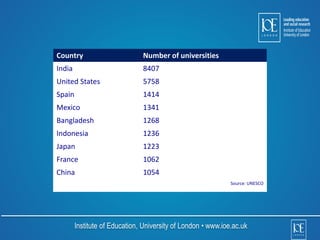
Country Number of universities 
India 8407 
United States 5758 
Spain 1414 
Mexico 1341 
Bangladesh 1268 
Indonesia 1236 
Japan 1223 
France 1062 
China 1054 
Source: UNESCO 
Institute of Education, University of London • www.ioe.ac.uk
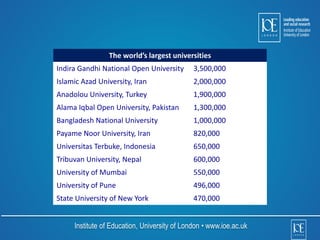
The world’s largest universities 
Indira Gandhi National Open University 3,500,000 
Islamic Azad University, Iran 2,000,000 
Anadolou University, Turkey 1,900,000 
Alama Iqbal Open University, Pakistan 1,300,000 
Bangladesh National University 1,000,000 
Payame Noor University, Iran 820,000 
Universitas Terbuke, Indonesia 650,000 
Tribuvan University, Nepal 600,000 
University of Mumbai 550,000 
University of Pune 496,000 
State University of New York 470,000 
Institute of Education, University of London • www.ioe.ac.uk
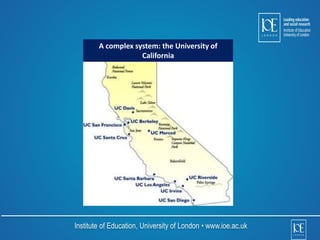
A complex system: the University of 
California 
Institute of Education, University of London • www.ioe.ac.uk
One view…. 
“the unfettered pursuit of truth and excellence through 
scholarship, research and teaching. Universities exist to conserve, 
create, re-create and communicate information, knowledge, ideas 
and their practical application in the form of inventions at the most 
advanced level open to that society. Other institutions - think tanks, 
consultancies, R&D departments etc – do some of this but not on 
the sustained scale or level of universities. Only universities are 
uniquely designed to carry out this role” 
Ivor Crewe, Universities UK, 2003 
Institute of Education, University of London • www.ioe.ac.uk
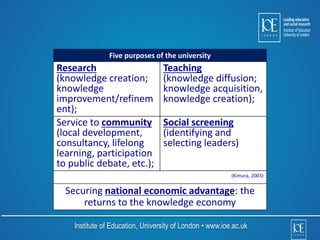
Five purposes of the university 
Research 
(knowledge creation; 
knowledge 
improvement/refinem 
ent); 
Teaching 
(knowledge diffusion; 
knowledge acquisition, 
knowledge creation); 
Service to community 
(local development, 
consultancy, lifelong 
learning, participation 
to public debate, etc.); 
Social screening 
(identifying and 
selecting leaders) 
(Kimura, 2003) 
Securing national economic advantage: the 
returns to the knowledge economy 
Institute of Education, University of London • www.ioe.ac.uk
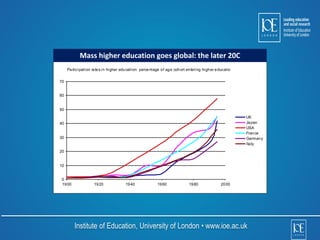
Participation rates i n higher education: percentage of age cohort entering higher education 
Institute of Education, University of London • www.ioe.ac.uk 
70 
60 
50 
40 
30 
20 
10 
0 
1900 1920 1940 1960 1980 2000 
UK 
Japan 
USA 
France 
Germany 
Italy 
Mass higher education goes global: the later 20C
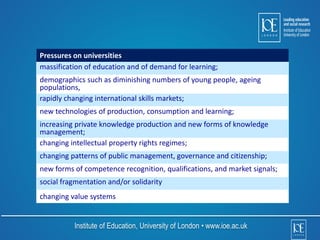
Pressures on universities 
massification of education and of demand for learning; 
demographics such as diminishing numbers of young people, ageing 
populations, 
rapidly changing international skills markets; 
new technologies of production, consumption and learning; 
increasing private knowledge production and new forms of knowledge 
management; 
changing intellectual property rights regimes; 
changing patterns of public management, governance and citizenship; 
new forms of competence recognition, qualifications, and market signals; 
social fragmentation and/or solidarity 
changing value systems 
Institute of Education, University of London • www.ioe.ac.uk
Case 1 
Research 
and 
Enquiry 
Institute of Education, University of London • www.ioe.ac.uk
What are universities for..the research economy 
Institute of Education, University of London • www.ioe.ac.uk 
80,000 
70,000 
60,000 
50,000 
40,000 
30,000 
20,000 
10,000 
0 
1995 1996 1997 1998 1999 2000 2001 2002 2003 2004 2005 2006 2007 2008 2009 
Japan China India Korea 
Research papers per year, 1995-2009: China, Japan, India & Korea
Case 2 
Universities 
and 
teaching 
Institute of Education, University of London • www.ioe.ac.uk
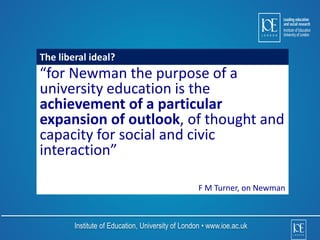
The liberal ideal? 
“for Newman the purpose of a 
university education is the 
achievement of a particular 
expansion of outlook, of thought and 
capacity for social and civic 
interaction” 
F M Turner, on Newman 
Institute of Education, University of London • www.ioe.ac.uk
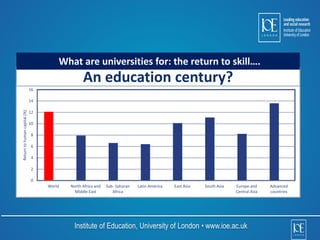
What are universities for: the return to skill…. 
Institute of Education, University of London • www.ioe.ac.uk 
16 
14 
12 
10 
8 
6 
4 
2 
0 
World North Africa and 
Middle East 
Sub- Saharan 
Africa 
Latin America East Asia South Asia Europe and 
Central Asia 
Advanced 
countries 
Return to human capital (%) 
An education century?
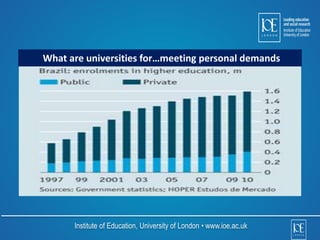
What are universities for…meeting personal demands 
Institute of Education, University of London • www.ioe.ac.uk
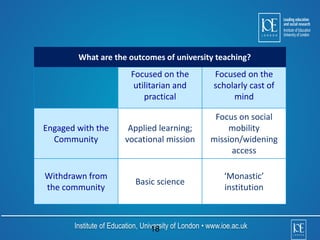
What are the outcomes of university teaching? 
Focused on the 
utilitarian and 
practical 
Focused on the 
scholarly cast of 
mind 
Engaged with the 
Community 
Applied learning; 
vocational mission 
Focus on social 
mobility 
mission/widening 
access 
Withdrawn from 
the community 
Basic science 
‘Monastic’ 
institution 
Institute of Education, Univ1e8rsity of London • www.ioe.ac.uk
Case 3 
Universities 
and 
society 
Institute of Education, University of London • www.ioe.ac.uk
What are universities for….securing national advantage 
Institute of Education, University of London • www.ioe.ac.uk
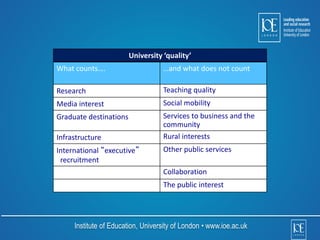
University ‘quality’ 
What counts…. …and what does not count 
Research Teaching quality 
Media interest Social mobility 
Graduate destinations Services to business and the 
community 
Infrastructure Rural interests 
International “executive” 
recruitment 
Other public services 
Collaboration 
The public interest 
Institute of Education, University of London • www.ioe.ac.uk
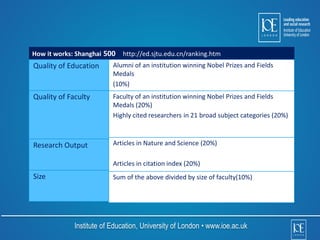
How it works: Shanghai 500 http://ed.sjtu.edu.cn/ranking.htm 
Quality of Education 
Quality of Faculty 
Research Output 
Institute of Education, University of London • www.ioe.ac.uk 
Size 
Alumni of an institution winning Nobel Prizes and Fields 
Medals 
(10%) 
Faculty of an institution winning Nobel Prizes and Fields 
Medals (20%) 
Highly cited researchers in 21 broad subject categories (20%) 
Articles in Nature and Science (20%) 
Articles in citation index (20%) 
Sum of the above divided by size of faculty(10%)
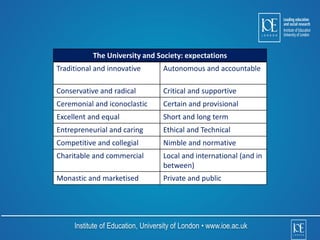
The University and Society: expectations 
Traditional and innovative Autonomous and accountable 
Conservative and radical Critical and supportive 
Ceremonial and iconoclastic Certain and provisional 
Excellent and equal Short and long term 
Entrepreneurial and caring Ethical and Technical 
Competitive and collegial Nimble and normative 
Charitable and commercial Local and international (and in 
between) 
Monastic and marketised Private and public 
Institute of Education, University of London • www.ioe.ac.uk
PolyU [stays] close to the practical needs of 
our community and our country. Our motto 
is “to learn and to apply, for the benefit of 
mankind", and we take pride in offering a 
wide range of quality programmes which 
nurture professionals and leaders for our 
society. 
Institute of Education, University of London • www.ioe.ac.uk 2 
4 
Indian Institute of Science, 
Bangalore 
Royal Scottish Conservatoire of 
Music 
Zaha Hadid’s new Hong Kong 
Polytechnic University building 
Harvard University 
The Royal Conservatoire of Scotland is a new-model 
conservatoire. Students and staff are inspired to generate 
truly innovative work. Everything we do is underpinned by 
our desire to achieve routes to mastery. Our students 
enjoy intensive tuition, professional partnerships, 
performances and the creative space to co-create across 
the disciplines 
Veritas 
IISc Bangalore is one of the premier post-graduate 
institutions of research and higher 
learning in India. The institute offers 
postgraduate and doctoral programs to over 
2000 active researchers from aerospace 
engineering to molecular biophysics to 
management. IISc was the first in India to offer 
Masters' programs in engineering and 
Integrated PhD Programs in Biological, 
Chemical, Physical and Mathematical Sciences
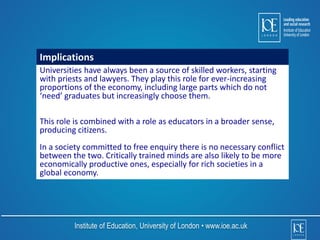
Implications 
Universities have always been a source of skilled workers, starting 
with priests and lawyers. They play this role for ever-increasing 
proportions of the economy, including large parts which do not 
‘need’ graduates but increasingly choose them. 
This role is combined with a role as educators in a broader sense, 
producing citizens. 
In a society committed to free enquiry there is no necessary conflict 
between the two. Critically trained minds are also likely to be more 
economically productive ones, especially for rich societies in a 
global economy. 
Institute of Education, University of London • www.ioe.ac.uk
Implications 
Universities are expensive, even though per-student spending has 
plummeted. 
The financial rewards of a degree, for individuals, are a mix of 
‘returns to skills’ and sorting. The extent to which students gain real 
skills at university depends on how much actual teaching, and 
learning, occur. 
Successful economies need innovation and invention. The need is 
for excellence in teaching as well as in research. 
The globalisation of higher education does not reward excellence in 
teaching. 
Institute of Education, University of London • www.ioe.ac.uk
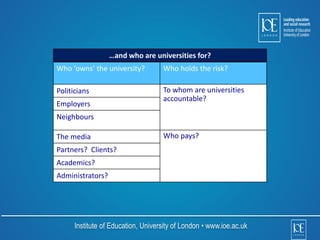
…and who are universities for? 
Who ‘owns’ the university? Who holds the risk? 
Politicians To whom are universities 
accountable? 
Employers 
Neighbours 
The media Who pays? 
Partners? Clients? 
Academics? 
Administrators? 
Institute of Education, University of London • www.ioe.ac.uk
What are(n’t) universities for? 
Professor Chris Husbands, 
Director, Institute of Education, 
University of London 
Buenos Aries, October 2014 
Institute of Education, University of London • www.ioe.ac.uk

2014 xi-s america universities

  • 1.
    What are(n’t) universitiesfor? Professor Chris Husbands, Director, Institute of Education, University of London Buenos Aries, October 2014 Professor Chris Husbands • Director, Institute of Education • www.ioe.ac.uk • director_ioe
  • 2.
    Institute of Education,University of London • www.ioe.ac.uk
  • 3.
    Institute of Education,University of London • www.ioe.ac.uk
  • 4.
    Institute of Education,University of London • www.ioe.ac.uk
  • 5.
    Country Number ofuniversities India 8407 United States 5758 Spain 1414 Mexico 1341 Bangladesh 1268 Indonesia 1236 Japan 1223 France 1062 China 1054 Source: UNESCO Institute of Education, University of London • www.ioe.ac.uk
  • 6.
    The world’s largestuniversities Indira Gandhi National Open University 3,500,000 Islamic Azad University, Iran 2,000,000 Anadolou University, Turkey 1,900,000 Alama Iqbal Open University, Pakistan 1,300,000 Bangladesh National University 1,000,000 Payame Noor University, Iran 820,000 Universitas Terbuke, Indonesia 650,000 Tribuvan University, Nepal 600,000 University of Mumbai 550,000 University of Pune 496,000 State University of New York 470,000 Institute of Education, University of London • www.ioe.ac.uk
  • 7.
    A complex system:the University of California Institute of Education, University of London • www.ioe.ac.uk
  • 8.
    One view…. “theunfettered pursuit of truth and excellence through scholarship, research and teaching. Universities exist to conserve, create, re-create and communicate information, knowledge, ideas and their practical application in the form of inventions at the most advanced level open to that society. Other institutions - think tanks, consultancies, R&D departments etc – do some of this but not on the sustained scale or level of universities. Only universities are uniquely designed to carry out this role” Ivor Crewe, Universities UK, 2003 Institute of Education, University of London • www.ioe.ac.uk
  • 9.
    Five purposes ofthe university Research (knowledge creation; knowledge improvement/refinem ent); Teaching (knowledge diffusion; knowledge acquisition, knowledge creation); Service to community (local development, consultancy, lifelong learning, participation to public debate, etc.); Social screening (identifying and selecting leaders) (Kimura, 2003) Securing national economic advantage: the returns to the knowledge economy Institute of Education, University of London • www.ioe.ac.uk
  • 10.
    Participation rates in higher education: percentage of age cohort entering higher education Institute of Education, University of London • www.ioe.ac.uk 70 60 50 40 30 20 10 0 1900 1920 1940 1960 1980 2000 UK Japan USA France Germany Italy Mass higher education goes global: the later 20C
  • 11.
    Pressures on universities massification of education and of demand for learning; demographics such as diminishing numbers of young people, ageing populations, rapidly changing international skills markets; new technologies of production, consumption and learning; increasing private knowledge production and new forms of knowledge management; changing intellectual property rights regimes; changing patterns of public management, governance and citizenship; new forms of competence recognition, qualifications, and market signals; social fragmentation and/or solidarity changing value systems Institute of Education, University of London • www.ioe.ac.uk
  • 12.
    Case 1 Research and Enquiry Institute of Education, University of London • www.ioe.ac.uk
  • 13.
    What are universitiesfor..the research economy Institute of Education, University of London • www.ioe.ac.uk 80,000 70,000 60,000 50,000 40,000 30,000 20,000 10,000 0 1995 1996 1997 1998 1999 2000 2001 2002 2003 2004 2005 2006 2007 2008 2009 Japan China India Korea Research papers per year, 1995-2009: China, Japan, India & Korea
  • 14.
    Case 2 Universities and teaching Institute of Education, University of London • www.ioe.ac.uk
  • 15.
    The liberal ideal? “for Newman the purpose of a university education is the achievement of a particular expansion of outlook, of thought and capacity for social and civic interaction” F M Turner, on Newman Institute of Education, University of London • www.ioe.ac.uk
  • 16.
    What are universitiesfor: the return to skill…. Institute of Education, University of London • www.ioe.ac.uk 16 14 12 10 8 6 4 2 0 World North Africa and Middle East Sub- Saharan Africa Latin America East Asia South Asia Europe and Central Asia Advanced countries Return to human capital (%) An education century?
  • 17.
    What are universitiesfor…meeting personal demands Institute of Education, University of London • www.ioe.ac.uk
  • 18.
    What are theoutcomes of university teaching? Focused on the utilitarian and practical Focused on the scholarly cast of mind Engaged with the Community Applied learning; vocational mission Focus on social mobility mission/widening access Withdrawn from the community Basic science ‘Monastic’ institution Institute of Education, Univ1e8rsity of London • www.ioe.ac.uk
  • 19.
    Case 3 Universities and society Institute of Education, University of London • www.ioe.ac.uk
  • 20.
    What are universitiesfor….securing national advantage Institute of Education, University of London • www.ioe.ac.uk
  • 21.
    University ‘quality’ Whatcounts…. …and what does not count Research Teaching quality Media interest Social mobility Graduate destinations Services to business and the community Infrastructure Rural interests International “executive” recruitment Other public services Collaboration The public interest Institute of Education, University of London • www.ioe.ac.uk
  • 22.
    How it works:Shanghai 500 http://ed.sjtu.edu.cn/ranking.htm Quality of Education Quality of Faculty Research Output Institute of Education, University of London • www.ioe.ac.uk Size Alumni of an institution winning Nobel Prizes and Fields Medals (10%) Faculty of an institution winning Nobel Prizes and Fields Medals (20%) Highly cited researchers in 21 broad subject categories (20%) Articles in Nature and Science (20%) Articles in citation index (20%) Sum of the above divided by size of faculty(10%)
  • 23.
    The University andSociety: expectations Traditional and innovative Autonomous and accountable Conservative and radical Critical and supportive Ceremonial and iconoclastic Certain and provisional Excellent and equal Short and long term Entrepreneurial and caring Ethical and Technical Competitive and collegial Nimble and normative Charitable and commercial Local and international (and in between) Monastic and marketised Private and public Institute of Education, University of London • www.ioe.ac.uk
  • 24.
    PolyU [stays] closeto the practical needs of our community and our country. Our motto is “to learn and to apply, for the benefit of mankind", and we take pride in offering a wide range of quality programmes which nurture professionals and leaders for our society. Institute of Education, University of London • www.ioe.ac.uk 2 4 Indian Institute of Science, Bangalore Royal Scottish Conservatoire of Music Zaha Hadid’s new Hong Kong Polytechnic University building Harvard University The Royal Conservatoire of Scotland is a new-model conservatoire. Students and staff are inspired to generate truly innovative work. Everything we do is underpinned by our desire to achieve routes to mastery. Our students enjoy intensive tuition, professional partnerships, performances and the creative space to co-create across the disciplines Veritas IISc Bangalore is one of the premier post-graduate institutions of research and higher learning in India. The institute offers postgraduate and doctoral programs to over 2000 active researchers from aerospace engineering to molecular biophysics to management. IISc was the first in India to offer Masters' programs in engineering and Integrated PhD Programs in Biological, Chemical, Physical and Mathematical Sciences
  • 25.
    Implications Universities havealways been a source of skilled workers, starting with priests and lawyers. They play this role for ever-increasing proportions of the economy, including large parts which do not ‘need’ graduates but increasingly choose them. This role is combined with a role as educators in a broader sense, producing citizens. In a society committed to free enquiry there is no necessary conflict between the two. Critically trained minds are also likely to be more economically productive ones, especially for rich societies in a global economy. Institute of Education, University of London • www.ioe.ac.uk
  • 26.
    Implications Universities areexpensive, even though per-student spending has plummeted. The financial rewards of a degree, for individuals, are a mix of ‘returns to skills’ and sorting. The extent to which students gain real skills at university depends on how much actual teaching, and learning, occur. Successful economies need innovation and invention. The need is for excellence in teaching as well as in research. The globalisation of higher education does not reward excellence in teaching. Institute of Education, University of London • www.ioe.ac.uk
  • 27.
    …and who areuniversities for? Who ‘owns’ the university? Who holds the risk? Politicians To whom are universities accountable? Employers Neighbours The media Who pays? Partners? Clients? Academics? Administrators? Institute of Education, University of London • www.ioe.ac.uk
  • 28.
    What are(n’t) universitiesfor? Professor Chris Husbands, Director, Institute of Education, University of London Buenos Aries, October 2014 Institute of Education, University of London • www.ioe.ac.uk